Blog

  • A Technical Guide to Cloud Computing Cost Reduction

    A Technical Guide to Cloud Computing Cost Reduction

    Slashing cloud costs isn't about hitting a budget number; it's about maximizing the value of every dollar spent. This requires engineering teams to own the financial impact of their architectural decisions, embedding cost as a core, non-functional requirement.

    This is a cultural shift away from reactive financial reviews. We are moving to a model of proactive cost intelligence built directly into the software development lifecycle (SDLC), where cost implications are evaluated at the pull request stage, not on the monthly invoice.

    Moving Beyond Budgets to Cloud Cost Intelligence

    Image

    Your cloud bill is a direct reflection of your operational efficiency. For many organizations, a rising AWS or GCP invoice isn't a sign of healthy growth but a symptom of technical debt and architectural inefficiencies.

    Consider this common scenario: a fast-growing SaaS company's monthly AWS spend jumps 40% with no corresponding user growth. The root cause? A poorly designed microservice for image processing was creating and orphaning multi-gigabyte temporary storage volumes with every transaction. The charges compounded silently, a direct result of an architectural oversight.

    This pattern is endemic and points to a critical gap: the absence of cost intelligence. Without granular visibility and engineering accountability, minor technical oversights snowball into significant financial liabilities.

    The Power Couple: FinOps and DevOps

    To effectively manage cloud expenditure, the organizational silos between finance and engineering must be dismantled. This is the core principle of FinOps, a cultural practice that injects financial accountability into the elastic, pay-as-you-go cloud model.

    Integrating FinOps with a mature DevOps culture creates a powerful synergy:

    • DevOps optimizes for velocity, automation, and reliability.
    • FinOps integrates cost as a first-class metric, on par with latency, uptime, and security.

    This fusion creates a culture where engineers are empowered to make cost-aware decisions as a standard part of their workflow. It's a proactive strategy of waste prevention, transforming cost management from a monthly financial audit into a continuous, shared engineering responsibility.

    The objective is to shift the dialogue from "How much did we spend?" to "What is the unit cost of our business metrics, and are we optimizing our architecture for value?" This reframes the problem from simple cost-cutting to genuine value engineering.

    The data is stark. The global cloud market is projected to reach $723.4 billion by 2025, yet an estimated 32% of this spend is wasted. The primary technical culprits are idle resources (66%) and overprovisioned compute capacity (59%).

    These are precisely the issues that proactive cost intelligence is designed to eliminate. For a deeper dive into these statistics, explore resources on cloud cost optimization best practices.

    This guide provides specific, technical solutions for the most common sources of cloud waste. The following table outlines the problems and the engineering-led solutions we will detail.

    Common Cloud Waste vs. Strategic Solutions

    The table below provides a quick overview of the most common sources of unnecessary cloud spend and the high-level strategic solutions that address them, which we'll detail throughout this article.

    Source of Waste Technical Solution Business Impact
    Idle Resources Automated Lambda/Cloud Functions triggered on a cron schedule to detect and terminate unattached EBS/EIPs, old snapshots, and unused load balancers. Immediate opex reduction by eliminating payment for zero-value assets without impacting production workloads.
    Overprovisioning Implement rightsizing automation using performance metrics (e.g., CPU, memory, network I/O) from monitoring tools and execute changes via Infrastructure as Code (IaC). Improved performance-to-cost ratio by aligning resource allocation with actual demand, eliminating payment for unused capacity.
    Inefficient Architecture Refactor monolithic services to serverless functions for event-driven tasks; leverage Spot/Preemptible instances with graceful shutdown handling for batch processing. Drastically lower compute costs for specific workload patterns and improve architectural scalability and resilience.

    By addressing these core technical issues, you build a more efficient, resilient, and financially sustainable cloud infrastructure. Let's dive into the implementation details.

    Weaving FinOps Into Your Engineering Culture

    Effective cloud computing cost reduction is not achieved through tools alone; it requires a fundamental shift in engineering culture. The goal is to evolve from the reactive, end-of-month financial review to a proactive, continuous optimization mindset.

    This means elevating cloud cost to a primary engineering metric, alongside latency, availability, and error rates. This is the essence of FinOps: empowering every engineer to become a stakeholder in the platform's financial efficiency. When this is achieved, the cost of a new feature is considered from the initial design phase, not as a financial post-mortem.

    Fostering Cross-Functional Collaboration

    Break down the silos between engineering, finance, and operations. High-performing organizations establish dedicated, cross-functional teams—often called "cost squads" or "FinOps guilds"—comprised of engineers, finance analysts, and product managers. Their mandate is not merely to cut costs but to optimize the business value derived from every dollar of cloud spend.

    This approach yields tangible results. A SaaS company struggling with unpredictable billing formed a cost squad and replaced the monolithic monthly bill with value-driven KPIs that resonated across the business:

    • Cost Per Active User (CPAU): Directly correlated infrastructure spend to user growth, providing a clear measure of scaling efficiency.
    • Cost Per API Transaction: Pinpointed expensive API endpoints, enabling targeted optimization efforts for maximum impact.
    • Cost Per Feature Deployment: Linked development velocity to its financial footprint, incentivizing the optimization of CI/CD pipelines and resource consumption.

    Making Cost Tangible for Developers

    An abstract, multi-million-dollar cloud bill is meaningless to a developer focused on a single microservice. To achieve buy-in, cost data must be contextualized and made actionable at the individual contributor level.

    Conduct cost-awareness workshops that translate cloud services into real-world financial figures. Demonstrate the cost differential between t3.micro and m5.large instances, or the compounding expense of inter-AZ data transfer fees at scale. The objective is to illustrate how seemingly minor architectural decisions have significant, long-term financial consequences.

    The real breakthrough occurs when cost feedback is integrated directly into the developer workflow. Imagine a CI/CD pipeline where a pull request triggers not only unit and integration tests but also an infrastructure cost estimation using tools like Infracost. The estimated cost delta becomes a required field for PR approval, making cost a tangible, immediate part of the engineering process.

    This tight integration of financial governance and DevOps is highly effective. A 2024 Deloitte analysis projects that FinOps adoption could save companies a collective $21 billion in 2025, with some organizations reducing cloud costs by as much as 40%. You can learn more about how FinOps tools are lowering cloud spending and see the potential impact.

    Driving Accountability with Alerts and Gamification

    Once a baseline of awareness is established, implement accountability mechanisms. Configure actionable budget alerts that trigger automated responses, not just email notifications. A cost anomaly should automatically open a Jira ticket assigned to the responsible team or post a detailed alert to a specific Slack channel with a link to the relevant cost dashboard. This ensures immediate investigation by the team with the most context.

    For advanced engagement, introduce gamification. Develop dashboards that publicly track and celebrate the most cost-efficient teams or highlight individuals who identify significant savings. Run internal "cost optimization hackathons" with prizes for the most innovative and impactful solutions. This transforms cost management from a mandate into a competitive engineering challenge, embedding the FinOps mindset into your team's DNA.

    Hands-On Guide to Automating Resource Management

    Theoretical frameworks are important, but tangible cloud computing cost reduction is achieved through automation embedded in daily operations. Manual cleanups are inefficient and temporary. Automation builds a self-healing system that prevents waste from accumulating.

    This section shifts from strategy to execution, providing specific, technical methods for automating resource management and eliminating payment for idle infrastructure.

    Proactive Prevention with Infrastructure as Code

    The most effective cost control is preventing overprovisioning at the source. This is a core strength of Infrastructure as Code (IaC) tools like Terraform. By defining infrastructure in code, you can enforce cost-control policies within your version-controlled development workflow.

    For example, create a standardized Terraform module for deploying EC2 instances that only permits instance types from a predefined, cost-effective list. You can enforce this using validation blocks in your variable definitions:

    variable "instance_type" {
      type        = string
      description = "The EC2 instance type."
      validation {
        condition     = can(regex("^(t3|t4g|m5|c5)\\.(micro|small|medium|large)$", var.instance_type))
        error_message = "Only approved instance types (t3, t4g, m5, c5 in smaller sizes) are allowed."
      }
    }
    

    If a developer attempts to deploy a m5.24xlarge for a development environment, the terraform plan command will fail, preventing the costly mistake before it occurs. If your team is new to this, a good https://opsmoon.com/blog/terraform-tutorial-for-beginners can help build these foundational guardrails.

    By codifying infrastructure, you shift cost control from a reactive, manual cleanup to a proactive, automated governance process. Financial discipline becomes an inherent part of the deployment pipeline.

    Automating the Cleanup of Idle Resources

    Despite guardrails, resource sprawl is inevitable. Development environments are abandoned, projects are de-prioritized, and resources are left running. Manually hunting for these "zombie" assets is slow, error-prone, and unscalable.

    Automation using cloud provider CLIs and SDKs is the only viable solution. You can write scripts to systematically identify and manage this waste.

    Here are specific commands to find common idle resources:

    • Find Unattached AWS EBS Volumes:
      aws ec2 describe-volumes --filters Name=status,Values=available --query "Volumes[*].{ID:VolumeId,Size:Size,CreateTime:CreateTime}" --output table
    • Identify Old Azure Snapshots (PowerShell):
      Get-AzSnapshot | Where-Object { $_.TimeCreated -lt (Get-Date).AddDays(-90) } | Select-Object Name,ResourceGroupName,TimeCreated
    • Locate Unused GCP Static IPs:
      gcloud compute addresses list --filter="status=RESERVED AND purpose!=DNS_RESOLVER" --format="table(name,address,region,status)"

    Your automation workflow should not immediately delete these resources. A safer, two-step process is recommended:

    1. Tagging: Run a daily script that finds idle resources and applies a tag like deletion-candidate-date:YYYY-MM-DD.
    2. Termination: Run a weekly script that terminates any resource with a tag older than a predefined grace period (e.g., 14 days). This provides a window for teams to reclaim resources if necessary. Integrating Top AI Workflow Automation Tools can enhance these scripts with more complex logic and reporting.

    The contrast between manual and automated approaches highlights the necessity of the latter for sustainable cost management.

    Manual vs. Automated Rightsizing Comparison

    Aspect Manual Rightsizing Automated Rightsizing
    Process Ad-hoc, reactive, often triggered by budget overruns. Relies on an engineer manually reviewing CloudWatch/Azure Monitor metrics and applying changes via the console. Continuous, proactive, and policy-driven. Rules are defined in code (e.g., Lambda functions, IaC) and executed automatically based on real-time monitoring data.
    Accuracy Prone to human error and biased by short-term data analysis (e.g., observing a 24-hour window misses weekly or monthly cycles). Data-driven decisions based on long-term performance telemetry (e.g., P95, P99 metrics over 30 days). Highly accurate and consistent.
    Speed & Scale Extremely slow and unscalable. A single engineer can only analyze and modify a handful of instances per day. Impossible for fleets of hundreds or thousands. Instantaneous and infinitely scalable. Can manage thousands of resources concurrently without human intervention.
    Risk High risk of under-provisioning, causing performance degradation, or over-correction, leaving performance on the table. Low risk. Automation includes safety checks (e.g., respect "do-not-resize" tags), adherence to maintenance windows, and gradual, canary-style rollouts.
    Outcome Temporary cost savings. Resource drift and waste inevitably return as soon as manual oversight ceases. Permanent, sustained cost optimization. The system is self-healing and continuously enforces financial discipline.

    Manual effort provides a temporary fix, while a well-architected automated system creates a permanent solution that enforces financial discipline across the entire infrastructure.

    Implementing Event-Driven Autoscaling and Rightsizing

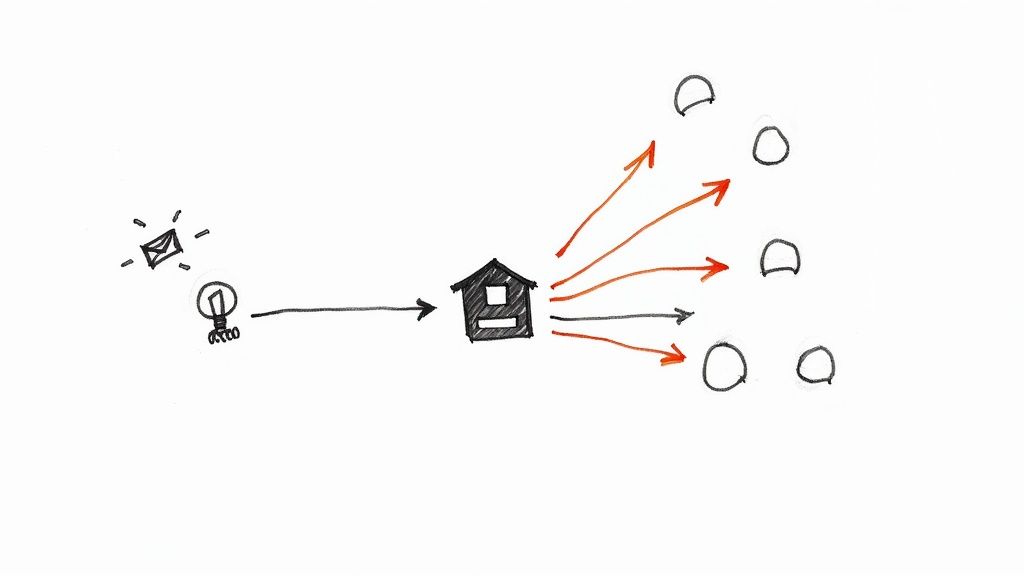
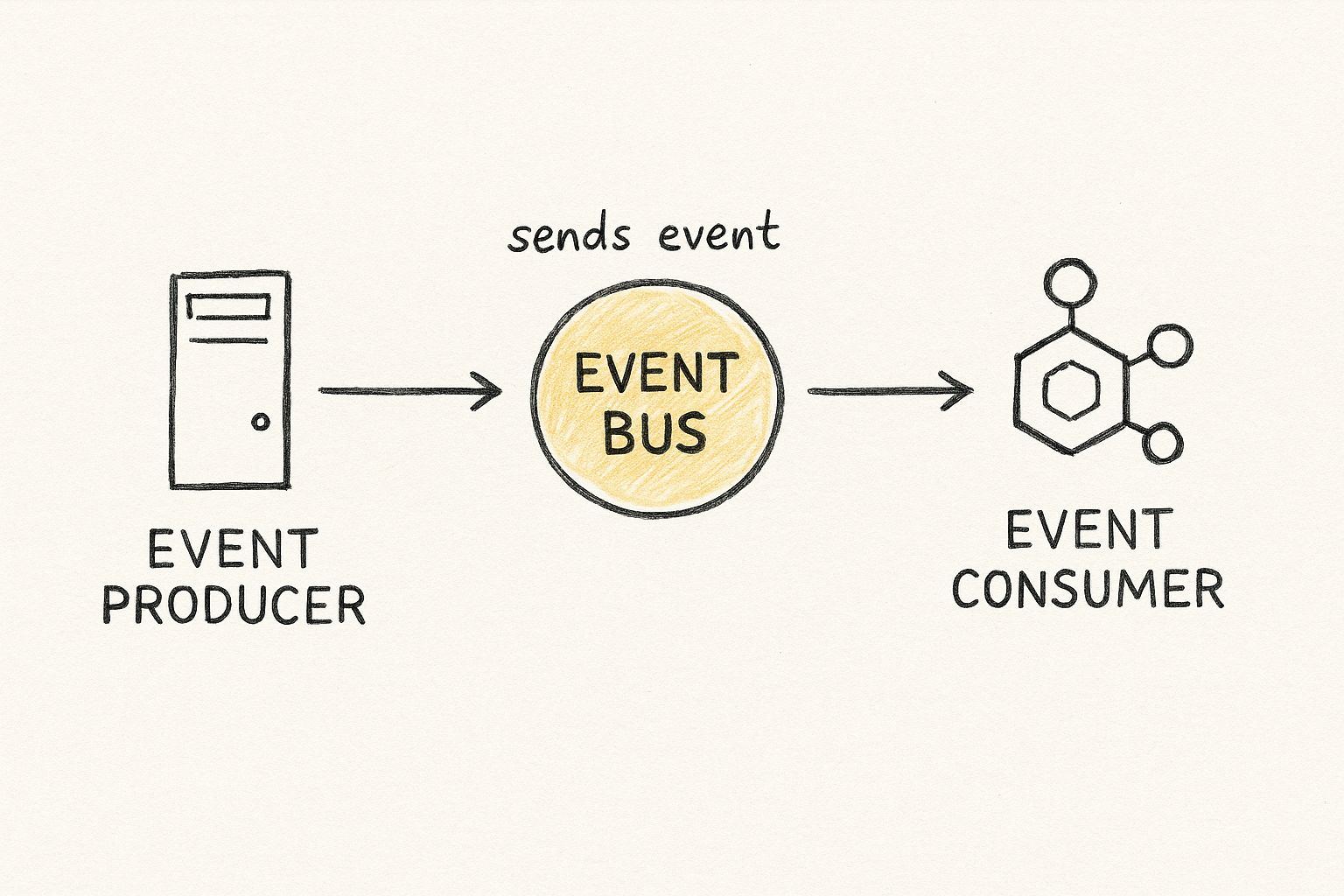
    Basic autoscaling, often triggered by average CPU utilization, is frequently too slow or irrelevant for modern, I/O-bound, or memory-bound applications. A more intelligent and cost-effective approach is event-driven automation.

    This involves triggering actions based on specific business events or a combination of granular performance metrics. A powerful pattern is invoking an AWS Lambda function from a custom CloudWatch alarm.

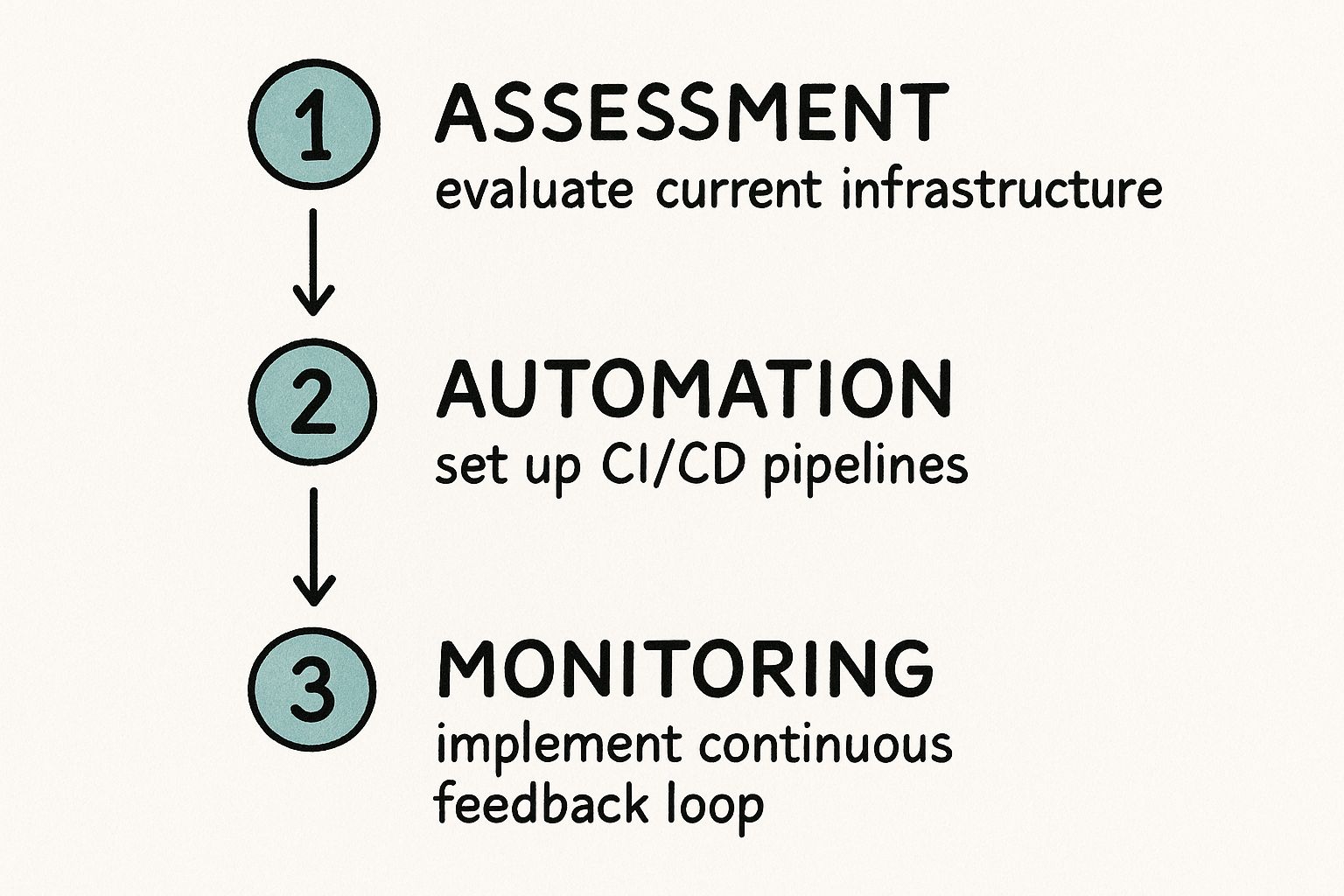
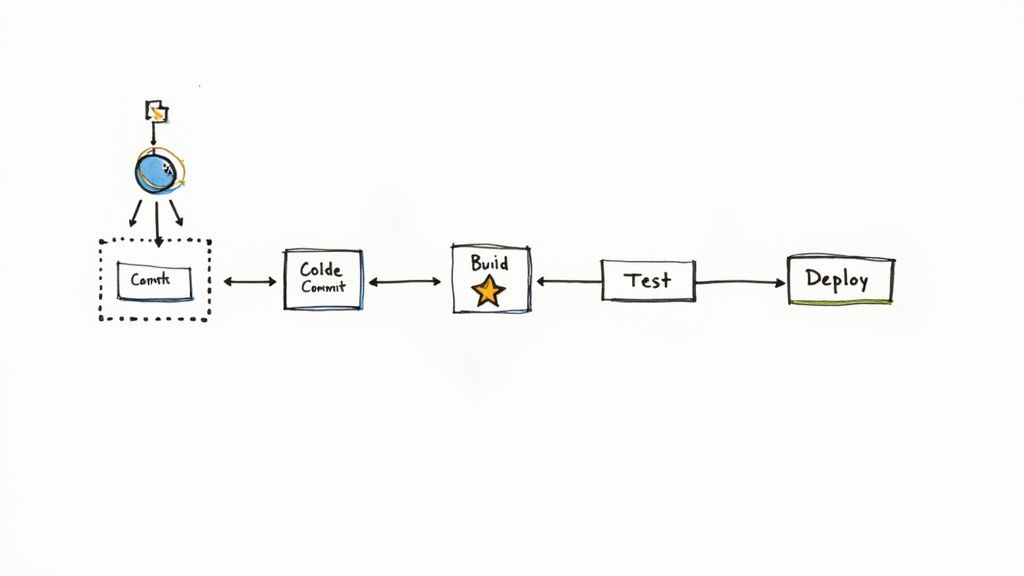
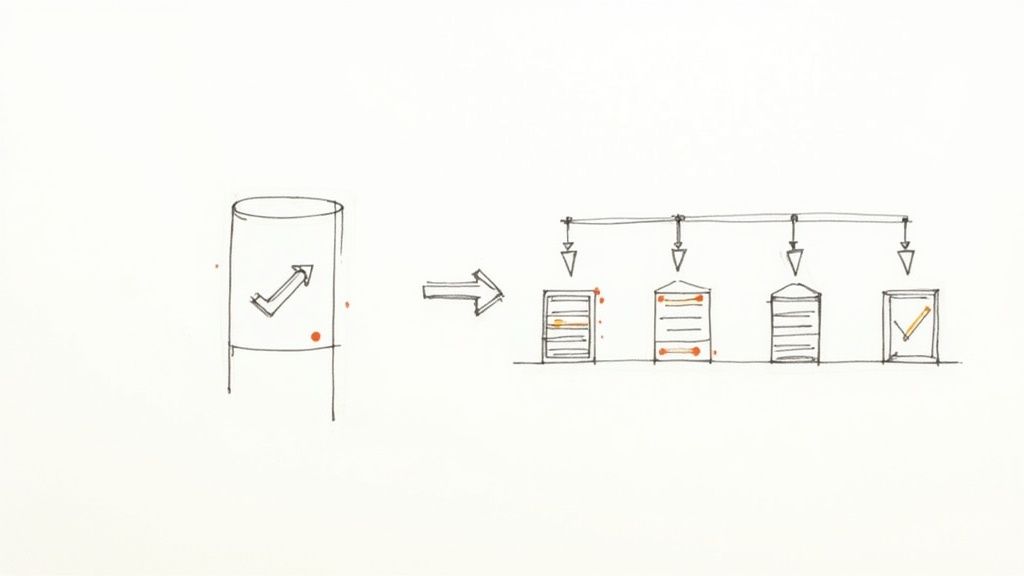
    This flow chart illustrates the concept: a system monitors specific thresholds, scales out to meet demand, and, critically, scales back in aggressively to minimize cost during idle periods.

    Image

    Consider a real-world scenario where an application's performance is memory-constrained. You can publish custom memory utilization metrics to CloudWatch and create an alarm that fires when an EC2 instance's memory usage exceeds 85% for a sustained period (e.g., ten minutes).

    This alarm triggers a Lambda function that executes a sophisticated, safety-conscious workflow:

    1. Context Check: The function first queries the instance's tags. Does it have a do-not-touch: true or critical-workload: prod-db tag? If so, it logs the event and exits, preventing catastrophic changes.
    2. Maintenance Window Verification: It checks if the current time falls within a pre-approved maintenance window. If not, it queues the action for later execution.
    3. Intelligent Action: If all safety checks pass, the function can perform a rightsizing operation. It could analyze recent performance data to select a more appropriate memory-optimized instance type and trigger a blue/green deployment or instance replacement during the approved window.

    This event-driven, programmatic approach ensures your cloud computing cost reduction efforts are both aggressive in optimizing costs and conservative in protecting production stability.

    Tapping Into AI and Modern Architectures for Deeper Savings

    Image

    Once foundational automation is in place, the next frontier for cost reduction lies in predictive systems and architectural modernization. AI and modern design patterns are powerful levers for achieving efficiencies unattainable through simple rightsizing.

    AI plays a dual role: while training large models can be a significant cost driver, applying AI to infrastructure management unlocks profound savings. It enables a shift from reactive to predictive resource scaling—a game-changer for cost control. This is not a future concept; projections show that AI-driven tools are already enabling predictive analytics that can reduce cloud waste by up to 30%.

    Predictive Autoscaling with AI

    Traditional autoscaling is fundamentally reactive. It relies on lagging indicators like average CPU utilization, waiting for a threshold to be breached before initiating a scaling action. This latency often results in either performance degradation during scale-up delays or wasteful overprovisioning to maintain a "hot" buffer.

    AI-powered predictive autoscaling inverts this model. By analyzing historical time-series data of key metrics (traffic, transaction volume, queue depth) and correlating it with business cycles (daily peaks, marketing campaigns, seasonal events), machine learning models can forecast demand spikes before they occur. This allows for precise, just-in-time capacity management.

    For an e-commerce platform approaching a major sales event, an AI model could:

    • Pre-warm instances minutes before the anticipated traffic surge, eliminating cold-start latency.
    • Scale down capacity during predicted lulls with high confidence, maximizing savings.
    • Identify anomalous traffic that deviates from the predictive model, serving as an early warning system for DDoS attacks or application bugs.

    This approach transforms the spiky, inefficient resource utilization typical of reactive scaling into a smooth curve that closely tracks actual demand. You pay only for the capacity you need, precisely when you need it. Exploring the best cloud cost optimization tools can provide insight into platforms already incorporating these AI features.

    Shifting Your Architecture to the Edge

    Architectural decisions have a direct and significant impact on cloud spend, particularly concerning data transfer costs. Data egress fees—the cost of moving data out of a cloud provider's network—are a notorious and often overlooked source of runaway expenditure.

    Adopting an edge computing model is a powerful architectural strategy to mitigate these costs.

    Consider an IoT application with thousands of sensors streaming raw telemetry to a central cloud region for processing. The constant data stream incurs massive egress charges. By deploying compute resources (e.g., AWS IoT Greengrass, Azure IoT Edge) at or near the data source, the architecture can be optimized:

    • Data is pre-processed and filtered at the edge.
    • Only aggregated summaries or critical event alerts are transmitted to the central cloud.
    • High-volume raw data is either discarded or stored locally, dramatically reducing data transfer volumes and associated costs.

    This architectural shift not only slashes egress fees but also improves application latency and responsiveness by processing data closer to the end-user or device.

    The core principle is technically sound and financially effective: Move compute to the data, not data to the compute. This fundamentally alters the cost structure of data-intensive applications.

    How "Green Cloud" Hits Your Bottom Line

    The growing focus on sustainability in cloud computing, or "Green Cloud," offers a direct path to financial savings. A cloud provider's energy consumption is a significant operational cost, which is passed on to you through service pricing. Architecting for energy efficiency is synonymous with architecting for cost efficiency.

    Choosing cloud regions powered predominantly by renewable energy can lead to lower service costs due to the provider's more stable and lower energy expenses.

    More technically, you can implement "load shifting" for non-critical, computationally intensive workloads like batch processing or model training. Schedule these jobs to run during off-peak hours when energy demand is lower. Cloud providers often offer cheaper compute capacity during these times via mechanisms like Spot Instances. By aligning your compute-intensive tasks with periods of lower energy cost and demand, you directly reduce your expenditure. Having the right expertise is crucial for this; hiring Kubernetes and Docker engineers with experience in scheduling and workload management is a key step.

    Mastering Strategic Purchasing and Multi-Cloud Finance

    Automating resource management yields significant technical wins, but long-term cost optimization is achieved through strategic financial engineering. This involves moving beyond reactive cleanups to proactively managing compute purchasing and navigating the complexities of multi-cloud finance.

    Treat your cloud spend not as a utility bill but as a portfolio of financial instruments that requires active, intelligent management.

    The Blended Strategy for Compute Purchasing

    Relying solely on on-demand pricing is a significant financial misstep for any workload with predictable usage patterns. A sophisticated approach involves building a blended portfolio of purchasing options—Reserved Instances (RIs), Savings Plans, and Spot Instances—to match the financial commitment to the workload's technical requirements.

    A practical blended purchasing strategy includes:

    • Savings Plans for Your Baseline: Cover your stable, predictable compute baseline with Compute Savings Plans. This is the minimum capacity you know you'll need running 24/7. They offer substantial discounts (up to 72%) and provide flexibility across instance families, sizes, and regions, making them ideal for your core application servers.
    • Reserved Instances for Ultra-Stable Workloads: For workloads with zero variability—such as a production database running on a specific instance type for the next three years—a Standard RI can sometimes offer a slightly deeper discount than a Savings Plan. Use them surgically for these highly specific, locked-in scenarios.
    • Spot Instances for Interruptible Jobs: For non-critical, fault-tolerant workloads like batch processing, CI/CD builds, or data analytics jobs, Spot Instances are essential. They offer discounts of up to 90% off on-demand prices. The technical requirement is that your application must be architected to handle interruptions gracefully, checkpointing state and resuming work on a new instance.

    This blended model is highly effective because it aligns your financial commitment with the workload's stability and criticality, maximizing discounts on predictable capacity while leveraging massive savings for ephemeral, non-critical tasks.

    Navigating the Multi-Cloud Financial Maze

    Adopting a multi-cloud strategy to avoid vendor lock-in and leverage best-of-breed services introduces significant financial management complexity. Achieving effective cloud computing cost reduction in a multi-cloud environment requires disciplined, unified governance.

    When managing AWS, Azure, and GCP concurrently, visibility and workload portability are paramount. Containerize applications using Docker and orchestrate them with Kubernetes to abstract them from the underlying cloud infrastructure. This technical decision enables workload mobility, allowing you to shift applications between cloud providers to capitalize on pricing advantages without costly re-architecting.

    For those starting this journey, our guide on foundational cloud cost optimization strategies provides essential knowledge for both single and multi-cloud environments.

    Unifying Governance Across Clouds

    Fragmented financial governance in a multi-cloud setup guarantees waste. The solution is to standardize policies and enforce them universally.

    Begin with a mandatory, universal tagging policy. Define a schema with required tags (project, team, environment, cost-center) and enforce it across all providers using policy-as-code tools like Open Policy Agent (OPA) or native services like AWS Service Control Policies (SCPs). This provides a unified lens through which to analyze your entire multi-cloud spend.

    A third-party cloud cost management platform is often a critical investment. These tools ingest billing data from all providers into a single, normalized dashboard. This unified view helps identify arbitrage opportunities—for example, you might discover that network-attached storage is significantly cheaper on GCP than AWS for a particular workload. This insight allows you to strategically shift workloads and realize direct savings, turning multi-cloud complexity from a liability into a strategic advantage. Knowing the specifics of provider offerings, like a Microsoft Cloud Solution, is invaluable for making these informed, data-driven decisions.

    Burning Questions About Cloud Cost Reduction

    As you delve into the technical and financial details of cloud cost management, specific, practical questions inevitably arise. Here are the most common ones, with technically-grounded answers.

    Where Should My Team Even Start?

    Your first action must be to achieve 100% visibility. You cannot optimize what you cannot measure. Before implementing any changes, you must establish a detailed understanding of your current expenditure.

    This begins with implementing and enforcing a comprehensive tagging strategy. Every provisioned resource—from a VM to a storage bucket—must be tagged with metadata identifying its owner, project, environment, and application. Once this is in place, leverage native tools like AWS Cost Explorer or Azure Cost Management + Billing to analyze spend. This data-driven approach will immediately highlight your largest cost centers and the most egregious sources of waste, providing a clear, prioritized roadmap for optimization.

    How Do I Get Developers to Actually Care About Costs?

    Frame cost optimization as a challenging engineering problem, not a budgetary constraint. A multi-million-dollar invoice is an abstract number; the specific cost of the microservices a developer personally owns and operates is a tangible metric they can influence.

    Use FinOps tools to translate raw spend data into developer-centric metrics like "cost per feature," "cost per deployment," or "cost per 1000 transactions." Integrate cost estimation tools into your CI/CD pipeline to provide immediate feedback on the financial impact of a code change at the pull request stage.

    Publicly celebrate engineering-led cost optimization wins. When a team successfully refactors a service to reduce its operational cost while maintaining or improving performance, recognize their achievement across the organization. This fosters a culture where financial efficiency is a mark of engineering excellence.

    Are Reserved Instances Still a Good Idea?

    Yes, but their application is now more nuanced and strategic. With the advent of more flexible options like Savings Plans, the decision requires careful analysis of workload stability.

    Here is the technical trade-off:

    • Savings Plans offer flexibility. They apply discounts to compute usage across different instance families, sizes, and regions. This makes them ideal for workloads that are likely to evolve over the 1- or 3-year commitment term.
    • Reserved Instances (specifically Standard RIs) offer a potential for slightly deeper discounts but impose a rigid lock-in to a specific instance family in a specific region. They remain a strong choice for workloads with exceptionally high stability, such as a production database where you are certain the instance type will not change for the entire term.

    What's the Biggest Mistake Companies Make?

    The single greatest mistake is treating cloud cost reduction as a one-time project rather than a continuous, programmatic practice. Many organizations conduct a large-scale cleanup, achieve temporary savings, and then revert to old habits.

    This approach is fundamentally flawed because waste and inefficiency are emergent properties of evolving systems.

    Sustainable cost reduction is achieved by embedding cost-conscious principles into daily operations through relentless automation, a cultural shift driven by FinOps, and continuous monitoring and feedback loops. It is a flywheel of continuous improvement, not a project with a defined end date.


    Ready to build a culture of cost intelligence and optimize your cloud spend with elite engineering talent? OpsMoon connects you with the top 0.7% of DevOps experts who can implement the strategies discussed in this guide. Start with a free work planning session to map out your cost reduction roadmap. Learn more and get started with OpsMoon.

  • Top Incident Response Best practices for SREs in 2025

    Top Incident Response Best practices for SREs in 2025

    In complex cloud-native environments, a security incident is not a matter of 'if' but 'when'. For DevOps and Site Reliability Engineering (SRE) teams, the pressure to maintain uptime and security is immense. A reactive, ad-hoc approach to incidents leads to extended downtime, data loss, and eroded customer trust. The solution lies in adopting a proactive, structured framework built on proven incident response best practices. This guide moves beyond generic advice to provide a technical, actionable roadmap specifically for SRE and DevOps engineers.

    We will deconstruct the incident lifecycle, offering specific commands, architectural patterns, and automation strategies you can implement immediately. The goal is to transform your incident management from a chaotic scramble into a controlled, efficient process. Prepare to build a resilient system that not only survives incidents but learns and improves from them. This article details the essential practices for establishing a robust incident response capability, from creating a comprehensive plan and dedicated team to implementing sophisticated monitoring and post-incident analysis. Each section provides actionable steps to strengthen your organization’s security posture and operational resilience, ensuring you are prepared to handle any event effectively.

    1. Codify Your IR Plan: From Static Docs to Actionable Playbooks

    Static incident response plans stored in wikis or shared drives are destined to become obsolete. This is a critical failure point in any modern infrastructure. One of the most impactful incident response best practices is to adopt an "everything as code" philosophy and apply it to your IR strategy, transforming passive documents into active, automated playbooks.

    By defining response procedures in machine-readable formats like YAML, JSON, or even Python scripts, you create a version-controlled, testable, and executable plan. This approach integrates directly into the DevOps toolchain, turning your plan from a theoretical guide into an active participant in the resolution process. When an alert from Prometheus Alertmanager or Datadog fires, a webhook can trigger a tool like Rundeck or a serverless function to automatically execute the corresponding playbook, executing predefined steps consistently and at machine speed.

    Real-World Implementation

    • Netflix: Their system triggers automated remediation actions directly from monitoring alerts. A sudden spike in latency on a service might automatically trigger a playbook that reroutes traffic to a healthy region, without requiring immediate human intervention.
    • Google SRE: Their playbooks are deeply integrated into production control systems. An engineer responding to an incident can execute complex diagnostic or remediation commands with a single command, referencing a playbook that is tested and maintained alongside the service code.

    "Your runbooks should be executable. Either by a human or a machine. The best way to do this is to write your runbooks as scripts." – Google SRE Handbook

    How to Get Started

    1. Select a High-Frequency, Low-Impact Incident: Start small. Choose a common issue like a full disk (/dev/sda1 at 95%) on a non-critical server or a failed web server process (systemctl status nginx shows inactive).
    2. Define Steps in Code: Use a tool like Ansible, Rundeck, or even a simple shell script to define the diagnostic and remediation steps. For a full disk, the playbook might execute df -h, find large files with find /var/log -type f -size +100M, archive them to S3, and then run rm. For a failed process, it would run systemctl restart nginx and then curl the local health check endpoint to verify recovery.
    3. Store Playbooks with Service Code: Keep your playbooks in the same Git repository as the application they protect. This ensures that as the application evolves, the playbook is updated in tandem. Use semantic versioning for your playbooks.
    4. Integrate and Test: Add a step to your CI/CD pipeline that tests the playbook. Use a tool like ansible-lint for static analysis. In staging, use Terraform or Pulumi to spin up a temporary environment, trigger the failure condition (e.g., fallocate -l 10G bigfile), run the playbook, and assert the system returns to a healthy state before tearing down the environment.

    2. Establish a Dedicated Incident Response Team (IRT)

    Without a designated team, incident response becomes a chaotic, all-hands-on-deck fire drill where accountability is blurred and critical tasks are missed. One of the most fundamental incident response best practices is to formalize a dedicated Incident Response Team (IRT). This team consists of pre-assigned individuals with defined roles, responsibilities, and the authority to act decisively during a crisis, moving from reactive scrambling to a coordinated, strategic response.

    Establish a Dedicated Incident Response Team (IRT)

    This structured approach ensures that technical experts, legal counsel, and communications personnel work in concert, not in silos. To significantly enhance efficiency and consistency in your incident response, integrating workflow automation principles is crucial for this team. A dedicated IRT transforms incident management from an unpredictable event into a practiced, efficient process, much like how SRE teams handle production reliability. You can explore more about these parallels in our article on SRE principles.

    Real-World Implementation

    • Microsoft's Security Response Center (MSRC): This global team is the frontline for responding to all security vulnerability reports in Microsoft products and services, coordinating everything from technical investigation to public disclosure.
    • IBM's X-Force Incident Response: This team operates as a specialized unit that organizations can engage for proactive services like IR plan development and reactive services like breach investigation, showcasing the model of a dedicated, expert-driven response.

    "A well-defined and well-rehearsed incident response plan, in the hands of a skilled and empowered team, is the difference between a controlled event and a catastrophe." – Kevin Mandia, CEO of Mandiant

    How to Get Started

    1. Define Core Roles and Responsibilities: Start by identifying key roles: Incident Commander (IC – final decision authority, manages the overall response), Technical Lead (TL – deepest SME, directs technical investigation and remediation), Communications Lead (CL – manages all internal/external messaging via status pages and stakeholder updates), and Scribe (documents the timeline, decisions, and actions in a dedicated incident channel or tool).
    2. Cross-Functional Representation: Your IRT is not just for engineers. Include representatives from Legal, PR, and senior management to ensure all facets of the business are covered during an incident. Have a pre-defined "call tree" in your on-call tool (e.g., PagerDuty, Opsgenie) for these roles.
    3. Establish Clear Escalation Paths: Document exactly who needs to be contacted and under what conditions. Define triggers based on technical markers (e.g., SLI error budget burn rate > 5% in 1 hour) or business impact (e.g., >10% of customers affected) for escalating an issue from a low-severity event to a major incident requiring executive involvement.
    4. Conduct Regular Drills and Training: An IRT is only effective if it practices. Run regular tabletop exercises and simulated incidents to test your procedures, identify gaps, and build the team's muscle memory for real-world events. Use "Game Day" or Chaos Engineering tools like Gremlin to inject failures safely into production environments.

    3. Implement Continuous Monitoring and Detection Capabilities

    A reactive incident response strategy is a losing battle. Waiting for a user report or a catastrophic failure to identify an issue means the damage is already done. A core tenet of modern incident response best practices is implementing a pervasive, continuous monitoring and detection capability. This involves deploying a suite of integrated tools that provides real-time visibility into the health and security of your infrastructure, from the network layer up to the application.

    Implement Continuous Monitoring and Detection Capabilities

    This practice moves beyond simple uptime checks. It leverages platforms like Security Information and Event Management (SIEM), Endpoint Detection and Response (EDR), and sophisticated log analysis to create a unified view of system activity. By correlating events from disparate sources—such as correlating a Web Application Firewall (WAF) block with a spike in 5xx errors in your application logs—you can detect subtle anomalies and complex attack patterns that would otherwise go unnoticed, shifting your posture from reactive to proactive.

    Real-World Implementation

    • Sony: After its major PlayStation Network breach, Sony heavily invested in advanced SIEM systems and a global Security Operations Center (SOC). This enabled them to centralize log data from thousands of systems worldwide, using platforms like Splunk to apply behavioral analytics and detect suspicious activities in real-time.
    • Equifax: The fallout from their 2017 breach prompted a massive overhaul of their security monitoring. They implemented enhanced network segmentation and deployed advanced endpoint detection and response (EDR) tools like CrowdStrike Falcon to gain granular visibility into every device, enabling them to detect and isolate threats before they could spread laterally.

    "The goal is to shrink the time between compromise and detection. Every second counts, and that's only achievable with deep, continuous visibility into your environment." – Bruce Schneier, Security Technologist

    How to Get Started

    1. Prioritize Critical Assets: You can't monitor everything at once. Start by identifying your most critical applications and data stores. Focus your initial monitoring and alerting efforts on these high-value targets. Instrument your code with custom metrics using libraries like Prometheus client libraries or OpenTelemetry.
    2. Integrate Multiple Data Sources: A single data stream is insufficient. Ingest logs from your applications (structured logs in JSON format are best), cloud infrastructure (e.g., AWS CloudTrail, VPC Flow Logs), network devices, and endpoints into a centralized log management or SIEM platform like Elastic Stack or Datadog.
    3. Tune and Refine Detection Rules: Out-of-the-box rules create alert fatigue. Regularly review and tune your detection logic to reduce false positives, ensuring your team only responds to credible threats. Implement a clear alert prioritization schema (e.g., P1-P4) based on the MITRE ATT&CK framework for security alerts.
    4. Test Your Detections: Don't assume your monitoring works. Use techniques like Atomic Red Team to execute small, controlled tests of specific TTPs (Tactics, Techniques, and Procedures). For example, run curl http://169.254.169.254/latest/meta-data/iam/security-credentials/ from a pod to validate that your detection for metadata service abuse fires correctly. For more on this, explore these infrastructure monitoring best practices.

    4. Conduct Regular Incident Response Training and Exercises

    An incident response plan is only effective if the team can execute it under pressure. Waiting for a real crisis to test your procedures is a recipe for failure. One of the most critical incident response best practices is to move beyond theory and into practice through regular, realistic training and simulation exercises. These drills build muscle memory, uncover procedural gaps, and ensure stakeholders can coordinate effectively when it matters most.

    By proactively simulating crises, teams can pressure-test their communication channels, technical tools, and decision-making frameworks in a controlled environment. This allows for iterative improvement and builds the confidence needed to manage high-stress situations. For proactive incident preparedness, it's beneficial to implement scenario-based training methodologies that simulate real-world challenges your team might face.

    Real-World Implementation

    • CISA's Cyber Storm: This biennial national-level exercise brings together public and private sectors to simulate a large-scale cyberattack, testing coordination and response capabilities across critical infrastructure.
    • Financial Sector's Hamilton Series: These exercises, focused on the financial services industry, simulate sophisticated cyber threats to test the sector's resilience and collaborative response mechanisms between major institutions and government agencies.

    "The more you sweat in training, the less you bleed in battle." – U.S. Navy SEALs

    How to Get Started

    1. Start with Tabletop Exercises: Begin with discussion-based sessions where team members walk through a simulated incident scenario, describing their roles and actions. Use a concrete scenario, e.g., "A customer reports that their data is accessible via a public S3 bucket. Walk me through the steps from validation to remediation." This is a low-cost way to validate roles and identify major communication gaps.
    2. Introduce Functional Drills: Progress to hands-on exercises. A functional drill might involve a simulated phishing attack where the security team must identify, contain, and analyze the threat using their actual toolset. Another example: give an engineer temporary SSH access to a staging server with instructions to exfiltrate a specific file and see if your EDR and SIEM detect the activity.
    3. Conduct Full-Scale Simulations: For mature teams, run full-scale simulations that mimic a real-world crisis, potentially without prior notice. Use Chaos Engineering to inject failure into a production canary environment. Scenarios could include a cloud region failure, a certificate expiration cascade, or a simulated ransomware encryption event on non-critical systems.
    4. Document and Iterate: After every exercise, conduct a blameless postmortem. Document what went well, what didn't, and create actionable tickets in your backlog to update playbooks, tooling, or training materials. Schedule these exercises quarterly or bi-annually to ensure continuous readiness.

    5. Establish Clear Communication Protocols and Stakeholder Management

    Technical resolution is only half the battle during an incident; perception and stakeholder alignment are equally critical. Failing to manage the flow of information can create a second, more damaging incident of chaos and mistrust. One of the most essential incident response best practices is to treat communication as a core technical function, with predefined channels, templates, and designated roles that operate with the same precision as your code-based playbooks.

    Effective communication protocols ensure that accurate information reaches the right people at the right time, preventing misinformation and enabling stakeholders to make informed decisions. This means creating a structured plan that dictates who communicates what, to whom, and through which channels. By standardizing this process, you reduce cognitive load on the technical response team, allowing them to focus on remediation while a parallel, well-oiled communication machine manages expectations internally and externally.

    Real-World Implementation

    • Norsk Hydro: Following a devastating LockerGoga ransomware attack, Norsk Hydro’s commitment to transparent and frequent communication was widely praised. They used their website and press conferences to provide regular, honest updates on their recovery progress, which helped maintain customer and investor confidence.
    • British Airways: During their 2018 data breach, their communication strategy demonstrated the importance of rapid, clear messaging. They quickly notified affected customers, regulatory bodies, and the public, providing specific guidance on protective measures, which is a key component of effective stakeholder management.

    "In a crisis, you must be first, you must be right, and you must be credible. If you are not first, someone else will be, and you will lose control of the message." – U.S. Centers for Disease Control and Prevention (CDC) Crisis Communication Handbook

    How to Get Started

    1. Map Stakeholders and Channels: Identify all potential audiences (e.g., engineers, executives, legal, customer support, end-users) and establish dedicated, secure communication channels for each. Use a dedicated Slack channel (#incident-war-room) for real-time technical coordination, a separate channel (#incident-updates) for internal stakeholder updates, and a public status page (e.g., Statuspage.io, Atlassian Statuspage) for customers.
    2. Develop Pre-Approved Templates: Create message templates for various incident types and severity levels. Store these in a version-controlled repository, including drafts for status page updates, executive summaries, and customer emails. Include placeholders for key details like [SERVICE_NAME], [IMPACT_DESCRIPTION], and [NEXT_UPDATE_ETA]. Automate the creation of incident channels and documents using tools like Slack's Workflow Builder or specialized incident management platforms.
    3. Define Communication Roles: Assign clear communication roles within your incident command structure. Designate a "Communications Lead" responsible for drafting and disseminating all official updates, freeing the "Incident Commander" to focus on technical resolution.
    4. Integrate Legal and PR Review: For any external-facing communication, build a fast-track review process with your legal and public relations teams. This can be automated via a Jira or Slack workflow to ensure speed without sacrificing compliance and brand safety. Have pre-approved "holding statements" ready for immediate use while details are being confirmed.

    6. Implement Proper Evidence Collection and Digital Forensics

    In the chaos of a security incident, the immediate goal is containment and remediation. However, skipping proper evidence collection is a critical mistake that undermines root cause analysis and legal recourse. One of the most essential incident response best practices is to integrate digital forensics and evidence preservation directly into your response process, ensuring that critical data is captured before it's destroyed.

    Treating your production environment like a potential crime scene ensures you can forensically reconstruct the attack timeline. This involves making bit-for-bit copies of affected disks (dd command), capturing memory snapshots (LiME), and preserving logs in a tamper-proof manner (WORM storage). This data is invaluable for understanding the attacker's methods, identifying the full scope of the compromise, and preventing recurrence.

    Implement Proper Evidence Collection and Digital Forensics

    Real-World Implementation

    • Colonial Pipeline: Following the DarkSide ransomware attack, their incident response team, alongside third-party experts from FireEye Mandiant, conducted an extensive forensic investigation. This analysis of system images and logs was crucial for identifying the initial intrusion vector (a compromised VPN account) and ensuring the threat was fully eradicated from their network before restoring operations.
    • Sony Pictures (2014): Forensic teams analyzed malware and hard drive images to attribute the devastating attack to the Lazarus Group. This deep digital investigation was vital for understanding the attackers' tactics, which included sophisticated wiper malware, and for informing the U.S. government's subsequent response.

    "The golden hour of forensics is immediately after the incident. Every action you take without a forensic mindset risks overwriting the very evidence you need to understand what happened." – Mandiant Incident Response Field Guide

    How to Get Started

    1. Prepare Forensic Toolkits: Pre-deploy tools for memory capture (like LiME for Linux or Volatility) and disk imaging (like dd or dc3dd) on bastion hosts or have them ready for deployment via your configuration management. In a cloud environment, have scripts ready to snapshot EBS volumes or VM disks via the cloud provider's API.
    2. Prioritize Volatile Data: Train your first responders to collect evidence in order of volatility (RFC 3227). Capture memory and network state (netstat -anp, ss -tulpn) first, as this data disappears on reboot. Then, collect running processes (ps aux), and finally, move to less volatile data like disk images and logs.
    3. Maintain Chain of Custody: Document every action taken. For each piece of evidence (e.g., a memory dump file), log who collected it, when, from which host (hostname, IP), and how it was transferred. Use cryptographic hashing (sha256sum memory.dump) immediately after collection and verify the hash at each step of transfer and analysis to prove data integrity.
    4. Integrate with DevOps Security: Incorporate evidence collection steps into your automated incident response playbooks. For example, if your playbook quarantines a compromised container, the first step should be to use docker commit to save its state as an image for later analysis before killing the running process.

    7. Develop Comprehensive Business Continuity and Recovery Procedures

    While your incident response team focuses on containment and eradication, the business must continue to operate. An incident that halts core revenue-generating functions can be more damaging than the technical breach itself. This is why a core tenet of modern incident response best practices is to develop and maintain robust business continuity (BCP) and disaster recovery (DR) procedures that run parallel to your technical response.

    These procedures are not just about data backups; they encompass the full spectrum of operations, including alternative communication channels, manual workarounds for critical systems, and supply chain contingencies. The goal is to isolate the impact of an incident, allowing the business to function in a degraded but operational state. This buys the IR team critical time to resolve the issue without the immense pressure of a complete business shutdown.

    Real-World Implementation

    • Maersk: Following the devastating NotPetya ransomware attack, Maersk recovered its global operations in just ten days. This remarkable feat was possible because a single domain controller in a remote office in Ghana had survived due to a power outage, providing a viable backup. Their recovery was guided by pre-established business continuity plans.
    • Toyota: When a key supplier suffered a cyberattack, Toyota halted production at 14 of its Japanese plants. Their BCP, honed from years of managing supply chain disruptions, enabled them to quickly assess the impact, communicate with partners, and resume operations with minimal long-term damage.

    "The goal of a BCP is not to prevent disasters from happening but to enable the organization to continue its essential functions in spite of the disaster." – NIST Special Publication 800-34

    How to Get Started

    1. Conduct a Business Impact Analysis (BIA): Identify critical business processes and the systems that support them. Quantify the maximum tolerable downtime (MTD) and recovery point objective (RPO) for each. This data-driven approach dictates your recovery priorities. For example, a transactional database might have an RPO of seconds, while an analytics warehouse might have an RPO of 24 hours.
    2. Implement Tiered, Immutable Backups: Follow the 3-2-1 rule (three copies, two different media, one off-site). Use air-gapped or immutable cloud storage (like AWS S3 Object Lock or Azure Blob immutable storage) for at least one copy to protect it from ransomware that actively targets and encrypts backups. Regularly test your restores; a backup that has never been tested is not a real backup.
    3. Document Dependencies and Manual Overrides: Map out all system and process dependencies using a configuration management database (CMDB) or infrastructure-as-code dependency graphs. For critical functions, document and test manual workaround procedures that can be executed if the primary system is unavailable.
    4. Schedule Regular DR Drills: A plan is useless if it's not tested. Conduct regular drills, including tabletop exercises and full-scale failover tests in a sandboxed environment, to validate your procedures and train your teams. Automate your infrastructure failover using DNS traffic management (like Route 53 or Cloudflare) and IaC to spin up a recovery site.

    8. Establish Post-Incident Analysis and Continuous Improvement Processes

    The end of an incident is not the resolution; it is the beginning of the learning cycle. Simply fixing a problem and moving on guarantees that systemic issues will resurface, often with greater impact. One of the most critical incident response best practices is embedding a rigorous, blameless post-incident analysis process into your operational rhythm, ensuring that every failure becomes a direct input for improvement.

    This process, also known as a retrospective or after-action review, is a structured evaluation that shifts the focus from "who caused the issue" to "what in our system, process, or culture allowed this to happen." By systematically dissecting the incident timeline, response actions, and contributing factors, teams can identify root causes and generate concrete, actionable follow-up tasks that strengthen the entire system against future failures.

    Real-World Implementation

    • SolarWinds: Following their supply chain attack, the company initiated a comprehensive "Secure by Design" initiative. Their post-incident analysis led to a complete overhaul of their build systems, enhanced security controls, and a new software development lifecycle that now serves as a model for the industry.
    • Capital One: After their 2019 data breach, their post-incident review led to significant investments in cloud security posture management, improved firewall configurations, and a deeper integration of security teams within their DevOps processes to prevent similar misconfigurations.

    "The primary output of a postmortem is a list of action items to prevent the incident from happening again, and to improve the response time and process if it does." – Etsy's Debriefing Facilitation Guide

    How to Get Started

    1. Schedule Immediately and Execute Promptly: Schedule the review within 24-48 hours of incident resolution while memories are fresh. Use a collaborative document to build a timeline of events based on logs, chat transcripts, and alert data. Automate timeline generation by pulling data from Slack, PagerDuty, and monitoring tool APIs.
    2. Conduct a Blameless Review: The facilitator's primary role is to create psychological safety. Emphasize that the goal is to improve the system, not to assign blame. Frame questions around "what," "how," and "why" the system behaved as it did, not "who" made a mistake. Use the "5 Whys" technique to drill down from a surface-level symptom to a deeper systemic cause.
    3. Produce Actionable Items (AIs): Every finding should result in a trackable action item assigned to an owner with a specific due date. These AIs should be entered into your standard project management tool (e.g., Jira, Asana) and prioritized like any other engineering work. Differentiate between short-term fixes (e.g., patch a vulnerability) and long-term improvements (e.g., refactor the authentication service).
    4. Share Findings Broadly: Publish a summary of the incident, its impact, the root cause, and the remediation actions. This transparency builds trust and allows other teams to learn from the event, preventing isolated knowledge and repeat failures across the organization. Create a central repository for post-mortems that is searchable and accessible to all engineering staff.

    Incident Response Best Practices Comparison

    Item Implementation Complexity Resource Requirements Expected Outcomes Ideal Use Cases Key Advantages
    Develop and Maintain a Comprehensive Incident Response Plan High – detailed planning and documentation Significant time and organizational buy-in Structured, consistent incident handling; reduced response time Organizations needing formalized IR processes Ensures compliance, reduces confusion, legal protection
    Establish a Dedicated Incident Response Team (IRT) High – requires skilled personnel and coordination High cost; continuous training needed Faster detection and response; expert handling of complex incidents Medium to large organizations with frequent incidents Specialized expertise; reduces burden on IT; better external coordination
    Implement Continuous Monitoring and Detection Capabilities Medium to High – integration of advanced tools Significant investment in technology and skilled staff Early detection, automated alerts, improved threat visibility Environments with critical assets and large data flows Early threat detection; proactive threat hunting; forensic data
    Conduct Regular Incident Response Training and Exercises Medium – planning and scheduling exercises Resource and time-intensive; possible operational disruption Improved team readiness; identification of gaps; enhanced coordination Organizations seeking to maintain IR skills and validate procedures Builds confidence; validates procedures; fosters teamwork
    Establish Clear Communication Protocols and Stakeholder Management Medium – defining protocols and templates Moderate resource allocation; involvement of PR/legal Clear, timely info flow; maintains reputation; compliance with notifications Incidents involving multiple stakeholders and public exposure Reduces miscommunication; protects reputation; ensures legal compliance
    Implement Proper Evidence Collection and Digital Forensics High – specialized skills and tools required Skilled forensic personnel and specialized tools needed Accurate incident scope understanding; supports legal action Incidents requiring legal investigation or insurance claims Detailed analysis; legal support; prevents recurrence
    Develop Comprehensive Business Continuity and Recovery Procedures High – extensive planning and coordination Significant planning and possible costly redundancies Minimizes disruption; maintains critical operations; supports fast recovery Organizations dependent on continuous operations Reduces downtime; maintains customer trust; regulatory compliance
    Establish Post-Incident Analysis and Continuous Improvement Processes Medium – structured reviews post-incident Stakeholder time and coordination Identifies improvements; enhances response effectiveness Every organization aiming for mature IR capability Creates learning culture; improves risk management; builds knowledge

    Beyond Response: Building a Resilient DevOps Culture

    Navigating the complexities of modern systems means accepting that incidents are not a matter of if, but when. The eight incident response best practices detailed in this article provide a comprehensive blueprint for transforming how your organization handles these inevitable events. Moving beyond a reactive, fire-fighting mentality requires a strategic shift towards building a deeply ingrained culture of resilience and continuous improvement.

    This journey begins with foundational elements like a well-documented Incident Response Plan and a clearly defined, empowered Incident Response Team (IRT). These structures provide the clarity and authority needed to act decisively under pressure. But a plan is only as good as its execution. This is where continuous monitoring and detection, coupled with regular, realistic training exercises and simulations, become critical. These practices sharpen your team’s technical skills and build the muscle memory required for a swift, coordinated response.

    From Reaction to Proactive Resilience

    The true power of mature incident response lies in its ability to create powerful feedback loops. Effective stakeholder communication, meticulous evidence collection, and a robust post-incident analysis process are not just procedural checkboxes; they are the mechanisms that turn every incident into a high-value learning opportunity.

    The most important takeaways from these practices are:

    • Preparation is paramount: Proactive measures, from codifying playbooks to running game days, are what separate a minor hiccup from a catastrophic failure.
    • Process fuels speed: A defined process for communication, forensics, and recovery eliminates guesswork, allowing engineers to focus on solving the problem.
    • Learning is the ultimate goal: The objective isn't just to fix the issue but to understand its root cause and implement changes that prevent recurrence. This is the essence of a blameless post-mortem culture.

    To move beyond just response and foster a truly resilient DevOps culture, it's vital to integrate robust recovery procedures into your overall strategy. A comprehensive business continuity planning checklist can provide an excellent framework for ensuring your critical business functions can withstand significant disruption, linking your technical incident response directly to broader organizational stability.

    Ultimately, mastering these incident response best practices is about more than just minimizing downtime. It’s about building confidence in your systems, empowering your teams, and creating an engineering culture that is antifragile-one that doesn't just survive incidents but emerges stronger and more reliable from them. This cultural shift is the most significant competitive advantage in today's fast-paced digital landscape.


    Ready to turn these best practices into reality but need the expert talent to make it happen? OpsMoon connects you with a global network of elite, pre-vetted DevOps and SRE freelancers who can help you build and implement a world-class incident response program. Find the specialized expertise you need to codify your playbooks, enhance your observability stack, and build a more resilient system today at OpsMoon.
  • 7 Actionable Infrastructure Monitoring Best Practices for Production Systems

    7 Actionable Infrastructure Monitoring Best Practices for Production Systems

    In today's distributed environments, legacy monitoring—simply watching CPU and memory graphs—is an invitation to failure. Modern infrastructure demands a proactive, deeply technical, and automated strategy that provides a holistic, machine-readable view of system health. This is not about dashboards; it is about data-driven control.

    This guide provides a technical deep-dive into the essential infrastructure monitoring best practices that elite engineering teams use to build resilient, high-performing systems. We will explore actionable techniques for immediate implementation, from establishing comprehensive observability with OpenTelemetry to automating remediation with event-driven runbooks. This is a practical blueprint for transforming your monitoring from a reactive chore into a strategic advantage that drives operational excellence.

    You will learn how to build robust, code-defined alerting systems, manage monitoring configurations with Terraform, and integrate security signal processing directly into your observability pipeline. Let's examine the seven critical practices that will help you gain control over your infrastructure, preempt failures, and ensure your services remain fast, reliable, and secure.

    1. Comprehensive Observability with the Three Pillars

    Effective infrastructure monitoring best practices begin with a foundational shift from simple monitoring to deep observability. This means moving beyond isolated health checks to a holistic understanding of your system’s internal state, derived from its outputs. The industry-standard approach to achieve this is through the "three pillars of observability": metrics, logs, and traces. Each pillar provides a unique perspective, and their combined power, when correlated, eliminates critical blind spots.

    • Metrics: Time-series numerical data (e.g., http_requests_total, container_cpu_usage_seconds_total). Metrics are aggregated and ideal for mathematical modeling, trend analysis, and triggering alerts on SLO violations. For example, an alert defined in PromQL: sum(rate(http_requests_total{status_code=~"5.."}[5m])) / sum(rate(http_requests_total[5m])) > 0.01.
    • Logs: Immutable, timestamped records of discrete events, typically in a structured format like JSON. Logs provide granular, context-rich details for debugging specific errors, such as a stack trace or the exact payload of a failed API request.
    • Traces: A visualization of a single request's journey through a distributed system. Each step in the journey is a "span," and a collection of spans forms a trace. Traces are indispensable for identifying latency bottlenecks in a microservices architecture by showing which service call in a long chain is introducing delay.

    Comprehensive Observability with the Three Pillars

    Why This Approach Is Crucial

    Relying on just one or two pillars creates an incomplete picture. Metrics might show high latency (p99_latency_ms > 500), but only logs can reveal the NullPointerException causing it. Logs might show an error, but only a trace can pinpoint that the root cause is a slow database query in an upstream dependency.

    Netflix's observability platform, Cosmos, is a prime example of this model at scale, correlating metrics from Atlas with distributed traces to manage its massive microservices fleet. Similarly, Uber's development and open-sourcing of the Jaeger tracing system was a direct response to the need to debug complex service interactions that were impossible to understand with logs alone. Correlating the three pillars is non-negotiable for maintaining reliability at scale.

    How to Implement the Three Pillars

    Integrating the three pillars requires a focus on standardization and correlation.

    1. Standardize and Correlate: The critical factor is correlation. Implement a system where a unique trace_id is generated at the system's entry point (e.g., your API gateway or load balancer) and propagated as an HTTP header (like traceparent in the W3C Trace Context standard) to every subsequent service call. This ID must be injected into every log line and attached as a label/tag to every metric emitted during the request's lifecycle. This allows you to pivot seamlessly from a high-latency trace to the specific logs and metrics associated with that exact request.
    2. Adopt Open Standards: Leverage OpenTelemetry (OTel). OTel provides a unified set of APIs, SDKs, and agents to collect metrics, logs, and traces from your applications and infrastructure. Using the OTel Collector, you can receive telemetry data in a standard format (OTLP), process it (e.g., add metadata, filter sensitive data), and export it to any backend of your choice, preventing vendor lock-in.
    3. Choose Integrated Tooling: Select an observability platform like Datadog, New Relic, or a self-hosted stack like Grafana (with Loki for logs, Mimir for metrics, and Tempo for traces). The key is the platform's ability to ingest and automatically link these three data types. This dramatically reduces mean time to resolution (MTTR) by allowing an engineer to jump from a metric anomaly to the associated traces and logs with a single click.

    2. Proactive Alerting and Intelligent Notification Systems

    An effective infrastructure monitoring practice moves beyond simply collecting data to implementing a smart, actionable alerting strategy. Proactive alerting is about building an intelligent notification system that delivers context-rich alerts to the right person at the right time via the right channel. This approach focuses on preventing "alert fatigue" by using dynamic thresholds, severity-based routing, and linking alerts directly to version-controlled runbooks, ensuring that every notification is a signal, not noise.

    Proactive Alerting and Intelligent Notification Systems

    Why This Approach Is Crucial

    A stream of low-value, unactionable alerts desensitizes on-call engineers, leading to slower response times for genuine incidents. An intelligent system acts as a signal processor, distinguishing between benign fluctuations and precursor signals of a major outage. It ensures that when an engineer is paged at 3 AM, the issue is both real, urgent, and comes with the necessary context to begin diagnosis.

    This model is a core tenet of Google's SRE philosophy, which emphasizes alerting on symptom-based Service Level Objectives (SLOs) rather than causes. For instance, Shopify uses PagerDuty to route critical e-commerce platform alerts based on service ownership defined in a YAML file, drastically reducing its mean time to acknowledge (MTTA). Similarly, Datadog's anomaly detection algorithms allow teams at Airbnb to move beyond static thresholds (CPU > 90%), triggering alerts only when behavior deviates from a baseline model trained on historical data.

    How to Implement Intelligent Alerting

    Building a robust alerting system requires a multi-faceted approach focused on relevance, context, and continuous improvement.

    1. Define Actionable Alerting Conditions: Every alert must be actionable and tied to user-facing symptoms. Instead of alerting on high CPU, alert on high p99 request latency or an elevated API error rate (your Service Level Indicator or SLI). Every alert definition should include a link to a runbook in its payload. The runbook, stored in a Git repository, must provide specific diagnostic queries (kubectl logs..., grep...) and step-by-step remediation commands.
    2. Implement Multi-Tiered Severity and Routing: Classify alerts into severity levels (e.g., SEV1: Critical outage, SEV2: Imminent threat, SEV3: Degraded performance). Configure routing rules in a tool like Opsgenie or PagerDuty. A SEV1 alert should trigger a phone call and SMS to the primary on-call engineer and auto-escalate if not acknowledged within 5 minutes. A SEV2 might post to a dedicated Slack channel (#ops-alerts), while a SEV3 could automatically create a Jira ticket with a low priority.
    3. Leverage Anomaly and Outlier Detection: Utilize monitoring tools with built-in machine learning capabilities to create dynamic, self-adjusting thresholds. This is critical for systems with cyclical traffic patterns. A static threshold might fire every day at peak traffic, while an anomaly detection algorithm understands the daily rhythm and only alerts on a true deviation from the norm. Regularly conduct "noisy alert" post-mortems to prune or refine alerts that are not providing clear, actionable signals.

    3. Real-time Performance Metrics Collection and Analysis

    Beyond a foundational observability strategy, one of the most critical infrastructure monitoring best practices is the high-frequency collection and analysis of performance data in real-time. This involves moving from delayed, batch-processed insights to an instantaneous view of system health. It means scraping system-level metrics (e.g., from a Kubernetes node exporter) and custom application metrics (e.g., from a /metrics endpoint) at a high resolution (e.g., every 15 seconds), enabling immediate anomaly detection and trend prediction.

    • System Metrics: Core indicators from the OS and hardware, like node_cpu_seconds_total and node_network_receive_bytes_total.
    • Application Metrics: Custom, business-relevant data points instrumented directly in your code, such as http_requests_total{method="POST", path="/api/v1/users"} or kafka_consumer_lag.
    • Real-time Analysis: Using a query language like PromQL to perform on-the-fly aggregations and calculations on a streaming firehose of data to power live dashboards and alerts.

    Real-time Performance Metrics Collection and Analysis

    Why This Approach Is Crucial

    In dynamic, auto-scaling environments, a five-minute data aggregation interval is an eternity. A critical failure can occur and resolve (or cascade) within that window, leaving you blind. Real-time metrics allow you to detect a sudden spike in error rates or latency within seconds, triggering automated rollbacks or alerting before a significant portion of users are affected.

    This practice was popularized by Prometheus, originally developed at SoundCloud to monitor a highly dynamic microservices environment. Its pull-based scraping model and powerful query language became the de facto standard for cloud-native monitoring. Companies like Cloudflare built custom pipelines to process billions of data points per minute, demonstrating that real-time visibility is essential for operating at a global scale.

    How to Implement Real-time Metrics

    Deploying an effective real-time metrics pipeline requires careful architectural decisions.

    1. Select a Time-Series Database (TSDB): Standard relational databases are entirely unsuitable. Choose a specialized TSDB like Prometheus, VictoriaMetrics, or InfluxDB. Prometheus's pull-based model is excellent for service discovery in environments like Kubernetes, while a push-based model supported by InfluxDB or VictoriaMetrics can be better for ephemeral serverless functions or batch jobs.
    2. Define a Metrics Strategy: Control metric cardinality. Every unique combination of key-value labels creates a new time series. Avoid high-cardinality labels like user_id or request_id, as this will overwhelm your TSDB. For example, use http_requests_total{path="/users/{id}"} instead of http_requests_total{path="/users/123"}. Instrument your code with libraries that support histograms or summaries to efficiently track latency distributions.
    3. Establish Data Retention Policies: Infinite retention of high-resolution data is cost-prohibitive. Implement tiered retention and downsampling. For example, use Prometheus to store raw, 15-second resolution data locally for 24 hours. Then, use a tool like Thanos or Cortex to ship that data to cheaper object storage (like S3), where it is downsampled to 5-minute resolution for 90-day retention and 1-hour resolution for long-term (multi-year) trend analysis. Exploring the various application performance monitoring tools can provide deeper insight into how different platforms handle this.

    4. Infrastructure as Code (IaC) for Monitoring Configuration

    One of the most powerful infrastructure monitoring best practices is treating your monitoring setup as version-controlled code. This is known as Infrastructure as Code (IaC) or, more specifically, Monitoring as Code. It involves defining alerts, dashboards, synthetic checks, and data collection agents using declarative configuration files (e.g., HCL for Terraform, YAML for Kubernetes operators).

    Instead of manually creating an alert in a UI, an engineer defines it in a Terraform file:

    resource "datadog_monitor" "api_latency" {
      name    = "API p99 Latency is too high on {{host.name}}"
      type    = "metric alert"
      query   = "p99:trace.http.request.duration{service:api-gateway,env:prod} > 0.5"
      # ... other configurations
    }
    

    This file is committed to Git, reviewed via a pull request, and automatically applied by a CI/CD pipeline. This eliminates configuration drift, provides a full audit trail, and ensures monitoring parity between staging and production.

    Infrastructure as Code (IaC) for Monitoring Configuration

    Why This Approach Is Crucial

    Manual configuration is brittle, error-prone, and unscalable. IaC makes your monitoring setup as reliable and manageable as your application code. It enables disaster recovery by allowing you to redeploy your entire monitoring stack from code. It also empowers developers to own the monitoring for their services by including alert definitions directly in the service's repository.

    Spotify uses Terraform to programmatically manage thousands of Datadog monitors, ensuring consistency across hundreds of microservices. Similarly, Capital One employs a GitOps workflow where changes to a Git repository are automatically synced to Grafana, versioning every dashboard. These examples prove that a codified monitoring strategy is essential for achieving operational excellence at scale. To learn more, explore these Infrastructure as Code best practices.

    How to Implement IaC for Monitoring

    Adopting IaC for monitoring is an incremental process that delivers immediate benefits.

    1. Select the Right Tool: Choose an IaC tool with a robust provider for your monitoring platform. Terraform has mature providers for Datadog, Grafana, New Relic, and others. The Prometheus Operator for Kubernetes allows you to define PrometheusRule custom resources in YAML. Pulumi lets you use languages like Python or TypeScript for more complex logic.
    2. Start Small and Modularize: Begin by codifying a single team's dashboards or a set of critical SLO-based alerts. Create reusable Terraform modules for standard alert types. For example, a service-slos module could take variables like service_name and latency_threshold and generate a standard set of availability, latency, and error rate monitors.
    3. Integrate with CI/CD: The real power is unlocked through automation. Set up a CI/CD pipeline (e.g., using GitHub Actions or Jenkins) that runs terraform plan on pull requests and terraform apply on merge to the main branch. This creates a fully automated, auditable "monitoring-as-code" workflow and prevents manual "hotfixes" in the UI that lead to drift.

    5. Distributed System and Microservices Monitoring

    Traditional, host-centric infrastructure monitoring best practices fail when applied to modern distributed architectures. Monitoring microservices requires a specialized approach that focuses on service interactions, dependencies, and emergent system behavior rather than individual component health.

    • Service Dependency Mapping: Dynamically generating a map of which services communicate with each other, crucial for understanding blast radius during an incident.
    • Inter-Service Communication: Monitoring focuses on the "golden signals" (latency, traffic, errors, saturation) for east-west traffic (service-to-service), which is often more critical than north-south traffic (user-to-service).
    • Distributed Tracing: As discussed earlier, this is non-negotiable for following a single request's journey across multiple service boundaries to pinpoint failures and performance bottlenecks.

    Why This Approach Is Crucial

    In a microservices environment, a failure in one small, non-critical service can trigger a catastrophic cascading failure. Monitoring individual pod CPU is insufficient; you must monitor the health of the API contracts and network communication between services. A single slow service can exhaust the connection pools of all its upstream dependencies.

    Netflix's Hystrix library (a circuit breaker pattern implementation) was developed specifically to prevent these cascading failures. Uber's creation of Jaeger was a direct response to the challenge of debugging a request that traversed hundreds of services. These tools address the core problem: understanding system health when the "system" is a dynamic and distributed network.

    How to Implement Microservices Monitoring

    Adopting this paradigm requires a shift in tooling and mindset.

    1. Implement Standardized Health Checks: Each microservice must expose a standardized /health endpoint that returns a structured JSON payload indicating its status and the status of its direct downstream dependencies (e.g., database connectivity). Kubernetes liveness and readiness probes should consume these endpoints to perform automated healing (restarting unhealthy pods) and intelligent load balancing (not routing traffic to unready pods).
    2. Use a Service Mesh: Implement a service mesh like Istio or Linkerd. These tools use a sidecar proxy (like Envoy) to intercept all network traffic to and from your service pods. This provides rich, out-of-the-box telemetry (metrics, logs, and traces) for all service-to-service communication without any application code changes. You get detailed metrics on request latency, error rates (including specific HTTP status codes), and traffic volume for every service pair.
    3. Define and Monitor SLOs Per-Service: Establish specific Service Level Objectives (SLOs) for the latency, availability, and error rate of each service's API. For example: "99.9% of /users GET requests over a 28-day window should complete in under 200ms." This creates a data-driven error budget for each team, giving them clear ownership and accountability for their service's performance. For more information, you can learn more about microservices architecture design patterns on opsmoon.com.

    6. Automated Remediation and Self-Healing Systems

    Advanced infrastructure monitoring best practices evolve beyond simple alerting to proactive, automated problem-solving. This is the realm of event-driven automation or self-healing systems, where monitoring data directly triggers automated runbooks to resolve issues without human intervention. This minimizes mean time to resolution (MTTR), reduces on-call burden, and frees engineers for proactive work.

    • Detection: A Prometheus alert fires, indicating a known issue (e.g., KubePodCrashLooping).
    • Trigger: The Alertmanager sends a webhook to an automation engine like Rundeck or a serverless function.
    • Execution: The engine executes a pre-defined, version-controlled script that performs diagnostics (e.g., kubectl describe pod, kubectl logs --previous) and then takes a remediation action (e.g., kubectl rollout restart deployment).
    • Verification: The script queries the Prometheus API to confirm that the alert condition has cleared. The results are posted to a Slack channel for audit purposes.

    Why This Approach Is Crucial

    The time it takes for a human to receive an alert, log in, diagnose, and fix a common issue can lead to significant SLO violations. Self-healing systems compress this entire process into seconds. They represent a mature stage of SRE, transforming operations from reactive to programmatic.

    Kubernetes is a prime example of this concept, with its built-in controllers that automatically reschedule failed pods or scale deployments. Netflix's resilience strategy relies heavily on automated recovery, terminating unhealthy instances and allowing auto-scaling groups to replace them. This automation isn't a convenience; it's a core requirement for operating services that demand near-perfect uptime.

    How to Implement Self-Healing

    Building a robust self-healing system requires a cautious, incremental approach. To understand the broader implications and benefits of automation, it's useful to consider real-world business process automation examples that streamline operations.

    1. Start with Low-Risk, High-Frequency Issues: Begin by automating responses to well-understood, idempotent problems. A classic starting point is automatically restarting a stateless service that has entered a crash loop. Other good candidates include clearing a full cache directory or scaling up a worker pool in response to a high queue depth metric.
    2. Use Runbook Automation Tools: Leverage platforms like PagerDuty Process Automation (formerly Rundeck), Ansible, or Argo Workflows. These tools allow you to codify your operational procedures into version-controlled, repeatable workflows that can be triggered by API calls or webhooks from your monitoring system.
    3. Implement Circuit Breakers and Overrides: To prevent runaway automation from causing a wider outage, build in safety mechanisms. A "circuit breaker" can halt automated actions if they are being triggered too frequently (e.g., more than 3 times in 5 minutes) or are failing to resolve the issue. Always have a clear manual override process, such as a "pause automation" button in your control panel or a feature flag.

    7. Security and Compliance Monitoring Integration

    A modern approach to infrastructure monitoring best practices demands that security is not a separate silo but an integral part of your observability fabric. This is often called DevSecOps and involves integrating security information and event management (SIEM) data and compliance checks directly into your primary monitoring platform. This provides a single pane of glass to correlate operational performance with security posture.

    • Security Signals: Ingesting events from tools like Falco (runtime security), Wazuh (HIDS), or cloud provider logs (e.g., AWS CloudTrail). This allows you to correlate a CPU spike on a host with a falco alert for unexpected shell activity in a container.
    • Compliance Checks: Using tools like Open Policy Agent (OPA) or Trivy to continuously scan your infrastructure configurations (both in Git and in production) against compliance benchmarks like CIS or NIST. Alerts are triggered for non-compliant changes, such as a Kubernetes network policy being too permissive.
    • Audit Logs: Centralizing all audit logs (e.g., kube-apiserver audit logs, database access logs) to track user and system activity for forensic analysis and compliance reporting.

    Why This Approach Is Crucial

    Monitoring infrastructure health without considering security is a critical blind spot. A security breach is the ultimate system failure. When security events are in a separate tool, correlating a DDoS attack with a latency spike becomes a manual, time-consuming process that extends your MTTR.

    Microsoft's Azure Sentinel integrates directly with Azure Monitor, allowing teams to view security alerts alongside performance metrics and trigger automated responses. Similarly, Capital One built Cloud Custodian, an open-source tool for real-time compliance enforcement in the cloud. These examples show that merging these data streams is essential for proactive risk management.

    How to Implement Security and Compliance Integration

    Unifying these disparate data sources requires a strategic approach focused on centralization and automation.

    1. Centralize Security and Operational Data: Use a platform with a flexible data model, like the Elastic Stack (ELK) or Splunk, to ingest and parse diverse data types. The goal is to have all data in one queryable system where you can correlate a performance metric from Prometheus with an audit log from CloudTrail and a security alert from your endpoint agent.
    2. Automate Compliance Auditing: Shift compliance left by integrating security scanning into your CI/CD pipeline. Use tools like checkov to scan Terraform plans for misconfigurations (e.g., publicly exposed S3 buckets) and fail the build if policies are violated. Use tools like the Kubernetes OPA Gatekeeper to enforce policies at admission time on your cluster. Learn more about how to master data security compliance to build a robust framework.
    3. Implement Role-Based Access Control (RBAC): As you centralize sensitive security data, it's critical to control access. Implement strict RBAC policies within your observability platform. For example, an application developer might have access to their service's logs and metrics, while only a member of the security team can view raw audit logs or modify security alert rules.

    7 Key Practices Comparison Guide

    Item Implementation Complexity Resource Requirements Expected Outcomes Ideal Use Cases Key Advantages
    Comprehensive Observability with the Three Pillars High – requires integration of metrics, logs, traces High – storage, processing, skilled personnel Complete visibility, faster root cause analysis End-to-end system monitoring Unified view, better incident response
    Proactive Alerting and Intelligent Notification Systems Moderate to high – complex initial setup and tuning Moderate – alert systems, tuning efforts Reduced alert fatigue, faster response Incident management, on-call teams Minimized noise, context-aware notifications
    Real-time Performance Metrics Collection and Analysis Moderate to high – handling high-frequency data High – bandwidth, storage, time-series DBs Early detection of issues, data-driven insights Performance monitoring, capacity planning Real-time trend detection, improved reliability
    Infrastructure as Code (IaC) for Monitoring Configuration Moderate – requires coding and automation skills Moderate – tooling and pipeline integration Consistent, reproducible monitoring setups Multi-environment config management Version control, reduced human error
    Distributed System and Microservices Monitoring High – complexity of distributed systems High – instrumentation, correlation efforts Visibility into microservices, faster troubleshooting Monitoring complex distributed architectures Detailed dependency mapping, cross-service insights
    Automated Remediation and Self-Healing Systems High – complex automation and safety design Moderate to high – automation infrastructure Reduced MTTR, 24/7 automated response Critical infrastructure with automation Consistent remediation, reduced manual overhead
    Security and Compliance Monitoring Integration High – combining security with operational monitoring High – security scanning, audit data storage Faster security incident detection, compliance Organizations with strict security needs Unified security and operational visibility

    Build a Resilient Future with Expert Monitoring

    Mastering infrastructure monitoring is a journey of continuous technical refinement. Moving beyond basic uptime checks to a sophisticated, proactive strategy is essential for building resilient, high-performing systems. The infrastructure monitoring best practices outlined in this guide are not isolated tactics; they are interconnected components of a holistic operational philosophy. By weaving them together, you transform your infrastructure from a potential point of failure into a powerful competitive advantage.

    Key Takeaways for a Proactive Monitoring Culture

    Adopting these principles requires a cultural shift towards data-driven engineering and proactive reliability.

    • Embrace True Observability: Go beyond simple metrics. Integrating the three pillars—metrics, logs, and traces—with strict correlation provides the deep, contextual insights necessary to understand not just what failed, but why. This comprehensive view is non-negotiable for debugging complex microservices architectures.
    • Automate Everything: From configuration management with IaC to event-driven remediation, automation is the key to scalability and consistency. It reduces human error, frees up engineering time, and ensures your monitoring can keep pace with rapid deployment cycles.
    • Make Alerting Actionable: Drowning in a sea of low-priority alerts leads to fatigue and missed critical incidents. Implementing intelligent, SLO-based alerting tied to version-controlled runbooks ensures that your team only receives notifications that require immediate, specific action.

    From Theory to Implementation: Your Next Steps

    The ultimate goal of advanced monitoring is not just to fix problems faster, but to prevent them from ever impacting your users. This requires a resilient infrastructure fortified by strategic foresight. A crucial part of this strategy extends beyond technical implementation; exploring how a robust approach to business contingency planning can complement your monitoring efforts to safeguard against unforeseen disruptions and ensure operational continuity.

    By investing in these infrastructure monitoring best practices, you are building more than just a stable system. You are fostering an engineering culture where innovation can thrive, confident that the underlying platform is robust, secure, and observable. This foundation empowers your teams to deploy faster, experiment with confidence, and deliver exceptional value to your customers. The path to monitoring excellence is an ongoing process of refinement, but the rewards—unmatched reliability, enhanced security, and accelerated business velocity—are well worth the commitment.


    Implementing these advanced strategies requires deep expertise in tools like Prometheus, Kubernetes, and Terraform. OpsMoon connects you with the top 0.7% of elite, pre-vetted DevOps and SRE freelancers who can architect and implement a world-class monitoring framework tailored to your specific needs. Start your journey to a more resilient infrastructure by booking a free work planning session today.

  • Continuous Deployment vs Continuous Delivery: An Engineer’s Guide

    Continuous Deployment vs Continuous Delivery: An Engineer’s Guide

    In the continuous deployment vs continuous delivery debate, the distinction hinges on a single, automated versus manual step: the final push to production. Continuous Delivery automates the entire software release process up to the point of deployment, requiring a manual trigger for the final step. Continuous Deployment automates this final step as well, pushing every change that successfully passes through the automated pipeline directly to production without human intervention.

    Understanding Core CI/CD Philosophies

    Continuous Delivery (CD) and Continuous Deployment are both advanced practices that follow the implementation of Continuous Integration (CI). They represent distinct philosophies on release automation, risk management, and development velocity. The fundamental difference is not the tooling, but the degree of trust placed in the automated pipeline. Both are critical components of a mature DevOps methodology, designed to ship higher-quality software at a greater velocity.

    Image

    In both models, a developer's git commit to the main branch triggers an automated pipeline that builds, tests, and packages the code. The objective is to maintain a perpetually deployable state of the main branch. The divergence occurs at the final stage.

    In Continuous Delivery, the pipeline produces a release candidate—a container image, a JAR file, etc.—that has been vetted and is ready for production. This artifact is deployed to a staging environment and awaits a manual trigger. This trigger is a strategic decision point, used to coordinate releases with marketing campaigns, satisfy compliance reviews, or deploy during specific maintenance windows.

    Continuous Deployment treats the successful completion of the final automated test stage as the go-ahead for production deployment. If all tests pass, the pipeline proceeds to deploy the change automatically. This model requires an exceptionally high degree of confidence in the test suite, infrastructure-as-code practices, monitoring, and automated rollback capabilities. Teams that achieve this can deploy 30 times faster than those reliant on manual gates.

    Core Distinctions At a Glance

    This table provides a technical breakdown of the fundamental differences, serving as a quick reference for engineers evaluating each approach.

    Aspect Continuous Delivery Continuous Deployment
    Production Release Manual trigger required (e.g., API call, UI button) Fully automated, triggered by successful pipeline run
    Core Principle Code is always deployable Every passed build is deployed
    Primary Bottleneck The manual approval decision and process latency The execution time and reliability of the test suite
    Risk Management Relies on a human gatekeeper for final sign-off Relies on comprehensive automation, observability, and feature flagging
    Best For Regulated industries, releases tied to business events, monolithic architectures Mature engineering teams, microservices architectures, rapid iteration needs

    Ultimately, the choice is dictated by technical maturity, product architecture, and organizational risk tolerance. One provides a strategic control point; the other optimizes for maximum velocity.

    The Manual Approval Gate: A Tactical Deep Dive

    The core of the continuous deployment vs continuous delivery distinction is the manual approval gate. This is not merely a "deploy" button; it is a strategic control point where human judgment is deliberately injected into an otherwise automated workflow. This final, tactical pause is where business, compliance, and technical stakeholders validate a release before it impacts users.

    This manual gate is indispensable in scenarios where full automation introduces unacceptable risk or is logistically impractical. It enables teams to synchronize a software release with external events, such as marketing launches or regulatory announcements. For organizations in highly regulated sectors like finance (SOX compliance) or healthcare (HIPAA), this step often serves as a non-negotiable audit checkpoint that cannot be fully automated.

    Why Automation Isn't Always the Answer

    While the goal of DevOps is extensive automation, certain validation steps resist it. Complex User Acceptance Testing (UAT) is a prime example. This may require product managers or beta testers to perform exploratory testing on a staging environment to provide qualitative feedback on new user interfaces or workflows. The approval gate serves as a formal sign-off, confirming that these critical human-centric validation tasks are complete.

    This intentional pause acknowledges that confidence cannot be derived solely from automated tests. A 2022 global survey highlighted this: while 47% of developers used CI/CD tools, only around 20% had pipelines that were fully automated from build to production deployment. This gap signifies that many organizations deliberately maintain a human-in-the-loop, balancing automation with strategic oversight. You can explore the data in the State of Continuous Delivery Report.

    Designing an Approval Process That Actually Works

    An effective manual gate must be efficient, not a source of friction. A well-designed process is characterized by clarity, speed, and minimal overhead. This begins with defining explicit go/no-go criteria.

    A well-designed approval gate isn't a barrier to speed; it's a filter for quality and business alignment. It ensures that the right people make the right decision at the right time, based on clear, pre-defined criteria.

    To engineer this process effectively:

    1. Identify Key Stakeholders: Define the smallest possible group of individuals required for sign-off. This could be a product owner, a lead SRE, or a compliance officer. Use role-based access control (RBAC) to enforce this.
    2. Define Go/No-Go Criteria: Codify the release criteria into a checklist. This should include items like: "UAT passed," "Security scan reports zero critical vulnerabilities," "Performance tests meet SLOs," and "Marketing team confirmation."
    3. Automate Information Gathering: The CI/CD pipeline is responsible for gathering and presenting all necessary data to the approvers. This includes links to test reports, security dashboards, and performance metrics, enabling a data-driven decision rather than a gut feeling.

    Continuous Deployment takes a fundamentally different approach. It replaces this manual human check with absolute trust in automation, positing that a comprehensive automated test suite, combined with robust observability and feature flags, is a more reliable and consistent gatekeeper than a human.

    Engineering Prerequisites For Each Strategy

    Implementing a CI/CD pipeline requires a solid engineering foundation, but the prerequisites for continuous delivery versus continuous deployment differ significantly in their stringency. Transitioning from one to the other is not a simple configuration change; it represents a substantial increase in engineering discipline and trust in automation.

    Here is a technical checklist of the prerequisites for each strategy.

    Image

    With continuous delivery, the manual approval gate provides a buffer. The pipeline can tolerate minor imperfections in automation because a human performs the final sanity check. However, several prerequisites are non-negotiable for a delivery-ready pipeline.

    Foundations For Continuous Delivery

    A successful continuous delivery strategy depends on a high degree of automation and environmental consistency. The primary goal is to produce a release artifact that is verifiably ready for production at any time.

    Key technical requirements include:

    • A Mature Automated Testing Suite: This includes a comprehensive set of unit tests (>=80% code coverage), integration tests verifying interactions between components or microservices, and a curated suite of end-to-end tests covering critical user paths.
    • Infrastructure as Code (IaC): All environments (dev, staging, production) must be defined and managed declaratively using tools like Terraform, CloudFormation, or Ansible. This eliminates configuration drift and ensures that the testing environment accurately mirrors production.
    • Automated Build and Packaging: The process of compiling code, running static analysis, executing tests, and packaging the application into a deployable artifact (e.g., a Docker image pushed to a container registry) must be fully automated and triggered on every commit.

    Both strategies are built upon a foundation of robust, automated testing. For a deeper dive, review these software testing best practices. This foundation provides the confidence that the "deploy" button is always safe to press.

    Escalating To Continuous Deployment

    Continuous deployment removes the human safety net, making the engineering prerequisites far more demanding. The system must be trusted to make release decisions autonomously.

    Continuous Deployment doesn't remove the manual gate; it replaces it with an unbreakable trust in automation.

    This trust is earned through superior technical execution. These prerequisites are mandatory to prevent the pipeline from becoming an engine for automated failure distribution.

    In addition to the foundations for continuous delivery, you must implement:

    • Comprehensive Monitoring and Observability: You need high-cardinality metrics, distributed tracing across services (e.g., using OpenTelemetry), and structured logging. The system must support automated alerting based on Service Level Objectives (SLOs) to detect anomalies post-deployment without human observation.
    • Robust Feature Flagging: Feature flags (toggles) are essential for decoupling code deployment from feature release. This is the primary mechanism for de-risking continuous deployment, allowing new code to be deployed to production in a disabled state. The feature can be enabled dynamically after the deployment is verified as stable.
    • Automated Rollback Capabilities: Failures are inevitable. The system must be capable of automatically initiating a rollback to a previously known good state when key health metrics (e.g., error rate, latency) degrade past a defined threshold. This is often implemented via blue-green deployments or automated canary analysis.

    The technical prerequisites for continuous deployment vs continuous delivery directly reflect their core philosophies. One prepares for a confident, human-led decision; the other builds a system trusted to make that decision itself.

    Comparing Tools and Pipeline Configurations

    The theoretical differences between continuous delivery and continuous deployment become concrete in the configuration of your CI/CD pipeline. The sequence of stages, job definitions, and triggers within your pipeline YAML is a direct implementation of your chosen release strategy.

    Let's examine how this is configured in popular tools like Jenkins, GitLab CI/CD, and Azure DevOps. In modern cloud-native environments, over 65% of enterprises practicing Continuous Deployment do so on Kubernetes. This has driven the adoption of GitOps tools like Argo CD and Flux CD, which are purpose-built for managing Kubernetes deployments and increasing release velocity. You can find more examples of continuous deployment tools on Northflank.com.

    Configuring for Continuous Delivery

    For Continuous Delivery, the pipeline is engineered to include a deliberate pause before production deployment. This manual approval gate ensures that while a new version is always ready, a human makes the final decision.

    Here’s how this gate is technically implemented in common CI/CD platforms:

    • Jenkins: In a Jenkinsfile (declarative pipeline), you define a stage that uses the input step. This step pauses pipeline execution and requires a user with appropriate permissions to click "Proceed."

      stage('Approval') {
          steps {
              input message: 'Deploy to Production?', submitter: 'authorized-group'
          }
      }
      stage('Deploy to Production') { ... }
      
    • GitLab CI/CD: In your .gitlab-ci.yml, the production deployment job includes the when: manual directive. This renders a manual "play" button in the GitLab UI for that job.

      deploy_production:
        stage: deploy
        script:
          - echo "Deploying to production..."
        when: manual
      
    • Azure DevOps: You configure "Approvals and checks" on a production environment. A release pipeline will execute up to this point, then pause and send notifications to designated approvers, who must provide their sign-off within the Azure DevOps UI.

    Configuring for Continuous Deployment

    For Continuous Deployment, the manual gate is removed entirely. The pipeline is an uninterrupted flow from code commit to production release, contingent only on the success of each preceding stage. Trust in automation is absolute.

    In Continuous Deployment, the pipeline itself becomes the release manager. Every successful test completion is treated as an explicit approval to deploy, removing human latency from the process.

    The configuration is often simpler syntactically but requires more robust underlying automation.

    • Jenkins: The Jenkinsfile has a linear flow. The stage('Deploy to Production') is triggered immediately after the stage('Automated Testing') successfully completes on the main branch.
    • GitLab CI/CD: The deploy_production job in .gitlab-ci.yml omits the when: manual directive and is typically configured to run only on commits to the main branch.
    • Argo CD: In a GitOps workflow, Argo CD continuously monitors a specified Git repository. A developer merges a pull request, updating a container image tag in a Kubernetes manifest. Argo CD detects this drift between the desired state (in Git) and the live state (in the cluster) and automatically synchronizes the cluster by applying the manifest. The deployment is triggered by the git merge itself.

    The primary configuration difference is the presence or absence of a step that requires human interaction.

    Tool Configuration For Delivery vs Deployment

    This table provides a side-by-side technical comparison of pipeline configurations for each strategy.

    Tool/Feature Continuous Delivery Implementation Continuous Deployment Implementation
    Jenkins (Jenkinsfile) Use the input step within a dedicated stage('Approval') to pause the pipeline and require manual confirmation before the production deploy stage. No input step. The production deploy stage is triggered automatically upon successful completion of the preceding testing stages on the main branch.
    GitLab CI/CD (.gitlab-ci.yml) The production deployment job is configured with the when: manual directive, creating a manual "play" button in the UI for triggering the release. The production deployment job has no when: manual rule. It runs automatically as the final pipeline stage for commits to the main branch.
    Azure DevOps (Pipelines) Implement "Approvals and checks" on the production environment. The pipeline pauses and sends notifications, requiring a manual sign-off to proceed. No approval gates are configured for the production stage. The deployment job is triggered automatically after all previous stages pass.
    Argo CD (GitOps) An approval workflow is managed at the Git level via mandatory pull request reviews before merging to the target branch. Argo CD itself syncs automatically post-merge. Argo CD is configured for auto-sync on the main branch. Any committed change to the application manifest in Git is immediately applied to the cluster.

    Though the configuration changes may appear minor, they represent a significant philosophical shift in release management. For a deeper dive, see our guide on 10 CI/CD pipeline best practices.

    Choosing The Right Strategy For Your Team

    Selecting between continuous deployment and continuous delivery is a strategic decision that must be grounded in a realistic assessment of your team's capabilities, product architecture, and organizational context. The optimal choice aligns your deployment methodology with your business objectives and risk profile.

    A fast-paced startup iterating on a mobile app benefits from the rapid feedback loop of Continuous Deployment. In contrast, a financial institution managing a core banking platform requires the explicit compliance and risk-mitigation checks provided by the manual gate in Continuous Delivery.

    Evaluating Your Team and Technology

    Begin with a frank assessment of your engineering maturity. Continuous Deployment requires absolute confidence in automation. This means a comprehensive, fast, and reliable automated testing suite is a non-negotiable prerequisite. If tests are flaky (non-deterministic) or code coverage is low, removing the manual safety net invites production incidents.

    Product architecture is also a critical factor. A monolithic application with high coupling presents significant risk for Continuous Deployment, as a single bug can cause a system-wide failure. A microservices architecture, where services can be deployed and rolled back independently, is far better suited for fully automated releases, as the blast radius of a potential failure is contained.

    This decision tree outlines the key technical and organizational factors.

    Image

    As shown, teams with mature automation, high risk tolerance, and a decoupled architecture are strong candidates for Continuous Deployment. Those with stringent regulatory requirements or a more risk-averse culture should adopt Continuous Delivery.

    Risk Tolerance and Business Impact

    Evaluate your organization's risk tolerance. Does a minor bug in production result in a support ticket, or does it lead to significant financial loss and regulatory scrutiny? Continuous Delivery provides an essential control point for high-stakes releases, allowing product owners, QA leads, and business stakeholders to provide final sign-off.

    The choice between Continuous Delivery and Continuous Deployment is ultimately a trade-off. You're balancing the raw speed of a fully automated pipeline against the control and risk mitigation of a final manual approval gate.

    To make an informed, data-driven decision, use this evaluation framework:

    1. Assess Testing Maturity: Quantify your automated testing. Is code coverage above 80%? Is the end-to-end test suite reliable (e.g., >95% pass rate on stable code)? Does the entire suite execute in under 15 minutes? A "no" to any of these makes Continuous Deployment highly risky.
    2. Analyze Risk Tolerance: Classify your application's risk profile (e.g., low-risk content site vs. high-risk payment processing system). High-risk systems should always begin with Continuous Delivery.
    3. Review Compliance Needs: Identify any regulatory constraints (e.g., SOX, HIPAA, PCI-DSS) that mandate separation of duties or explicit human approval for production changes. These requirements often make Continuous Delivery the only viable option.

    This structured analysis elevates the discussion from a theoretical debate to a practical decision. For expert guidance in designing and implementing a pipeline tailored to your needs, professional CI/CD services can provide the necessary expertise.

    Common CI/CD Questions Answered

    Image

    As engineering teams implement CI/CD, several practical questions arise that go beyond standard definitions. This section provides technical, actionable answers to these common points of confusion when comparing continuous deployment vs continuous delivery.

    These are field notes from real-world implementations to help you architect a deployment strategy that is both ambitious and sustainable.

    Can a Team Practice Both Methodologies?

    Yes, and a hybrid approach is often the most practical and effective strategy. It is typically applied by varying the methodology based on the environment or the service.

    A common and highly effective pattern is to use Continuous Deployment for pre-production environments (development, staging). Any commit merged to the main branch is automatically deployed to these environments, ensuring they are always up-to-date for testing and validation.

    For the production environment, the same pipeline switches to a Continuous Delivery model, incorporating a manual approval stage. This provides the best of both worlds: rapid iteration and feedback in lower environments, with strict, risk-managed control for production releases.

    This hybrid model can also be applied on a per-service basis. Low-risk microservices (e.g., a documentation service) can be continuously deployed, while critical services (e.g., an authentication service) use continuous delivery.

    What Is the Role of Feature Flags?

    Feature flags are a critical enabling technology for both practices, but they are an absolute prerequisite for implementing safe Continuous Deployment. They function by decoupling the act of deploying code from the act of releasing a feature.

    In Continuous Delivery, flags allow teams to deploy new, disabled code to production. After deployment, the feature can be enabled for specific user segments or at a specific time via a configuration change, without requiring a new deployment.

    For Continuous Deployment, feature flags are your modern safety net. They allow developers to merge and deploy unfinished work or experimental features straight to production without anyone ever seeing them. It completely de-risks the process.

    This technique is the foundation for advanced release strategies like canary releases, A/B testing, and ring deployments within a fully automated pipeline. It empowers product teams to control feature visibility while allowing engineering to maintain maximum deployment velocity.

    How Does Automated Testing Maturity Impact the Choice?

    Automated testing maturity is the single most critical factor in the continuous deployment vs. continuous delivery decision. The confidence you have in your test suite directly dictates which strategy is viable.

    For Continuous Delivery, you need a robust test suite that provides high confidence that a build is "releasable." The final manual gate serves as a fallback, mitigating the risk of deficiencies in test coverage.

    For Continuous Deployment, trust in automation must be absolute. There is no human safety net. This necessitates a comprehensive and performant testing pyramid:

    • Extensive unit tests: Covering business logic, edge cases, and achieving high code coverage (>80%).
    • Thorough integration tests: Verifying contracts and interactions between services or components.
    • Targeted end-to-end tests: Covering only the most critical user journeys to avoid brittleness and long execution times.

    The test suite must be reliable (non-flaky) and fast, providing feedback within minutes. Attempting Continuous Deployment without this level of testing maturity will inevitably lead to an increase in Mean Time to Recovery (MTTR) as teams constantly fight production fires.


    At OpsMoon, we design and implement CI/CD pipelines that actually fit your team's maturity, risk tolerance, and business goals. Our experts can help you build the right automation foundation, whether you're aiming for the controlled precision of Continuous Delivery or the raw velocity of Continuous Deployment. Start with a free work planning session to map your DevOps roadmap.

  • Terraform Tutorial for Beginners: A Technical, Hands-On Guide

    Terraform Tutorial for Beginners: A Technical, Hands-On Guide

    If you're ready to manage cloud infrastructure with code, you've found the right starting point. This technical guide is designed to walk you through the core principles of Terraform, culminating in the deployment of your first cloud resource. We're not just covering the 'what'—we're digging into the 'how' and 'why' so you can build a solid foundation for managing modern cloud environments with precision.

    What Is Terraform and Why Does It Matter?

    Before writing any HashiCorp Configuration Language (HCL), let's establish a technical understanding of what Terraform is and why it's a critical tool in modern DevOps and cloud engineering.

    At its heart, Terraform is an Infrastructure as Code (IaC) tool developed by HashiCorp. It enables you to define and provision a complete data center infrastructure using a declarative configuration language, HCL.

    Consider the traditional workflow: manually provisioning a server, a database, or a VPC via a cloud provider's web console. This process is error-prone, difficult to replicate, and impossible to version. Terraform replaces this manual effort with a configuration file that becomes the canonical source of truth for your entire infrastructure. This paradigm shift is fundamental to building scalable, repeatable systems.

    The Power of a Declarative Approach

    Terraform employs a declarative model. This means you define the desired end state of your infrastructure, not the procedural, step-by-step commands required to achieve it.

    You declare in your configuration, "I require a t2.micro EC2 instance with AMI ami-0c55b159cbfafe1f0 and these specific tags." You do not write a script that details how to call the AWS API to create that instance. Terraform's core engine handles the logic. It performs a diff against the current state, determines the necessary API calls, and formulates a precise execution plan to reconcile the real-world infrastructure with your declared configuration.

    This declarative methodology provides significant technical advantages:

    • Elimination of Configuration Drift: Terraform automatically detects and can correct any out-of-band manual changes, enforcing consistency between your code and your live environments.
    • Idempotent Execution: Each terraform apply operation ensures the infrastructure reaches the same defined state, regardless of its starting point. Running the same apply multiple times will result in no changes after the first successful execution.
    • Automated Dependency Management: Terraform builds a dependency graph of your resources, ensuring they are created and destroyed in the correct order (e.g., creating a VPC before a subnet within it).

    Learning Terraform is a significant career investment. It provides you with some of the most in-demand skills and technologies essential for future-proofing careers in today's cloud-first landscape.

    Before proceeding, it is essential to understand the fundamental concepts that form Terraform's operational model. These are the building blocks for every configuration you will write.

    Terraform Core Concepts at a Glance

    Concept Description Why It's Important
    Provider A plugin that interfaces with a target API (e.g., AWS, Azure, GCP, Kubernetes). It's a Go binary that exposes resource types. Providers are the abstraction layer that enables Terraform to manage resources across disparate platforms using a consistent workflow.
    Resource A single infrastructure object, such as an EC2 instance (aws_instance), a DNS record, or a database. Resources are the fundamental components you declare and manage in your HCL configurations. Each resource has specific arguments and attributes.
    State File A JSON file (terraform.tfstate) that stores a mapping between your configuration's resources and their real-world counterparts. The state file is critical for Terraform's planning and execution. It's the database that allows Terraform to manage the lifecycle of your infrastructure.
    Execution Plan A preview of the actions (create, update, destroy) Terraform will take to reach the desired state. Generated by terraform plan. The plan allows for a dry-run, enabling you to validate changes and prevent unintended modifications to your infrastructure before execution.
    Module A reusable, self-contained package of Terraform configurations that represents a logical unit of infrastructure. Modules are the primary mechanism for abstraction and code reuse, enabling you to create composable and maintainable infrastructure codebases.

    Grasping these core components is crucial for progressing from simple configurations to complex, production-grade infrastructure.

    Key Benefits for Beginners

    Even as you begin this Terraform tutorial, the technical advantages are immediately apparent. It transforms a complex, error-prone manual process into a repeatable, predictable, and version-controlled workflow.

    By treating infrastructure as code, you gain the ability to version, test, and automate your cloud environments with the same rigor used for software development. This is a game-changer for reliability and speed.

    Developing proficiency in IaC is a non-negotiable skill for modern engineers. For teams looking to accelerate adoption, professional Terraform consulting services can help implement best practices from day one. This foundational knowledge is what separates a good engineer from a great one.

    Configuring Your Local Development Environment

    Before provisioning any infrastructure, you must configure your local machine with the necessary tools: the Terraform Command Line Interface (CLI) and secure credentials for your target cloud provider. For this guide, we will use Amazon Web Services (AWS) as our provider, a common starting point for infrastructure as code practitioners.

    Installing the Terraform CLI

    First, you must install the Terraform binary. HashiCorp provides pre-compiled binaries, simplifying the installation process. You will download the appropriate binary and ensure it is available in your system's executable path.

    Navigate to the official downloads page to find packages for macOS, Windows, Linux, and other operating systems.

    Image

    Select your OS and architecture. The download is a zip archive containing a single executable file named terraform.

    Once downloaded and unzipped, you must place the terraform executable in a directory listed in your system's PATH environment variable. This allows you to execute the terraform command from any location in your terminal.

    • For macOS/Linux: A standard location is /usr/local/bin. Move the binary using a command like sudo mv terraform /usr/local/bin/.
    • For Windows: Create a dedicated folder (e.g., C:\Terraform) and add this folder to your system's Path environment variable.

    After placing the binary, open a new terminal session and verify the installation:

    terraform -v
    

    A successful installation will output the installed Terraform version. This confirms that the CLI is correctly set up.

    Securely Connecting to Your Cloud Provider

    With the CLI installed, you must now provide it with credentials to authenticate against the AWS API.

    CRITICAL SECURITY NOTE: Never hardcode credentials (e.g., access keys) directly within your .tf configuration files. This is a severe security vulnerability that exposes secrets in your version control history.

    The standard and most secure method for local development is to use environment variables. The AWS provider for Terraform is designed to automatically detect and use specific environment variables for authentication.

    To configure this, you will need an AWS Access Key ID and a Secret Access Key from your AWS account's IAM service. Once you have them, export them in your terminal session:

    1. Export the Access Key ID:
      export AWS_ACCESS_KEY_ID="YOUR_ACCESS_KEY_ID"
      
    2. Export the Secret Access Key:
      export AWS_SECRET_ACCESS_KEY="YOUR_SECRET_ACCESS_KEY"
      
    3. (Optional but Recommended) Export a Default Region:
      export AWS_DEFAULT_REGION="us-east-1"
      

    Replace the placeholder text with your actual credentials.

    These variables are scoped to your current terminal session and are not persisted to disk, providing a secure method for local development. Your workstation is now configured to provision AWS resources via Terraform.

    With your local environment configured, it is time to write HCL code. We will define and provision a foundational cloud resource: an AWS S3 bucket.

    This exercise will transition the theory of IaC into a practical application, demonstrating how a few lines of declarative code can manifest as a tangible resource in your AWS account.

    The Anatomy of a Terraform Configuration File

    First, create a new file in an empty project directory named main.tf. While Terraform reads all .tf and .tf.json files in a directory, main.tf is the conventional entry point.

    Inside this file, we will define three essential configuration blocks that orchestrate the provider, the resource, and the state.

    Image

    This provider-resource-state relationship is the core of every Terraform operation, ensuring your code and cloud environment remain synchronized.

    Let's break down the code for our main.tf file.

    1. The terraform Block
    This block defines project-level settings. Its most critical function is declaring required providers and their version constraints, which is essential for ensuring stable and predictable builds over time.

    terraform {
      required_providers {
        aws = {
          source  = "hashicorp/aws"
          version = "~> 5.0"
        }
      }
    }
    

    Here, we instruct Terraform that this project requires the official hashicorp/aws provider. The version constraint ~> 5.0 specifies that any version greater than or equal to 5.0 and less than 6.0 is acceptable. This prevents breaking changes from a future major version from impacting your configuration.

    2. The provider Block
    Next, we configure the specific provider. While credentials are provided via environment variables, this block is used for other core settings, such as the target cloud region.

    provider "aws" {
      region = "us-west-2"
    }
    

    This configuration instructs the AWS provider to create all resources in the us-west-2 (Oregon) region by default.

    3. The resource Block
    This is the heart of your configuration where you declare an infrastructure object you want to exist.

    resource "aws_s3_bucket" "my_first_bucket" {
      bucket = "opsmoon-unique-tutorial-bucket-12345"
    
      tags = {
        Name        = "My first Terraform bucket"
        Environment = "Dev"
      }
    }
    

    In this block, "aws_s3_bucket" is the resource type, defined by the AWS provider. The second string, "my_first_bucket", is a local resource name used to reference this resource within your Terraform code. The bucket argument sets the globally unique name for the S3 bucket itself.

    Executing the Core Terraform Workflow

    With your main.tf file saved, you are ready to execute the three commands that constitute the core Terraform lifecycle: init, plan, and apply.

    Initializing Your Project with terraform init

    The first command you must run in any new Terraform project is terraform init. This command performs several setup tasks:

    • Provider Installation: It inspects your required_providers blocks and downloads the necessary provider plugins (e.g., the AWS provider) into a .terraform subdirectory.
    • Backend Initialization: It configures the backend where Terraform will store its state file.
    • Module Installation: If you are using modules, it downloads them into the .terraform/modules directory.

    Execute the command in your project directory:

    terraform init
    

    The output will confirm that Terraform has been initialized and the AWS provider plugin has been downloaded. This is typically a one-time operation per project, but it must be re-run whenever you add a new provider or module.

    Previewing Changes with terraform plan

    Next is terraform plan. This command is a critical safety mechanism. It generates an execution plan by comparing your desired state (HCL code) with the current state (from the state file) and proposes a set of actions (create, update, or destroy) to reconcile them.

    Execute the command:

    terraform plan
    

    Terraform will analyze your configuration and, since the state is currently empty, determine that one S3 bucket needs to be created. The output will display a green + symbol next to the aws_s3_bucket.my_first_bucket resource, indicating it will be created.

    Always review the plan output carefully. It is your final opportunity to catch configuration errors before they are applied to your live environment. This single command is a cornerstone of safe infrastructure management.

    Applying Your Configuration with terraform apply

    Once you have verified the plan, the terraform apply command executes it.

    Run the command in your terminal:

    terraform apply
    

    Terraform will display the execution plan again and prompt for confirmation. This is a final safeguard. Type yes and press Enter.

    Terraform will now make the necessary API calls to AWS. After a few seconds, you will receive a success message: Apply complete! Resources: 1 added, 0 changed, 0 destroyed.

    You have now successfully provisioned a cloud resource using a repeatable, version-controlled process. Mastering these foundational commands is your first major step toward implementing advanced infrastructure as code best practices. This workflow is also a key component in the broader practice of automating application and infrastructure deployment.

    Scaling Your Code with Providers and Modules

    Image

    You have successfully provisioned a single resource. To manage production-grade systems, you must leverage the ecosystem and abstraction capabilities of Terraform. This is where providers and modules become critical for managing complexity and creating scalable, reusable infrastructure blueprints.

    Providers are the plugins that act as a translation layer between Terraform's declarative HCL and a target service's API. Without a provider, Terraform has no knowledge of how to interact with AWS, GitHub, or any other service. They are the engine that enables Terraform's cloud-agnostic capabilities.

    The Terraform AWS provider, for example, is the bridge between your configuration and the AWS API. By May 2025, it had surpassed 4 billion downloads, a testament to Terraform's massive adoption and AWS's 32% market share as the leading public cloud provider. You can dig deeper into these Terraform AWS provider findings for more context.

    Understanding Providers Beyond AWS

    While this tutorial focuses on AWS, the provider model is what makes Terraform a true multi-cloud and multi-service tool. You can manage resources across entirely different platforms from a single, unified workflow.

    For example, a single terraform apply could orchestrate:

    • Provisioning a virtual machine in Azure.
    • Configuring a corresponding DNS record in Cloudflare.
    • Setting up a monitoring dashboard in Datadog.

    This is achieved by declaring each required provider in your terraform block. The terraform init command will then download and install all of them, enabling you to manage a heterogeneous environment from a single codebase.

    Introducing Terraform Modules

    As your infrastructure grows, you will inevitably encounter repeated patterns of resource configurations. For example, your development, staging, and production environments may each require an S3 bucket with nearly identical settings. This is where Modules become indispensable.

    A module in Terraform is a container for a group of related resources. It functions like a reusable function in a programming language, but for infrastructure. Instead of duplicating code, you invoke a module and pass in arguments (variables) to customize its behavior.

    This approach is fundamental to writing clean, maintainable, and scalable infrastructure code, adhering to the DRY (Don't Repeat Yourself) principle.

    Refactoring Your S3 Bucket into a Module

    Let's refactor our S3 bucket configuration into a reusable module. This is a common and practical step for scaling a Terraform project.

    First, create a modules directory in your project root, and within it, another directory named s3-bucket. Your project structure should now be:

    .
    ├── main.tf
    └── modules/
        └── s3-bucket/
            ├── main.tf
            └── variables.tf
    

    Next, move the aws_s3_bucket resource block from your root main.tf into modules/s3-bucket/main.tf.

    Now, we must make the module configurable by defining input variables. In modules/s3-bucket/variables.tf, declare the inputs:

    # modules/s3-bucket/variables.tf
    
    variable "bucket_name" {
      description = "The globally unique name for the S3 bucket."
      type        = string
    }
    
    variable "tags" {
      description = "A map of tags to assign to the bucket."
      type        = map(string)
      default     = {}
    }
    

    Then, update the resource block in modules/s3-bucket/main.tf to use these variables, making it dynamic:

    # modules/s3-bucket/main.tf
    
    resource "aws_s3_bucket" "this" {
      bucket = var.bucket_name
    
      tags = var.tags
    }
    

    Finally, return to your root main.tf file. Remove the original resource block and replace it with a module block that calls your new S3 module:

    # root main.tf
    
    module "my_app_bucket" {
      source = "./modules/s3-bucket"
    
      bucket_name = "opsmoon-production-app-data-56789"
      tags = {
        Environment = "Production"
        ManagedBy   = "Terraform"
      }
    }
    

    Now, when you run terraform init, Terraform will detect and initialize the new local module. Executing terraform apply will provision an S3 bucket using your reusable module, configured with the bucket_name and tags you provided. You have just created your first composable piece of infrastructure.

    Managing Infrastructure State and Using Variables

    Image

    Every terraform apply you've run has interacted with a critical file: terraform.tfstate. This file is the "brain" of your Terraform project. It's a JSON document that maintains a mapping of your HCL resources to the actual remote objects. Without it, Terraform has no memory of the infrastructure it manages, making it impossible to plan updates or destroy resources.

    By default, this state file is stored locally in your project directory. This is acceptable for solo experimentation but becomes a significant bottleneck and security risk in a collaborative team environment.

    Why You Absolutely Need a Remote Backend

    Local state storage is untenable for team-based projects. If two engineers run terraform apply concurrently from their local machines, they can easily cause a race condition, leading to a corrupted state file and an infrastructure that no longer reflects your code.

    A remote backend solves this by moving the terraform.tfstate file to a shared, remote location. This introduces two critical features:

    • State Locking: When one team member runs apply, the backend automatically "locks" the state file, preventing any other user from initiating a conflicting operation until the first one completes.
    • A Shared Source of Truth: The entire team operates on the same, centralized state file, ensuring consistency and eliminating the risks associated with local state.

    A common and robust backend is an AWS S3 bucket with DynamoDB for state locking. To configure it, you add a backend block to your terraform configuration:

    terraform {
      backend "s3" {
        bucket         = "opsmoon-terraform-remote-state-bucket"
        key            = "global/s3/terraform.tfstate"
        region         = "us-east-1"
        dynamodb_table = "terraform-state-lock" # For state locking
      }
    }
    

    After adding this block, run terraform init again. Terraform will detect the new backend configuration and prompt you to migrate your local state to the S3 bucket. Confirm the migration to secure your state and enable safe team collaboration.

    Making Your Code Dynamic with Variables

    Hardcoding values like bucket names or instance types is poor practice and severely limits reusability. To create flexible and scalable configurations, you must use input variables. Variables parameterize your code, turning static definitions into dynamic templates.

    Let's define a variable for our S3 bucket's name. In a new file named variables.tf, add this block:

    variable "app_bucket_name" {
      description = "The unique name for the application S3 bucket."
      type        = string
      default     = "my-default-app-bucket"
    }
    

    This defines a variable app_bucket_name with a description, a string type constraint, and a default value. Now, in main.tf, you can reference this value using the syntax var.app_bucket_name instead of a hardcoded string.

    Using variables is fundamental to writing production-ready Terraform. It decouples configuration logic from environment-specific values, making your code dramatically more reusable. You can explore more practical infrastructure as code examples to see this principle applied in complex projects.

    Exposing Important Data with Outputs

    After provisioning a resource, you often need to access its attributes, such as a server's IP address or a database's endpoint. Outputs are used for this purpose. They expose specific data from your Terraform state, making it accessible on the command line or usable by other Terraform configurations.

    Let's create an output for our S3 bucket's regional domain name. In a new file, outputs.tf, add this:

    output "s3_bucket_regional_domain_name" {
      description = "The regional domain name of the S3 bucket."
      value       = aws_s3_bucket.my_first_bucket.bucket_regional_domain_name
    }
    

    After the next terraform apply, Terraform will print this output value to the console. This is a simple but powerful mechanism for extracting key information from your infrastructure for use in other systems or scripts.

    Common Terraform Questions Answered

    As you conclude this introductory tutorial, several technical questions are likely emerging. Addressing these is crucial for moving from basic execution to strategic, real-world application.

    What Is the Difference Between Terraform and Ansible?

    This question highlights the fundamental distinction between provisioning and configuration management.

    • Terraform is for Provisioning: Its primary function is to create, modify, and destroy the foundational infrastructure components—virtual machines, VPCs, databases, load balancers. It builds the "house."
    • Ansible is for Configuration Management: Its primary function is to configure the software within those provisioned resources. Once the servers exist, Ansible installs packages, applies security hardening, and deploys applications. It "furnishes" the house.

    While there is some overlap in their capabilities, they are most powerful when used together. A standard DevOps workflow involves using Terraform to provision a fleet of servers, then using Terraform's provisioner block or a separate CI/CD step to trigger an Ansible playbook that configures the application stack on those newly created instances.

    How Does Terraform Track the Resources It Manages?

    Terraform's memory is the state file, typically named terraform.tfstate. This JSON file acts as a database, creating a precise mapping between the resource declarations in your HCL code and the actual resource IDs in your cloud provider's environment.

    This file is the single source of truth for Terraform's view of your infrastructure. When you run terraform plan, Terraform performs a three-way comparison: it reads your HCL configuration, reads the current state from the state file, and queries the cloud provider's API for the real-world status of resources. This allows it to generate an accurate plan of what needs to change.

    A crucial piece of advice: For any project involving more than one person or automation, you must use a remote backend (e.g., AWS S3 with DynamoDB, Terraform Cloud) to store the state file. Local state is a direct path to state corruption, merge conflicts, and infrastructure drift in a team setting.

    Can I Use Terraform for Multi-Cloud Management?

    Yes, and this is a primary design goal and a major driver of its adoption. Terraform's provider-based architecture makes it inherently cloud-agnostic. You can manage resources across multiple cloud platforms from a single, unified codebase and workflow.

    To achieve this, you simply declare multiple provider blocks in your configuration—one for each target platform.

    For example, your main.tf could include provider blocks for AWS, Azure, and Google Cloud. You can then define resources associated with each specific provider, enabling you to, for instance, provision a VM in AWS and create a related DNS record in Azure within a single terraform apply execution.

    This provides a consistent workflow and a common language (HCL) for managing complex multi-cloud or hybrid-cloud environments, simplifying operations and reducing the cognitive load for engineers working across different platforms.


    Ready to implement robust DevOps practices without the overhead? At OpsMoon, we connect you with the top 0.7% of remote DevOps engineers to build, automate, and scale your infrastructure. Start with a free work planning session and get a clear roadmap for success. Let's build your future, today.

  • 7 Actionable Benefits of Infrastructure as Code for 2025

    7 Actionable Benefits of Infrastructure as Code for 2025

    In modern software delivery, speed, consistency, and reliability are non-negotiable. Manually managing complex cloud environments via GUIs or bespoke scripts is no longer viable; it's slow, error-prone, and a direct bottleneck to innovation. Infrastructure as Code (IaC) offers a transformative solution, treating infrastructure provisioning and management with the same rigor as application development. By defining your entire technology stack—from networks and virtual machines to Kubernetes clusters and load balancers—in declarative configuration files, you unlock a powerful new paradigm for optimizing IT infrastructure for enhanced efficiency.

    This article moves beyond the surface-level and dives deep into the seven most impactful, technical benefits of Infrastructure as Code. We'll provide actionable code snippets, real-world examples, and specific tools you can use to translate these advantages into tangible results for your engineering team. Prepare to see how IaC can fundamentally reshape your DevOps lifecycle, from version control and security to disaster recovery and cost management.

    1. Version Control and Change Tracking

    One of the most transformative benefits of infrastructure as code (IaC) is its ability to bring the same robust version control practices used in software development to infrastructure management. By defining infrastructure in code files using tools like Terraform or AWS CloudFormation, you can store these configurations in a Git repository. This approach treats your infrastructure's blueprint exactly like application code, creating a single source of truth that is versioned, auditable, and collaborative.

    This method provides a complete, immutable history of every change made to your environment. Teams can pinpoint exactly who changed a configuration, what was modified, and when the change occurred. This granular visibility is crucial for debugging, auditing, and maintaining stability. For instance, git blame can instantly identify the commit and author responsible for a faulty firewall rule change. Similarly, financial institutions leverage Git's signed commits to create a non-repudiable audit trail for infrastructure modifications, essential for meeting strict regulatory compliance like SOX or PCI DSS.

    Actionable Implementation Strategy

    To effectively implement version control for your IaC, follow these technical best practices:

    • Meaningful Commit Messages: Enforce a conventional commit format (type(scope): message) to make your Git history machine-readable and easy to parse. A message like feat(networking): increase subnet range for new microservice is far more useful than updated vpc.
    • Branch Protection Rules: In GitHub or GitLab, configure branch protection on main to require pull requests (PRs) with at least one peer review before merging. Integrate CI checks that run terraform plan and post the output as a PR comment, allowing reviewers to see the exact execution plan before approval.
    • Tagging and Releases: Use Git tags to mark stable, deployable versions of your infrastructure. This creates clear milestones (v1.0.0-prod) and simplifies rollbacks. If a deployment fails, you can revert the merge commit or check out the previous tag and re-apply a known-good state with terraform apply.
    • Semantic Versioning for Modules: When creating reusable infrastructure modules (e.g., a standard Kubernetes cluster setup in a dedicated repository), use semantic versioning (MAJOR.MINOR.PATCH). This allows downstream consumers of your module to control updates and understand the impact of new versions, preventing unexpected breaking changes in their infrastructure.

    2. Reproducible and Consistent Environments

    One of the most significant benefits of infrastructure as code is its ability to eliminate configuration drift and ensure environments are idempotent. By defining infrastructure through code with tools like Terraform or Azure Resource Manager, teams can programmatically spin up development, staging, and production environments that are exact replicas of one another. This codification acts as the definitive blueprint, stamping out the notorious "it works on my machine" problem by guaranteeing consistency across the entire SDLC.

    This consistency drastically reduces environment-specific bugs and accelerates deployment cycles. When developers can trust that the staging environment perfectly mirrors production—down to the exact AMI, kernel parameters, and network ACLs—they can validate changes with high confidence. For example, a company can use a single Terraform module to define a Kubernetes cluster, then instantiate it with different variable files for each environment, ensuring identical configurations except for scale and endpoints. This approach is fundamental to reliable, scalable software delivery and enables practices like blue-green deployments.

    Actionable Implementation Strategy

    To build and maintain reproducible environments with IaC, focus on these technical strategies:

    • Parameterized Templates: Design your code to accept variables for environment-specific settings. Use Terraform workspaces or Terragrunt to manage state and apply different sets of variables for dev, staging, and prod from a single codebase.
    • Separate Variable Files: Maintain distinct variable definition files (e.g., dev.tfvars, prod.tfvars) for each environment. Store sensitive values in a secrets manager like HashiCorp Vault or AWS Secrets Manager and reference them dynamically at runtime, rather than committing them to version control.
    • Automated Infrastructure Testing: Implement tools like Terratest (Go), kitchen-terraform (Ruby), or pytest-testinfra (Python) to write unit and integration tests for your IaC. These tests can spin up the infrastructure, verify that resources have the correct state (e.g., a specific port is open, a service is running), and then tear it all down.
    • Modular Design: Break down your infrastructure into small, reusable, and composable modules (e.g., a VPC module, a Kubernetes EKS cluster module). Publish them to a private module registry. This enforces standardization and prevents configuration drift by ensuring every team builds core components from a versioned, single source of truth.

    3. Faster Provisioning and Deployment

    One of the most immediate and tangible benefits of infrastructure as code is the radical acceleration of provisioning and deployment cycles. By automating the creation, configuration, and teardown of environments through code, IaC condenses processes that once took hours or days of manual CLI commands and console clicking into minutes of automated execution. This speed eliminates manual bottlenecks, reduces the risk of human error, and empowers teams to spin up entire environments on-demand for development, testing, or production. This agility is a core tenet of modern DevOps.

    For example, a developer can create a feature branch, and the CI/CD pipeline can automatically provision a complete, isolated "preview" environment by running terraform apply. This allows for end-to-end testing before merging to main. When the PR is merged, the environment is automatically destroyed with terraform destroy. This level of speed allows organizations to test new ideas, scale resources dynamically, and recover from failures with unprecedented velocity. The infographic below highlights the typical time savings achieved through IaC adoption.

    These statistics underscore a fundamental shift from slow, manual setup to swift, automated deployment, directly boosting developer productivity and reducing time-to-market.

    Actionable Implementation Strategy

    To maximize provisioning speed and reliability, integrate these technical practices into your IaC workflow:

    • Implement Parallel Provisioning: Structure your IaC configurations to provision independent resources simultaneously. Terraform does this by default by analyzing the dependency graph (DAG). Avoid using depends_on unless absolutely necessary, as it can serialize operations and slow down execution.
    • Utilize a Module Registry: Develop and maintain a library of standardized, pre-vetted infrastructure modules in a private Terraform Registry. This modular approach accelerates development by allowing teams to compose complex environments from trusted, versioned building blocks instead of writing boilerplate code.
    • Cache Dependencies and Artifacts: In your CI/CD pipeline (e.g., GitLab CI, GitHub Actions), configure caching for provider plugins (.terraform/plugins directory) and modules. This avoids redundant downloads on every pipeline run, shaving critical seconds or even minutes off each execution.
    • Targeted Applies: For minor changes during development or troubleshooting, use targeted applies like terraform apply -target=aws_instance.my_app to only modify a specific resource. Caution: Use this sparingly in production, as it can cause state drift; it's better to rely on the full plan for production changes.

    4. Cost Optimization and Resource Management

    One of the most impactful benefits of infrastructure as code is its direct influence on cost control and efficient resource management. By defining infrastructure declaratively, you gain granular visibility and automated control over your cloud spending. This approach shifts cost management from a reactive, manual cleanup process to a proactive, automated strategy embedded directly within your CI/CD pipeline. IaC prevents resource sprawl and eliminates "zombie" infrastructure by making every component accountable to a piece of code in version control.

    This codified control allows teams to enforce cost-saving policies automatically. For instance, using tools like Infracost, you can integrate cost estimates directly into your pull request workflow. A developer submitting a change will see a comment detailing the monthly cost impact (e.g., + $500/month) before the change is even merged. This makes cost a visible part of the development process and encourages the use of right-sized resources from the start.

    Actionable Implementation Strategy

    To leverage IaC for superior financial governance, integrate these technical practices into your workflow:

    • Automated Resource Tagging: Use Terraform's default_tags feature or module-level variables to enforce a mandatory tagging policy (owner, project, cost-center). These tags are essential for accurate cost allocation and showback using native cloud billing tools or third-party platforms.
    • Scheduled Scaling and Shutdowns: Define auto-scaling policies for services like Kubernetes node groups or EC2 Auto Scaling Groups directly in your IaC. For non-production environments, use AWS Lambda functions or scheduled CI jobs to run terraform destroy or scale down resources during off-hours and weekends.
    • Cost-Aware Modules and Policies: Integrate policy-as-code tools like Open Policy Agent (OPA) or Sentinel to enforce cost constraints. For example, write a policy that rejects any terraform plan that attempts to provision a gp3 EBS volume without setting the iops and throughput arguments, preventing over-provisioning.
    • Ephemeral Environment Automation: Use your IaC scripts within your CI/CD pipeline to spin up entire environments for feature branch testing and then automatically run terraform destroy when the pull request is merged or closed. This "pay-per-PR" model ensures you only pay for resources precisely when they are providing value.

    5. Enhanced Security and Compliance

    One of the most critical benefits of infrastructure as code is its ability to embed security and compliance directly into the development lifecycle, a practice known as DevSecOps. By codifying security policies, network ACLs, and IAM roles in tools like Terraform or CloudFormation, you create a repeatable and auditable blueprint for your infrastructure. This "shift-left" approach ensures security isn't a manual review step but a foundational, automated check applied consistently across all environments.

    This method makes demonstrating compliance with standards like CIS Benchmarks, SOC 2, or HIPAA significantly more straightforward. Instead of manual audits, you can point to version-controlled code that defines your security posture. For example, a security team can write a Sentinel policy that prevents the creation of any AWS security group with an inbound rule allowing 0.0.0.0/0 on port 22. This policy can be automatically enforced in the CI pipeline, blocking non-compliant changes before they are ever deployed. For more in-depth strategies, you can learn more about DevOps security best practices.

    Actionable Implementation Strategy

    To effectively integrate security and compliance into your IaC workflow, implement these technical best practices:

    • Policy-as-Code Integration: Use tools like Open Policy Agent (OPA) with conftest or HashiCorp Sentinel to write and enforce custom security policies. Integrate these tools into your CI pipeline to fail any build where a terraform plan violates a rule, such as creating an unencrypted S3 bucket.
    • Automated Security Scanning: Add static code analysis tools like tfsec, checkov, or terrascan as a pre-commit hook or a CI pipeline step. These scanners analyze your IaC templates for thousands of common misconfigurations and security vulnerabilities, providing immediate, actionable feedback to developers.
    • Codify Least-Privilege IAM: Define IAM roles and policies with the minimum required permissions directly in your IaC templates. Avoid using wildcard (*) permissions. Use Terraform's aws_iam_policy_document data source to build fine-grained policies that are easy to read and audit.
    • Immutable Infrastructure: Use IaC with tools like Packer to build and version "golden" machine images (AMIs). Your infrastructure code then provisions new instances from these secure, pre-approved images. Instead of patching running servers (which causes configuration drift), you roll out new instances and terminate the old ones, ensuring a consistent and secure state.

    6. Improved Collaboration and Knowledge Sharing

    Infrastructure as code breaks down knowledge silos, transforming infrastructure management from an esoteric practice known by a few into a shared, documented, and collaborative discipline. By defining infrastructure in human-readable code, teams can use familiar development workflows like pull requests and code reviews to propose, discuss, and implement changes. This democratizes infrastructure knowledge, making it accessible and understandable to developers, QA, and security teams alike.

    This collaborative approach ensures that infrastructure evolution is transparent and peer-reviewed, significantly reducing the risk of misconfigurations caused by a single point of failure. The IaC repository becomes a living document of the system's architecture. A new engineer can clone the repository and understand the entire network topology, service dependencies, and security posture without needing to access a cloud console. Beyond the benefits of Infrastructure as Code, robust communication and shared understanding are also significantly enhanced by utilizing the right tools, such as the Top Remote Collaboration Tools.

    Actionable Implementation Strategy

    To foster better collaboration and knowledge sharing with your IaC practices, implement these technical strategies:

    • Establish an Internal Module Registry: Create a central Git repository or use a private Terraform Registry to store and version reusable infrastructure modules. This promotes a "Don't Repeat Yourself" (DRY) culture and allows teams to consume standardized patterns for components like databases or VPCs.
    • Implement a "Request for Comments" (RFC) Process: For significant infrastructure changes (e.g., migrating to a new container orchestrator), adopt an RFC process via pull requests. An engineer creates a PR with a markdown file outlining the design, justification, and execution plan, allowing for asynchronous, documented feedback from all stakeholders.
    • Enforce Comprehensive Documentation: Mandate that all IaC modules include a README.md file detailing their purpose, inputs (variables), and outputs. Use tools like terraform-docs to automatically generate and update this documentation from code and comments, ensuring it never becomes stale.
    • Use Code Ownership Files: Implement a CODEOWNERS file in your Git repository. This automatically assigns specific teams or individuals (e.g., the security team for IAM changes, the networking team for VPC changes) as required reviewers for pull requests that modify critical parts of the infrastructure codebase.

    7. Disaster Recovery and Business Continuity

    One of the most critical benefits of infrastructure as code is its ability to radically enhance disaster recovery (DR) and business continuity strategies. By defining your entire infrastructure in version-controlled, executable code, you create a repeatable blueprint for your environment. In the event of a catastrophic failure, such as a region-wide outage, IaC enables you to redeploy your entire stack from scratch in a new, unaffected region with unparalleled speed and precision.

    This codified approach dramatically reduces Recovery Time Objectives (RTO) from days or weeks to mere hours or minutes. Instead of relying on manual checklists and error-prone human intervention, an automated CI/CD pipeline executes the rebuild process by running terraform apply against the recovery environment. This eliminates configuration drift between your primary and DR sites. The process becomes predictable, testable, and reliable, allowing organizations to meet strict uptime and compliance mandates.

    Actionable Implementation Strategy

    To build a robust, IaC-driven disaster recovery plan, focus on these technical best practices:

    • Codify Multi-Region Deployments: Design your IaC to be region-agnostic. Use variables for region-specific details (e.g., AMIs, availability zones). Use Terraform workspaces or different state files per region to manage deployments across multiple regions from a single, unified codebase.
    • Automate Recovery Runbooks: Convert your DR runbooks from static documents into executable CI/CD pipelines. A DR pipeline can be triggered on-demand to perform the full failover sequence: provision infrastructure in the secondary region, restore data from backups (e.g., RDS snapshots), update DNS records via Route 53 or your DNS provider, and run health checks.
    • Regularly Test Your DR Plan: Schedule automated, periodic tests of your recovery process. Use a dedicated CI/CD pipeline to spin up the DR environment, run a suite of integration and smoke tests to validate functionality, and then tear it all down. This practice validates that your IaC and data backups are always in a recoverable state.
    • Version and Back Up State Files: Your infrastructure state file (e.g., terraform.tfstate) is a critical component of your DR plan. Store it in a highly available, versioned, and replicated backend like Amazon S3 with versioning and replication enabled, or use a managed service like Terraform Cloud. This ensures you can recover the last known state of your infrastructure even if the primary backend is unavailable.

    7-Key Benefits Comparison

    Aspect Version Control and Change Tracking Reproducible and Consistent Environments Faster Provisioning and Deployment Cost Optimization and Resource Management Enhanced Security and Compliance Improved Collaboration and Knowledge Sharing Disaster Recovery and Business Continuity
    Implementation Complexity Moderate; requires version control discipline and learning curve High; demands significant planning and environment refactoring Moderate; initial automation setup can be time-intensive Moderate; ongoing monitoring and cost policy adjustments needed High; needs security expertise and complex policy definitions Moderate; cultural shift and training required High; requires careful state, backup strategies, and testing
    Resource Requirements Version control systems, branch protection, code review tools Infrastructure templating tools, environment variable management Automation tools, CI/CD pipeline integration, parallel provisioning Cost tracking tools, tagging, scheduling automation Security tools, policy-as-code, scanning tools Collaboration platforms, reusable modules, code review systems Backup systems, multi-region capability, disaster testing tools
    Expected Outcomes Full audit trail, rollback ability, improved compliance Identical environments, reduced config drift, predictable deploys Faster provisioning, reduced time-to-market, rapid scaling Reduced cloud costs, optimized resource use, compliance enforced Consistent security posture, automated compliance, audit ease Shared knowledge, faster onboarding, higher quality changes Reduced RTO/RPO, consistent recovery, improved business continuity
    Ideal Use Cases Teams managing large, complex infrastructure needing strict change control Organizations requiring stable, identical dev-test-prod setups Environments needing rapid provisioning and scaling Businesses aiming to control cloud expenses and resource sprawl Environments subject to strict security & compliance needs Organizations fostering DevOps culture and cross-team collaboration Mission-critical systems needing fast disaster recovery
    Key Advantages Enhanced security, auditability, rollback, integration with code reviews Eliminates manual errors, improves testing accuracy, onboarding Significant productivity gains, quick testing and scaling Cost savings, resource visibility, automated scaling Reduced human error, consistent policy enforcement Reduced knowledge silos, improved collaboration, peer review Fast recovery, regular DR testing, consistent failover

    Implementing IaC: Your Path to a Mature DevOps Practice

    Moving beyond manual configuration to a codified infrastructure is a pivotal moment in any organization's DevOps journey. It marks a fundamental shift from reactive problem-solving to proactive, strategic engineering. Throughout this article, we’ve dissected the multifaceted benefits of infrastructure as code, from achieving perfectly reproducible environments with version control to accelerating deployment cycles and embedding security directly into your provisioning process. These aren't just isolated advantages; they are interconnected pillars that support a more resilient, efficient, and scalable operational model.

    The transition to IaC transforms abstract operational goals into concrete, executable realities. The ability to track every infrastructure change through Git commits, for instance, directly enables robust disaster recovery plans. Likewise, codifying resource configurations makes cost optimization a continuous, automated practice rather than a periodic manual audit. It empowers teams to collaborate on infrastructure with the same rigor and clarity they apply to application code, breaking down silos and building a shared foundation of knowledge.

    To begin your journey, focus on a phased, strategic implementation:

    • Start Small: Select a single, non-critical service or a development environment to codify first. Use this pilot project to build team skills and establish best practices with tools like Terraform or Pulumi.
    • Modularize Everything: From the outset, design your code in reusable modules (e.g., a standard VPC setup, a secure S3 bucket configuration, or a Kubernetes node pool). This accelerates future projects and ensures consistency.
    • Integrate and Automate: The true power of IaC is unlocked when it’s integrated into your CI/CD pipeline. Automate infrastructure deployments for pull requests to create ephemeral preview environments, and trigger production changes only after successful code reviews and automated tests.

    Adopting IaC is more than a technical upgrade; it's an investment in operational excellence and a catalyst for a mature DevOps culture. The initial learning curve is undeniable, but the long-term payoff in speed, security, and stability is immense, providing the technical bedrock required to out-innovate competitors.


    Ready to accelerate your IaC adoption and unlock its full potential? OpsMoon connects you with the top 0.7% of freelance DevOps, SRE, and Platform Engineering experts specializing in Terraform, Kubernetes, and CI/CD automation. Build your dream infrastructure with world-class talent by visiting OpsMoon today.

  • 9 Infrastructure as Code Best practices for 2025

    9 Infrastructure as Code Best practices for 2025

    Adopting Infrastructure as Code (IaC) is more than just scripting; it's a fundamental shift in how we build, deploy, and manage modern systems. By defining infrastructure in declarative configuration files, teams can automate provisioning, eliminate configuration drift, and create reproducible environments. But without a solid foundation of best practices, IaC can introduce its own brand of complexity, risk, and technical debt, turning a powerful enabler into a source of friction. The difference between a high-performing IaC strategy and a brittle one often comes down to the disciplined application of proven principles.

    This guide moves beyond the basics, providing a technical deep-dive into the nine most critical infrastructure as code best practices that elite DevOps teams use to achieve velocity, reliability, and security at scale. Your Infrastructure as Code strategy should be built upon a solid understanding of fundamental SDLC best practices, as treating your infrastructure definitions with the same rigor as your application code is paramount. We will explore specific, actionable techniques that address the entire lifecycle of your infrastructure, from initial commit to production deployment and beyond.

    Whether you're refining your Terraform workflows, automating Kubernetes deployments with Helm, or managing cloud resources with Pulumi, these strategies will provide the blueprint you need. You will learn how to:

    • Structure your code for modularity and reuse.
    • Implement robust testing and validation pipelines.
    • Manage state and secrets securely and effectively.
    • Integrate IaC into a seamless CI/CD workflow.

    This isn't a theoretical overview. It's a practical playbook for building robust, maintainable, and highly automated cloud environments that can scale with your organization's demands. Let’s dive into the core practices that separate the successful from the struggling.

    1. Version Control Everything: Treat Infrastructure as a First-Class Citizen

    The foundational principle of Infrastructure as Code (IaC) is to manage and provision infrastructure through machine-readable definition files, rather than physical hardware configuration or interactive configuration tools. This first and most crucial of all infrastructure as code best practices is to treat those definition files with the same discipline and rigor as application source code. This begins by committing every infrastructure artifact to a version control system (VCS) like Git.

    Placing your Terraform configurations, CloudFormation templates, Ansible playbooks, or Kubernetes manifests in a Git repository establishes a single source of truth. This creates an immutable, auditable log of every single change made to your environment. You can pinpoint exactly who changed what, when they changed it, and why, transforming infrastructure management from an opaque, manual process into a transparent engineering discipline.

    Why This Is a Foundational Practice

    Version control is the bedrock upon which other advanced practices like CI/CD, GitOps, and automated testing are built. Without it, collaboration becomes chaotic, rollbacks are manual and risky, and disaster recovery is a matter of guesswork. It enables parallel development using branching strategies, ensures quality through peer reviews via pull requests, and provides the stability needed to build complex systems.

    For example, a DevOps team can use a dedicated Git repository for their Terraform modules, enforcing a rule that no change is merged to the main branch without at least one approval. This simple workflow prevents configuration drift and unilateral changes that could cause an outage.

    Actionable Implementation Tips

    To effectively implement version control for your infrastructure, follow these technical guidelines:

    • Adopt a Branching Strategy: Use a model like GitFlow or a simpler trunk-based development flow. Create feature branches for new infrastructure (e.g., feature/add-redis-cache) and use pull/merge requests to review, test, and approve changes before integrating them.
    • Write Atomic, Descriptive Commits: A commit message like feat(vpc): add egress-only internet gateway for private subnets is far more valuable than updated network stuff. This provides clear, searchable history.
    • Use Git Tags for Releases: Tag commits that represent a stable, deployable version of your infrastructure (e.g., v1.2.0). This helps align infrastructure versions with specific application releases.
    • Leverage Pre-Commit Hooks: Integrate tools like tfsec for security scanning, tflint for linting, and terraform fmt for formatting. These hooks run automatically before a commit is created, catching errors and enforcing standards early.

    2. Embrace Immutable Infrastructure: Eliminate Configuration Drift

    Immutable infrastructure is a powerful paradigm where servers and other infrastructure components are never modified after they are deployed. Instead of logging in to patch a running server or reconfigure an application, you build a completely new version of that component, deploy it, and then terminate the old one. This approach, another critical infrastructure as code best practice, treats infrastructure components as ephemeral, replaceable artifacts.

    By adopting this model, you fundamentally eliminate configuration drift, the slow, untracked accumulation of changes that makes environments inconsistent and unpredictable. Every deployment starts from a known, version-controlled state, ensuring that your staging environment is an exact replica of production, which drastically simplifies debugging and testing.

    Immutable Infrastructure

    Why This Is a Foundational Practice

    Immutability turns deployments and rollbacks into simple, low-risk atomic operations. An update is just a new set of resources, and a rollback is as easy as deploying the previous version. This practice, popularized by companies like Netflix and foundational to containerization with Docker and Kubernetes, brings unprecedented predictability and reliability to infrastructure management. It moves teams away from complex, error-prone "in-place" updates toward a more declarative, idempotent operational model.

    For instance, a team using Kubernetes doesn't ssh into a running container to apply a patch. Instead, they build a new container image with the patch, update the Deployment manifest to reference the new image tag, and let Kubernetes manage a rolling update, safely replacing old Pods with new ones.

    Actionable Implementation Tips

    To effectively adopt an immutable infrastructure model, focus on creating and managing deployment artifacts:

    • Package Applications as Immutable Units: Use tools like Packer to build versioned Amazon Machine Images (AMIs) or create container images with Docker. These artifacts should contain the application and all its dependencies, ensuring a self-contained, ready-to-run unit.
    • Implement Blue-Green or Canary Deployments: Leverage these advanced deployment strategies to safely transition traffic from the old infrastructure version to the new one. This allows for zero-downtime updates and provides an immediate rollback path if issues are detected.
    • Decouple State from Compute: Stateful data (like databases, user uploads, or session logs) must be stored externally on managed services like Amazon RDS, S3, or ElastiCache. This allows your compute instances or containers to be terminated and replaced without data loss.
    • Automate Artifact Promotion: Create a CI/CD pipeline that automatically builds, tests, and validates your immutable images. A successful build should result in a versioned, tagged artifact that is then promoted through different environments (dev, staging, prod).

    3. Strive for Environment Parity: Eliminate the "It Works on My Machine" Problem

    A classic source of deployment failures and bugs is the subtle-yet-critical divergence between development, staging, and production environments. Environment parity, a core tenet of modern DevOps and one of the most impactful infrastructure as code best practices, directly addresses this by ensuring that all environments are as identical as possible. The goal is to provision every environment from the same IaC templates, with the only differences being configuration parameters like resource sizes, secrets, and domain names.

    This approach, popularized by frameworks like the Twelve-Factor App methodology, minimizes surprises during deployment. When your staging environment mirrors production's architecture, network topology, and service integrations, you can be highly confident that code validated in staging will behave predictably in production. IaC is the key enabler, turning the complex task of replicating environments into a repeatable, automated process.

    Why This Is a Foundational Practice

    Environment parity transforms your pre-production environments from loose approximations into high-fidelity simulators of production. This drastically reduces the risk of environment-specific bugs that are costly and difficult to debug post-release. By codifying the entire environment, you eliminate configuration drift caused by manual "hotfixes" or undocumented changes, ensuring that every deployment target is a known, consistent state.

    For instance, a team using Terraform can manage multiple AWS accounts (dev, staging, prod) using the same set of modules. The production environment might be provisioned with a t3.large RDS instance, while staging uses a t3.medium and dev a t3.small. While the instance sizes differ for cost-saving, the networking rules, IAM policies, and database configurations remain identical, preserving architectural integrity across the pipeline.

    Actionable Implementation Tips

    To effectively achieve and maintain environment parity, apply these technical strategies:

    • Use Variables and Parameter Files: Externalize all environment-specific configurations. Use Terraform's .tfvars files, CloudFormation parameter files, or Helm values.yaml files for each environment. The core IaC logic should remain unchanged.
    • Leverage IaC Workspaces or Stacks: Tools like Terraform Workspaces or Pulumi Stacks are designed to manage multiple instances of the same infrastructure configuration. Each workspace or stack maps to an environment (e.g., dev, stg, prod) and manages its own separate state file.
    • Automate Environment Provisioning: Integrate your IaC toolchain into your CI/CD pipeline to create and destroy ephemeral environments for pull requests. This allows for testing changes in a perfect, isolated replica of production before merging.
    • Keep Topologies Identical: While resource scaling (CPU, memory) can differ to manage costs, the architectural topology should not. If production has a load balancer, a web fleet, and a database, your staging and development environments should too, even if the "fleet" is just a single small instance.

    4. Infrastructure Testing and Validation

    Just as application code requires rigorous testing before being deployed to production, so does your infrastructure code. One of the most critical infrastructure as code best practices is to establish a comprehensive testing and validation strategy. This involves creating automated checks that run against your IaC definitions to catch syntax errors, logical flaws, security vulnerabilities, and compliance violations before they impact your live environment.

    Infrastructure Testing and Validation

    Treating infrastructure code as a testable artifact fundamentally shifts the operational mindset from reactive fire-fighting to proactive quality assurance. Instead of discovering a misconfigured security group after a breach, you can identify the issue during a CI pipeline run. This practice builds confidence in your deployments, accelerates release velocity, and significantly reduces the risk of costly, service-impacting errors.

    Why This Is a Foundational Practice

    Without automated testing, every infrastructure change is a high-stakes gamble. Manual reviews are prone to human error and cannot scale effectively as infrastructure complexity grows. A robust testing pyramid for IaC, including static analysis, unit, and integration tests, provides a safety net that ensures infrastructure is deployed correctly, securely, and consistently every time. This discipline is essential for achieving true continuous delivery and maintaining operational stability.

    For example, a platform engineering team can use Terratest to write Go-based integration tests for their Terraform modules. A test could be designed to spin up an AWS S3 bucket using the module, verify that server-side encryption is enabled by default, and then tear down the resource. This automated check guarantees that all buckets provisioned by this module adhere to the company's security policy.

    Actionable Implementation Tips

    To effectively integrate testing and validation into your IaC workflow, follow these technical guidelines:

    • Start with Static Analysis and Linting: Integrate tools like tflint or cfn-lint directly into your CI pipeline and pre-commit hooks. These tools perform fast checks for syntax errors, deprecated resources, and common misconfigurations without deploying any infrastructure.
    • Implement Policy-as-Code for Compliance: Use frameworks like Open Policy Agent (OPA) with Conftest or Sentinel by HashiCorp. This allows you to define and enforce specific governance rules, such as "all EBS volumes must be encrypted" or "EC2 instances cannot use the 0.0.0.0/0 security group ingress rule."
    • Use Ephemeral Test Environments: For integration and end-to-end tests, spin up short-lived environments that mirror production. Tools like Ansible Molecule for role testing or Terratest for Terraform are designed to provision infrastructure, run validation checks, and then automatically destroy the resources to control costs.
    • Integrate Testing into CI/CD Pipelines: Embed your testing stages directly into your CI/CD pipeline. A typical pipeline should follow a sequence of lint -> validate -> plan -> test (in a temporary environment) -> deploy. This ensures that no untested code reaches your production environment.

    5. Modular and Reusable Code

    As infrastructure environments grow in complexity, managing monolithic configuration files becomes untenable. Adopting a modular approach is one of the most impactful infrastructure as code best practices for achieving scale and maintainability. This practice involves structuring your code into smaller, reusable, and composable modules that encapsulate specific functionality, like a VPC network, a database instance, or a Kubernetes cluster configuration.

    By breaking down your infrastructure into logical, self-contained units, you transform your codebase from a sprawling script into a clean, well-organized library of building blocks. A team can define a standard module for deploying an application's backend services, which can then be instantiated consistently across development, staging, and production environments with different input parameters. This greatly reduces duplication, simplifies maintenance, and enforces organizational standards.

    Why This Is a Foundational Practice

    Modular code is the key to managing complexity and ensuring consistency at scale. It prevents configuration drift by providing standardized, versioned components that teams can trust. Instead of reinventing the wheel for every project, engineers can leverage a catalog of pre-approved modules, accelerating delivery and reducing the likelihood of human error. This pattern is so fundamental that major IaC tools have built entire ecosystems around it, such as the Terraform Registry and Ansible Galaxy.

    This approach also simplifies updates and refactoring. If you need to update the logging configuration for all RDS databases, you only need to modify the central RDS module. Once the new module version is published, every project that consumes it can be updated in a controlled, predictable manner.

    Actionable Implementation Tips

    To effectively create and manage modular infrastructure code, consider these technical guidelines:

    • Design for Single Responsibility: Each module should do one thing and do it well. For example, a module for an AWS S3 bucket should only create the bucket and its associated policies, not the IAM roles that access it.
    • Use Semantic Versioning: Tag your modules with versions (e.g., v1.2.0) in their Git repository. This allows consuming projects to pin to a specific, stable version, preventing unexpected changes from breaking their deployments.
    • Provide Clear Documentation and Examples: Every module should have a README.md file that explains its purpose, lists all input variables and outputs, and includes a clear usage example. See these infrastructure as code examples for a practical look at how modules are structured.
    • Implement Input Validation and Sensible Defaults: Your module should validate incoming variables to catch errors early and provide sane default values wherever possible to make it easier to use. For instance, a security group module could default to denying all ingress traffic.

    6. Secrets and Configuration Management: Secure Your Sensitive Data

    One of the most critical infrastructure as code best practices is the secure handling of sensitive data. Hardcoding secrets like API keys, database passwords, or private certificates directly into your IaC files is a severe security vulnerability. Once committed to version control, this sensitive information becomes exposed to anyone with repository access and can persist in the Git history even if removed later. Effective secrets management separates sensitive data from your declarative code, injecting it securely only when and where it is needed.

    This practice involves using dedicated secret management tools to store, control, and audit access to tokens, passwords, and other credentials. Your infrastructure code then references these secrets dynamically during runtime, rather than storing them in plain text. This approach not only prevents credential leakage but also centralizes secrets management, making rotation and auditing a streamlined, policy-driven process. It is a non-negotiable step for building secure, compliant, and production-ready infrastructure.

    Why This Is a Foundational Practice

    Failing to properly manage secrets undermines the security of your entire stack. A leaked credential can provide an attacker with a direct entry point into your cloud environment, databases, or third-party services. Centralized secret stores like HashiCorp Vault, AWS Secrets Manager, or Azure Key Vault provide a secure, encrypted, and access-controlled source of truth for all sensitive configuration. This decouples the lifecycle of your secrets from your code, enabling automated rotation and fine-grained access policies without requiring code changes.

    For instance, a Kubernetes deployment manifest can be configured to pull a database password from Azure Key Vault at pod startup. The manifest itself contains only a reference to the secret, not the value. This ensures developers can manage deployments without ever needing to see or handle the production password, drastically reducing the attack surface. For deeper insights into securing your CI/CD pipeline, you can learn more about comprehensive DevOps security best practices.

    Actionable Implementation Tips

    To implement robust secrets management in your IaC workflows, follow these technical guidelines:

    • Use a Dedicated Secret Store: Integrate your IaC tools with a specialized service. Use the AWS Secrets Manager data source in Terraform, the secrets-store.csi.k8s.io driver in Kubernetes, or native integrations with Azure Key Vault in ARM templates.
    • Implement Least-Privilege Access: Configure IAM roles or policies that grant your CI/CD pipeline or deployment compute instances the minimum permissions required to retrieve only the specific secrets they need for a task.
    • Automate Secret Rotation: Leverage the built-in rotation capabilities of your secrets manager. For example, configure AWS Secrets Manager to automatically rotate RDS database credentials every 30 days, ensuring credentials have a limited lifetime.
    • Scan for Secrets in CI/CD: Integrate automated secret scanning tools like gitleaks or truffleHog into your pre-commit hooks and CI pipeline. This acts as a safety net to catch any credentials that are accidentally hardcoded before they are merged.

    7. State Management and Backend Configuration

    Most modern IaC tools, like Terraform and Pulumi, rely on a state file to map real-world resources to your configuration. This state file tracks metadata about your managed infrastructure, acting as a crucial bridge between your code and the provisioned environment. Another essential entry in our list of infrastructure as code best practices is to actively manage this state, moving it away from your local machine and into a secure, centralized location.

    Using a remote backend is the standard solution for state management in any collaborative setting. A remote backend is a shared storage service (like an AWS S3 bucket, Azure Blob Storage, or Google Cloud Storage) configured to store the state file. This ensures that every team member operates with the same, most up-to-date view of the infrastructure, preventing conflicts and data loss.

    Why This Is a Foundational Practice

    Local state management is a recipe for disaster in team environments. If a state file is stored only on a developer's laptop, it can be accidentally deleted, become out of sync, or lead to multiple engineers unknowingly making conflicting changes to the same resources, causing corruption. Proper state management with remote backends and locking mechanisms is non-negotiable for collaborative, production-grade IaC.

    For instance, a team using Terraform can configure an AWS S3 backend with a DynamoDB table for state locking. When one engineer runs terraform apply, a lock is placed in the DynamoDB table. If another team member attempts to run an apply at the same time, the operation will fail until the lock is released, preventing "race conditions" that could corrupt the state and the infrastructure itself.

    Actionable Implementation Tips

    To implement robust state management, follow these technical guidelines:

    • Always Use Remote Backends: For any project involving more than one person, configure a remote backend from day one. Do not commit state files directly to your version control system; add *.tfstate and *.tfstate.backup to your .gitignore file.
    • Enable State Locking: Choose a backend that supports state locking, such as AWS S3 with DynamoDB, Azure Blob Storage with native locking, or HashiCorp Consul. This is your primary defense against concurrent state modifications.
    • Encrypt State at Rest: State files contain potentially sensitive information about your infrastructure. Ensure the remote backend is configured to encrypt data at rest (e.g., using S3 server-side encryption).
    • Logically Organize State Files: Avoid a single, monolithic state file for your entire infrastructure. Instead, break it down by environment, region, or component (e.g., prod/us-east-1/vpc/terraform.tfstate). Tools like Terragrunt can help automate this organization.

    8. Continuous Integration and Deployment (CI/CD)

    Just as application code benefits from automated build and deployment pipelines, your infrastructure code requires the same level of automation and rigor. Implementing CI/CD for IaC is a cornerstone of modern DevOps and one of the most impactful infrastructure as code best practices. It involves creating automated pipelines that validate, test, plan, and apply infrastructure changes whenever code is pushed to your version control system.

    By integrating IaC into a CI/CD pipeline, you transform infrastructure management from a manual, error-prone task into a systematic, repeatable, and audited process. This automation ensures every change is consistently vetted against your standards before it reaches production, dramatically reducing the risk of misconfigurations and configuration drift.

    Why This Is a Foundational Practice

    Automating infrastructure deployments through CI/CD pipelines enforces consistency and provides a clear, controlled path to production. It removes the "it works on my machine" problem by running IaC tools like Terraform or CloudFormation in a standardized, ephemeral environment. This practice codifies your deployment process, making it transparent and easy for new team members to understand and contribute to.

    For instance, a GitHub Actions workflow can be configured to automatically run terraform plan on every pull request, posting the output as a comment. This gives reviewers an exact preview of the proposed changes, allowing them to approve or deny the change with full confidence before it is merged and applied to the production environment.

    Actionable Implementation Tips

    To build robust and secure CI/CD pipelines for your infrastructure, follow these technical guidelines:

    • Start Simple and Iterate: Begin with a basic pipeline that only performs validation (e.g., terraform validate) and linting (tflint). Gradually add more complex stages like automated testing, security scanning with tools like tfsec, and plan generation.
    • Implement Approval Gates: For sensitive environments like production, add a manual approval step in your pipeline. This ensures that a human reviews the planned changes (the terraform plan output) before the pipeline proceeds with the apply stage.
    • Securely Manage Credentials: Never hardcode secrets or credentials in your IaC files or pipeline definitions. Use the CI/CD platform's built-in secret management tools, such as GitHub Secrets, GitLab CI/CD variables, or a dedicated vault solution like HashiCorp Vault.
    • Use Pipeline Templates: To maintain consistency across multiple projects and teams, create reusable pipeline templates or shared actions. This approach standardizes your deployment process and makes it easier to enforce global security and compliance policies. To go deeper, learn more about CI/CD pipeline best practices on opsmoon.com.

    9. Documentation and Self-Describing Code

    Infrastructure code that is difficult to understand is difficult to maintain, extend, and troubleshoot. This ninth entry in our list of infrastructure as code best practices focuses on making your codebase approachable and sustainable by combining explicit documentation with self-describing code. This means not only creating external guides but also writing code that explains itself through clarity and convention.

    This dual approach ensures that another engineer, or even your future self, can quickly grasp the purpose, design, and operational nuances of your infrastructure. Instead of relying solely on reverse-engineering complex configurations during an outage, your team can consult well-maintained documentation and readable code, dramatically reducing mean time to resolution (MTTR) and improving collaboration.

    Why This Is a Foundational Practice

    Undocumented infrastructure is a form of technical debt that accrues interest rapidly. It creates knowledge silos, increases onboarding time for new team members, and makes peer reviews less effective. By embedding documentation directly within your IaC repository and adopting clean coding habits, you create a living, single source of truth that evolves alongside your infrastructure, preventing configuration drift between what is documented and what is deployed.

    For example, a Terraform module for a production database should have a comprehensive README.md file detailing its input variables, outputs, and usage examples. Simultaneously, the resource names within the code, like aws_db_instance.prod_postgres_primary, should immediately convey their purpose without requiring external lookup.

    Actionable Implementation Tips

    To effectively document your infrastructure and write self-describing code, follow these technical guidelines:

    • Adopt Descriptive Naming Conventions: Use a consistent and clear naming scheme for resources, variables, modules, and files. A name like variable "web_app_instance_count" is far more informative than var_a.
    • Keep Documentation Close to Code: Store documentation, like README.md files for modules and Architecture Decision Records (ADRs), in the same Git repository as the code it describes. This ensures they are versioned together.
    • Use Code Comments for the "Why," Not the "What": Your code should describe what it is doing. Use comments to explain complex logic, business justifications, or compromises (e.g., # Increased timeout due to slow upstream API response - JIRA-123).
    • Document Module Interfaces: For every reusable module (Terraform, Ansible role, etc.), provide a clear README.md that documents all input variables and output values, including their types, defaults, and a usage example.
    • Leverage IaC Tooling for Documentation: Use tools like terraform-docs to automatically generate documentation from your code, ensuring it never goes stale. CloudFormation templates support detailed Description fields for parameters, which appear directly in the AWS console.

    To further enhance your IaC documentation, you can explore detailed insights on technical documentation best practices.

    Best Practices Comparison Matrix for IaC

    Practice Implementation Complexity Resource Requirements Expected Outcomes Ideal Use Cases Key Advantages
    Version Control Everything Moderate Version control systems (Git) Full change tracking, auditability Collaborative infrastructure development Enables rollback, compliance, code reviews
    Immutable Infrastructure High Immutable images/artifacts Consistent, drift-free environments Deployments requiring predictability and security Eliminates drift, eases rollback, improves security
    Environment Parity Moderate Multi-environment IaC setups Consistent behavior across environments Multi-stage deployments (dev/staging/prod) Reduces environment-specific bugs
    Infrastructure Testing and Validation High Testing frameworks and CI/CD Early error detection, compliance Regulated environments and critical infrastructure Improves quality, reduces manual testing
    Modular and Reusable Code Moderate to High Module libraries and versioning Reusable, maintainable code Large teams/projects requiring standardization Reduces duplication, accelerates development
    Secrets and Configuration Management Moderate Secret management services Secure handling of sensitive data Security-critical deployments Prevents secrets leaks, supports rotation
    State Management and Backend Configuration Moderate Remote backends and locking Consistent state, team collaboration Team-based IaC workflows Prevents conflicts, enables disaster recovery
    Continuous Integration and Deployment (CI/CD) High CI/CD pipelines and automation Automated, consistent deployments Automated infrastructure delivery Reduces errors, accelerates delivery
    Documentation and Self-Describing Code Low to Moderate Documentation tools, discipline Maintainable, understandable code Teams focused on knowledge sharing and compliance Reduces onboarding time, supports audits

    Build Your Foundation for Scalable DevOps with OpsMoon

    Transitioning from manual infrastructure management to a mature Infrastructure as Code (IaC) practice is a significant undertaking, but the rewards are transformative. Throughout this guide, we've explored the core pillars that separate fragile, high-maintenance IaC from robust, scalable systems. Embracing these infrastructure as code best practices is not merely about adopting new tools; it's about fundamentally shifting your team's mindset towards treating infrastructure with the same discipline and rigor as application code.

    The journey begins with establishing an unshakable foundation. By committing every configuration to version control, you create a single source of truth that enables audibility, rollback capabilities, and collaborative development. This principle, combined with the pursuit of immutable infrastructure, eradicates configuration drift and ensures that every environment is a predictable, reproducible artifact built from your codebase.

    From Principles to Production-Ready Pipelines

    Moving beyond foundational concepts, the true power of IaC is unlocked through systematic execution and automation. The practices of maintaining strict environment parity and implementing a comprehensive infrastructure testing strategy are critical. These two disciplines work in tandem to eliminate the "it works on my machine" problem, catching bugs and misconfigurations long before they can impact production users. Validating your code with static analysis, unit tests, and integration tests turns your CI/CD pipeline into a quality gatekeeper for your infrastructure.

    This level of automation and quality control is only sustainable with clean, well-structured code. The principles of modular and reusable code are paramount. Breaking down complex infrastructure into smaller, composable modules (like Terraform modules or CloudFormation nested stacks) not only reduces duplication but also accelerates development and lowers the cognitive load on your engineers.

    Key Takeaway: The goal is to build a "factory" for your infrastructure. Each component should be a standardized, tested, and versioned artifact that can be assembled reliably through an automated pipeline, not a unique, handcrafted piece of art.

    Securing and Scaling Your IaC Practice

    As your infrastructure grows in complexity, so do the challenges of managing it securely and collaboratively. This is where advanced practices become non-negotiable. Implementing a robust strategy for secrets and configuration management using tools like HashiCorp Vault or AWS Secrets Manager is essential to prevent sensitive data from ever touching your version control system.

    Similarly, disciplined state management, using remote backends with locking mechanisms, is the only way to prevent conflicts and data corruption when multiple engineers are making changes simultaneously. This, integrated into a mature CI/CD pipeline, forms the automated backbone of your operations. Every git push should trigger a plan, a series of validation tests, and a manual or automatic apply, ensuring every change is peer-reviewed and deployed consistently. Finally, clear documentation and self-describing code close the loop, making your systems understandable and maintainable for a growing team.

    Ultimately, mastering these infrastructure as code best practices is the key to unlocking true DevOps agility. It transforms your infrastructure from a brittle, static liability into a dynamic, resilient, and programmable asset that directly enables business velocity and innovation.


    Ready to implement these best practices with world-class expertise? OpsMoon connects you with the top 0.7% of freelance DevOps and platform engineers who specialize in building secure, scalable, and automated infrastructure. Start with a free work planning session to get a clear roadmap for your IaC journey by visiting OpsMoon.
  • Top 8 Best Practices for Continuous Integration in 2025

    Top 8 Best Practices for Continuous Integration in 2025

    Continuous Integration is no longer an optional luxury but a foundational pillar of modern software delivery. Moving beyond textbook definitions, we'll dive into the technical bedrock of elite CI pipelines. This guide provides a curated roundup of the most critical, actionable best practices for continuous integration, designed for engineers and leaders who want to build, test, and deploy code with greater speed and confidence. Each practice is a building block for creating a resilient, efficient, and fully automated software factory.

    Implementing these technical strategies requires a deep understanding of process and collaboration, often forming a core part of mastering DevOps team roles and responsibilities. The goal is to establish a system where small, frequent code changes are automatically verified, enabling teams to detect integration errors as early as possible. This approach dramatically reduces the risk and complexity associated with large, infrequent merges, ultimately accelerating the delivery lifecycle without sacrificing quality.

    This article bypasses high-level theory to deliver specific, tactical advice. We will explore eight essential practices, from maintaining a single source repository and automating the build to the critical discipline of fixing broken builds immediately. Let's examine the technical strategies that separate high-performing engineering teams from the rest.

    1. Commit Code Frequently in Small, Logical Batches

    A core principle of effective Continuous Integration is a high-frequency commit cadence. Instead of working on large, long-lived feature branches for days or weeks, developers should integrate small, logical changes into the shared mainline (e.g., main or trunk) multiple times per day. This practice, often called atomic commits, is the heartbeat of a healthy CI pipeline. Each commit represents a single, complete unit of work that passes local tests before being pushed.

    1. Commit Code Frequently in Small, Logical Batches

    This approach minimizes the risk of complex merge conflicts, the dreaded "merge hell" that arises when integrating massive changes. When commits are small, pinpointing the source of a build failure or a new bug becomes exponentially faster. This practice is one of the most fundamental best practices for continuous integration because it creates a consistent, predictable flow of code into the system, enabling rapid feedback and early issue detection.

    Why This Is a Foundational CI Practice

    Frequent, small commits directly reduce integration risk. Large-scale integrations are complex, unpredictable, and difficult to troubleshoot. By contrast, a small commit that breaks the build is immediately identifiable and can often be fixed in minutes with a git revert <commit-hash>. This rapid feedback loop builds developer confidence and accelerates the entire development lifecycle. Industry leaders like Google and Netflix have built their engineering cultures around this concept, processing thousands of small, independent commits daily to maintain velocity and stability at scale.

    "The whole point of Continuous Integration is to avoid the pain of big-bang integrations. If you aren't integrating at least daily, you aren't really doing CI."

    Actionable Implementation Tips

    • Decompose Large Features: Break down epic-level tasks into the smallest possible vertical slices that can be built, tested, and committed independently. A single commit might only add a new API endpoint without any business logic, followed by another commit adding the logic, and a third adding tests.
    • Utilize Feature Flags: Merge incomplete features into the mainline by wrapping them in feature flags using libraries like LaunchDarkly or Unleash. This decouples code deployment from feature release, allowing you to integrate continuously without exposing unfinished work to users.
    • Establish Commit Standards: Enforce clear commit message formats like Conventional Commits (feat: add user login endpoint). Use Git hooks (e.g., with Husky) to lint commit messages before they are created, ensuring consistency and enabling automated changelog generation.
    • Commit Tested, Working Code: Before pushing, run a pre-commit hook that executes core unit tests. A simple script can prevent pushing code that is known to be broken: npm test && git push or a more robust pre-push hook.

    2. Maintain a Single Source Repository

    A foundational pillar of Continuous Integration is consolidating all project assets into a single source repository, often called a monorepo. This practice dictates that all source code, configuration files (Jenkinsfile, .gitlab-ci.yml), build scripts (pom.xml, package.json), database schemas, and IaC definitions (main.tf) reside in one centralized version control system. This creates a single, authoritative source of truth, ensuring that every developer, build agent, and deployment pipeline works from the identical, up-to-date codebase.

    Maintain a Single Source Repository

    This centralized approach simplifies dependency management and streamlines the build process. When the application, its tests, and its build scripts are all versioned together, a single git clone command is all that’s needed to create a complete, buildable development environment. This is one of the most critical best practices for continuous integration because it provides the consistency and visibility required for a reliable, automated pipeline.

    Why This Is a Foundational CI Practice

    A single repository provides unparalleled atomic commit capabilities across multiple services or components. Refactoring an API? The changes to the server and all its clients can be committed in a single transaction, ensuring they are tested and deployed together. This eliminates the complex orchestration and risk of version mismatches common in multi-repo setups. Tech giants like Google with its Piper system and Microsoft's massive Git repository for Windows have demonstrated that this model can scale effectively, providing unified visibility and simplifying large-scale code changes.

    "Your CI system needs a single point of entry to build everything. If your code, tests, and scripts are scattered, you don't have a single source of truth; you have a recipe for disaster."

    Actionable Implementation Tips

    • Version Everything: Store not just source code but also infrastructure-as-code scripts (Terraform, Ansible), build configurations (e.g., Jenkinsfile), and database migration scripts (e.g., using Flyway or Liquibase) in the repository.
    • Adopt Monorepo Tooling: For large-scale projects, use specialized tools like Nx, Turborepo, or Bazel to manage dependencies and enable efficient, partial builds and tests based on changed paths. These tools prevent the CI from rebuilding and retesting the entire monorepo on every commit.
    • Standardize Branching Strategy: Implement a clear, consistent branching strategy like GitHub Flow (feature branches off main) and protect the main branch with rules requiring pull request reviews and passing status checks before merging.
    • Choose a Distributed VCS: Use a modern Distributed Version Control System (DVCS) like Git. Its powerful branching and merging capabilities are essential for managing contributions in a centralized repository.

    3. Automate the Build Process

    The cornerstone of any CI system is a fully automated, one-step build process. This means the entire sequence—from fetching dependencies and compiling source code to running static analysis and packaging the application into a Docker image or JAR file—should be executable with a single, scriptable command. Automation eradicates inconsistencies and human error inherent in manual builds, ensuring every single commit is built and validated in exactly the same way.

    Automate the Build Process

    This practice is non-negotiable for achieving true Continuous Integration because it makes the build process reliable, repeatable, and fast. When builds are automated, they can be triggered automatically by a webhook from your Git provider upon every git push, providing immediate feedback on integration health. This systematic approach is one of the most critical best practices for continuous integration, turning the build from a manual chore into a seamless, background process.

    Why This Is a Foundational CI Practice

    An automated build transforms the development pipeline into a predictable, self-verifying system. It serves as the first line of defense, catching syntax errors, dependency issues, and compilation failures moments after they are introduced. Tech giants like Netflix and Amazon rely on sophisticated, fully automated build infrastructures to handle thousands of builds daily, enabling their engineers to iterate quickly and with confidence. This level of automation is essential for managing complexity and maintaining velocity at scale.

    "A build that cannot be run from a single command is not a real build. It's just a set of instructions somebody has to follow, and people are terrible at following instructions."

    Actionable Implementation Tips

    • Select the Right Build Tools: Use declarative build automation tools appropriate for your technology stack, such as Maven or Gradle for Java, MSBuild for .NET, or npm scripts with Webpack/Vite for JavaScript applications.
    • Implement Build Caching: Speed up subsequent builds dramatically by caching dependencies and unchanged build outputs. In a Docker-based build, structure your Dockerfile to leverage layer caching effectively by placing frequently changed commands (like COPY . .) as late as possible.
    • Parallelize Build Steps: Identify independent tasks in your build script (like running unit tests and linting) and configure your CI server (e.g., using parallel stages in a Jenkinsfile or parallel jobs in GitLab CI) to execute them concurrently.
    • Integrate Quality Gates: Embed static code analysis (SonarQube, Checkstyle), security scans (Snyk, Trivy), and code formatters (Prettier, Spotless) directly into the automated build script to enforce standards and fail the build if thresholds are not met.

    4. Make Your Build Self-Testing

    A core tenet of Continuous Integration is that a build must validate its own correctness. This is achieved by embedding a comprehensive, automated test suite directly into the build process. Every time new code is integrated, the CI pipeline automatically executes a series of tests, such as unit, integration, and component tests. If any single test fails, the CI server must return a non-zero exit code, which marks the entire build as broken and prevents the flawed artifact from being stored or deployed.

    Make Your Build Self-Testing

    This automated validation is one of the most critical best practices for continuous integration because it provides immediate, objective feedback on the health of the codebase. Instead of relying on manual QA cycles days later, developers know within minutes if their change introduced a regression. This instant feedback loop dramatically reduces the cost of fixing bugs. The value of this automation is a clear example of workflow automation benefits in modern software development.

    Why This Is a Foundational CI Practice

    A self-testing build acts as an automated contract that enforces quality standards with every commit. It ensures that no matter how small the change, it adheres to the established expectations of functionality and stability. This prevents the gradual erosion of code quality, a common problem in large, fast-moving projects. Companies like Etsy, which runs over 40,000 tests on every commit, rely on this practice to deploy code multiple times a day with high confidence. It codifies quality and makes it a non-negotiable part of the development workflow.

    "The build is the ultimate arbiter of truth. If the tests don't pass, the code is broken. Period."

    Actionable Implementation Tips

    • Implement the Test Pyramid: Structure your test suite with a large base of fast, in-memory unit tests (JUnit, Jest), a smaller layer of integration tests that verify interactions between components, and a minimal number of slow end-to-end UI tests (Cypress, Playwright).
    • Utilize Parallel Test Execution: Configure your test runner (mvn -T 4 for Maven, or Jest's --maxWorkers flag) to execute tests in parallel. For larger suites, use CI features to shard tests across multiple build agents.
    • Set Code Coverage Thresholds: Enforce a minimum code coverage percentage (e.g., 80%) using tools like JaCoCo or Istanbul. Configure your CI pipeline to fail the build if a commit causes coverage to drop below this threshold.
    • Use Test Containers: Leverage libraries like Testcontainers to programmatically spin up ephemeral Docker containers for dependencies (e.g., PostgreSQL, Redis) during your integration tests, ensuring a clean, consistent, and production-like test environment.

    5. Everyone Commits to Mainline Every Day

    This principle takes the concept of frequent commits a step further by establishing a team-wide discipline: every developer integrates their work into the shared mainline branch (e.g., main or trunk) at least once per day. This approach, a cornerstone of Trunk-Based Development, is designed to eliminate long-lived feature branches, which are a primary source of integration friction, complex merges, and delayed feedback. It ensures that the integration process is truly continuous.

    This daily commit cadence forces developers to break down work into extremely small, manageable pieces that can be completed and integrated within a single workday. It is one of the most impactful best practices for continuous integration because it maximizes collaboration and keeps the entire team synchronized with the latest codebase. When everyone's changes are integrated daily, the main branch always represents the current, collective state of the project, making it easier to build, test, and release on demand.

    Why This Is a Foundational CI Practice

    Committing to the mainline daily drastically reduces the time and complexity of merging code. The longer a branch lives in isolation, the more it diverges from the mainline, leading to painful merge conflicts and regression bugs. By enforcing a daily integration rhythm, teams prevent this divergence entirely. This model has been battle-tested at an immense scale by tech giants like Google and Meta, where thousands of engineers successfully contribute to a single monorepo daily. It creates an environment of shared ownership and collective responsibility for the health of the main branch.

    "If a branch lives for more than a few hours, it is a fossil. The value of your work is tied to its integration with everyone else's."

    Actionable Implementation Tips

    • Implement Branch by Abstraction: For large-scale refactoring, use the Branch by Abstraction pattern. Introduce a new implementation behind an interface, migrate callers incrementally via a series of small commits, and then remove the old implementation—all without a long-lived branch.
    • Use Feature Flags for Incomplete Work: This is the most critical enabler for this practice. Merge unfinished features into the mainline, but keep them hidden from users behind a runtime configuration flag. This decouples integration from release.
    • Keep Feature Branches Ephemeral: If feature branches are used, they should exist for less than a day before being merged. A git merge --squash can be used to combine the small, incremental commits on the branch into a single, logical commit on the mainline.
    • Establish a Team Agreement: Ensure the entire team understands and commits to this practice. Set up tooling like a Git pre-push hook that warns developers if their branch is too far behind main, encouraging them to rebase frequently (git pull --rebase origin main).

    6. Fix Broken Builds Immediately

    A core discipline in any mature CI environment is treating a broken build as a "stop-the-line" event. The moment the main branch fails to build or pass its essential tests, fixing it must become the absolute highest priority for the entire development team. No new features should be worked on, and no pull requests should be merged until the build is green again. This practice ensures the central codebase remains stable and always in a potentially releasable state.

    This principle preserves the trust and value of the CI pipeline itself. If builds are frequently broken, developers lose confidence in the feedback loop, and the mainline ceases to be a reliable source of truth. Adhering to this rule is one of the most critical best practices for continuous integration because it reinforces accountability and maintains the integrity of the development process, preventing the accumulation of technical debt.

    Why This Is a Foundational CI Practice

    Inspired by the "Andon Cord" from the Toyota Production System, this practice prevents a single error from cascading into a system-wide failure. A broken build blocks all other developers from integrating their work, creating a significant bottleneck. By addressing the break immediately, the team minimizes downtime and ensures the integration pipeline remains open. Atlassian and Spotify use sophisticated notification systems and rotating "Build Police" roles to ensure the person who broke the build, or a designated expert, fixes it within minutes.

    "A broken build is like a stop sign for the entire team. You don't ignore it and drive through; you stop, fix the problem, and then proceed. It’s a non-negotiable part of maintaining flow."

    Actionable Implementation Tips

    • Implement Build Radiators: Set up large, visible monitors in the office or a shared digital dashboard (e.g., using Grafana) displaying the real-time status of the build pipeline. A glaring red screen is a powerful, unambiguous signal that demands immediate attention.
    • Establish a 'Sheriff' or 'Build Master' Role: Create a rotating role responsible for monitoring the build. This person is the first responder, tasked with either fixing the break, reverting the offending commit, or coordinating the fix with the committer.
    • Configure Instantaneous Alerts: Your CI server should immediately notify the team via a dedicated, high-signal channel like a #ci-alerts Slack channel, Microsoft Teams, or PagerDuty the moment a build fails. The notification should include a direct link to the failed build log and identify the commit hash and author.
    • Consider Automated Rollbacks: Configure your CI pipeline to automatically git revert the offending commit from the mainline if the build fails. This instantly restores a green build while the problematic code is fixed offline on a separate branch. This approach is a key indicator of a highly mature process, as highlighted in various DevOps maturity assessment models.

    7. Keep the Build Fast

    The primary goal of a CI pipeline is to provide rapid feedback. If developers have to wait an hour to find out if their commit broke the build, the feedback loop is broken, and productivity plummets. A fast build process, ideally completing in under ten minutes, is essential for maintaining a high-frequency commit cadence. When builds are quick, developers are encouraged to commit more often, receive immediate validation, and can address issues while the context is still fresh.

    Slow builds act as a bottleneck, discouraging integration and creating a drag on the entire development lifecycle. This practice is one of the most critical best practices for continuous integration because the speed of the build directly dictates the speed of the development team. A fast build is not a luxury; it is a fundamental requirement for achieving agility.

    Why This Is a Foundational CI Practice

    A build time of under ten minutes is a widely accepted industry benchmark. This target ensures that developers can get feedback within a single "focus block," preventing context switching. Slow builds lead developers to batch larger changes to avoid the long wait, which reintroduces the very integration risks CI was designed to prevent. Companies like Shopify have famously documented their journey of reducing build times from over an hour to just a few minutes, directly correlating the improvement to increased developer productivity and deployment frequency.

    "A slow build is a broken build. The value of CI diminishes exponentially as the feedback loop time increases. Aim for a coffee-break build, not a lunch-break build."

    Actionable Implementation Tips

    • Profile Your Build: Use build profilers (e.g., Gradle's --scan or mvn -Dprofile). Analyze the output to identify exactly which tasks, plugins, or tests are consuming the most time. Use this data to target your optimization efforts.
    • Implement Parallel Test Execution: Configure your test runner to execute tests in parallel. For CI, use features like GitLab's parallel keyword or CircleCI's test splitting to distribute your test suite across multiple, containerized build agents.
    • Utilize Caching Aggressively: Leverage dependency caching (e.g., .m2/, node_modules/), build layer caching in Docker, and incremental builds. Tools like Google's Bazel or Nx are built around advanced caching to ensure only affected projects are rebuilt.
    • Optimize Hardware & Infrastructure: Run your CI agents on powerful hardware with fast SSDs and ample RAM. Use ephemeral, auto-scaling runners on cloud platforms (e.g., GitHub Actions hosted runners, AWS EC2 Spot Instances) to provide elastic compute capacity that matches your workload.

    8. Test in a Clone of the Production Environment

    A CI pipeline's reliability is only as good as the environment in which it runs tests. If the testing environment diverges significantly from production, you create a breeding ground for "it works on my machine" syndromes. The goal is to eliminate environmental variables as a source of bugs by ensuring your testing environment is a high-fidelity replica of production, from the operating system and dependency versions to network configurations and security policies.

    This practice ensures that tests are run against the same constraints and infrastructure characteristics that the application will encounter live. Adopting this approach is one of the most critical best practices for continuous integration because it provides the highest possible confidence that code proven to work in the pipeline will behave predictably after deployment. It transforms testing from a theoretical exercise into a realistic dress rehearsal.

    Why This Is a Foundational CI Practice

    Testing in a production-like environment directly mitigates the risk of environment-specific defects, which are notoriously difficult to debug post-deployment. Issues related to mismatched library versions, subtle OS differences, or IAM permission errors can be caught and resolved early. Companies like Airbnb and Salesforce rely on this principle, using containerization and sophisticated environment management to replicate their complex production stacks, ensuring that what passes CI has a high probability of succeeding in the real world.

    "Your Continuous Integration tests are a promise to the business. Testing in a production clone ensures that promise is based on reality, not on a loosely related development environment."

    Actionable Implementation Tips

    • Use Infrastructure as Code (IaC): Employ tools like Terraform, CloudFormation, or Pulumi to define both your production and testing environments from the same version-controlled codebase. Use different variable files (.tfvars) for each environment but reuse the same modules to prevent configuration drift.
    • Implement Containerization: Package your application and its dependencies into containers using Docker and define your multi-service application stack using Docker Compose. This creates a portable, consistent runtime environment that can be deployed identically across all environments.
    • Automate Environment Provisioning: Integrate dynamic environment creation into your CI/CD pipeline. For each pull request, use your IaC scripts to spin up a fresh, ephemeral "review app" environment for testing and destroy it automatically upon merging to control costs.
    • Monitor for Environment Drift: Implement automated checks that periodically run a terraform plan or use configuration management tools to compare the deployed state of your testing/staging environment against its IaC definition and alert the team when discrepancies are detected.

    Continuous Integration Best Practices Comparison

    Practice Implementation Complexity Resource Requirements Expected Outcomes Ideal Use Cases Key Advantages
    Commit Code Frequently Moderate (requires discipline) Low to Moderate (tools + culture) Reduced merge conflicts, faster feedback Fast-paced development, Agile teams Minimizes integration hell, faster feature delivery
    Maintain a Single Source Repository Moderate to High (infrastructure + maintenance) High (storage, backup, tools) Single source of truth, version consistency Collaborative large teams, mono/micro repos Eliminates version confusion, enables collaboration
    Automate the Build Process High (setup and scripting) Moderate to High (build servers) Consistent, error-free builds Multi-language projects, continuous integration Eliminates manual errors, speeds up builds
    Make Your Build Self-Testing High (test suite maintenance) Moderate to High (test infrastructure) Early bug detection, high code quality Critical quality assurance, CI/CD pipelines Prevents regressions, builds confidence
    Everyone Commits to Mainline Every Day Moderate (team discipline) Low to Moderate Reduced integration complexity, continuous integration Teams practicing trunk-based development Minimizes merge conflicts, supports continuous deployment
    Fix Broken Builds Immediately Moderate (team discipline + notifications) Low to Moderate (monitoring tools) Stable main branch, quick issue resolution High-reliability projects, DevOps teams Maintains releasable codebase, reduces debugging time
    Keep the Build Fast High (optimization and tooling) Moderate to High (infrastructure) Rapid feedback, frequent commits Large teams, rapid development cycles Improves productivity, reduces context switching
    Test in a Clone of the Production Environment High (environment setup & management) High (infrastructure and data) Fewer production bugs, realistic testing Complex, large-scale systems, critical apps Catches environment-specific bugs, increases reliability

    From Best practices to Business Impact

    Implementing a robust continuous integration pipeline is not merely a technical checkbox; it is a fundamental cultural and operational shift. The eight core principles we've explored, from frequently committing code to a single source repository to ensuring fast, self-testing builds, collectively create a powerful engine for software delivery. Each practice builds upon the others, forming a cohesive system that minimizes risk, maximizes developer velocity, and enhances code quality.

    The journey begins with discipline. Encouraging daily commits to the mainline, fixing broken builds immediately, and keeping the build fast are not just suggestions, they are the non-negotiable pillars of a high-performing CI culture. When your team internalizes these habits, the feedback loop tightens dramatically. Developers can integrate and validate changes in minutes, not days, preventing the painful, complex merges that plague slower-moving teams. This rapid validation cycle is the cornerstone of agile development and a prerequisite for true continuous delivery.

    Turning Technical Excellence into Strategic Advantage

    Adopting these best practices for continuous integration is about more than just shipping code faster. It's about building a more resilient, predictable, and responsive engineering organization. When you can trust that every commit to main is production-ready, you de-risk the entire development process. Testing in a clone of the production environment ensures that what works in the pipeline will work for your users, eliminating last-minute surprises and costly deployment failures.

    This level of automation and reliability directly translates into significant business value. It frees up your most skilled engineers from manual testing and deployment tasks, allowing them to focus on innovation and feature development. The strategic adoption of CI can unlock significant competitive advantages, mirroring the broader discussion on key business process automation benefits seen across other organizational functions. Ultimately, a mature CI process reduces your time-to-market, allowing you to respond to customer needs and market changes with unparalleled speed and confidence. This is the ultimate goal: transforming technical best practices into a tangible, sustainable business impact.


    Ready to elevate your CI/CD pipeline from a simple tool to a strategic asset? The expert freelance platform engineers and SREs at OpsMoon specialize in designing, building, and optimizing elite DevOps workflows tailored to your business needs. Learn more at OpsMoon and connect with the talent that can accelerate your DevOps maturity.

  • A Technical Guide to Kubernetes Consulting Services

    A Technical Guide to Kubernetes Consulting Services

    When you hear "Kubernetes consulting," what comes to mind? Is it a glorified help desk for when your pods enter a CrashLoopBackOff state? The reality is much deeper. Think of it as a strategic partnership that brings in the expert architectural design, heavy-lifting engineering, and operational wisdom you need to succeed with cloud-native infrastructure.

    These services exist to bridge the massive skills gap that most organizations face, turning Kubernetes from a complex beast into a genuine business advantage—a platform for reliable, scalable application delivery.

    What Exactly is a Kubernetes Consulting Service?

    Let's use a technical analogy. Imagine you're building a distributed system from scratch. You wouldn't just provision VMs and hope for the best. You'd bring in a specialized systems architect and a team of Site Reliability Engineers (SREs).

    In this world, Kubernetes consulting services are your architects and master builders. They don't just patch security vulnerabilities (CVEs); they design the entire cloud-native foundation, map out the complex systems like the CNI plugin and CSI drivers (networking and storage), and ensure the whole structure is secure, efficient, and ready to scale horizontally.

    This isn't your typical IT support contract. It's a focused engagement to build a resilient, automated platform that your developers can trust and build upon. The entire point is to make Kubernetes a launchpad for innovation, not an operational headache that consumes all your engineering resources.

    More Than Just a Help Desk: It's a Partnership

    One of the biggest misconceptions is seeing consultants as just an outsourced support team. A real consulting partnership is far more integrated and strategic. It’s all about building long-term capability within your team and ensuring your Kubernetes investment delivers on its promise of velocity and reliability.

    So, what does that look like in practice?

    • A Strategic Blueprint: A good consultant starts by understanding your business goals and existing application architecture. They'll create a cloud-native adoption roadmap that lays out every technical step, from choosing a CNI plugin to implementing a GitOps workflow for production deployments.
    • Rock-Solid Engineering: They build a production-grade Kubernetes foundation from the ground up. This means getting the tricky parts right from day one—networking with Calico or Cilium, persistent storage via CSI drivers, and multi-AZ control plane security. This proactive approach saves you from the painful misconfigurations that cause instability and security holes later on.
    • Automation at the Core: Their work is centered on building robust automation. We're talking slick CI/CD pipelines defined in code, Infrastructure as Code (IaC) using Terraform for provisioning, and comprehensive monitoring with a Prometheus/Grafana stack. The goal is to eliminate manual toil and let your team ship code faster.

    This focus on strategy and automation is a huge reason why the market is exploding. The entire Kubernetes ecosystem is projected to jump from USD 2.57 billion in 2025 to USD 7.07 billion by 2030. That's a massive shift, and you can explore more data on this growth trajectory to see how consulting is fueling this adoption.

    The official Kubernetes project homepage itself talks about the platform being planet-scale, future-proof, and portable. Expert consultants are the ones who help translate those big ideas into your production reality. They make sure your setup actually lives up to the hype.

    Breaking Down Core Technical Capabilities

    Image

    High-level promises are one thing, but the real value of kubernetes consulting services is in the deep technical work. These aren't just advisors who hand you a PowerPoint deck; they're hands-on engineers who build, secure, and fine-tune the complex machinery of your cloud-native platform.

    Let's pull back the curtain and look at the specific, tangible skills you should expect from a top-tier partner. This is where theory is replaced by practice. A consultant’s job is to translate your business goals into a production-ready, resilient, and efficient Kubernetes environment. That means getting their hands dirty with everything from architectural blueprints to long-term cost management.

    Designing a Multi-Stage Adoption Roadmap

    Jumping into Kubernetes headfirst is a recipe for disaster. A successful journey requires a carefully planned, multi-stage roadmap that aligns technical milestones with business objectives. An expert consultant won't just start building—they'll start by assessing your current infrastructure, your applications' architecture (e.g., monolith vs. microservices), and your team's existing skill set.

    From there, they'll architect a phased adoption plan. This isn't just a document; it's a technical blueprint for success.

    • Phase 1: Proof of Concept (PoC): First, you validate the core architecture. They'll deploy a non-critical, stateless application to a test cluster to validate the CNI, ingress controller, and logging/monitoring stack. This builds confidence and surfaces early-stage "gotchas."
    • Phase 2: Initial Production Workloads: Next, you migrate low-risk but meaningful applications, including a stateful service, to a production-grade cluster. This is where you establish initial monitoring dashboards, alerting rules, and runbooks for incident response.
    • Phase 3: Scaled Adoption: Finally, you start onboarding complex, business-critical services. At this stage, the focus shifts to hardening security with NetworkPolicies and PodSecurityStandards, refining CI/CD pipelines for zero-downtime deployments, and optimizing resource requests and limits.

    This phased approach prevents the "big bang" failures that so often derail ambitious platform engineering projects. It ensures your team builds skills and institutional knowledge incrementally. A lot of this work involves optimizing deployments across various cloud computing services.

    Engineering a Production-Ready Cluster

    Building a Kubernetes cluster that can handle production traffic is a highly specialized skill. It goes way beyond running a simple kubeadm init command. Consultants bring the hard-won experience needed to engineer a resilient, secure, and performant foundation from day one.

    This foundational work touches on several critical domains:

    • Networking Configuration: This means implementing a robust Container Network Interface (CNI) like Calico for its powerful NetworkPolicies or Cilium for eBPF-based performance and observability. It also includes setting up proper network policies to control ingress and egress traffic between pods—your first and most important line of defense.
    • Storage Integration: They'll configure persistent storage solutions using Container Storage Interface (CSI) drivers for your specific cloud provider (e.g., AWS EBS CSI driver). This ensures your stateful apps, like databases, have reliable, high-performance storage that can be provisioned dynamically.
    • High Availability (HA) Architecture: This involves designing a multi-master control plane (at least 3 nodes) and spreading worker nodes across multiple availability zones. This engineering work prevents single points of failure and keeps your cluster's API server responsive even if a cloud provider's AZ experiences an outage.

    A production-ready cluster isn't defined by its ability to run kubectl get pods. It's defined by its ability to recover from failure, defend against threats, and scale predictably under load. Getting this right is the core engineering challenge.

    Integrating GitOps for Declarative CI/CD

    Modern software delivery is about automation and consistency. Consultants will help you implement GitOps workflows, which use Git as the single source of truth for everything—both your application code and your infrastructure configuration. This is a massive shift from imperative, script-based deployment methods.

    Using tools like Argo CD or Flux, they create a fully declarative CI/CD pipeline that works something like this:

    1. A developer pushes a container image tag change or a new Kubernetes manifest to a Git repository.
    2. The GitOps controller running inside the cluster constantly watches the repository and detects the change.
    3. The controller automatically compares the desired state (what's in Git) with the actual state of the cluster and applies any changes needed to make them match using the Kubernetes API.

    This workflow gives you a perfect audit trail (git log), makes rollbacks as simple as a git revert, and dramatically cuts down on the risk of human error from manual kubectl apply commands. It empowers your development teams to ship code faster and with more confidence. For teams looking to bring in this level of expertise, exploring a complete list of Kubernetes services can provide a clear path forward.

    Hardening Security and Implementing FinOps

    Security and cost control can't be afterthoughts. They have to be baked into your platform from the very beginning. A good Kubernetes consulting service brings deep expertise in both of these critical areas.

    On the security front, consultants implement a defense-in-depth strategy. This includes using admission controllers like OPA/Gatekeeper to enforce policies before a pod is even created and integrating security scanners like Trivy or Grype directly into the CI/CD pipeline to catch vulnerabilities early.

    At the same time, they introduce FinOps (Cloud Financial Operations) practices to keep your cloud bill from spiraling out of control. This isn't just about watching the budget; it's a technical discipline that involves:

    • Implementing Resource Quotas and Limits: Setting precise CPU and memory requests and limits for all workloads to prevent resource contention and waste.
    • Right-Sizing Nodes: Analyzing workload patterns with tools like the Vertical Pod Autoscaler (VPA) to pick the most cost-effective virtual machine instances for your cluster nodes.
    • Cost Monitoring and Allocation: Using tools like Kubecost or OpenCost to get a granular view of how much each team, application, or namespace is costing. This makes chargebacks and showbacks a reality.

    The table below breaks down these core technical offerings and the real-world business value they deliver.

    Core Kubernetes Consulting Service Offerings

    Service Category Key Activities & Technical Focus Business Impact
    Strategic Roadmap & Architecture Platform assessment, phased adoption planning, PoC development, cloud provider selection, and overall system design. Aligns technical investment with business goals, reduces adoption risk, and ensures a scalable, future-proof foundation.
    Production Cluster Engineering High-availability setup, CNI/CSI integration, control plane hardening, ingress controller configuration, and node provisioning. Creates a stable, resilient, and performant platform that minimizes downtime and can handle production-level traffic from day one.
    CI/CD & GitOps Integration Building declarative pipelines with tools like Argo CD/Flux, integrating automated testing, and establishing Git as the single source of truth. Increases deployment speed and frequency, reduces manual errors, improves system reliability, and provides a full audit trail for changes.
    Security & Compliance Implementing network policies, RBAC, pod security standards, secret management (e.g., Vault), and integrating vulnerability scanning into pipelines. Strengthens security posture, protects sensitive data, helps meet compliance requirements (like SOC 2 or HIPAA), and reduces attack surface.
    Observability & Monitoring Deploying Prometheus/Grafana stack, setting up logging with Fluentd/Loki, implementing distributed tracing with Jaeger, and creating actionable alerts. Provides deep visibility into system health and performance, enabling proactive problem detection and faster incident resolution.
    FinOps & Cost Optimization Implementing cost monitoring tools (Kubecost), right-sizing nodes and workloads, setting resource quotas, and using spot instances with autoscalers. Prevents cloud spend overruns, provides granular cost visibility for chargebacks, and maximizes the ROI of your cloud infrastructure.

    Ultimately, these technical capabilities are the building blocks of a successful cloud-native platform. They represent the difference between a Kubernetes project that struggles to get off the ground and one that becomes a true business enabler.

    Comparing Kubernetes Engagement Models

    Picking the right partnership model is as important as the technology itself. When you start looking for kubernetes consulting services, you're not just buying an expert's time; you're establishing a relationship. The engagement model shapes how work is executed, how knowledge is transferred, and the ultimate success of the initiative.

    You'll encounter a few common models: project-based work, staff augmentation, and fully managed services. Each is designed for a different business need, team structure, and strategic objective. Let’s get into the technical specifics of each so you can determine the best fit.

    This infographic lays out what you can typically get from these different models, from sketching out your initial architecture and migrating apps over to handling the day-to-day grind of operations.

    Image

    As you can see, whether you need a blueprint, hands-on migration support, or someone to manage the entire platform long-term, there's a service model designed for it.

    Project-Based Engagements

    A Project-Based Engagement is ideal when you have a specific, well-defined goal with a clear start and end. Think of it like contracting a firm to build and deliver a CI/CD pipeline. You agree on the design, timeline, and deliverables before work begins.

    The consultant takes complete ownership of delivering that outcome, managing the project from start to finish.

    • Ideal Use Case: Building a new Kubernetes platform from scratch, migrating a critical legacy application from VMs to containers, or conducting a security audit against the CIS Kubernetes Benchmark.
    • Technical Execution: The consulting firm assigns a dedicated team, often with a project manager and engineers, who execute against a detailed Statement of Work (SOW). Your team provides initial requirements, participates in regular technical reviews, and performs user acceptance testing (UAT).
    • Knowledge Transfer: This typically occurs at the project's conclusion through comprehensive documentation (e.g., architecture diagrams, runbooks) and formal handover sessions. It's structured but less organic than other models.

    The primary advantage here is predictability in scope, cost, and timeline. The downside is reduced flexibility if requirements change mid-project.

    Staff Augmentation

    With Staff Augmentation, you embed one or more expert consultants directly into your engineering team. They don’t work in a silo; they participate in your daily stand-ups, contribute to your sprints, and report to your engineering managers just like any other team member.

    This model is perfect when you need to accelerate a project or fill a specific skill gap immediately—like bringing in a security specialist for a quarter or a networking expert to resolve a complex CNI issue.

    This model isn't about outsourcing a task; it's about insourcing expertise. The real goal is to amplify your team's capabilities and accelerate your roadmap by leveraging specialized skills you lack in-house.

    The key benefit is continuous, organic knowledge sharing. Your engineers learn advanced techniques and best practices by working shoulder-to-shoulder with the experts every day. This model is also highly flexible—you can scale the consultant's involvement up or down as project needs evolve.

    Managed Services

    Finally, the Managed Services model is for organizations that want to completely offload the operational burden of running a Kubernetes platform. Instead of building and maintaining it yourself, you entrust a partner to guarantee its uptime, security, and performance, all backed by a Service Level Agreement (SLA).

    This is the "you build the apps, we'll handle the platform" approach. Your team focuses 100% on application development, knowing that the underlying infrastructure is professionally managed 24/7. This service covers everything from patching kubelet versions and responding to PagerDuty alerts to performance tuning and capacity planning. As Kubernetes becomes more common in fields like finance and healthcare, expert firms are key for managing these complex operations. You can learn more about the growth in the expanding Kubernetes solutions market and its trajectory.

    To make the choice clearer, here’s a side-by-side look.

    Engagement Model Comparison

    Criteria Project-Based Staff Augmentation Managed Services
    Ideal For Defined projects with clear start/end dates (e.g., platform build) Accelerating internal teams and filling skill gaps Outsourcing platform operations and focusing on applications
    Cost Structure Fixed price or time & materials for a specific scope Hourly or daily rate for embedded experts Monthly recurring fee, often tiered by cluster size or usage
    Knowledge Transfer Formal; occurs at project completion via documentation Continuous; organic learning through daily collaboration Minimal by design; focuses on operational offloading
    Control Level High on outcome, low on day-to-day execution High; consultants are integrated into your team structure Low on infrastructure, high on application development

    Ultimately, selecting the right model is a strategic decision that must align with your team's current capabilities, budget, and business objectives. For a deeper dive into how we put these models into practice, check out our overview of expert Kubernetes consulting.

    Translating Technical Work Into Business Value

    The most technically elegant Kubernetes platform is meaningless if it doesn't positively impact the business. While your engineers are rightly focused on pod eviction rates, API latency, and security patches, the C-suite is asking a different question: "What's our ROI on this platform?"

    A sharp kubernetes consulting services provider acts as the translator, bridging the gap between complex technical execution and the business outcomes leaders care about. It's about connecting the dots from an engineer's kubectl command to tangible financial results.

    Accelerating Feature Delivery and Innovation

    In a competitive market, speed is a key differentiator. A major goal of any Kubernetes engagement is to reduce the lead time for changes—the time from a git commit to code running in production. Consultants achieve this by building highly efficient, automated CI/CD pipelines.

    Consider a team stuck with manual deployments that require a multi-page checklist and a weekend maintenance window. They might deploy new features once a month. A consultant can redesign the entire workflow using GitOps principles with tools like Argo CD, enabling multiple, low-risk deployments per day.

    This isn't just a tech upgrade; it's a strategic weapon. A 10x increase in deployment frequency lets you test ideas faster, react to customer feedback instantly, and out-innovate competitors who are still stuck in the slow lane.

    Enhancing System Reliability and Reducing Toil

    Every minute of downtime costs money and erodes customer trust. Consultants enhance reliability by implementing robust observability stacks and proactive incident response plans. This marks a fundamental shift from reactive firefighting to a preventative, SRE-driven approach.

    Here’s how they execute this:

    • Defining Service Level Objectives (SLOs): They work with you to set clear, measurable targets for system performance (e.g., "99.95% of API requests should complete in under 200ms").
    • Automating Alerting: Smart alerts are configured in Prometheus's Alertmanager to flag potential issues before they breach an SLO and cause a full-blown outage.
    • Reducing Operational Toil: Routine, manual tasks like node scaling or certificate rotation are automated. Instead of spending their days on repetitive work, your engineers can focus on feature development.

    Even cutting down toil by just 15-20% can free up thousands of engineering hours over a year—time that gets funneled directly back into innovation.

    Mitigating Risk and Hardening Security

    A single security breach can be catastrophic, leading to financial losses, reputational damage, and regulatory fines. Kubernetes consultants implement a defense-in-depth strategy that significantly reduces this risk.

    This goes far beyond basic security scans. It involves implementing advanced measures like NetworkPolicy resources to isolate services, admission controllers that automatically block non-compliant workloads, and vulnerability scanning integrated directly into the CI/CD pipeline. This proactive hardening turns your platform into a much more resilient environment.

    The business value is clear: preventing the average data breach, which can cost millions.

    Optimizing Cloud Spend with FinOps

    Without rigorous oversight, cloud costs can spiral out of control. A significant value-add from consultants is implementing FinOps—a practice that brings financial accountability to the variable spend model of the cloud.

    Consultants use specialized tools to gain granular visibility into resource consumption, quickly identifying waste from oversized nodes or idle workloads. They then implement technical guardrails, like ResourceQuotas and Horizontal Pod Autoscalers (HPAs), to ensure you’re only paying for what you need.

    It’s not uncommon for a focused FinOps engagement to uncover 20-30% in potential cloud cost savings within the first few months.

    And it doesn't stop at the infrastructure level. The best partners also help teams adopt modern workflows, incorporating things like AI-powered productivity tools to make everyone more efficient. By tying every technical decision back to a quantifiable business result, consultants build an undeniable case for investing in a world-class Kubernetes platform.

    How To Select The Right Consulting Partner

    Image

    Selecting a partner for your Kubernetes journey is one of the most critical technical decisions you'll make. The right choice accelerates adoption, hardens your infrastructure, and upskills your entire team.

    The wrong choice can lead to costly architectural mistakes, security vulnerabilities, and a platform that creates more operational toil than it solves.

    This isn't about finding another vendor. It's about finding a true partner who understands your engineering culture and business objectives. A proper evaluation requires a deep, technical vetting process to ensure they have the real-world expertise to deliver.

    Assess Deep Technical Expertise

    First and foremost: raw technical skill. Kubernetes is a vast ecosystem, and superficial knowledge is insufficient when mission-critical services are at stake. You need a team with proven, deep-seated expertise.

    Industry certifications provide a baseline of knowledge.

    • Certified Kubernetes Administrator (CKA): This certifies an engineer has the skills for the day-to-day administration of a Kubernetes cluster. This should be considered table stakes for any hands-on consultant.
    • Certified Kubernetes Security Specialist (CKS): This advanced certification demonstrates expertise in securing container-based applications and the Kubernetes platform itself. If security is a top priority, this is a key indicator of capability.

    But don't stop at certifications. Scrutinize their experience with your specific tech stack. Have they delivered projects on your chosen cloud provider (AWS, GCP, Azure)? Do they have production experience implementing the same service mesh you’re considering, like Istio or Linkerd? Their direct experience in your kind of environment is a huge predictor of success.

    Evaluate Methodologies and Philosophies

    How a consulting firm works is just as important as what they know. Any modern kubernetes consulting services provider should be experts in methodologies that emphasize automation, consistency, and collaboration. Their commitment to effective project management principles ensures they’ll deliver on time and on budget.

    Here’s what to look for:

    • Infrastructure as Code (IaC): They must be experts in tools like Terraform or Pulumi. Ask to see how they structure their code and manage state for complex environments. All infrastructure should be defined declaratively in version control, not created manually via a UI.
    • GitOps: This is non-negotiable for modern CI/CD. The partner must be able to explain exactly how they use tools like Argo CD or Flux to make Git the single source of truth for all cluster state. This is fundamental to achieving auditable, visible, and revertible changes.

    A partner’s commitment to IaC and GitOps isn't just a technical preference; it's a cultural one. It signals a dedication to building repeatable, scalable, and resilient systems that minimize human error and empower your development teams.

    This focus on best practices has to extend to security. The global market for Kubernetes security is projected to hit nearly USD 10.7 billion by 2031, which shows how seriously the industry is taking container security risks. A potential partner's security posture is absolutely paramount.

    Ask Targeted Technical Questions

    The interview is your opportunity to move beyond slide decks and evaluate their real-world problem-solving skills. Come prepared with a list of targeted, open-ended technical questions that reveal their architectural reasoning and hands-on experience.

    Here are a few powerful questions to get you started:

    1. Scenario Design: "Describe how you would design a multi-tenant cluster for three separate internal teams. How would you enforce strict security and resource boundaries between them using native Kubernetes constructs like namespaces, resource quotas, and network policies?"
    2. Troubleshooting: "A developer reports their application is experiencing intermittent high latency, but only in the production cluster. Walk me through your step-by-step diagnostic process, from kubectl commands to checking Prometheus metrics."
    3. Security Hardening: "We need to ensure no container in our cluster ever runs as the root user. How would you enforce this policy across all namespaces automatically using a policy engine like OPA/Gatekeeper or Kyverno?"
    4. Cost Optimization: "Our staging cluster's cloud bill is significantly higher than expected. What tools and strategies would you use to identify the primary cost drivers and implement optimizations?"

    The quality of their answers—the specific tools they mention (e.g., ksniff, pprof), the trade-offs they consider, and the clarity of their explanation—will tell you everything you need to know about their real capabilities. Choosing the right partner is a massive investment in your platform's future, so putting in the time for a thorough, technical evaluation is worth every minute.

    Here are some of the technical questions that pop up most often when engineering teams start talking to Kubernetes consultants. We'll get straight to the point and give you clear, practical answers so you know what to expect.

    How Do Consultants Handle Our Existing Infrastructure and Tooling?

    A major concern for teams is that a consultant will demand a complete overhaul of their existing tools. A good partner works with your current setup, not against it.

    The first step is a discovery phase to understand your existing CI/CD pipelines, monitoring stack, and IaC tooling. The goal is to integrate and improve, not to rip and replace for the sake of it.

    If your team is already skilled with Jenkins and Terraform, for instance, they'll build on that foundation. They might introduce best practices like version-controlled Jenkins Pipelines (Jenkinsfile) or structured Terraform modules for reusability, but it's an evolution, not a disruptive overhaul.

    What Is the Process for Migrating a Legacy Application to Kubernetes?

    Migrating a monolithic application from on-premises servers to Kubernetes is a complex operation. Simply containerizing it ("lift-and-shift") often fails to realize the benefits of the platform. Consultants typically follow a structured approach to determine the best migration path.

    The process generally breaks down into these technical steps:

    1. Assessment: They analyze the application's architecture, dependencies, and state management. This determines whether a simple "rehost" is feasible or if a more involved "refactor" is needed to break it into smaller, cloud-native services.
    2. Containerization: The application and its dependencies are packaged into Docker images. A multi-stage Dockerfile is created to produce a minimal, secure runtime image.
    3. Manifest Creation: They author the Kubernetes manifests—YAML files for Deployments, Services, ConfigMaps, and PersistentVolumeClaims. This is where critical configurations like liveness/readiness probes, resource requests/limits, and security contexts are defined.
    4. CI/CD Integration: The new containerized workflow is integrated into the CI/CD pipeline. This automates the build, test, and deployment process, ensuring consistent promotion through environments (dev, staging, prod).

    This methodical approach minimizes risk and ensures the application is configured to be resilient and scalable in its new environment.

    How Is Security Handled During and After the Engagement?

    Security is not a final step; it's integrated throughout the entire process. Any competent consultant will adopt a "shift-left" security philosophy, building security controls in from the beginning.

    The core idea is to build security into the platform's DNA, not just bolt it on at the end. This means automating security checks, enforcing strict policies, and designing a multi-layered defense that protects your workloads from development all the way to production.

    This defense-in-depth strategy includes several technical layers:

    • Infrastructure Hardening: This means configuring the underlying cloud infrastructure and Kubernetes components (like the API server and etcd) to meet industry standards like the CIS benchmarks.
    • Workload Security: They'll implement Pod Security Standards and use admission controllers to automatically block insecure configurations, such as containers attempting to run as the root user or mount sensitive host paths.
    • Network Segmentation: Using NetworkPolicy resources, they create a zero-trust network by default. Pods can only communicate with other services if explicitly allowed, limiting the blast radius of a potential compromise.
    • Supply Chain Security: Image scanners like Trivy are integrated directly into the CI/CD pipeline. This catches known vulnerabilities (CVEs) in your container images before they are ever deployed to the cluster.

    By the time the engagement concludes, your team receives not just a secure platform but also the knowledge and tools to maintain that security posture. For a deeper dive, check out our guide on Kubernetes security best practices.

    What Does Knowledge Transfer and Team Upskilling Look Like?

    The ultimate goal of a great consulting partnership is to make themselves redundant. This is achieved through a deliberate, continuous knowledge transfer process designed to upskill your internal team.

    This is not a single handover meeting. It’s an ongoing effort that includes:

    • Paired Engineering Sessions: Your engineers work side-by-side with the consultants, solving real technical problems and learning by doing. This is the most effective way to transfer practical skills.
    • Comprehensive Documentation: While everything is documented as code (IaC, GitOps manifests), this is supplemented with clear architectural diagrams, decision records, and operational runbooks.
    • Architectural Reviews: Regular sessions where consultants explain the "why" behind their technical choices. This provides your team with the deep context needed to operate, troubleshoot, and evolve the platform independently.

    When the engagement is over, your team doesn't just hold the keys to a new platform. They have the deep institutional knowledge and confidence to truly own it.


    We've covered some of the most common questions that come up, but every situation is unique. To help clear up a few more, here's a quick FAQ table.

    Frequently Asked Questions About Kubernetes Consulting

    Question Detailed Answer
    What's the typical duration of an engagement? It varies widely based on scope. A small project like a cluster audit might take 2-4 weeks. A full platform build or a large-scale migration could take anywhere from 3-9 months. The key is defining clear milestones and goals from the start.
    Do consultants need full access to our systems? Consultants need enough access to do their job, but it's always based on the principle of least privilege. They'll work with your security team to get role-based access control (RBAC) permissions that are scoped only to the necessary resources and environments.
    How do we measure the ROI of consulting? ROI is measured against the business goals you set. This could be faster deployment frequency (DORA metrics), reduced infrastructure costs through optimization, improved system uptime (SLOs), or fewer security incidents. Good consultants help you define and track these metrics.
    Can you help with just one part of our stack, like CI/CD? Absolutely. Engagements can be highly focused. Many teams bring in experts specifically to modernize their CI/CD pipelines for Kubernetes, set up observability with tools like Prometheus, or harden their security posture. You don't have to sign up for a massive overhaul.

    Hopefully, these answers give you a clearer picture of what a technical partnership looks like in practice. The right consultant becomes an extension of your team, focused on building both a great platform and your team's ability to run it.


    Ready to transform your cloud native strategy with expert guidance? At OpsMoon, we connect you with the top 0.7% of DevOps talent to build, secure, and optimize your Kubernetes environment. Schedule your free work planning session today and let's map out your path to success.

  • Top 10 Best Cloud Cost Optimization Tools for 2025

    Top 10 Best Cloud Cost Optimization Tools for 2025

    Navigating the complexities of cloud billing is a critical challenge for modern DevOps and finance teams. Unchecked, cloud spend can quickly spiral out of control, eroding margins and hindering innovation. The solution lies in moving from reactive cost analysis in spreadsheets to proactive, automated optimization. This requires a robust FinOps culture supported by the right technology. To truly master cloud spend, it's essential to not only leverage the right FinOps toolkit but also implement powerful cloud cost optimization strategies.

    This guide dives deep into the 12 best cloud cost optimization tools available today, moving beyond marketing claims to provide a technical, actionable analysis. We cut through the noise to deliver an in-depth resource tailored for CTOs, platform engineers, and DevOps leaders who need to make informed decisions. We'll explore native cloud provider tools, specialized third-party platforms, and Kubernetes-focused solutions, examining their core architectures, implementation nuances, and specific use cases.

    Inside this comprehensive review, you will find:

    • Detailed profiles of each tool, complete with screenshots and direct links.
    • Technical breakdowns of key features, from cost allocation models to automated rightsizing.
    • Practical use cases showing how to apply each tool to specific engineering challenges.
    • Honest assessments of limitations and potential implementation hurdles.

    Our goal is to help you select the precise solution that aligns with your technical stack, team structure, and business objectives. We'll show you how to build a cost-efficient, high-performance cloud infrastructure by choosing the right platform for your unique needs.

    1. AWS Marketplace – Cloud cost management solutions hub

    The AWS Marketplace isn't a single tool but rather a centralized procurement hub where you can discover, trial, and deploy a wide array of third-party cloud cost optimization tools. Its primary value proposition is streamlining vendor management and billing. Instead of juggling multiple contracts and invoices, you can subscribe to various solutions and have all charges consolidated directly into your existing AWS bill. This is particularly effective for teams already deeply embedded in the AWS ecosystem.

    AWS Marketplace – Cloud cost management solutions hub

    This platform simplifies the technical and financial overhead of adopting new software. For engineering leaders, this means faster access to tooling, as procurement can often be handled via private offers within the Marketplace, leveraging pre-approved AWS spending commitments. This approach significantly reduces the friction of onboarding a new vendor, making it one of the best cloud cost optimization tools for organizations seeking operational efficiency.

    Key Considerations

    • Procurement Model: The ability to use AWS credits or Enterprise Discount Program (EDP) commitments to purchase third-party software is a major draw.
    • Vendor Selection: While extensive, the catalog naturally favors tools with strong AWS integrations. You may find fewer options for multi-cloud or non-AWS-specific solutions.
    • User Experience: The interface provides standardized listings, making it easy to compare features and initiate trials. However, detailed pricing often requires requesting a private offer directly from the vendor.
    Feature Analysis
    Centralized Billing Consolidates software costs into your AWS invoice, simplifying accounting and budget tracking.
    Private Offers Enables negotiation of custom pricing and terms directly with vendors, fulfilled through AWS.
    Simplified Deployment Many listings offer one-click deployment via CloudFormation templates, accelerating implementation.

    Practical Tip: Before committing, use the free trial option available for many tools. This allows you to evaluate a solution's real-world impact on your infrastructure without financial risk. Integrating these platforms is a key part of holistic cloud infrastructure management services that focus on both performance and cost.

    Website: aws.amazon.com/marketplace

    2. AWS Cost Explorer

    AWS Cost Explorer is the native, no-extra-license tool integrated directly into the AWS Management Console for visualizing, understanding, and managing your AWS costs and usage. It serves as the foundational layer for cost analysis within the AWS ecosystem, providing default reports and customizable views with daily or monthly granularity. Its main advantage is its seamless integration, offering immediate insights without the need for third-party subscriptions or complex setup.

    AWS Cost Explorer

    For engineering teams and CTOs, Cost Explorer is the first stop for identifying spending trends, forecasting future expenses, and detecting anomalies. You can filter and group data using tags, accounts, or services to pinpoint which resources are driving costs. While it provides a solid baseline, advanced analysis often requires combining its data with other tools. For instance, teams frequently build more sophisticated dashboards by programmatically extracting raw billing data from AWS to feed into external business intelligence platforms.

    Key Considerations

    • Accessibility: As a native tool, it’s available to all AWS customers without a separate subscription, making it a zero-friction starting point for cost management.
    • Data Granularity: While daily and monthly views are free, enabling hourly and resource-level granularity incurs a small fee, which is crucial for detailed performance-to-cost analysis.
    • Automation Limitations: The tool is primarily for visualization and exploration. Implementing automated cost-saving actions based on its findings typically requires custom development using the AWS SDK or third-party solutions.
    Feature Analysis
    Cost Visualization Offers pre-configured and custom reports to track spending trends, helping identify unexpected cost spikes.
    Forecasting Engine Predicts future costs based on historical usage patterns, aiding in budget planning and financial modeling.
    Filtering & Grouping Allows deep dives into cost data by filtering by service, linked account, region, or cost allocation tags.

    Practical Tip: Leverage cost allocation tags from day one. By tagging resources with identifiers like project, team, or environment, you can use Cost Explorer to generate highly specific reports that attribute spending directly to business units, which is essential for accurate chargebacks and accountability.

    Website: aws.amazon.com/aws-cost-management/aws-cost-explorer/

    3. Microsoft Azure Cost Management + Billing

    As Microsoft's native FinOps suite, Azure Cost Management + Billing is the foundational tool for organizations operating primarily on the Azure cloud. It provides a comprehensive set of capabilities for monitoring, controlling, and optimizing Azure spending directly within the portal. Its greatest strength lies in its seamless integration with the Azure ecosystem, offering granular visibility into consumption data and robust governance features without requiring any third-party licenses.

    The platform is designed for enterprise-grade control, enabling engineering leaders to set budgets with proactive alerts, detect spending anomalies, and allocate costs precisely using tag inheritance and shared cost-splitting rules. For deep, customized analysis, its integration with Power BI allows teams to build sophisticated dashboards and reports, making it one of the best cloud cost optimization tools for data-driven financial governance within an Azure-centric environment.

    Key Considerations

    • Native Integration: Being a first-party service, it offers unparalleled access to Azure billing data and resource metadata, with no extra licensing fees.
    • Multi-Cloud Limitations: While it has some capabilities to ingest AWS cost data, its most powerful features for optimization and governance are exclusive to Azure resources.
    • Data Latency: Cost data is refreshed periodically throughout the day, not in real-time, which can introduce a slight delay in detecting immediate spending spikes.
    Feature Analysis
    Budget & Anomaly Alerts Set spending thresholds and receive automated notifications for unexpected cost increases or overruns.
    Cost Allocation Use powerful rules to split shared costs and distribute expenses accurately across teams or projects.
    Power BI Integration Connects directly to a rich dataset for creating custom, interactive financial reports and dashboards.

    Practical Tip: Leverage the automated export feature to schedule regular data dumps into an Azure Storage account. This creates a historical cost dataset that you can query directly or feed into other business intelligence tools for long-term trend analysis beyond the portal's default retention periods.

    Website: learn.microsoft.com/azure/cost-management-billing/costs/overview-cost-management

    4. Google Cloud cost management stack (Budgets/Alerts + Recommender)

    Google Cloud’s native cost management stack offers a powerful, built-in suite of tools for teams operating primarily within the GCP ecosystem. It combines proactive budget setting and alerting with intelligent, automated recommendations to curb unnecessary spending. This integrated approach allows engineering leaders to enforce financial governance directly within the platform where resources are consumed, making it a foundational element of any GCP-centric cost optimization strategy.

    Google Cloud cost management stack (Budgets/Alerts + Recommender)

    The core components, Cloud Billing Budgets and the Recommender API, work together to provide both manual control and machine-learning-driven insights. Budgets can be configured to trigger notifications at specific spending thresholds, and more advanced users can automate actions-like disabling billing or throttling resources-using Pub/Sub notifications. This makes Google's native offering one of the best cloud cost optimization tools for organizations that value deep platform integration and automated responses without third-party licensing costs.

    Key Considerations

    • Platform Integration: As a native solution, these tools are deeply woven into the GCP console, providing context-aware recommendations and seamless access to cost data.
    • Automation Hooks: The use of Pub/Sub topics for budget alerts enables sophisticated, event-driven automation, such as triggering Cloud Functions to resize instances or shut down non-critical projects.
    • Scope Limitations: The entire stack is inherently GCP-specific. Teams with multi-cloud or hybrid environments will need a separate, overarching tool for a complete financial overview.
    Feature Analysis
    Budgets & Alerts Set granular budgets by project, service, or label, with programmatic alerts via email and Pub/Sub.
    Recommender API Provides AI-driven suggestions for rightsizing VMs, deleting idle resources, and purchasing commitments.
    Cost Analysis Reports Visualize spending trends with detailed, customizable reports that can be exported to BigQuery for deeper analysis.

    Practical Tip: Leverage the Recommender API to automatically identify and act on optimization opportunities. You can script the process of applying rightsizing recommendations to development environments during off-peak hours, ensuring you capture savings without manual intervention.

    Website: cloud.google.com/billing

    5. CloudZero

    CloudZero positions itself as a cost intelligence platform, moving beyond simple spend monitoring to map cloud costs directly to business metrics. Its core strength lies in translating complex infrastructure spend into understandable unit costs, such as cost-per-customer or cost-per-feature. This approach empowers engineering and finance teams to collaborate effectively by tying technical decisions directly to business value and profitability.

    CloudZero

    This platform is particularly powerful for SaaS companies where understanding tenant-level profitability is critical. By aggregating data from AWS, PaaS providers like Snowflake, and Kubernetes, CloudZero provides a holistic view of the COGS for specific product features. For engineering leaders, this shifts the conversation from "How much are we spending?" to "What is the ROI on our spend?", making it one of the best cloud cost optimization tools for organizations focused on unit economics.

    Key Considerations

    • Business-Centric Metrics: The focus on unit costs (e.g., cost per tenant, per API call) provides actionable data for pricing, engineering, and product strategy.
    • Tagging Dependency: Achieving maximum value from the platform requires a mature and consistent resource tagging strategy across your infrastructure.
    • Pricing Model: Pricing often scales with your cloud spend, especially when purchased via the AWS Marketplace, which can be a significant factor for large-scale operations.
    Feature Analysis
    Unit Cost Telemetry Maps costs to specific business units, enabling precise COGS analysis for SaaS products.
    Anomaly Detection Proactively alerts teams to unexpected cost spikes, allowing for rapid investigation and remediation.
    Shared Cost Allocation Intelligently distributes shared infrastructure and Kubernetes costs to the appropriate teams or features.

    Practical Tip: Start by focusing on a single, high-value product or feature to map its unit cost. This provides a tangible win and a clear blueprint for expanding cost intelligence across your entire organization. This level of detail is a cornerstone of advanced cloud cost optimization strategies aimed at improving gross margins.

    Website: https://www.cloudzero.com/

    6. Harness Cloud Cost Management

    Harness Cloud Cost Management is a FinOps platform designed to drive automated savings through intelligent resource management. Its core strength lies in its ability to automatically shut down idle non-production resources, a feature it calls AutoStopping. This directly targets a major source of wasted cloud spend in development and testing environments, making it a powerful tool for engineering teams focused on efficiency.

    Harness Cloud Cost Management

    The platform extends its automation capabilities to commitment orchestration for AWS Savings Plans and Reserved Instances, ensuring that you maximize discounts without manual analysis. For teams heavily invested in containerization, Harness provides deep visibility into Kubernetes costs, offering granular breakdowns and rightsizing recommendations. This focus on automation makes it one of the best cloud cost optimization tools for organizations with dynamic, ephemeral infrastructure.

    Key Considerations

    • Automation Focus: The AutoStopping feature is a key differentiator, providing immediate and tangible savings on ephemeral resources that are often overlooked.
    • Pricing Model: Harness offers transparent, spend-based pricing tiers, which can be procured directly or through the AWS Marketplace for consolidated billing.
    • Implementation: Achieving full functionality for features like AutoStopping requires deploying a Harness agent and configuring appropriate permissions within your cloud environment.
    Feature Analysis
    AutoStopping Automatically detects and shuts down idle resources like VMs and Kubernetes clusters, saving costs on non-production workloads.
    Commitment Orchestration Maximizes the utilization of Savings Plans and RIs by automating purchasing and management based on usage patterns.
    Kubernetes Cost Visibility Provides detailed cost allocation for containers, pods, and namespaces, enabling precise chargebacks and rightsizing.

    Practical Tip: Start by implementing AutoStopping in a single development or staging environment to quantify its impact. This provides a clear business case for a broader rollout. Integrating such automated tools is a sign of a mature DevOps culture, which you can evaluate with a DevOps maturity assessment.

    Website: www.harness.io/

    7. Apptio Cloudability

    Apptio Cloudability is an enterprise-grade FinOps platform, now part of IBM, designed for large organizations navigating complex multi-cloud environments. Its core strength lies in providing granular cost visibility, allocation, and forecasting, enabling mature financial governance. The platform ingests and normalizes billing data from AWS, Azure, and GCP, translating arcane cloud bills into clear, business-centric financial reports. This makes it a powerful tool for finance and IT leaders aiming to implement robust showback and chargeback models.

    Unlike tools focused purely on engineering-led optimization, Cloudability bridges the gap between finance, IT, and engineering. Its integration with Turbonomic allows it to connect cost data with performance metrics, offering resource optimization actions grounded in both financial impact and application health. For large enterprises, this dual focus makes it one of the best cloud cost optimization tools for establishing a holistic, data-driven FinOps practice that aligns technology spending with business value.

    Key Considerations

    • Target Audience: Geared towards large enterprises with dedicated FinOps teams or mature cloud financial management processes.
    • Implementation: Requires a significant setup effort to configure business mappings, reporting structures, and integrations. This is not a plug-and-play solution.
    • Pricing Model: Typically sold via custom enterprise contracts, making it less accessible for small to medium-sized businesses.
    Feature Analysis
    Advanced Reporting Delivers highly customizable dashboards for showback/chargeback, breaking down costs by team, product, or cost center.
    Container Cost Insights Provides detailed visibility into Kubernetes costs, allocating shared cluster expenses back to specific teams or applications.
    Financial Planning Robust forecasting and budgeting modules allow teams to plan cloud spend accurately and track variance against targets.

    Practical Tip: Leverage Cloudability's Business Mapping feature early in the implementation. By defining custom dimensions based on your organization's tagging strategy, you can create reports that directly align cloud costs with specific business units or projects, making the data instantly actionable for non-technical stakeholders.

    Website: www.apptio.com/products/cloudability/

    8. Flexera One – Cloud Cost Optimization

    Flexera One is an enterprise-grade, multi-cloud management platform that excels in providing deep governance and financial controls. It moves beyond simple cost visibility to offer a robust policy-driven approach to cloud financial management. For organizations managing complex, multi-cloud environments, Flexera One provides the guardrails needed to enforce budget adherence, detect anomalies, and implement chargeback models, making it one of the best cloud cost optimization tools for mature cloud operations.

    Flexera One – Cloud Cost Optimization

    The platform is particularly well-suited for Managed Service Providers (MSPs) and large enterprises that require granular control and automation. Its ability to manage billing across different clouds and provide detailed cost allocation helps finance and engineering teams align on spending. A unique feature is the integration with Greenpixie, which provides tangible sustainability insights by translating cloud usage into CO2e emissions data, a growing priority for many businesses.

    Key Considerations

    • Pricing Model: Flexera One operates on a contract-based pricing model, which can represent a significant investment. It is available directly or through the AWS Marketplace, offering flexible procurement options.
    • Target Audience: The extensive feature set is designed for large-scale operations and may be overly complex for smaller teams or startups with straightforward cloud footprints.
    • Governance Focus: Its primary strength lies in its extensive library of over 90 cost policies, which automate the detection and remediation of wasteful spending patterns.
    Feature Analysis
    Policy-Driven Automation Leverages 90+ pre-built policies to automatically identify cost-saving opportunities and anomalies.
    Multi-Cloud Governance Provides a single pane of glass for cost allocation, budgeting, and chargeback across AWS, Azure, and GCP.
    Sustainability Reporting Integrated Greenpixie data offers CO2e emissions tracking to help achieve corporate green initiatives.

    Practical Tip: Leverage the platform's budgeting and forecasting tools to set proactive alerts. Configure notifications to be sent to specific team Slack channels or email distribution lists when a project's spending forecast exceeds its budget, enabling rapid intervention before costs escalate.

    Website: www.flexera.com/products/flexera-one/cloud-cost-optimization

    9. Spot by NetApp

    Spot by NetApp delivers a powerful automation suite engineered to dramatically reduce compute costs by intelligently managing cloud infrastructure. It excels at automating the use of spot instances, Reserved Instances (RIs), and Savings Plans, ensuring you get the lowest possible price for your workloads without sacrificing performance or availability. For engineering leaders, Spot abstracts away the complexity of managing diverse pricing models, making it one of the best cloud cost optimization tools for achieving hands-off savings.

    Spot by NetApp

    The platform's flagship products, like Ocean for Kubernetes and Elastigroup for other workloads, provide predictive autoscaling and fallbacks to on-demand instances when spot capacity is unavailable. This proactive approach allows teams to confidently run production and mission-critical applications on spot instances, a task that is often too risky to manage manually. The system continuously analyzes your usage patterns and automates the buying and selling of RIs and Savings Plans to maximize your commitment coverage.

    Key Considerations

    • Automation Focus: Spot is designed for teams that prefer to automate cost management rather than perform manual analysis and tuning. It requires granting significant permissions to your cloud account to execute its automated actions.
    • Pricing Model: Its pricing is typically based on a percentage of the savings it generates or a charge per vCPU-hour. This can be complex to forecast but directly ties the tool's cost to its value.
    • Technical Integration: The tool integrates deeply into your environment, especially with Kubernetes via Ocean, to manage pod scheduling and node scaling for optimal cost and performance.
    Feature Analysis
    Spot Instance Automation Predicts interruptions and gracefully migrates workloads to other spot pools or on-demand instances, providing an SLA for availability.
    Commitment Management (Eco) Automates the entire lifecycle of RIs and Savings Plans, including buying, selling, and modification, to maintain high utilization.
    Kubernetes Autoscaling (Ocean) Optimizes container deployments by right-sizing pods and using the most cost-effective mix of spot, reserved, and on-demand nodes.

    Practical Tip: Start by deploying Spot's Elastigroup on a non-production, stateless workload. This allows you to safely evaluate its spot instance management capabilities and quantify the potential savings before rolling it out to more critical systems.

    Website: spot.io

    10. CAST AI

    CAST AI is an automation platform designed specifically for Kubernetes cost optimization, offering a powerful suite of tools that work across AWS, GCP, and Azure. Its core function is to analyze Kubernetes workloads in real time and automatically adjust the underlying compute resources to match demand precisely. This is achieved through a combination of intelligent instance selection, rightsizing of pod requests, and advanced scheduling that ensures maximum resource utilization.

    CAST AI

    For engineering teams running EKS, GKE, or AKS, CAST AI delivers immediate value by automating complex cost-saving strategies that are difficult to implement manually. Its algorithms continuously rebalance workloads onto the most cost-effective Spot, On-Demand, or Reserved Instances without compromising availability. This makes it one of the best cloud cost optimization tools for organizations that have heavily invested in containerization and are looking to drive down their cloud spend without manual intervention.

    Key Considerations

    • Kubernetes Focus: The platform is purpose-built for Kubernetes, providing deep, container-aware optimization that generic tools often lack. It is not suitable for non-containerized workloads.
    • Automation Level: It goes beyond recommendations by actively managing cluster capacity, automatically provisioning and de-provisioning nodes as needed.
    • Pricing Transparency: CAST AI offers a clear, publicly available pricing model, including a free tier for cost monitoring and a savings-based model for its automation features, which aligns its success with the customer's.
    Feature Analysis
    Autonomous Rightsizing Continuously analyzes pod resource requests and adjusts them to eliminate waste and prevent throttling.
    Spot Instance Automation Manages Spot Instance lifecycle, including interruption handling and fallback to On-Demand, to maximize savings.
    Intelligent Bin-Packing Optimizes pod scheduling to pack workloads onto the fewest nodes possible, reducing idle capacity.

    Practical Tip: Start with the free read-only agent to get a detailed savings report. This report analyzes your current cluster configuration and provides a precise estimate of potential savings, offering a data-driven business case before you enable any automated optimization features.

    Website: cast.ai/pricing

    11. ProsperOps

    ProsperOps provides an autonomous cloud cost optimization service focused specifically on managing AWS Savings Plans and Reserved Instances (RIs). The platform automates the complex process of analyzing compute usage and executing commitment purchases to maximize savings without requiring manual intervention. Its core value is shifting the burden of commitment management from FinOps teams to an automated, algorithm-driven system that continuously optimizes discount instruments.

    ProsperOps

    This tool is one of the best cloud cost optimization tools for teams that want a "set it and forget it" solution for their AWS compute spend. Rather than merely providing recommendations, ProsperOps executes the strategy on your behalf, dynamically adjusting commitments as your usage patterns change. Its unique pay-for-performance model, where it takes a percentage of the actual savings it generates, directly aligns its success with your financial outcomes.

    Key Considerations

    • Automation Level: The service is fully autonomous after initial setup, handling all aspects of commitment portfolio management, including buying, selling, and converting RIs.
    • Pricing Model: The outcomes-based pricing (a percentage of savings) eliminates upfront costs and ensures you only pay for tangible results.
    • Focus Area: Its specialization is its strength and limitation. It excels at compute commitment optimization but does not address other cost areas like storage, data transfer, or idle resource management.
    Feature Analysis
    Autonomous Management Continuously blends and optimizes Savings Plans and RIs to maintain high coverage and savings rates with zero manual effort.
    Risk-Aware Strategies Uses algorithms to manage commitment terms, effectively de-risking long-term lock-in by managing a dynamic portfolio of instruments.
    Savings Analytics Provides clear FinOps reporting that tracks Effective Savings Rate (ESR) and demonstrates the value generated by the service.

    Practical Tip: Before onboarding, use your AWS Cost Explorer to understand your baseline compute usage and current Savings Plan/RI coverage. This will help you accurately evaluate the net savings ProsperOps delivers on top of your existing efforts and quantify its ROI.

    Website: https://prosperops.com/

    12. Kubecost

    Kubecost is an open-core cost monitoring and optimization solution built specifically for Kubernetes environments. It provides engineering teams with granular visibility into containerized spending, breaking down costs by namespace, deployment, service, label, and even individual pods. This level of detail empowers developers and platform engineers to understand the financial impact of their architectural decisions directly within their native workflows. It stands out by accurately allocating shared and out-of-cluster resources back to the correct teams.

    The platform is designed for self-hosting, giving organizations full control over their cost data, a crucial factor for security-conscious teams. Kubecost translates complex cloud bills from AWS, GCP, and Azure into a clear, Kubernetes-centric context, making it one of the best cloud cost optimization tools for organizations scaling their container strategy. Its actionable recommendations for rightsizing cluster nodes and workloads help prevent overprovisioning before it impacts the bottom line.

    Key Considerations

    • Deployment Model: Can be installed directly into your Kubernetes cluster in minutes with a simple Helm chart. The core data remains within your infrastructure.
    • Target Environment: Its strength lies entirely within Kubernetes. Organizations with significant non-containerized workloads will need a separate tool to gain a complete cost overview.
    • Pricing: A powerful free and open-source tier provides core cost allocation. Paid plans unlock advanced features like long-term metric retention, SAML/SSO integration, and enterprise-grade support.
    Feature Analysis
    Granular Cost Allocation Breaks down K8s costs by any native concept like namespace, pod, or label for precise showback and chargeback.
    Rightsizing Recommendations Actively analyzes workload utilization to suggest changes to container requests and limits, reducing waste.
    Multi-Cloud and On-Prem Ingests billing data from major cloud providers and supports on-premise clusters for a unified view of all Kubernetes spending.

    Practical Tip: Start with the free, open-source version to establish a baseline of your Kubernetes spending. Use its cost allocation reports to identify your most expensive namespaces and workloads, creating an immediate, data-driven priority list for optimization efforts.

    Website: www.kubecost.com

    Cloud Cost Optimization Tools Comparison

    Solution Core Features User Experience / Quality Value Proposition Target Audience Price & Licensing
    AWS Marketplace – Cloud cost management solutions hub Centralized catalog, procurement, billing Simplifies vendor management, easy trials One-stop-shop for AWS-aligned tools US-based enterprises Vendor-dependent pricing, private offers
    AWS Cost Explorer Cost visualization, forecasting, API access Native AWS tool, no extra subscription Baseline tool with deep AWS billing integration AWS users No separate license, small API fees
    Microsoft Azure Cost Management + Billing Budgets, anomaly alerts, Power BI integration Enterprise-grade reporting, strong governance Built-in Azure FinOps suite Azure users Included with Azure account
    Google Cloud cost management stack Budgets, alerts, recommender insights No extra cost, integrated recommendations Native GCP spend optimization Google Cloud users Free with GCP account
    CloudZero Cost per customer/feature telemetry Product-level insights, AWS Marketplace purchases SaaS economics focus SaaS and product teams Pricing scales with AWS spend
    Harness Cloud Cost Management AutoStopping, commitment orchestration, Kubernetes Automates savings, transparent Marketplace pricing Automated savings for complex environments AWS/Kubernetes users Transparent tier pricing via Marketplace
    Apptio Cloudability Advanced reporting, chargeback, forecasting Robust enterprise controls Enterprise-grade FinOps Large enterprises Enterprise pricing, custom contracts
    Flexera One – Cloud Cost Optimization Cost policies, anomaly detection, sustainability Broad enterprise governance Multi-cloud optimization and governance Enterprises, MSPs Contract-based pricing
    Spot by NetApp Automated RI/Savings Plans management, autoscaling Hands-off compute savings Strong compute cost automation Automation-focused teams Savings share or vCPU-hour pricing
    CAST AI Kubernetes rightsizing, Spot automation, real-time Transparent pricing, free monitoring tier Kubernetes cost automation Kubernetes users Public pricing with free tier
    ProsperOps Savings Plans and RI optimization Outcomes-based pricing, minimal management Optimizes AWS compute commitments AWS users focused on savings Pay-for-performance based on savings
    Kubecost Kubernetes cost allocation, savings, budgets/alerts Free tier, self-hosted and SaaS options Popular K8s cost management Kubernetes operators Free tier, paid enterprise subscriptions

    Integrating FinOps Tools into Your DevOps Workflow

    The journey through the landscape of the best cloud cost optimization tools reveals a clear truth: there is no single, perfect solution for every organization. Your ideal toolset depends entirely on your specific cloud environment, technical maturity, and organizational structure. From the foundational, native services like AWS Cost Explorer and Google Cloud's cost management stack to sophisticated, AI-driven platforms such as CAST AI and ProsperOps, the options are as diverse as the challenges they aim to solve. The key is not just to select a tool but to build a comprehensive strategy around it.

    A recurring theme across our analysis of platforms like CloudZero, Harness, and Kubecost is the critical need for granular visibility. Abstract, high-level spending reports are no longer sufficient. Modern engineering teams require unit cost economics, allowing them to attribute every dollar of cloud spend to a specific feature, customer, or product line. This level of detail transforms cost from an opaque, top-down metric into a tangible piece of feedback that developers can act upon directly within their workflows.

    From Tool Selection to Strategic Implementation

    Choosing a tool is the starting point, not the finish line. The real challenge lies in weaving cost-awareness into the very fabric of your engineering culture. This process, often called FinOps, is a cultural and operational shift that empowers engineers with the data and autonomy to make cost-conscious decisions. Simply deploying a tool without changing your processes will yield limited results.

    To truly succeed, consider these critical implementation factors:

    • Integration with CI/CD: The most effective cost optimization happens pre-production. Integrate cost estimation and anomaly detection directly into your CI/CD pipelines. Tools that provide this feedback loop, like Harness, can prevent costly architectural decisions from ever reaching production.
    • Defining Ownership and Governance: Who is responsible for acting on cost recommendations? Establish clear ownership at the team or service level. Create automated policies and governance rules to enforce budgets and tag compliance, preventing cost issues before they escalate.
    • Automating Savings: Manual intervention is not a scalable strategy. Leverage the powerful automation capabilities of tools like Spot by NetApp for instance management or ProsperOps for Savings Plan and Reserved Instance optimization. The goal is to create a self-healing, cost-efficient infrastructure that requires minimal human oversight.
    • Kubernetes-Specific Focus: If your workloads are containerized, a generic cloud cost tool will miss critical nuances. Solutions like Kubecost and CAST AI are purpose-built to provide pod-level cost allocation and automated node right-sizing, addressing the unique challenges of managing Kubernetes expenses.

    Making the Right Choice for Your Team

    To navigate this complex decision, start by evaluating your organization's primary pain points.

    • For multi-cloud or complex environments: Platforms like Flexera One or Apptio Cloudability offer robust, enterprise-grade capabilities for managing diverse cloud estates.
    • For engineering-led FinOps cultures: CloudZero and Harness excel at providing the granular, contextualized cost data that developers need to understand the impact of their code.
    • For heavy Kubernetes users: Prioritize specialized tools like CAST AI or Kubecost that offer deep container-level visibility and automated optimization.
    • For maximizing commitment discounts: ProsperOps provides a focused, "set it and forget it" solution for automating Reserved Instances and Savings Plans, delivering predictable savings with minimal effort.

    Ultimately, the goal is to create a symbiotic relationship between your DevOps practices and financial objectives. By embedding cost visibility and optimization directly into the software delivery lifecycle, you transform cloud cost management from a reactive, firefighting exercise into a proactive, strategic advantage. This integrated approach ensures that as you innovate and scale faster, you also do so more efficiently and profitably.


    Navigating the implementation of these powerful tools and fostering a true FinOps culture requires specialized expertise. OpsMoon provides access to the top 0.7% of global DevOps and SRE talent who can help you select, integrate, and manage the best cloud cost optimization tools for your unique needs. Let OpsMoon help you build a cost-efficient, scalable cloud infrastructure today.