Blog

  • A Practical Guide to Monitoring Kubernetes with Prometheus

    A Practical Guide to Monitoring Kubernetes with Prometheus

    When you move workloads to Kubernetes, you quickly realize traditional monitoring tools are inadequate. The environment is dynamic, distributed, and ephemeral. You need a monitoring solution architected for this paradigm, and Prometheus has become the de facto open-source standard for cloud-native observability. This guide provides a technical walkthrough for deploying and configuring a production-ready Prometheus stack.

    Why Prometheus Is the Right Choice for Kubernetes
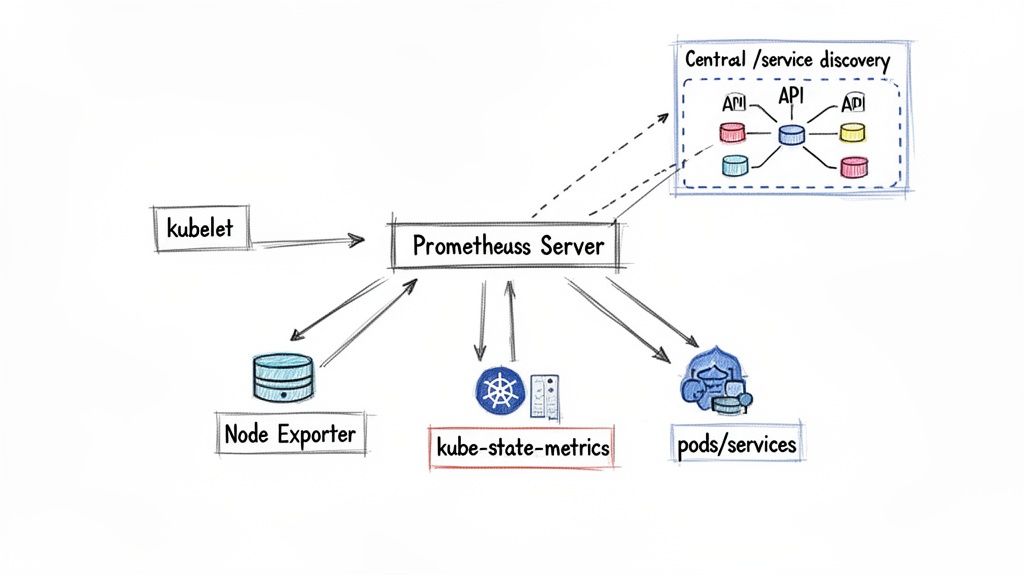
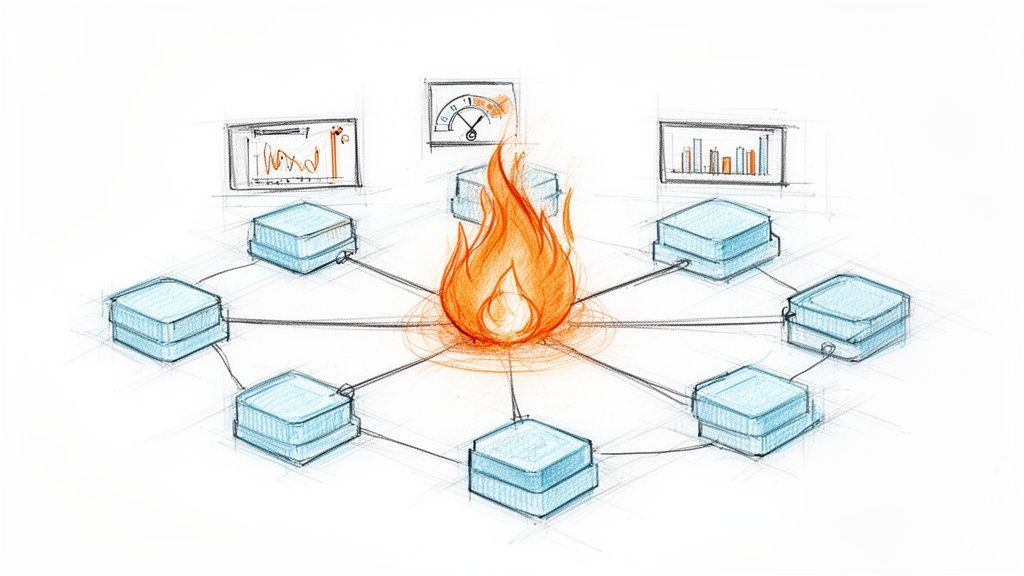
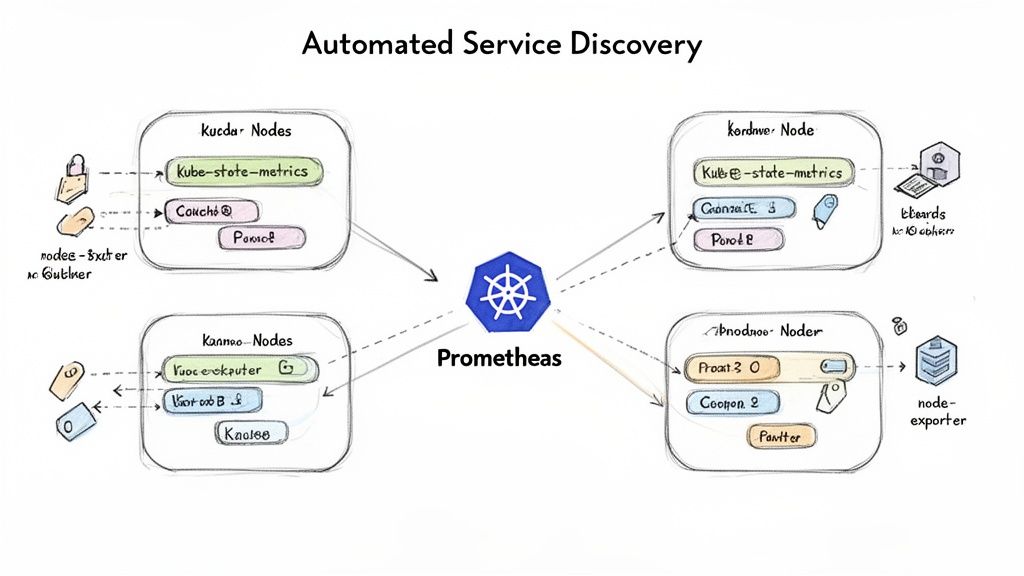
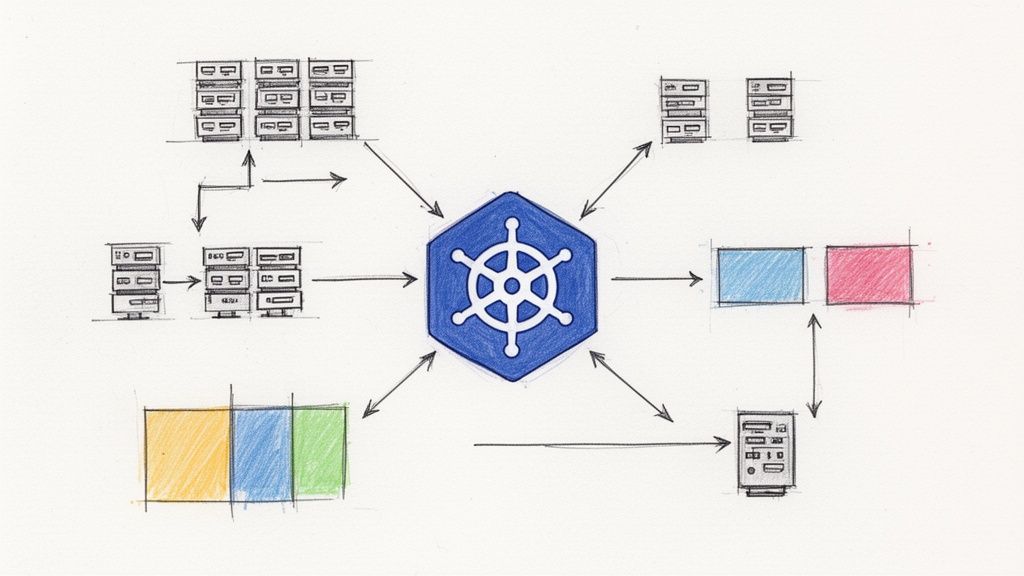
    Diagram showing Prometheus Server collecting metrics from various Kubernetes components and services with service discovery.

    Prometheus's core strength lies in its pull-based metric collection model. Instead of applications pushing metrics to a central collector, Prometheus actively scrapes HTTP endpoints where metrics are exposed in a simple text-based format. This design decouples your services from the monitoring system. A microservice only needs to expose a /metrics endpoint; Prometheus handles discovery and collection. In a Kubernetes environment where pod IP addresses are ephemeral, this pull model is essential for reliability.

    Built for Dynamic Environments

    Prometheus integrates directly with the Kubernetes API for service discovery, enabling it to automatically detect new pods, services, and nodes as they are created or destroyed. Manually configuring scrape targets in a production cluster is not feasible at scale. Prometheus leverages Kubernetes labels and annotations to dynamically determine what to monitor, which port to scrape, and how to enrich the collected data with contextual labels like pod name, namespace, and container.

    This functionality is powered by a dimensional data model and its corresponding query language, PromQL. Every metric is stored as a time series, identified by a name and a set of key-value pairs (labels). This model allows for powerful, flexible aggregation and analysis, enabling you to ask precise questions about your system's performance and health.

    The Ecosystem That Powers Production Reliability

    Prometheus itself is the core, but a production-grade monitoring solution relies on an entire ecosystem of components working in concert. Before deploying, it is critical to understand the role of each tool in the stack.

    Core Prometheus Components for Kubernetes Monitoring

    Component Primary Role Technical Functionality
    Prometheus Server Scrapes, stores, and queries time-series data Executes scrape jobs, ingests metrics into its TSDB, and serves PromQL queries.
    Exporters Expose metrics from third-party systems Acts as a proxy, translating metrics from non-Prometheus formats (e.g., JMX, StatsD) to the Prometheus exposition format.
    Alertmanager Manages and routes alerts Deduplicates, groups, and routes alerts from Prometheus to configured receivers like PagerDuty or Slack based on defined rules.
    Grafana Visualizes metrics in dashboards Queries the Prometheus API to render time-series data into graphs, charts, and dashboards for operational visibility.

    These components form a complete observability platform. Exporters provide the data, Alertmanager handles incident response, and Grafana provides the human interface for analysis.

    Kubernetes adoption has surged, with 93% of organizations using or planning to use it in 2024. Correspondingly, Prometheus has become the dominant monitoring tool, used by 65% of Kubernetes users. To effectively leverage this stack, a strong foundation in general application monitoring best practices is indispensable.

    Getting a Production-Ready Prometheus Stack Deployed

    Moving from theory to a functional Prometheus deployment requires careful configuration. While a simple helm install can launch the components, a production stack demands high availability, persistent storage, and declarative management.

    The standard for this task is the kube-prometheus-stack Helm chart. This chart bundles Prometheus, Alertmanager, Grafana, and essential exporters, all managed by the Prometheus Operator. The Operator extends the Kubernetes API with Custom Resource Definitions (CRDs) like Prometheus, ServiceMonitor, and PrometheusRule. This allows you to manage monitoring configurations declaratively as native Kubernetes objects, which is ideal for GitOps workflows.

    Laying the Groundwork: Chart Repo and Namespace

    First, add the Helm repository and create a dedicated namespace for the monitoring stack. Isolating monitoring components simplifies resource management, access control (RBAC), and lifecycle operations.

    # Add the Prometheus community Helm repository
    helm repo add prometheus-community https://prometheus-community.github.io/helm-charts
    
    # Update your local Helm chart repository cache
    helm repo update
    
    # Create a dedicated namespace for monitoring components
    kubectl create namespace monitoring
    

    Deploying a complex chart like this without a custom values.yaml file is a common anti-pattern. Defaults are for demonstration; production requires deliberate configuration.

    Don't Lose Your Data: Configuring Persistent Storage

    The default Helm chart configuration may use an emptyDir volume for Prometheus, which is ephemeral. If the Prometheus pod is rescheduled, all historical metric data is lost. For any production environment, you must configure persistent storage using a PersistentVolumeClaim (PVC). This requires a provisioned StorageClass in your cluster.

    Here is the required values.yaml configuration snippet:

    # values.yaml
    prometheus:
      prometheusSpec:
        storageSpec:
          volumeClaimTemplate:
            spec:
              # Replace 'standard' with your provisioner's StorageClass if needed
              storageClassName: standard 
              accessModes: ["ReadWriteOnce"]
              resources:
                requests:
                  # Size based on metric cardinality, scrape interval, and retention
                  storage: 50Gi 
        # Define how long metrics are kept in this local TSDB
        retention: 24h 
    

    Pro Tip: The local retention period (retention) should be carefully considered. If you are using remote_write to offload metrics to a long-term storage solution, a shorter local retention (e.g., 12-24 hours) is sufficient and reduces disk costs. If this Prometheus instance is your primary data store, you'll need a larger PVC and a longer retention period.

    Give It Room to Breathe: Setting Resource Requests and Limits

    Resource starvation is a leading cause of monitoring stack instability. Prometheus can be memory-intensive, especially in clusters with high metric cardinality. Without explicit resource requests and limits, the Kubernetes scheduler might place the pod on an under-resourced node, or the OOMKiller might terminate it under memory pressure.

    Define these values in your values.yaml to ensure stable operation.

    # values.yaml
    prometheus:
      prometheusSpec:
        resources:
          requests:
            cpu: "1" # Start with 1 vCPU
            memory: 2Gi
          limits:
            cpu: "2" # Allow bursting to 2 vCPUs
            memory: 4Gi
    
    alertmanager:
      alertmanagerSpec:
        resources:
          requests:
            cpu: 100m
            memory: 200Mi
          limits:
            cpu: 200m
            memory: 300Mi
    

    These settings guarantee that Kubernetes allocates sufficient resources for your monitoring components. For further optimization, review different strategies for Prometheus service monitoring.

    Firing Up the Visuals: Enabling Grafana

    The kube-prometheus-stack chart includes Grafana, but it must be explicitly enabled. Activating it provides an immediate visualization layer, and the chart includes a valuable set of pre-built dashboards for cluster monitoring. As with Prometheus, enable persistence for Grafana to retain custom dashboards and settings across pod restarts.

    # values.yaml
    grafana:
      enabled: true
      persistence:
        type: pvc
        enabled: true
        storageClassName: standard
        accessModes:
          - ReadWriteOnce
        size: 10Gi
      # WARNING: For production, use a secret management tool like Vault or ExternalSecrets
      # to manage the admin password instead of plain text.
      adminPassword: "your-secure-password-here"
    

    With these configurations, you are ready to deploy a production-ready stack using helm install. This declarative approach is the foundation of a scalable and manageable monitoring strategy in any Kubernetes environment.

    Configuring Dynamic Service Discovery and Scraping

    Static scrape configurations are obsolete in Kubernetes. Pod and service IPs are ephemeral, changing with deployments, scaling events, and node failures. Manually tracking scrape targets is untenable. The solution is Prometheus's dynamic service discovery mechanism, specifically kubernetes_sd_config.

    This directive instructs Prometheus to query the Kubernetes API to discover scrape targets based on their role (e.g., role: pod, role: service). This real-time awareness is the foundation of an automated monitoring configuration.

    The operational workflow becomes a continuous cycle of configuration, deployment, and management.
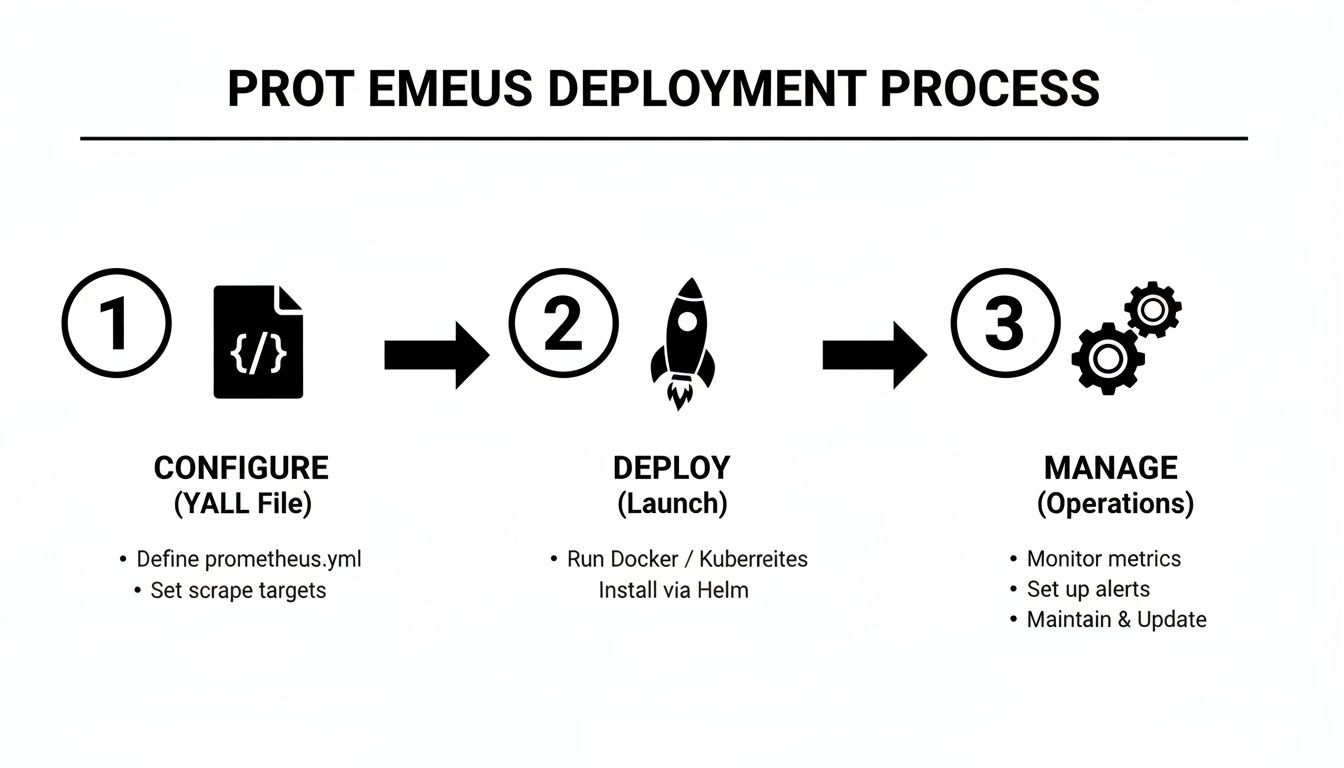
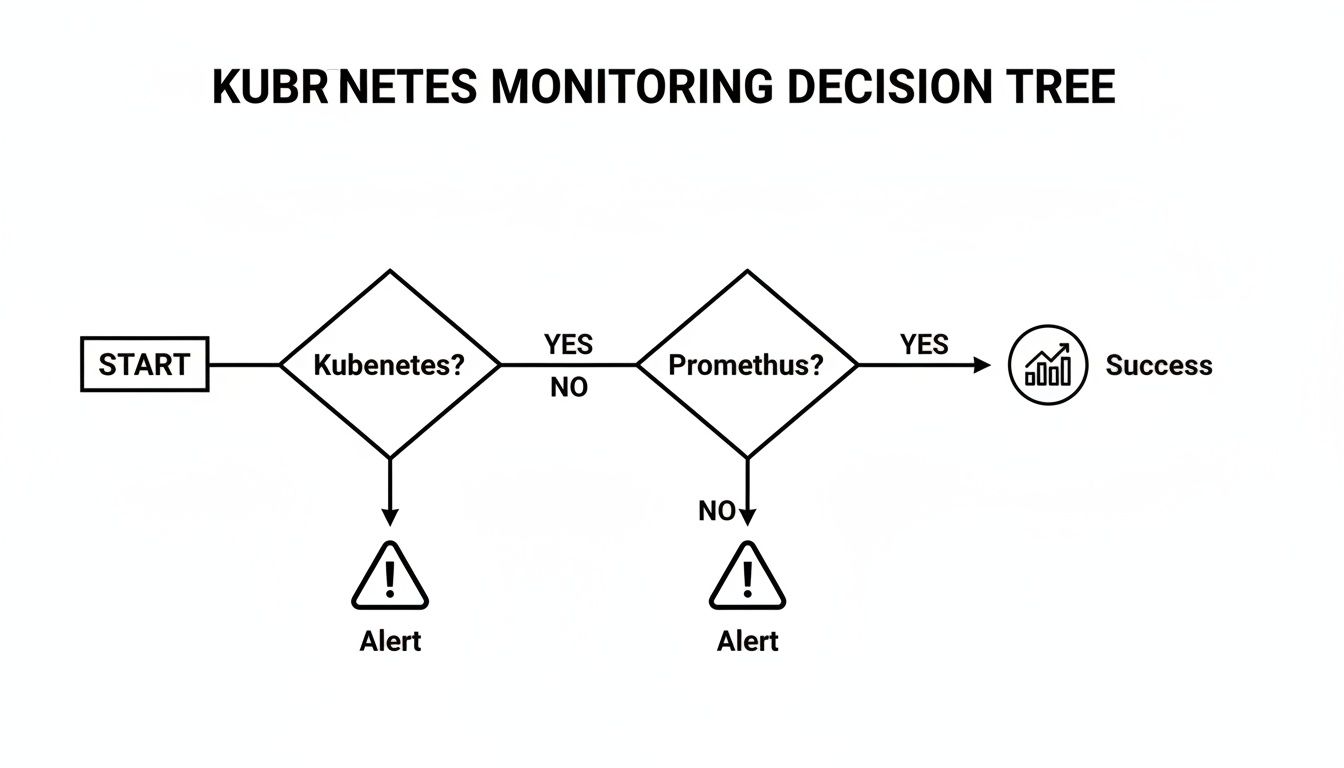
    Diagram illustrating the three-step PROT EMEUS deployment process: Configure, Deploy, and Manage.

    As the diagram illustrates, monitoring configuration is not a one-time setup but an iterative process that evolves with your cluster and applications.

    Leveraging Labels for Automatic Discovery

    The power of kubernetes_sd_config is fully realized when combined with Kubernetes labels and annotations. Instead of specifying individual pods, you create a rule that targets any pod matching a specific label selector.

    For example, a standard practice is to adopt a convention like prometheus.io/scrape: 'true'. Your Prometheus configuration then targets any pod with this label. When a developer deploys a new service with this label, Prometheus automatically begins scraping it without any manual intervention. This decouples monitoring configuration from application deployment, empowering developers to make their services observable by adding metadata to their Kubernetes manifests.

    A Practical Example with a Spring Boot App

    Consider a Java Spring Boot microservice that exposes metrics on port 8080 at the /actuator/prometheus path. To enable automatic discovery, add the following annotations to the pod template in your Deployment manifest:

    apiVersion: apps/v1
    kind: Deployment
    metadata:
      name: my-spring-boot-app
    spec:
      template:
        metadata:
          annotations:
            prometheus.io/scrape: "true"
            prometheus.io/path: "/actuator/prometheus"
            prometheus.io/port: "8080"
    ...
    

    The scrape annotation marks the pod as a target. The path and port annotations override Prometheus's default scrape behavior, instructing it to use the specified endpoint. This declarative approach integrates seamlessly into a GitOps workflow.

    Mastering Relabeling to Refine Targets

    After discovering a target, Prometheus attaches numerous metadata labels prefixed with __meta_kubernetes_, such as pod name, namespace, and container name. While useful, this raw metadata can be noisy and inconsistent.

    The relabel_configs section in your scrape job configuration is a powerful mechanism for transforming, filtering, and standardizing these labels before metrics are ingested. Mastering relabeling is critical for maintaining a clean, efficient, and cost-effective monitoring system.

    Key Takeaway: Relabeling is a crucial tool for performance optimization and cost control. You can use it to drop high-cardinality metrics or unwanted targets at the source, preventing them from consuming storage and memory resources.

    Common relabeling actions include:

    • Filtering Targets: Using the keep or drop action to scrape only targets that match specific criteria (e.g., pods in a production namespace).
    • Creating New Labels: Constructing meaningful labels by combining existing metadata, such as creating a job label from a Kubernetes app label.
    • Cleaning Up: Dropping all temporary __meta_* labels after processing to keep the final time-series data clean.

    Prometheus is the dominant Kubernetes observability tool, with 65% of organizations relying on it. Originally developed at SoundCloud in 2012 for large-scale containerized environments, its tight integration with Kubernetes makes it the default choice. For more on these container adoption statistics, you can review recent industry reports. By combining dynamic service discovery with strategic relabeling, you can build a monitoring configuration that scales effortlessly with your cluster.

    Building Actionable Alerts with Alertmanager

    Metric collection provides data; alerting turns that data into actionable signals that can prevent or mitigate outages. Alertmanager is the component responsible for this transformation.

    The primary challenge in a microservices architecture is alert fatigue. If on-call engineers receive a high volume of low-value notifications, they will begin to ignore them. An effective alerting strategy focuses on user-impacting symptoms, such as elevated error rates or increased latency, rather than raw resource utilization.

    Defining Alerting Rules with PrometheusRule

    The Prometheus Operator provides the PrometheusRule CRD, allowing you to define alerting rules as native Kubernetes objects. This approach integrates perfectly with GitOps workflows.

    An effective alert definition requires:

    • expr: The PromQL query that triggers the alert.
    • for: The duration a condition must be true before the alert fires. This is the most effective tool for preventing alerts from transient, self-correcting issues.
    • Labels: Metadata attached to the alert, used by Alertmanager for routing, grouping, and silencing. The severity label is a standard convention.
    • Annotations: Human-readable context, including a summary and description. These can use template variables from the query to provide dynamic information.

    Production-Tested Alerting Templates

    This example demonstrates an alert that detects a pod in a CrashLoopBackOff state using metrics from kube-state-metrics.

    apiVersion: monitoring.coreos.com/v1
    kind: PrometheusRule
    metadata:
      name: critical-pod-alerts
      labels:
        # These labels are used by the Prometheus Operator to select this rule
        prometheus: k8s
        role: alert-rules
    spec:
      groups:
      - name: kubernetes-pod-alerts
        rules:
        - alert: KubePodCrashLooping
          expr: rate(kube_pod_container_status_restarts_total{job="kube-state-metrics"}[15m]) * 60 * 5 > 0
          for: 10m
          labels:
            severity: critical
          annotations:
            summary: "Pod {{ $labels.namespace }}/{{ $labels.pod }} is crash-looping"
            description: "Container {{ $labels.container }} in Pod {{ $labels.pod }} has been restarting frequently over the last 15 minutes."
    

    The for: 10m clause is critical. It ensures that the alert only fires if the pod has been consistently restarting for 10 minutes, filtering out noise from temporary issues.

    Key Takeaway: The goal of alerting is to identify persistent, meaningful failures. The for duration is the simplest and most effective mechanism for reducing alert noise and preserving the focus of your on-call team.

    Intelligent Routing with Alertmanager

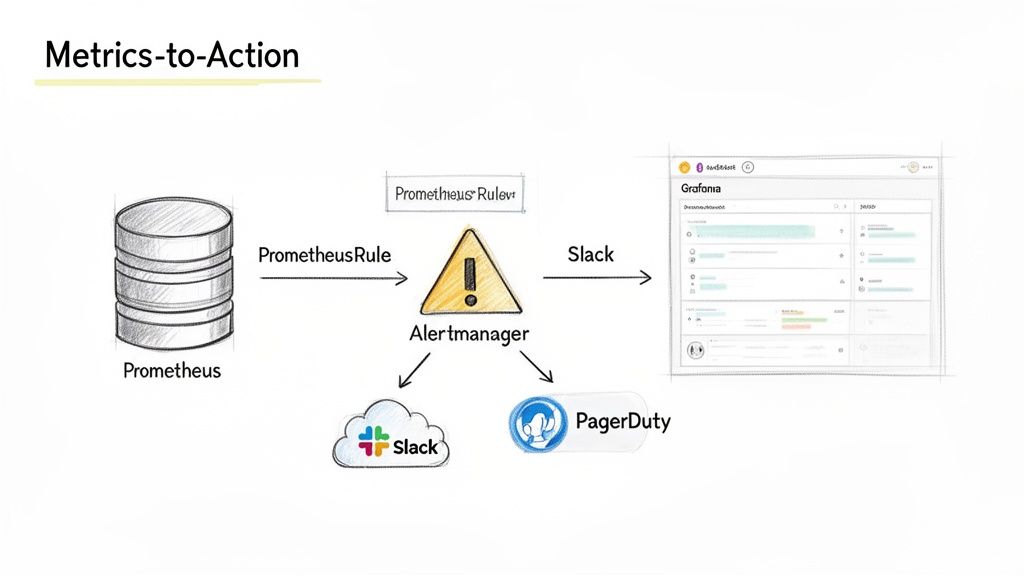
    Effective alerting requires routing the right information to the right team at the right time. Alertmanager acts as a central dispatcher, receiving alerts from Prometheus and then grouping, silencing, and routing them to notification channels like Slack, PagerDuty, or email.

    This routing logic is defined in the AlertmanagerConfig CRD. A common and effective strategy is to route alerts based on their severity label:

    • severity: critical: Route directly to a high-urgency channel like PagerDuty.
    • severity: warning: Post to a team's Slack channel for investigation during business hours.
    • severity: info: Log for awareness without sending a notification.

    This tiered approach ensures critical issues receive immediate attention. Furthermore, you can configure inhibition rules to suppress redundant alerts. For example, if a KubeNodeNotReady alert is firing for a specific node, you can automatically inhibit all pod-level alerts originating from that same node. This prevents an alert storm and allows the on-call engineer to focus on the root cause.

    Visualizing Kubernetes Health with Grafana

    Alerts notify you of failures. Dashboards provide the context to understand why a failure is occurring or is about to occur. Grafana is the visualization layer that transforms raw Prometheus time-series data into actionable insights about your cluster's health.
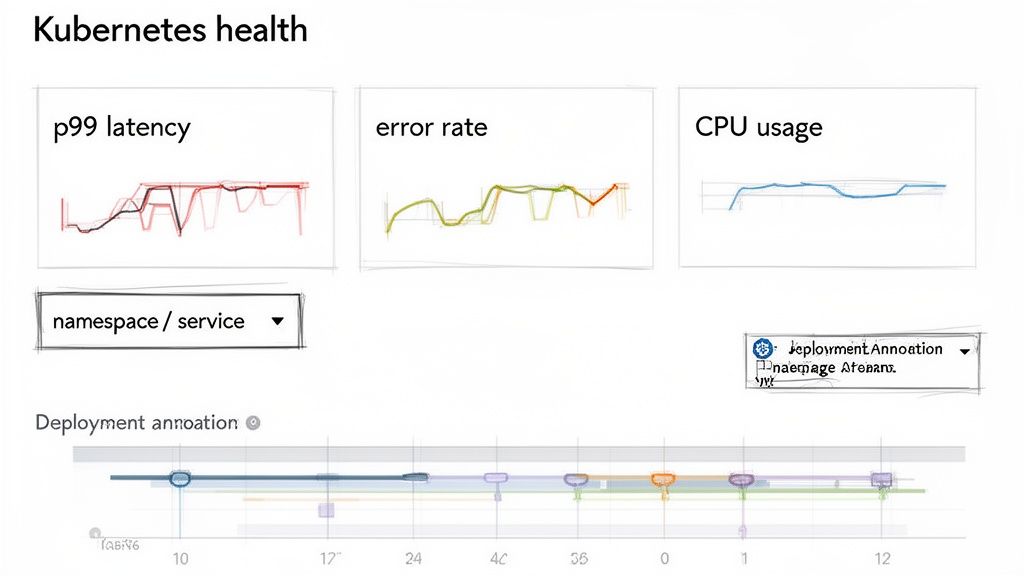
    A Kubernetes health dashboard displaying p99 latency, error rate, CPU usage, and deployment annotations over time.

    The kube-prometheus-stack Helm chart automatically configures Grafana with Prometheus as its data source, allowing you to begin visualizing metrics immediately. It also provisions a suite of battle-tested community dashboards for monitoring core Kubernetes components.

    Jumpstart with Community Dashboards

    Before building custom dashboards, leverage the pre-built ones included with the stack. They provide immediate visibility into critical cluster metrics.

    Essential included dashboards:

    • Kubernetes / Compute Resources / Cluster: Provides a high-level overview of cluster-wide resource utilization (CPU, memory, disk).
    • Kubernetes / Compute Resources / Namespace (Workloads): Drills down into resource consumption by namespace, useful for capacity planning and identifying resource-heavy applications.
    • Kubernetes / Compute Resources / Pod: Offers granular insights into the performance of individual pods, essential for debugging specific application issues.

    These dashboards are the first step in diagnosing systemic problems, such as cluster-wide memory pressure or CPU saturation in a specific namespace.

    Building a Custom Microservice Dashboard

    While community dashboards are excellent for infrastructure health, operational excellence requires dashboards tailored to your specific applications. A standard microservice dashboard should track the "Golden Signals" or RED metrics (Rate, Errors, Duration).

    Key Performance Indicators (KPIs) to track:

    1. Request Throughput (Rate): Requests per second (RPS).
    2. Error Rate: The percentage of requests resulting in an error (typically HTTP 5xx).
    3. 99th Percentile Latency (Duration): The request duration for the slowest 1% of users.

    To produce meaningful visualizations, you must focus on efficient metrics collection and instrument your applications properly.

    Writing the Right PromQL Queries

    Each panel in a Grafana dashboard is powered by a PromQL query. To build our microservice dashboard, we need queries that calculate our KPIs from the raw counter and histogram metrics exposed by the application. For a deep dive, consult our guide on the Prometheus Query Language in our detailed article.

    Sample PromQL queries for a service named my-microservice:

    • Request Rate (RPS):

      sum(rate(http_requests_total{job="my-microservice"}[5m]))
      

      This calculates the per-second average request rate over a 5-minute window.

    • Error Rate (%):

      (sum(rate(http_requests_total{job="my-microservice", status=~"5.."}[5m])) / sum(rate(http_requests_total{job="my-microservice"}[5m]))) * 100
      

      This calculates the percentage of requests with a 5xx status code relative to the total request rate.

    • P99 Latency (ms):

      histogram_quantile(0.99, sum(rate(http_request_duration_seconds_bucket{job="my-microservice"}[5m])) by (le))
      

      This calculates the 99th percentile latency from a histogram metric, providing insight into the worst-case user experience.

    Pro Tip: Use Grafana's "Explore" view to develop and test your PromQL queries. It provides instant feedback, graphing capabilities, and autocompletion, significantly accelerating the dashboard development process.

    Enhance your dashboards with variables for dynamic filtering (e.g., a dropdown to select a namespace or pod) and annotations. Annotations can overlay events from Prometheus alerts or your CI/CD pipeline directly onto graphs, which is invaluable for correlating performance changes with deployments or other system events.

    Burning Questions About Prometheus and Kubernetes

    Deploying Prometheus in Kubernetes introduces several architectural and operational questions. Here are solutions to some of the most common challenges.

    How Do I Keep Prometheus Metrics Around for More Than a Few Weeks?

    Prometheus's local time-series database (TSDB) is not designed for long-term retention in an ephemeral Kubernetes environment. A pod failure can result in total data loss. The standard solution is to configure remote_write, which streams metrics from Prometheus to a durable, long-term storage backend.

    Several open-source projects provide this capability, including Thanos and Cortex. They leverage object storage (e.g., Amazon S3, Google Cloud Storage) for cost-effective long-term storage and offer features like a global query view across multiple Prometheus instances and high availability.

    For those seeking to offload operational complexity, managed services are an excellent alternative:

    What's the Real Difference Between Node Exporter and Kube-State-Metrics?

    These two exporters provide distinct but equally critical views of cluster health. They are not interchangeable.

    Node Exporter monitors the health of the underlying host machine. It runs as a DaemonSet (one instance per node) and exposes OS-level and hardware metrics: CPU utilization, memory usage, disk I/O, and network statistics. It answers the question: "Are my servers healthy?"

    kube-state-metrics monitors the state of Kubernetes objects. It runs as a single deployment and queries the Kubernetes API server to convert the state of objects (Deployments, Pods, PersistentVolumes) into metrics. It answers questions like: "How many pods are in a Pending state?" or "What are the resource requests for this deployment?" It tells you if your workloads are healthy from a Kubernetes perspective.

    In short: Node Exporter monitors the health of your nodes. Kube-state-metrics monitors the health of your Kubernetes resources. A production cluster requires both for complete visibility.

    How Can I Monitor Apps That Don't Natively Support Prometheus?

    The Prometheus ecosystem solves this with exporters. An exporter is a specialized proxy that queries a third-party system (e.g., a PostgreSQL database, a Redis cache), translates the data into the Prometheus exposition format, and exposes it on an HTTP endpoint for scraping. This pattern allows you to integrate hundreds of different technologies into a unified monitoring system.

    For legacy or custom applications, several general-purpose exporters are invaluable:

    • The Blackbox Exporter performs "black-box" monitoring by probing endpoints over HTTP, TCP, or ICMP. It can verify that a service is responsive, check for valid SSL certificates, and measure response times.
    • The JMX Exporter is essential for Java applications. It connects to a JVM's JMX interface to extract a wide range of metrics from the JVM itself and the application running within it.

    With the vast library of available exporters, there is virtually no system that cannot be monitored with Prometheus.


    Navigating the complexities of a production-grade Kubernetes monitoring setup requires deep expertise. OpsMoon connects you with the top 0.7% of remote DevOps engineers who specialize in building and scaling observability platforms with Prometheus, Grafana, and Alertmanager. Start with a free work planning session to map out your monitoring strategy and get matched with the exact talent you need. Build a resilient, scalable system with confidence by visiting https://opsmoon.com.
  • Cloud Migration Consultants: A Practical Hiring Playbook

    Cloud Migration Consultants: A Practical Hiring Playbook

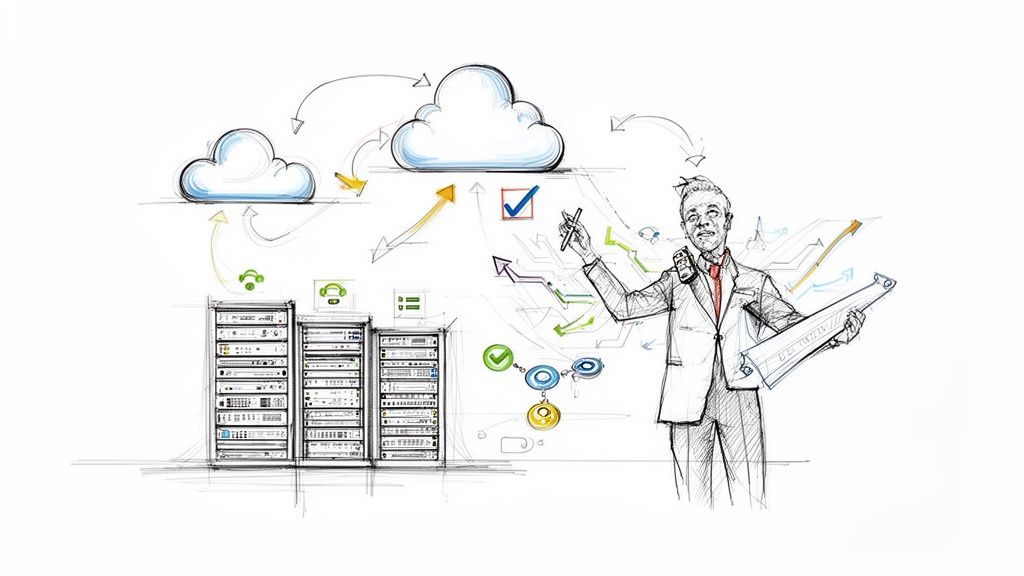
    Engaging cloud migration consultants without a detailed technical blueprint is like hiring a contractor and saying, "build me a house." The result is wasted budget, extended timelines, and a final product that fails to meet business requirements.

    A comprehensive migration blueprint is your most critical asset. It converts high-level business goals into a concrete, technically-vetted roadmap. When you perform this due diligence upfront, you engage consultants with a data-backed plan, enabling them to provide accurate proposals and execute a precise strategy from day one.

    Build Your Migration Blueprint Before Hiring Consultants

    Initiating consultant interviews without a clearly defined strategy inevitably leads to scope creep, budget overruns, and suboptimal outcomes. Successful cloud migrations begin with rigorous internal planning.

    This involves more than just a server inventory. It requires building a robust business and technical case for the migration that directly aligns with your product roadmap and financial projections.

    The market for this expertise is immense. The global cloud migration services market was valued at USD 257.38 billion in 2024 and is projected to reach USD 1,490.12 billion by 2033. This growth underscores the necessity of a well-architected strategy from the outset.

    Define Specific Business and Technical Outcomes

    Before analyzing your technology stack, you must quantify success. Vague objectives like "improve performance" or "reduce costs" are insufficient. You must provide consultants with precise, measurable targets to architect a viable plan.

    Here’s how to translate business goals into technical specifications:

    • Latency Reduction: "Reduce P95 latency for the /api/v2/checkout endpoint from 250ms to sub-100ms under a load of 5,000 concurrent users."
    • Cost Optimization: "Achieve a 20% reduction in infrastructure spend for our Apache Spark analytics workload by implementing AWS Graviton instances and a spot instance strategy for non-critical jobs."
    • Scalability: "The user authentication service must handle a 5x increase in peak RPS (requests per second) during promotional events with a zero-downtime scaling mechanism, such as a Kubernetes Horizontal Pod Autoscaler (HPA)."
    • Developer Velocity: "Reduce the provisioning time for a full staging environment from 48 hours to under 30 minutes using a parameterized Terraform module and a CI/CD pipeline."

    Achieving this level of specificity requires collaboration between engineering leads, product managers, and finance stakeholders to ensure technical objectives directly support business imperatives.

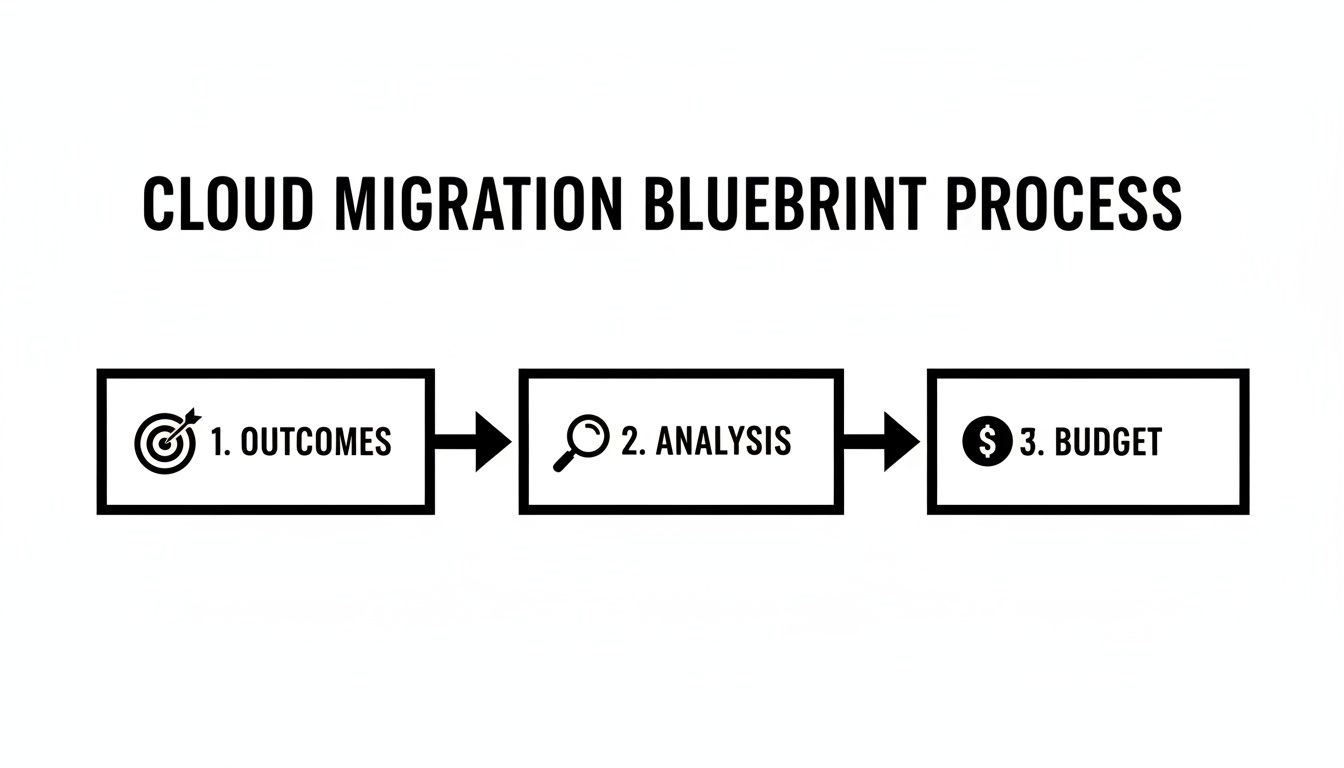
    This entire process—from defining quantifiable outcomes to in-depth technical analysis and financial modeling—constitutes your migration blueprint.

    A diagram illustrating the Cloud Migration Blueprint Process, outlining steps: Outcomes, Analysis, and Budget.

    As illustrated, clear, measurable outcomes are the bedrock upon which all subsequent technical analysis and financial planning are built.

    Conduct a Deep Application Portfolio Analysis

    With outcomes defined, conduct a thorough analysis of your applications and infrastructure. This extends beyond a simple asset inventory to mapping all inter-service dependencies, performance characteristics, and business criticality for each component.

    A common failure is treating all applications monolithically. A legacy Java application with high-traffic dependencies on a central Oracle database requires a fundamentally different migration strategy than a self-contained Go microservice. The analysis must differentiate these workloads.

    Begin by mapping all critical dependencies between applications, databases, message queues, and third-party APIs. A dependency graph is essential for sequencing migration waves and preventing cascading failures.

    Next, classify each workload using the "6 R's" framework to determine the optimal migration path:

    • Rehost (Lift and Shift): Migrate as-is to IaaS. Fast but accrues technical debt.
    • Replatform (Lift and Reshape): Migrate with minor modifications to leverage cloud-managed services (e.g., move a self-hosted PostgreSQL to Amazon RDS).
    • Refactor/Re-architect: Substantial code and architectural changes to become cloud-native.
    • Repurchase: Replace with a SaaS solution.
    • Retire: Decommission the application.
    • Retain: Keep on-premises, often due to compliance or latency constraints.

    As you assemble this blueprint, consider leveraging modern talent acquisition software platforms to streamline the subsequent search for qualified consultants.

    For a more granular examination of these technical steps, consult our comprehensive guide on how to migrate to the cloud.

    How to Technically Vet Cloud Migration Consultants

    The success of your migration is directly proportional to the technical competence of your consultants. A compelling presentation and a list of certifications are merely prerequisites. You are paying for proven, hands-on expertise in navigating complex technical landscapes. This vetting process must distinguish genuine architects from individuals who can only recite documentation.

    A partner must possess deep, nuanced knowledge of platform-specific behaviors, data migration complexities, and production-grade orchestration. A superficial understanding is a direct path to performance bottlenecks, security vulnerabilities, and costly rework.

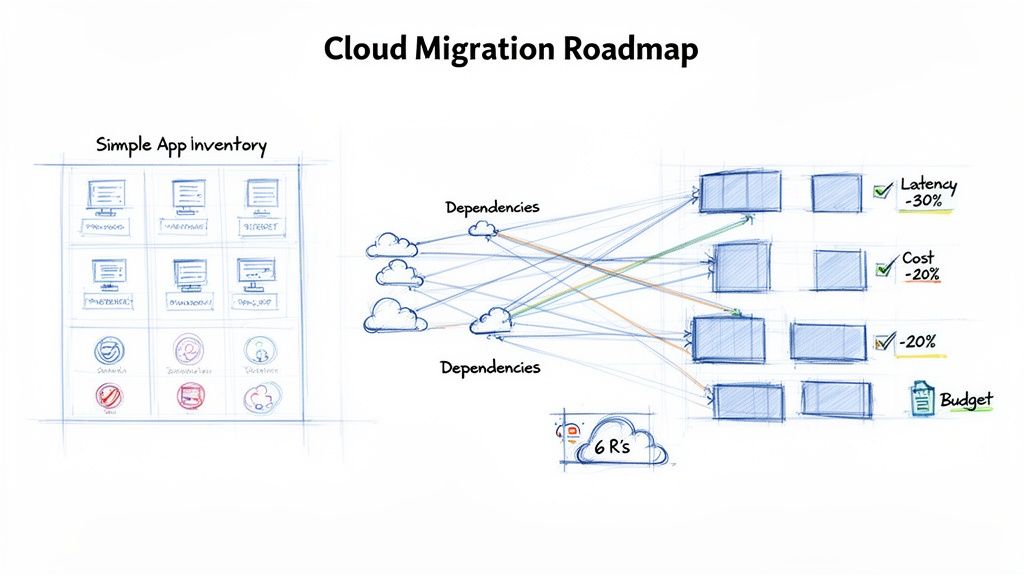
    A cloud migration roadmap diagram illustrating app inventory, dependencies, and benefits like reduced latency and cost.

    Your vetting process must be rigorous, practical, and focused on demonstrated problem-solving abilities, not theoretical knowledge.

    Dissecting Case Studies and Verifying Outcomes

    Every consultant will present case studies. Your task is to treat these not as marketing collateral but as technical evidence to be cross-examined. Move beyond the high-level ROI figures and probe the technical execution.

    Ask questions that require specific, technical answers:

    • "Describe the most significant unforeseen technical challenge in that project. What specific steps, tools, and code changes did your team implement to resolve it?"
    • "Walk me through the structure of the Infrastructure as Code modules you developed. How did you manage state, handle secrets, and ensure modularity for multi-environment deployments?"
    • "What specific performance tuning was required post-migration to meet the client's latency SLOs? Detail any kernel-level adjustments, database query optimizations, or CDN configurations you implemented."

    A consultant with direct experience will provide detailed, verifiable accounts. Ambiguous, high-level responses are a significant red flag. Identifying these deficiencies is as crucial as recognizing strengths, a principle detailed in this guide on red flags to avoid when selecting a consulting partner.

    Probing Real-World Experience with Technical Questions

    Your interview process must be designed to evaluate practical expertise. Scenario-based questions are highly effective at revealing a consultant's thought process and depth of knowledge.

    Key Areas to Probe:

    1. Cloud Platform Nuances: Avoid simple "Do you know AWS?" questions. Ask comparative questions that expose true familiarity. For example: "For a containerized .NET application, contrast the technical trade-offs of using Azure App Service for Containers versus AWS Fargate, specifically regarding VNet integration, IAM role management, and observability."
    2. Infrastructure as Code (IaC) Proficiency: Go beyond "Do you use Terraform?" Test their best practices. A strong question is: "Describe your strategy for structuring a multi-account AWS organization with Terraform. How would you use Terragrunt or workspaces to manage shared modules for networking and IAM while maintaining environment isolation?"
    3. Container Orchestration: Kubernetes is a common element. Test their knowledge of stateful workloads: "You need to migrate a stateful application like Kafka to Kubernetes. Detail your approach for managing persistent storage. What are the operational pros and cons of using an operator with local persistent volumes versus a managed cloud storage class via a StorageClass and PersistentVolumeClaim?"

    Elite consultants not only know the 'what' but can defend the 'why' and 'how' with data and real-world examples. They justify architectural decisions with performance benchmarks and cost models, not just vendor whitepapers.

    Implementing a Practical Technical Challenge

    To validate their capabilities, assign a small, well-defined technical challenge. This is not about soliciting free work but observing their analytical and design process. The exercise should be a microcosm of a problem you are facing.

    Sample Take-Home Challenge:
    "We have a monolithic on-premises Java application using a large Oracle database, requiring 99.95% uptime. Provide a high-level migration plan (2-3 pages) that outlines:

    • Your recommended migration strategy (e.g., Replatform to RDS with DMS, Re-architect to microservices on EKS). Justify your choice based on technical trade-offs.
    • A target architecture diagram on a preferred cloud provider (AWS, Azure, or GCP), including networking, security, and CI/CD components.
    • The top three technical risks you foresee and a detailed mitigation plan for each, including specific tools and validation steps."

    Evaluate the response for strategic thinking, architectural soundness, and risk awareness. A strong submission will be pragmatic and highly tailored to the constraints provided. A generic, boilerplate response indicates a lack of depth.

    This multi-faceted approach provides a comprehensive view of a consultant's true technical acumen, ensuring you hire a genuine expert. For further insights, see our guide on finding a premier cloud DevOps consultant.

    Choosing the Right Engagement and Contract Model

    Once you have vetted your top candidates, the next critical step is defining the engagement model. This is not a mere administrative detail; the contractual structure dictates the operational dynamics of the partnership.

    A mismatched model can lead to friction, budget overruns, and a final architecture that is misaligned with your team's capabilities. The contract serves as the operational rulebook for the migration. A well-defined contract fosters a transparent, accountable partnership, while a vague one invites scope creep and technical debt.

    There are three primary models, each suited to different phases and levels of technical ambiguity in a cloud migration project.

    Matching the Model to Your Migration Phase

    Selecting the appropriate model requires an objective assessment of your project's maturity, your team's existing skill set, and your desired outcomes.

    Cloud Consultant Engagement Model Comparison

    This table provides a comparative overview of common engagement models. Evaluate your position in the migration lifecycle and the specific type of support you require—be it strategic architectural validation, hands-on project execution, or specialized skill injection.

    Model Type Best For Pros Cons
    Strategic Advisory (Retainer) Architectural design/review, technology selection, and high-level strategy formulation. Cost-effective access to senior expertise; high flexibility. Not suitable for implementation; requires strong internal project management.
    Fixed-Scope Project (Deliverable-Based) Well-defined work packages like migrating a specific application or implementing a CI/CD pipeline. Predictable budget and timeline; clear accountability for deliverables. Inflexible to scope changes; requires an exhaustive Statement of Work (SOW).
    Staff Augmentation (Time & Materials) Projects with evolving requirements or when augmenting your team with a niche skill set (e.g., Kubernetes networking). Maximum flexibility; facilitates deep knowledge transfer to your team. Potential for budget unpredictability; requires significant management overhead.

    The optimal model is contingent on your specific project needs. A project might begin with a strategic advisory retainer to develop the roadmap and then transition to a fixed-scope model for execution.

    A Closer Look at the Models

    1. Strategic Advisory (Retainer Model)
    This model is ideal for the initial planning phase. You are developing the migration blueprint and require expert validation of your architecture or guidance on complex compliance issues. You are effectively purchasing a fractional allocation of a senior architect's time to serve as a technical advisor.

    2. Fixed-Scope Project (Deliverable-Based)
    This is the standard model for executing well-defined migration tasks. Examples include migrating a specific application suite or building out a cloud landing zone. The consultant is contractually obligated to deliver a specific, measurable outcome for a predetermined price.

    Refactoring is a common activity in these projects. The market for refactoring services is growing at a 19.4% CAGR as companies modernize for cloud-native performance, while fully automated migration services are expanding at a 19.9% CAGR. You can explore more data on public cloud migration trends for further market insights.

    3. Staff Augmentation (Time & Materials – T&M)
    Under a T&M model, a consultant is embedded within your team, operating under your direct management. This is ideal for filling a critical skill gap, accelerating a project with evolving scope, or facilitating intensive knowledge transfer to your permanent staff.

    Crafting a Bulletproof Statement of Work

    The Statement of Work (SOW) is the most critical document governing the engagement. A poorly defined SOW is a direct invitation to scope creep and budget disputes. It must be technically precise and unambiguous.

    A robust SOW does not merely list tasks; it defines "done" with measurable, technical criteria. It should function as a technical specification, not a marketing document.

    Your SOW must include these technical clauses:

    • Performance Acceptance Criteria: Be explicit. Instead of "the application must be fast," specify "The migrated CRM application must maintain a P95 API response time of under 200ms and an Apdex score of 0.95 or higher, measured under a sustained load of 1,000 concurrent users for 60 minutes."
    • Security and Compliance Guardrails: Define the exact standards. State: "All infrastructure provisioned via IaC must pass all critical and high-severity checks from the CIS AWS Foundations Benchmark v1.4.0, as validated by an automated scan using a tool like Checkov."
    • IP Ownership of IaC Modules: Clarify intellectual property rights. A standard clause is: "All Terraform modules, Ansible playbooks, Kubernetes manifests, and other custom code artifacts developed during this engagement shall become the exclusive intellectual property of [Your Company Name] upon final payment."
    • Firm Deliverable Schedule: Attach a detailed project plan with specific technical milestones, dependencies, and delivery dates. This establishes clear accountability and a framework for tracking progress.

    Onboarding Consultants for Maximum Impact

    Executing the Statement of Work is the beginning, not the end. The success of the partnership is determined in the first 48 hours of engagement.

    A disorganized onboarding process creates immediate friction, reduces velocity, and places the project on a reactive footing. A structured, technical onboarding process is mandatory to integrate external experts into your engineering workflows, enabling immediate productivity.

    Establishing Secure Access and Communication

    Your first priority is provisioning secure access based on the principle of least privilege. Granting broad administrative permissions is a significant security risk. Create a dedicated IAM role for the consultant team with granular permissions scoped exclusively to the resources defined in the SOW.

    They require immediate, controlled access to:

    • Code Repositories: Read/write access to specific Git repositories relevant to the migration.
    • CI/CD Tooling: Permissions to view build logs, trigger pipelines for their feature branches, and access deployment artifacts in non-production environments.
    • Cloud Environments: Scoped-down IAM roles for development and staging environments. Production access must be heavily restricted, requiring just-in-time (JIT) approval for specific, audited actions.
    • Observability Platforms: Read-only access to dashboards and logs in platforms like Datadog or New Relic to analyze baseline application performance.

    Simultaneously, establish clear communication protocols.

    Create a dedicated, shared Slack or Teams channel immediately for asynchronous technical communication and status updates. Mandate consultant participation in your daily stand-ups, sprint planning, and retrospectives. This embeds them within your team's operational rhythm and prevents siloed work.

    The Project Kickoff Checklist

    The formal kickoff meeting is the forum for aligning all stakeholders on technical objectives and rules of engagement. A generic agenda is insufficient; a detailed checklist is required to drive a productive discussion.

    Your kickoff checklist must cover:

    1. SOW Review: A line-by-line review of technical deliverables, acceptance criteria, and timelines to eliminate ambiguity.
    2. Architecture Deep Dive: A session led by your principal engineer to walk through the current-state architecture, including known technical debt, performance bottlenecks, and critical dependencies.
    3. Tooling and Process Intro: A demonstration of your CI/CD pipeline, Git branching strategy (e.g., GitFlow), and any internal CLI tools or platforms they will use.
    4. Security Protocol Briefing: A clear explanation of your secrets management process (e.g., HashiCorp Vault), access request procedures, and incident response contacts.
    5. RACI Matrix Agreement: Finalize and gain explicit agreement on the roles and responsibilities for every major migration task.

    This process is not bureaucratic overhead; it is a critical investment in ensuring operational alignment from day one. For teams still sourcing talent, our guide on streamlining consultant talent acquisition can be a valuable resource.

    Defining Roles with a RACI Matrix

    A RACI (Responsible, Accountable, Consulted, Informed) matrix is a simple yet powerful tool for eliminating ambiguity and establishing clear ownership.

    Task / Deliverable Responsible (Does the work) Accountable (Owns the outcome) Consulted (Provides input) Informed (Kept up-to-date)
    Provisioning New VPC Consultant Lead Your Head of Infrastructure Your Security Team Product Manager
    Refactoring Auth Service Consultant & Your Sr. Engineer Your Engineering Lead Your Principal Architect Entire Engineering Team
    Updating Terraform Modules Consultant DevOps Engineer Your DevOps Lead Application Developers QA Team
    Final Production Cutover Consultant & Your SRE Team CTO Head of Product Company Leadership

    This level of role clarity is essential. When this strategic integration is executed correctly, the ROI is significant. Post-migration, organizations frequently realize IT cost reductions of up to 50% and operational efficiency gains around 30%. You can explore the impact of cloud migration services for further data on these outcomes.

    Managing the Migration and Measuring Technical Success

    After the consultants are onboarded, your role transitions from planner to project governor. This phase is about active technical oversight to prevent the project from deviating into a chaotic and costly endeavor.

    This requires maintaining control, making data-driven architectural decisions, and holding all parties accountable to the engineering standards and outcomes defined in the SOW.

    A critical component of this is deeply understanding cloud migration patterns. You must be able to critically evaluate and challenge the strategies proposed by your consultants for different application workloads.

    Choosing the Right Migration Pattern (The 6 R's)

    The migration strategy for each application has long-term implications for cost, operational complexity, and technical debt. The fundamental choice is often between a simple rehosting ("lift and shift") and a more involved modernization effort.

    Your consultants must justify their chosen pattern for each workload with a quantitative cost-benefit analysis. A successful migration employs a mix of strategies tailored to the technical and business requirements of each application.

    Below is a technical summary of the common "6 R's" of cloud migration patterns.

    Strategy Description Use Case Key Risk
    Rehost (Lift & Shift) Move applications to cloud VMs without code changes. Fastest path to the cloud. Data center evacuation with a hard deadline; migrating COTS applications with no source code access. Poor cost-performance in the cloud; perpetuates existing technical debt and scalability issues.
    Replatform (Lift & Reshape) Make targeted cloud optimizations, like moving to managed services, without changing core architecture. Migrating a self-managed Oracle database to Amazon RDS or replacing a self-hosted RabbitMQ with SQS. Scope creep is high. Minor tweaks can expand into a larger refactoring effort if not tightly managed.
    Repurchase (Drop & Shop) Replace an on-premises system with a SaaS solution. Migrating from an on-premise CRM like Siebel to Salesforce or an HR system to Workday. Data migration complexity and loss of custom functionality built into the legacy system.
    Refactor / Rearchitect Fundamentally re-architect the application to be cloud-native, often adopting microservices and serverless. Breaking down a monolith to improve scalability, developer velocity, and fault tolerance. Highest cost and time commitment. Essentially a new software development project with significant risk.
    Retire Decommission applications that are no longer providing business value. Eliminating redundant or obsolete applications identified during the portfolio analysis. Failure to correctly archive data for regulatory compliance before decommissioning.
    Retain Keep specific applications in their current environment. Applications with extreme low-latency requirements, specialized hardware dependencies, or major compliance hurdles. Can increase operational complexity and security risks as the on-prem island becomes more isolated.

    Your role is to ensure that each strategic choice is deliberate, technically sound, and justified by business value.

    Establishing KPIs That Actually Matter

    Technical success must be measured by concrete Key Performance Indicators (KPIs) that validate the migration delivered tangible improvements. These KPIs must be part of the consultant's contractual obligations.

    Avoid vanity metrics. Focus on indicators that reflect application performance, cost efficiency, and security posture.

    • Application Performance Metrics: The Apdex (Application Performance Index) score is an industry standard for measuring user satisfaction with application response times. For critical APIs, track P95 latency and error rates (e.g., percentage of 5xx responses). A regression in these metrics post-migration indicates a failure.
    • Infrastructure Cost-to-Serve Ratios: Tie cloud spend directly to business metrics. For an e-commerce platform, this could be infrastructure cost per 1,000 orders processed. This ratio should decrease, demonstrating improved efficiency.
    • Security Compliance Posture: Use automated tools to continuously assess your environment. The CIS (Center for Internet Security) benchmark score for your cloud provider, reported by a CSPM (Cloud Security Posture Management) tool, is an excellent KPI. Target a score of 90% or higher for all production environments.

    Your SOW must explicitly define target KPIs and acceptance criteria. If a stated goal is a 20% cost reduction for a specific workload, this must be a measurable deliverable tied to payment.

    Mitigating Common Technical Migration Risks

    Despite expert planning, technical issues will arise. A proactive risk mitigation strategy differentiates a minor incident from a major outage.

    1. Data Corruption During Transfer
    Large-scale data transfer is fraught with risk. Network interruptions or misconfigured transfer jobs can lead to silent data corruption that may go undetected for weeks.

    • Mitigation Strategy: Enforce checksum validation on all data transfers. Use tools like rsync --checksum for file-based transfers and leverage the built-in integrity checking features of cloud-native services like AWS DataSync. For database migrations, perform post-migration data validation using tools like pt-table-checksum or custom scripts to verify record counts and data consistency.

    2. Unexpected Performance Bottlenecks
    An application that performs well on-premises can encounter significant performance degradation in the cloud due to subtle differences in network latency, storage IOPS, or CPU virtualization.

    • Mitigation Strategy: Conduct rigorous pre-migration performance testing in a staging environment that is an exact replica of the target production architecture. Use load testing tools like k6 or JMeter to simulate realistic traffic patterns and identify bottlenecks before the production cutover. Never assume on-prem performance will translate directly to the cloud.

    3. Security Misconfigurations
    The most common source of cloud security breaches is not sophisticated attacks, but simple human error, such as an exposed S3 bucket or an overly permissive firewall rule.

    • Mitigation Strategy: Implement security as code by integrating automated security scanning into your CI/CD pipeline. Use tools like Checkov or Terrascan to scan Infrastructure as Code (IaC) templates for misconfigurations before deployment. This "shift-left" approach makes security a proactive, preventative discipline rather than a reactive cleanup effort.

    Frequently Asked Questions About Hiring Consultants

    When engaging cloud migration consultants, numerous technical and strategic questions arise. Clear, early answers are critical for managing expectations, controlling costs, and ensuring a successful partnership.

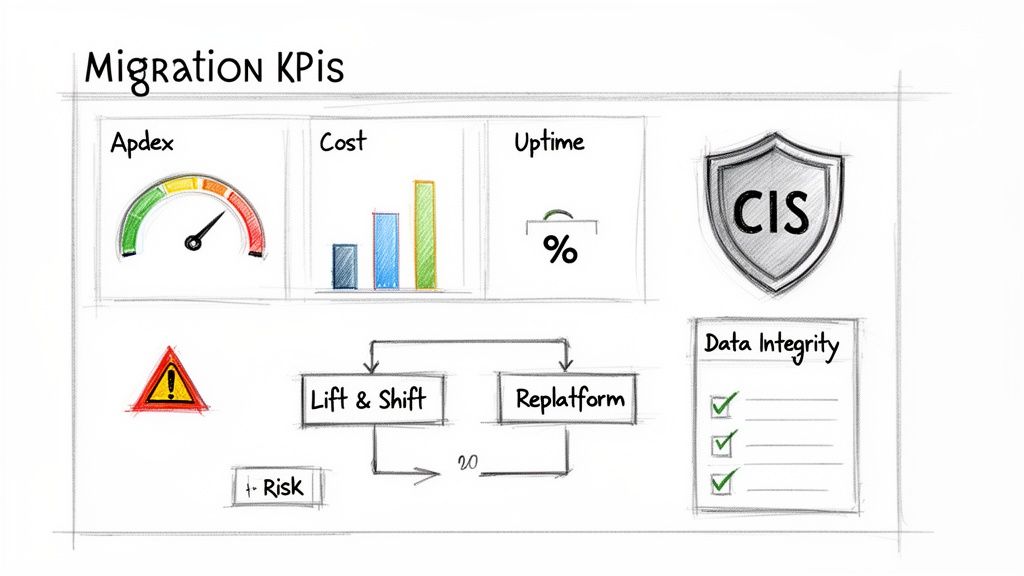
    Hand-drawn sketch of cloud migration KPIs: Apdex, Cost, Uptime, Data Integrity, with Lift & Shift and Replatform strategies and risk.

    Here are direct answers to the most common questions from engineering leaders.

    What Are The Most Common Hidden Costs?

    Beyond the consultant fees and cloud provider bills, several technical costs frequently surprise teams. A competent consultant should identify and budget for these upfront.

    Be prepared for:

    • Data Egress Fees: Transferring large datasets out of your existing data center or another cloud provider can incur significant, often overlooked, costs. This must be calculated, not estimated.
    • New Observability Tooling: On-premises monitoring tools are often inadequate for dynamic, distributed cloud environments. Budget for new SaaS licenses for logging (e.g., Splunk, Datadog), metrics (e.g., Prometheus, Grafana Cloud), and distributed tracing (e.g., Honeycomb, Lightstep).
    • Team Retraining and Productivity Dips: There is a tangible cost associated with your team's learning curve on new cloud-native technologies, CI/CD workflows, and architectural patterns. Plan for a temporary decrease in development velocity as they ramp up.

    How Do I Ensure Knowledge Transfer To My Team?

    You must prevent the consultants from becoming a single point of failure. If their departure results in a knowledge vacuum, the engagement has failed. Knowledge transfer must be an explicit, contractual obligation.

    Mandate knowledge transfer as a specific, line-item deliverable in the SOW. Require mandatory pair programming sessions, the creation of Architectural Decision Records (ADRs) for all major design choices, and hands-on training workshops. The objective is not just documentation, but building lasting institutional capability.

    The most effective method is to embed your engineers directly into the migration team. They should co-author IaC modules, participate in incident response drills, and contribute to runbooks. This hands-on involvement is the only way to build the deep, internal expertise required to own and operate the new environment.

    What Is The Single Biggest Red Flag?

    The most significant red flag is a cloud migration consultant who presents a pre-defined solution before conducting a thorough discovery of your specific applications, business objectives, and team skill set.

    Be highly skeptical of any consultant who advocates for a one-size-fits-all methodology or a preferred vendor without a data-driven justification tailored to your unique context.

    Elite consultants begin with a deep technical assessment. They ask probing questions about your stack, dependencies, and performance baselines. Their proposed strategy should feel bespoke and highly customized. If a consultant's pitch is generic enough to apply to any company, they are a salesperson, not a technical partner. A bespoke strategy is the hallmark of an expert; a canned solution is a reason to walk away.


    Ready to partner with experts who build strategies tailored to your unique challenges? At OpsMoon, we connect you with the top 0.7% of DevOps talent to ensure your cloud migration delivers on its technical and business promises. Start with a free work planning session to map out your migration with confidence at https://opsmoon.com.
  • A Technical Guide to Cloud Transformation Consulting

    A Technical Guide to Cloud Transformation Consulting

    Cloud transformation consulting is a strategic partnership designed to re-architect a company's technology, operations, and culture to fully leverage cloud-native capabilities. It extends far beyond a simple server migration; the primary objective is to redesign applications and infrastructure workflows for maximum efficiency, scalability, and resilience using modern engineering practices.

    This isn't about moving to the cloud. It's about re-platforming to thrive in it.

    Defining True Cloud Transformation

    Think of it this way: a simple cloud migration is like moving your factory's machinery to a new, bigger building. Cloud transformation is redesigning the entire production line inside that new building with robotics, real-time analytics, and automated supply chains. It’s a foundational shift in how your business operates, from the way you provision infrastructure to how you build, deploy, and observe applications.

    This entire process rests on three core technical pillars.

    The Core Technical Pillars

    Any comprehensive cloud transformation journey leans on specialized expertise in three distinct areas, with each one building on the last:

    • Strategic Advisory: This is where the architectural blueprint is defined. Consultants perform a deep analysis of your existing application portfolio, map out inter-service dependencies and data flows, and define the target state architecture. This stage involves concrete decisions on cloud service selection (e.g., Kubernetes vs. Serverless, managed vs. self-hosted databases) and the creation of a phased, technical roadmap.
    • Technical Execution: With the blueprint approved, engineers get hands-on. This involves constructing secure and compliant cloud landing zones using Infrastructure as Code (IaC), implementing robust CI/CD pipelines, and executing the migration or refactoring of applications. This is the heavy lifting of building your new cloud foundation, from networking VPCs to configuring IAM policies.
    • Cultural Change Management: Advanced technology is ineffective without skilled operators. This pillar focuses on upskilling your teams with the necessary competencies to manage a cloud-native ecosystem. It means hands-on training for new tooling, embedding DevOps and SRE principles into daily workflows, and fostering a culture of continuous improvement and operational ownership.

    Beyond a Simple 'Lift-and-Shift'

    It is technically imperative to understand the difference between a genuine transformation and a basic "lift-and-shift" migration. While moving existing virtual machines as-is into the cloud might offer a short-term timeline, it rarely delivers the promised benefits of cloud computing. You often end up with the same monolithic applications and manual operational processes, just running on someone else's hardware—frequently at a higher, unoptimized cost.

    True cloud transformation is about fundamentally changing how applications are built, deployed, and operated. This means decomposing monolithic applications into discrete microservices, containerizing them with Docker, and orchestrating them with platforms like Kubernetes.

    This modern architectural approach is what unlocks the real technical advantages of the cloud. For instance, by refactoring an e-commerce platform into microservices, you can independently scale the checkout service during a high-traffic event without over-provisioning resources for the entire application. Adopting serverless architectures (e.g., AWS Lambda, Google Cloud Functions) for event-driven workloads is another game-changer, allowing you to run code without provisioning or managing servers and paying only for the precise compute time consumed. You can dive deeper into these nuances in our guide to cloud migration consulting.

    The business drivers for this deep technical change are rooted in performance and agility. Companies execute cloud transformations to gain the elastic scalability needed for unpredictable traffic, reduce TCO with pay-as-you-go pricing models, and accelerate development velocity by leveraging powerful cloud-native services like managed databases (e.g., RDS, Cloud SQL) and AI/ML platforms. It's a strategic move that turns your technology from a cost center into a tangible engine for business growth.

    Assessing Your Cloud Maturity with a Practical Framework

    Before you can construct a viable cloud transformation roadmap, you must establish a precise baseline of your current state. Attempting to plan without this data is like trying to debug a distributed system without logs or traces—you’ll just end up chasing ghosts. A cloud maturity framework is a diagnostic tool that provides CTOs and technical leaders with an objective, data-driven assessment of their organization's technical and operational readiness.

    This is not a high-level checklist. It's a granular analysis of your infrastructure provisioning methods, application architecture patterns, and operational procedures. By accurately identifying your current stage, you can pinpoint specific capability gaps, prioritize technical investments, and build a quantitative business case for engaging cloud transformation consulting experts to accelerate your progress.

    The Four Stages of Cloud Maturity

    Organizations do not instantly become "cloud-native." It's an evolutionary process through four distinct stages. Each level is characterized by specific technical indicators that reveal how deeply cloud-native principles have been integrated into your engineering and operations.

    • Stage 1 Foundational: This is the traditional on-premise model. Your infrastructure consists of physical or virtual servers configured via manual processes or bespoke scripts. Deployments are high-risk, infrequent, monolithic events, and your applications are likely large, tightly coupled systems.
    • Stage 2 Developing: You've begun experimenting with cloud services. Perhaps you’re using basic IaaS (e.g., EC2, Compute Engine) for some workloads or have a rudimentary CI pipeline for automated builds. However, infrastructure is still largely managed manually, and deployment processes lack robust automation and validation.
    • Stage 3 Mature: Cloud-native practices are becoming standard. You are using Infrastructure as Code (IaC) tools like Terraform to declaratively manage and version-control your environments. Most applications are containerized and run on IaaS or PaaS, and your CI/CD pipelines automate testing, security scanning, and deployments.
    • Stage 4 Optimized: You operate at a high level of automation and efficiency. Operations are driven by GitOps workflows, where the Git repository is the single source of truth for both application and infrastructure configuration. FinOps is an integral part of your engineering culture, ensuring cost-efficiency. You may be leveraging multi-cloud or serverless architectures to optimize for cost, performance, and resilience.

    To make this concrete, here’s a framework that details what each stage looks like across key technical domains.

    Cloud Maturity Assessment Framework

    This table helps you pinpoint your current stage of cloud adoption by looking at technical and operational signposts. It’s a good way to get an objective view of where you stand today.

    Maturity Stage Infrastructure & Automation Application Architecture Operational Model
    Foundational Manual server provisioning; physical or basic virtualization; no automation. Monolithic applications; tightly coupled dependencies; infrequent, large releases. Reactive incident response; siloed teams (Dev vs. Ops); manual change management.
    Developing Some IaaS adoption; basic CI pipelines; scripts for ad-hoc automation. Some services decoupled; limited container use (e.g., Docker); inconsistent release cycles. Basic monitoring in place; teams begin to collaborate; some manual approval gates.
    Mature Infrastructure as Code (IaC) is standard; automated CI/CD pipelines; widespread PaaS/IaaS use. Microservices architecture; container orchestration (e.g., Kubernetes); frequent, automated deployments. Proactive monitoring with alerting; cross-functional DevOps teams; automated governance.
    Optimized GitOps-driven automation; FinOps practices integrated; serverless and multi-cloud architectures. Event-driven architectures; service mesh for observability; continuous deployment on demand. AIOps for predictive insights; SRE culture of ownership; fully automated security and compliance.

    Having a framework like this gives you a common technical language to discuss where you are and, more importantly, where you need to go. It transforms a vague ambition of "moving to the cloud" into a series of concrete, measurable engineering initiatives.

    This diagram helps visualize how a successful transformation flows from the top down, starting with a clear strategy.

    As you can see, a great project is built on three pillars: a high-level strategy, solid technical execution on the ground, and a people-first approach to managing change.

    From Self-Assessment to Strategic Action

    Once you've identified your current stage, the next step is to translate that assessment into an actionable plan. This is precisely where a cloud transformation consulting partner adds immense value. They leverage their experience to convert your internal diagnosis into a formal, data-backed strategy that is technically feasible and aligned with business objectives.

    The demand for this expertise is growing rapidly. Cloud professional services, the engine behind cloud consulting, reached USD 26.3 billion in 2024 and are projected to hit USD 130.4 billion by 2034. This growth is driven by companies requiring expert guidance to navigate the complexities of building secure, scalable, and cost-effective cloud platforms. You can learn more about the market forces driving cloud consulting to see the full picture.

    A formal assessment from a consulting partner will deliver:

    • Technical Gap Analysis: A detailed report identifying specific deficiencies in your tooling, architectural patterns, and operational processes.
    • Risk Mitigation Plan: A clear strategy for remediating security vulnerabilities, addressing compliance gaps (e.g., SOC 2, HIPAA), and mitigating operational risks identified during the assessment.
    • Prioritized Initiatives: A concrete list of engineering projects, ordered by business impact and technical feasibility, which forms the core of your transformation roadmap.

    An honest maturity assessment prevents you from wasting capital on advanced tools your team isn't ready to operate, or worse, underestimating the foundational infrastructure work required for success. It ensures your transformation is built on a solid engineering foundation.

    And remember, this isn’t just about technology—it’s about your people and processes, too. A robust maturity model also evaluates your team's skillsets, your security posture, and your FinOps capabilities. If you want to go deeper on this, check out our guide on how to run a DevOps maturity assessment.

    At the end of the day, understanding where you are is the only way to get where you want to go.

    Building Your Cloud Transformation Roadmap

    Executing a cloud transformation is not a single event; it's a meticulously planned program of work, broken down into distinct, interdependent phases. For any technical leader, this plan is your cloud transformation roadmap—a living document that translates high-level business goals into concrete engineering milestones, epics, and sprints.

    Proceeding without a roadmap is a recipe for failure, leading to uncontrolled costs, significant technical debt, and a failure to realize the cloud's promised benefits. A well-structured plan ensures each phase builds logically on the previous one, guiding your organization from initial discovery to continuous innovation.

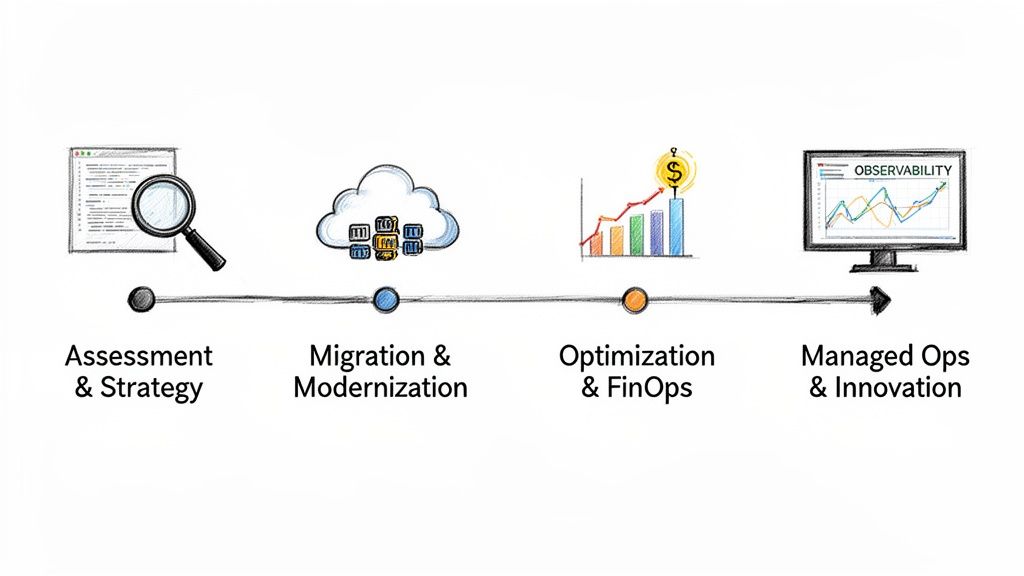
    Infographic detailing the cloud transformation journey: assessment, migration, optimization, and managed services.

    Phase 1: Assessment and Strategy

    This initial phase is dedicated to discovery and planning. Before any infrastructure is provisioned, a deep technical audit of your current environment is mandatory. This involves mapping application dependencies using observability tools, analyzing performance metrics to establish baselines, and conducting thorough security vulnerability scans.

    A critical output of this phase is the application portfolio analysis. Using a framework like the "6 Rs of Migration" (Rehost, Replatform, Refactor, Repurchase, Retire, Retain), each application is categorized based on its business criticality and technical architecture. This systematic approach prevents a "one-size-fits-all" migration strategy, ensuring that engineering resources are focused on modernizing the systems that deliver the most business value.

    This phase also includes a technical evaluation of cloud providers. This analysis must go beyond pricing comparisons:

    • Service Mesh Capabilities: Does the provider offer a managed service mesh (e.g., AWS App Mesh, Google Anthos Service Mesh) or robust support for open-source tools like Istio or Linkerd? This is crucial for managing traffic, security, and observability for microservices.
    • Data Egress Costs: What are the precise costs for data transfer between availability zones, regions, and out to the internet? These costs must be modeled accurately to avoid significant, unexpected expenses.
    • Compliance and Sovereignty: Can the provider meet specific regulatory requirements for data residency and provide necessary compliance attestations (e.g., FedRAMP, HIPAA BAA)?

    Phase 2: Migration and Modernization

    With a detailed strategy, execution begins. The first step is constructing a secure landing zone. This is the foundational scaffolding of your cloud environment, built entirely with Infrastructure as Code (IaC) using tools like Terraform. This ensures that your networking (VPCs, subnets, routing), identity management (IAM roles and policies), and security controls are automated, version-controlled, and auditable from day one.

    Next, we execute the migration patterns defined in Phase 1. Each path has distinct technical implications:

    • Rehosting ("Lift and Shift"): The fastest migration path, involving the direct migration of existing VMs. While it minimizes application changes, it often fails to leverage cloud-native features, potentially leading to higher operational costs and lower resilience.
    • Replatforming ("Lift and Reshape"): A pragmatic approach where applications are modified to use managed cloud services. A common example is migrating a self-hosted PostgreSQL database to Amazon RDS or Azure Database for PostgreSQL. This reduces operational burden and improves performance.
    • Refactoring: The most intensive approach, involving complete re-architecture to a cloud-native model (e.g., decomposing a monolith into microservices running on Kubernetes). This is complex but unlocks the full potential of the cloud for scalability, resilience, and agility.

    A common technical error is to default to "lift and shift" for all workloads. An effective consulting partner will advocate for a pragmatic, hybrid approach—refactoring high-value, business-critical applications while rehosting or replatforming less critical systems to manage complexity and accelerate time-to-value.

    Phase 3: Optimization and FinOps

    Deploying to the cloud is just the beginning. Operating efficiently without incurring runaway costs is a continuous discipline. This phase focuses on relentless optimization and embedding a culture of financial accountability, known as FinOps, directly into engineering workflows.

    The technical work here includes:

    • Instance Right-Sizing: Using monitoring and profiling data to precisely match compute resources (vCPU, memory, IOPS) to workload requirements, thereby eliminating wasteful over-provisioning.
    • Automated Cost Policies: Implementing policy-as-code to automatically shut down non-production environments during off-hours or terminate untagged or idle resources.
    • Reserved Instances and Savings Plans: For predictable, steady-state workloads, leveraging long-term pricing commitments from cloud providers can significantly reduce compute costs.

    This phase is where you secure the ROI of your cloud investment. The global cloud consulting services market, a major component of cloud transformation consulting, is projected to grow from USD 37.59 billion in 2026 to USD 143.2 billion by 2035, driven by the demand for this specialized optimization expertise.

    Phase 4: Managed Operations and Innovation

    The final phase shifts from a migration focus to long-term operational excellence and innovation. The goal is to create a resilient, observable, and automated platform. This involves implementing a robust observability stack using tools like Prometheus for metrics, Loki for logging, and Grafana for visualization, providing deep insight into system behavior.

    This is also where Site Reliability Engineering (SRE) principles are formally adopted, defining Service Level Objectives (SLOs) and error budgets to make data-driven decisions about reliability versus feature velocity. A forward-looking roadmap must also address talent development; you may need to focus on hiring software engineers with specific cloud-native skills.

    With a stable, optimized, and observable platform, your engineering team is freed to focus on high-value innovation using advanced cloud services. This includes building event-driven architectures with AWS Lambda, leveraging managed AI/ML platforms for intelligent features, and exploring new data analytics capabilities. Our experts are always available for a detailed cloud migration consultation to help refine your strategy. This is the point where your cloud environment transitions from being mere infrastructure to a strategic platform for business growth.

    Choosing the Right Consulting Engagement Model

    Selecting the right partner for your cloud transformation consulting is critical, but how you structure the engagement is equally important. The engagement model directly dictates project governance, cost structure, risk allocation, and the ultimate technical outcome.

    An inappropriate model can lead to misaligned incentives, scope creep, and budget overruns. The right model, however, creates a true partnership, accelerating progress and maximizing the value of your investment.

    For technical leaders, this is a strategic decision. The engagement model must align with your project's technical complexity, budget predictability requirements, and desired level of collaboration. There is no single "best" model, only the model that is best suited for your specific technical and business context.

    Advisory Retainers for Strategic Guidance

    An advisory retainer is the optimal model when you require senior-level strategic guidance rather than hands-on implementation. This gives you fractional access to an experienced CTO or principal architect.

    These experts provide high-level direction, conduct architectural reviews of your team's designs, and help navigate complex technical decisions, such as choosing between different database technologies or service mesh implementations. They advise and validate, but do not engage in day-to-day coding or configuration.

    This model is ideal for:

    • Roadmap Development: Gaining expert validation of your multi-year technical strategy to ensure architectural soundness and feasibility.
    • Architectural Validation: Having an external expert review the design of a new Kubernetes platform or a complex serverless architecture before significant engineering resources are committed.
    • Technology Selection: Obtaining an unbiased, technically-grounded opinion on which cloud services, open-source tools, or vendor products are best suited for a specific use case.

    The key advantage is access to elite-level expertise on a fractional basis. You gain strategic oversight without the cost of a full-time executive, helping you avoid costly architectural errors that can plague a project for years.

    Pricing is typically a fixed monthly fee, providing predictable costs for ongoing strategic counsel. This model is not designed for projects with defined deliverables but for continuous, high-impact advice.

    Project-Based Engagements for Defined Outcomes

    When you have a specific, well-defined technical objective, a project-based engagement is the most appropriate model. It is structured around a clear scope of work, measurable deliverables, and a defined timeline.

    Examples include building a production-ready CI/CD pipeline, migrating a specific application portfolio to the cloud, or implementing a new observability platform.

    The pricing structure within this model is a critical decision, representing a trade-off between risk and flexibility.

    Pricing Structure Description Best For
    Fixed-Bid A single, all-inclusive price for the entire project scope. The consultant assumes the risk of cost overruns. Projects with clearly defined, stable requirements. It provides complete budget predictability but offers limited flexibility to change scope.
    Time and Materials You are billed at an hourly or daily rate for the time consultants spend on the project. This offers maximum flexibility to adapt to changing requirements. Complex, exploratory projects where requirements are expected to evolve. Requires diligent project management to control the budget.
    Value-Based The consulting fee is tied to the achievement of a specific business outcome, such as a percentage of cost savings realized from cloud optimization. Projects where the business impact can be clearly quantified. This model creates a true partnership by perfectly aligning incentives.

    The project-based model provides clarity and accountability, making it ideal for executing discrete components of a larger cloud roadmap.

    Team Augmentation for Specialized Skills

    Sometimes, the need isn't for project delivery but for a specific, high-demand skill set that your internal team lacks. Team augmentation addresses this by embedding a specialist—such as a Senior SRE, a Kubernetes security expert, or a Terraform specialist—directly into your existing engineering squad.

    The embedded consultant operates under your management, adheres to your development processes, and functions as an integral team member for a defined period, without the overhead of a full-time hire.

    This model is highly effective when you need deep, focused expertise to accelerate a project or bootstrap a new capability. For example, embedding a Kubernetes expert for six months can dramatically fast-track a platform build-out while simultaneously upskilling your internal team.

    The most significant technical advantage is knowledge transfer. The expert doesn't just deliver code; they mentor your engineers, establish best practices, and leave your organization more capable than they found it. It provides a flexible mechanism to scale your team's technical capabilities on demand.

    How to Select the Right Cloud Consulting Partner

    Selecting a partner for your cloud transformation is one of the most critical technical decisions a leader can make. The right partner accelerates your roadmap and helps you build a secure, scalable, and cost-efficient platform. The wrong one can lead to costly architectural flaws, vendor lock-in, and significant project delays.

    This is not a sales evaluation; it is a rigorous technical assessment to identify a true engineering partner. You must look beyond marketing materials and certifications to scrutinize their methodologies, engineering culture, and the technical caliber of their consultants.

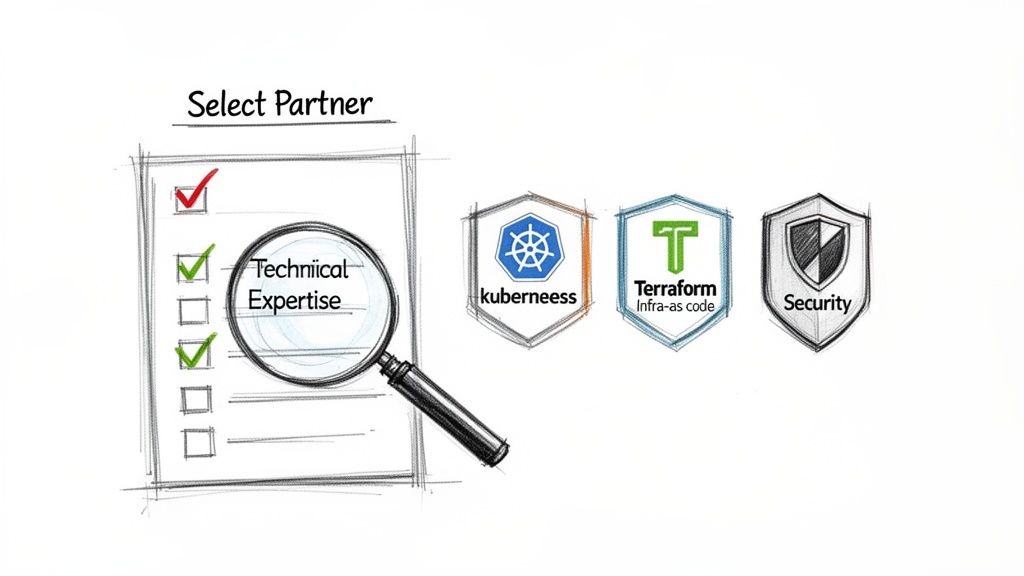
    A checklist for selecting a partner, emphasizing technical expertise, Kubernetes, Terraform, and security capabilities.

    Verifying Deep Technical Expertise

    First, you must validate their hands-on expertise in the specific technologies that are core to your roadmap. A general "cloud" proficiency is no longer sufficient. You need specialists who have deep, practical experience with the tools that will form the foundation of your modern infrastructure.

    Probe these key technical domains:

    • Container Orchestration: Do not simply ask if they "use" Kubernetes. Ask them to describe their process for designing and securing production-grade clusters. Can they discuss, in detail, complex topics like service mesh implementation (Istio vs. Linkerd), the development of custom Kubernetes operators, and the implementation of GitOps workflows with tools like Flux or Argo CD?
    • Infrastructure as Code (IaC): Go beyond "do you use Terraform?" Ask how they structure reusable Terraform modules to promote consistency and reduce code duplication. How do they manage Terraform state for multiple environments and teams? How do they integrate policy-as-code tools like Open Policy Agent (OPA) to enforce security and compliance standards?
    • Multi-Cloud Security: Get specific about their approach to unified security posture management. How do they implement identity federation across AWS, Azure, and GCP? What specific tools and techniques do they use for Cloud Security Posture Management (CSPM) and Cloud Workload Protection Platforms (CWPP) in a hybrid environment?

    Assessing Engineering Methodologies

    A top-tier partner brings more than just technical skills; they bring a mature, modern engineering methodology. Their process directly impacts the quality of the delivered work and, critically, your team's ability to operate and evolve the new environment after the engagement concludes.

    A primary objective of any successful cloud consulting engagement should be to make your own team self-sufficient. This requires a partner who prioritizes knowledge transfer over creating long-term dependencies.

    To evaluate this, ask detailed questions about their approach to knowledge transfer. Do they practice pair-programming with your engineers? Do they produce comprehensive, living documentation as a standard deliverable? A partner who operates in a "black box" is a major red flag and a common source of vendor lock-in. You should also verify their commitment to transparency. Do they provide direct access to shared project management boards, source code repositories, and CI/CD pipelines?

    Evaluating Talent and Compliance Know-How

    Ultimately, a consulting firm's value is a direct function of the quality of its engineers. It is essential to understand their technical vetting process. How do they source, screen, and qualify their consultants? Do their interviews include hands-on technical challenges, system design sessions, and live coding exercises, or do they rely on certifications? The rigor of their process is a direct indicator of the quality of talent that will be assigned to your project.

    Furthermore, compliance cannot be an afterthought. Your partner must have demonstrable, hands-on experience with the specific regulatory frameworks relevant to your business, whether that's HIPAA, PCI DSS, or GDPR. As part of your evaluation, it is wise to understand how they can support your broader security and audit needs, which often overlaps with knowing How to Choose From the Top IT Audit Companies for future validation of your cloud environment.

    Conducting this level of due diligence ensures you find more than a contractor. The software consulting market is projected to grow from USD 380.26 billion in 2026 to USD 801.43 billion by 2031. By asking these tough, technical questions, you can identify a true partner capable of delivering a successful and sustainable cloud transformation.

    Consulting Partner Evaluation Checklist

    Use this checklist to systematically compare potential partners and ensure you're covering all the critical bases.

    Evaluation Criteria What to Look For How OpsMoon Delivers
    Technical Depth Deep, hands-on experience in Kubernetes, IaC (Terraform), and multi-cloud security. Ability to discuss complex scenarios. Our Experts Matcher connects you with pre-vetted specialists who have proven, deep expertise in these exact technologies.
    Engineering Process A transparent methodology focused on knowledge transfer, pair-programming, and comprehensive documentation. We prioritize co-development and create "living documentation" to ensure your team is fully enabled, not dependent.
    Talent Quality A rigorous, multi-stage vetting process that includes hands-on coding challenges and system design interviews. Our vetting is intense. Only the top 3% of engineers pass our practical, real-world technical assessments.
    Compliance Expertise Demonstrable experience with industry-specific regulations (HIPAA, PCI, etc.) and a proactive approach to security. We match you with consultants who have direct experience navigating the compliance landscape of your specific industry.
    Engagement Flexibility A range of engagement models (project-based, dedicated team, hourly) to fit your budget and project needs. From fixed-scope projects to on-demand expert access, our flexible models adapt to your requirements.
    Business Acumen The ability to connect technical solutions directly to business outcomes, ROI, and your long-term strategic goals. Our free planning session starts with your business goals, ensuring every technical decision serves a strategic purpose.

    Making a thoughtful, informed decision here will pay dividends for years to come, setting you up with a partner who not only builds but also empowers.

    Frequently Asked Questions

    Even the most well-architected cloud transformation plan will raise critical questions for technical leaders. This section addresses some of the most common technical challenges and concerns that arise during the journey to the cloud.

    What Are the Most Common Technical Mistakes in a Cloud Migration?

    Most organizations encounter the same technical pitfalls. The most significant errors almost always stem from inadequate planning and a fundamental misunderstanding of the operational shifts required to run systems in the cloud.

    One of the most damaging mistakes is improper network architecture planning. A poorly designed VPC/VNet structure can lead to high latency, excessive data transfer costs, and critical security vulnerabilities. Teams also consistently underestimate data gravity—the technical and financial difficulty of moving large datasets. This results in performance bottlenecks and unexpected egress costs when cloud-based applications need to frequently access data from on-premise systems.

    Another classic error is adopting a blanket "lift-and-shift" strategy. Migrating a monolithic application as-is to the cloud without modification means it cannot leverage cloud-native features like auto-scaling or self-healing. This results in poor performance, low resilience, and high operational costs, negating the primary benefits of the migration.

    However, the single most critical error we see is the failure to implement Infrastructure as Code (IaC) rigorously from day one. Without a declarative tool like Terraform, your cloud environment will inevitably suffer from configuration drift, becoming an inconsistent and unmanageable collection of manually configured resources. This makes it impossible to scale reliably and securely, undermining the entire value proposition of the cloud.

    How Can We Control Costs During a Cloud Transformation?

    Effective cloud cost management, or FinOps, is an engineering discipline, not a finance-led accounting exercise. True cost control is built on three technical pillars: visibility, accountability, and automation.

    The foundation is resource right-sizing. This involves analyzing performance metrics from observability tools like Prometheus or native cloud monitoring services to ensure that compute instances have the exact CPU, memory, and IOPS they require—and no more. Systemic over-provisioning is the single largest contributor to wasted cloud spend.

    Beyond that, a mature FinOps practice incorporates several key technical habits:

    • Implement Strict Resource Tagging: Enforce a mandatory tagging policy for all cloud resources via automation and policy-as-code. This is non-negotiable. Tagging allows you to precisely attribute costs to specific teams, projects, or application features, enabling granular cost visibility and accountability.
    • Automate Shutdowns: Implement automated scripts or use managed services to shut down non-production environments (e.g., development, staging, QA) during non-business hours. This simple action can reduce non-production compute costs by 30-40%.
    • Leverage Savings Plans: For predictable, steady-state workloads, strategically purchase Reserved Instances (RIs) or Savings Plans. Committing to one- or three-year terms for consistent compute usage can yield discounts of up to 72% compared to on-demand pricing.

    The objective is not merely to reduce costs but to build a culture where engineering teams are empowered with cost data and feel accountable for the financial impact of their architectural and operational decisions.

    Is a Multi-Cloud Strategy Always Better?

    A multi-cloud strategy is often presented as a panacea, but it is not a universally applicable solution. While it can offer benefits like mitigating vendor lock-in and allowing for best-of-breed service selection, it introduces significant technical and operational complexity that can overwhelm unprepared teams.

    Operating a multi-cloud environment requires a high degree of engineering maturity in several key domains:

    • Unified Security: How do you enforce consistent security policies, identity management, and threat detection across disparate cloud platforms with different APIs and control planes?
    • Cross-Cloud Networking: Establishing secure, low-latency, and cost-effective connectivity between different cloud providers is a complex networking challenge.
    • Identity and Access Management (IAM): Federating user identities and enforcing consistent permissions across multiple clouds without creating security gaps is a non-trivial architectural task.
    • Centralized Observability: Achieving a "single pane of glass" for monitoring, logging, and tracing across different cloud environments requires significant investment in tooling and integration.

    For most organizations, particularly those early in their cloud journey, the most prudent approach is to achieve deep expertise and operational excellence on a single cloud platform first. A multi-cloud strategy should be a deliberate, strategic decision driven by a specific and compelling business or technical requirement—such as regulatory constraints or the need for a unique service offered by another provider. If the "why" is not crystal clear, the added complexity will almost certainly outweigh the perceived benefits.


    Ready to navigate these complexities with a team that's been there before? OpsMoon is here to help. We connect you with elite, pre-vetted cloud and DevOps engineers who can accelerate your transformation and make sure you sidestep these common pitfalls. It all starts with a free, no-obligation work planning session to build a clear, actionable roadmap for your cloud journey.

    Get started with OpsMoon today.

  • A CTO’s Playbook to Outsource DevOps Services

    A CTO’s Playbook to Outsource DevOps Services

    To outsource DevOps services means engaging an external partner to architect, build, and manage your software delivery lifecycle. This encompasses everything from infrastructure automation with tools like Terraform to orchestrating CI/CD pipelines and managing containerized workloads on platforms like Kubernetes. It's a strategic move to bypass the protracted and costly process of building a specialized in-house team, giving you immediate access to production-grade engineering expertise.

    Why Top CTOs Now Outsource DevOps

    The rationale for outsourcing DevOps has evolved from pure cost arbitrage to a calculated strategy for gaining a significant technical and operational advantage. Astute CTOs recognize that outsourcing transforms the DevOps function from a capital-intensive cost center into a strategic enabler, accelerating product delivery and enhancing system resilience.

    This shift is driven by tangible engineering challenges. The intense competition for scarce, high-salaried specialists in areas like Kubernetes administration and cloud security places immense pressure on hiring pipelines and budgets. Concurrently, the operational burden of maintaining complex CI/CD toolchains and responding to infrastructure incidents diverts senior engineers from their primary mission: architecting and building core product features.

    The Strategic Shift from In-House to Outsourced

    Engaging a global talent pool provides more than just additional engineering capacity; it injects battle-tested expertise directly into your operations. Instead of your principal engineers debugging a failed deployment pipeline at 2 AM, they can focus on shipping features that drive revenue and competitive differentiation.

    Outsourcing converts your DevOps function from a fixed, high-overhead cost center into a flexible, on-demand operational expense. This agility is critical for dynamically scaling infrastructure in response to market demand without the friction of long-term hiring commitments.

    The global DevOps Outsourcing market is expanding rapidly for this reason. Projections show a leap from USD 10.9 billion in 2025 to USD 26.8 billion by 2033, reflecting a compound annual growth rate (CAGR) of 10.2%. This isn't a fleeting trend but a market-wide pivot towards specialized, scalable solutions over in-house operational overhead. You can review the complete data in this market growth analysis on OpenPR.com.

    The following diagram illustrates the transition from a traditional in-house model to a more agile, outsourced partnership.

    This visual highlights the move from a static, capital-intensive internal team to a dynamic, global model engineered for efficiency and deep technical expertise. Of course, this approach has its nuances. For a balanced perspective, explore the pros and cons of offshore outsourcing in our detailed guide.

    In-House vs Outsourced DevOps A Strategic Comparison

    The decision between building an internal DevOps team and partnering with an external provider is a pivotal strategic choice, impacting capital allocation, hiring velocity, and your engineering team's focus. This table provides a technical breakdown of the key differentiators.

    Factor In-House Model Outsourced Model
    Cost Structure High fixed costs: salaries, benefits, training, tools. Significant capital expenditure. Variable operational costs: pay-for-service or retainer. Predictable monthly expense.
    Talent Acquisition Long, competitive, and expensive recruitment cycles for specialized skills. Immediate access to a vetted pool of senior engineers and subject matter experts.
    Time-to-Impact Slow ramp-up time for hiring, onboarding, and team integration. Rapid onboarding and immediate impact, often within weeks.
    Expertise & Skills Limited to the knowledge of current employees. Continuous training is required. Access to a broad range of specialized skills (e.g., K8s, security, FinOps) across a diverse team.
    Scalability Rigid. Scaling up or down requires lengthy hiring or difficult layoff processes. Highly flexible. Easily scale resources up or down based on project needs or market changes.
    Focus of Core Team Internal team often gets bogged down with infrastructure maintenance and support tickets. Frees up your in-house engineering team to focus on core product development and innovation.
    Operational Overhead High. Includes managing payroll, HR, performance reviews, and team dynamics. Low. The vendor handles all HR, management, and administrative overhead.
    Risk High concentration of knowledge in a few key individuals ("key-person dependency"). Risk is distributed. Knowledge is documented and shared across the provider's team.

    Ultimately, the choice hinges on your specific goals. If you have the resources and a long-term plan to build a deep internal competency, the in-house model can work. However, for most businesses—especially those looking for speed, specialized expertise, and financial flexibility—outsourcing offers a clear strategic advantage.

    Know Where You Stand: Assessing Your DevOps Maturity for Outsourcing

    Before engaging a DevOps partner, you must perform a rigorous technical audit to establish a baseline of your current capabilities. Entering a partnership without this self-assessment is like attempting to optimize a system without metrics—you'll be directionless.

    This internal audit is a data-gathering exercise, not a blame session. It provides the "before" snapshot required to define a precise scope of work, set quantifiable objectives, and ultimately prove the ROI of your investment. Any credible partner will require this baseline to formulate an accurate proposal and deliver tangible results.

    How Automated Is Your CI/CD, Really?

    Begin by dissecting your CI/CD pipeline, the engine of your development velocity. Its current state will dictate a significant portion of the initial engagement.

    Ask targeted, technical questions:

    • Deployment Cadence: Are you deploying on-demand, multiple times a day, or is each release a monolithic, manually orchestrated event that requires a change advisory board and a weekend maintenance window?
    • Automation Level: What percentage of the path from git commit to production is truly zero-touch? Does a merge to the main branch automatically trigger a build, run a full suite of tests (unit, integration, E2E), and deploy to a staging environment, or are there manual handoffs requiring human intervention?
    • Rollback Mechanism: When a production deployment fails, is recovery an automated, one-click action that reroutes traffic to the previous stable version? Or is it a high-stress, manual process involving git revert, database restores, and frantic server configuration changes?

    A low-maturity team might be using Jenkins with manually configured jobs and deploying via shell scripts over SSH. A more advanced team might leverage declarative pipelines in GitLab CI or GitHub Actions but lack critical automated quality gates like static analysis (SAST) or dynamic analysis (DAST). Be brutally honest about your current state.

    For a deeper dive into these stages, check out our guide on the different DevOps maturity levels and what they look like in practice.

    What’s Your Infrastructure and Container Game Plan?

    Next, scrutinize your infrastructure management practices. The transition from manual "click-ops" in a cloud console to version-controlled, declarative infrastructure is a fundamental marker of DevOps maturity.

    Your Infrastructure as Code (IaC) maturity can be evaluated by your adoption of tools like Terraform or CloudFormation. Are your VPCs, subnets, security groups, and compute resources defined in version-controlled .tf files? Or are engineers still manually provisioning resources, leading to configuration drift and non-reproducible environments? A lack of IaC is a significant technical debt and a security risk.

    Similarly, evaluate your containerization and orchestration strategy using Docker and Kubernetes.

    • Are your applications packaged as immutable container images stored in a registry like ECR or Docker Hub, or are you deploying artifacts to mutable virtual machines?
    • If you use Kubernetes, are you leveraging a managed service (EKS, GKE, AKS) or self-managing the control plane, which incurs significant operational overhead?
    • How are you managing Kubernetes manifests? Are you using Helm charts with a GitOps operator like Argo CD to automate deployments, or are engineers running kubectl apply -f from their local machines?

    Can You Actually See What’s Happening? Benchmarking Your Observability

    Finally, assess your ability to observe and understand your systems' behavior. Without robust monitoring, logging, and tracing—the three pillars of observability—you are operating in the dark, and every incident becomes a prolonged investigation.

    A rudimentary setup might involve SSHing into servers to grep log files and relying on basic cloud provider metrics. A truly observable system, however, integrates a suite of specialized, interoperable tools:

    • Monitoring: Using Prometheus for time-series metrics collection and Grafana for building dashboards that visualize key service-level indicators (SLIs).
    • Logging: Centralizing structured logs (e.g., in JSON format) into a system like the ELK Stack (Elasticsearch, Logstash, Kibana) or a SaaS platform like Datadog for high-cardinality analysis.
    • Tracing: Implementing distributed tracing with OpenTelemetry and a backend like Jaeger to trace the lifecycle of a request across multiple microservices.

    The ultimate test of your observability is your Mean Time to Resolution (MTTR). If it takes hours or days to diagnose and resolve a production issue, your observability stack is immature, regardless of the tools you use.

    Translate these findings into specific, measurable, achievable, relevant, and time-bound (SMART) goals. For example: "Implement a fully automated blue-green deployment strategy in our GitLab CI pipeline for the core API, reducing the Change Failure Rate from 15% to under 2% within Q3." This provides a clear directive for your partner and a tangible benchmark for success.

    Choosing Your DevOps Engagement Model

    Once you have a clear understanding of your DevOps maturity, the next critical step is selecting the appropriate engagement model. A mismatch between your needs and the partnership structure is a direct path to scope creep, budget overruns, and misaligned expectations.

    The decision to outsource DevOps services is about surgically applying the right type of expertise to your specific technical and business challenges. Just as you'd select a specific tool for a specific job, your choice of model must align with the problem you're solving—be it a strategic architectural decision, a well-defined project, or a critical skills gap in your team.

    Advisory And Consulting for Strategic Guidance

    This model is ideal when you need strategic direction, not just execution. It is best suited for organizations that have a competent engineering team but are facing complex architectural decisions, planning a major technology migration, or needing to validate their technical roadmap against industry best practices.

    An advisory engagement provides a senior, third-party perspective to de-risk major initiatives and provide a clear, actionable plan. It's about leveraging external expertise to make better internal decisions.

    Consider this model for scenarios such as:

    • Architecture Reviews: You are planning a migration from a monolithic architecture to event-driven microservices and require an expert review of the proposed design to identify potential scalability bottlenecks, single points of failure, or security vulnerabilities.
    • Technology Roadmapping: Your team needs to select a container orchestration platform (Kubernetes vs. Nomad vs. ECS) or an observability stack. An advisory partner can provide an unbiased, data-driven recommendation based on your specific operational requirements and team skill set.
    • Security and Compliance Audits: You are preparing for a SOC 2 Type II or ISO 27001 audit and need a partner to perform a gap analysis of your current infrastructure and provide a detailed remediation plan.

    This model is less about outsourcing tasks and more about insourcing expertise. You're buying strategic insights, not just engineering hours. It's a short-term, high-impact engagement designed to set your internal team up for long-term success.

    Project-Based Delivery for Defined Outcomes

    When you have a specific, well-defined technical objective with a clear start and end, a project-based model is the most efficient choice. This approach is optimal for initiatives where the scope, deliverables, and acceptance criteria can be clearly articulated upfront. The partner assumes full ownership of the project, from design and implementation to final delivery.

    This model provides cost and timeline predictability, making it ideal for budget-constrained initiatives. You are purchasing a guaranteed outcome, not just engineering hours.

    A project-based engagement is a strong fit for initiatives like:

    • Full Kubernetes Migration: Migrating a legacy monolithic application from on-premise virtual machines to a managed Kubernetes service like Amazon EKS, including containerization, Helm chart creation, and CI/CD integration.
    • Building a CI/CD Pipeline from Scratch: Designing and implementing a secure, multi-stage CI/CD pipeline using tools like GitLab CI, GitHub Actions, and Argo CD, complete with automated testing, security scanning, and progressive delivery patterns.
    • Infrastructure as Code (IaC) Implementation: Converting an existing manually managed cloud environment into fully automated, modular Terraform or Pulumi code, managed in a version control system.

    For example, a fintech company might use a project-based model to build its initial PCI DSS-compliant infrastructure on AWS. The scope is clear (e.g., "Deploy a three-tier web application architecture with encrypted data stores and strict network segmentation"), the outcome is measurable, and the partner is accountable for delivering a production-ready, auditable environment.

    Staff Augmentation for Specialized Skills

    Staff augmentation, or capacity extension, is a tactical model designed to fill specific skill gaps within your existing team. It involves embedding one or more specialized engineers who function as integrated members of your squad, reporting to your engineering managers and adhering to your internal development processes and workflows.

    This is the most flexible model for accelerating your roadmap when you need specialized expertise that is difficult or time-consuming to hire for directly. It's about adding targeted engineering firepower to your team to increase velocity.

    Here are scenarios where staff augmentation is the optimal solution:

    • You require a senior Kubernetes engineer for six months to optimize cluster performance, implement a service mesh like Istio, and mentor your existing engineers on cloud-native best practices.
    • Your team excels at application development but lacks deep expertise in Terraform and advanced cloud networking needed to build out a new multi-region architecture.
    • You are adopting a GitOps workflow and need an Argo CD specialist to lead the implementation, set up the initial repositories, and train the team on the new deployment paradigm.

    This hybrid model allows you to maintain full control over your project roadmap and architecture while accessing elite talent on demand. That same fintech company, after its initial project-based infrastructure build, could transition to a staff augmentation model, bringing in a DevOps engineer to manage daily operations and collaborate with developers on the new platform.

    Vetting Vendors and Crafting a Bulletproof SLA

    This is the most critical phase of the process, where technical due diligence must align with contractual precision. When you decide to outsource DevOps services, a polished sales presentation is irrelevant if the engineering team lacks the technical depth to manage your production systems.

    The vetting process must be a rigorous technical evaluation, not a casual conversation. Ask specific, scenario-based questions that compel candidates to demonstrate their problem-solving methodology and real-world experience.

    A diagram outlining vendor vetting and SLA, showing security, SLA response time, Terraform, and an approved SOW document.

    Probing for Real-World Technical Acumen

    Avoid generic questions like "Do you have Kubernetes experience?" Instead, pose technical challenges that reveal their thought process.

    • On Infrastructure as Code: "Describe a scenario where you encountered a Terraform state-locking issue in a collaborative environment. Detail the terraform commands you used to diagnose it, the steps you took to resolve the lock, and the long-term solution you implemented, such as using a remote backend with DynamoDB locking."
    • On Container Orchestration: "Walk me through your preferred GitOps architecture for managing multi-cluster Kubernetes deployments. How do you structure your Git repositories for applications and infrastructure? How do you handle secrets management and progressive delivery strategies like canaries using tools like Argo CD with Argo Rollouts?"
    • On CI/CD Pipelines: "Design a CI/CD pipeline for a microservices architecture that enforces security without creating bottlenecks. Where in the pipeline would you place SAST, DAST, and container vulnerability scanning stages? How would you configure quality gates to block a deployment if critical vulnerabilities are found?"
    • On Observability: "You receive a PagerDuty alert for a 50% increase in p99 latency for your primary API, correlated with a spike in CPU usage in Grafana. Describe your step-by-step diagnostic process using logs, metrics, and traces to identify the root cause."

    The goal is not to find a single "correct" answer but to assess their ability to reason through complex problems, articulate trade-offs, and draw on proven experience from managing production systems. A live whiteboarding session where the candidate designs a scalable and resilient cloud architecture is an invaluable vetting tool. For a more complete look, check out our guide on vendor management best practices.

    Defining the Contract Statement of Work and SLA

    Once you've identified a technically proficient partner, you must codify the engagement in a meticulous Statement of Work (SOW) and Service Level Agreement (SLA). These documents must be precise, eliminating all ambiguity and leaving no room for misinterpretation.

    Global rates for outsourced DevOps can range from $20–$35/hour in some regions to $120–$200/hour in North America, often delivering 40–60% cost savings compared to an in-house hire. A 500-hour project at $35/hour in Eastern Europe might total $17,500—a fraction of a single US-based engineer's annual salary. With these economics, it's imperative that your SLA defines exactly what you receive for your investment.

    Your SLA must be built on specific, measurable, and non-negotiable terms.

    A well-architected SLA is your operational insurance policy. It defines success metrics, establishes penalties for non-compliance, and ensures both parties operate from a shared understanding of performance expectations.

    Non-Negotiable SLA Components

    Every SLA must include these components to protect your business and ensure service quality.

    • Uptime Guarantees: Specify a minimum of 99.95% uptime for production environments, calculated monthly and excluding pre-approved maintenance windows.
    • Incident Response Tiers: Define clear priority levels and response times. A P1 (critical production outage) requires <15-minute acknowledgment and <1-hour time to begin remediation, 24/7/365. P2 (degraded service) and P3 (minor issue) incidents should have correspondingly longer timeframes.
    • Security and Compliance Mandates: Explicitly require vendor compliance with standards like SOC 2 Type II or ISO 27001. Mandate background checks for all personnel and specify data handling protocols.
    • Intellectual Property Clause: The contract must unequivocally state that all work product—including all code, scripts, configurations, and documentation—is the exclusive intellectual property of your company.
    • Change Management Process: Define a strict change management protocol. Every infrastructure change must be executed via an Infrastructure as Code pull request, which must be reviewed and approved by your internal engineering lead before being merged.
    • Exit Strategy and Knowledge Transfer: The contract must outline a comprehensive offboarding process, including a mandatory knowledge transfer period where all documentation, runbooks, credentials, and system access are cleanly transitioned back to your team.

    Onboarding and Managing Your Outsourced Team

    Signing the contract is merely the beginning. The success of your decision to outsource DevOps services hinges on the effectiveness of your onboarding and integration process. This initial phase sets the operational tempo for the entire engagement.

    This is a structured, security-first process for embedding your new partners into your daily engineering workflow and providing them with the necessary context to be effective.

    The first priority is access provisioning, governed by the principle of least privilege. Your outsourced engineers must be granted only the minimum permissions required to perform their duties. This means creating specific IAM roles in your cloud environment, granting role-based access control (RBAC) in Kubernetes, and providing access only to necessary code repositories. Never grant broad administrative privileges.

    To streamline this process, adopt established remote onboarding best practices. A structured checklist-driven approach ensures consistency and completeness from day one.

    Diagram illustrating a secure onboarding flow with process steps, Slack integration, Jira tasks, and DevOps metrics.

    Establishing a Communications Framework

    Effective management requires a robust communication framework that fosters transparency and collaboration. The objective is to integrate the outsourced team so they function as a genuine extension of your internal team, not as a disconnected third party.

    Achieve this with a combination of synchronous and asynchronous tools:

    • Shared Slack Channels: Create dedicated channels for specific projects or operational domains (e.g., #devops-infra, #k8s-cluster-prod). This ensures focused, searchable communication.
    • Daily Stand-ups: A mandatory 15-minute daily video call is essential for identifying blockers, aligning on priorities, and building team cohesion.
    • Shared Project Boards: Use a single project management tool like Jira or Asana for all work. A unified backlog and Kanban board create a single source of truth for work in progress.

    Knowledge transfer must be an active, not passive, process. Schedule live walkthroughs of your architecture using diagrams from tools like Lucidchart or Diagrams.net. Review operational runbooks together, ensuring they detail not just the "how" but also the "why" of a process and provide clear remediation steps.

    Measuring Performance with DORA Metrics

    Once the team is operational, your focus must shift to objective performance measurement. Gut feelings are insufficient. Use the industry-standard DORA (DevOps Research and Assessment) metrics to get a data-driven view of your software delivery performance.

    These four key metrics provide a clear, quantitative assessment of your engineering velocity and stability:

    1. Deployment Frequency: How often is code successfully deployed to production? Elite teams deploy on-demand, multiple times a day.
    2. Lead Time for Changes: What is the median time from code commit to production deployment? This measures the efficiency of your entire CI/CD pipeline.
    3. Change Failure Rate: What percentage of production deployments result in a degraded service or require remediation (e.g., rollback, hotfix)?
    4. Time to Restore Service: What is the median time to restore service after a production failure? This is a direct measure of your system's resilience.

    Tracking DORA metrics transforms performance conversations from subjective ("Are you busy?") to objective ("Are we delivering value faster and more reliably?"). It aligns both your internal and outsourced teams around the same measurable outcomes.

    This data-driven approach fosters a culture of continuous improvement. In weekly or bi-weekly reviews, use these metrics to identify bottlenecks. A high Change Failure Rate might indicate insufficient automated testing coverage. A long Lead Time for Changes could point to inefficiencies in the code review or QA process. Your outsourced partner's responsibility is not just to maintain the status quo but to proactively identify and implement improvements that positively impact these key metrics.

    Common Pitfalls in DevOps Outsourcing

    Even with a technically proficient partner, several common pitfalls can derail a DevOps outsourcing engagement, leading to budget overruns and timeline delays. Awareness of these risks is the first step toward mitigating them.

    The most common failure mode is treating the outsourced team as a "black box" vendor—providing a high-level requirements document and expecting a perfect solution without further interaction. This hands-off approach guarantees a disconnect. The team lacks the business context and technical nuance needed to make optimal decisions, resulting in a solution that is technically functional but misaligned with business needs.

    The solution is deep integration. Include them in daily stand-ups, architectural design sessions, and relevant Slack channels. This fosters a sense of ownership and transforms them from a service provider into a true partner.

    Vague Scope and the Slow Burn of Creep

    An ambiguous scope is a primary cause of project failure. Vague requirements like "build a CI/CD pipeline" or "manage our Kubernetes cluster" are invitations for scope creep, where a series of small, undocumented requests incrementally derail the project's timeline and budget.

    Apply the same rigor to infrastructure tasks as you do to application features.

    • Write User Stories for Infrastructure: Frame every task as a user story with a clear outcome. For example: "As a developer, I need a CI pipeline that automatically runs unit and integration tests and deploys my feature branch to a dynamic staging environment so I can get rapid feedback."
    • Define Clear Acceptance Criteria: Specify what "done" means in measurable, testable terms. For the pipeline story, acceptance criteria might include: "The pipeline must complete in under 10 minutes," "The deployment must succeed without manual intervention," and "A notification with a link to the staging environment is posted to Slack."

    This level of precision eliminates ambiguity and ensures alignment on deliverables for every task.

    A vague Statement of Work is an open invitation for budget overruns. Getting crystal clear on deliverables isn't just good practice—it's your best defense against surprise costs and delays.

    Forgetting About Security Until It’s an Emergency

    Another critical error is treating security as a final-stage gate rather than an integrated part of the development lifecycle. Bolting on security after the fact is invariably more costly, less effective, and often requires significant architectural rework.

    This risk is amplified when you outsource DevOps services, as you are granting access to your core infrastructure. The DevOps market is projected to reach $86.16 billion by 2034, with DevSecOps—the integration of security into DevOps practices—being a major driver. Gartner predicts that by 2027, 80% of organizations will have full DevOps toolchains where security is a mandatory, automated component. You can dive deeper into these DevOps market statistics on Programs.com.

    Integrate security from day one. Make it a key part of your vendor vetting process and codify requirements in the SLA. Enforce the principle of least privilege for all access. Mandate vulnerability scanning (SAST, DAST, and container scanning) within the CI/CD pipeline. Require that every infrastructure change undergoes a security-focused peer review as part of the pull request process.

    DevOps Outsourcing FAQ

    Engaging an external DevOps partner raises valid questions around security, cost, and control. Here are direct answers to the most common concerns from engineering leaders.

    How Do You Actually Keep Things Secure When Outsourcing?

    Security is achieved through a multi-layered strategy of technical controls and contractual obligations, not trust alone. Vetting starts with verifying the vendor's own security posture, such as SOC 2 or ISO 27001 compliance.

    Operationally, enforce the principle of least privilege using granular IAM roles and Kubernetes RBAC. All access must be brokered through a VPN with mandatory multi-factor authentication (MFA) using hardware tokens. Secrets must be managed centrally in a tool like HashiCorp Vault or AWS Secrets Manager, not stored in code or environment variables.

    All security protocols, data handling requirements, and the incident response plan must be explicitly defined in your Service Level Agreement (SLA). This is a non-negotiable contractual requirement.

    Finally, security must be automated within the development lifecycle. Implement automated security scanning (SAST/DAST) and software composition analysis (SCA) as mandatory stages in all CI/CD pipelines to catch vulnerabilities before they reach production.

    What’s the Real Cost Structure for Outsourced DevOps?

    The cost model depends on the engagement type, typically falling into one of three categories:

    • Staff Augmentation: A fixed monthly or hourly rate per engineer. Rates vary based on seniority and geographic location.
    • Project-Based Work: A fixed price for a project with a clearly defined scope and deliverables, such as "Implement a production-ready EKS cluster based on our reference architecture."
    • Advisory Services: A monthly retainer for strategic guidance, architectural reviews, and high-level planning, not day-to-day execution.

    Demand complete pricing transparency. The proposal must clearly itemize all costs and explicitly state what is included (e.g., project management overhead, access to senior architects) to prevent unexpected charges.

    How Do I Keep Control Over My Own Infrastructure?

    You maintain control through process and technology, not micromanagement. The fundamental rule is: 100% of infrastructure changes must be implemented via Infrastructure as Code (e.g., Terraform, Pulumi) and submitted as a pull request to a Git repository.

    This pull request must be reviewed and approved by your internal engineering team before it can be merged and applied. Direct console access for making changes should be forbidden. This GitOps workflow provides a complete, immutable audit trail of every change to your environment. Combined with shared observability dashboards from tools like Grafana or Datadog, this gives you more control and real-time visibility than most in-house teams possess.


    Ready to accelerate your software delivery with expert support? OpsMoon connects you with the top 0.7% of global DevOps talent. Schedule your free work planning session to map out your infrastructure roadmap and get matched with the perfect engineers for your project.

  • What Is a Deployment Pipeline: A Technical Guide

    What Is a Deployment Pipeline: A Technical Guide

    A deployment pipeline is an automated series of processes that transforms raw source code from a developer's machine into a running application in a production environment. It's the technical implementation of DevOps principles, designed to systematically build, test, package, and release software with minimal human intervention.

    Decoding the Deployment Pipeline

    At its core, a deployment pipeline is the engine that drives modern DevOps. Its objective is to establish a reliable, repeatable, and fully automated path for any code change to travel from a version control commit to a live production environment. This structured process is the central nervous system for any high-performing engineering team, providing visibility and control over the entire software delivery lifecycle.

    Historically, software releases were manual, error-prone, and infrequent quarterly events. The deployment pipeline concept, formalized in the principles of Continuous Delivery, changed this by defining a series of automated stages. This automation acts as a quality gate, programmatically catching bugs, security vulnerabilities, and integration issues early in the development cycle before they can impact users.

    The Power of Automation

    The primary goal is to eliminate manual handoffs and reduce human error—the root causes of most deployment failures. By scripting and automating every step, teams can release software with greater velocity and confidence. This shift isn't unique to software; for instance, a similar strategic move toward Automation in banking is a key factor in how modern financial institutions remain competitive.

    The technical benefits of pipeline automation are significant:

    • Increased Speed and Frequency: Automation drastically shortens the release cycle from months to minutes. Instead of monolithic quarterly releases, teams can deploy small, incremental changes daily or even multiple times per day.
    • Improved Reliability: Every code change, regardless of size, is subjected to the same rigorous, automated validation process. This consistency ensures that only stable, high-quality code reaches production, reducing outages and runtime errors.
    • Enhanced Developer Productivity: By offloading repetitive build, test, and deployment tasks to the pipeline, developers can focus on feature development. The pipeline provides fast feedback loops, allowing them to identify and resolve issues in minutes, not days.

    A well-structured deployment pipeline transforms software delivery from a high-stakes, stressful event into a routine, low-risk business activity. It's the technical implementation of the "move fast without breaking things" philosophy.

    In this guide, we will dissect the fundamental stages of a typical pipeline—build, test, and deploy—to provide a solid technical foundation. Understanding these core components is the first step toward building a system that not only accelerates delivery but also significantly improves application quality and stability.

    Anatomy of the Core Pipeline Stages

    To understand what a deployment pipeline is, you must examine its internal mechanics. Let's trace the path of a code change, from a developer's git commit to a live feature. This journey is an automated sequence of stages, each with a specific technical function.

    Deployment pipeline process flow showing build, test, and deploy stages with icons.

    This flow acts as a series of quality gates. A change can only proceed to the next stage if it successfully passes the current one, ensuring that only validated code advances toward production.

    Stage 1: The Build Stage

    The pipeline is triggered the moment a developer pushes code to a version control system like Git using a command like git push origin feature-branch. This action, detected by a webhook, initiates the first stage: transforming raw source code into an executable artifact.

    This is more than simple compilation. The build stage is the first sanity check. It executes scripts to pull in all necessary dependencies (e.g., npm install or mvn clean install), runs static code analysis and linters (like ESLint or Checkstyle) to enforce code quality, and packages everything into a single, cohesive build artifact.

    For a Java application, this artifact is typically a JAR or WAR file. For a Node.js application, it would be the node_modules directory and transpiled JavaScript. This artifact is a self-contained, versioned unit, ready for the next stage. A successful build is the first signal that the new code integrates correctly with the existing codebase.

    Stage 2: The Automated Testing Stage

    With a build artifact ready, the pipeline enters the most critical phase for quality assurance: automated testing. This is a multi-layered suite of tests designed to detect bugs and regressions programmatically.

    This stage executes tests of increasing scope and complexity.

    • Unit Tests: These are the first line of defense, executed via commands like jest or pytest. They are fast, isolated tests that verify individual functions, classes, or components. They confirm that the smallest units of logic behave as expected.
    • Integration Tests: Once unit tests pass, the pipeline proceeds to integration tests. These verify interactions between different components of the application. For example, they might test if an API endpoint correctly queries a database and returns the expected data. These tests are crucial for identifying issues that only emerge when separate modules interact.
    • End-to-End (E2E) Tests: This is the final layer, simulating a complete user workflow. An E2E test, often run with frameworks like Cypress or Selenium, might launch a browser, navigate the UI, log in, perform an action, and assert the final state. While slower, they are invaluable for confirming that the entire system functions correctly from the user's perspective.

    A robust testing stage provides the safety net that enables high-velocity development. A "green" test suite provides a high degree of confidence that the code is stable and ready for release.

    Stage 3: The Release Stage

    The code has been built and thoroughly tested. Now, it's packaged for deployment. In the release stage, the pipeline takes the validated build artifact and encapsulates it in a format suitable for deployment to any server environment.

    This is where containerization tools like Docker are prevalent. The artifact is bundled into a Docker image by executing a docker build command against a Dockerfile. This image is a sealed, immutable, and portable package containing the application, its runtime, and all dependencies. This guarantees that the software will behave identically across all environments.

    Once created, this release artifact is tagged with a unique version (e.g., v1.2.1 or a Git commit hash) and pushed to an artifact repository, such as Docker Hub, Artifactory, or Amazon ECR. It is now an official release candidate—a certified, deployable version of the software.

    Stage 4: The Deploy Stage

    Finally, the deployment stage is executed. The pipeline retrieves the versioned artifact from the repository and deploys it to a target environment. This is typically a phased rollout across several environments before reaching production.

    1. Development Environment: Often the first stop, where developers can see their changes live in an integrated, shared space for initial validation.
    2. Staging/QA Environment: A mirror of the production environment. This is the final gate for automated acceptance tests or manual QA validation before a production release.
    3. Production Environment: The ultimate destination. After passing all previous stages, the new code is deployed and becomes available to end-users.

    This multi-environment progression is a risk mitigation strategy. Discovering a bug in the staging environment is a success for the pipeline, as it prevents a production incident. The deploy stage completes the cycle, turning a developer's commit into a live, running feature.

    Understanding the CI/CD and Pipeline Relationship

    The terms "CI/CD" and "deployment pipeline" are often used interchangeably, but they represent different concepts: one is the philosophy and the other is the technical implementation.

    A deployment pipeline is the automated infrastructure—the series of scripts, servers, and tools that execute the build, test, and deploy stages.

    CI/CD is the set of development practices that leverage this infrastructure to deliver software efficiently. The pipeline is the machinery that brings the philosophy of CI/CD to life.

    Continuous Integration: The Foundation of Teamwork

    Continuous Integration (CI) is a practice where developers frequently merge their code changes into a central repository, like Git. Each merge triggers the deployment pipeline to automatically build the code and run the initial test suites.

    This frequent integration provides rapid feedback and prevents "merge hell," where long-lived feature branches create complex and conflicting integration challenges.

    With CI, if a build fails or a test breaks, the team is alerted within minutes and can address the issue immediately. This keeps the main branch of the codebase in a healthy, buildable state at all times.

    The core of CI relies on a few technical habits:

    • Frequent Commits: Developers commit small, logical changes multiple times a day.
    • Automated Builds: Every commit to the main branch triggers an automated build process.
    • Automated Testing: After a successful build, a suite of automated tests runs to validate the change.

    Continuous Delivery: The Always-Ready Principle

    Continuous Delivery (CD) extends CI by ensuring that every change that passes the automated tests is automatically packaged and prepared for release. The software is always in a deployable state.

    In a Continuous Delivery model, the output of your pipeline is a production-ready artifact. The final deployment to production might be a manual, one-click action, but the software itself is verified and ready to ship at any time.

    This provides the business with maximum agility. Deployments can be scheduled daily, weekly, or on-demand to respond to market opportunities. The pipeline automates all the complex validation steps, transforming a release from a high-risk technical event into a routine business decision.

    Continuous Deployment: The Ultimate Automation Goal

    The second "CD," Continuous Deployment, represents the highest level of automation. In this model, every change that successfully passes the entire pipeline is automatically deployed to production without any human intervention.

    If a code change passes all automated build, test, and release gates, the pipeline proceeds to execute the production deployment. This model is used by elite tech companies that deploy hundreds or thousands of times per day. It requires a very high level of confidence in automated testing and monitoring systems.

    The rise of cloud computing has been a massive catalyst for this level of automation. In fact, cloud-based data pipeline tools have captured nearly 71% of the market's revenue share, because they offer incredible scale without needing a rack of servers in your office. This is especially true in North America, which holds a 36% market share, where leaders in finance, healthcare, and e-commerce rely on these automated pipelines for everything from software releases to critical analytics. You can learn more about the data pipeline tools market on snsinsider.com.

    Together, CI and the two forms of CD create a powerful progression. They rely on the deployment pipeline's automated stages to transform a code commit into value for users, establishing a software delivery process optimized for both speed and reliability.

    Building Your Pipeline with the Right Tools

    A deployment pipeline is only as effective as the tools used to implement it. Moving from theory to practice involves selecting the right technology for each stage. A modern DevOps toolchain is an integrated set of specialized tools working in concert to automate software delivery.

    Understanding these tool categories is the first step toward building a powerful and scalable pipeline. This is a rapidly growing market; the global value of data pipeline tools was $10.01 billion and is projected to reach $43.61 billion by 2032, indicating massive industry investment in cloud-native pipelines. You can get the full scoop on the data pipeline market growth on fortunebusinessinsights.com.

    An open briefcase surrounded by icons representing key DevOps concepts: Version Control, CI/CD, Containerization, Infra as Code, and Observability.

    Version Control Systems: The Single Source of Truth

    Every pipeline begins with code. Version Control Systems (VCS) are the foundation, providing a centralized repository where every code change is tracked, versioned, and stored.

    • Git: The de facto standard for version control. Its distributed nature allows for powerful branching and merging workflows. Platforms like GitHub, GitLab, and Bitbucket build upon Git, adding features for collaboration, code reviews (pull requests), and project management.

    Your Git repository is the single source of truth for your application. The pipeline is configured to listen for changes here, making it the trigger for every automated process that follows.

    CI/CD Platforms: The Pipeline's Engine

    If Git is the source of truth, the CI/CD platform is the orchestration engine. It watches your VCS for changes, executes your build and test scripts, and manages the progression of artifacts through different environments.

    Your CI/CD platform is where your DevOps strategy is defined as code. It is the connective tissue that integrates every other tool, transforming a collection of disparate tasks into a seamless, automated workflow.

    The leading platforms offer different strengths:

    • Jenkins: An open-source, self-hosted automation server. It is extremely flexible and extensible through a vast plugin ecosystem, but requires significant configuration and maintenance. It is ideal for teams that need complete control over their environment.
    • GitLab CI/CD: Tightly integrated into the GitLab platform, offering an all-in-one solution. It centralizes source code and CI/CD configuration in a single .gitlab-ci.yml file, simplifying setup and management.
    • GitHub Actions: A modern, event-driven automation platform built directly into GitHub. It excels at more than just CI/CD, enabling automation of repository management, issue tracking, and more. Its marketplace of pre-built actions significantly accelerates development.

    Choosing the right CI/CD platform is critical, as it forms the backbone of your automation. A good tool not only automates tasks but also provides essential visibility into the health and velocity of your delivery process. We've compared some of the most popular options below to help you get started.

    For an even deeper dive, we put together a complete guide on the best CI/CD tools for modern software development.

    Comparison of Popular CI/CD Tools

    This table provides a high-level comparison of leading CI/CD platforms, highlighting their primary strengths and use cases.

    Tool Primary Use Case Hosting Model Key Strength
    Jenkins Highly customizable, self-hosted CI/CD automation Self-Hosted Unmatched flexibility with a massive plugin ecosystem.
    GitLab CI/CD All-in-one DevOps platform from SCM to CI/CD Self-Hosted & SaaS Seamless integration with source code, issues, and registries.
    GitHub Actions Event-driven automation within the GitHub ecosystem SaaS Excellent for repository-centric workflows and a huge marketplace of actions.
    CircleCI Fast, performance-oriented CI/CD for cloud-native teams SaaS Powerful caching, parallelization, and performance optimizations.
    TeamCity Enterprise-grade CI/CD server with strong build management Self-Hosted & SaaS User-friendly interface and robust build chain configurations.

    The best tool is one that empowers your team to ship code faster and more reliably. Each of these platforms can build a robust pipeline, but their approaches cater to different organizational needs.

    Containerization and Orchestration: Package Once, Run Anywhere

    Containers solve the "it works on my machine" problem by bundling an application with its libraries and dependencies into a single, portable unit that runs consistently across all environments.

    • Docker: The platform that popularized containers. It allows you to create lightweight, immutable images that guarantee your application runs identically on a developer's laptop, a staging server, or in production.
    • Kubernetes (K8s): At scale, managing hundreds of containers becomes complex. Kubernetes is the industry standard for container orchestration, automating the deployment, scaling, and management of containerized applications.

    Infrastructure as Code: Managing Environments Programmatically

    Infrastructure as Code (IaC) is the practice of managing and provisioning infrastructure (servers, networks, databases) through code and automation, rather than manual processes. This makes your environments reproducible, versionable, and consistent.

    • Terraform: A cloud-agnostic tool that lets you define infrastructure in declarative configuration files. You describe the desired state of your infrastructure (e.g., "three EC2 instances and one RDS database"), and Terraform determines and executes the necessary API calls to create it.
    • Ansible: A configuration management tool focused on defining the state of systems. After Terraform provisions a server, Ansible can be used to install software, apply security patches, and ensure it is configured correctly.

    Observability Tools: Seeing Inside Your Pipeline

    Once your code is deployed, observability tools provide critical visibility into application health, performance, and errors, enabling you to debug issues in a complex, distributed system.

    • Prometheus: An open-source monitoring and alerting toolkit that has become a cornerstone of cloud-native observability. It scrapes metrics from your applications and infrastructure, storing them as time-series data.
    • Grafana: A visualization tool that pairs perfectly with Prometheus. Grafana transforms raw metrics data into insightful dashboards and graphs, providing a real-time view of your system's health.

    Executing Advanced Deployment Strategies

    An automated pipeline is the foundation, but advanced deployment strategies are what enable zero-downtime releases and risk mitigation. The "how" of deployment is as critical as the "what." These battle-tested strategies transform high-risk release events into controlled, routine operations.

    An illustration of deployment strategies: Blue/Green, Canary, and Feature Flags, showcasing software release techniques.

    These are practical techniques for achieving zero-downtime releases. Let's examine three powerful strategies: Blue/Green deployments, Canary releases, and Feature Flags. Each offers a different approach to managing release risk.

    Blue Green Deployments

    Imagine two identical production environments: "Blue" (the current live version) and "Green" (the idle version). The new version of your application is deployed to the idle Green environment.

    This provides a complete, production-like environment for final validation and smoke tests, completely isolated from user traffic. Once you've confirmed the Green environment is stable, you update the router or load balancer to redirect all incoming traffic from Blue to Green. The new version is now live.

    The old Blue environment is kept on standby. If any critical issues are detected in the Green version, rollback is achieved by simply switching traffic back to Blue—a near-instantaneous recovery.

    This technique is excellent for eliminating downtime but requires maintaining duplicate infrastructure, which can increase costs.

    Canary Releases

    A Canary release is a more gradual and cautious rollout strategy. Instead of shifting 100% of traffic at once, the new version is released to a small subset of users—the "canaries." This might be 1% or 5% of traffic, or perhaps a group of internal users.

    The pipeline deploys the new code to a small pool of servers, while the majority continue to run the stable version. You then closely monitor the canary group for errors, performance degradation, or negative impacts on business metrics. If the new version performs well, you incrementally increase traffic—from 5% to 25%, then 50%, and finally 100%.

    • Benefit: This approach significantly limits the "blast radius" of any potential bugs. A problem only affects a small fraction of users and can be contained immediately by rolling back just the canary servers.
    • Prerequisite: Canary releases are heavily dependent on sophisticated monitoring and observability. You need robust tooling to compare the performance of the new and old versions in real-time.

    This strategy is ideal for validating new features with real-world traffic before committing to a full release. To explore this and other methods more deeply, check out our guide on modern software deployment strategies.

    Feature Flags

    Feature Flags (or feature toggles) provide the most granular control by decoupling code deployment from feature release. New functionality is wrapped in a conditional block of code—a "flag"—that can be toggled on or off remotely. This allows you to deploy new code to production with the feature disabled by default.

    With the new code dormant, it poses zero risk to system stability. After deployment, the feature can be enabled for specific users, customer segments, or a percentage of your audience via a configuration dashboard, without requiring a new deployment.

    This technique provides several advantages:

    1. Risk Mitigation: If a new feature causes issues, it can be instantly disabled with a single click, eliminating the need for an emergency rollback or hotfix.
    2. Targeted Testing: You can enable a feature for beta testers or users in a specific geographic region to gather feedback.
    3. A/B Testing: Easily show different versions of a feature to different user groups to measure engagement and make data-driven product decisions.

    Feature Flags shift release management from a purely engineering function to a collaborative effort with product and business teams, enabling continuous deployment while maintaining precise control over the user experience.

    Modernizing Your Pipeline for Peak Performance

    Even a functional pipeline can become a bottleneck over time. What was once efficient can degrade into a source of friction, slowing down the entire engineering organization. Recognizing the signs of an outdated pipeline is the first step toward restoring development velocity and reliability.

    Symptoms of a struggling pipeline include slow build times, flaky tests that fail intermittently, and manual approval gates that cause developers to wait hours to deploy a minor change. These issues don't just waste time; they erode developer morale and discourage rapid, iterative development.

    When Is It Time to Modernize?

    Several key events often signal the need for a pipeline overhaul. A major architectural shift, such as migrating from a monolith to microservices, imposes new requirements that a legacy pipeline cannot meet. Similarly, adopting container orchestration with Kubernetes requires a pipeline that is container-native—capable of building, testing, and deploying Docker images efficiently.

    Security is another primary driver. To achieve high performance and trust in your deployments, security must be integrated into every stage of the pipeline, a practice known as DevSecOps. A modern pipeline automates security scans as a required step in the workflow, making security a non-negotiable part of the delivery process. For more on this, see Mastering software development security best practices.

    Use this technical checklist to evaluate your pipeline:

    • Slow Feedback Loops: Do developers wait more than 15 minutes for build and test results on a typical commit?
    • Unreliable Deployments: Is the deployment failure rate high, requiring frequent manual intervention or rollbacks?
    • Complex Onboarding: Does it take a new engineer days to understand the deployment process and push their first change?
    • Security Blind Spots: Are security scans (SAST, DAST, SCA) manual, infrequent, or absent from the pipeline?

    Answering "yes" to any of these indicates that your pipeline is likely hindering, rather than helping, your team. Modernization is not about adopting the latest tools for their own sake; it's about re-architecting your delivery process to provide speed, safety, and autonomy. For a deeper look, check out our guide on CI/CD pipeline best practices.

    Got Questions? We've Got Answers

    Even with a solid understanding of the fundamentals, several common technical questions arise when teams begin building a deployment pipeline.

    What Is The Difference Between A Build And A Deployment Pipeline

    This is a common point of confusion. The distinction lies in their scope and purpose.

    A build pipeline is typically focused on Continuous Integration (CI). Its primary responsibility is to take source code, compile it, run fast-executing unit and integration tests, and produce a versioned build artifact. Its main goal is to answer the question: "Does the new code integrate correctly and pass core quality checks?"

    A deployment pipeline encompasses the entire software delivery lifecycle. It includes the build pipeline as its first stage and extends through multiple test environments, final release packaging, and deployment to production. It implements Continuous Delivery (CD), ensuring that the software is not just built correctly, but also delivered to users reliably.

    Think of it in terms of scope: the build pipeline validates a single commit. The deployment pipeline manages the promotion of a validated artifact across all environments, from development to production.

    How Do I Secure My Deployment Pipeline

    Securing a pipeline requires integrating security practices at every stage, a methodology known as DevSecOps. Security cannot be an afterthought.

    Key technical controls include:

    • Secrets Management: Never store credentials, API keys, or passwords in source code or CI/CD configuration files. Use a dedicated secrets management tool like HashiCorp Vault or AWS Secrets Manager to inject them securely at runtime.
    • Vulnerability Scanning: Automate security scanning within the pipeline. Use Static Application Security Testing (SAST) tools to analyze source code for vulnerabilities and Software Composition Analysis (SCA) to scan third-party dependencies for known CVEs.
    • Container Security: If using Docker, scan your container images for vulnerabilities before pushing them to a registry. Tools like Trivy or Clair can be integrated directly into your CI stage.
    • Access Control: Implement the principle of least privilege. Use strict, role-based access control (RBAC) on your CI/CD platform. Only authorized personnel or automated processes should have permissions to trigger production deployments.

    Can A Small Startup Benefit From A Complex Pipeline

    A startup doesn't need a "complex" pipeline, but it absolutely needs an automated one. The goal is automation, not complexity.

    Even a simple pipeline that automates the build -> test -> package workflow for every commit provides immense value. It establishes best practices from day one, provides a rapid feedback loop for developers, and eliminates the "it works on my machine" problem that plagues early-stage teams.

    The key is to start with a minimal viable pipeline and iterate. Choose a platform that can scale with you, like GitHub Actions or GitLab CI. Begin with a basic build-and-test workflow defined in a simple configuration file. As your team and product grow, you can progressively add stages for security scanning, multi-environment deployments, and advanced release strategies.


    Navigating the complexities of designing, building, and securing a modern deployment pipeline requires deep expertise. If your team is looking to accelerate releases and improve system reliability without the steep learning curve, OpsMoon can help. We connect you with elite DevOps engineers to build the exact pipeline your business needs to succeed. Start with a free work planning session today.

  • A Practical Guide to Prometheus and Kubernetes Monitoring

    A Practical Guide to Prometheus and Kubernetes Monitoring

    When running workloads on Kubernetes, legacy monitoring tools quickly prove inadequate. This is where Prometheus becomes essential. The combination of Prometheus and Kubernetes is the de-facto standard for cloud-native observability, providing engineers a powerful, open-source solution for deep visibility into cluster health and performance.

    This guide is not just about metric collection; it's about implementing a technical strategy to interpret data within a highly dynamic, auto-scaling environment to ensure operational reliability.

    Why Prometheus Is the Go-To for Kubernetes Monitoring

    Traditional monitoring was designed for static servers with predictable lifecycles. A Kubernetes cluster, however, is ephemeral by nature—Pods and Nodes are created and destroyed in seconds. This constant churn makes push-based agents and manual configuration untenable.

    Kubernetes requires a monitoring system built for this dynamic environment, which is precisely what Prometheus provides. The core challenge is not merely data acquisition but interpreting that data as the underlying infrastructure shifts. In a microservices architecture, where a single request can traverse dozens of services, a unified, label-based observability model is non-negotiable.

    The Unique Demands of Containerized Environments

    Monitoring containers introduces layers of complexity absent in VM monitoring. You must gain visibility into the container runtime (e.g., containerd), the orchestrator (the Kubernetes control plane), and every application running within the containers. Prometheus was designed for this cloud-native paradigm.

    Here’s a breakdown of its technical advantages:

    • Dynamic Service Discovery: Prometheus natively integrates with the Kubernetes API to discover scrape targets. It automatically detects new Pods and Services via ServiceMonitor and PodMonitor resources, eliminating the need for manual configuration updates during deployments or auto-scaling events.
    • Multi-Dimensional Data Model: Instead of flat metric strings, Prometheus uses key-value pairs called labels. This data model provides rich context, enabling flexible and powerful queries using PromQL. You can slice and dice metrics by any label, such as namespace, deployment, or pod_name.
    • High Cardinality Support: Modern applications generate a vast number of unique time series (high cardinality). Prometheus's time-series database (TSDB) is specifically engineered to handle this data volume efficiently, a common failure point for legacy monitoring systems.

    A Pillar of Modern DevOps and SRE

    Effective DevOps and Site Reliability Engineering (SRE) practices are impossible without robust monitoring. The insights derived from a well-configured Prometheus instance directly inform reliability improvements, performance tuning, and cost optimization strategies.

    With 96% of organizations now using or evaluating Kubernetes, production-grade monitoring is a critical operational requirement.

    When monitoring is treated as a first-class citizen, engineering teams can transition from a reactive "firefighting" posture to a proactive, data-driven approach. This is the only sustainable way to meet service level objectives (SLOs) and maintain system reliability.

    Ultimately, choosing Prometheus and Kubernetes is a strategic architectural decision. It provides the observability foundation required to operate complex distributed systems with confidence. For a deeper dive into specific strategies, check out our guide on Kubernetes monitoring best practices.

    Choosing Your Prometheus Deployment Strategy

    When deploying Prometheus into a Kubernetes cluster, you face a critical architectural choice: build from the ground up using the core Operator, or deploy a pre-packaged stack. This decision balances granular control against operational convenience and will define your monitoring management workflow.

    The choice hinges on your team's familiarity with Kubernetes operators and whether you require an immediate, comprehensive solution or prefer a more customized, component-based approach.

    This decision tree summarizes the path to effective Kubernetes monitoring.

    Flowchart showing a Kubernetes monitoring decision tree, leading to success with Prometheus or alerts.

    For any serious observability initiative in Kubernetes, Prometheus is the default choice that provides a direct path to actionable monitoring and alerting.

    The Power of the Prometheus Operator

    At the core of a modern Kubernetes monitoring architecture is the Prometheus Operator. It extends the Kubernetes API with a set of Custom Resource Definitions (CRDs) that allow you to manage Prometheus, Alertmanager, and Thanos declaratively using standard Kubernetes manifests and kubectl.

    This approach replaces the monolithic prometheus.yml configuration file with version-controllable Kubernetes resources.

    • ServiceMonitor: This CRD declaratively specifies how a group of Kubernetes Services should be monitored. You define a selector to match Service labels, and the Operator automatically generates the corresponding scrape configurations in the underlying Prometheus config.
    • PodMonitor: Similar to ServiceMonitor, this CRD discovers pods directly based on their labels, bypassing the Service abstraction. It is ideal for scraping infrastructure components like DaemonSets (e.g., node-exporter) or StatefulSets where individual pod endpoints are targeted.
    • PrometheusRule: This CRD allows you to define alerting and recording rules as distinct Kubernetes resources, making them easy to manage within a GitOps workflow.

    Deploying the Operator directly provides maximum architectural flexibility, allowing you to assemble your monitoring stack with precisely the components you need.

    The All-in-One Kube-Prometheus-Stack

    For teams seeking a production-ready, batteries-included deployment, the kube-prometheus-stack Helm chart is the standard. This popular chart bundles the Prometheus Operator with a curated collection of essential monitoring components.

    The kube-prometheus-stack provides the most efficient path to a robust, out-of-the-box observability solution. It bundles Grafana for dashboards and Alertmanager for notifications, all deployable with a single Helm command.

    This strategy dramatically reduces initial setup time. The chart includes pre-configured dashboards for cluster health, essential exporters like kube-state-metrics and node-exporter, and a comprehensive set of default alerting rules.

    Installation requires just a few Helm commands:

    # Add the prometheus-community Helm repository
    helm repo add prometheus-community https://prometheus-community.github.io/helm-charts
    helm repo update
    
    # Install the kube-prometheus-stack chart into a dedicated namespace
    helm install prometheus prometheus-community/kube-prometheus-stack \
      --namespace monitoring --create-namespace
    

    This command deploys a fully functional monitoring and alerting system, ready for immediate use.

    Prometheus Operator vs Kube-Prometheus-Stack

    The decision between the core Operator and the full stack depends on your desired level of control versus pre-configuration.

    Feature Prometheus Operator (Core) Kube-Prometheus-Stack (Helm Chart)
    Components Only the Prometheus Operator and its CRDs. Bundles Operator, Prometheus, Grafana, Alertmanager, and key exporters.
    Initial Setup Requires manual installation and configuration of each component (Prometheus, Grafana, etc.). Deploys a complete, pre-configured stack with one helm install command.
    Configuration Total granular control. You define every ServiceMonitor, rule, and dashboard from scratch. Comes with sensible defaults, pre-built dashboards, and alerting rules.
    Flexibility Maximum flexibility. Ideal for custom or minimalist setups. Highly configurable via Helm values.yaml, but starts with an opinionated setup.
    Best For Teams building a bespoke monitoring stack or integrating with existing tools. Most teams, especially those seeking a quick, production-ready starting point.
    Management Higher initial configuration effort but precise control over each component. Lower initial effort. Abstracts away much of the initial configuration complexity.

    The kube-prometheus-stack leverages the power of the Operator, wrapping it in a convenient, feature-rich package. For most teams, it’s the ideal starting point for monitoring Prometheus and Kubernetes environments, providing a fast deployment with the ability to customize underlying CRDs as requirements evolve.

    While Prometheus combined with Grafana offers a powerful, license-free observability stack, this freedom requires significant in-house expertise to manage and scale. You can learn more about the trade-offs among leading Kubernetes observability tools to evaluate its fit for your organization.

    Automating Service Discovery and Metric Collection

    Manually configuring Prometheus scrape targets in a Kubernetes cluster is fundamentally unscalable. Any static configuration becomes obsolete the moment a deployment scales or a pod is rescheduled. The powerful synergy of Prometheus and Kubernetes lies in automated, dynamic service discovery.

    Diagram illustrating Prometheus and Kubernetes for automated service discovery across multiple nodes and metrics.

    Instead of resisting Kubernetes's dynamic nature, we leverage it. By using the Prometheus Operator's CRDs, we declaratively define what to monitor, while the Operator handles the how. This system relies on Kubernetes labels and selectors to transform a tedious manual process into a seamless, automated workflow. For a foundational understanding, review our article explaining what service discovery is.

    Using ServiceMonitor for Application Metrics

    The ServiceMonitor is the primary tool for discovering and scraping metrics from applications. It is designed to watch for Kubernetes Service objects that match a specified label selector. Upon finding a match, it automatically instructs Prometheus to scrape the metrics from all endpoint pods backing that service.

    Consider a microservice with the following Service manifest:

    apiVersion: v1
    kind: Service
    metadata:
      name: my-app-service
      namespace: production
      labels:
        app.kubernetes.io/name: my-app
        # This label is the key for discovery
        release: prometheus
    spec:
      selector:
        app.kubernetes.io/name: my-app
      ports:
      - name: web # Must match the port name in the ServiceMonitor endpoint
        port: 8080
        targetPort: http
    

    To enable Prometheus to scrape this service, create a ServiceMonitor that targets the release: prometheus label.

    apiVersion: monitoring.coreos.com/v1
    kind: ServiceMonitor
    metadata:
      name: my-app-monitor
      namespace: production # Must be in the same namespace as the Prometheus instance or use namespaceSelector
      labels:
        # This label connects the monitor to your Prometheus instance
        release: prometheus
    spec:
      selector:
        matchLabels:
          # This selects the Service based on its labels
          release: prometheus
      endpoints:
      - port: web # Must match the 'name' of the port in the Service spec
        # Scrape metrics every 30 seconds
        interval: 30s
        # Scrape from the /metrics path
        path: /metrics
    

    Once this manifest is applied, the Prometheus Operator detects it, finds the matching my-app-service, and dynamically generates the required scrape configuration in the Prometheus configmap. No manual reloads are necessary.

    Scraping Infrastructure with PodMonitor

    While ServiceMonitor is ideal for applications fronted by a Kubernetes Service, it doesn't fit all use cases. Infrastructure components like node-exporter, which typically run as a DaemonSet to expose OS-level metrics from every cluster node, are not usually placed behind a load-balanced service.

    This is the exact use case for PodMonitor. It bypasses the service layer and discovers pods directly based on their labels.

    Here is a practical PodMonitor manifest for scraping node-exporter:

    apiVersion: monitoring.coreos.com/v1
    kind: PodMonitor
    metadata:
      name: kube-prometheus-stack-node-exporter
      namespace: monitoring
      labels:
        release: prometheus
    spec:
      selector:
        matchLabels:
          # Selects the node-exporter pods directly
          app.kubernetes.io/name: node-exporter
      podMetricsEndpoints:
      - port: metrics
        interval: 30s
    

    Key Takeaway: Use ServiceMonitor for application workloads exposed via a Service and PodMonitor for infrastructure components like DaemonSets or stateful jobs where direct pod scraping is required. This separation ensures your monitoring configuration is clean and intentional.

    Enriching Metrics with Relabeling

    Ingesting metrics is insufficient; they must be enriched with context to be useful. Prometheus's relabeling mechanism is a powerful feature for dynamically adding, removing, or rewriting labels on metrics before they are ingested. This allows you to tag application metrics with critical Kubernetes metadata, such as pod name, namespace, or the node it's scheduled on.

    The Prometheus Operator exposes relabelings and metricRelabelings fields in its monitor CRDs.

    • relabelings: Actions performed before the scrape, modifying labels on the target itself.
    • metricRelabelings: Actions performed after the scrape but before ingestion, modifying labels on the metrics themselves.

    For example, a metricRelabeling rule can be used to drop a high-cardinality metric that is causing storage pressure, thereby optimizing Prometheus performance.

    metricRelabelings:
    - sourceLabels: [__name__]
      regex: http_requests_total_by_path_user # A metric with user ID in a label
      action: drop
    

    This rule instructs Prometheus to discard any metric with a matching name, preventing a potentially expensive metric from being stored in the time-series database. Mastering relabeling is a critical skill for operating an efficient Prometheus installation at scale.

    Turning Metrics Into Actionable Alerts and Visuals

    Collecting vast quantities of metrics is useless without mechanisms for interpretation and action. The goal is to create a feedback loop that transforms raw data from your Prometheus and Kubernetes environment into operational value through alerting and visualization.

    Diagram showing Prometheus monitoring, Alertmanager processing alerts, and notifications sent to Slack, PagerDuty, and Grafana.

    This process relies on two key components: Alertmanager handles the logic for deduplicating, grouping, and routing alerts, while Grafana provides the visual context required for engineers to rapidly diagnose the root cause of those alerts.

    Configuring Alerts with PrometheusRule

    In a Prometheus Operator-based setup, alerting logic is defined declaratively using the PrometheusRule CRD. This allows you to manage alerts as version-controlled Kubernetes objects, aligning with GitOps best practices.

    A PrometheusRule manifest defines one or more rule groups. Here is an example of a critical alert designed to detect a pod in a CrashLoopBackOff state—a common and urgent issue in Kubernetes.

    apiVersion: monitoring.coreos.com/v1
    kind: PrometheusRule
    metadata:
      name: critical-pod-alerts
      namespace: monitoring
      labels:
        release: prometheus # Ensures the Operator discovers this rule
    spec:
      groups:
      - name: kubernetes-pod-alerts
        rules:
        - alert: KubePodCrashLooping
          expr: rate(kube_pod_container_status_restarts_total{job="kube-state-metrics"}[5m]) * 60 * 5 > 0
          for: 15m
          labels:
            severity: critical
          annotations:
            summary: "Pod {{ $labels.pod }} is crash looping"
            description: "Pod {{ $labels.pod }} in namespace {{ $labels.namespace }} has been restarting frequently for the last 15 minutes."
    

    This rule uses the kube_pod_container_status_restarts_total metric exposed by kube-state-metrics. The expression calculates the per-second restart rate over a 5-minute window and triggers a critical alert only if this condition persists for 15 minutes. The for clause is crucial for preventing alert fatigue from transient, self-recovering issues.

    Routing Notifications with Alertmanager

    When an alert's condition is met, Prometheus forwards it to Alertmanager. Alertmanager then uses a configurable routing tree to determine the notification destination. This allows for sophisticated routing logic, such as sending high-severity alerts to PagerDuty while routing lower-priority warnings to a Slack channel.

    The Alertmanager configuration is typically managed via a Kubernetes Secret. Here is a sample configuration:

    global:
      resolve_timeout: 5m
      slack_api_url: '<YOUR_SLACK_WEBHOOK_URL>'
    
    route:
      group_by: ['alertname', 'namespace']
      group_wait: 30s
      group_interval: 5m
      repeat_interval: 1h
      receiver: 'default-slack'
      routes:
      - match_re:
          severity: critical|high
        receiver: 'on-call-pagerduty'
    
    receivers:
    - name: 'default-slack'
      slack_configs:
      - channel: '#alerts-general'
        send_resolved: true
    - name: 'on-call-pagerduty'
      pagerduty_configs:
      - service_key: '<YOUR_PAGERDUTY_INTEGRATION_KEY>'
    

    This configuration defines two receivers. All alerts are routed to the #alerts-general Slack channel by default. However, if an alert contains a label severity matching critical or high, it is routed directly to PagerDuty, ensuring immediate notification for the on-call team.

    Visualizing Data with Grafana

    Alerts indicate when something is wrong; dashboards explain why. Grafana is the industry standard for visualizing Prometheus data. The kube-prometheus-stack chart deploys Grafana with Prometheus pre-configured as a data source, enabling immediate use.

    A common first step is to import a community dashboard from the Grafana marketplace. For example, dashboard ID 15757 provides a comprehensive overview of Kubernetes pod resources.

    For deeper insights, create custom panels to track application-specific SLOs. To visualize the 95th percentile (p95) API latency, you would use a PromQL (Prometheus Query Language) query like this:

    histogram_quantile(0.95, sum(rate(http_request_duration_seconds_bucket[5m])) by (le, job))

    This query calculates the p95 latency from a Prometheus histogram metric, providing a far more accurate representation of user experience than a simple average. To master such queries, explore the Prometheus Query Language in our detailed article. Building targeted visualizations is how you transform raw metrics into deep operational understanding.

    Scaling Prometheus for Enterprise Workloads

    A single Prometheus instance, while powerful, has inherent limitations in memory, disk I/O, and query performance. To monitor a large-scale, enterprise-grade infrastructure, you must adopt an architecture designed for high availability (HA), long-term data storage, and a global query view across all clusters.

    This is where the Prometheus and Kubernetes ecosystem truly shines. Instead of scaling vertically by provisioning a massive server, we scale horizontally using a distributed architecture. Solutions like Thanos and Grafana Mimir build upon Prometheus, transforming it from a single-node tool into a globally scalable, highly available telemetry platform.

    From Federation to Global Query Layers

    An early scaling strategy was Prometheus Federation, where a central Prometheus server scrapes aggregated time series from leaf instances in each cluster. While simple, this approach has significant drawbacks, as the central server only receives a subset of the data, precluding deep, high-granularity analysis.

    Modern architectures have evolved to use tools like Thanos and Grafana Mimir, which provide a true global query view without sacrificing metric fidelity.

    The architectural principle is to let local Prometheus instances handle in-cluster scraping, their core competency. A separate, horizontally scalable layer is then added to manage global querying, long-term storage, and high availability. This decoupled model is inherently more robust and scalable.

    These systems solve three critical challenges at scale:

    • High Availability (HA): By running redundant, stateless components, they eliminate single points of failure, ensuring the monitoring system remains operational even if a Prometheus server fails.
    • Long-Term Storage (LTS): They offload historical metrics to cost-effective and durable object storage like Amazon S3 or Google Cloud Storage, decoupling retention from local disk capacity.
    • Global Query View: They provide a single query endpoint that intelligently fetches data from all cluster-local Prometheus instances and long-term storage, presenting a seamless, unified view of the entire infrastructure.

    Comparing Thanos and Mimir Architectures

    While Thanos and Mimir share similar goals, their underlying architectures differ. Understanding these differences is key to selecting the appropriate tool.

    Thanos typically employs a sidecar model. A Thanos Sidecar container is deployed within each Prometheus pod. This sidecar has two primary functions: it uploads newly written TSDB blocks to object storage and exposes a gRPC Store API that allows a central Thanos Query component to access recent data directly from the Prometheus instance.

    Grafana Mimir, conversely, primarily uses a remote-write model (inherited from its predecessor, Cortex). In this architecture, each Prometheus instance is configured to actively push its metrics to a central Mimir distributor via the remote_write API. This decouples the Prometheus scrapers from the central storage system completely.

    Architectural Model Thanos (Sidecar) Grafana Mimir (Remote-Write)
    Data Flow Pull-based. Thanos Query fetches data from sidecars and object storage. Push-based. Prometheus pushes metrics to the Mimir distributor.
    Deployment Requires adding a sidecar container to each Prometheus pod. Requires configuring the remote_write setting in Prometheus.
    Coupling Tightly coupled. The sidecar's lifecycle is tied to the Prometheus instance. Loosely coupled. Prometheus and Mimir operate as independent services.
    Use Case Excellent for augmenting existing Prometheus deployments with minimal disruption. Ideal for building a centralized, multi-tenant monitoring-as-a-service platform.

    As organizations scale, so does workload complexity. The convergence of Kubernetes and AI is reshaping application deployment, making monitoring even more critical. Prometheus is essential for tracking AI-specific metrics like model inference latency, GPU utilization, and prediction accuracy. For more on this trend, explore these insights on Kubernetes and AI orchestration.

    Common Questions About Prometheus and Kubernetes

    Deploying a new monitoring stack invariably raises practical questions. As you integrate Prometheus into your Kubernetes clusters, you will encounter common challenges and architectural decisions. This section provides technical answers to frequently asked questions.

    Getting these details right transforms a monitoring system from a maintenance burden into a robust, reliable observability platform.

    How Do I Secure Prometheus and Grafana in Production?

    Securing your monitoring stack is a day-one priority. A defense-in-depth strategy is essential for protecting sensitive operational data.

    For Prometheus, implement network-level controls using Kubernetes NetworkPolicies. Define ingress rules that restrict access to the Prometheus API and UI, allowing connections only from trusted sources like Grafana and Alertmanager. This prevents unauthorized access from other pods within the cluster.

    For Grafana, immediately replace the default admin:admin credentials. Configure a robust authentication method like OAuth2/OIDC integrated with your organization's identity provider (e.g., Google, Okta, Azure AD). This enforces single sign-on (SSO) and centralizes user management.

    Beyond authentication, implement Role-Based Access Control (RBAC). Both the Prometheus Operator and Grafana support fine-grained permissions. Configure Grafana roles to grant teams read-only access to specific dashboards while restricting administrative privileges to SREs or platform engineers.

    Finally, manage all secrets—such as Alertmanager credentials for Slack webhooks or PagerDuty keys—using Kubernetes Secrets. Mount these secrets into pods as environment variables or files; never hardcode them in manifests or container images. Always expose UIs through an Ingress controller configured with TLS termination.

    What Are the Best Practices for Managing Resource Consumption?

    Unconstrained, Prometheus can consume significant CPU, memory, and disk resources. Proactive resource management is critical for maintaining performance and stability.

    First, manage storage. Configure a sensible retention period using the --storage.tsdb.retention.time flag. A retention of 15 to 30 days is a common starting point for local storage. For longer-term data retention, implement a solution like Thanos or Grafana Mimir.

    Second, control metric cardinality. Use metric_relabel_configs to drop high-cardinality metrics that provide low operational value. High-cardinality labels (e.g., user IDs, request UUIDs) are a primary cause of memory pressure. Additionally, adjust scrape intervals; less critical targets may not require a 15-second scrape frequency and can be set to 60 seconds or longer to reduce load.

    Finally, define resource requests and limits for your Prometheus pods. Leaving these unset makes the pod a candidate for OOMKilled events or resource starvation. Start with a baseline (e.g., 2 CPU cores, 4Gi memory) and use the Vertical Pod Autoscaler (VPA) in recommendation mode to determine optimal values based on actual usage patterns in your environment.

    How Can I Monitor Applications Without Native Prometheus Metrics?

    To monitor applications that do not natively expose a /metrics endpoint (e.g., legacy services, third-party databases), you must use an exporter.

    An exporter is a specialized proxy that translates metrics from a non-Prometheus format into the Prometheus exposition format. It queries the target application using its native protocol (e.g., SQL, JMX, Redis protocol) and exposes the translated metrics on an HTTP endpoint for Prometheus to scrape.

    A vast ecosystem of open-source exporters exists for common applications:

    • postgres_exporter for PostgreSQL databases.
    • jmx_exporter for Java applications exposing metrics via JMX.
    • redis_exporter for Redis instances.

    The recommended deployment pattern is to run the exporter as a sidecar container within the same pod as the application. This simplifies network communication (typically over localhost) and couples the lifecycle of the exporter to the application. A PodMonitor can then be used to discover and scrape the exporter's metrics endpoint.

    What Is the Difference Between a ServiceMonitor and a PodMonitor?

    ServiceMonitor and PodMonitor are the core CRDs that enable the Prometheus Operator's automated service discovery, but they target resources differently.

    A ServiceMonitor is the standard choice for monitoring applications deployed within your cluster. It discovers targets by selecting Kubernetes Service objects based on labels. Prometheus then scrapes the endpoints of all pods backing the selected services. This is the idiomatic way to monitor microservices.

    A PodMonitor, in contrast, bypasses the Service abstraction and discovers Pod objects directly via a label selector. This is necessary for scraping targets that are not fronted by a stable service IP, such as individual members of a StatefulSet or pods in a DaemonSet like node-exporter. A PodMonitor is required when you need to target each pod instance individually.


    Navigating the complexities of DevOps can be a major challenge. OpsMoon connects you with the top 0.7% of remote DevOps engineers to help you build, scale, and manage your infrastructure with confidence. Start with a free work planning session to map out your goals and see how our experts can accelerate your software delivery. Learn more about our flexible DevOps services at OpsMoon.

  • Kubernetes Deployment Strategies: A Technical Guide to Modern Release Techniques

    Kubernetes Deployment Strategies: A Technical Guide to Modern Release Techniques

    Kubernetes deployment strategies are the methodologies used to upgrade a running application to a new version. The choice of strategy dictates the trade-offs between release velocity, risk exposure, and resource consumption during an update.

    Selecting the appropriate strategy is a critical architectural decision. A default RollingUpdate is suitable for many stateless applications where temporary version mixing is acceptable. However, for a critical service update, a Canary release is superior, as it allows for validating the new version with a small percentage of live traffic before proceeding. This decision directly impacts system reliability and the end-user experience.

    Why Your Kubernetes Deployment Strategy Matters

    In cloud-native architectures, application deployment is a sophisticated process that extends far beyond a simple stop-and-start update. The chosen strategy is a fundamental operational decision that defines how the system behaves during a version change.

    The core tension is between deployment velocity and production stability. An ill-suited strategy can introduce downtime, user-facing errors, or catastrophic failures. Conversely, the right strategy, properly automated, empowers engineering teams to ship features with higher frequency and confidence.

    The Core Trade-Offs: Speed, Risk, and Cost

    Every deployment strategy involves a trade-off between three primary factors. A clear understanding of these is the first step toward selecting the right approach for a given workload.

    • Speed: The time required to fully roll out a new version. A Recreate deployment is fast to execute but incurs downtime.
    • Risk: The potential impact radius if the new version contains a critical bug. Strategies like Canary and Blue/Green are designed to minimize this blast radius.
    • Cost: The additional compute and memory resources required during the update process. A Blue/Green deployment, for example, doubles the resource footprint of the application for the duration of the deployment.

    This chart visualizes the decision matrix for these trade-offs.

    Flowchart detailing a Kuburrentes strategy guide, outlining deployment decisions based on speed, cost, data sensitivity, and resource optimization leading to various outcomes.

    As shown, advanced strategies typically exchange higher resource cost and operational complexity for lower risk and zero downtime. This guide provides the technical details required to implement each of these strategies effectively.

    A Quick Guide to Kubernetes Deployment Strategies

    This table offers a high-level comparison of the most common deployment strategies, functioning as a quick reference for their respective trade-offs and ideal technical scenarios.

    Strategy Downtime Resource Cost Ideal Use Case
    Recreate Yes Low Development environments, batch jobs, or applications where downtime is acceptable.
    Rolling Update No Low Stateless applications where running mixed versions temporarily is not problematic.
    Blue/Green No High Critical stateful or stateless applications requiring instant rollback and zero downtime.
    Canary No Medium Validating new features or backend changes with a small subset of live traffic before a full rollout.
    A/B Testing No Medium Comparing multiple feature variations against user segments to determine which performs better against business metrics.
    Shadow No High Performance and error testing a new version with real production traffic without impacting users.

    This table serves as a starting point. The following sections provide a detailed technical breakdown of each strategy.

    The Foundational Strategies: Recreate and Rolling Updates

    Kubernetes provides two native deployment strategies implemented directly within the Deployment controller: Recreate and Rolling Update. These are the foundational patterns upon which more advanced strategies are built. A thorough understanding of their mechanics is essential before adopting more complex release patterns.

    Visualizing Kubernetes Recreate strategy with full replacement versus a Rolling Update with gradual transition.

    The Recreate Strategy Explained

    The Recreate strategy is the most straightforward but also the most disruptive. It follows a "terminate-then-launch" sequence: all running pods for the current version are terminated before any pods for the new version are created. This ensures that only one version of the application is ever running, eliminating any potential for version incompatibility issues.

    The primary trade-off is guaranteed downtime. A service outage occurs during the interval between the termination of the old pods and the new pods becoming ready to serve traffic.

    This makes the Recreate strategy unsuitable for most production, user-facing services. Its use is typically confined to development environments or for workloads that can tolerate interruptions, such as background processing jobs or periodic batch tasks.

    The core principle of the Recreate strategy is "stop-before-start." It prioritizes version consistency over availability, making it a predictable but high-impact method for updates.

    Implementation requires a single line in the Deployment manifest.

    apiVersion: apps/v1
    kind: Deployment
    metadata:
      name: my-app-deployment
    spec:
      replicas: 3
      strategy:
        type: Recreate # Specifies the deployment strategy
      template:
        metadata:
          labels:
            app: my-app
        spec:
          containers:
          - name: my-app-container
            image: my-app:v2 # The new container image version
    

    The Rolling Update Strategy

    The Rolling Update is the default deployment strategy for Kubernetes Deployments. It provides a graceful, zero-downtime update by incrementally replacing old pods with new ones. The controller ensures that a minimum number of application instances remain available to serve traffic throughout the process.

    The sequence is managed carefully: Kubernetes creates a new pod, waits for it to pass its readiness probe, and only then terminates one of the old pods. This cycle repeats until all old pods are replaced.

    This incremental approach offers a strong balance between update velocity and service availability, making it the standard for a vast number of stateless applications.

    Fine-Tuning Your Rollout

    Kubernetes provides two parameters within the rollingUpdate spec to fine-tune the behavior of the update: maxUnavailable and maxSurge.

    • maxUnavailable: Defines the maximum number of pods that can be unavailable during the update. This can be specified as an absolute number (e.g., 1) or a percentage (e.g., 25%). A lower value ensures higher availability at the cost of a slower rollout.
    • maxSurge: Defines the maximum number of additional pods that can be created above the desired replica count. This can also be an absolute number or a percentage. This allows the controller to create new pods before terminating old ones, accelerating the rollout at the cost of temporarily increased resource consumption.

    Here is a practical configuration example:

    apiVersion: apps/v1
    kind: Deployment
    metadata:
      name: my-app-deployment
    spec:
      replicas: 10
      strategy:
        type: RollingUpdate
        rollingUpdate:
          maxUnavailable: 1 # Guarantees at most 1 pod is down at any time
          maxSurge: 2       # Allows up to 2 extra pods (12 total) during the update
    

    With these settings for a 10-replica Deployment, Kubernetes ensures that at least 9 pods (10 - 1) are always available. It may temporarily scale up to 12 pods (10 desired + 2 surge) to expedite the update. You can monitor the progress of the rollout using kubectl rollout status deployment/my-app-deployment.

    Achieving Flawless Releases with Blue/Green Deployments

    While a Rolling Update minimizes downtime, it creates a period where both old and new application versions are running concurrently. This can introduce subtle bugs or compatibility issues. For mission-critical applications requiring instant, predictable rollbacks and zero risk of version mixing, the Blue/Green deployment strategy is the superior choice.

    The concept involves maintaining two identical, isolated production environments, designated 'Blue' (current version) and 'Green' (new version). At any given time, live traffic is directed to only one environment—for example, Blue. The Green environment remains idle or is used for final-stage testing.

    When a new version is ready for release, it is deployed to the idle Green environment. This allows for comprehensive testing—smoke tests, integration tests, and performance validation—against a production-grade stack without affecting any users.

    Once the Green environment is fully validated, a routing change instantly redirects all live traffic from Blue to Green.

    A diagram illustrating the Blue/Green deployment strategy, showing traffic switching between blue and green server environments.

    Implementing Blue/Green with Kubernetes Services

    In Kubernetes, Blue/Green deployments are implemented by manipulating the label selectors of a Service. A Kubernetes Service provides a stable endpoint for an application, routing traffic to pods matching its selector. The strategy hinges on atomically updating this selector to point from the Blue deployment to the Green deployment.

    This requires two separate Deployment manifests, differing only by a version label.

    The Blue Deployment for version v1.0.0:

    apiVersion: apps/v1
    kind: Deployment
    metadata:
      name: my-app-blue
    spec:
      replicas: 3
      selector:
        matchLabels:
          app: my-app
          version: v1.0.0
      template:
        metadata:
          labels:
            app: my-app
            version: v1.0.0 # Blue version label
        spec:
          containers:
          - name: my-app-container
            image: my-app:v1.0.0
    

    The Green Deployment for the new version v2.0.0:

    apiVersion: apps/v1
    kind: Deployment
    metadata:
      name: my-app-green
    spec:
      replicas: 3
      selector:
        matchLabels:
          app: my-app
          version: v2.0.0
      template:
        metadata:
          labels:
            app: my-app
            version: v2.0.0 # Green version label
        spec:
          containers:
          - name: my-app-container
            image: my-app:v2.0.0
    

    The Service initially directs traffic to the Blue deployment.

    apiVersion: v1
    kind: Service
    metadata:
      name: my-app-service
    spec:
      selector:
        app: my-app
        version: v1.0.0 # Initially targets the Blue deployment
      ports:
        - protocol: TCP
          port: 80
          targetPort: 8080
    

    To execute the cutover, you patch the Service to change its selector. The command kubectl patch service my-app-service -p '{"spec":{"selector":{"version":"v2.0.0"}}}' atomically updates the selector.version field from v1.0.0 to v2.0.0, rerouting all traffic instantly.

    Benefits and Drawbacks of Blue/Green

    The benefits of this Kubernetes deployment strategy are significant for stability-focused teams.

    • Zero Downtime: The traffic switch is atomic and transparent to users.
    • Instant Rollback: If issues are detected in the Green environment, rollback is achieved by patching the Service selector back to the Blue version.
    • Production Testing: The new release can be fully validated in an isolated, production-identical environment before receiving live traffic.

    This reliability is crucial. With 66% of organizations now running Kubernetes in production according to the CNCF Annual Survey 2023, robust deployment automation is a necessity.

    The main drawback is cost. A Blue/Green deployment requires you to run double the infrastructure for the duration of the release process, which can be expensive.

    The primary disadvantage is resource cost, as it requires enough cluster capacity for two full production environments simultaneously. This can be mitigated with cluster autoscaling or by treating the old Blue environment as the staging ground for the next release. For a deeper look, see our guide on the essentials of a Blue/Green deployment.

    Minimizing Risk with Canary and Progressive Delivery

    Blue/Green deployments provide a strong safety net, but the all-or-nothing traffic cutover can still be high-stakes. If a latent bug exists, 100% of users are exposed simultaneously. Canary deployments offer a more gradual, data-driven approach to de-risking releases by exposing the new version to a small subset of users first.

    The strategy involves routing a small percentage of live traffic (e.g., 5%) to the new version (the "canary") while the majority remains on the stable version. Key performance indicators (KPIs) like error rates, latency, and resource utilization are monitored for the canary instances.

    A visual explanation of canary deployment, showing 95% stable traffic and 5% canary traffic monitored by a graph.

    If the canary performs as expected, traffic is incrementally shifted to the new version until it handles 100% of requests. This "test in production" methodology validates changes with real user traffic, minimizing the blast radius of any potential issues.

    Implementing Canary with a Service Mesh

    Native Kubernetes objects do not support fine-grained, percentage-based traffic splitting. This functionality requires an advanced networking layer, typically provided by a service mesh like Istio or Linkerd, or a capable ingress controller. These tools provide the necessary traffic management capabilities.

    With Istio, this is achieved using a VirtualService Custom Resource Definition (CRD). You deploy both the stable and canary versions as separate Deployments and then use a VirtualService to precisely route traffic between them based on weights.

    This VirtualService manifest routes 90% of traffic to the stable v1 and 10% to the canary v2:

    apiVersion: networking.istio.io/v1beta1
    kind: VirtualService
    metadata:
      name: my-app-virtualservice
    spec:
      hosts:
        - my-app-service
      http:
      - route:
        - destination:
            host: my-app-service
            subset: v1
          weight: 90 # 90% of traffic to stable
        - destination:
            host: my-app-service
            subset: v2
          weight: 10 # 10% of traffic to canary
    

    Based on monitoring data, an operator can update the weights to 50/50, then 0/100 to complete the rollout. If issues arise, setting the v1 weight back to 100 executes an instant rollback.

    Progressive Delivery with Argo Rollouts

    Manual management of Canary deployments is error-prone. Progressive Delivery tools like Argo Rollouts automate this process. Argo Rollouts introduces a Rollout CRD, an alternative to the standard Deployment object, which orchestrates advanced deployment strategies like Canary and Blue/Green.

    Argo Rollouts automates Canary releases by linking the traffic shifting process directly to performance metrics. It can query a monitoring system like Prometheus and automatically promote or roll back the release based on the results, removing manual guesswork.

    The entire release strategy is defined declaratively within the Rollout manifest, including traffic percentages, pauses for analysis, and success criteria based on metrics. Argo Rollouts integrates with service meshes and ingress controllers to manipulate traffic and with observability tools like Prometheus to perform automated analysis.

    Consider this Rollout manifest snippet:

    apiVersion: argoproj.io/v1alpha1
    kind: Rollout
    metadata:
      name: my-app-rollout
    spec:
      strategy:
        canary:
          steps:
          - setWeight: 10
          - pause: { duration: 5m } # Wait 5 minutes for metrics to stabilize
          - setWeight: 25
          - pause: {} # Pause indefinitely until manually promoted
    

    This configuration defines a multi-step rollout, providing opportunities for observation at each stage. This makes advanced deployment strategies more accessible and significantly safer.

    Canary vs. A/B Testing

    While both involve traffic splitting, Canary deployments and A/B testing serve different purposes.

    • Canary Deployments are for technical risk mitigation. The goal is to validate the stability and performance of a new software version under production load. Traffic is typically split randomly by percentage.
    • A/B Testing is for business hypothesis validation. The goal is to compare different feature variations to determine which one better achieves a business outcome (e.g., higher conversion rate). Traffic is routed based on user attributes (e.g., cookies, headers). A/B testing often relies on effective feature toggle management.

    Enterprise Kubernetes adoption has reached 96%, and Kubernetes now holds a 92% market share in orchestration. You can discover more insights about Kubernetes adoption trends on Edge Delta. This widespread adoption drives the need for safer, automated release practices like Canary deployments.

    Validating New Code with Shadow Deployments

    A Shadow Deployment (or traffic mirroring) is an advanced strategy for testing a new application version with live production traffic without affecting end-users. It offers the highest fidelity for pre-release validation.

    The mechanism involves deploying the new "shadow" version alongside the stable production version. The networking layer is configured to send a copy of live production traffic to the shadow service. The shadow service processes these requests, but its responses are discarded. Users only ever receive responses from the stable version, making the entire test invisible and risk-free.

    This provides invaluable data on how the new code performs under real-world load and with real data patterns, allowing teams to analyze performance, check for errors, and validate behavior before a full rollout.

    How Shadow Deployments Work in Kubernetes

    Standard Kubernetes objects lack the capability for traffic mirroring. This functionality is a feature of advanced networking layers provided by a service mesh like Istio. Istio's traffic management features allow for the creation of sophisticated routing rules to duplicate requests.

    The setup requires two Deployments: one for the stable version (v1) and another for the shadow version (v2). An Istio VirtualService is then configured to route 100% of user traffic to v1 while simultaneously mirroring that traffic to v2.

    This Istio VirtualService manifest demonstrates the configuration:

    apiVersion: networking.istio.io/v1beta1
    kind: VirtualService
    metadata:
      name: my-app-shadowing
    spec:
      hosts:
        - my-app-service
      http:
      - route:
        - destination:
            host: my-app-service
            subset: v1 # Primary destination for 100% of user-facing traffic
        mirror:
          host: my-app-service
          subset: v2 # Mirrored (shadow) destination
        mirrorPercentage:
          value: 100.0 # Specifies that 100% of traffic should be mirrored
    

    A breakdown of the configuration:

    • The route.destination block ensures all user-facing requests are handled by the v1 service subset.
    • The mirror block instructs Istio to send a copy of the traffic to the v2 service subset.
    • mirrorPercentage is set to 100.0, meaning every request to v1 is duplicated to v2.

    The mirrored traffic is handled in a "fire-and-forget" manner. The service mesh does not wait for a response from the shadow service, minimizing any potential latency impact on the primary request path.

    Key Benefits and Operational Needs

    The primary benefit is risk-free production testing, which helps answer critical questions before a release:

    • Does the new version introduce performance regressions under production load?
    • Are there unexpected errors or memory leaks when processing real-world data?
    • Can the new service handle the same traffic volume as the stable version?

    A Shadow Deployment is the closest you can get to a perfect pre-release test. It validates performance and correctness using real production traffic, effectively eliminating surprises that might otherwise only appear after a full rollout.

    This strategy demands a mature observability stack. Without robust monitoring, logging, and tracing, the mirrored traffic generates no value. Engineering teams must be able to compare key performance indicators (KPIs) between the production and shadow versions. This typically involves dashboarding:

    • Latency: Comparing p95 and p99 request latencies.
    • Error Rates: Monitoring for spikes in HTTP 5xx error rates in the shadow service.
    • Resource Consumption: Analyzing CPU and memory usage for performance bottlenecks.

    This data enables an evidence-based decision to promote the new version or iterate further, all without any impact on the end-user experience.

    Automating Deployments with CI/CD and Observability

    The effectiveness of a Kubernetes deployment strategy is directly proportional to the quality of its automation. Manual execution of traffic shifts or performance analysis is slow and error-prone. True operational excellence is achieved when these advanced strategies are integrated directly into a CI/CD pipeline.

    This integration creates a resilient, intelligent, and autonomous release process.

    CI/CD platforms like Jenkins, GitLab CI, or GitOps tools like Argo CD orchestrate the entire release workflow. They can be configured to automatically trigger deployments, manage Blue/Green traffic switches, or execute phased Canary rollouts. This automation eliminates human error and ensures repeatable, predictable releases. For more on this topic, refer to our guide on building a robust Kubernetes CI/CD pipeline.

    The Critical Role of Observability

    Automation without observability is dangerous. A CI/CD pipeline can automate the deployment of a faulty release just as easily as a good one. A resilient system pairs automation with a comprehensive observability stack, using real-time data as an automated quality gate.

    This involves leveraging metrics, logs, and traces to programmatically decide whether a deployment should proceed or be automatically rolled back.

    An automated deployment pipeline that queries observability data is the cornerstone of modern, high-velocity software delivery. It transforms deployments from a hopeful push into a controlled, evidence-based process.

    Consider a Canary deployment managed by Argo Rollouts. The pipeline itself performs the analysis. Using an AnalysisTemplate, it automatically queries a data source like Prometheus to validate the health of the canary against predefined Service Level Objectives (SLOs).

    This automated feedback loop relies on key signals:

    • Metrics (Prometheus): Tracking application vitals like HTTP 5xx error rates and p99 request latency.
    • Logs (Loki): Querying for specific error messages or log patterns that indicate a problem.
    • Traces (Jaeger): Analyzing distributed traces to identify performance degradation in downstream services caused by the new release.

    Creating an Intelligent Delivery Pipeline

    Combining CI/CD automation with observability creates an intelligent delivery system.

    For example, an Argo Rollouts AnalysisTemplate can be configured to query Prometheus every minute during a Canary analysis step. The query might check if the 5xx error rate for the canary version exceeds 1% or if its p99 latency surpasses 500ms.

    If either SLO is breached, Argo Rollouts immediately halts the deployment and triggers an automatic rollback, shifting 100% of traffic back to the last known stable version. No human intervention is required.

    This automated safety net empowers teams to increase their deployment frequency with confidence, knowing the system can detect and react to failures faster than a human operator. The overall effectiveness of this pipeline can be measured by tracking industry-standard benchmarks like the DORA Metrics, providing a quantitative assessment of your software delivery performance.

    Got Questions? We've Got Answers.

    Implementing Kubernetes deployment strategies often raises practical questions. Here are answers to some of the most common inquiries from DevOps and platform engineering teams.

    How Do I Choose the Right Deployment Strategy?

    The optimal strategy depends on the specific context of the application: its architecture, criticality, and tolerance for risk and downtime.

    • For dev/test environments or internal tools: Recreate is often sufficient. Brief downtime is acceptable.
    • For most stateless production applications: The default Rolling Update is the standard. It provides zero-downtime updates with minimal complexity.
    • For critical services requiring instant rollback: Blue/Green is the best choice. The atomic traffic switch and simple rollback mechanism provide maximum safety.
    • For high-risk changes or major feature releases: A Canary deployment is ideal. It allows for validating performance and stability with a small subset of real users before a full rollout.

    Think of it like this: start with your risk profile. The higher the cost of failure, the more sophisticated your strategy needs to be. You'll naturally move from simple rollouts to carefully controlled releases like Canary.

    What Tools Do I Need for the Fancy Stuff?

    While Kubernetes natively supports Recreate and Rolling Update, advanced strategies require additional tooling for traffic management and automation.

    A service mesh is a prerequisite for fine-grained traffic control. Tools like Istio or Linkerd provide the control plane necessary to split traffic by percentage for Canary releases or to mirror traffic for Shadow deployments.

    A progressive delivery controller is essential for automation. Tools like Argo Rollouts or Flagger automate the release lifecycle. They integrate with service meshes and observability platforms to analyze, promote, or roll back a release based on predefined metrics and success criteria.

    Can I Mix and Match Deployment Strategies in the Same Cluster?

    Yes, and you absolutely should. A one-size-fits-all approach is inefficient. The most effective platform engineering strategy is to select the right deployment method for each individual service based on its specific requirements.

    A typical microservices application running on a single Kubernetes cluster might use a hybrid approach:

    • A Rolling Update for a stateless API gateway.
    • A Blue/Green deployment for a critical, stateful service like a user authentication module.
    • A Canary release for a new, experimental feature in the frontend application.

    This tailored approach allows you to apply the appropriate level of risk management and resource allocation where it is most needed, optimizing for both reliability and development velocity.


    Ready to implement these strategies without the operational overhead? OpsMoon provides access to the top 0.7% of DevOps engineers who can build and manage your entire software delivery lifecycle. Start with a free work planning session to map your path to deployment excellence.

  • GitHub Action Tutorial: A Technical Guide to Building CI/CD Pipelines

    GitHub Action Tutorial: A Technical Guide to Building CI/CD Pipelines

    This guide provides a hands-on, technical walkthrough for constructing your first automated workflow with GitHub Actions. We will focus on the core concepts, YAML syntax, and the implementation of a functional CI/CD pipeline, omitting extraneous details.

    By the end of this tutorial, you will understand how to leverage the fundamental components—workflows, jobs, steps, and runners—to implement robust automation in your development lifecycle.

    Demystifying Your First GitHub Actions Workflow

    To effectively use GitHub Actions, you must first understand its fundamental components. The architecture is hierarchical: a workflow contains one or more jobs, each job consists of a sequence of steps, and every job executes on a runner.

    Every automated process, from simple linting to complex multi-cloud deployments, is constructed from these core primitives.

    A workflow is the top-level process defined by a YAML file located in your repository's .github/workflows directory. It is triggered by specific repository events, such as a push to a branch, the creation of a pull request, or a manual dispatch. This event-driven architecture is the foundation of Continuous Integration.

    For a deeper understanding of the principles driving this model, review our technical guide on what is Continuous Integration, a cornerstone of modern DevOps practices.

    The Core Concepts You Need to Know

    A firm grasp of the workflow structure is essential for writing effective automation. Let's deconstruct the hierarchy and define the function of each component.

    This reference table outlines the fundamental building blocks of any workflow.

    Core Concepts in GitHub Actions

    Component Role and Responsibility
    Workflow The entire automated process defined in a single YAML file. It is triggered by specified repository events.
    Job A set of steps that execute on the same runner. Jobs can run in parallel by default or be configured to run sequentially using the needs directive.
    Step An individual task within a job. It can be a shell command executed with run or a pre-packaged, reusable Action invoked with uses.
    Runner The server instance that executes your jobs. GitHub provides hosted runners (e.g., ubuntu-latest, windows-latest), or you can configure self-hosted runners on your own infrastructure.

    With these concepts defined, the logical flow of a complete automation pipeline becomes clear. Each component has a distinct role in the execution of the defined process.

    Your First Practical Workflow: Hello World

    Let's transition from theory to practice by creating a "Hello, World!" workflow to observe these concepts in a live execution.

    First, create the required directory structure. In your repository's root, create a .github directory, and within it, a workflows directory.

    Inside .github/workflows/, create a new file named hello-world.yml.

    Paste the following YAML configuration into the file:

    name: A Simple Hello World Workflow
    
    on:
      push:
        branches: [ "main" ]
      pull_request:
        branches: [ "main" ]
      workflow_dispatch:
    
    jobs:
      say-hello:
        runs-on: ubuntu-latest
        steps:
          - name: Greet the World
            run: echo "Hello, World! I am running my first GitHub Action!"
          - name: Greet a Specific Person
            run: echo "Hello, OpsMoon user!"
    

    Let's analyze this configuration. The workflow is triggered on a push or pull_request event targeting the main branch. The workflow_dispatch trigger enables manual execution from the GitHub Actions UI.

    It defines a single job, say-hello, configured to execute on the latest GitHub-hosted Ubuntu runner (ubuntu-latest). This job contains two sequential steps, each using the run keyword to execute an echo shell command.

    Commit this file and push it to your main branch. Navigate to the "Actions" tab in your GitHub repository to observe the workflow's execution log. You have now successfully configured and executed your first piece of automation.

    Building a Practical CI Pipeline from Scratch

    While a "Hello, World!" example demonstrates the basics, real-world value comes from building functional pipelines. We will now construct a standard Continuous Integration (CI) pipeline for a Node.js application. The objective is to automatically build and test the codebase whenever a pull request is opened, providing immediate feedback on code changes.

    This process illustrates the core automation loop of GitHub Actions, where a single repository event triggers a cascade of jobs and steps.

    Diagram illustrating the sequential process flow of GitHub Actions, from workflow to jobs and steps.

    As shown, the workflow acts as the container for jobs, which are composed of sequential steps executed on a runner. This hierarchical structure is both straightforward and powerful.

    Crafting the Node.js CI Workflow

    First, create a new YAML file at .github/workflows/node-ci.yml in your repository. This file will define the entire CI process.

    Here is the complete workflow configuration. We will dissect each section immediately following the code block.

    name: Node.js CI
    
    on:
      pull_request:
        branches: [ "main" ]
    
    jobs:
      build-and-test:
        runs-on: ubuntu-latest
        strategy:
          matrix:
            node-version: [18.x, 20.x, 22.x]
    
        steps:
          - name: Checkout repository code
            uses: actions/checkout@v4
    
          - name: Use Node.js ${{ matrix.node-version }}
            uses: actions/setup-node@v4
            with:
              node-version: ${{ matrix.node-version }}
              cache: 'npm'
    
          - name: Install dependencies
            run: npm ci
    
          - name: Run tests
            run: npm test
    

    The trigger is defined in the on block, configured to execute on any pull_request targeting the main branch. This is a standard CI practice to validate code changes before they are merged.

    Breaking Down the Job Configuration

    The single job, build-and-test, is configured to run on an ubuntu-latest runner—a fresh, GitHub-hosted virtual machine equipped with common development tools.

    The core of this job's efficiency lies in the strategy block. It defines a build matrix, instructing GitHub Actions to execute the entire job multiple times, once for each specified Node.js version. This is a highly efficient method for testing compatibility across multiple environments without code duplication.

    The job proceeds through a series of steps:

    • Checkout repository code: This step utilizes actions/checkout@v4, a pre-built Action that clones a copy of your repository's code onto the runner.
    • Use Node.js: The actions/setup-node@v4 action installs the Node.js version specified by the matrix variable. The with: cache: 'npm' directive is a critical performance optimization. It caches the node_modules directory, allowing subsequent runs to bypass the time-consuming dependency installation process, significantly reducing pipeline execution time.
    • Install dependencies: We use npm ci instead of npm install. For CI environments, ci is faster and more reliable as it installs dependencies strictly from the package-lock.json file, ensuring reproducible builds.
    • Run tests: The npm test command executes the test suite defined in your package.json file.

    The scale of GitHub Actions' infrastructure is substantial. To handle accelerating demand, GitHub re-architected its backend, and by August 2025, the system was processing 71 million jobs daily, up from 23 million in early 2024. This overhaul was critical for maintaining performance and reliability at scale.

    To further enhance quality assurance, consider integrating additional automated testing tools. You can explore a range of options in this guide to the Top 12 Automated Website Testing Tools.

    After committing this file, open a pull request to see the action execute. A green checkmark indicates that all tests passed across all Node.js versions, providing a clear signal that the code is safe to merge.

    Managing Secrets and Environments for Secure Deployments

    Automating builds and tests is foundational, but the ultimate goal is often automated deployment. This introduces a security challenge: deployments require sensitive credentials like API keys, cloud provider tokens, and database passwords. Committing these secrets directly into your repository is a severe security vulnerability.

    GitHub's secrets management system is a critical feature for secure automation. It provides a mechanism for storing sensitive data as encrypted secrets, which can be accessed by workflows without being exposed in logs or source code.

    Diagram showing secrets management process from a secure safe to staging workflow and manual production approval.

    Creating and Using Repository Secrets

    The primary tool for this is repository secrets. These are encrypted environment variables scoped to a specific repository.

    To create a secret, navigate to your repository's Settings > Secrets and variables > Actions. Here, you can add new repository secrets. Once a secret is saved, its value is permanently masked and cannot be viewed again; it can only be updated or deleted.

    To use a secret in a workflow, you reference it through the secrets context. GitHub injects the value securely at runtime.

    jobs:
      deploy:
        runs-on: ubuntu-latest
        steps:
          - name: Deploy to Cloud Provider
            run: echo "Deploying with API key..."
            env:
              API_KEY: ${{ secrets.YOUR_API_KEY }}
    

    In this example, YOUR_API_KEY is the name of the secret created in the settings. The expression ${{ secrets.YOUR_API_KEY }} injects the secret's value into the API_KEY environment variable for that step. GitHub automatically redacts this secret's value in logs, replacing it with *** to prevent accidental exposure.

    For a comprehensive approach to data protection, it is beneficial to study established secrets management best practices that apply across your entire technology stack.

    Structuring Workflows with Environments

    For managing deployments to distinct environments like staging and production, GitHub Environments provide a formal mechanism for applying protection rules and environment-specific secrets.

    Create environments from your repository's Settings > Environments page. Here, you can configure crucial deployment guardrails:

    • Required reviewers: Mandate manual approval from one or more specified users or teams before a deployment to this environment can proceed.
    • Wait timer: Configure a delay before a job targeting the environment begins, providing a window to cancel a problematic deployment.
    • Deployment branches: Restrict deployments to an environment to originate only from specific branches (e.g., only the main branch can deploy to production).

    Once an environment is configured, reference it in your workflow job:

    jobs:
      deploy-to-prod:
        runs-on: ubuntu-latest
        environment: 
          name: production
          url: https://your-app-url.com
        steps:
          - name: Deploy to Production
            run: ./deploy.sh
            env:
              AWS_ACCESS_KEY_ID: ${{ secrets.AWS_ACCESS_KEY_ID }}
    

    Adding the environment key links this job to the configured protection rules. If the production environment requires a review, the workflow will pause at this job, awaiting approval from an authorized user in the GitHub UI. This simple YAML addition introduces a significant layer of control and safety to your deployment process.

    Advanced Deployment Strategies for Cloud Environments

    With a robust CI pipeline and secure secrets management in place, the next step is automating deployments. Continuous Deployment (CD) enables faster feature delivery with reduced manual intervention. This section focuses on implementing production-grade deployment patterns for major cloud providers.

    We will move beyond simple shell scripts to integrate Infrastructure as Code (IaC) tools like Terraform directly into the pipeline. This approach allows you to provision, modify, and version your cloud infrastructure with the same rigor as your application code.

    Integrating Terraform for Automated Infrastructure

    Manual management of cloud resources is inefficient, error-prone, and not scalable. By integrating Terraform into GitHub Actions, you can automate the entire infrastructure lifecycle, from provisioning an S3 bucket to deploying a complex Kubernetes cluster.

    The following workflow demonstrates a common pattern: running terraform plan on pull requests for review and terraform apply upon merging to the main branch. This example assumes AWS credentials (AWS_ACCESS_KEY_ID and AWS_SECRET_ACCESS_KEY) are stored as repository secrets.

    name: Deploy Infrastructure with Terraform
    
    on:
      push:
        branches:
          - main
      pull_request:
    
    jobs:
      terraform:
        name: 'Terraform IaC'
        runs-on: ubuntu-latest
    
        steps:
        - name: Checkout
          uses: actions/checkout@v4
    
        - name: Setup Terraform
          uses: hashicorp/setup-terraform@v3
          with:
            terraform_version: 1.8.0
    
        - name: Terraform Format Check
          id: fmt
          run: terraform fmt -check
    
        - name: Terraform Init
          id: init
          run: terraform init
          env:
            AWS_ACCESS_KEY_ID: ${{ secrets.AWS_ACCESS_KEY_ID }}
            AWS_SECRET_ACCESS_KEY: ${{ secrets.AWS_SECRET_ACCESS_KEY }}
    
        - name: Terraform Plan
          id: plan
          if: github.event_name == 'pull_request'
          run: terraform plan -no-color
          continue-on-error: true
    
        - name: Terraform Apply
          if: github.ref == 'refs/heads/main' && github.event_name == 'push'
          run: terraform apply -auto-approve
          env:
            AWS_ACCESS_KEY_ID: ${{ secrets.AWS_ACCESS_KEY_ID }}
            AWS_SECRET_ACCESS_KEY: ${{ secrets.AWS_SECRET_ACCESS_KEY }}
    

    This workflow uses conditional execution. On a pull request, it generates a terraform plan, providing a preview of the impending changes. When the pull request is merged to main, the push event triggers the workflow again, this time executing terraform apply to implement the changes.

    This automation ensures your infrastructure state remains synchronized with your codebase. It also enables more advanced release patterns, such as blue-green or canary deployments. For further reading on this topic, consult our guide to zero-downtime deployment strategies.

    Leveraging Self-Hosted Runners for Specialized Workloads

    While GitHub-hosted runners are convenient and require no maintenance, they are not suitable for all use cases. Self-hosted runners provide a solution for jobs requiring more control, specialized hardware, or enhanced security. They allow you to execute jobs on your own infrastructure, whether on-premises servers or VMs in a private cloud.

    The adoption of GitHub Actions has grown significantly since its 2018 launch. In 2023, public projects consumed 11.5 billion GitHub Actions minutes, a 35% increase year-over-year. The platform now processes over 71 million jobs daily, a testament to its scale. More details on this growth are available on the official GitHub blog.

    While GitHub's runner fleet handles the majority of this load, self-hosted runners are essential for specialized requirements.

    Self-hosted runners offer complete control over the execution environment, which is necessary for jobs requiring GPU access, ARM architecture, or direct connectivity to on-premises systems.

    Consider a self-hosted runner for the following scenarios:

    • Specialized Hardware: Your build process requires a GPU for machine learning model training, or you are compiling for a non-x86 architecture like ARM.
    • Strict Security Compliance: Corporate security policies mandate that all CI/CD processes execute within your private network perimeter.
    • Access to Private Resources: Your workflow must interact with a firewalled database, internal artifact repository, or other non-public services.

    Setting up a self-hosted runner involves installing an agent on your machine and registering it with your repository or organization. This initial setup provides complete environmental control.

    GitHub-Hosted vs Self-Hosted Runners

    The choice between runner types is a trade-off between convenience and control. This table compares key features to aid in your decision-making.

    Feature GitHub-Hosted Runners Self-Hosted Runners
    Maintenance Fully managed by GitHub; no patching required. You are responsible for OS, software, and security updates.
    Environment Pre-configured with a wide range of common software. Fully customizable; install any required tool or hardware.
    Cost Billed per minute of execution time. You incur costs for your own infrastructure (servers, cloud VMs).
    Security Each job runs in a fresh, isolated VM. Runs on your hardware, enabling complete network-level isolation.

    To use a self-hosted runner, simply change the runs-on key in your workflow to a label assigned during the runner's setup (e.g., self-hosted, or a more specific label like gpu-runner-v1). This one-line change directs the job to your infrastructure, unlocking advanced capabilities for your deployment pipelines.

    Optimizing Workflows for Cost and Performance

    Active workflows incur costs, both in compute charges and developer wait time. Optimizing pipelines for speed and efficiency is a critical practice for managing budgets and maintaining development velocity.

    GitHub is adjusting the economics of Actions. Effective January 1, 2026, a 40% price reduction for hosted runners will be implemented, but it will be paired with a new $0.002 per-minute "cloud platform charge" for all workflows, including those on self-hosted runners. While GitHub estimates that 96% of customers will not see a bill increase, this change underscores the importance of efficient workflows. You can review the specifics of the 2026 pricing changes for GitHub Actions for more details.

    A sketch showing the balance between speed and cost, with cache, parallel jobs, and runner size factors.

    Effective optimization focuses on three key areas: caching, job parallelization, and runner selection.

    Implement Smart Caching Strategies

    Intelligent caching is the most effective method for reducing job runtime. Re-downloading dependencies or rebuilding artifacts in every run is a significant waste of time and resources. The actions/cache action addresses this.

    By caching directories like node_modules, ~/.m2 (Maven), or ~/.gradle (Gradle), you can reduce build times significantly.

    A well-designed cache key is crucial. A key that is too broad may result in using stale dependencies, while a key that is too specific will lead to frequent cache misses. A robust pattern is to combine the runner's OS, a static identifier, and a hash of the dependency lock file.

    Here is a standard caching implementation for a Node.js project:

    - name: Cache node modules
      uses: actions/cache@v4
      with:
        path: ~/.npm
        key: ${{ runner.os }}-node-${{ hashFiles('**/package-lock.json') }}
        restore-keys: |
          ${{ runner.os }}-node-
    

    This configuration invalidates the cache only when package-lock.json is modified, which is precisely when dependencies need to be updated.

    Parallelize Jobs for Maximum Throughput

    If a workflow contains independent tasks such as linting, unit testing, and integration testing, executing them sequentially creates a bottleneck. By defining them as separate jobs, they can run in parallel, drastically reducing the total workflow duration.

    The total runtime becomes the duration of the longest-running job, not the sum of all jobs.

    By default, all jobs in a workflow without explicit dependencies run in parallel. The needs keyword is used to enforce a sequential execution order, such as making a deployment job dependent on a successful build job.

    Consider structuring a CI pipeline with parallel jobs:

    • Linting Job: Performs static code analysis.
    • Unit Test Job: Executes fast, isolated tests.
    • Integration Test Job: A longer-running job that may require external services like a database.

    This structure provides faster feedback; a linting failure that occurs in 30 seconds is not delayed by a 20-minute test suite.

    Choose the Right Runner Size

    GitHub offers hosted runners with varying vCPU counts and memory. Selecting the appropriate runner size is a balance between performance and cost.

    For lightweight tasks like linting, a standard 2-core runner is cost-effective. For computationally intensive tasks—such as compiling large C++ projects, building complex Docker images, or running extensive end-to-end test suites—a larger runner can provide significant performance gains.

    A more expensive runner can paradoxically reduce total cost. While the per-minute rate is higher, if the job completes substantially faster, the overall cost may be lower. For example, a job that takes 30 minutes on a 2-core runner might finish in 8 minutes on an 8-core machine, reducing both cost and developer wait time. Profile your critical jobs to identify the optimal runner size.

    Common GitHub Actions Questions Answered

    This section addresses frequently asked questions from engineers who are new to GitHub Actions, focusing on core concepts that are key to building maintainable and effective automation.

    Can I Use GitHub Actions For More Than Just CI/CD?

    Yes. While CI/CD is a primary use case, GitHub Actions is a general-purpose, event-driven automation platform. Any event within a GitHub repository can trigger a workflow.

    Teams have implemented GitHub Actions for a variety of automation tasks beyond CI/CD:

    • Automated Issue Triage: A workflow can automatically apply a needs-triage label to new bug reports and assign them to an on-call engineer based on a defined schedule.
    • Scheduled Housekeeping: Using on: schedule, you can run cron jobs to perform tasks like nightly database cleanup, generating weekly performance reports for Slack, or archiving stale feature branches.
    • Living Documentation: Configure a workflow to automatically build and deploy a static documentation site (e.g., MkDocs, Docusaurus) on every merge to the main branch.
    • Custom Notifications: Implement workflows to post targeted messages to specific Discord or Slack channels when a high-priority pull request is opened or a production deployment completes successfully.

    How Do I Troubleshoot a Failing Workflow?

    Start by examining the logs for the specific failing job. GitHub Actions provides detailed, step-by-step output that typically highlights the command that failed and its error message.

    For more complex issues, enable debug logging by creating a repository secret named ACTIONS_RUNNER_DEBUG with the value true. The subsequent workflow run will produce verbose logs, detailing the runner's operations.

    For interactive debugging, the tmate/tmate-action is an invaluable tool. Adding this action as a step in your workflow establishes a temporary SSH session directly into the runner. This allows you to inspect the filesystem, check environment variables, and execute commands interactively to diagnose the problem.

    What Is The Difference Between An Action And A Workflow?

    The distinction lies in their place in the hierarchy.

    An action is a reusable, self-contained unit of code that performs a specific task. A workflow is the high-level process definition, written in YAML, that orchestrates multiple steps (which can be actions or shell commands) into jobs to accomplish a goal.

    An analogy is a recipe. The actions are pre-packaged components like actions/checkout (to fetch code) or actions/setup-node (to install Node.js). The workflow is the complete recipe that specifies the sequence of jobs and steps required to produce the final result. A workflow is composed of jobs, jobs are composed of steps, and steps can either execute a shell command or use an action.

    Applying principles from best practices for clear software documentation to your workflow files can greatly improve their maintainability.

    When Should I Use A Self-Hosted Runner?

    GitHub-hosted runners are sufficient for the majority of use cases. A self-hosted runner becomes necessary when you encounter specific limitations.

    The transition to a self-hosted runner is indicated in these scenarios:

    • Specialized Hardware: Standard runners lack GPUs. For ML model training or complex simulations, you must provide your own hardware. The same applies to building for non-x86 architectures like ARM.
    • Strict Security and Compliance: In regulated industries like finance or healthcare, the build process must often occur within a private network. A self-hosted runner ensures your source code and build artifacts never leave your network perimeter.
    • Accessing Private Resources: If your workflow needs to connect to a database, artifact repository, or other service behind a corporate firewall, a self-hosted runner located within that network is the most secure solution.

    Self-hosted runners provide complete control over the operating system, installed software, and network configuration, making them essential for complex or highly regulated environments.


    At OpsMoon, we specialize in designing and implementing robust CI/CD pipelines that accelerate your development cycle. Our expert DevOps engineers can help you build, optimize, and scale your automation workflows with GitHub Actions, ensuring your team can ship software faster and more reliably. Find out how we can help at https://opsmoon.com.
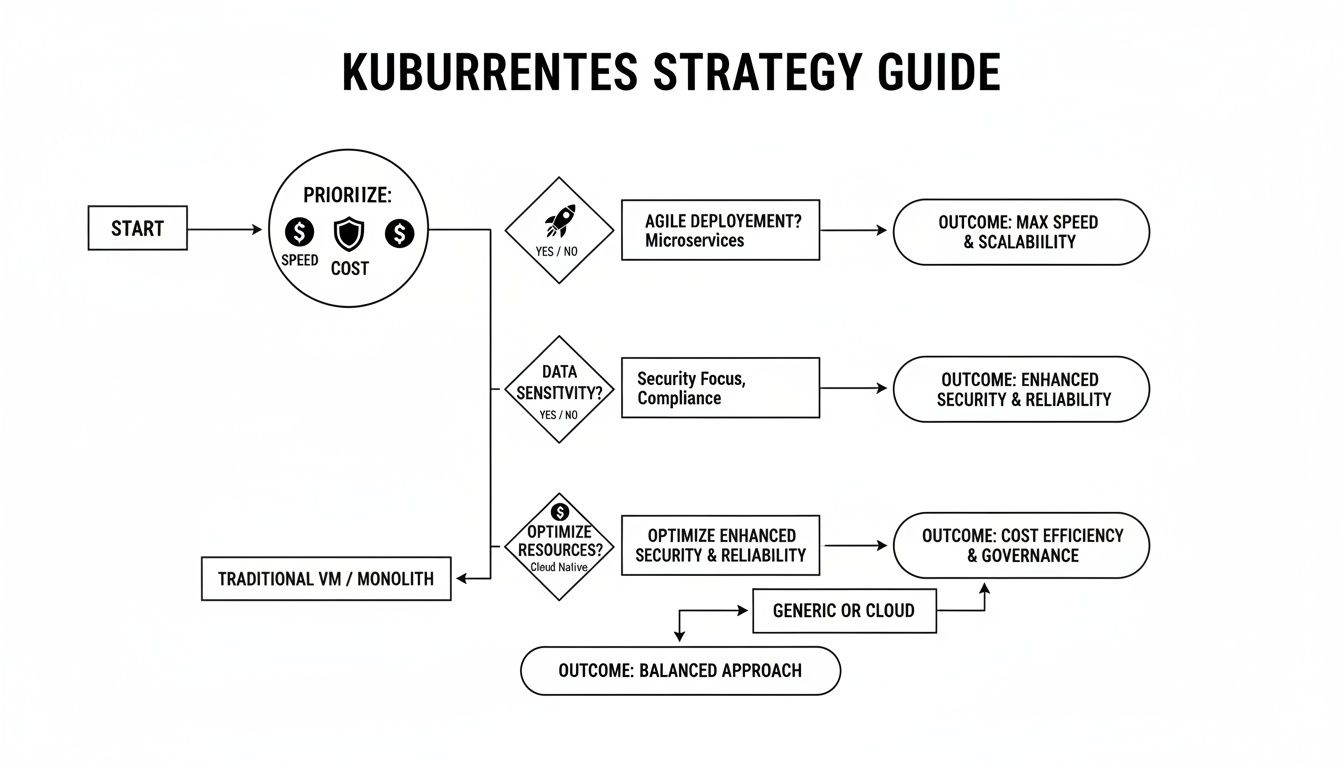
  • Top 10 Technical API Gateway Best Practices for 2026

    Top 10 Technical API Gateway Best Practices for 2026

    API gateways are the cornerstone of modern distributed systems, acting as the central control plane for traffic, security, and observability. But simply deploying one is not enough to guarantee success. Achieving true resilience, performance, and security requires a deliberate, engineering-driven approach that goes beyond default configurations. Getting this right prevents cascading failures, secures sensitive data, and provides the visibility needed to operate complex microservices architectures effectively.

    This article moves beyond generic advice to provide a technical, actionable checklist of the top 10 API gateway best practices that high-performing DevOps and platform engineering teams implement. We will not just tell you what to do; we will show you how with specific configurations, architectural trade-offs, and recommended tooling. Our focus is on the practical application of these principles in a real-world production environment.

    Prepare to dive deep into the technical specifics that separate a basic gateway setup from a production-hardened, scalable architecture. You will learn how to:

    • Implement sophisticated rate-limiting algorithms to protect backend services.
    • Enforce centralized, zero-trust authentication and authorization patterns.
    • Build fault tolerance using circuit breakers and intelligent retry mechanisms.
    • Establish a comprehensive observability stack with structured logging and distributed tracing.

    Each practice is designed to be a blueprint you can directly apply to your own systems, whether you're a startup CTO building from scratch or an enterprise SRE optimizing an existing deployment. This guide provides the technical details needed to build a robust, secure, and efficient API management layer.

    1. Implement Comprehensive Rate Limiting and Throttling

    One of the most critical API gateway best practices is implementing robust rate limiting and throttling to shield backend services from traffic spikes and abuse. Rate limiting sets a hard cap on the number of requests a client can make within a specific time window, while throttling smooths out request bursts by queuing or delaying them. These controls are non-negotiable for preventing cascading failures, ensuring fair resource allocation among tenants, and maintaining service stability.

    When a client exceeds a defined rate limit, the gateway must immediately return an HTTP 429 Too Many Requests status code. This clear, standardized response mechanism informs the client application that it needs to back off, preventing it from overwhelming the system.

    An illustration showing a funnel dropping items into a 'rate' bucket, with a 'throttle' gauge controlling the flow.

    Why It's a Top Priority

    Without effective rate limiting, a single misconfigured client, a malicious actor launching a denial-of-service attack, or an unexpected viral event can saturate your backend resources. This leads to increased latency, higher error rates, and potentially a full-system outage, impacting all users. For multi-tenant SaaS platforms, this practice is foundational to guaranteeing a baseline quality of service (QoS) for every customer.

    Practical Implementation and Examples

    • GitHub's API uses a tiered approach based on authentication context: unauthenticated requests (identified by source IP) are limited to 60 per hour, while authenticated requests using OAuth tokens get a much higher limit of 5,000 per hour, identified by the token itself.
    • AWS API Gateway allows configuration of a steady-state rate and a burst capacity using a token bucket algorithm. For example, a configuration of rate: 1000 and burst: 2000 allows for handling brief spikes up to 2,000 requests, while sustaining an average of 1,000 requests per second.
    • Kong API Gateway leverages its rate-limiting plugin, which can be configured with various algorithms (like fixed-window, sliding-window, or sliding-log) and can use a Redis cluster for a distributed counter. A typical configuration would specify limits per minute, hour, and day for a given consumer.

    Actionable Tip: Always include a Retry-After header in your 429 responses. This header tells the client exactly how many seconds to wait before attempting another request, helping well-behaved clients to implement an effective exponential backoff strategy and reduce unnecessary retry traffic. For example: Retry-After: 30.

    2. Implement Centralized Authentication and Authorization

    One of the most impactful API gateway best practices is to centralize authentication (AuthN) and authorization (AuthZ). This approach delegates security enforcement to the gateway, creating a single, robust checkpoint for all incoming API requests. Instead of embedding complex security logic within each downstream microservice, the gateway validates credentials, verifies identities, and enforces access policies upfront, simplifying the overall architecture and reducing the attack surface.

    This model establishes the gateway as the single source of truth for identity. It typically involves standard protocols like OAuth 2.0 and OpenID Connect, using mechanisms like JSON Web Tokens (JWT) to carry identity and permission information. Once the gateway validates a token's signature, expiration, and claims, it can inject verified user information (e.g., X-User-ID, X-Tenant-ID) as HTTP headers before forwarding the request, freeing backend services to focus purely on business logic.

    Hand-drawn diagram of a centralized authentication gateway using JWT for client-service authorization.

    Why It's a Top Priority

    Without centralized security, each microservice team must independently implement, test, and maintain its own authentication and authorization logic. This leads to code duplication, inconsistent security standards (e.g., different JWT validation libraries with varying vulnerabilities), and a significantly higher risk of security gaps. Centralizing this function ensures that security policies are applied uniformly, makes auditing straightforward, and allows security teams to manage policies in one place without requiring code changes in every service.

    Practical Implementation and Examples

    • AWS API Gateway integrates directly with AWS Cognito for user authentication and AWS IAM for fine-grained authorization using SigV4 signatures. It also provides Lambda authorizers for custom logic, such as validating JWTs from an external IdP.
    • Kong Gateway uses plugins like jwt, oauth2, and oidc to connect with identity providers (IdPs) such as Okta, Auth0, or Keycloak. It can offload all token validation and introspection from backend services.
    • Azure API Management can validate JWTs issued by Azure Active Directory. You can use policy expressions to check for specific claims, such as roles or scopes, and reject requests that lack the required permissions (e.g., <validate-jwt header-name="Authorization" failed-validation-httpcode="401"><required-claims><claim name="scp" match="any" separator=" "><value>read:users</value></claim></required-claims></validate-jwt>). For more details, see our guide on effective secrets management strategies.

    Actionable Tip: Use short-lived access tokens (e.g., 5-15 minutes) combined with long-lived refresh tokens. This model, central to OAuth 2.0, minimizes the window of opportunity for a compromised token to be misused. The gateway should only be concerned with validating the access token; the client is responsible for using the refresh token to obtain a new access token from the IdP.

    3. Enable API Versioning and Backward Compatibility

    As APIs evolve, introducing breaking changes is inevitable. Handling this evolution gracefully is a core API gateway best practice that prevents disruptions for existing clients. API versioning at the gateway level allows you to manage multiple concurrent versions of an API, routing requests to the appropriate backend service based on version identifiers. This strategy is essential for innovating your services while maintaining stability for a diverse and established user base.

    The most common versioning strategies managed by the gateway include URL pathing (/api/v2/users), custom request headers (Accept-Version: v2), or query parameters (/api/users?version=2). By abstracting this routing logic to the gateway, you decouple version management from your backend services, allowing them to focus solely on business logic.

    Why It's a Top Priority

    Without a clear versioning strategy, any change to an API, no matter how small, risks breaking client integrations. This forces clients to constantly adapt, creating a frustrating developer experience and potentially leading to churn. For platforms with a public API, such as a SaaS product, maintaining backward compatibility is a non-negotiable aspect of the developer contract. An API gateway provides the perfect control plane to implement and enforce this contract consistently.

    Practical Implementation and Examples

    • Stripe’s API famously uses a date-based version specified in a Stripe-Version header (e.g., Stripe-Version: 2022-11-15). This allows clients to pin their integration to a specific API version, ensuring that their code continues to work even as Stripe releases non-backward-compatible updates.
    • Twilio prefers URL path versioning (e.g., /2010-04-01/Accounts). The API gateway can use a simple regex match on the URL path to route the request to the backend service deployment responsible for that specific version.
    • AWS API Gateway can manage this through "stages." You can deploy different API specifications (e.g., openapi-v1.yaml, openapi-v2.yaml) to different stages (e.g., v1, v2, beta), each with its own endpoint and backend integration configuration, providing clear separation.

    Actionable Tip: Use response headers to communicate deprecation schedules. Include a Deprecation header with a timestamp indicating when the endpoint will be removed and a Link header pointing to documentation for the new version. For example: Deprecation: Tue, 24 Jan 2023 23:59:59 GMT and Link: <https://api.example.com/v2/docs>; rel="alternate". This provides clients with clear, machine-readable warnings and a timeline for migration.

    4. Implement Advanced Logging and Request Tracing

    Comprehensive logging and distributed tracing at the API gateway are fundamental for gaining visibility into system behavior. This practice involves capturing detailed metadata for every request and response, including headers, payloads (sanitized), latency, and status codes. More importantly, it correlates these logs into a single, cohesive view of a request's journey across multiple microservices, which is a non-negotiable for modern distributed architectures.

    This end-to-end visibility is essential for rapidly diagnosing production issues, monitoring system health, and understanding user behavior. By treating the gateway as a centralized observation point, you can debug complex, cross-service failures that would otherwise be nearly impossible to piece together.

    Distributed tracing diagram showing services, a trace timeline, and log details with a magnifying glass.

    Why It's a Top Priority

    Without centralized logging and tracing, debugging becomes a time-consuming process of manually grep-ing through logs on individual services. A single user-facing error could trigger a cascade of events across a dozen backends, and without a correlation ID, linking these events is pure guesswork. This practice transforms your API gateway from a simple proxy into an intelligent observability hub, drastically reducing Mean Time to Resolution (MTTR) for incidents.

    Practical Implementation and Examples

    • AWS API Gateway integrates natively with CloudWatch for logging and AWS X-Ray for distributed tracing. When X-Ray is enabled, the gateway automatically injects a trace header (X-Amzn-Trace-Id) into downstream requests made to other AWS services.
    • Kong API Gateway can be configured to stream logs in a structured format (JSON) to external systems like Fluentd or an ELK stack. It integrates with observability platforms like Datadog or OpenTelemetry collectors for full-stack tracing.
    • Nginx, when used as a gateway, can be extended with the OpenTelemetry module to generate traces. These traces can then be sent to a backend collector like Jaeger or Zipkin for visualization and analysis. A typical log format might include $request_id to correlate entries.

    Actionable Tip: Standardize on a specific trace header across all services, preferably the W3C Trace Context specification (traceparent and tracestate). Your gateway should be configured to generate this header if it's missing or propagate it if it already exists, ensuring every log entry from every microservice involved in a request can be correlated with a single trace ID.

    5. Implement Request/Response Transformation and Validation

    A powerful API gateway best practice is to offload request and response transformation and validation from backend services. The gateway acts as an intermediary, intercepting traffic to remap data structures, validate schemas, and normalize payloads before they reach the backend. This decoupling allows backend services to focus purely on business logic, while the gateway handles the "last mile" of data adaptation and integrity checks. This is invaluable when integrating legacy systems, composing services, or adapting protocols like REST to gRPC.

    By handling this logic at the edge, you can evolve frontend clients and backend services independently. The gateway becomes a smart facade, ensuring that regardless of what a client sends or a service returns, the data conforms to a predefined contract. This prevents malformed data from ever hitting your core systems.

    Why It's a Top Priority

    Without gateway-level transformation, backend services become bloated with boilerplate code for data validation and mapping. Each time a new client requires a slightly different data format, you must modify, test, and redeploy the backend service. This creates tight coupling and slows down development cycles. Placing this responsibility on the gateway centralizes data governance, reduces backend complexity, and enables much faster adaptation to new requirements or service versions. It is a critical enabler of the "Strangler Fig" pattern for modernizing legacy applications.

    Practical Implementation and Examples

    • AWS API Gateway uses Mapping Templates with Velocity Template Language (VTL) to transform JSON payloads. You can define "Models" using JSON Schema to validate incoming requests against a contract, rejecting them with a 400 Bad Request at the gateway if they don't conform.
    • Kong Gateway provides plugins like request-transformer and response-transformer. These allow you to add, replace, or remove headers and body fields using simple declarative configuration, effectively creating a data mediation layer without custom code.
    • Apigee offers a rich set of transformation policies, including "Assign Message" and "JSON to XML," allowing developers to visually configure complex data manipulations and logic flows directly within the API proxy.
    • MuleSoft's Anypoint Platform is built around transformation, using its proprietary DataWeave language to handle even the most complex mappings between different formats like JSON, XML, CSV, and proprietary standards.

    Actionable Tip: Always version your transformation policies alongside your API versions. A change in a data mapping is a breaking change for a consumer. Tie transformation logic to a specific API version route (e.g., /v2/users) to ensure older clients continue to function without interruption while new clients can leverage the updated data structure. Store these transformation templates in version control.

    6. Implement Circuit Breaker and Fault Tolerance Patterns

    In a distributed microservices architecture, temporary service failures are inevitable. A critical API gateway best practice is to implement the circuit breaker pattern, which prevents a localized failure from cascading into a system-wide outage. This pattern monitors backend services for failures (e.g., connection timeouts, 5xx responses), and if the error rate exceeds a configured threshold, the gateway "trips" the circuit. Once open, it immediately rejects further requests to the failing service with a 503 Service Unavailable, giving it time to recover without being overwhelmed by a flood of retries.

    This proactive failure management isolates faults and significantly improves the overall resilience and stability of your application. Instead of allowing requests to time out against a struggling service, the gateway provides an immediate, controlled response, such as a fallback message or data from a cache.

    Diagram illustrating fault tolerance with a client, service, a traffic light circuit breaker, and fallback cache.

    Why It's a Top Priority

    Without a circuit breaker, client applications will continuously retry requests to a failing or degraded backend service. This not only exhausts resources on the client side (like connection pools and threads) but also exacerbates the problem for the backend, preventing it from recovering. This tight coupling of client and service health leads to brittle systems. By implementing this pattern at the gateway, you decouple the client's experience from transient backend issues, ensuring the rest of the system remains operational and responsive.

    Practical Implementation and Examples

    • Resilience4j, a Java library often used with Spring Cloud Gateway, can be configured to open a circuit after 50% of the last 10 requests have failed, then transition to a "half-open" state after a 60-second wait to send a single test request. If it succeeds, the circuit closes; otherwise, it remains open.
    • Envoy Proxy, the foundation for many service meshes like Istio, uses its "outlier detection" feature to achieve the same goal. It can be configured to temporarily eject an unhealthy service instance from the load-balancing pool if it returns a specified number of consecutive 5xx errors.
    • Kong API Gateway offers a circuit-breaker plugin that can be applied to a service or route. You can define rules for tripping the circuit based on thresholds for consecutive failures or failure ratios, protecting your upstream services automatically.

    Actionable Tip: Combine circuit breakers with active and passive health checks. The gateway should actively poll a dedicated endpoint (e.g., /healthz) on the backend service. The circuit breaker's logic can use this health status as a primary signal, allowing it to trip pre-emptively before requests even begin to fail, leading to faster fault detection. This is also a core principle of chaos engineering, where you intentionally test these failure modes.

    7. Implement Comprehensive Monitoring and Alerting

    You cannot manage what you do not measure. Implementing comprehensive monitoring and alerting is a foundational API gateway best practice for transforming your gateway from a black box into a transparent, observable system. This involves continuously tracking key performance indicators (KPIs) like request rates, error rates (by status code family, e.g., 4xx/5xx), latency percentiles (p50, p95, p99), and upstream service health. This data provides the visibility needed to detect issues proactively, often before they impact end-users.

    When a metric crosses a predefined threshold, an integrated alerting system should automatically notify the appropriate on-call team via PagerDuty, Slack, or another tool. This immediate feedback loop is critical for maintaining service reliability, upholding service-level agreements (SLAs), and enabling rapid incident response.

    Why It's a Top Priority

    Without robust monitoring, performance degradation and outages become silent killers. A gradual increase in p99 latency or a spike in 5xx errors might go unnoticed until customer complaints flood your support channels. Proactive monitoring allows you to identify anomalies, correlate them with recent deployments or traffic patterns, and diagnose root causes swiftly. It’s the cornerstone of maintaining high availability and a positive user experience, providing the data needed for intelligent capacity planning and performance tuning.

    Practical Implementation and Examples

    • Prometheus + Grafana is a popular open-source stack. You can configure your API gateway (like Kong or Traefik) to expose metrics in a Prometheus-compatible format on a /metrics endpoint. Then, build detailed Grafana dashboards to visualize latency heatmaps, error budgets, and request volumes per route.
    • Datadog APM provides out-of-the-box integrations for many gateways like AWS API Gateway. It can automatically trace requests from the gateway through to backend services, making it easy to pinpoint bottlenecks and set up sophisticated, multi-level alerts based on anomaly detection algorithms.
    • AWS CloudWatch is the native solution for AWS API Gateway. You can create custom alarms based on metrics like Latency, Count, and 4XXError/5XXError. For instance, you can set an alarm to trigger if the p95 latency for a specific route exceeds 200ms for more than five consecutive one-minute periods.

    Actionable Tip: Focus on business-aligned metrics and Service Level Objectives (SLOs). Instead of just alerting when CPU is high, define an SLO like "99.5% of /login requests must be served in under 300ms over a 28-day window." Then, configure your alerts to fire when your error budget for that SLO is being consumed too quickly. This directly ties system performance to user impact.

    8. Implement CORS and Security Headers Management

    Managing Cross-Origin Resource Sharing (CORS) and security headers at the API gateway layer is a foundational best practice for securing web applications. CORS policies dictate which web domains are permitted to access your APIs from a browser, preventing unauthorized cross-site requests. Simultaneously, security headers like Strict-Transport-Security (HSTS), Content-Security-Policy (CSP), and X-Content-Type-Options instruct browsers on how to behave when handling your site's content, mitigating common attacks like cross-site scripting (XSS) and clickjacking.

    By centralizing this control at the gateway, you enforce a consistent security posture across all downstream services. This approach eliminates the need for each microservice to manage its own security headers and CORS logic, simplifying development and reducing the risk of inconsistent or missing protections.

    Why It's a Top Priority

    Without proper CORS management, malicious websites could potentially make requests to your APIs from a user's browser, exfiltrating sensitive data. Similarly, a lack of security headers leaves your application vulnerable to a host of browser-based attacks. Centralizing these controls at the gateway ensures that no API is accidentally deployed without these critical safeguards, which is a key part of any robust API security strategy. This also prevents security misconfiguration where individual services might have overly permissive settings.

    Practical Implementation and Examples

    • AWS API Gateway provides built-in CORS configuration options, allowing you to specify Access-Control-Allow-Origin, Access-Control-Allow-Methods, and Access-Control-Allow-Headers for REST and HTTP APIs.
    • Kong Gateway uses its powerful CORS plugin to apply granular policies. You can enable it globally or on a per-service or per-route basis, defining specific allowed origins with regex patterns for dynamic environments like development feature branches (e.g., https://*.dev.example.com).
    • NGINX can be configured as a gateway to inject security headers into all responses using the add_header directive within a server or location block. For example: add_header Strict-Transport-Security "max-age=31536000; includeSubDomains" always;. This setup acts similarly to a reverse proxy configuration where the gateway fronts your backend services.

    Actionable Tip: Never use a wildcard (*) for Access-Control-Allow-Origin in a production environment where credentials (cookies, auth headers) are sent. Always specify the exact domains that should have access. A wildcard allows any website on the internet to make requests to your API from a browser, nullifying the security benefit of CORS.

    9. Implement API Analytics and Usage Insights

    Beyond simple operational monitoring, a core API gateway best practice is to capture detailed analytics and usage insights. This involves collecting, processing, and visualizing data on how consumers interact with your APIs, transforming raw request logs into strategic business intelligence. This data reveals popular endpoints, identifies top consumers (by API key), tracks feature adoption, and provides a clear view of performance trends over time, enabling data-driven product and engineering decisions.

    By treating your API as a product, the gateway becomes the primary source of truth for understanding its performance and value. It answers critical questions like "Which API versions are still in use?", "Which customers are approaching their rate limits?", and "Did latency on the /checkout endpoint increase after the last deployment?".

    Why It's a Top Priority

    Without dedicated API analytics, you are operating blindly. You cannot effectively plan for future capacity needs, identify opportunities for new features, or proactively engage with customers who are either struggling or demonstrating high-growth potential. It becomes impossible to measure the business impact of your APIs, justify future investment, or troubleshoot complex issues related to specific usage patterns. Effective analytics turns your API gateway from a simple traffic cop into a powerful business insights engine.

    Practical Implementation and Examples

    • Stripe's API Dashboard provides merchants with detailed analytics on API request volume, error rates, and latency, allowing them to monitor their integration's health and usage patterns directly.
    • AWS API Gateway integrates with CloudWatch to provide metrics and logs, which can be further analyzed using services like Amazon QuickSight or OpenSearch. It also offers usage plans that track API key consumption against quotas, feeding directly into billing and business analytics.
    • Apigee (Google Cloud) offers a powerful, built-in analytics suite that allows teams to create custom reports and dashboards to track API traffic, latency, error rates, and even business-level metrics like developer engagement or API product monetization.

    Actionable Tip: Define your Key Performance Indicators (KPIs) before you start collecting data. Align metrics with business objectives by tracking both technical data (p99 latency, error rate) and business data (active consumers, API call volume per pricing tier, feature adoption rate). Structure your gateway logs as JSON so this data can be easily parsed and ingested by your analytics platform.

    10. Implement API Documentation and Developer Portal

    An often-overlooked yet vital API gateway best practice is to treat your APIs as products by providing a comprehensive developer portal and interactive documentation. The gateway is the ideal place to centralize and automate this process, as it has a complete view of your API landscape. A well-designed portal serves as the front door for developers, offering everything they need to discover, understand, test, and integrate with your services efficiently.

    This includes automatically generated, interactive documentation from OpenAPI/Swagger specifications, detailed guides, code samples, and self-service API key management. By making APIs accessible and easy to use, you significantly reduce the friction for adoption, decrease support overhead, and foster a healthy developer ecosystem.

    Why It's a Top Priority

    Without a centralized, high-quality developer portal, API consumers are left to piece together information from outdated wikis, internal documents, or direct support requests. This creates a frustrating developer experience, slows down integration projects, and can lead to incorrect API usage. A great portal not only accelerates time-to-market for consumers but also acts as a critical tool for governance, ensuring developers are using the correct, most current versions of your APIs.

    Practical Implementation and Examples

    • Stripe's Developer Portal is a gold standard, offering interactive API documentation where developers can make real API calls directly from the browser, alongside extensive guides and recipes for common use cases.
    • Twilio's Developer Portal provides robust SDKs in multiple languages, quickstart guides, and a comprehensive API reference, making it exceptionally easy for developers to integrate their communication APIs.
    • AWS API Gateway can export its configuration as an OpenAPI specification, which can then be used by tools like Swagger UI to render documentation. AWS also offers a managed developer portal feature.
    • SwaggerHub and tools like Redocly allow teams to collaboratively design and document APIs using the OpenAPI specification, then publish them to polished, professional-looking portals that can be hosted independently or integrated with a gateway.

    Actionable Tip: Automate your documentation lifecycle. Integrate your CI/CD pipeline to generate and publish OpenAPI specifications to your developer portal whenever an API is updated. Your pipeline should treat the API spec as an artifact. A failure to generate a valid spec should fail the build, ensuring documentation is never out of sync with the actual implementation.

    10-Point API Gateway Best Practices Comparison

    Practice Implementation complexity Resource requirements Expected outcomes Ideal use cases Key advantages
    Implement Comprehensive Rate Limiting and Throttling Medium — requires algorithms and distributed coordination Medium — gateway config, state store (Redis), monitoring Prevents spikes/DDoS; protects backend stability Multi-tenant SaaS, public APIs with variable traffic Protects backend; enforces fair usage
    Implement Centralized Authentication and Authorization High — integrates identity protocols and providers High — IdPs, token stores, PKI/mTLS, security expertise Consistent access control and auditability across APIs Enterprises, multi-tenant platforms, compliance-driven systems Single security enforcement point; simpler policy updates
    Enable API Versioning and Backward Compatibility Medium — routing and lifecycle management Low–Medium — gateway routing rules, documentation effort Safe API evolution with minimal client disruption APIs with many external clients or long-term integrations Enables gradual migration; preserves backward compatibility
    Implement Advanced Logging and Request Tracing High — distributed tracing design and correlation High — storage, tracing/telemetry tools (OTel, Jaeger), expertise End-to-end visibility for debugging and performance tuning Distributed microservices, incident response, observability initiatives Faster root-cause analysis; performance insights
    Implement Request/Response Transformation and Validation Medium — mapping rules and schema enforcement Medium — CPU for transformations, config management Decouples clients from backends; standardized payloads Legacy integration, protocol translation, API evolution Reduces backend changes; enforces data consistency
    Implement Circuit Breaker and Fault Tolerance Patterns Medium — health checks, state machines, retries Medium — health probes, caching/fallback stores, monitoring Prevents cascading failures; enables graceful degradation Systems with flaky dependencies or high reliability needs Improves resilience; reduces wasted requests to failing services
    Implement Comprehensive Monitoring and Alerting Medium — metrics design and alerting strategy Medium–High — metrics pipeline, dashboards, on-call tooling Proactive detection and SLA/SLO tracking Production services with SLOs and capacity planning needs Reduces MTTD; supports data-driven scaling
    Implement CORS and Security Headers Management Low–Medium — header and TLS configuration Low — gateway config, certificate management Safer browser-based API consumption; consistent security posture Web APIs and browser clients Prevents cross-origin abuse; enforces security policies centrally
    Implement API Analytics and Usage Insights Medium — event collection and reporting pipelines High — data storage, analytics platform, privacy controls Business and usage insights for product and monetization Usage-based billing, product optimization, customer success Drives product decisions; identifies high-value users
    Implement API Documentation and Developer Portal Medium — spec generation and portal tooling Medium — hosting, SDK generation, sandbox environment Faster onboarding and reduced support load Public APIs, partner ecosystems, developer-focused products Improves adoption; enables self-service integration

    From Theory to Production: Operationalizing Your Gateway Strategy

    Navigating the intricate landscape of API gateway best practices can feel like assembling a complex puzzle. We've journeyed through ten critical pillars, from establishing robust rate limiting and centralized authentication to implementing advanced observability with tracing, logging, and analytics. Each practice, whether it's managing API versioning, enforcing security headers, or enabling a seamless developer portal, represents a vital component in constructing a resilient, secure, and scalable API ecosystem.

    The core takeaway is this: an API gateway is far more than a simple traffic cop. When configured with intention, it becomes the central nervous system of your microservices architecture. It enforces your security posture, guarantees service reliability through patterns like circuit breaking, and provides the invaluable usage insights needed for strategic business decisions. It's the critical control plane that unlocks true operational excellence and accelerates developer velocity.

    Moving from Checklist to Implementation

    Merely understanding these concepts is the first step; the real value is unlocked through disciplined operationalization. Your goal should be to transform this checklist into a living, automated, and continuously improving system.

    • Embrace Infrastructure-as-Code (IaC): Your gateway configuration, including routes, rate limits, and security policies, should be defined declaratively using tools like Terraform, Ansible, or custom Kubernetes operators. This approach eliminates configuration drift, enables peer reviews for changes, and makes your gateway setup reproducible and auditable.
    • Integrate into CI/CD: Gateway configuration changes must flow through your CI/CD pipeline. Automate testing for new routes, validate policy syntax, and perform canary or blue-green deployments for gateway updates to minimize the blast radius of any potential issues.
    • Prioritize a Monitoring-First Culture: Your gateway is the perfect vantage point for observing your entire system. The metrics, logs, and traces it generates are not "nice-to-haves"; they are essential. Proactively build dashboards and set up precise alerts for latency spikes, error rate increases (especially 5xx errors), and authentication failures.

    The Strategic Value of a Well-Architected Gateway

    Mastering these API gateway best practices yields compounding returns. A well-implemented gateway doesn't just prevent outages; it builds trust with your users and partners by delivering a consistently reliable and secure experience. It empowers your development teams by abstracting away cross-cutting concerns, allowing them to focus on building business value instead of reinventing security and traffic management solutions for every service.

    Ultimately, your API gateway strategy is a direct reflection of your platform's maturity. By investing the effort to implement these best practices, you are not just managing APIs; you are building a strategic asset that provides a competitive advantage, enhances your security posture, and lays a scalable foundation for future innovation. The journey from a basic proxy to a sophisticated control plane is a defining step in engineering excellence.


    Ready to implement these advanced strategies but need the specialized expertise to get it right? OpsMoon connects you with the top 0.7% of elite DevOps and platform engineers who specialize in architecting, deploying, and managing scalable, secure API infrastructures. Start with a free work planning session at OpsMoon to map your journey from theory to a production-ready, resilient API ecosystem.

  • 10 Actionable Software Security Best Practices for 2026

    10 Actionable Software Security Best Practices for 2026

    In today's fast-paced development landscape, software security can no longer be a final-stage checkbox; it's the bedrock of reliable and trustworthy applications. Reactive security measures are costly, inefficient, and leave organizations exposed to ever-evolving threats. The most effective strategy is to build security into every layer of the software delivery lifecycle. This 'shift-left' approach transforms security from a barrier into a competitive advantage.

    This guide moves beyond generic advice to provide a technical, actionable roundup of 10 software security best practices you can implement today. We will explore specific tools, frameworks, and architectural patterns designed to fortify your code, infrastructure, and processes. Our focus is on practical implementation, covering everything from secure CI/CD pipelines and Infrastructure as Code (IaC) hardening to Zero Trust networking and automated vulnerability scanning.

    Each practice is presented as a building block toward a comprehensive DevSecOps culture, empowering your teams to innovate quickly without compromising on security. We will detail how to integrate these measures directly into your existing workflows, ensuring security becomes a seamless and automated part of development, not an afterthought. Let's dive into the technical details that separate secure software from the vulnerable.

    1. Implement a Secure Software Development Lifecycle (SSDLC)

    A Secure Software Development Lifecycle (SSDLC) is a foundational practice that embeds security activities directly into every phase of your existing development process. Instead of treating security as a final gate before deployment, an SSDLC framework makes it a continuous, shared responsibility from initial design to post-release maintenance. This "shift-left" approach is one of the most effective software security best practices for proactively identifying and mitigating vulnerabilities early, when they are cheapest and easiest to fix.

    The core principle is to integrate specific security checks and balances at each stage: requirements, design, development, testing, and deployment. This model transforms security from a siloed function into an integral part of software creation, dramatically reducing the risk of releasing insecure code.

    How an SSDLC Works in Practice

    Implementing an SSDLC involves augmenting your standard development workflow with targeted security actions. For a comprehensive understanding of how to implement security practices throughout your development process, refer to this Guide to the Secure Software Development Life Cycle (SDLC). A typical implementation includes:

    • Requirements Phase: Define clear security requirements alongside functional ones. Specify data encryption standards (e.g., require TLS 1.3 for all data in transit, AES-256-GCM for data at rest), authentication protocols (e.g., mandate OIDC with PKCE flow for all user-facing applications), and compliance constraints (e.g., GDPR data residency).
    • Design Phase: Conduct threat modeling sessions using frameworks like STRIDE (Spoofing, Tampering, Repudiation, Information Disclosure, Denial of Service, Elevation of Privilege) or DREAD. Document data flows and trust boundaries to identify potential architectural weaknesses, such as an unauthenticated internal API.
    • Development Phase: Developers follow secure coding guidelines (e.g., OWASP Top 10, CERT C) and use Static Application Security Testing (SAST) tools (e.g., SonarQube, Snyk Code) integrated into their IDEs via plugins and pre-commit hooks to catch vulnerabilities in real-time.
    • Testing Phase: Augment standard QA with Dynamic Application Security Testing (DAST) tools like OWASP ZAP, Interactive Application Security Testing (IAST), and manual penetration testing against a staging environment to find runtime vulnerabilities not visible in source code.
    • Deployment & Maintenance: Implement security gates in your CI/CD pipeline (e.g., Jenkins, GitLab CI) that automatically fail a build if SAST or SCA scans detect critical vulnerabilities. Continuously monitor production environments with runtime application self-protection (RASP) tools and have a defined incident response plan.

    OpsMoon Expertise: Our DevOps specialists can help you design and implement a tailored SSDLC framework. We can integrate automated security tools like SAST and DAST into your CI/CD pipelines, establish security gates, and conduct a maturity assessment to identify and close gaps in your current processes.

    2. Enforce Secret Management and Credential Rotation

    Enforcing robust secret management and credential rotation is a critical software security best practice for protecting your most sensitive data. This involves a systematic approach to securely storing, accessing, and rotating credentials like API keys, database passwords, and TLS certificates. Hardcoding secrets in source code or configuration files is a common but dangerous mistake that creates a massive security vulnerability, making centralized management essential.

    The core principle is to treat secrets as dynamic, short-lived assets that are centrally managed and programmatically accessed. By removing credentials from developer workflows and application codebases, you dramatically reduce the risk of accidental leaks and provide a single, auditable point of control for all sensitive information. This practice is fundamental to achieving a zero-trust security posture.

    Sketch of a secure safe with API keys and data cards, connected to cloud networks.

    How Secret Management Works in Practice

    Implementing a strong secret management strategy involves adopting dedicated tools and automated workflows. These systems provide a secure vault and an API for applications to request credentials just-in-time, ensuring they are never exposed in plaintext. For a deeper dive into this topic, explore these secrets management best practices. A typical implementation includes:

    • Centralized Vaulting: Use a dedicated secrets manager like HashiCorp Vault or cloud-native services (AWS Secrets Manager, Azure Key Vault) as the single source of truth for all credentials. Applications authenticate to the vault using a trusted identity (e.g., a Kubernetes Service Account, an AWS IAM Role).
    • Dynamic Secret Generation: Configure the vault to generate secrets on-demand with a short Time-To-Live (TTL). For instance, an application can request temporary database credentials from Vault's database secrets engine that expire in one hour, eliminating the need for long-lived static passwords.
    • Automated Rotation: Enable automatic credential rotation policies for long-lived secrets, such as rotating a root database password every 30-90 days without manual intervention. The secrets manager handles the entire lifecycle of updating the credential in the target system and the vault. Robust secret management extends to securing API access, and a thorough understanding of authentication mechanisms is crucial for protecting sensitive resources. To learn more, see this ultimate guide to API key authentication.
    • CI/CD Integration: Integrate secret scanning tools like GitGuardian or TruffleHog into your CI pipeline's pre-commit or pre-receive hooks to detect and block any commits that contain hardcoded credentials, preventing them from ever entering the codebase.
    • Auditing and Access Control: Implement strict, role-based access control (RBAC) policies within the secrets manager and maintain comprehensive audit logs that track every secret access event, including which identity accessed which secret and when.

    OpsMoon Expertise: Our security and DevOps engineers are experts in deploying and managing enterprise-grade secret management solutions. We can help you implement HashiCorp Vault with Kubernetes integration, configure cloud-native services like AWS Secrets Manager, establish automated rotation policies, and integrate secret scanning directly into your CI/CD pipelines to prevent credential leaks.

    3. Implement Container and Image Security Scanning

    Containerization has revolutionized software deployment, but it also introduces new attack surfaces. Implementing container and image security scanning is a critical software security best practice that prevents vulnerable or misconfigured containers from ever reaching production. This practice involves systematically analyzing container images for known vulnerabilities (CVEs) in OS packages and application dependencies, malware, embedded secrets, and policy violations.

    By integrating scanning directly into the build and deployment pipeline, teams can shift security left and automate the detection of issues within container layers and application dependencies. This proactive approach hardens your runtime environment by ensuring that only trusted, vetted images are used, significantly reducing the risk of exploitation in production.

    How Container and Image Scanning Works in Practice

    The process involves using specialized tools to dissect container images, inspect their contents, and compare them against vulnerability databases and predefined security policies. For a deep dive into container security tools and their integration, you can explore the CNCF's Cloud Native Security Whitepaper, which covers various aspects of securing cloud-native applications. A typical implementation workflow includes:

    • Build-Time Scanning: Integrate an image scanner like Trivy, Grype, or Clair directly into your CI/CD pipeline. For example, in a GitLab CI pipeline, a dedicated job can run trivy image my-app:$CI_COMMIT_SHA --exit-code 1 --severity CRITICAL,HIGH to fail the build if severe vulnerabilities are found.
    • Registry Scanning: Configure your container registry (e.g., AWS ECR, Google Artifact Registry, Azure Container Registry) to automatically scan images upon push. This serves as a second gate and provides continuous scanning for newly discovered vulnerabilities in existing images.
    • Policy Enforcement: Define and enforce security policies as code. For example, use a Kubernetes admission controller like Kyverno or OPA Gatekeeper to block pods from running if their image contains critical vulnerabilities or originates from an untrusted registry.
    • Runtime Monitoring: Use tools like Falco or Sysdig Secure to continuously monitor running containers for anomalous behavior (e.g., unexpected network connections, shell execution in a container) based on predefined rules, providing real-time threat detection.
    • Image Signing: Implement image signing with technologies like Cosign (part of Sigstore) to cryptographically verify the integrity and origin of your container images. This ensures the image deployed to production is the exact same one that was built and scanned in CI.

    OpsMoon Expertise: Our team specializes in embedding robust container security into your Kubernetes and CI/CD workflows. We can integrate and configure advanced scanners like Trivy, Snyk, or Prisma Cloud into your pipelines, establish automated security gates, and implement comprehensive image signing and verification strategies to ensure your containerized applications are secure from build to runtime.

    4. Deploy Infrastructure as Code (IaC) with Security Reviews

    Infrastructure as Code (IaC) is the practice of managing and provisioning infrastructure through machine-readable definition files, such as Terraform, CloudFormation, or Ansible, rather than manual configuration. This approach brings version control, automation, and repeatability to infrastructure management. When combined with rigorous security reviews, it becomes a powerful software security best practice for preventing misconfigurations that often lead to data breaches.

    Treating your infrastructure like application code allows you to embed security directly into your provisioning process. By codifying security policies and running automated static analysis checks against your IaC templates, you can ensure that every deployed resource—from VPCs to IAM roles—adheres to your organization's security and compliance standards before it ever goes live.

    Diagram illustrating a software development and security process, from version control to storage, with compute and network steps.

    How IaC Security Works in Practice

    Implementing secure IaC involves integrating security validation into your development and CI/CD pipelines. This ensures that infrastructure definitions are scanned for vulnerabilities and misconfigurations automatically. For an in-depth look at this process, explore our guide on how to check IaC for security issues. Key actions include:

    • Policy as Code (PaC): Use tools like Open Policy Agent (OPA) or HashiCorp Sentinel to define and enforce security guardrails. For example, write an OPA policy in Rego to deny any AWS Security Group resource that defines an ingress rule with cidr_blocks = ["0.0.0.0/0"] on port 22 (SSH).
    • Static IaC Scanning: Integrate scanners like Checkov, tfsec, or Terrascan directly into your CI pipeline. These tools analyze your Terraform or CloudFormation files for thousands of known misconfigurations, such as unencrypted S3 buckets or overly permissive IAM roles, and can fail the build if issues are found.
    • Peer Review Process: Enforce mandatory pull request reviews for all infrastructure changes via branch protection rules in Git. This human-in-the-loop step ensures that a second pair of eyes validates the logic and security implications before a terraform apply is executed.
    • Drift Detection: Continuously monitor your production environment for drift—manual changes made outside of your IaC workflow. Tools like driftctl or built-in features in Terraform Cloud can detect these changes and alert your team, allowing you to remediate them and maintain the integrity of your code-defined state.

    OpsMoon Expertise: Our cloud and DevOps engineers specialize in building secure, compliant, and scalable infrastructure using IaC. We can help you integrate tools like Checkov and OPA into your CI/CD pipelines, establish robust peer review workflows, and implement automated drift detection to ensure your infrastructure remains secure and consistent.

    5. Establish Comprehensive Logging, Monitoring, and Observability

    Comprehensive logging, monitoring, and observability form the bedrock of a proactive security posture, enabling you to see and understand what is happening across your applications and infrastructure in real-time. Instead of reacting to incidents after significant damage is done, this practice allows for the rapid detection of suspicious activities, forensic investigation of breaches, and continuous verification of security controls. It goes beyond simple log collection by correlating logs, metrics, and traces to provide deep context into system behavior.

    This approach transforms your operational data into a powerful security tool. By establishing a centralized system for collecting, analyzing, and alerting on security-relevant events, you can identify threats like unauthorized access attempts or data exfiltration as they occur. This visibility is not just a best practice; it's often a mandatory requirement for meeting compliance standards like SOC 2, ISO 27001, and GDPR.

    How Comprehensive Observability Works in Practice

    Implementing a robust observability strategy involves instrumenting your entire stack to emit detailed telemetry data and funneling it into a centralized platform for analysis and alerting. For a deeper dive into modern observability platforms, consider reviewing how a service like Datadog provides security monitoring across complex environments. A typical implementation includes:

    • Log Aggregation: Centralize logs from all sources, including applications, servers, load balancers, firewalls, and cloud services (e.g., AWS CloudTrail, VPC Flow Logs). Use agents like Fluentd or Vector to ship structured logs (e.g., JSON format) to a centralized platform like the ELK Stack (Elasticsearch, Logstash, Kibana) or managed solutions like Splunk or Datadog.
    • Real-Time Monitoring & Alerting: Define and configure alerts for specific security events and behavioral anomalies. Examples include multiple failed login attempts from a single IP within a five-minute window, unexpected privilege escalations in audit logs, or API calls to sensitive endpoints from unusual geographic locations or ASNs.
    • Distributed Tracing: Implement distributed tracing with OpenTelemetry to track the full lifecycle of a request as it moves through various microservices. This is critical for pinpointing the exact location of a security flaw or understanding the attack path during an incident by visualizing the service call graph.
    • Security Metrics & Dashboards: Create dashboards to visualize key security metrics, such as authentication success/failure rates, firewall block rates, and the number of critical vulnerabilities detected by scanners over time. This provides an at-a-glance view of your security health and trends.

    OpsMoon Expertise: Our observability specialists can design and deploy a scalable logging and monitoring stack tailored to your specific security and compliance needs. We can configure tools like the ELK Stack or Datadog, establish critical security alerts, and create custom dashboards to give you actionable insights into your environment's security posture.

    6. Implement Network Segmentation and Zero Trust Architecture

    A Zero Trust Architecture (ZTA) is a modern security model built on the principle of "never trust, always verify." It assumes that threats can exist both outside and inside the network, so it eliminates the concept of a trusted internal network and requires strict verification for every user, device, and application attempting to access resources. This approach, often combined with network segmentation, is a critical software security best practice for minimizing the potential impact, or "blast radius," of a security breach.

    A diagram illustrating a multi-layered security model with padlocks and arrows, representing a process of access control.

    The core principle is to enforce granular access policies based on identity and context, not network location. By segmenting the network into smaller, isolated zones and applying strict access controls between them, you can prevent lateral movement from a compromised component to the rest of the system. This model is essential for modern, distributed architectures like microservices and cloud environments where traditional perimeter security is no longer sufficient.

    How Zero Trust Works in Practice

    Implementing a Zero Trust model involves layering multiple security controls to validate every access request dynamically. For a detailed overview of the core principles, you can explore the NIST Special Publication on Zero Trust Architecture. A practical implementation often includes:

    • Micro-segmentation: In a Kubernetes environment, use Network Policies to define explicit ingress and egress rules for pods based on labels. For instance, a policy can specify that pods with the label app=frontend can only initiate traffic to pods with the label app=api-gateway on TCP port 8080.
    • Identity-Based Access: Enforce strong authentication and authorization for all service-to-service communication. Implementing a service mesh like Istio or Linkerd allows you to enforce mutual TLS (mTLS), where each microservice presents a cryptographic identity (e.g., SPIFFE/SPIRE) to authenticate itself before any communication is allowed.
    • Least Privilege Access: Grant users and services the minimum level of access required to perform their functions. Use Role-Based Access Control (RBAC) in Kubernetes or Identity and Access Management (IAM) in cloud providers to enforce this principle rigorously. An IAM role for an EC2 instance should only have permissions for the specific AWS services it needs to call.
    • Continuous Monitoring: Actively monitor network traffic and access logs for anomalous behavior or policy violations. For example, use VPC Flow Logs and a SIEM to set up alerts for any attempts to access a production database from an unauthorized service or IP range, even if the firewall would have blocked it.

    OpsMoon Expertise: Our platform engineers specialize in designing and implementing robust Zero Trust architectures. We can help you deploy and configure service meshes like Istio, write and manage Kubernetes Network Policies, and establish centralized identity and access management systems to secure your cloud-native applications from the ground up.

    7. Enable Automated Security Testing (SAST, DAST, SCA)

    Integrating automated security testing is a non-negotiable software security best practice for modern development teams. This approach embeds different types of security analysis directly into the CI/CD pipeline, allowing for continuous and rapid feedback on the security posture of your code. By automating these checks, you can systematically catch vulnerabilities before they reach production, without slowing down development velocity.

    The three core pillars of this practice are SAST, DAST, and SCA. SAST (Static Application Security Testing) analyzes your source code for flaws without executing it. DAST (Dynamic Application Security Testing) tests your running application for vulnerabilities, and SCA (Software Composition Analysis) scans your dependencies for known security issues. Together, they provide comprehensive, automated security coverage.

    How Automated Security Testing Works in Practice

    Implementing automated security testing involves selecting the right tools for your technology stack and integrating them at key stages of your CI/CD pipeline. The goal is to create a safety net that automatically flags potential security risks, often blocking a build or deployment if critical issues are found. For a deeper look at security scanning tools, consider this OWASP Source Code Analysis Tools list. A robust setup includes:

    • Static Application Security Testing (SAST): Integrate a tool like SonarQube, Semgrep, or GitHub’s native CodeQL to scan code on every commit or pull request. This provides developers with immediate feedback on security hotspots, such as potential SQL injection vulnerabilities identified by taint analysis or hardcoded secrets.
    • Software Composition Analysis (SCA): Use tools like Snyk, Dependabot, or JFrog Xray to scan third-party libraries and frameworks. SCA tools check your project's manifests (e.g., package-lock.json, pom.xml) against a database of known vulnerabilities (CVEs) and can automatically create pull requests to update insecure packages.
    • Dynamic Application Security Testing (DAST): Configure a DAST tool, such as OWASP ZAP or Burp Suite, to run against a staging or test environment after a successful deployment. The pipeline can trigger an authenticated scan that crawls the application, simulating external attacks to find runtime vulnerabilities like cross-site scripting (XSS) or insecure cookie configurations.
    • Security Gates: Establish automated quality gates in your CI/CD pipeline. For example, configure your Jenkins or GitLab CI pipeline to fail if an SCA scan detects a high-severity vulnerability (CVSS score > 7.0) with a known exploit, preventing insecure code from being promoted.

    OpsMoon Expertise: Our team specializes in integrating comprehensive security testing into your CI/CD pipelines. We can help you select, configure, and tune SAST, DAST, and SCA tools to minimize false positives, establish meaningful security gates, and create dashboards that provide clear visibility into your application's security posture.

    8. Enforce Principle of Least Privilege (PoLP) and RBAC

    The Principle of Least Privilege (PoLP) is a foundational security concept stating that any user, program, or process should have only the bare minimum permissions necessary to perform its function. When combined with Role-Based Access Control (RBAC), which groups users into roles with defined permissions, PoLP becomes a powerful tool for controlling access and minimizing the potential damage from a compromised account or service. This is one of the most critical software security best practices for preventing lateral movement and privilege escalation.

    Instead of granting broad, default permissions, this approach forces a deliberate and granular assignment of access rights. By restricting what an entity can do, you dramatically shrink the attack surface. If a component is compromised, the attacker's capabilities are confined to that component’s minimal set of permissions, preventing them from accessing sensitive data or other parts of the system.

    How PoLP and RBAC Work in Practice

    Implementing PoLP and RBAC involves defining roles based on job functions and assigning the most restrictive permissions possible to each. The goal is to move away from a model of implicit trust to one of explicit, verified access. A comprehensive access control strategy is detailed in resources like the NIST Access Control Guide. A practical implementation includes:

    • Cloud Environments: Use AWS IAM policies or Azure AD roles to grant specific permissions. For instance, an application service running on EC2 that only needs to read objects from a specific S3 bucket should have an IAM role with a policy allowing only s3:GetObject on the resource arn:aws:s3:::my-specific-bucket/*, not s3:* on *.
    • Kubernetes: Leverage Kubernetes RBAC to create fine-grained Roles and ClusterRoles. A CI/CD service account deploying to the production namespace should be bound to a Role with permissions limited to create, update, and patch on Deployments and Services resources only within that namespace.
    • Application Level: Define user roles within the application itself (e.g., 'admin', 'editor', 'viewer') and enforce access checks at the API gateway or within the application logic to ensure users can only perform actions and access data aligned with their role.
    • Databases: Create dedicated database roles with specific SELECT, INSERT, or UPDATE permissions on certain tables or schemas, rather than granting a service account full db_owner or root privileges.

    OpsMoon Expertise: Our cloud and security experts can help you design and implement a robust RBAC strategy across your entire technology stack. We audit existing permissions, create least-privilege IAM policies for AWS, Azure, and GCP, and configure Kubernetes RBAC to secure your containerized workloads, ensuring access is strictly aligned with operational needs.

    9. Implement Incident Response and Disaster Recovery Planning

    Even with the most robust preventative measures, security incidents can still occur. A comprehensive Incident Response (IR) and Disaster Recovery (DR) plan is a critical software security best practice that prepares your organization to detect, respond to, and recover from security breaches and service disruptions efficiently. This proactive planning minimizes financial damage, protects brand reputation, and ensures operational resilience by providing a clear, actionable roadmap for chaotic situations.

    The goal is to move from a reactive, ad-hoc scramble to a structured, rehearsed process. A well-defined plan enables your team to contain threats quickly, eradicate malicious actors, restore services with minimal data loss, and conduct post-mortems to prevent future occurrences. It addresses not just the technical aspects of recovery but also the crucial communication and coordination required during a crisis.

    How IR and DR Planning Works in Practice

    Implementing a formal IR and DR strategy involves creating documented procedures, assigning clear responsibilities, and regularly testing your organization's readiness. For a deeper dive into establishing these procedures, explore our Best Practices for Incident Management. A mature plan includes several key components:

    • Preparation Phase: Develop detailed incident response playbooks for common scenarios like ransomware attacks, data breaches, or DDoS attacks. These playbooks should contain technical checklists, communication templates, and contact information. Establish a dedicated Computer Security Incident Response Team (CSIRT) with defined roles and escalation paths.
    • Detection & Analysis: Implement robust monitoring and alerting systems using SIEM (Security Information and Event Management) and observability tools. Define clear criteria for what constitutes a security incident to trigger the response plan, such as alerts from a Web Application Firewall (WAF) indicating a successful SQL injection attack.
    • Containment, Eradication & Recovery: Outline specific technical procedures to isolate affected systems (e.g., using security groups to quarantine a compromised EC2 instance), preserve forensic evidence (e.g., taking a disk snapshot), remove the threat, and restore operations from secure, immutable backups. This includes DR strategies like automated failover to a secondary region or rebuilding services from scratch using Infrastructure as Code (IaC) templates.
    • Post-Incident Activity: Conduct a blameless post-mortem to analyze the incident's root cause, evaluate the effectiveness of the response, and identify areas for improvement. Use these findings to update playbooks, harden security controls, and improve monitoring. Regularly test the plan through tabletop exercises and full-scale DR simulations (e.g., chaos engineering).

    OpsMoon Expertise: Our cloud and security experts specialize in designing and implementing resilient systems based on frameworks like the AWS Well-Architected Framework. We can help you create automated DR strategies, build immutable infrastructure, configure robust backup and recovery solutions, and conduct realistic failure-scenario testing to ensure your business can withstand and recover from any incident.

    10. Maintain Security Patches and Dependency Updates

    Proactive patch management is a critical software security best practice focused on keeping all components of your software stack, including operating systems, third-party libraries, and frameworks, current with the latest security updates. Neglected dependencies are a primary vector for attacks, as adversaries actively scan for systems running software with known, unpatched vulnerabilities (e.g., Log4Shell, Struts). This practice establishes a systematic process for identifying, testing, and deploying patches to close these security gaps swiftly.

    The core principle is to treat dependency and patch management not as an occasional cleanup task but as a continuous, automated part of your operations. By integrating tools that automatically detect outdated components and vulnerabilities, you can address threats before they are exploited, maintaining the integrity and security of your applications and infrastructure.

    How Patch and Dependency Management Works in Practice

    Effective implementation involves automating the detection and, where possible, the application of updates. This reduces manual effort and minimizes the window of exposure. A robust strategy balances the urgency of security fixes with the need for stability, ensuring updates do not introduce breaking changes.

    • Automated Dependency Scanning: Integrate tools like GitHub’s Dependabot, Renovate, or Snyk directly into your source code repositories. Configure them to automatically scan your package.json, pom.xml, or requirements.txt files daily, identify vulnerable dependencies, and create pull requests with the necessary version bumps.
    • Prioritization and Triage: Not all patches are equal. Use the Common Vulnerability Scoring System (CVSS) and other threat intelligence (e.g., EPSS – Exploit Prediction Scoring System) to prioritize updates. Critical vulnerabilities with known public exploits (e.g., CISA KEV catalog) must be addressed within a strict SLA (e.g., 24-72 hours).
    • Base Image and OS Patching: Automate the process of updating container base images (e.g., node:18-alpine) and underlying host operating systems. Set up CI/CD pipelines that periodically pull the latest secure base image, rebuild your application container, and run it through a full regression test suite before promoting it to production.
    • Systematic Rollout: Implement phased rollouts (canary or blue-green deployments) for significant updates, especially for core infrastructure like the Kubernetes control plane or service mesh components. This allows you to validate functionality and performance on a subset of traffic before a full production rollout.
    • End-of-Life (EOL) Monitoring: Actively track the lifecycle of your software components. When a library or framework (e.g., Python 2.7, AngularJS) reaches its end-of-life, it will no longer receive security patches, making it a permanent liability. Plan migrations away from EOL software well in advance.

    OpsMoon Expertise: Our infrastructure specialists excel at creating and managing large-scale, automated patch management systems. We can configure tools like Renovate for complex monorepos, build CI/CD pipelines that automate container base image updates and rebuilds, and establish clear Service Level Agreements (SLAs) for deploying critical security patches across your entire infrastructure.

    Top 10 Software Security Best Practices Comparison

    Practice Implementation complexity Resource requirements Expected outcomes Ideal use cases Key advantages
    Implement Secure Software Development Lifecycle (SSDLC) High — process changes, tool integration, training Moderate–High: security tools, CI/CD integration, skilled staff Fewer vulnerabilities, improved compliance, safer releases Organizations building custom apps, regulated industries Shifts security left, reduces remediation costs, builds security culture
    Enforce Secret Management and Credential Rotation Medium — vault integration and automation Low–Medium: secret vault, rotation tooling, policies Reduced credential leaks, audit trails, limited blast radius Multi-cloud, Kubernetes, services with many secrets Eliminates hardcoded creds, automated rotation, compliance-ready
    Implement Container and Image Security Scanning Medium — CI and registry integration Medium: scanners, compute, vulnerability DB updates, triage Fewer vulnerable images, SBOMs, improved supply-chain visibility Containerized deployments, Kubernetes clusters, CI/CD pipelines Prevents vulnerable containers in prod, enforces image policies
    Deploy Infrastructure as Code (IaC) with Security Reviews Medium–High — IaC adoption and policy-as-code Medium: IaC tools, policy engines, code review processes Consistent secure infra, drift detection, auditable changes Cloud infrastructure teams, multi-environment deployments Repeatable secure deployments, policy enforcement at scale
    Establish Comprehensive Logging, Monitoring, and Observability Medium — telemetry pipelines and alert tuning High: storage, SIEM/monitoring platforms, analyst capacity Faster detection/investigation, forensic evidence, compliance Production systems needing incident detection and audits Provides visibility for threat hunting, detection, and audits
    Implement Network Segmentation and Zero Trust Architecture High — architectural redesign, service mesh, identity High: network, identity, policy management, ongoing ops Reduced lateral movement, granular access control Distributed systems, hybrid cloud, high-security environments Limits blast radius, enforces least privilege across network
    Enable Automated Security Testing (SAST, DAST, SCA) Medium — tool selection and CI integration Medium: testing tools, maintenance, triage resources Early vulnerability detection, faster developer feedback Active dev teams with CI/CD and rapid release cadence Automates security checks, scales with development workflows
    Enforce Principle of Least Privilege (PoLP) and RBAC Medium — role modeling and governance Medium: IAM tooling, access reviews, automation Reduced unauthorized access, simpler audits, less overprivilege Teams with many users/services and cloud resources Minimizes overprivilege, reduces insider and lateral risks
    Implement Incident Response and Disaster Recovery Planning Medium — process design and regular testing High: runbooks, backup systems, forensic tools, drills Lower MTTD/MTTR, clear recovery procedures, auditability Organizations requiring resilience, regulated industries Improves recovery readiness and organizational resilience
    Maintain Security Patches and Dependency Updates Low–Medium — automation and testing workflows Medium: update pipelines, test environments, monitoring Reduced exposure to known vulnerabilities, lower technical debt All software environments, especially dependency-heavy projects Prevents exploitation of known flaws, keeps stack maintainable

    From Theory to Practice: Operationalizing Your Security Strategy

    Navigating the landscape of modern software development requires more than just building functional features; it demands a deep, ingrained commitment to security. We have explored ten critical software security best practices that form the bedrock of a resilient and trustworthy application. From embedding security into the earliest stages with a Secure Software Development Lifecycle (SSDLC) to establishing robust incident response plans, each practice serves as a vital layer in a comprehensive defense-in-depth strategy.

    The journey from understanding these principles to implementing them effectively is where the real challenge lies. It is not enough to simply acknowledge the importance of secret management or dependency updates. The key to a mature security posture is operationalization: transforming these concepts from checklist items into automated, integrated, and repeatable processes within your daily workflows.

    Key Takeaways for a Mature Security Posture

    The transition from a reactive to a proactive security model hinges on several core philosophical and technical shifts. Mastering these is not just about preventing breaches; it is about building a competitive advantage through reliability and user trust.

    • Security is a Shared Responsibility: The "shift-left" principle is not just a buzzword. It represents a cultural transformation where developers, operations engineers, and security teams collaborate from day one. Integrating automated security testing (SAST, DAST, SCA) directly into the CI/CD pipeline empowers developers with immediate feedback, making security a natural part of the development process rather than an afterthought.
    • Automation is Your Greatest Ally: Manual security reviews and processes cannot keep pace with modern release cycles. Automating container image scanning, Infrastructure as Code (IaC) security reviews using tools like tfsec or checkov, and enforcing credential rotation policies are essential. Automation reduces human error, ensures consistent policy application, and frees up your engineering talent to focus on more complex strategic challenges.
    • Assume a Breach, Build for Resilience: The principles of Zero Trust Architecture and Least Privilege (PoLP) are critical because they force you to design systems that are secure by default. By assuming that any internal or external actor could be a threat, you are driven to implement stronger controls like network segmentation, strict Role-Based Access Control (RBAC), and comprehensive observability to detect and respond to anomalous activity quickly.

    Your Actionable Next Steps

    Translating this knowledge into action can feel overwhelming, but a structured approach makes it manageable. Start by assessing your current state and identifying the most significant gaps.

    1. Conduct a Maturity Assessment: Where are you today? Do you have an informal SSDLC? Is secret management handled inconsistently? Use the practices outlined in this article as a scorecard to pinpoint your top 1-3 areas for immediate improvement.
    2. Prioritize and Implement Incrementally: Do not try to boil the ocean. Perhaps your most pressing need is to get control over vulnerable dependencies. Start there by integrating an SCA tool into your pipeline. Next, focus on implementing IaC security reviews for your Terraform or CloudFormation scripts. Each small, incremental win builds momentum and demonstrably reduces risk.
    3. Invest in Expertise: Implementing these technical solutions requires a specialized skill set that blends security acumen with deep DevOps engineering expertise. Building secure, automated CI/CD pipelines, configuring comprehensive logging and monitoring stacks, and hardening container orchestration platforms are complex tasks. Engaging with experts who have done it before can accelerate your progress and help you avoid common pitfalls.

    Ultimately, adopting these software security best practices is an ongoing commitment to excellence and a fundamental component of modern software engineering. It is a continuous cycle of assessment, implementation, and refinement that protects your data, your customers, and your reputation in an increasingly hostile digital world.


    Ready to move from theory to a fully operationalized security strategy? The expert DevOps and SRE talent at OpsMoon specializes in implementing the robust, automated security controls your business needs. Schedule a free work planning session today to build a roadmap for a more secure and resilient software delivery pipeline.