Category: Uncategorized

  • A Technical Guide to Selecting a DevOps Consulting Firm

    A Technical Guide to Selecting a DevOps Consulting Firm

    A DevOps consulting firm is a specialized engineering partner that architects and implements automated software delivery pipelines. Their primary function is to integrate development (Dev) and operations (Ops) teams by introducing automation, codified infrastructure, and a culture of shared ownership. The objective is to increase deployment frequency while improving system reliability and security.

    This is achieved by systematically re-engineering the entire software development lifecycle (SDLC), from code commit to production monitoring, enabling organizations to release high-quality software with greater velocity.

    What a DevOps Consulting Firm Actually Does

    Engineers collaborating on a software delivery pipeline, representing the work of a DevOps consulting firm.

    A DevOps consulting firm's core task is to transform a manual, high-latency, and error-prone software release process into a highly automated, low-risk, and resilient system. They achieve this by implementing a combination of technology, process, and cultural change.

    Their engagement is not about simply recommending tools; it's about architecting and building a cohesive ecosystem where code can flow from a developer's integrated development environment (IDE) to a production environment with minimal human intervention. This involves breaking down organizational silos between development, QA, security, and operations teams to create a single, cross-functional team responsible for the entire application lifecycle.

    Core Technical Domains of a DevOps Consultancy

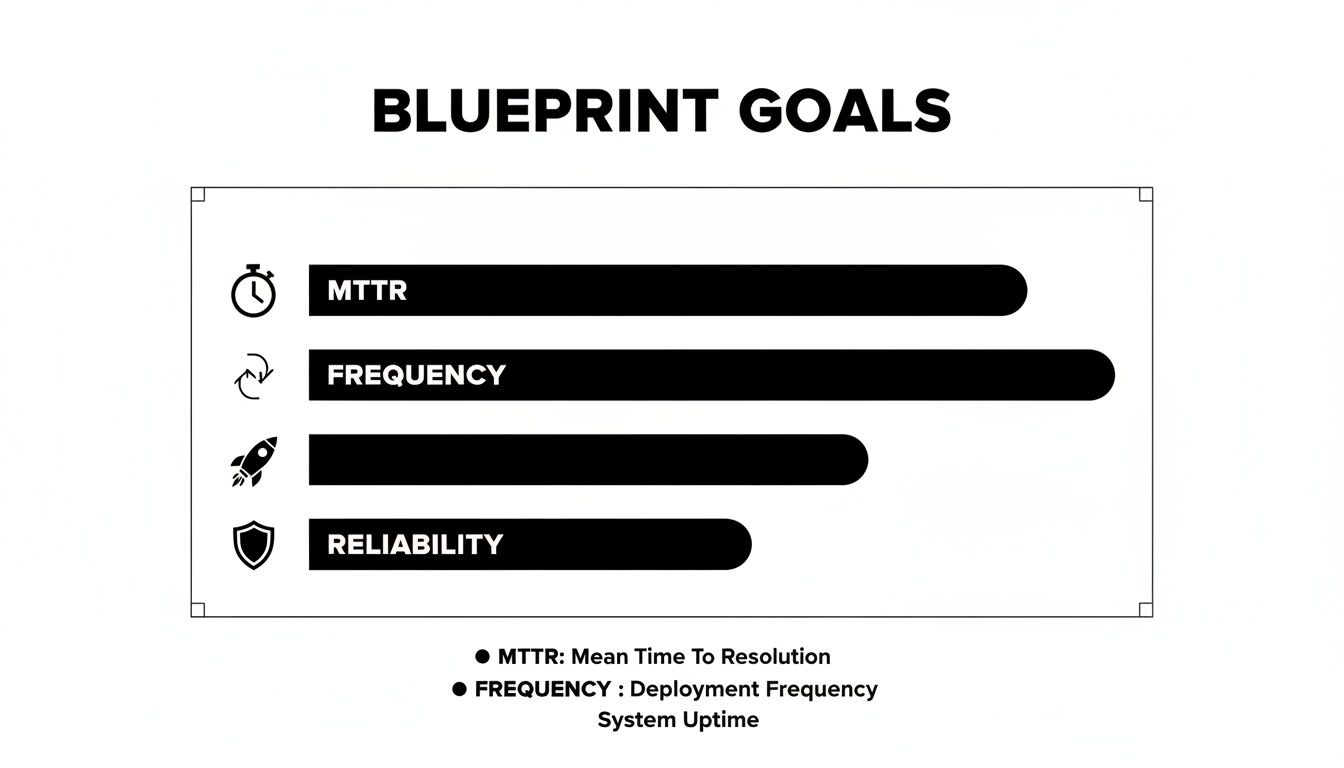
    To build this high-velocity engineering capability, a competent DevOps consultancy must demonstrate deep expertise across several interconnected technical domains. These disciplines are the foundational pillars for measurable improvements in deployment frequency, lead time for changes, mean time to recovery (MTTR), and change failure rate.

    This table breaks down the key functions and the specific technologies they implement:

    Technical Domain Strategic Objective Common Toolchains
    CI/CD Pipelines Implement fully automated build, integration, testing, and deployment workflows triggered by code commits. Jenkins, GitLab, GitHub Actions, CircleCI
    Infrastructure as Code (IaC) Define, provision, and manage infrastructure declaratively using version-controlled code for idempotent and reproducible environments. Terraform, Ansible, Pulumi, AWS CloudFormation
    Cloud & Containerization Architect and manage scalable, fault-tolerant applications using cloud-native services and container orchestration platforms. AWS, Azure, GCP, Docker, Kubernetes
    Observability & Monitoring Instrument applications and infrastructure to collect metrics, logs, and traces for proactive issue detection and performance analysis. Prometheus, Grafana, Datadog, Splunk
    Security (DevSecOps) Integrate security controls, vulnerability scanning, and compliance checks directly into the CI/CD pipeline ("shifting left"). Snyk, Checkmarx, HashiCorp Vault

    Each domain is a critical component of a holistic DevOps strategy, designed to create a feedback loop that continuously improves the speed, quality, and security of the software delivery process.

    The Strategic Business Impact

    The core technical deliverable of a DevOps firm is advanced workflow automation. This intense focus on automation is precisely why the DevOps market is experiencing significant growth.

    The global DevOps market was recently valued at $18.4 billion and is on track to hit $25 billion. It is no longer a niche methodology; a staggering 80% of Global 2000 companies now have dedicated DevOps teams, demonstrating its criticality in modern enterprise IT.

    A DevOps consulting firm fundamentally re-architects an organization's software delivery capability. The engagement shifts the operational model from infrequent, high-risk deployments to a continuous flow of validated changes, transforming technology from a cost center into a strategic business enabler.

    Engaging a firm is an investment in adopting new operational models and engineering practices, not just procuring tools. For companies committed to modernizing their technology stack, this partnership is essential. You can explore the technical specifics in our guide on DevOps implementation services.

    Evaluating Core Technical Service Offerings

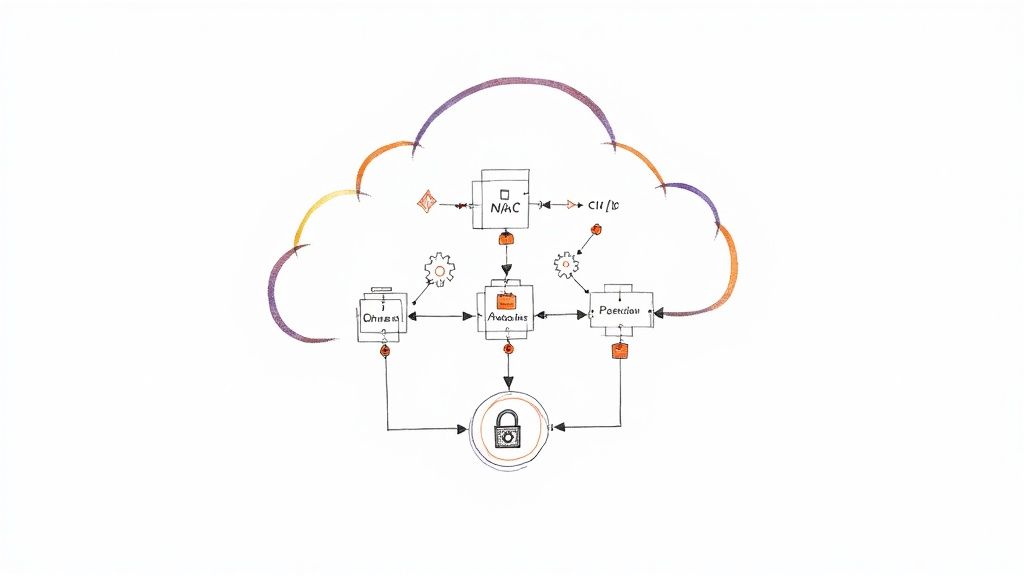
    A technical diagram showing interconnected cloud services, representing the core offerings of a DevOps consulting firm.

    When you engage a DevOps consulting firm, you are procuring expert-level engineering execution. The primary value is derived from the implementation of specific, measurable technical services. It is crucial to look beyond strategic presentations and assess their hands-on capabilities in building and managing modern software delivery systems.

    A high-quality firm integrates these services into a cohesive, automated system, creating a positive feedback loop that accelerates development velocity and improves operational stability.

    CI/CD Pipeline Construction and Automation

    The Continuous Integration/Continuous Deployment (CI/CD) pipeline is the core engine of a DevOps practice. It's an automated workflow that compiles, tests, and deploys code from a source code repository to production. A proficient firm architects a multi-stage, gated pipeline, not merely a single script.

    A typical implementation involves these technical stages:

    • Source Code Management (SCM) Integration: Configuring webhooks in Git repositories (e.g., GitHub, GitLab) to trigger pipeline executions in tools like GitLab CI or GitHub Actions upon every git push or merge request.
    • Automated Testing Gates: Scripting sequential testing stages (unit, integration, SAST, end-to-end) that act as quality gates. A failure in any stage halts the pipeline, preventing defective code from progressing and providing immediate feedback to the developer.
    • Artifact Management: Building and versioning immutable artifacts, such as Docker images or JAR files, and pushing them to a centralized binary repository like JFrog Artifactory. This ensures every deployment uses a consistent, traceable build.
    • Secure Deployment Strategies: Implementing deployment patterns like Blue/Green, Canary, or Rolling updates to release new code to production with zero downtime and provide a mechanism for rapid rollback in case of failure.

    Infrastructure as Code Implementation

    Manual infrastructure management is non-scalable, prone to human error, and a primary source of configuration drift. Infrastructure as Code (IaC) solves this by using declarative code to define and provision infrastructure. A DevOps consulting firm will use tools like Terraform or Ansible to manage the entire cloud environment—from VPCs and subnets to Kubernetes clusters and databases—as version-controlled code.

    By treating infrastructure as software, IaC makes environments fully idempotent, auditable, and disposable. This eliminates the "it works on my machine" problem by ensuring perfect parity between development, staging, and production environments.

    This technical capability allows a consultant to programmatically spin up an exact replica of a production environment for testing in minutes and destroy it afterward to control costs. IaC is the foundation for building stable, predictable systems on any major cloud platform (AWS, Azure, GCP).

    Containerization and Orchestration

    For building scalable and portable applications, containers are the de facto standard. Firms utilize Docker to package an application and its dependencies into a self-contained, lightweight unit. To manage containerized applications at scale, an orchestrator like Kubernetes is essential. Kubernetes automates the deployment, scaling, healing, and networking of container workloads.

    A skilled firm designs and implements a production-grade Kubernetes platform, addressing complex challenges such as:

    • Configuring secure inter-service communication and traffic management using a service mesh like Istio.
    • Implementing Horizontal Pod Autoscalers (HPAs) and Cluster Autoscalers to dynamically adjust resources based on real-time traffic load.
    • Integrating persistent storage solutions using Storage Classes and Persistent Volume Claims for stateful applications.

    The Kubernetes ecosystem is notoriously complex, which is why specialized expertise is often required. Our guide to Kubernetes consulting services provides a deeper technical analysis.

    Observability and DevSecOps Integration

    A system that is not observable is unmanageable. A seasoned DevOps consulting firm implements a comprehensive observability stack using tools like Prometheus for time-series metrics, Grafana for visualization, and the ELK Stack (Elasticsearch, Logstash, Kibana) for aggregated logging. This provides deep, real-time telemetry into application performance and system health.

    Simultaneously, they integrate security into the SDLC—a practice known as DevSecOps. This involves embedding automated security tooling directly into the CI/CD pipeline, such as Static Application Security Testing (SAST), Software Composition Analysis (SCA) for dependency vulnerabilities, and Dynamic Application Security Testing (DAST), making security a continuous and automated part of the development process.

    A Technical Vetting Checklist for Your Ideal Partner

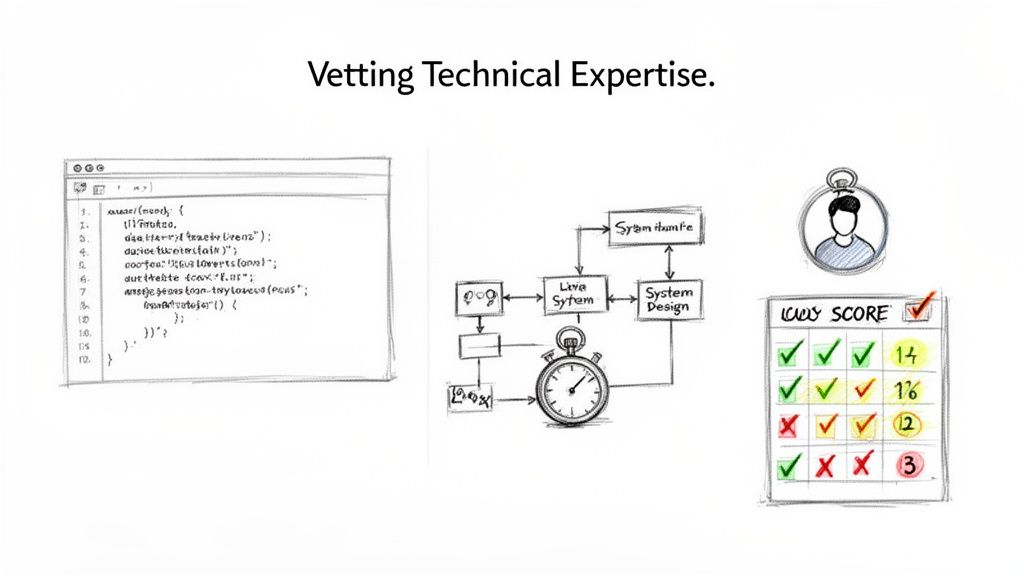
    Selecting a DevOps consulting firm requires a rigorous technical evaluation, not just a review of marketing materials. Certifications are a baseline, but the ability to architect solutions to complex, real-world engineering problems is the true differentiator.

    Your objective is to validate their hands-on expertise. This involves pressure-testing their technical depth on infrastructure design, security implementation, and collaborative processes. As you prepare your evaluation, it's useful to consult broader guides on topics like how to choose the best outsourcing IT company.

    Assessing Cloud Platform and IaC Expertise

    Avoid generic questions like, "Do you have AWS experience?" Instead, pose specific, scenario-based questions that reveal their operational maturity and architectural depth with platforms like AWS, Azure, or GCP.

    Probe their expertise with targeted technical inquiries:

    • Multi-Account Strategy: "Describe the Terraform structure you would use to implement a multi-account AWS strategy using AWS Organizations, Service Control Policies (SCPs), and IAM roles for cross-account access. How would you manage shared VPCs or Transit Gateway?"
    • Networking Complexity: "Walk me through the design of a resilient hybrid cloud network using AWS Direct Connect or Azure ExpressRoute. How did you handle DNS resolution, routing propagation with BGP, and firewall implementation for ingress/egress traffic?"
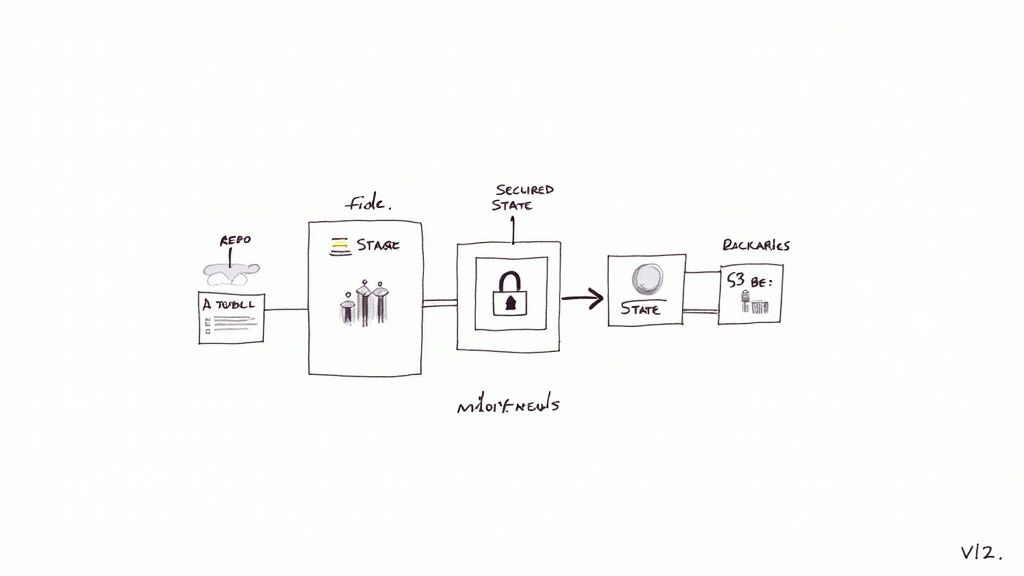
    • Infrastructure as Code (IaC): "Show me a sanitized example of a complex Terraform module you've written that uses remote state backends, state locking, and variable composition. How do you manage secrets within IaC without committing them to version control?"

    Their responses should demonstrate a command of enterprise-grade cloud architecture, not just surface-level service configuration. For a deeper analysis, see our article on vetting cloud DevOps consultants.

    Probing DevSecOps and Compliance Knowledge

    Security must be an integrated, automated component of the SDLC, not a final-stage manual review. A credible DevSecOps firm will demonstrate a "shift-left" security philosophy, embedding controls throughout the pipeline.

    Test their security posture with direct, technical questions:

    • "Describe the specific stages in a CI/CD pipeline where you would integrate SAST, DAST, SCA (dependency scanning), and container image vulnerability scanning. Which open-source or commercial tools would you use for each, and how would you configure the pipeline to break the build based on vulnerability severity?"
    • "Detail your experience in automating compliance for frameworks like SOC 2 or HIPAA. How have you used policy-as-code tools like Open Policy Agent (OPA) with Terraform or Kubernetes to enforce preventative controls and generate audit evidence?"

    These questions compel them to provide specific implementation details, revealing whether DevSecOps is a core competency or an afterthought.

    Evaluating Collaboration and Knowledge Transfer

    A true partner enhances your team's capabilities, aiming for eventual self-sufficiency rather than long-term dependency. They should function as a force multiplier, upskilling your engineers through structured collaboration.

    The DevOps consulting market varies widely. Some firms offer low-cost staff augmentation with global providers like eSparkBiz listing over 400 employees at rates from $12 to $25 per hour. Others position themselves as high-value strategic partners, with established firms of 250 employees charging premium rates between $25 and $99 for deep specialization. Top-rated firms consistently earn 4.6 to 5.0 stars on platforms like Clutch, indicating that client satisfaction and technical excellence are key differentiators.

    The most critical question to ask is: "What is your specific methodology for knowledge transfer?" An effective partner will outline a clear process involving pair programming, architectural design reviews, comprehensive documentation in a shared repository (e.g., Confluence), and hands-on training sessions.

    Their primary goal should be to empower your team to confidently operate and evolve the new systems long after the engagement concludes.


    How Regional Specializations Impact Technical Solutions

    A DevOps consulting firm's technical approach is often shaped by its primary region of operation. The regulatory constraints, market maturity, and dominant technology stacks in North America differ significantly from those in Europe or the Asia-Pacific.

    Ignoring these regional nuances can lead to a mismatch between a consultant's standard playbook and your specific technical and compliance requirements. A consultant with deep regional experience possesses an implicit understanding of local data center performance, prevalent compliance frameworks, and industry-specific demands.

    North America Focus on DevSecOps and Scale

    In the mature North American market, many organizations have already implemented foundational CI/CD and cloud infrastructure. Consequently, consulting firms in this region often focus on advanced, second-generation DevOps challenges.

    There is a significant emphasis on DevSecOps, moving beyond basic vulnerability scanning to integrating sophisticated security automation, threat modeling, and secrets management into the SDLC. North American consultants are typically experts in architecting for hyper-scale, designing multi-region, fault-tolerant systems capable of handling the massive, unpredictable traffic patterns of large consumer-facing applications.

    Europe Expertise in Compliance as Code

    In Europe, the regulatory environment, headlined by the General Data 'Protection Regulation (GDPR), is a primary driver of technical architecture. As a result, European DevOps firms have developed deep expertise in compliance-as-code.

    This practice involves codifying compliance rules and security policies into automated, auditable controls within the infrastructure and CI/CD pipeline. They utilize tools like Open Policy Agent (OPA) to create version-controlled policies that govern infrastructure deployments and data access, ensuring that the system is "compliant by default."

    This specialization makes them ideal partners for projects where data sovereignty, privacy, and regulatory adherence are non-negotiable architectural requirements.

    Asia-Pacific Diverse and Dynamic Strategies

    The Asia-Pacific (APAC) region is not a single market but a complex mosaic of diverse economies, each with unique technical requirements. In technologically advanced markets like Japan and South Korea, the focus is on AI-driven AIOps and edge computing for low-latency services in dense urban areas.

    Conversely, in the rapidly growing markets of Southeast Asia, the primary driver is often cost optimization and rapid scalability. Startups and scale-ups require lean, cloud-native architectures that enable fast growth without excessive infrastructure spend. A global market report highlights these varied regional trends. A successful APAC engagement requires a partner with proven experience navigating the specific economic and technological landscape of the target country.

    Your Phased Roadmap to DevOps Transformation

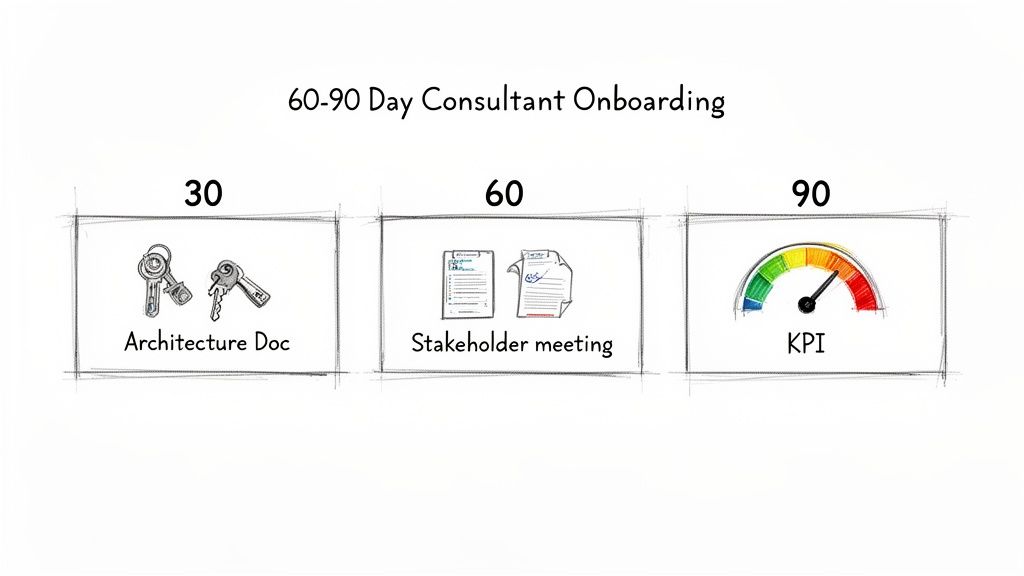
    A successful engagement with a DevOps consulting firm follows a structured, phased methodology. This approach is designed to de-risk the transformation, deliver incremental value, and ensure alignment with business objectives at each stage.

    Each phase builds logically on the previous one, establishing a solid technical foundation before scaling complex systems. This methodical process manages stakeholder expectations and delivers measurable, data-driven results.

    Phase 1: Technical Assessment and Discovery

    The engagement begins with a deep-dive technical audit of the current state. Consultants perform a comprehensive analysis of existing infrastructure, application architecture, source code repositories, and release processes.

    This involves mapping CI/CD workflows (or lack thereof), reverse-engineering manual infrastructure provisioning steps, and using metrics to identify key bottlenecks in the software delivery pipeline. The objective is to establish a quantitative baseline of current performance (e.g., deployment frequency, lead time).

    Phase 2: Strategic Roadmap and Toolchain Design

    With a clear understanding of the "as-is" state, the consultants architect the target "to-be" state. They produce a strategic technical roadmap that details the specific initiatives, timelines, and required resources.

    A critical deliverable of this phase is the selection of an appropriate toolchain. Based on the client's existing technology stack, team skills, and strategic goals, they will recommend and design an integrated set of tools for CI/CD (GitLab CI), IaC (Terraform), container orchestration (Kubernetes), and observability (Prometheus).

    Phase 3: Pilot Project Implementation

    To demonstrate value quickly and mitigate risk, the strategy is first implemented on a self-contained pilot project. The firm selects a single, representative application or service to modernize using the new architecture and toolchain.
    The pilot serves as a proof-of-concept, providing tangible evidence of the benefits—such as reduced deployment times or improved stability—in a controlled environment. A successful pilot builds technical credibility and secures buy-in from key stakeholders for a broader rollout.

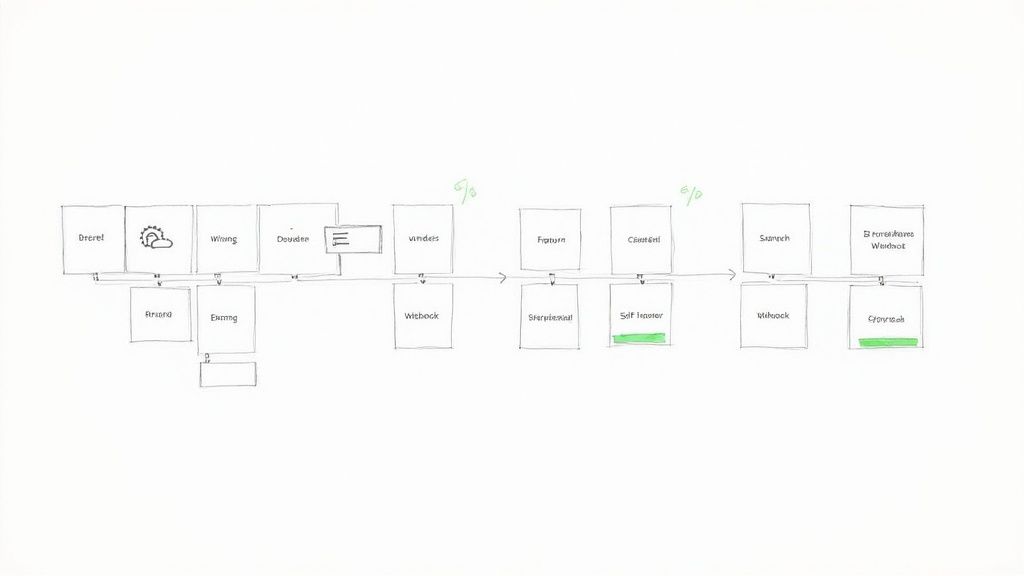
    The infographic below illustrates how regional priorities can influence the focus of a pilot project. For example, a North American pilot might prioritize automated security scanning, while a European one might focus on implementing compliance-as-code.
    Infographic about devops consulting firm

    The pilot must align with key business drivers to be considered a success, whether that is improving security posture or automating regulatory compliance.

    Phase 4: Scaling and Organizational Rollout

    Following a successful pilot, the next phase is to systematically scale the new DevOps practices across the organization. The technical patterns, IaC modules, and CI/CD pipeline templates developed during the pilot are productized and rolled out to other application teams.

    This is a carefully managed process. The consulting firm works directly with engineering teams, providing hands-on support, code reviews, and architectural guidance to ensure a smooth adoption of the new tools and workflows.

    Phase 5: Knowledge Transfer and Governance

    The final and most critical phase ensures the long-term success and self-sufficiency of the transformation. A premier DevOps consulting firm aims to make their client independent by institutionalizing knowledge. This is achieved through comprehensive documentation, a series of technical workshops, and pair programming sessions.

    Simultaneously, they help establish a governance model. This includes defining standards for code quality, security policies, and infrastructure configuration to maintain the health and efficiency of the new DevOps ecosystem. The ultimate goal is to foster a self-sufficient, high-performing engineering culture that owns and continuously improves its processes.

    Got Questions? We've Got Answers.

    Engaging a DevOps consulting firm is a significant technical and financial investment. It is critical to get clear, data-driven answers to key questions before committing to a partnership.

    Here are some of the most common technical and operational inquiries.

    How Do You Actually Measure Success?

    What's the real ROI of hiring a DevOps firm?

    The return on investment is measured through specific, quantifiable Key Performance Indicators (KPIs), often referred to as the DORA metrics.

    From an engineering standpoint, success is demonstrated by a significant increase in deployment frequency (from monthly to on-demand), a reduction in the change failure rate (ideally to <15%), and a drastically lower mean time to recovery (MTTR) following a production incident. You should also see a sharp decrease in lead time for changes (from code commit to production deployment).

    These technical metrics directly impact business outcomes by accelerating time-to-market for new features, improving service reliability, and increasing overall engineering productivity.

    How long does a typical engagement last?

    The duration is dictated by the scope of work. A targeted, tactical engagement—such as a CI/CD pipeline audit or a pilot IaC implementation for a single application—can be completed in 4-8 weeks.

    A comprehensive, strategic transformation—involving cultural change, legacy system modernization, and extensive team upskilling—is a multi-phase program that typically lasts from 6 to 18 months. A competent firm will structure this as a series of well-defined Sprints or milestones, each with clear deliverables.

    Will This Work With Our Current Setup?

    Is a consultant going to force us to use all new tools?

    No. A reputable DevOps consulting firm avoids a "rip and replace" approach. The initial phase of any engagement should be a thorough assessment of your existing toolchain and processes to identify what can be leveraged and what must be improved.

    The objective is evolutionary architecture, not a revolution. New tools are introduced only when they solve a specific, identified problem and offer a substantial improvement over existing systems. The strategy should be pragmatic and cost-effective, building upon your current investments wherever possible.

    What’s the difference between a DevOps consultant and an MSP?

    The roles are fundamentally different. A DevOps consultant is a strategic change agent. Their role is to design, build, and automate new systems and, most importantly, transfer knowledge to your internal team to make you self-sufficient. Their engagement is project-based with a defined endpoint.

    A Managed Service Provider (MSP) provides ongoing operational support. They take over the day-to-day management, monitoring, and maintenance of infrastructure. An MSP manages the environment that a DevOps consultant helps build. One architects and builds; the other operates and maintains.


    Ready to accelerate your software delivery with proven expertise? OpsMoon connects you with the top 0.7% of global DevOps engineers to build, automate, and scale your infrastructure. Start with a free work planning session to map your roadmap to success. Find your expert today.

  • How to Configure a Load Balancer: A Technical Guide

    How to Configure a Load Balancer: A Technical Guide

    Before you touch a single config file, you need a technical blueprint. A load balancer isn't a "set and forget" device; it's the control plane for your application's reliability and scalability. Initiating configuration without a clear architectural strategy is a direct path to introducing new bottlenecks, single points of failure, or resource contention.

    The core function is to distribute incoming network traffic across multiple backend servers. This distribution prevents any single server from becoming saturated under load, which would otherwise lead to performance degradation or complete failure.

    This distribution is also the mechanism for achieving high availability. If a backend server fails its health check, a properly configured load balancer will instantly and automatically remove it from the active server pool and reroute traffic to the remaining healthy instances. For your end-users, the failure is transparent. This principle is fundamental to building fault-tolerant, self-healing systems. To delve deeper into the architectural patterns, review this guide on understanding distributed systems and their topologies.

    Choosing Between Layer 4 and Layer 7

    Your first critical architectural decision is selecting the operational layer for load balancing. This choice dictates the sophistication of the routing logic your load balancer can execute.

    • Layer 4 (Transport Layer): This operates at the transport level (TCP/UDP). Decisions are made based on data from network packets, specifically source/destination IP addresses and ports. It's exceptionally fast due to its simplicity and doesn't need to inspect packet contents. This makes it ideal for high-throughput, non-HTTP/HTTPS workloads where raw packet-forwarding speed is paramount.

    • Layer 7 (Application Layer): This operates at the application level, providing access to protocol-specific data like HTTP headers, cookies, URL paths, and query parameters. This enables highly granular, content-aware routing decisions. For example, you can route requests for /api/v2 to a dedicated microservice pool or implement session persistence by inspecting a session cookie.

    Use this decision tree to determine the appropriate layer for your workload.

    Infographic about how to configure load balancer

    As illustrated, high-volume, simple TCP/UDP traffic is an optimal fit for Layer 4. However, any application requiring content-based routing logic necessitates the intelligence of a Layer 7 configuration.

    The demand for this level of sophisticated traffic management is a primary driver behind the global load balancer market's growth, which is currently valued at approximately $6.2 billion. Before proceeding, ensure you have a firm grasp of the core concepts by understanding the fundamentals of network load balancing.

    Comparing Common Load Balancing Algorithms

    After selecting the layer, you must choose a distribution algorithm. This logic dictates how the load balancer selects a backend server for each new request. The algorithm has a direct impact on resource utilization and application performance.

    Here is a technical analysis of the most common algorithms, their underlying mechanisms, and their optimal use cases.

    Algorithm Technical Mechanism Ideal Use Case
    Round Robin Iterates through a list of backend servers, forwarding each new request to the next server in a circular sequence. (server_index = request_count % server_count) Best for homogeneous server pools where all instances have identical processing capacity and handle stateless requests of similar complexity.
    Least Connections Maintains a real-time counter of active connections for each backend server and forwards the new request to the server with the lowest count. Excellent for applications with varying session durations or request complexities, as it dynamically distributes load based on current server workload, preventing overload on any single instance.
    IP Hash Computes a hash of the source client's IP address and uses this hash to consistently map the client to a specific backend server. (server_index = hash(client_ip) % server_count) Essential for stateful applications that require session persistence but cannot use cookies. It ensures all requests from a single client hit the same server, maintaining session state.
    Weighted Round Robin An extension of Round Robin where an administrator assigns a numerical "weight" to each server. Servers with a higher weight receive a proportionally larger number of requests. Perfect for heterogeneous environments with servers of varying capacities (CPU, RAM). It allows you to balance the load according to each server's actual processing power.

    While Round Robin is a common default, do not hesitate to switch to a more dynamic algorithm like Least Connections if monitoring reveals an imbalanced load distribution across your backend pool.

    Preparing Your Backend Environment

    A load balancer's reliability is entirely dependent on the health and consistency of the servers it manages. Before routing live traffic, your backend environment must be standardized, healthy, and reachable. A robust foundation here prevents intermittent and hard-to-diagnose production issues.

    Diagram showing a load balancer distributing traffic to a pool of backend servers

    The core of your backend is the server pool (also known as a target group or backend set). This is a logical grouping of server instances that will service requests. The non-negotiable rule is consistency: every server in the pool must be a functional replica.

    This means identical operating systems, application code, dependencies, and environment configurations. Any deviation can lead to inconsistent application behavior and elusive bugs. To enforce this uniformity, especially at scale, Infrastructure as Code (IaC) and configuration management tools like Ansible or Terraform are essential.

    Solidifying Network and Security Rules

    With your servers provisioned, the next technical step is configuring network connectivity. The load balancer requires a clear, low-latency network path to each backend instance. Misconfigured firewall or security group rules are a frequent source of deployment failures.

    You must configure your network ACLs and firewall rules (e.g., AWS Security Groups, Azure Network Security Groups) to explicitly allow inbound traffic from the load balancer's IP address or security group on the application's listening port (e.g., port 80 for HTTP, 443 for HTTPS). Crucially, this rule should be scoped as narrowly as possible. Do not allow traffic from 0.0.0.0/0 to your backend servers.

    Pro Tip: Your backend servers should never be directly accessible from the public internet. The load balancer must be the sole ingress point. This security posture, known as a bastion or jump host model for traffic, significantly reduces your application's attack surface and prevents users from bypassing your routing and security logic.

    Configuring Intelligent Health Checks

    A key function of a load balancer is its ability to automatically detect and eject unhealthy servers from the active rotation. This is accomplished via health checks. Without properly configured health checks, your load balancer would become a failure distributor, sending traffic to dead instances and causing widespread user-facing errors.

    You must define a precise mechanism for determining server health. Common and effective approaches include:

    • TCP Probes: The load balancer attempts to establish a TCP connection on a specified port. A successful three-way handshake constitutes a pass. This is a basic but reliable check to confirm that a service process is running and listening on the correct port.
    • HTTP/HTTPS Checks: A more robust method where the load balancer sends an HTTP/S GET request to a dedicated health check endpoint (e.g., /healthz or /status). It then inspects the HTTP response code, expecting a 200 OK. Any other status code (e.g., 503 Service Unavailable) is treated as a failure. This validates not just network connectivity but also the application's ability to process requests.

    When configuring these checks, you must fine-tune the timing and threshold parameters to control their behavior.

    Setting Description Recommended Practice
    Timeout The maximum time in seconds to wait for a health check response before considering it a failure. Keep this value low, typically 2-5 seconds, to enable rapid detection of unresponsive servers.
    Interval The time in seconds between consecutive health checks for a single instance. A moderate interval of 10-30 seconds strikes a balance between rapid detection and avoiding excessive health check traffic.
    Unhealthy Threshold The number of consecutive failed checks required to mark a server as unhealthy. Set to 2 or 3. A value of 1 can lead to false positives due to transient network issues (flapping).

    Correctly tuning these parameters creates a truly fault-tolerant system. By methodically preparing your backend servers, network rules, and health checks, you build a reliable foundation that simplifies all subsequent load balancer configuration.

    Configuring Your Load Balancer Listeners and Rules

    With a healthy backend pool established, you can now define the load balancer's frontend behavior. This involves configuring listeners and the associated routing rules that govern how incoming traffic is processed and directed.

    A listener is a process that checks for connection requests on a specific protocol and port combination. For a standard web application, you will configure at least two listeners:

    • HTTP on port 80.
    • HTTPS on port 443.

    When a client request arrives at the load balancer's public IP on one of these ports, the corresponding listener accepts the connection. A common best practice is to configure the HTTP listener on port 80 to issue a permanent redirect (HTTP 301) to the HTTPS listener on port 443, thereby enforcing secure connections.

    Engineering Your Routing Rules

    Once a listener accepts a connection, it applies a set of ordered rules to determine the appropriate backend server pool. This is where the power of Layer 7 load balancing becomes evident, allowing for sophisticated, content-aware traffic management that goes far beyond what a simple reverse proxy can offer. A solid understanding of how to configure a reverse proxy provides a good conceptual foundation.

    These rules inspect attributes of the incoming request and route it to a specific target group if the conditions are met. Common routing rule conditions include:

    • Path-Based Routing: Route requests based on the URL path. For instance, if (path == "/api/*") then forward to api_server_pool; while if (path == "/images/*") then forward to static_asset_servers;.
    • Hostname-Based Routing: Route traffic based on the HTTP Host header. For example, if (host == "store.example.com") then forward to ecommerce_backend; while if (host == "blog.example.com") then forward to wordpress_servers;.

    Rules are evaluated in a specific priority order (e.g., lowest numerical value first). It is critical to define a default rule with the lowest priority that catches all traffic not matching any specific condition, directing it to a primary server pool.

    A common mistake is building an overly complex rule set from the outset. Start with a simple default rule forwarding all traffic to your main backend pool. Then, incrementally add and test more specific rules one at a time to ensure they function as expected without unintended side effects.

    Implementing Session Persistence

    For many stateful applications, it is critical that all requests from a single user during a session are handled by the same backend server. Routing a user to a different server mid-session can result in lost state (e.g., an empty shopping cart), creating a frustrating user experience.

    This is solved with session persistence, also known as "sticky sessions."

    The most prevalent implementation is cookie-based affinity. Here is the technical workflow:

    1. A user sends their first request. The load balancer selects a backend server using the configured algorithm (e.g., Least Connections).
    2. Before forwarding the response to the user, the load balancer injects its own HTTP cookie (e.g., AWSALB, BIGipServer) into the response headers.
    3. The user's browser stores this cookie and automatically includes it in all subsequent requests to the same domain.
    4. The load balancer inspects incoming requests for this persistence cookie. If present, it bypasses the load-balancing algorithm and forwards the request directly to the server identified by the cookie's value.

    This mechanism ensures a consistent user experience for stateful applications. When configuring cookie-based affinity, you define a cookie name and an expiration time (TTL) which dictates the duration of the session stickiness.

    Boosting Security and Performance

    A modern load balancer serves as a critical network appliance for both security enforcement and performance optimization. By offloading specific tasks from your backend servers, you can significantly improve the resilience and speed of your application. These advanced configurations elevate the load balancer from a simple traffic distributor to the intelligent, high-performance core of your infrastructure.

    A shield icon superimposed on a server rack, symbolizing load balancer security

    One of the most impactful configurations is SSL/TLS termination (or SSL offloading). Instead of each backend server bearing the CPU-intensive overhead of TLS handshake negotiations, encryption, and decryption, this entire workload is centralized on the load balancer.

    The workflow is as follows: The load balancer handles the secure TLS connection with the client, decrypts the incoming HTTPS traffic, and then forwards the now-unencrypted HTTP request to the backend servers over your secure, private network. This offloading frees up significant CPU resources on your application servers, allowing them to focus exclusively on executing application logic. For a comprehensive look at backend efficiency, review these strategies for application performance optimization.

    Hardening Your Defenses with ACLs and a WAF

    With TLS termination enabled, the load balancer has full visibility into the decrypted Layer 7 traffic, which allows for the application of advanced security policies.

    Your primary defense mechanism should be Access Control Lists (ACLs). These are firewall rules that filter traffic based on source IP addresses. For example, you can implement a "deny" rule for known malicious IP address ranges or an "allow" rule for an internal application that only permits traffic from your corporate VPN's IP CIDR block. This is a highly effective method for blocking unauthorized access attempts at the network edge.

    A critical best practice is to integrate a Web Application Firewall (WAF) with your load balancer. A WAF inspects the content of HTTP requests for common attack vectors like SQL injection (SQLi) and cross-site scripting (XSS) based on a set of rules (e.g., the OWASP Top 10). Most cloud-native and hardware load balancers offer WAF integration as a native feature.

    Optimizing Content Delivery for Speed

    Beyond security, your load balancer can be configured to dramatically improve client-side performance.

    Enabling HTTP/2 on your HTTPS listener is a significant performance gain. HTTP/2 introduces multiplexing, allowing multiple requests and responses to be sent concurrently over a single TCP connection, which drastically reduces latency caused by head-of-line blocking present in HTTP/1.1.

    Additionally, enabling Gzip compression is essential. The load balancer can compress text-based assets (HTML, CSS, JavaScript) on-the-fly before sending them to the client's browser. The browser then decompresses the content. This can reduce payload sizes by up to 70%, resulting in substantially faster page load times and reduced bandwidth costs.

    These advanced features are becoming standard. The hardware load balancer market, valued at around $3.9 billion, is rapidly evolving to incorporate AI and machine learning for predictive traffic analysis and automated security threat mitigation. You can explore market research on hardware load balancers to understand how these intelligent systems are shaping the industry.

    Validating and Stress-Testing Your Configuration

    https://www.youtube.com/embed/hOG8PaYvdIA

    A load balancer configuration is purely theoretical until it has been validated under realistic conditions. Deploying an untested configuration into production is a direct cause of outages. A methodical validation and stress-testing protocol is mandatory to ensure a configuration is not just syntactically correct, but operationally resilient.

    The initial step is functional validation: confirm that the load balancer is distributing traffic according to the configured algorithm. A simple curl command within a loop is an effective tool for this. By inspecting a unique identifier in the response from each backend server, you can verify the distribution pattern.

    # A simple loop to check traffic distribution
    # Assumes each backend server returns a unique identifier, e.g., its hostname or container ID
    for i in {1..10}; do
      curl -s http://your-load-balancer-address/ | grep "Server-ID";
      sleep 1;
    done
    

    If you configured a Round Robin algorithm, the Server-ID in the output should cycle sequentially through your backend instances. This provides immediate confirmation of listener rule processing and backend pool health.

    Simulating Real-World Failure Scenarios

    Once you've confirmed basic traffic flow, you must validate the failover mechanism through chaos engineering. A server failure is an inevitability; your system must handle it gracefully. The only way to verify this is to induce a failure yourself.

    Intentionally stop the application process or shut down one of your backend server instances.

    Immediately re-run your curl loop. The output should now show traffic being routed exclusively to the remaining healthy instances, with the failed server completely absent from the rotation. This test is non-negotiable; it proves that your health check configuration (interval, timeout, and thresholds) is effective at detecting failure and that the load balancer correctly removes the failed node from the pool.

    This deliberate failure injection is critical. It validates that your configured thresholds are tuned correctly to remove a failed server from rotation quickly, thus minimizing the window of potential user impact.

    Performance and Load Testing Under Pressure

    With functional and failover capabilities verified, the final step is performance validation. You must understand the breaking point of your system under heavy load. Load testing tools like Apache JMeter or k6 are designed for this purpose, allowing you to simulate thousands of concurrent users.

    During these tests, monitor key performance indicators (KPIs) to identify bottlenecks. Focus on these critical metrics:

    • P99 Latency: The response time for the 99th percentile of requests. A sharp increase in this metric indicates that your backend servers are approaching saturation.
    • Requests Per Second (RPS): The maximum throughput your system can sustain before performance degrades or error rates increase. This defines your system's capacity.
    • Backend Error Rate: An increase in 5xx HTTP status codes (e.g., 502, 503, 504) from your backend servers is a definitive signal that they are overloaded and unable to process incoming requests.

    This data-driven testing methodology is what transitions your configuration from "functionally correct" to "production-ready." The economic reliance on highly available systems is driving the load balancer market's projected growth from $5.51 billion to $18.54 billion. This expansion is led by industries like fintech and e-commerce where downtime is unacceptable—a standard achievable only through rigorous, empirical testing. You can learn more about the driving forces behind the load balancer market to appreciate the criticality of these engineering practices.

    Load Balancer Configuration FAQs

    A person working on a laptop with network diagrams in the background, representing load balancer configuration.

    Even with meticulous planning, you will encounter technical challenges and questions during configuration. This section provides direct, technical answers to common issues to help you troubleshoot and optimize your setup.

    Can I Balance Non-HTTP Traffic?

    Yes. While web traffic (HTTP/S) is the most common use case, Layer 4 load balancers are designed to be protocol-agnostic. They operate at the transport layer (TCP/UDP) and are concerned only with IP addresses and port numbers, not the application-layer payload.

    This makes them suitable for a wide range of services:

    • Database Connections: Distributing read queries across a cluster of PostgreSQL or MySQL read replicas.
    • Gaming Servers: Handling high volumes of TCP and UDP packets for real-time multiplayer game sessions.
    • MQTT Brokers: Building a highly available and scalable backend for IoT device messaging.
    • Custom TCP Services: Any proprietary TCP-based application can be made highly available.

    The configuration simply requires creating a TCP or UDP listener on the load balancer instead of an HTTP/S listener, pointing it to your backend pool on the correct port.

    Key Takeaway: For any TCP/UDP-based service where application-level inspection is unnecessary and maximum throughput is the priority, a Layer 4 load balancer is the correct and most efficient tool.

    How Do I Handle Server Weight Differences?

    In real-world environments, server fleets are often heterogeneous, comprising a mix of instances with varying CPU and memory capacities. A simple Round Robin algorithm would overload less powerful servers.

    To solve this, use a Weighted Round Robin or Weighted Least Connections algorithm. These algorithms allow you to assign a numerical "weight" to each server in the backend pool during configuration.

    The load balancer distributes traffic proportionally to these weights. For example, a server with a weight of 200 will receive twice as many new connections as a server with a weight of 100. This allows you to precisely balance the load based on each machine's actual capacity, ensuring optimal resource utilization across your entire infrastructure.

    What Is the Difference Between a Load Balancer and a Reverse Proxy?

    While they appear functionally similar as intermediaries between clients and servers, their core purpose, feature set, and intended use case are distinct.

    A reverse proxy's primary functions are often forwarding, caching, SSL termination, and serving as a single gateway. A dedicated load balancer is engineered specifically for traffic distribution, high availability, and scalability.

    Here is a technical comparison:

    Feature Reverse Proxy (e.g., Nginx, HAProxy) Load Balancer (e.g., AWS ALB, F5 BIG-IP)
    Primary Goal Request forwarding, URL rewriting, caching, and serving as a single ingress point. Distributing traffic across a pool of servers to ensure high availability and scalability.
    Health Checks Often provides basic active or passive health checks. Core feature with advanced, configurable active health checks (TCP, HTTP/S, custom) and automated failover.
    Scalability Can become a single point of failure unless explicitly deployed in a complex high-availability cluster. Natively designed for high availability and dynamic scalability, often as a managed cloud service.

    In summary, while a reverse proxy can perform rudimentary load balancing, a true load balancer is a purpose-built, feature-rich appliance designed for the rigorous demands of managing production traffic at scale.


    Navigating the complexities of load balancing and infrastructure automation requires deep expertise. OpsMoon provides access to the top 0.7% of DevOps engineers who can design and implement a resilient, scalable, and secure architecture for your application. Start with a free work planning session to map out your infrastructure roadmap. Learn more at https://opsmoon.com.

  • A Developer’s Guide to Managing Feature Flags

    A Developer’s Guide to Managing Feature Flags

    To manage feature flags without creating unmaintainable spaghetti code, you need a full lifecycle process rooted in strict governance and automation. This process must cover everything from a flag's initial creation and rollout strategy to its mandatory cleanup. Without a disciplined approach, flags accumulate, turning into a significant source of technical debt that complicates debugging, testing, and new development. The key is implementing strict governance, clear ownership via a registry, and automated cleanup processes to maintain codebase velocity and health.

    Why You Can't Afford to Ignore Feature Flag Management

    Feature flags are a powerful tool in modern CI/CD, but they introduce a significant risk if managed poorly. Without a deliberate management strategy, they accumulate, creating a tangled web of conditional logic (if/else blocks) that increases the codebase's cyclomatic complexity. This makes the code brittle, exponentially harder to test, and nearly impossible for new engineers to reason about. This isn't a minor inconvenience; it's a direct path to operational chaos and crippling technical debt.

    The core problem is that flags created for temporary purposes—a canary release, an A/B test, or an operational toggle—are often forgotten once their initial purpose is served. Each orphaned flag represents a dead code path, a potential security vulnerability, and another layer of cognitive load for developers. Imagine debugging a production incident when dozens of latent flags could be altering application behavior based on user attributes or environmental state.

    The Hidden Costs of Poor Flag Hygiene

    Unmanaged flags create significant operational risk and negate the agility they are meant to provide. Teams lacking a formal process inevitably encounter:

    • Bloated Code Complexity: Every if/else block tied to a flag adds to the cognitive load required to understand a function or service. This slows down development on subsequent features and dramatically increases the likelihood of introducing bugs.
    • Testing Nightmares: With each new flag, the number of possible execution paths grows exponentially (2^n, where n is the number of flags). It quickly becomes computationally infeasible to test every permutation, leaving critical gaps in QA coverage and opening the door to unforeseen production failures.
    • Stale and Zombie Flags: Flags that are no longer in use but remain in the codebase are particularly dangerous. They can be toggled accidentally via an API call or misconfiguration, causing unpredictable behavior or, worse, re-enabling old bugs that were thought to be fixed.

    A disciplined, programmatic approach to managing feature flags is the difference between a high-velocity development team and one bogged down by its own tooling. The goal is to design flags as ephemeral artifacts, ensuring they are retired as soon as they become obsolete.

    From Ad-Hoc Toggles to a Governed System

    Effective flag management requires shifting from using flags as simple boolean switches to treating them as managed components of your infrastructure with a defined lifecycle. Organizations that master feature flag-driven development report significant improvements, such as a 20-30% increase in deployment frequency. This is achieved by decoupling code deployment from feature release, enabling safer and more frequent production updates. You can explore more insights about feature flag-based development and its impact on CI/CD pipelines.

    This transition requires a formal lifecycle for every flag, including clear ownership, standardized naming conventions, and a defined Time-to-Live (TTL). By embedding this discipline into your workflow, you transform feature flags from a potential liability into a strategic asset for continuous delivery.

    Building Your Feature Flag Lifecycle Management Process

    Allowing feature flags to accumulate is a direct path to technical debt and operational instability. To prevent this, you must implement a formal lifecycle management process, treating flags as first-class citizens of your codebase, not as temporary workarounds. This begins with establishing strict, non-negotiable standards for how every flag is created, documented, and ultimately decommissioned.

    The first step is enforcing a strict naming convention. A vague name like new-checkout-flow is useless six months later when the original context is lost. A structured format provides immediate context. A robust convention is [team]-[ticket]-[description]. For example, payments-PROJ123-add-apple-pay immediately tells any engineer the owning team (payments), the associated work item (PROJ-123), and its explicit purpose. This simple discipline saves hours during debugging or code cleanup.

    Establishing a Central Flag Registry

    A consistent naming convention is necessary but not sufficient. Every flag requires standardized metadata stored in a central flag registry—your single source of truth. This should not be a spreadsheet; it must be a version-controlled file (e.g., flags.yaml in your repository) or managed within a dedicated feature flagging platform like LaunchDarkly.

    This registry must track the following for every flag:

    • Owner: The team or individual responsible for the flag's lifecycle.
    • Creation Date: The timestamp of the flag's introduction.
    • Ticket Link: A direct URL to the associated Jira, Linear, or Asana ticket.
    • Expected TTL (Time-to-Live): A target date for the flag's removal, which drives accountability.
    • Description: A concise, plain-English summary of the feature's function and impact.

    This infographic illustrates how the absence of a structured process degrades agility and leads to chaos.

    Infographic about managing feature flags

    Without a formal process, initial agility quickly spirals into unmanageable complexity. A structured lifecycle is the only way to maintain predictability and control at scale.

    A clean flag definition in a flags.yaml file might look like this:

    flags:
      - name: "payments-PROJ123-add-apple-pay"
        owner: "@team-payments"
        description: "Enables the Apple Pay option in the checkout flow for users on iOS 16+."
        creationDate: "2024-08-15"
        ttl: "2024-09-30"
        ticket: "https://your-jira.com/browse/PROJ-123"
        type: "release"
        permanent: false
    

    This registry serves as the foundation of your governance model, providing immediate context for audits and automated tooling. For technical implementation details, our guide on how to implement feature toggles offers a starting point.

    Differentiating Between Flag Types

    Not all flags are created equal, and managing them with a one-size-fits-all approach is a critical mistake. Categorizing flags by type is essential because each type has a different purpose, risk profile, and expected lifespan. This categorization should be enforced at the time of creation.

    Feature Flag Type and Use Case Comparison

    This table provides a technical breakdown of common flag types. Selecting the correct type from the outset defines its lifecycle and cleanup requirements.

    Flag Type Primary Use Case Typical Lifespan Key Consideration
    Release Toggles Decoupling deployment from release; gradual rollouts of new functionality. Short-term (days to weeks) Must have an automated cleanup ticket created upon reaching 100% rollout.
    Experiment Toggles A/B testing, multivariate testing, or canary releases to compare user behavior. Medium-term (weeks to months) Requires integration with an analytics pipeline to determine a winning variant before removal.
    Operational Toggles Enabling or disabling system behaviors for performance (e.g., circuit breakers), safety, or maintenance. Potentially long-term Must be reviewed quarterly to validate continued necessity. Overuse indicates architectural flaws.
    Permission Toggles Controlling access to features for specific user segments based on entitlements (e.g., beta users, premium subscribers). Long-term or permanent Directly tied to the product's business logic and user model; should be clearly marked as permanent: true.

    By defining a flag's type upon creation, you are pre-defining its operational lifecycle.

    A 'release' flag hitting 100% rollout should automatically trigger a cleanup ticket in the engineering backlog. An 'operational' flag, on the other hand, should trigger a quarterly review notification to its owning team.

    This systematic approach transforms flag creation from an ad-hoc developer task into a governed, predictable engineering practice. It ensures every flag is created with a clear purpose, an owner, and a predefined plan for its eventual decommission. This is how you leverage feature flags for velocity without accumulating technical debt.

    Once a robust lifecycle is established, the next step is integrating flag management directly into your CI/CD pipeline. This transforms flags from manual toggles into a powerful, automated release mechanism, enabling safe and predictable delivery at scale. The primary principle is to manage flag configurations as code (Flags-as-Code). Instead of manual UI changes, the pipeline should programmatically manage flag states for each environment via API calls or declarative configuration files. This eliminates the risk of human error, such as promoting a feature to production prematurely.

    Environment-Specific Flag Configurations

    A foundational practice is defining flag behavior on a per-environment basis. A new feature should typically be enabled by default in dev and staging for testing but must be disabled in production until explicitly released. This is handled declaratively, either through your feature flagging platform's API or with environment-specific config files stored in your repository.

    For a new feature checkout-v2, the declarative configuration might be:

    • config.dev.yaml: checkout-v2-enabled: true (Always on for developers)
    • config.staging.yaml: checkout-v2-enabled: true (On for QA and automated E2E tests)
    • config.prod.yaml: checkout-v2-enabled: false (Safely off until release)

    This approach decouples deployment from release, a cornerstone of modern DevOps. To fully leverage this model, it's crucial to understand the theories and practices of CI/CD.

    Securing Flag Management with Access Controls and Audits

    As flags become central to software delivery, controlling who can modify them and tracking when changes occur becomes critical. This is your primary defense against unauthorized or accidental production changes.

    Implement Role-Based Access Control (RBAC) to define granular permissions:

    • Developers: Can create flags and toggle them in dev and staging.
    • QA Engineers: Can modify flags in staging to execute test plans.
    • Product/Release Managers: Are the only roles permitted to modify flag states in production, typically as part of a planned release or incident response.

    Every change to a feature flag's state, especially in production, must be recorded in an immutable audit log. This log should capture the user, the timestamp, and the exact change made. This is invaluable during incident post-mortems.

    When a production issue occurs, the first question is always, "What changed?" A detailed, immutable log of flag modifications provides the answer in seconds, not hours.

    Automated Smoke Testing Within the Pipeline

    A powerful automation is to build a smoke test that validates code behind a disabled flag within the CI/CD pipeline. This ensures that new, unreleased code merged to your main branch doesn't introduce latent bugs.

    Here is a technical workflow:

    1. Deploy Code: The pipeline deploys the latest build to a staging environment with the new feature flag (new-feature-x) globally OFF.
    2. Toggle Flag ON (Scoped): The pipeline makes an API call to the flagging service to enable new-feature-x only for the test runner's session or a specific test user.
    3. Run Test Suite: A targeted set of automated integration or end-to-end tests runs against critical application paths affected by the new feature.
    4. Toggle Flag OFF: Regardless of test outcome, the pipeline makes another API call to revert the flag's state, ensuring the environment is clean for subsequent tests.
    5. Report Status: If the smoke tests pass, the build is marked as stable. If they fail, the pipeline fails, immediately notifying the team of a breaking change in the unreleased code.

    This automated validation loop provides a critical safety net, giving developers the confidence to merge feature branches frequently without destabilizing the main branch—the core tenet of continuous integration. For more on this, review our guide on CI/CD pipeline best practices.

    Advanced Rollout and Experimentation Strategies

    Once you have mastered basic flag management, you can leverage them for more than simple on/off toggles. This is where you unlock their true power: sophisticated deployment strategies that de-risk releases and provide invaluable product insights. By using flags for gradual rollouts and production-based experiments, you can move from "release and pray" to data-driven delivery.

    These advanced techniques allow you to validate major changes with real users before committing to a full launch.

    Person looking at a complex dashboard with charts and graphs

    Executing a Technical Canary Release

    A canary release is a technique for testing new functionality with a small subset of production traffic, serving as an early warning system for bugs or performance degradation. Managing feature flags is the mechanism that makes this process precise and controllable.

    You begin by creating a feature flag with percentage-based or attribute-based targeting rules. Instead of a simple true/false state, this flag intelligently serves the new feature to a specific cohort.

    A common first step is an internal-only release (dogfooding):

    • Targeting Attribute: user.email
    • Rule: if user.email.endsWith('@yourcompany.com') then serve: true
    • Default Rule: serve: false

    After internal validation, you can progressively expand the rollout. The next phase might target 1% of production traffic. You configure the flag to randomly assign 1% of users to the true variation.

    This gradual exposure is critical. You must monitor key service metrics (error rates via Sentry/Datadog, latency, CPU utilization) for any negative correlation with the rollout. If metrics remain stable, you can increase the percentage to 5%, then 25%, and eventually 100%, completing the release.

    Setting Up A/B Experiments with Flags

    Beyond risk mitigation, feature flags are essential tools for running A/B experiments. This allows you to test hypotheses by serving different experiences to separate user groups and measuring which variant performs better against a key business metric, such as conversion rate.

    To execute this, you need a multivariate flag—one that can serve multiple variations, not just on or off.

    Consider a test on a new checkout button color:

    • Flag Name: checkout-button-test-q3
    • Variation A ("control"): {"color": "#007bff"} (The original blue)
    • Variation B ("challenger"): {"color": "#28a745"} (A new green)

    You configure this flag to split traffic 50/50. The flagging SDK ensures each user is sticky and consistently bucketed into one variation. Critically, your application code must report which variation a user saw when they complete a goal action.

    Your analytics instrumentation would look like this:

    // Get the flag variation for the current user
    const buttonVariation = featureFlagClient.getVariation('checkout-button-test-q3', { default: 'control' });
    
    // When the button is clicked, fire an analytics event with the variation info
    analytics.track('CheckoutButtonClicked', {
      variationName: buttonVariation,
      userId: user.id
    });
    

    This data stream allows your analytics platform to determine if Variation B produced a statistically significant lift in clicks.

    By instrumenting your code to report metrics based on flag variations, you transition from making decisions based on intuition to making them based on empirical data. This transforms a simple toggle into a powerful business intelligence tool.

    These techniques are fundamental to modern DevOps. Teams that effectively use flags for progressive delivery report up to a 30% reduction in production incidents because they can instantly disable a problematic feature without a high-stress rollback. For more, explore these feature flag benefits and best practices.

    A Practical Guide To Cleaning Up Flag-Driven Tech Debt

    Feature flags are intended to be temporary artifacts. Without a disciplined cleanup strategy, they become permanent fixtures, creating a significant source of technical debt that complicates the codebase and slows development. The key is to treat cleanup as a mandatory, non-negotiable part of the development lifecycle, not as a future chore.

    This is a widespread problem; industry data shows that about 35% of firms struggle with cleaning up stale flags, leading directly to increased code complexity. A proactive, automated cleanup process is essential for maintaining a healthy and simple codebase.

    A developer cleaning up code on a screen, representing technical debt cleanup.

    Establish a Formal Flag Retirement Process

    First, implement a formal, automated "Flag Retirement" workflow. This process begins when a flag is created by assigning it a Time-to-Live (TTL) in your flag management system. This sets the expectation from day one that the flag is temporary. As the TTL approaches, automated alerts should be sent to the flag owner's Slack channel or email, prompting them to initiate the retirement process.

    The retirement workflow should consist of clear, distinct stages:

    • Review: The flag owner validates that the flag is no longer needed (e.g., the feature has rolled out to 100% of users, the A/B test has concluded).
    • Removal: A developer creates a pull request to remove the conditional if/else logic associated with the flag, deleting the now-obsolete code path.
    • Archiving: The flag is archived in the management platform, removing it from active configuration while preserving its history for audit purposes.

    Using Static Analysis To Hunt Down Dead Code

    Manual cleanup is error-prone and inefficient. Use static analysis tools to automatically identify dead code paths associated with stale flags. These tools can scan the codebase for references to flags that are permanently configured to true or false in production.

    For a release flag like new-dashboard-enabled that has been at 100% rollout for months, a static analysis script can be configured to find all usages and automatically flag the corresponding else block as unreachable (dead) code. This provides developers with an actionable, low-risk list of code to remove.

    Automating the detection of stale flags shifts the burden from unreliable human memory to a consistent, repeatable process, preventing the gradual accumulation of technical debt.

    For more strategies on this topic, our guide on how to manage technical debt provides complementary techniques.

    Scripting Your Way To a Cleaner Codebase

    Further automate cleanup by writing scripts that utilize your flag management platform's API and your Git repository's history. This powerful combination helps answer critical questions like, "Which flags have a 100% rollout but still exist in the code?" or "Which flags are referenced in code but are no longer defined in our flagging platform?"

    A typical cleanup script's logic would be:

    1. Fetch All Flags: Call the flagging service's API to get a JSON list of all defined flags and their metadata (e.g., creation date, current production rollout percentage).
    2. Scan Codebase: Use a tool like grep or an Abstract Syntax Tree (AST) parser to find all references to these flags in the repository.
    3. Cross-Reference Data: Identify flags that are set to 100% true for all users but still have conditional logic in the code.
    4. Check Git History: For flags that appear stale, use git log -S'flag-name' to find the last time the code referencing the flag was modified. A flag that has been at 100% for six months and whose code hasn't been touched in that time is a prime candidate for removal.

    This data-driven approach allows you to prioritize cleanup efforts on the oldest and riskiest flags. To learn more about systematic code maintenance, explore various approaches on how to reduce technical debt. By making cleanup an active, automated part of your engineering culture, you ensure feature flags remain a tool for agility, not a long-term liability.

    Common Questions on Managing Feature Flags

    As your team adopts feature flags, practical questions about long-term management, testing strategies, and distributed architectures will arise. Here are technical answers to common challenges.

    Handling Long-Lived Feature Flags

    Not all flags are temporary. Operational kill switches, permission toggles, and architectural routing flags may be permanent. Managing them requires a different strategy than for short-lived release toggles.

    • Explicitly Categorize Them: In your flag registry, mark them as permanent (e.g., permanent: true). This tag should exclude them from automated TTL alerts and cleanup scripts.
    • Mandate Periodic Reviews: Schedule mandatory quarterly or semi-annual reviews for all permanent flags. The owning team must re-validate the flag's necessity and document the review's outcome.
    • Document Their Impact: For permanent flags, documentation is critical. It must clearly state the flag's purpose, the system components it affects, and the procedure for operating it during an incident.

    The Best Way to Test Code Behind a Flag

    Code behind a feature flag requires more rigorous testing, not less, to cover all execution paths. A multi-layered testing strategy is essential.

    1. Unit Tests (Mandatory): Unit tests must cover both the on and off states. Mock the feature flag client to force the code down each conditional path and assert the expected behavior for both scenarios.
    2. Integration Tests in CI: Your CI pipeline should run integration tests against the default flag configuration for that environment. This validates that the main execution path remains stable.
    3. End-to-End (E2E) Tests: Use frameworks like Cypress or Selenium to test full user journeys. These tools can dynamically override a flag's state for the test runner's session (e.g., via query parameters, cookies, or local storage injection), allowing you to validate the new feature's full workflow even if it is disabled by default in the test environment.

    The cardinal rule is: new code behind a flag must have comprehensive test coverage for all its states. A feature flag is not an excuse to compromise on quality.

    Managing Flags Across Microservices

    In a distributed system, managing flags with local configuration files is an anti-pattern that leads to state inconsistencies and debugging nightmares. A centralized feature flagging service is not optional; it is a requirement for microservice architectures.

    Each microservice should initialize a client SDK on startup that fetches flag configurations from the central service. The SDK should subscribe to a streaming connection (e.g., Server-Sent Events) for real-time updates. This ensures that when a flag's state is changed in the central dashboard, the change propagates to all connected services within seconds. This architecture prevents state drift and ensures consistent behavior across your entire system.

    Using a dedicated service decouples feature release from code deployment, provides powerful targeting capabilities, and generates a critical audit trail—all of which are nearly impossible to achieve reliably with distributed config files in Git.


    Ready to implement a robust DevOps strategy without the overhead? At OpsMoon, we connect you with the top 0.7% of remote DevOps engineers to build, scale, and manage your infrastructure. Get started with a free work planning session and let our experts map out your roadmap to success.

  • Agile DevOps: A Practical Guide to Implementation

    Agile DevOps: A Practical Guide to Implementation

    Agile and DevOps aren't two competing methodologies; they are complementary disciplines that, when combined, create a powerful engine for software delivery. Think of it as a cultural and technical framework where the customer-focused, iterative loops of Agile define what to build, while the automation and continuous delivery practices of DevOps define how to build and ship it efficiently and reliably.

    This integrated approach dismantles the traditional silos between development and operations teams, creating a single, streamlined value stream from a concept on a backlog to a feature running in production. The objective is to align teams around a shared goal: delivering high-quality software, faster.

    The Synergy of Agile and DevOps

    At its core, the Agile DevOps model is a partnership designed to accelerate the delivery of value to end-users. Agile frameworks like Scrum or Kanban provide the structure for planning and executing work in short, iterative cycles. You organize work into sprints, manage a prioritized backlog, and continuously gather feedback, creating a clear pipeline of user stories ready for implementation.

    DevOps then takes those well-defined software increments and automates their entire journey from a developer's local machine to the production environment.

    Two teams collaborating at a whiteboard, representing the synergy between Agile and DevOps.

    Here's the technical breakdown: Agile provides the "why" and the "what" through user stories, business value metrics, and iterative development. DevOps delivers the "how" with a robust CI/CD (Continuous Integration/Continuous Delivery) pipeline, Infrastructure as Code (IaC), and automated quality gates.

    Without Agile, a DevOps team might efficiently automate the deployment of the wrong features. Without DevOps, an Agile team could develop valuable features that remain stuck in slow, manual, and error-prone release cycles. To dive deeper into the core principles, this guide on what is DevOps methodology is an excellent resource.

    Unifying Speed and Direction

    This combination directly addresses the classic conflict between development teams, who are incentivized to ship features quickly, and operations teams, who are tasked with maintaining system stability. An Agile DevOps culture resolves this by establishing shared goals and accountability. Both teams become responsible for the entire software lifecycle, from initial code commit to production performance monitoring.

    The technical and business gains from this alignment are significant:

    • Faster Time-to-Market: CI/CD pipelines automate builds, testing, and deployments, eliminating manual handoffs. Features developed in an Agile sprint can be deployed in hours, not weeks.
    • Improved Quality and Reliability: By integrating automated testing (unit, integration, E2E) and security scanning early in the development process (shifting left), teams detect and remediate defects when they are least expensive to fix.
    • Enhanced Adaptability: Short feedback loops—from both automated tests and end-users—allow teams to pivot quickly based on real-world data. This ensures engineering effort is always focused on maximum-impact work.

    A true Agile DevOps setup isn't just about new tools. It's about building a culture of shared ownership, continuous improvement, and blameless problem-solving. A production incident is treated as a systemic failure to be learned from, not an individual's fault.

    This cultural shift is the non-negotiable foundation. It empowers engineers to experiment, innovate, and take end-to-end ownership, which is the ultimate driver of both velocity and stability. The following sections provide a technical roadmap for establishing this culture and the workflows that support it.

    Building the Cultural Foundation for Success

    Before configuring a single CI/CD pipeline or writing a line of YAML, you must focus on your team's culture. Technology only accelerates the existing processes and behaviors; your culture is the engine. Many DevOps initiatives fail because they treat it as a tooling problem rather than a human and process problem.

    The primary objective is to dismantle the organizational silos that separate Development, Operations, and Quality Assurance. These silos create friction, misaligned incentives, and a "throw it over the wall" mentality that is toxic to speed and quality. An effective Agile DevOps culture replaces these walls with bridges built on shared ownership, transparent communication, and mutual respect.

    This is no longer a niche strategy; it's the industry standard. Agile methodology adoption has skyrocketed. In 2020, approximately 37% of developers utilized agile frameworks. By 2025, that figure is projected to reach 86%, according to industry analysis. This rapid adoption reflects a widespread recognition of its benefits. You can explore more data in these Agile adoption statistics.

    Fostering Psychological Safety

    The absolute bedrock of a high-performing, collaborative culture is psychological safety. This is an environment where engineers feel safe to experiment, ask questions, challenge the status quo, and admit mistakes without fear of retribution. When engineers fear blame, they avoid taking calculated risks, which stifles innovation and slows down problem resolution.

    Leaders must model this behavior by openly acknowledging their own errors and framing every failure as a learning opportunity.

    Blameless Postmortems: A Cornerstone Practice
    When an incident occurs, the focus must shift from "who caused this?" to "what systemic weakness allowed this to happen?". This reframing directs the team toward identifying and fixing root causes in the system—be it insufficient testing, ambiguous alerting, or a brittle deployment process—rather than assigning individual blame. The output should be actionable follow-up tasks assigned to the team's backlog.

    This practice fosters transparency and encourages proactive problem-solving. Engineers become more willing to flag potential issues early because they trust the process is about collective improvement, not punishment.

    Creating Cross-Functional Teams with Shared Ownership

    Silos are best dismantled by creating durable, product-oriented teams that possess all the skills necessary to deliver value from concept to production. A truly cross-functional team includes developers, operations engineers, QA specialists, security experts, and a product owner, all aligned around a common set of objectives.

    These teams must be granted both responsibility and authority. They should own their service's entire lifecycle, including architecture, development, testing, deployment, and on-call support. This autonomy cultivates a powerful sense of accountability and pride. Understanding the essential roles in agile software development is key to assembling these effective teams.

    Here are actionable team rituals to reinforce this collaborative model:

    • Daily Stand-ups: This is a daily synchronization meeting, not just a status report. It's an opportunity for Ops and QA to raise concerns about non-functional requirements or testing environments alongside developers' progress on features.
    • Unified Backlogs: A single, prioritized backlog must contain all work: new features (stories), technical debt, bug fixes, and operational tasks (e.g., "Upgrade Postgres database"). This makes all work visible and forces the team to make collective trade-off decisions.
    • Shared On-Call Rotations: When developers are on the hook for production incidents, they are intrinsically motivated to write more resilient, observable, and maintainable code. This "you build it, you run it" model is one of the most effective drivers of software quality.

    By implementing these structures, you align incentives and make collaboration the path of least resistance. The team's success becomes a shared outcome, which is the essence of an Agile DevOps culture.

    Designing Your Agile DevOps Workflow

    With a collaborative culture in place, the next step is to engineer the technical workflow. This involves creating a clear, repeatable, and automated process to move ideas from the backlog to production. This is about building a system optimized for speed, feedback, and value delivery.

    Begin by mapping your value stream—every single step from a user story's creation to its deployment and validation in production. This exercise is critical for identifying bottlenecks, manual handoffs, and wait times that are silently eroding your delivery speed. A well-designed workflow ensures that the work prioritized in Agile sprints flows through the CI/CD pipeline without friction.

    This process is underpinned by the cultural shifts previously discussed. Without them, even the most technically elegant workflow will fail under pressure.

    As illustrated, dismantling silos and aligning teams on shared objectives are the foundational prerequisites for an efficient, collaborative workflow.

    Connecting Agile Planning to Technical Execution

    The critical link in an Agile DevOps workflow is the traceability from product backlog items to code commits. Every task or user story must be directly linked to the Git commits that implement it. This creates an auditable trail from business requirement to technical solution.

    To achieve this, implement a robust Git branching strategy. This decision profoundly impacts team collaboration and release cadence.

    • GitFlow: A structured model with long-lived develop and main branches, alongside supporting branches for features, releases, and hotfixes. It provides strict control, which can be suitable for projects with scheduled, versioned releases. However, its complexity can create merge conflicts and slow down teams aiming for continuous delivery.
    • Trunk-Based Development (TBD): Developers integrate small changes directly into a single main branch (the "trunk") multiple times a day. Incomplete features are managed using feature flags to keep the trunk in a deployable state. TBD simplifies the branching model, minimizes merge hell, and is the standard for high-performing teams practicing continuous integration.

    For most modern Agile DevOps teams, Trunk-Based Development is the target state. It enforces the small, frequent integrations that are fundamental to CI/CD.

    Defining a Robust Definition of Done

    In a DevOps context, "Done" means far more than "code complete." A feature is not truly done until it is deployed to production, delivering value to users, and being monitored for performance and errors. Therefore, your team's Definition of Done (DoD) must encompass operational readiness.

    Your Definition of Done is a non-negotiable quality checklist. It ensures that non-functional requirements like security, performance, and observability are engineered into the product from the start, not treated as an afterthought.

    A technical DoD for an Agile DevOps team should include criteria such as:

    • Code is peer-reviewed (pull request approved) and merged to the main branch.
    • All unit and integration tests pass in the CI pipeline (>90% code coverage).
    • Infrastructure as Code (IaC) changes (e.g., Terraform plans) are reviewed and applied.
    • Performance tests against a production-like environment meet latency and throughput SLOs.
    • Static Application Security Testing (SAST) and Software Composition Analysis (SCA) scans report no new critical vulnerabilities.
    • Structured logging, metrics (e.g., RED metrics), and key alerts are configured and tested.
    • The feature is deployed and validated in a staging environment behind a feature flag.
    • The product owner has accepted the feature as meeting acceptance criteria.

    This checklist acts as a quality gate, ensuring that any work item completing a sprint is genuinely production-ready.

    Structuring Sprints for Continuous Flow

    Finally, structure your sprints to promote a continuous flow of value, not a "mini-waterfall" where development occurs in week one and testing is rushed in week two. The goal is to avoid end-of-sprint integration chaos.

    To learn more about this integration, explore how Agile and continuous delivery complement each other to establish a predictable and sustainable delivery rhythm.

    Instead, the team should focus on completing and deploying small, vertical slices of functionality continuously throughout the sprint. This approach provides faster feedback loops and reduces the risk associated with large, infrequent integrations. By combining a clear value stream, a TBD branching strategy, and a robust DoD, you engineer a workflow that makes rapid, reliable delivery the default mode of operation.

    Building Your Modern CI/CD Toolchain

    While culture and workflow define the strategy of agile dev ops, the toolchain is the tactical engine that executes it. A well-architected CI/CD toolchain automates the entire software delivery lifecycle, transforming principles into practice. It is an integrated system designed to move code from a developer's IDE to production with maximum velocity and minimal risk.

    This is no longer an optional advantage; it's a competitive necessity. Projections indicate that by 2025, approximately 80% of organizations will have adopted DevOps practices. The data is compelling: 99% of organizations that implement DevOps report positive results, with 61% observing a direct improvement in software quality. You can explore these trends further in this report on the state of DevOps in 2025.

    Diagram showing the CI/CD pipeline stages, from code commit to deployment.

    Let's break down the essential components of a modern CI/CD pipeline and the industry-standard tools for each stage.

    Version Control: The Single Source of Truth

    Every automated process begins with a git commit. Your version control system (VCS) is the absolute source of truth not just for application code, but also for infrastructure configuration, pipeline definitions, and monitoring setup. Git is the de facto standard, providing the foundation for collaboration, change tracking, and triggering automated workflows.

    Hosted Git platforms like GitHub, GitLab, and Bitbucket are essential. They provide critical features for pull requests (code reviews), issue tracking, and native CI/CD integrations. The core principle is non-negotiable: every change to the system must be versioned, peer-reviewed, and auditable.

    Build and Test Automation

    Upon a commit to the repository, the CI pipeline is triggered. A build automation server compiles the code, runs a comprehensive suite of automated tests (unit, integration, component), and packages the application into a deployable artifact. This stage provides the rapid feedback loop that is essential for agile development.

    Key tools in this space include:

    • Jenkins: The highly extensible, open-source automation server. Jenkins is known for its vast plugin ecosystem. Its declarative Pipeline-as-Code feature allows you to define your entire CI/CD process in a Jenkinsfile, which is versioned alongside your application code.
    • GitLab CI/CD: A tightly integrated solution for teams using GitLab. The entire pipeline is defined in a .gitlab-ci.yml file within the repository, providing a seamless, all-in-one experience from code management to deployment that is lauded for its simplicity and power.

    Containerization and Orchestration

    Modern applications are rarely deployed directly to virtual machines. Instead, they are packaged into lightweight, immutable containers that bundle the application with all its runtime dependencies. Docker is the standard for this, creating a consistent artifact that behaves identically across all environments.

    Containers definitively solve the "it worked on my machine" problem by creating immutable, portable artifacts that guarantee consistency from local development to production.

    Managing containers at scale requires an orchestrator. Kubernetes (K8s) has emerged as the industry standard for automating the deployment, scaling, and operation of containerized applications. K8s handles complex tasks like service discovery, load balancing, automated rollouts, and self-healing, enabling resilient and scalable systems.

    Infrastructure as Code

    The final component of a modern toolchain is managing your infrastructure—servers, networks, databases, and cloud services—using code. Infrastructure as Code (IaC) is the practice of defining and provisioning infrastructure through version-controlled configuration files.

    Terraform by HashiCorp is the leading tool in this domain. It allows you to define your entire multi-cloud infrastructure (AWS, Azure, GCP) in a declarative language. The benefits are transformative:

    • Repeatability: Provision identical development, staging, and production environments from the same codebase with terraform apply.
    • Auditing: Every infrastructure modification is captured in Git history, providing a complete audit trail.
    • Disaster Recovery: Rebuild your entire infrastructure from code within minutes, drastically reducing recovery time.

    By integrating Terraform into your CI/CD pipeline, you automate infrastructure provisioning alongside application deployments. For example, a pull request can trigger a job that runs terraform plan to preview infrastructure changes, adding a layer of safety and review. This level of automation is the hallmark of a high-maturity agile dev ops culture, where speed and stability are mutually reinforcing goals.

    Integrating Security with DevSecOps Practices

    In a rapid-release environment, treating security as a final, manual gate before deployment is a critical anti-pattern. It creates bottlenecks, fosters an adversarial relationship between security and engineering teams, and ultimately leads to slower, riskier releases. In a mature Agile DevOps culture, security is not a separate phase but an integrated practice woven into the entire software development lifecycle. This is the essence of DevSecOps—automating and embedding security controls from day one.

    This is a necessary evolution, not just a trend. By 2025, 36% of teams are expected to be actively practicing DevSecOps, a significant increase from 27% in 2020. With the market projected to reach $41.66 billion by 2030, it is clear that building security in is the industry standard.

    Shifting Security Left in Your Pipeline

    The practical implementation of DevSecOps is often called "shifting left," which means moving security testing as early as possible in the development lifecycle. To do this effectively, you must understand the core principles of Shift Left Security. Instead of relying on a pre-production penetration test, you automate security checks at every stage of the CI/CD pipeline.

    Here’s a technical breakdown of how to embed security testing directly into your pipeline:

    • Static Application Security Testing (SAST): SAST tools analyze source code for security flaws before the application is compiled. Integrate a SAST tool like SonarQube or Snyk Code as a required step in your CI pipeline. Configure it to fail the build if new vulnerabilities of a certain severity (e.g., 'High' or 'Critical') are detected in a pull request. This prevents common flaws like SQL injection or insecure deserialization from ever being merged into the main branch.

    • Software Composition Analysis (SCA): Modern applications depend heavily on open-source libraries. SCA tools scan these dependencies for known vulnerabilities (CVEs). Integrate a tool like OWASP Dependency-Check or Snyk Open Source into your build process. This provides immediate alerts when a dependency has a disclosed vulnerability, allowing the team to patch it before it becomes a production risk.

    Automating Security in Staging and Beyond

    While shifting left is crucial, some vulnerabilities, such as misconfigurations or business logic flaws, are only detectable in a running application. This is where Dynamic Application Security Testing (DAST) is essential.

    DAST tools probe a running application from the outside, simulating an attacker's perspective. Automate DAST scans by integrating a tool like OWASP ZAP as a post-deployment step in your pipeline, targeting your staging environment. The scanner can run a suite of attacks and report its findings back to the pipeline, providing a critical layer of real-world security validation before production release.

    In a DevSecOps model, security becomes a shared responsibility. The goal is to empower developers with automated tools and immediate feedback, making the secure path the easiest path.

    Managing Secrets and Policies as Code

    Two final pillars of a robust DevSecOps practice are secret management and policy as code. Hardcoding secrets (API keys, database passwords, TLS certificates) in source code or CI/CD environment variables is a major security vulnerability.

    Use a dedicated secrets management tool like HashiCorp Vault or a cloud provider's service (e.g., AWS Secrets Manager, Azure Key Vault). Your application and CI/CD pipeline can then authenticate to the vault at runtime to dynamically fetch the credentials they need, ensuring secrets are never exposed in plaintext.

    Finally, codify your security policies. Just as you use IaC for infrastructure, use Policy as Code (PaC) tools like Open Policy Agent (OPA) to define and enforce security rules. These policies can be automatically checked at various pipeline stages. For instance, you can enforce a policy that prevents a Kubernetes deployment from using the root user or ensures all S3 buckets are created with encryption enabled. This makes your security posture versionable, testable, and auditable.

    For a deeper dive, explore these additional DevOps security best practices.

    Got Questions About Agile DevOps? We've Got Answers.

    Adopting an Agile DevOps model inevitably raises challenging questions about culture, process, and technology. These are common hurdles. Here are technical, actionable answers to the most frequent challenges teams encounter.

    What’s the Biggest Roadblock When Getting Started?

    The most significant and common roadblock is cultural resistance, not technical limitations.

    Decades of siloed operations have ingrained specific habits and mindsets in developers, operators, and security professionals. Asking them to transition to a model of shared ownership and deep collaboration requires a fundamental shift in behavior.

    Simply providing new tools is insufficient. The transformation must be driven by strong, visible leadership support that constantly reinforces the why behind the change.

    Actionable Strategy:
    Start with a pilot project. Select a single, high-impact service and form a dedicated cross-functional team to own it. This team becomes an incubator for new practices. Document their successes, failures, and key learnings. Use the performance data (e.g., improved DORA metrics) from this pilot to demonstrate the value of the new model and build momentum for a broader rollout.
    How Do You Actually Know if Agile DevOps is Working?

    Success must be measured holistically across technical performance, business outcomes, and team health. Over-optimizing for one metric at the expense of others leads to unsustainable practices.

    Implement a balanced scorecard approach by tracking these key metrics:

    • Technical Performance (DORA Metrics): These four metrics are the industry standard for measuring the performance of a software delivery organization.
      • Deployment Frequency: How often does your team successfully release to production? (Elite performers deploy multiple times per day.)
      • Lead Time for Changes: What is the median time from code commit to production deployment? (Elite: < 1 hour.)
      • Mean Time to Recovery (MTTR): How long does it take to restore service after a production failure? (Elite: < 1 hour.)
      • Change Failure Rate: What percentage of deployments to production result in degraded service? (Elite: 0-15%.)
    • Business Outcomes: Connect engineering activities to business value. Track metrics like time-to-market for new features, customer satisfaction (CSAT) scores, user adoption rates, and revenue impact.
    • Team Health: A successful transformation must be sustainable. Monitor metrics like engineer satisfaction (e.g., via regular surveys), on-call burden (number of pages per week), and employee retention rates.

    If your DORA metrics are elite but your engineers are burning out, your system is not successful. A healthy DevOps culture optimizes for both system performance and human sustainability.

    Can This Approach Work for Teams Outside of Software?

    Yes. The core principles of Agile and DevOps—iterative work, fast feedback loops, cross-functional collaboration, and automation—are applicable to any domain that involves complex, knowledge-based work.

    The key is to adapt the principles, not just mimic the ceremonies of software development.

    Example Implementations:

    • IT Infrastructure Team: Use Kanban to manage infrastructure requests. Employ Infrastructure as Code (IaC) with tools like Terraform and Ansible to automate server provisioning and configuration management, treating infrastructure changes like software releases with testing and version control.
    • Marketing Team: Use sprints to manage marketing campaigns. A Kanban board can visualize the content creation pipeline (e.g., 'Idea', 'Drafting', 'Review', 'Published'). Marketing automation tools can be used to schedule and track campaign performance, creating a feedback loop for future iterations.

    We Have Separate Agile and DevOps Teams. Where Do We Start?

    The most effective starting point is to create a single, cross-functional pilot team for a specific product or service. Avoid a "big bang" reorganization, which is disruptive and likely to fail.

    Actionable Steps:

    1. Select a Pilot: Choose a service that is important to the business but not so critical that failure would be catastrophic.
    2. Form the Team: Hand-pick a small group of individuals: a few developers, a QA engineer, an operations/SRE specialist, and a dedicated product owner. Co-locate them if possible.
    3. Set a Clear Goal: Give the team a clear, measurable business objective (e.g., "Reduce user login latency by 50% in Q3").
    4. Empower Them: Grant the team the autonomy to choose their tools, define their workflow, and manage their own backlog and on-call rotation.

    This pilot team acts as a learning engine for the organization. Their proven successes and documented failures will provide an invaluable blueprint for scaling the Agile DevOps model effectively.


    Ready to accelerate your software delivery without the friction? The expert engineers at OpsMoon specialize in building the culture, workflows, and toolchains that power high-performing teams. We provide top-tier remote talent and tailored support to help you master Kubernetes, Terraform, and CI/CD pipelines. Start your journey with a free work planning session and see how we can map out your success. Learn more and get started at OpsMoon.

  • A Pro’s Guide to Deploy to Production

    A Pro’s Guide to Deploy to Production

    Successfully deploying to production is the final, critical step in the software development lifecycle, where tested code is migrated from a development environment to a live server accessible by end-users. A successful deployment hinges on a robust foundation of well-defined environments, strict version control protocols, and comprehensive automation. Without these, a release becomes a high-stakes gamble rather than a predictable, routine operation.

    Setting the Stage for a Seamless Deployment

    Pushing code live is the culmination of a highly structured process. Before any new code reaches a user, foundational work must be executed to guarantee stability, security, and predictability. Bypassing these preliminary steps is analogous to constructing a building without architectural blueprints—it invites catastrophic failure. The objective is to transform every deployment into a routine, non-eventful process, eliminating the need for high-stress, all-hands-on-deck interventions.

    This level of preparation is non-negotiable for modern software engineering teams. The global software development market is projected to expand from approximately $524.16 billion in 2025 to over $1.03 trillion by 2032. This growth is driven by an insatiable demand for rapid and reliable software delivery. A significant portion of this market, particularly in cloud-native software, depends on executing deployments flawlessly and consistently.

    Differentiating Your Environments

    A common and catastrophic failure mode is the use of a single, undifferentiated environment for development, testing, and production. Professional teams enforce strict logical and physical separation between at least three core environments to isolate risk and enforce quality control gates.

    Here is a technical breakdown of a standard environment topology:

    Comparing Key Deployment Environments

    Environment Primary Purpose Data Source Typical Access Level
    Development Sandbox for writing and unit testing new code on local machines or ephemeral cloud instances. Mock data, seeded databases, or lightweight fixtures. Unrestricted shell and database access for developers.
    Staging A 1:1 mirror of production for final QA, integration tests, performance load testing, and User Acceptance Testing (UAT). Anonymized production data or a recent sanitized snapshot. Limited to QA engineers, Product Managers, and DevOps via CI/CD pipelines.
    Production The live environment serving real users and handling real transaction traffic. Live customer data. Highly restricted, often with Just-In-Time (JIT) access for senior engineers and on-call SREs.

    This table delineates the distinct roles each environment serves. The cardinal rule is that code promotion must be unidirectional: from Development, to Staging, and finally to Production.

    Maintaining configuration parity between Staging and Production is mission-critical. Discrepancies in OS versions, database engine patches, or library dependencies invalidate staging tests. You must validate code in an environment that is identical to the production environment, down to the network policies and environment variables.

    This diagram from GitHub Actions illustrates a typical automated workflow. It visualizes how code progresses from a git commit, through automated builds and tests, before being staged for a production release. This level of automation is a key differentiator between amateur and professional operations.

    Mastering Version Control with Git

    Version control is the central nervous system of a deployment strategy. Adopting a battle-tested Git branching model, such as GitFlow or the simpler Trunk-Based Development, provides the necessary structure and traceability for rapid, yet safe, releases.

    Any robust branching strategy must include:

    • A main (or master) branch that is always a direct, deployable representation of stable production code. All commits to main must pass all CI checks.
    • Short-lived feature branches (e.g., feature/user-auth-jwt) for isolated development. These are merged into a develop or main branch after review.
    • A mandatory code review process enforced via pull requests (PRs). No code should be merged into the main branch without peer review and passing automated status checks.

    A comprehensive approach to SaaS operations management forms the bedrock for achieving seamless and successful production deployments. It integrates environment management, version control, and automation into a cohesive strategy that minimizes risk and maximizes release velocity.

    Building Your Automated CI/CD Pipeline

    Transitioning from manual to automated deployments is the single most impactful optimization for improving release velocity and reducing human error. Manual processes are notoriously slow, inconsistent, and prone to configuration drift. An automated Continuous Integration and Continuous Deployment (CI/CD) pipeline codifies the release process, making every deploy to production predictable, repeatable, and auditable.

    The core principle is simple: after a developer commits code, a series of automated actions are triggered. This includes compiling the application, executing a battery of automated tests, and packaging the build artifact for deployment. This hands-off methodology ensures every change is subjected to the same rigorous quality standards before it can be promoted to a live environment.

    The Anatomy of a Modern Pipeline

    A robust CI/CD pipeline functions like a software assembly line, composed of discrete stages that execute sequentially, with each stage acting as a quality gate for the next.

    This diagram illustrates the critical pre-deployment workflow, from version control and peer review to final production configuration management.

    Infographic about deploy to production

    Adherence to such a structured process is paramount for vetting every change, thereby drastically reducing the risk of deploying bugs or regressions.

    The canonical stages of a pipeline include:

    • Build Stage: Triggered by a git push, the CI server checks out the latest code. It compiles source code, resolves dependencies using managers like Maven or npm, and generates a build artifact (e.g., a JAR file, a static web bundle, or a binary).
    • Test Stage: This is the primary quality gate. The pipeline executes a multi-layered test suite: fast unit tests for code-level logic, integration tests to verify component interactions, and end-to-end (E2E) tests that simulate user workflows via frameworks like Cypress or Selenium. A single test failure halts the pipeline and fails the build.
    • Package Stage: Upon successful test completion, the artifact is packaged for deployment. The current industry standard is to containerize the application using Docker. This process creates a lightweight, immutable Docker image containing the application and all its runtime dependencies, ready for distribution to a container registry.

    This level of automation is becoming ubiquitous. Global spending on enterprise software is projected to hit $1.25 trillion by 2025, with a significant portion allocated to tools that accelerate software delivery. With 92% of US developers already using AI-powered coding tools, the drive for more efficient, automated pipelines has never been stronger.

    A Practical Example with GitHub Actions

    Here is a concrete implementation of these stages using GitHub Actions. The pipeline is defined in a YAML file (e.g., .github/workflows/deploy.yml) within the repository.

    This example outlines a CI workflow for a Node.js application:

    name: CI/CD Pipeline
    
    on:
      push:
        branches: [ main ]
    
    jobs:
      build-and-test:
        runs-on: ubuntu-latest
        steps:
          - name: Checkout code
            uses: actions/checkout@v3
    
          - name: Setup Node.js
            uses: actions/setup-node@v3
            with:
              node-version: '18'
              cache: 'npm'
    
          - name: Install dependencies
            run: npm ci
    
          - name: Run unit and integration tests
            run: npm test
    
      package-and-deploy:
        needs: build-and-test
        runs-on: ubuntu-latest
        steps:
          - name: Checkout code
            uses: actions/checkout@v3
    
          - name: Log in to Docker Hub
            uses: docker/login-action@v2
            with:
              username: ${{ secrets.DOCKER_USERNAME }}
              password: ${{ secrets.DOCKER_PASSWORD }}
    
          - name: Build and push Docker image
            uses: docker/build-push-action@v4
            with:
              context: .
              push: true
              tags: your-username/your-app:latest
    

    This workflow triggers on any push to the main branch. The build-and-test job checks out the code, installs dependencies using npm ci for faster, deterministic builds, and runs the test suite. If it succeeds, the package-and-deploy job builds a Docker image and pushes it to a container registry like Docker Hub.

    Managing Secrets and Configuration

    Production-grade pipelines require a secure mechanism for managing sensitive data like API keys, database credentials, and TLS certificates. Hardcoding secrets in source code or CI scripts is a severe security vulnerability and must be avoided.

    Utilize the secret management features native to your CI/CD platform or a dedicated secrets manager like HashiCorp Vault. GitHub Actions provides encrypted secrets that can be injected into the pipeline as environment variables (e.g., ${{ secrets.DOCKER_PASSWORD }}). This approach prevents secrets from being exposed in logs or version control history.

    Key Takeaway: The primary objective of a CI/CD pipeline is to make deployments deterministic and "boring." By automating the build, test, and packaging stages, you establish a reliable and efficient path to production that eliminates manual error and minimizes risk.

    To further harden your pipeline, incorporate Infrastructure as Code best practices. This allows you to manage infrastructure with the same version control and automation principles used for application code. For a more detailed guide, see our article on CI/CD pipeline best practices.

    Choosing the Right Deployment Strategy

    The methodology used to deploy to production is a critical engineering and business decision that directly impacts system availability and user experience. The optimal strategy minimizes risk, prevents downtime, and maintains customer trust. A poorly chosen strategy leads to service outages, emergency rollbacks, and reputational damage.

    The ideal method is contingent upon your application's architecture, risk tolerance, and infrastructure capabilities. There is no one-size-fits-all solution.

    Let's dissect the most prevalent deployment strategies, examining their technical implementation, infrastructure requirements, and ideal use cases. This analysis will equip you to make an informed decision for your release process.

    An abstract illustration showing interconnected nodes, representing different deployment paths and strategies in a production environment.

    Blue-Green Deployments for Zero Downtime

    For applications requiring true zero-downtime releases, the Blue-Green strategy is the gold standard. It involves maintaining two identical, isolated production environments: "Blue" (the current live version) and "Green" (the new candidate version).

    The execution flow is as follows:

    • Deploy to Green: The new application version is deployed to the Green environment. This environment is fully operational but does not receive live user traffic.
    • Full Validation: The Green environment undergoes rigorous validation. This includes running a full suite of integration tests, smoke tests, and performance benchmarks against a production-like configuration, all without impacting live users.
    • Flip the Switch: Once the Green environment is fully validated, the load balancer or router configuration is updated to redirect all incoming traffic from Blue to Green. This traffic shift is instantaneous.

    The old Blue environment is kept on standby, providing an immediate rollback path. If post-deployment monitoring reveals critical issues, traffic can be instantly routed back to Blue. The primary disadvantage is the high operational cost, as it requires maintaining double the production infrastructure capacity.

    Canary Releases for Gradual Exposure

    A Canary release is a more risk-averse strategy designed to validate new features with a small subset of real users before a full rollout. The name is an analogy for the "canary in a coal mine," where the small user group serves as an early warning system for potential problems.

    This strategy involves routing a small percentage of traffic (e.g., 5%) to the new version ("canary") while the majority remains on the stable version. Key performance indicators (KPIs) for the canary instances—such as error rates, API latency, and CPU/memory utilization—are closely monitored. If metrics remain healthy, traffic is incrementally increased (e.g., to 25%, then 50%) until it reaches 100%.

    This incremental exposure is a powerful technique to de-risk a major deploy to production. It allows you to detect performance bottlenecks or subtle bugs that only manifest under real-world load, effectively limiting the blast radius of any failure.

    Service mesh tools like Istio or Linkerd are often used to manage the sophisticated traffic splitting required for canary releases. However, this approach introduces complexity, as it requires maintaining multiple application versions in production simultaneously, which can complicate database schema management and require backward compatibility.

    Rolling Deployments for Simplicity

    A Rolling deployment is one of the most common and straightforward strategies. Instead of a simultaneous update, it gradually replaces old application instances with new ones in a phased manner.

    For example, in a cluster of ten application servers, a rolling update might replace them two at a time. It de-registers two old instances from the load balancer, deploys the new version, waits for them to pass health checks, and then proceeds to the next pair until all instances are updated.

    The main advantage is its simplicity and lower infrastructure cost compared to Blue-Green. Application availability is maintained as only a fraction of capacity is offline at any given time. The downside is that for a transient period, both old and new code versions are running concurrently, which can introduce compatibility issues. Rollbacks are also more complex, typically requiring another rolling deployment of the previous version.

    Deployment Strategy Trade-Offs

    Selecting the right strategy is a matter of balancing risk, cost, and operational complexity. This table summarizes the key trade-offs:

    Strategy Downtime Risk Rollback Complexity Infrastructure Cost Ideal Use Case
    Blue-Green Very Low Very Low (Instant) High (2x Prod) Critical applications where any downtime is unacceptable.
    Canary Low Low (Redirect traffic) Medium-High Validating high-risk features with a subset of real users.
    Rolling Medium Medium (Requires redeploy) Low Stateless applications where temporary version mismatches are safe.

    Ultimately, your choice should align with your team's operational maturity and your application's requirements. For teams just getting their sea legs, a Rolling deployment is a fantastic starting point. As your systems grow more critical, exploring Blue-Green or Canary strategies becomes less of a luxury and more of a necessity.

    To go deeper, you can learn more about these zero-downtime deployment strategies and see which one really fits your architecture best.

    Mastering Post-Deployment Monitoring and Observability

    Deploying code to production is not the finish line; it's the starting point for ongoing operational responsibility. Post-deployment, the focus shifts to performance, stability, and reliability. This requires moving beyond basic monitoring (is the server up?) to deep system observability (why is the p99 latency for this specific API endpoint increasing for users in this region?).

    Deploying code without a clear view of its real-world impact is negligent. It is imperative to have tooling and strategies in place to understand not just if something is wrong, but why it is wrong—ideally before users are impacted.

    From Monitoring to True Observability

    Traditional monitoring excels at tracking "known unknowns"—predefined failure conditions like CPU saturation or disk exhaustion. Observability, however, is about equipping you to investigate "unknown unknowns"—novel failure modes you couldn't anticipate. It is the ability to ask arbitrary questions about your system's state without needing to ship new code to answer them.

    Observability is built upon three pillars of telemetry data:

    • Logs: Granular, timestamped records of discrete events. These are invaluable for debugging specific errors or tracing the execution path of a single transaction.
    • Metrics: Aggregated numerical data over time, such as requests per second or API error rates. Metrics are ideal for dashboards, trend analysis, and alerting on high-level system health.
    • Traces: A complete, end-to-end view of a single request as it propagates through a distributed system or microservices architecture. Traces are essential for identifying performance bottlenecks and understanding inter-service dependencies.

    By instrumenting your application to emit this telemetry, you build a rich, queryable model of your system's internal state.

    Observability isn't just a buzzword; it's a cultural shift. It means building systems that are understandable and debuggable by design, enabling your team to move from reactive firefighting to proactive problem-solving.

    Implementing Structured and Queryable Logging

    Unstructured, free-text logs are nearly useless during a high-pressure incident. To be effective, logs must be structured, typically in a format like JSON. This simple change makes logs machine-readable, enabling powerful filtering, aggregation, and querying in log management tools like Splunk or the ELK Stack (Elasticsearch, Logstash, Kibana).

    A well-structured log entry should contain key-value pairs like this:

    {
      "timestamp": "2024-10-27T10:00:05.123Z",
      "level": "error",
      "message": "Failed to process payment",
      "service": "payment-service",
      "trace_id": "a1b2c3d4-e5f6-7890-g1h2-i3j4k5l6m7n8",
      "user_id": "usr_9876",
      "error_code": "5003"
    }
    

    With this structure, you can execute precise queries, such as finding all errors from the payment-service or correlating all log entries for a single transaction using the trace_id.

    Real-Time Performance Monitoring and Alerting

    Once telemetry data is flowing, you need to visualize and act on it. Tools like Prometheus combined with Grafana, or commercial platforms like Datadog, excel at this. They scrape metrics from your applications, store them in a time-series database, and allow you to build real-time dashboards tracking key performance indicators (KPIs).

    As a baseline, you must track these core application metrics:

    • Latency: Request processing time, specifically tracking p95 and p99 percentiles, which are more sensitive to user-facing slowdowns than simple averages.
    • Traffic: Request rate (e.g., requests per second).
    • Errors: The rate of failed requests, often broken down by HTTP status code (e.g., 5xx vs. 4xx errors).
    • Saturation: A measure of system resource utilization (CPU, memory, disk I/O) relative to its capacity.

    The final component is intelligent alerting. Avoid primitive alerts like "CPU > 90%." Instead, define alerts based on symptoms that directly impact users, such as a statistically significant increase in the API error rate or a sustained breach of the p99 latency SLO. These are the service-level indicators (SLIs) that signal genuine user-facing degradation and form the core of what is continuous monitoring.

    Implementing Failsafe Rollback and Recovery Plans

    Despite rigorous testing and automation, failures will occur when you deploy to production. It is inevitable. An esoteric bug, a performance regression, or a downstream dependency failure can transform a routine deployment into a critical incident.

    A well-rehearsed rollback and recovery plan is your most critical safety net. It's about more than just reverting code; it's about safeguarding user trust and ensuring business continuity. A robust plan reduces a potential catastrophe to a controlled, manageable event.

    Automated vs. Manual Rollbacks

    When a deployment introduces a severe regression, the primary objective is to restore service. The method depends heavily on the deployment strategy employed.

    • Automated Rollbacks: Blue-Green deployments excel here. If monitoring detects critical errors in the "Green" environment post-traffic switch, an automated rollback can be triggered by simply reconfiguring the load balancer to point back to the last known-good "Blue" environment. This recovery is nearly instantaneous and minimizes the mean time to recovery (MTTR).
    • Manual Rollbacks: In a Rolling deployment, a rollback is effectively a "roll-forward" to the previous stable version. This involves initiating a new deployment pipeline with the previous version's build artifact. This process is inherently slower and requires careful execution to avoid exacerbating the issue. It's typically reserved for severe but non-catastrophic issues.

    Key Takeaway: Your rollback procedure must be as rigorously tested and automated as your deployment process. Conduct regular "game day" exercises where you simulate a production failure in a staging environment and execute a full rollback. This builds muscle memory and reveals weaknesses in your recovery plan before a real crisis.

    Handling Database Migrations and Schema Changes

    Database schema changes are the most perilous aspect of any rollback. Reverting application code without considering the database state is a recipe for disaster. If a new code version relied on a forward migration that altered the schema (e.g., adding a NOT NULL column), the old code will be incompatible and will likely crash, leading to data corruption.

    To mitigate this, migrations must be backward-compatible and decoupled from application logic deployment. This is often achieved with an expand-and-contract pattern:

    1. Expand Phase (Deploy Schema Changes): First, deploy a schema change that is compatible with both the old and new code. For example, to rename a column, you would first add the new column (allowing NULL values) and deploy application code that writes to both the old and new columns but reads from the old one. The system can now operate with either code version.
    2. Contract Phase (Deploy Application Logic): After the expand phase is stable, deploy the new application logic that reads and writes exclusively to the new column. A final, separate migration to remove the old column is deferred to a future release, long after the rollback window for the current deployment has passed.

    This multi-phase approach decouples schema evolution from application deployment, making rollbacks significantly safer.

    Fostering a Blameless Post-Mortem Culture

    Following an incident, the natural impulse is to assign blame. This is counterproductive. The focus must be on systemic failures—what in the system or process allowed the failure to occur, not who caused it. A blameless post-mortem is a structured process for converting failures into institutional knowledge.

    Once service is restored, the involved teams convene to reconstruct the incident timeline. The objective is to identify the root causes and generate concrete, actionable follow-up items to prevent recurrence. This could lead to improved monitoring, enhanced automated testing, or a more robust rollback procedure.

    This practice fosters psychological safety, encouraging engineers to report and analyze failures openly without fear of reprisal. This culture of continuous improvement is the foundation of a resilient engineering organization. The need for this operational agility is critical across industries; for instance, the manufacturing operations management software market is projected to reach $76.71 billion by 2033, driven by the intolerance for software unreliability on production lines. You can read the full research about this market's growth and see its dependency on dependable software.

    Got Questions About Production Deployments? We've Got Answers

    Even with a mature deployment process, specific technical questions frequently arise. Addressing these effectively is key to maintaining a smooth release cadence and operational stability when you deploy to production. Let's address some of the most common challenges.

    How Often Should We Be Deploying?

    Deployment frequency should be dictated by your team's operational maturity and the robustness of your CI/CD pipeline, not by an arbitrary schedule. Elite DevOps performers deploy multiple times per day. The guiding principle is not speed for its own sake, but rather the reduction of batch size. Small, incremental changes are inherently less risky.

    Instead of targeting a specific deployment cadence, focus on minimizing the scope of each release. Small, frequent deployments are easier to test, faster to deploy, and simpler to roll back. A high change-fail rate is not an indicator to slow down deployments; it is a clear signal to invest more heavily in automated testing, monitoring, and fault-tolerant deployment strategies.

    What's the Safest Way to Push a Hotfix?

    A hotfix is an emergency patch for a critical production bug. Speed is essential, but it must not compromise process safety. Never SSH into a production server to apply a manual patch; this introduces untracked changes and invites further instability.

    A disciplined, battle-tested hotfix process follows these steps:

    1. Create a dedicated hotfix branch directly from the main or master branch.
    2. Commit only the minimal change required to resolve the specific bug. Resist the temptation to bundle other changes.
    3. The hotfix commit must pass through an accelerated CI pipeline, executing a critical subset of tests that validate the fix and check for major regressions.
    4. Once tests pass, merge the hotfix branch into main, tag it, and deploy immediately. Crucially, this branch must also be merged back into the develop branch to prevent the bug from being reintroduced in the next regular release.

    This structured process ensures even emergency patches are version-controlled, tested, and correctly integrated back into the main development line, preventing regressions.

    Can We Really Deploy to Production During Business Hours?

    Yes; in fact, deploying during peak business hours should be the goal. This practice ensures that the entire engineering team is online, available, and mentally prepared to address any issues that may arise. Deployments conducted late at night or on weekends, while seemingly safer due to lower traffic, suffer from reduced staff availability and slower incident response times.

    The ability to deploy during the day is a direct measure of your confidence in your automation, monitoring, and deployment strategy. If you can only deploy when user traffic is minimal, it is a strong indicator that your deployment process is fragile. Implementing strategies like Blue-Green or Canary and having a tested rollback plan are prerequisites for making daytime deployments a routine, low-stress event. The ultimate goal is to make a deploy to production so reliable that it becomes a non-event.


    Navigating the complexities of production deployments requires real-world expertise. OpsMoon connects you with the top 0.7% of remote DevOps engineers who live and breathe this stuff. We build and manage robust CI/CD pipelines, implement zero-downtime strategies, and make sure your releases are always smooth and reliable.

    Start with a free work planning session to map out your path to deployment excellence at https://opsmoon.com.

  • What Is Serverless Architecture: A Technical Deep Dive

    What Is Serverless Architecture: A Technical Deep Dive

    At its core, serverless architecture is a cloud computing execution model where the cloud provider dynamically manages the allocation and provisioning of servers. This doesn't mean servers have disappeared. It means the operational burden of managing, patching, and scaling the underlying compute infrastructure is abstracted away from the developer.

    Instead of deploying a monolithic application or long-running virtual machines, you deploy your code in the form of stateless, event-triggered functions. This allows you to focus entirely on writing application logic that delivers business value.

    Deconstructing Serverless Architecture

    To understand the serverless model, consider the billing paradigm. Traditional cloud computing is like paying a flat monthly fee for your home's electricity, regardless of usage. Serverless is analogous to paying only for the exact milliseconds you have a light on. You are billed purely on the compute time your code is actually executing, completely eliminating the cost of idle server capacity.

    This is a fundamental departure from traditional infrastructure management. Previously, you would provision a server (or a fleet of them), perform OS hardening and patching, and engage in capacity planning to handle traffic spikes—a constant operational overhead.

    Serverless inverts this model. Your application is decomposed into granular, independent functions. Each function is a self-contained unit of code designed for a specific task and only executes in response to a defined trigger.

    These triggers are the nervous system of a serverless application and can include:

    • An HTTP request to an API Gateway endpoint.
    • A new object being uploaded to a storage bucket like Amazon S3.
    • An event from an authentication service, such as a new user registration via AWS Cognito.
    • A message arriving in a queue like Amazon SQS.
    • A scheduled event, similar to a cron job, executing at a fixed interval.

    Serverless abstracts the entire infrastructure layer. The cloud provider handles everything from the operating system and runtime environment to security patching, capacity planning, and automatic scaling. This operational offloading empowers development teams to increase their deployment velocity.

    This shift in operational responsibility is driving significant market adoption. The global serverless architecture market is projected to grow from USD 15.29 billion in 2025 to over USD 148.2 billion by 2035. This growth reflects its central role in modern software engineering.

    To fully appreciate this evolution, it's useful to understand the broader trend of decomposing applications into smaller, decoupled services. A Practical Guide to Microservices and APIs provides essential context on this architectural shift, which laid the conceptual groundwork for serverless. The core philosophy is a move toward granular, independent services that are easier to develop, deploy, and maintain.

    Exploring Core Components and Concepts

    To engineer serverless systems effectively, you must understand their technical building blocks. These components work in concert to execute code, manage state, and react to events—all without direct server management.

    The primary compute layer is known as Functions as a Service (FaaS). FaaS is the execution engine of serverless. Application logic is packaged into stateless functions, each performing a single, well-defined job. These functions remain dormant until invoked by a trigger.

    This infographic details the core value proposition for developers adopting a serverless model.

    Infographic about what is serverless architecture

    As illustrated, the primary benefits are a singular focus on application code, a pay-per-execution cost model, and the elimination of infrastructure management. The canonical example of a FaaS platform is AWS Lambda. As organizations scale their serverless footprint, they often hire specialized AWS Lambda developers to architect and optimize these event-driven functions.

    The Power of Managed Backends

    Compute is only one part of the equation. Serverless architectures heavily leverage Backend as a Service (BaaS), which provides a suite of fully managed, highly available services for common application requirements, accessible via APIs.

    This means you offload the development, scaling, and maintenance of backend components such as:

    • Databases: Services like Amazon DynamoDB offer a fully managed, multi-region NoSQL database with single-digit millisecond latency.
    • Storage: Amazon S3 provides durable, scalable object storage for assets like images, videos, and log files.
    • Authentication: AWS Cognito or Auth0 manage user identity, authentication, and authorization, offloading complex security implementations.

    By combining FaaS for custom business logic with BaaS for commodity backend services, you can assemble complex, production-grade applications with remarkable velocity and reduced operational overhead.

    The market reflects this efficiency. The global serverless architecture market, valued at USD 10.21 billion in 2023, is projected to reach USD 78.12 billion by 2032, signaling its strategic importance in modern cloud infrastructure.

    Comparing Traditional vs Serverless Architecture

    A direct technical comparison highlights the paradigm shift from traditional infrastructure to serverless.

    Aspect Traditional Architecture Serverless Architecture
    Server Management You provision, configure, patch, and manage physical or virtual servers. The cloud provider manages the entire underlying infrastructure stack.
    Resource Allocation Resources are provisioned statically and often sit idle, incurring costs. Resources are allocated dynamically per execution, scaling to zero when idle.
    Cost Model Billed for uptime (e.g., per hour), regardless of utilization. Billed per execution, typically in milliseconds of compute time.
    Scalability Requires manual configuration of auto-scaling groups and load balancers. Automatic, seamless, and fine-grained scaling based on invocation rate.
    Unit of Deployment Monolithic applications or container images (e.g., Docker). Individual functions (code and dependencies).
    Developer Focus Managing infrastructure, operating systems, runtimes, and application logic. Writing business logic and defining function triggers and permissions.

    This side-by-side analysis clarifies that serverless is not an incremental improvement but a fundamental re-architecting of how applications are built and operated, prioritizing efficiency and developer velocity.

    Events: The Driving Force of Serverless

    The final core concept is the event-driven model. In a serverless architecture, execution is initiated by an event. These events are the lifeblood of the system, triggering functions and orchestrating workflows between disparate services.

    An event is a data record representing a change in state. It could be an HTTP request payload, a new record in a database stream, or a notification from a message queue.

    This reactive, event-driven design is what makes serverless exceptionally efficient. Compute resources are consumed only in direct response to a specific occurrence. To gain a deeper understanding of the patterns and mechanics, explore our guide on what is event-driven architecture.

    Ultimately, it is the powerful combination of FaaS, BaaS, and an event-driven core that defines modern serverless architecture.

    The Technical Benefits of Going Serverless

    Now that we've dissected the components, let's analyze the technical advantages driving engineering teams toward serverless adoption. These benefits manifest directly in cloud expenditure, application performance, and developer productivity.

    The most prominent advantage is the pay-per-use cost model. In a traditional architecture, you pay for provisioned server capacity 24/7, regardless of traffic. This results in significant expenditure on idle resources.

    Serverless completely inverts this. You are billed for the precise duration your code executes, often measured in millisecond increments. For applications with intermittent or unpredictable traffic patterns, the cost savings can be substantial. This granular billing is a key component of effective cloud cost optimization strategies.

    Effortless Scaling and Enhanced Velocity

    Another critical advantage is automatic and inherent scaling. With serverless, you no longer need to configure auto-scaling groups or provision servers to handle anticipated traffic. The cloud provider's FaaS platform handles concurrency automatically.

    Your application can scale from zero to thousands of concurrent executions in seconds without manual intervention. This ensures high availability and responsiveness during traffic spikes, such as a viral marketing campaign or a sudden usage surge, without requiring any operational action.

    This offloading of operational responsibilities directly translates to increased developer velocity. When engineers are abstracted away from managing servers, patching operating systems, and capacity planning, they can dedicate their full attention to implementing features and writing business logic.

    By offloading the undifferentiated heavy lifting of infrastructure management, serverless frees engineering teams to innovate faster, reduce time-to-market, and respond more agilely to customer requirements.

    This focus on efficiency is a primary driver of the model's growth. Teams adopt serverless to eliminate the "infrastructure tax" and move beyond traditional DevOps tasks. The combination of pay-per-execution pricing, elastic scaling, and accelerated deployment cycles continues to propel its adoption. You can discover more about this market trend and its impressive growth projections.

    A Breakdown of Key Advantages

    The technical characteristics of serverless deliver tangible business outcomes. Here's how they connect:

    • Reduced Operational Overhead: Eliminating server management significantly reduces time spent on maintenance, security patching, and infrastructure monitoring. This allows operations teams to focus on higher-value activities like automation and platform engineering.
    • Improved Fault Tolerance: FaaS platforms are inherently highly available. Functions are typically stateless and distributed across multiple availability zones by default, providing resilience against single-point-of-failure scenarios.
    • Faster Deployment Cycles: The granular nature of functions allows for independent development, testing, and deployment. This modularity simplifies CI/CD pipelines, enabling smaller, more frequent releases and reducing the blast radius of potential deployment failures.

    Navigating Common Serverless Challenges

    While the advantages of serverless are compelling, it is not a panacea. Adopting this architecture requires a realistic understanding of its technical challenges. You are trading a familiar set of operational problems for a new set of distributed systems challenges.

    A primary concern is vendor lock-in. When you build an application using a specific provider's services, such as AWS Lambda and DynamoDB, your code becomes coupled to their APIs and ecosystem. Migrating to another cloud provider can become a complex and costly undertaking.

    However, this risk can be mitigated. Using infrastructure-as-code (IaC) tools like the Serverless Framework or Terraform allows you to define your application's architecture in provider-agnostic configuration files. This abstraction layer facilitates deploying the same application logic across AWS, Azure, or Google Cloud with minimal changes, preserving architectural flexibility.

    Tackling Latency with Cold Starts

    The most frequently discussed technical challenge is the cold start. Because serverless functions are not running continuously, the first invocation after a period of inactivity requires the cloud provider to initialize a new execution environment. This setup process introduces additional latency to the first request.

    For latency-sensitive, user-facing applications, this invocation latency can negatively impact user experience. Fortunately, several strategies exist to mitigate this:

    • Provisioned Concurrency: Cloud providers like AWS offer this feature, which keeps a specified number of function instances initialized and "warm," ready to handle requests instantly. This eliminates cold starts for a predictable volume of traffic in exchange for a fixed fee.
    • Keep-Alive Functions: A common pattern is to use a scheduled task (e.g., an AWS CloudWatch Event) to invoke critical functions at regular intervals (e.g., every 5 minutes). This periodic invocation prevents the execution environment from being reclaimed, ensuring it remains warm and responsive.

    A cold start is not a design flaw but a direct trade-off for the pay-per-execution cost model. The strategy is to manage this latency for critical, synchronous workloads while leveraging the cost benefits of scaling to zero for asynchronous, background tasks.

    Debugging and Monitoring in a Distributed World

    Troubleshooting in a serverless environment requires a paradigm shift. You can no longer SSH into a server to inspect log files. Serverless applications are inherently distributed systems, comprising numerous ephemeral functions and managed services. This makes root cause analysis more complex.

    Effective monitoring and debugging rely on centralized observability. Instead of inspecting individual machines, you utilize services like AWS CloudWatch or Azure Monitor to aggregate logs, metrics, and traces from all functions into a unified platform. For deeper insights, many teams adopt third-party observability platforms that provide distributed tracing, which visually maps a request's journey across multiple functions and services.

    Finally, security requires a granular approach. Instead of securing a monolithic server, you must secure each function individually. This is achieved by adhering to the principle of least privilege with IAM (Identity and Access Management) roles, granting each function only the permissions it absolutely requires to perform its task.

    Real World Serverless Use Cases

    Theory is valuable, but practical application demonstrates the true power of serverless architecture. Let's examine concrete scenarios where this event-driven model provides a superior technical solution.

    Diagram showing various serverless use cases connected to a central cloud icon

    These real-world examples illustrate how serverless components can be composed to solve complex engineering problems efficiently. The common denominator is workloads that are event-driven, have variable traffic, or benefit from decomposition into discrete, stateless tasks.

    Building Scalable Web APIs

    One of the most common serverless use cases is building highly scalable, cost-effective APIs for web and mobile applications. Instead of maintaining a fleet of servers running 24/7, you can construct a serverless API that automatically scales from zero to thousands of requests per second.

    The architecture is clean and effective:

    1. Amazon API Gateway: This managed service acts as the HTTP frontend. It receives incoming requests (GET, POST, etc.), handles routing, authentication (e.g., with JWTs), rate limiting, and then forwards the request to the appropriate backend compute service.
    2. AWS Lambda: Each API endpoint (e.g., POST /users or GET /products/{id}) is mapped to a specific Lambda function. API Gateway triggers the corresponding function, which contains the business logic to process the request, interact with a database, and return a response.

    This pattern is exceptionally cost-efficient, as you are billed only for the invocations your API receives. It is an ideal architecture for startups, internal tooling, and any service with unpredictable traffic patterns.

    Serverless excels at handling bursty, unpredictable traffic that would otherwise require significant over-provisioning in a traditional server-based setup. The architecture inherently absorbs spikes without manual intervention.

    Real-Time Data and IoT Processing

    Another powerful application for serverless is processing real-time data streams, particularly from Internet of Things (IoT) devices. Consider a fleet of thousands of sensors transmitting telemetry data every second. A serverless pipeline can ingest, process, and act on this data with minimal latency.

    A typical IoT processing pipeline is structured as follows:

    • Data Ingestion: A scalable ingestion service like AWS IoT Core or Amazon Kinesis receives the high-throughput data stream from devices.
    • Event-Triggered Processing: As each data record arrives in the stream, it triggers a Lambda function. This function executes logic to perform tasks such as data validation, transformation, anomaly detection, or persisting the data to a time-series database like DynamoDB.

    This event-driven model is far more efficient than traditional batch processing, enabling immediate action on incoming data, such as triggering an alert if a sensor reading exceeds a critical threshold. Companies like Smartsheet have leveraged similar serverless patterns to achieve an 80% reduction in latency for their real-time services, demonstrating the model's capacity for building highly responsive systems.

    Build Your First Serverless Application

    The most effective way to internalize serverless concepts is through hands-on implementation. This guide will walk you through deploying a live API endpoint from scratch.

    This is where theory becomes practice.

    A developer at a computer, with icons representing code, cloud services, and deployment pipelines floating around.

    We will use a standard serverless stack: AWS Lambda for compute, API Gateway for the HTTP interface, and the Serverless Framework as our infrastructure-as-code tool for deployment and management. This exercise is designed to demonstrate the velocity of serverless development.

    Step 1: Get Your Environment Ready

    First, ensure your local development environment is configured with the necessary tools.

    You will need Node.js (LTS version) and npm. You must also have an AWS account and have your AWS credentials configured for use with the command-line interface (CLI), typically via the AWS CLI (aws configure).

    With those prerequisites met, install the Serverless Framework globally using npm:
    npm install -g serverless

    This command installs the CLI that will translate our configuration into provisioned cloud resources.

    Step 2: Define Your Service

    The Serverless Framework uses a serverless.yml file to define all components of the application—from functions and their runtimes to the events that trigger them.

    Create a new project directory and, within it, create a serverless.yml file with the following content:

    service: hello-world-api
    
    frameworkVersion: '3'
    
    provider:
      name: aws
      runtime: nodejs18.x
    
    functions:
      hello:
        handler: handler.hello
        events:
          - httpApi:
              path: /hello
              method: get
    

    This YAML configuration instructs the framework to provision a service on AWS. It defines a single function named hello using the Node.js 18.x runtime. The handler property specifies that the function's code is the hello export in the handler.js file.

    Crucially, the events section configures an API Gateway trigger. Any GET request to the /hello path will invoke this Lambda function. This is a core principle of cloud-native application development—defining infrastructure declaratively alongside application code.

    Step 3: Write the Function Code

    Next, create the handler.js file in the same directory to contain the function's logic.

    Paste the following Node.js code into the file:

    'use strict';
    
    module.exports.hello = async (event) => {
      return {
        statusCode: 200,
        body: JSON.stringify(
          {
            message: 'Hello from your first serverless function!',
            input: event,
          },
          null,
          2
        ),
      };
    };
    

    This is a standard AWS Lambda handler for Node.js. It's an async function that accepts an event object (containing details about the HTTP request) and must return a response object. Here, we are returning a 200 OK status code and a JSON payload.

    Step 4: Deploy It

    With the service definition and function code complete, deployment is a single command.

    The Serverless Framework abstracts away the complexity of cloud provisioning. It translates the serverless.yml file into an AWS CloudFormation template, packages the code and its dependencies into a ZIP archive, and orchestrates the creation of all necessary resources (IAM roles, Lambda functions, API Gateway endpoints).

    From your project's root directory in your terminal, execute the deploy command:
    sls deploy

    The framework will now provision the resources in your AWS account. After a few minutes, the command will complete, and your terminal will display the live URL for your newly created API endpoint.

    Navigate to that URL in a web browser or use a tool like curl. You have successfully invoked your Lambda function via an HTTP request. You have now built and deployed a production-ready serverless application.

    Frequently Asked Questions About Serverless

    As you explore serverless architecture, several common technical questions arise. Clear answers are essential for understanding the model's practical implications.

    If It’s Serverless, Where Does My Code Actually Run?

    The term "serverless" is an abstraction, not a literal description. Servers are still fundamental to the execution. The key distinction is that the cloud provider—AWS, Google Cloud, or Azure—is responsible for managing them.

    Your code executes within ephemeral, stateless execution environments (often lightweight containers) that the provider provisions, manages, and scales dynamically in response to triggers.

    As a developer, you are completely abstracted from the underlying infrastructure. Tasks like OS patching, capacity planning, and server maintenance are handled by the cloud platform. You simply provide the code and its configuration.

    This abstraction is the core value proposition of serverless. It allows engineers to focus exclusively on application-level concerns, which fundamentally changes the software development and operations lifecycle.

    Is Serverless Always Cheaper Than Traditional Servers?

    Not necessarily. Serverless is extremely cost-effective for applications with intermittent, event-driven, or unpredictable traffic. The pay-per-execution model eliminates costs associated with idle capacity. If your application has long periods of inactivity, you pay nothing for compute.

    However, for applications with high-volume, constant, and predictable traffic, a provisioned model (like a fleet of EC2 instances running at high utilization) may be more economical. A cost analysis based on your specific workload and traffic patterns is necessary to determine the most financially optimal architecture.

    How Do I Monitor And Debug Serverless Applications?

    This requires a shift from traditional methods. Because functions are distributed and ephemeral, you cannot SSH into a server to inspect logs. Instead, you must rely on centralized logging, metrics, and tracing provided by services like AWS CloudWatch or Azure Monitor.

    These platforms aggregate telemetry data from all function executions into a single, queryable system. This typically includes:

    • Logs: Structured or unstructured output (console.log, etc.) from every function invocation, aggregated and searchable.
    • Metrics: Key performance indicators such as invocation count, duration, error rate, and concurrency.
    • Traces: A visualization of a request's lifecycle as it propagates through multiple functions and managed services within your distributed system.

    Many engineering teams also integrate third-party observability platforms to gain enhanced capabilities, such as automated anomaly detection and more sophisticated distributed tracing across their entire serverless architecture.


    Ready to implement a robust DevOps strategy without the overhead? At OpsMoon, we connect you with the top 0.7% of remote DevOps engineers to build, scale, and manage your infrastructure. Start with a free work planning session to map out your success.

  • A Technical Guide on How to Migrate to Cloud

    A Technical Guide on How to Migrate to Cloud

    Executing a cloud migration successfully requires a deep, technical analysis of your current infrastructure. This is non-negotiable. The objective is to create a detailed strategic blueprint before moving a single workload. This initial phase involves mapping all application dependencies, establishing granular performance baselines, and defining precise success metrics for the migration.

    Building Your Pre-Migration Blueprint

    A cloud migration is a complex engineering project. A robust pre-migration blueprint transforms that complexity into a sequence of manageable, technically-defined steps. This blueprint is the foundation for the entire project, providing the business and technical justification that will guide every subsequent decision.
    Without this plan, you risk unpredicted outages, scope creep, and budget overruns that can derail the entire initiative.

    By 2025, an estimated 94% of organizations will utilize cloud infrastructure, storage, or software, often in multi-cloud or hybrid configurations. The average migration project costs approximately $1.2 million and takes around 8 months to complete. These statistics underscore the criticality of meticulous initial planning.

    Technical Discovery and Application Mapping

    You cannot migrate what you do not fundamentally understand. The first step is a comprehensive inventory of all on-premise assets. This goes beyond a simple server list; it requires a deep discovery process to map the intricate web of dependencies between applications, databases, network devices, and other services.

    Automated discovery tools like AWS Application Discovery Service or Azure Migrate are essential for mapping network connections and running processes. However, manual verification and architectural deep dives are mandatory to validate the automated data. The goal is a definitive dependency map that answers critical technical questions:

    • What are the specific TCP/UDP ports, protocols, and endpoints for each application's inbound and outbound connections? This data directly informs the configuration of cloud security groups and network access control lists (ACLs).
    • Which database instances, schemas, and tables does each application rely on? This is vital for planning data migration strategy, ensuring data consistency, and minimizing application latency post-migration.
    • Are there any hardcoded IP addresses, legacy authentication protocols (e.g., NTLMv1), or reliance on network broadcasts? These are common failure points that must be identified and remediated before migration.

    I've witnessed migrations fail because teams underestimated the complexity of their legacy systems. A simple three-tier application on a diagram can have dozens of undocumented dependencies—from a cron job on an old server to a dependency on a specific network appliance—that only surface during a production outage. Thorough, technical mapping is your primary defense against these catastrophic surprises.

    Performance Baselining and Setting Success Metrics

    To validate the success of a migration, you must define the success criteria quantitatively before you start. This requires establishing a granular performance baseline of your on-premise environment.

    Collect performance data over a representative period—a minimum of 30 days is recommended to capture business cycle peaks—covering key metrics like CPU utilization (P95 and average), memory usage, disk I/O operations per second (IOPS), and network throughput (Mbps). This data is critical for right-sizing cloud instances and providing empirical proof of the migration's value to stakeholders.

    Success metrics must be specific, measurable, achievable, relevant, and time-bound (SMART). Avoid vague goals like "improve performance."

    Examples of Strong Technical Success Metrics:

    • Reduce P99 API response time for the /login endpoint from 200ms to under 80ms.
    • Decrease the compute cost per transaction by 15%, measured via cost allocation tagging.
    • Improve database failover time from 15 minutes to under 60 seconds by leveraging a managed multi-AZ database service.

    This quantitative approach provides a clear benchmark to evaluate the outcome of the migration.

    Finally, a critical but often overlooked component of the pre-migration plan is the decommissioning strategy for the legacy data center. Formulate a plan for secure and sustainable data center decommissioning and ITAD practices. This ensures a smooth transition, responsible asset disposal, and accurate project budgeting.

    Choosing Your Cloud Migration Strategy

    With a complete understanding of your current environment, the next technical decision is selecting the right migration strategy for each application. There is no one-size-fits-all solution. The optimal strategy depends on an application's architecture, its business value, and its long-term technology roadmap.

    This choice directly impacts the project's cost, timeline, and ultimate success.

    The process begins with a simple question: should this application be migrated at all? This infographic provides a high-level decision tree.

    Infographic about how to migrate to cloud

    It all starts with assessment. For the applications that warrant migration, we must select the appropriate technical pathway.

    The 7 Rs of Cloud Migration

    The "7 Rs" is the industry-standard framework for classifying migration strategies. Each "R" represents a different level of effort, cost, and cloud-native benefit.

    A common mistake is selecting a strategy without a deep technical understanding of the application. Let's analyze the options.

    Comparing the 7 R's of Cloud Migration Strategies

    Choosing the correct "R" is one of the most critical technical decisions in the migration process. Each path represents a different level of investment and delivers a distinct outcome. This table breaks down the technical considerations for each workload.

    Strategy Description Effort/Complexity Cost Impact Best For
    Rehost (Lift-and-Shift) Migrating virtual or physical servers to cloud IaaS instances (e.g., EC2, Azure VMs) with no changes to the OS or application code. Low. Primarily an infrastructure operation, often automated with block-level replication tools. Low initial cost, but can lead to higher long-term operational costs due to unoptimized resource consumption. COTS applications, legacy systems with unavailable source code, or rapid data center evacuation scenarios.
    Replatform (Lift-and-Tinker) Migrating an application with minor modifications to leverage cloud-managed services. Example: changing a database connection string to point to a managed RDS or Azure SQL instance. Low-to-Medium. Requires minimal code or configuration changes. Medium. Slightly higher upfront effort yields significant reductions in operational overhead and improved reliability. Applications using standard components (e.g., MySQL, PostgreSQL, MS SQL) that can be easily swapped for managed cloud equivalents.
    Repurchase (Drop-and-Shop) Decommissioning an on-premise application and migrating its data to a SaaS platform. Low. The primary effort is focused on data extraction, transformation, and loading (ETL), plus user training and integration. Variable. Converts capital expenditures (CapEx) to a predictable operational expenditure (OpEx) subscription model. Commodity functions like CRM, HR, email, or financial systems where a vendor-managed SaaS solution meets business requirements.
    Refactor/Rearchitect Fundamentally altering the application's architecture to be cloud-native, such as decomposing a monolithic application into microservices running in containers. Very High. A significant software development and architectural undertaking. High. Requires substantial investment in developer time and specialized skills. Core, business-critical applications where achieving high scalability, performance, and agility provides a significant competitive advantage.
    Relocate Migrating an entire virtualized environment (e.g., a VMware vSphere cluster) to a dedicated cloud offering without converting individual VMs. Low. Utilizes specialized, highly-automated tools for hypervisor-to-hypervisor migration. Medium. Can be highly cost-effective for large-scale migrations of VMware-based workloads. Organizations with a heavy investment in VMware seeking the fastest path to cloud with minimal operational changes.
    Retain Making a strategic decision to keep an application in its current on-premise environment. None. The application is not migrated. None (initially), but incurs the ongoing cost of maintaining the on-premise infrastructure. Applications with ultra-low latency requirements (e.g., factory floor systems), specialized hardware dependencies, or complex regulatory constraints.
    Retire Decommissioning an application that is no longer required by the business. Low. Involves data archival according to retention policies and shutting down associated infrastructure. Positive. Immediately eliminates all infrastructure, licensing, and maintenance costs associated with the application. Redundant, obsolete, or low-value applications identified during the initial discovery and assessment phase.

    These strategies represent a spectrum from simple infrastructure moves to complete application transformation. The optimal choice is always context-dependent.

    • Rehost (Lift-and-Shift): This is your fastest migration path. It's a pure infrastructure play, ideal for legacy applications you cannot modify or when facing a strict deadline to exit a data center.

    • Replatform (Lift-and-Tinker): A pragmatic middle ground. You migrate the application while making targeted optimizations. The classic example is replacing a self-managed database server with a managed service like Amazon RDS or Azure SQL Database. This reduces operational burden without a full rewrite.

    • Repurchase (Drop-and-Shop): Involves migrating from a self-hosted application to a SaaS equivalent. For example, moving from a local Exchange server to Microsoft 365 or a custom CRM to Salesforce.

    • Refactor/Rearchitect: This is the most complex path, involving rewriting application code to leverage cloud-native patterns like microservices, serverless functions, and managed container orchestration. It's expensive and time-consuming but unlocks maximum cloud benefits. For older, critical systems, explore various legacy system modernization strategies to approach this correctly.

    The decision to refactor is a major strategic commitment. It should be reserved for core applications where achieving superior scalability, performance, and agility will generate substantial business value. Do not attempt to refactor every application.

    • Relocate: A specialized, hypervisor-level migration for large VMware environments. Services like VMware Cloud on AWS allow moving vSphere workloads without re-platforming individual VMs, offering a rapid migration path for VMware-centric organizations.

    • Retain: Sometimes, the correct technical decision is not to migrate. An application may have extreme latency requirements, specialized hardware dependencies, or compliance rules that mandate an on-premise location.

    • Retire: A highly valuable outcome of the discovery phase. Identifying and decommissioning unused or redundant applications provides a quick win by eliminating unnecessary migration effort and operational costs.

    Matching Strategies to Cloud Providers

    Your choice of cloud provider can influence your migration strategy, as each has distinct technical strengths.

    • AWS offers the broadest and deepest set of services, making it ideal for complex refactoring and building new cloud-native applications. Services like AWS Lambda for serverless and EKS for managed Kubernetes are industry leaders.

    • Azure excels for organizations heavily invested in the Microsoft ecosystem. Replatforming Windows Server, SQL Server, and Active Directory workloads to Azure is often the most efficient path due to seamless integration and hybrid capabilities.

    • Google Cloud has strong capabilities in containers and Kubernetes, making GKE a premier choice for re-architecting applications into microservices. Its data analytics and machine learning services are also a major draw for data-intensive workloads.

    To further inform your technical approach, review these 10 Cloud Migration Best Practices for practical, experience-based advice.

    Designing a Secure Cloud Landing Zone

    With a migration strategy defined, you must now construct the foundational cloud environment. This is the "landing zone"—a pre-configured, secure, and compliant launchpad for your workloads.

    A well-architected landing zone is not an afterthought; it is the bedrock of your entire cloud operation. A poorly designed one leads to security vulnerabilities, cost overruns, and operational chaos.

    Diagram of a secure cloud architecture

    Establish a Logical Account Structure

    Before deploying any resources, design a logical hierarchy for your cloud accounts to enforce security boundaries, segregate billing, and simplify governance. In AWS, this is achieved with AWS Organizations; in Azure, with Azure Management Groups.

    Avoid deploying all resources into a single account. A multi-account structure is the standard best practice. A common and effective pattern is:

    • A root/management account: This top-level account is used exclusively for consolidated billing and identity management. Access should be highly restricted.
    • Organizational Units (OUs): Group accounts logically, for instance, by environment (Production, Development, Sandbox) or by business unit.
    • Individual accounts: Each account within an OU is an isolated resource container. For example, your production e-commerce application and its related infrastructure reside in a dedicated account under the "Production" OU.

    This structure establishes a clear "blast radius." A security incident or misconfiguration in a development account is contained and cannot affect the production environment.

    Lay Down Core Networking and Connectivity

    The next step is to engineer the network fabric. This involves setting up Virtual Private Clouds (VPCs in AWS) or Virtual Networks (VNets in Azure). The hub-and-spoke network topology is a proven, scalable design.

    The "hub" VNet/VPC contains shared services like DNS resolvers, network monitoring tools, and the VPN Gateway or Direct Connect/ExpressRoute connection to your on-premise network.

    The "spoke" VNets/VPCs host your applications. Each spoke peers with the central hub, which controls traffic routing between spokes and to/from the on-premise network and the internet.

    Within each VPC/VNet, subnet design is critical for security:

    • Public Subnets: These are for internet-facing resources like load balancers and bastion hosts. They have a route to an Internet Gateway.
    • Private Subnets: This is where application servers and databases must reside. They have no direct route to the internet. Outbound internet access is provided via a NAT Gateway deployed in a public subnet.

    This segregation is a foundational security control that shields critical components from direct external attack.

    Cloud security is not about building a single perimeter wall; it's about defense-in-depth. This principle assumes any single security control can fail. Therefore, you must implement multiple, overlapping controls. A well-designed, segregated network is your first and most important layer.

    Implement Identity and Access Management

    Identity and Access Management (IAM) governs who can perform what actions on which resources. The guiding principle is least privilege: grant users and services the absolute minimum set of permissions required to perform their functions.

    Avoid using the root user for daily administrative tasks. Instead, create specific IAM roles with finely-grained permissions tailored to each task. For example, a developer's role might grant read-only access to production S3 buckets but full administrative control within their dedicated development account.

    The only way to manage this securely and consistently at scale is by codifying your landing zone using tools like Terraform or CloudFormation. This makes your entire setup version-controlled, repeatable, and auditable. Adhering to Infrastructure as Code best practices is essential.

    This IaC approach mitigates one of the most significant security risks: human error. Misconfigurations are a leading cause of cloud data breaches. Building a secure, well-architected landing zone from day one establishes a solid foundation for a successful and safe cloud journey.

    Executing a Phased and Controlled Migration

    With your secure landing zone established, it's time to transition from planning to execution. A cloud migration should never be a "big bang" event. This approach is unacceptably risky for any non-trivial system.

    Instead, the migration must be a methodical, phased process designed to minimize risk, validate technical assumptions, and build operational experience.

    https://www.youtube.com/embed/2hICfmrvk5s

    The process should be broken down into manageable migration waves. The initial wave should consist of applications that are low-risk but complex enough to test the end-to-end migration process, tooling, and team readiness.

    An internal-facing application or a development environment is an ideal candidate. This first wave serves as a proof of concept, allowing you to debug your automation, refine runbooks, and provide the team with hands-on experience before migrating business-critical workloads.

    Mastering Replication and Synchronization Tools

    The technical core of a live migration is server replication. The goal is to create a byte-for-byte replica of your source servers in the cloud without requiring significant downtime for the source system. This requires specialized tools.

    Services like AWS Application Migration Service (MGN) install a lightweight agent on your source servers (physical, virtual, or another cloud). This agent performs continuous, block-level replication of disk changes to a low-cost staging area in your AWS account. Similarly, Azure Migrate provides both agent-based and agentless replication for on-premise VMware or Hyper-V VMs to Azure.

    These tools are crucial because they maintain continuous data synchronization. While the on-premise application remains live, its cloud-based replica is kept up-to-date in near real-time, enabling a cutover with minimal downtime.

    A common technical error is treating replication as a one-time event. It's a continuous process that must be monitored for days or weeks leading up to the cutover. It is critical to monitor the replication lag; a significant delay between the source and target systems will result in data loss during the final cutover.

    Crafting a Bulletproof Cutover Plan

    The cutover is the planned event where you redirect production traffic from the legacy environment to the new cloud environment. A detailed, minute-by-minute cutover plan is non-negotiable.

    This plan is an executable script for the entire migration team. It must include:

    • Pre-Flight Checks: A final, automated validation that all cloud resources are deployed, security group rules are correct, and replication lag is within acceptable limits (e.g., under 5 seconds).
    • The Cutover Window: A specific, pre-approved maintenance window, typically during off-peak hours (e.g., Saturday from 2 AM to 4 AM EST).
    • Final Data Sync: The final synchronization process. This involves stopping the application services on the source server, executing one last replication sync to capture in-memory data and final transactions, and then shutting down the source servers.
    • DNS and Traffic Redirection: The technical procedure for updating DNS records (with a low TTL) or reconfiguring load balancers to direct traffic to the new cloud endpoint IP addresses.
    • Post-Migration Validation: A comprehensive suite of automated and manual tests to confirm the application is fully functional. This includes health checks, API endpoint validation, database connectivity tests, and key user workflow tests.

    This sequence requires precise, cross-functional coordination. The network, database, and application teams must conduct a full dry-run of the cutover plan in a non-production environment.

    The Critical Importance of a Rollback Plan

    Hope is not a viable engineering strategy. Regardless of confidence in the migration plan, you must have a documented and tested rollback procedure. This plan defines the exact steps to take if post-migration validation fails.

    The rollback plan is your escape hatch.

    It details the precise steps to redirect traffic back to the original on-premise environment. Since the source servers were shut down, not deleted, they can be powered back on, and the DNS changes can be reverted.

    The decision to execute a rollback must be made swiftly based on pre-defined criteria. For example, a clear rule could be: if the application is not fully functional and passing all validation tests within 60 minutes of the cutover, the rollback plan is initiated. Having a pre-defined trigger removes ambiguity during a high-stress event, making the process of how to migrate to cloud safer and more predictable.

    Optimizing Performance and Managing Cloud Costs

    Your applications are live in the cloud. The migration was successful. This is not the end of the project; it is the beginning of the continuous optimization phase.

    This post-migration phase is where you transform the initial migrated workload into a cost-effective, high-performance, cloud-native solution. Neglecting this step means leaving the primary benefits of the cloud—elasticity and efficiency—on the table.

    A dashboard showing cloud cost and performance metrics

    Tuning Your Cloud Engine for Peak Performance

    The initial instance sizing was an estimate based on on-premise data. Now, with workloads running in the cloud, you have real-world performance data to drive optimization.

    Right-sizing compute instances is the first step. Use the provider's monitoring tools, like AWS CloudWatch or Azure Monitor, to analyze performance metrics. Identify instances with average CPU utilization consistently below 20%; these are prime candidates for downsizing to a smaller, less expensive instance type.

    Conversely, an instance with CPU utilization consistently above 80% is a performance bottleneck. This instance should be scaled up or, preferably, placed into an auto-scaling group.

    Implementing Dynamic Scalability

    Auto-scaling is a core cloud capability. Instead of provisioning for peak capacity 24/7, you define policies that automatically scale the number of instances based on real-time metrics.

    • For a web application tier, configure a policy to add a new instance when the average CPU utilization across the fleet exceeds 60% for five consecutive minutes. Define a corresponding scale-in policy to terminate instances when utilization drops.
    • For asynchronous job processing, scale your worker fleet based on the number of messages in a queue like Amazon SQS or Azure Queue Storage.

    This dynamic approach ensures you have the necessary compute capacity to meet demand while eliminating expenditure on idle resources during off-peak hours.

    Think of auto-scaling as an elastic guardrail for performance and cost. It protects the user experience by preventing overloads while simultaneously protecting your budget from unnecessary spending on idle resources.

    Mastering Cloud Financial Operations

    While performance tuning inherently reduces costs, a dedicated cost management practice, known as FinOps, is essential. FinOps brings financial accountability and data-driven decision-making to the variable spending model of the cloud.

    While most companies save 20-30% on IT costs post-migration, a staggering 27% of cloud spend is reported as waste due to poor resource management. FinOps aims to eliminate this waste.

    Utilize native cost management tools extensively:

    • AWS Cost Explorer: Provides tools to visualize, understand, and manage your AWS costs and usage over time.
    • Azure Cost Management + Billing: Offers a similar suite for analyzing costs, setting budgets, and receiving optimization recommendations.

    Use these tools to identify and eliminate "cloud waste," such as unattached EBS volumes, idle load balancers, and old snapshots, which incur charges while providing no value. For a more detailed guide, see these cloud cost optimization strategies.

    A Robust Tagging Strategy Is Non-Negotiable

    You cannot manage what you cannot measure. A mandatory and consistent resource tagging strategy is the foundation of effective cloud financial management. Every provisioned resource—VMs, databases, storage buckets, load balancers—must be tagged.

    A baseline tagging policy should include:

    • project: The specific application or service the resource supports (e.g., ecommerce-prod).
    • environment: The deployment stage (e.g., prod, dev, staging).
    • owner: The team or individual responsible for the resource (e.g., backend-team).
    • cost-center: The business unit to which the cost should be allocated.

    With this metadata in place, you can generate granular cost reports, showing precisely how much the backend-team spent on the ecommerce-prod environment. This level of visibility is essential for transforming your cloud bill from an opaque, unpredictable number into a manageable, transparent operational expense.

    Answering the Tough Cloud Migration Questions

    Even with a detailed plan, complex technical challenges will arise. The optimal solution always depends on your specific application architecture, data, and business requirements.

    Let's address some of the most common technical questions that arise during migration projects.

    How Do We Actually Move a Giant Database Without Taking the Site Down for Hours?

    Migrating a multi-terabyte, mission-critical database with minimal downtime is a common challenge. A simple "dump and restore" operation is not feasible due to the extended outage it would require.

    The solution is to use a continuous data replication service. Tools like AWS Database Migration Service (DMS) or Azure Database Migration Service are purpose-built for this scenario.

    The technical process is as follows:

    1. Initial Full Load: The service performs a full copy of the source database to the target cloud database. The source database remains fully online and operational during this phase.
    2. Continuous Replication (Change Data Capture – CDC): Once the full load is complete, the service transitions to CDC mode. It captures ongoing transactions from the source database's transaction log and applies them to the target database in near real-time, keeping the two synchronized.
    3. The Cutover: During a brief, scheduled maintenance window, you stop the application, wait for the replication service to apply any final in-flight transactions (ensuring the target is 100% synchronized), and then update the application's database connection string to point to the new cloud database endpoint.

    This methodology reduces a potential multi-hour outage to a matter of minutes.

    What’s the Right Way to Think About Security and Compliance in the Cloud?

    Security cannot be an afterthought; it must be designed into the cloud architecture from the beginning. The traditional on-premise security model of a strong perimeter firewall is insufficient in the cloud. The modern paradigm is identity-centric and data-centric.

    The architectural mindset must shift to a "zero trust" model. Do not implicitly trust any user or service, even if it is "inside" your network. Every request must be authenticated, authorized, and encrypted.

    Implementing this requires a layered defense strategy:

    • Identity and Access Management (IAM): Implement the principle of least privilege with surgical precision. Define IAM roles and policies that grant only the exact permissions required for a specific function.
    • Encrypt Everything: All data must be encrypted in transit (using TLS 1.2 or higher) and at rest. Use managed services like AWS KMS or Azure Key Vault to manage encryption keys securely.
    • Infrastructure as Code (IaC): Define all security configurations—security groups, network ACLs, IAM policies—as code using Terraform or CloudFormation. This makes your security posture version-controlled, auditable, and less susceptible to manual configuration errors.
    • Continuous Monitoring: Employ threat detection services like AWS GuardDuty or Azure Sentinel. Leverage established security benchmarks like the CIS Foundations Benchmark to audit your configuration against industry best practices.

    How Do We Keep Our Cloud Bills from Spiraling Out of Control?

    The risk of "bill shock" is a valid concern. The pay-as-you-go model offers great flexibility but can lead to significant cost overruns without disciplined financial governance.

    Cost management must be a proactive, continuous process.

    • Set Budgets and Alerts: Immediately configure billing alerts in your cloud provider's console. Set thresholds to be notified when spending forecasts exceed your budget, allowing you to react before a minor overage becomes a major financial issue.
    • Enforce Strict Tagging: A mandatory tagging policy is non-negotiable. Use policy enforcement tools (e.g., AWS Service Control Policies) to prevent the creation of untagged resources. This is the only way to achieve accurate cost allocation.
    • Commit to Savings Plans: For any workload with predictable, steady-state usage (like production web servers or databases), leverage commitment-based pricing models. Reserved Instances (RIs) or Savings Plans can reduce compute costs by up to 72% compared to on-demand pricing in exchange for a one or three-year commitment.

    Navigating the complexities of a cloud migration requires deep technical expertise. At OpsMoon, we connect you with the top 0.7% of DevOps engineers to ensure your project is architected for security, performance, and cost-efficiency from day one. Plan your cloud migration with our experts today.

  • 10 Zero Downtime Deployment Strategies for 2025

    10 Zero Downtime Deployment Strategies for 2025

    In today's always-on digital ecosystem, the traditional 'maintenance window' is a relic. Users expect flawless, uninterrupted service, and businesses depend on continuous availability to maintain their competitive edge. The central challenge for any modern engineering team is clear: how do you release new features, patch critical bugs, and update infrastructure without ever flipping the 'off' switch on your application? The cost of even a few minutes of downtime can be substantial, impacting revenue, user trust, and brand reputation.

    This article moves beyond high-level theory to provide a technical deep-dive into ten proven zero downtime deployment strategies. We will dissect the mechanics, evaluate the specific pros and cons, and offer actionable implementation details for each distinct approach. You will learn the tactical differences between the gradual rollout of a Canary release and the complete environment swap of a Blue-Green deployment. We will also explore advanced patterns like Shadow Deployment for risk-free performance testing and Feature Flags for granular control over new functionality.

    Prepare to equip your team with the practical knowledge needed to select and implement the right strategy for your specific technical and business needs. The goal is to deploy with confidence, eliminate service interruptions, and deliver a superior, seamless user experience with every single release.

    1. Blue-Green Deployment

    Blue-Green deployment is a powerful zero downtime deployment strategy that minimizes risk by maintaining two identical production environments, conventionally named "Blue" and "Green." One environment, the Blue one, is live and serves all production traffic. The other, the Green environment, acts as a staging ground for the new version of the application.

    Blue-Green Deployment

    The new code is deployed to the idle Green environment, where it undergoes a full suite of automated and manual tests without impacting live users. Once the new version is validated and ready, a simple router or load balancer switch directs all incoming traffic from the Blue environment to the Green one. The Green environment is now live, and the old Blue environment becomes the idle standby.

    Why It's a Top Strategy

    The key benefit of this approach is the near-instantaneous rollback capability. If any issues arise post-deployment, traffic can be rerouted back to the old Blue environment with the same speed, effectively undoing the deployment. This makes it an excellent choice for critical applications where downtime is unacceptable. Tech giants like Netflix and Amazon rely on this pattern to update their critical services reliably.

    Actionable Implementation Tips

    • Database Management is Key: Handle database schema changes with care. Use techniques like expand/contract or parallel change to ensure the new application version is backward-compatible with the old database schema and vice-versa. A shared, compatible database is often the simplest approach, but any breaking changes must be managed across multiple deployments.
    • Automate the Switch: Use a load balancer (like AWS ELB, NGINX) or DNS CNAME record updates to manage the traffic switch. The switch should be a single, atomic operation executed via script to prevent manual errors during the critical cutover.
    • Run Comprehensive Smoke Tests: Before flipping the switch, run a battery of automated smoke tests against the Green environment's public endpoint to verify core functionality is working as expected. These tests should simulate real user journeys, such as login, add-to-cart, and checkout.
    • Handle Sessions Carefully: If your application uses sessions, ensure they are managed in a shared data store (like Redis or a database) so user sessions persist seamlessly after the switch. Avoid in-memory session storage, which would cause all users to be logged out post-deployment.

    2. Canary Deployment

    Canary deployment is a progressive delivery strategy that introduces a new software version to a small subset of production users before a full rollout. This initial group, the "canaries," acts as an early warning system. By closely monitoring performance and error metrics for this group, teams can detect issues and validate the new version with real-world traffic, significantly reducing the risk of a widespread outage.

    Canary Deployment

    If the new version performs as expected, traffic is gradually shifted from the old version to the new one in controlled increments. If any critical problems arise, the traffic is immediately routed back to the stable version, impacting only the small canary group. This methodical approach is one of the most effective zero downtime deployment strategies for large-scale, complex systems.

    Why It's a Top Strategy

    The core advantage of a canary deployment is its ability to test new code with live production data and user behavior while minimizing the blast radius of potential failures. This data-driven validation is far more reliable than testing in staging environments alone. This technique was popularized by tech leaders like Google and Facebook, who use it to deploy updates to their massive user bases with high confidence and minimal disruption.

    Actionable Implementation Tips

    • Define Clear Success Metrics: Before starting, establish specific thresholds for key performance indicators like error rates, CPU utilization, and latency in your monitoring tool (e.g., Prometheus, Datadog). For example, set a rule to roll back if the canary's p99 latency exceeds the baseline by more than 10%.
    • Start Small and Increment Slowly: Begin by routing a small percentage of traffic (e.g., 1-5%) to the canary using a load balancer's weighted routing rules or a service mesh like Istio. Monitor for a stable period (at least 30 minutes) before increasing traffic in measured steps (e.g., to 10%, 25%, 50%, 100%).
    • Automate Rollback Procedures: Configure your CI/CD pipeline or monitoring system (e.g., using Prometheus Alertmanager) to trigger an automatic rollback script if the defined metrics breach their thresholds. This removes human delay and contains issues instantly.
    • Leverage Feature Flags for Targeting: Combine canary deployments with feature flags to control which users see new features within the canary group. You can target specific user segments, such as internal employees or beta testers, before exposing the general population.

    3. Rolling Deployment

    Rolling deployment is a classic zero downtime deployment strategy where instances running the old version of an application are incrementally replaced with instances running the new version. Unlike Blue-Green, which switches all traffic at once, this method updates a small subset of servers, or a "window," at a time. Traffic is gradually shifted to the new instances as they come online and pass health checks.

    This process continues sequentially until all instances in the production environment are running the new code. This gradual replacement ensures that the application's overall capacity is not significantly diminished during the update, maintaining service availability. Modern orchestration platforms like Kubernetes have adopted rolling deployments as their default strategy due to this inherent safety and simplicity.

    Why It's a Top Strategy

    The primary advantage of a rolling deployment is its simplicity and resource efficiency. It doesn't require doubling your infrastructure, as you only need enough extra capacity to support the small number of new instances being added in each batch. The slow, controlled rollout minimizes the blast radius of potential issues, as only a fraction of users are exposed to a faulty new version at any given time, allowing for early detection and rollback.

    Actionable Implementation Tips

    • Implement Readiness Probes: In Kubernetes, define a readinessProbe that checks a /healthz or similar endpoint. The orchestrator will only route traffic to a new pod after this probe passes, preventing traffic from being sent to an uninitialized instance.
    • Use Connection Draining: Configure your load balancer or ingress controller to use connection draining (graceful shutdown). This allows existing requests on an old instance to complete naturally before the instance is terminated, preventing abrupt session terminations for users. For example, in Kubernetes, this is managed by the terminationGracePeriodSeconds setting.
    • Keep Versions Compatible: During the rollout, both old and new versions will be running simultaneously. Ensure the new code is backward-compatible with any shared resources like database schemas or message queue message formats to avoid data corruption or application errors.
    • Control the Rollout Velocity: Configure the deployment parameters to control speed and risk. In Kubernetes, maxSurge controls how many new pods can be created above the desired count, and maxUnavailable controls how many can be taken down at once. A low maxSurge and maxUnavailable value results in a slower, safer rollout.

    4. Feature Flags (Feature Toggle) Deployment

    Feature Flags, also known as Feature Toggles, offer a sophisticated zero downtime deployment strategy by decoupling the act of deploying code from the act of releasing a feature. New functionality is wrapped in conditional logic within the codebase. This allows new code to be deployed to production in a "dark" or inactive state, completely invisible to users.

    The feature is only activated when its corresponding flag is switched on, typically via a central configuration panel or API. This switch doesn't require a new deployment, giving teams granular control over who sees a new feature and when. The release can be targeted to specific users, regions, or a percentage of the user base, enabling controlled rollouts and A/B testing directly in the production environment.

    Why It's a Top Strategy

    This strategy is paramount for teams practicing continuous delivery, as it dramatically reduces the risk associated with each deployment. If a new feature causes problems, it can be instantly disabled by turning off its flag, effectively acting as an immediate rollback without redeploying code. Companies like Slack and GitHub use feature flags extensively to test new ideas and safely release complex features to millions of users, minimizing disruption and gathering real-world feedback.

    Actionable Implementation Tips

    • Establish Strong Conventions: Implement strict naming conventions (e.g., feature-enable-new-dashboard) and documentation for every flag, including its purpose, owner, and intended sunset date to avoid technical debt from stale flags.
    • Centralize Flag Management: Use a dedicated feature flag management service (like LaunchDarkly, Optimizely, or a self-hosted solution like Unleash) to control flags from a central UI, rather than managing them in config files, which would require a redeploy to change.
    • Monitor Performance Impact: Keep a close eye on the performance overhead of flag evaluations. Implement client-side SDKs that cache flag states locally to minimize network latency on every check. To learn more, check out this guide on how to implement feature toggles.
    • Create an Audit Trail: Ensure your flagging system logs all changes: who toggled a flag, when, and to what state. This is crucial for debugging production incidents, ensuring security, and maintaining compliance.

    5. Shadow Deployment

    Shadow Deployment is a sophisticated zero downtime deployment strategy where a new version of the application runs in parallel with the production version. It processes the same live production traffic, but its responses are not sent back to the user. Instead, the output from the "shadow" version is compared against the "production" version to identify any discrepancies or performance issues.

    This technique, also known as traffic mirroring, provides a high-fidelity test of the new code under real-world load and data patterns without any risk to the end-user experience. It’s an excellent way to validate performance, stability, and correctness before committing to a full rollout. Tech giants like GitHub and Uber use shadow deployments to safely test critical API and microservice updates.

    Why It's a Top Strategy

    The primary advantage of shadow deployment is its ability to test new code with actual production traffic, offering the highest level of confidence before a release. It allows teams to uncover subtle bugs, performance regressions, or data corruption issues that might be missed in staging environments. Because the shadow version is completely isolated from the user-facing response path, it offers a zero-risk method for production validation.

    Actionable Implementation Tips

    • Implement Request Mirroring: Use a service mesh like Istio or Linkerd to configure traffic mirroring. For example, in Istio, you can define a VirtualService with a mirror property that specifies the shadow service. This forwards a copy of the request with a "shadow" header.
    • Compare Outputs Asynchronously: The comparison between production and shadow responses should happen in a separate, asynchronous process or a dedicated differencing service. This prevents any latency or errors in the shadow service from impacting the real user's response time.
    • Mock Outbound Calls: Ensure your shadow service does not perform write operations to shared databases or call external APIs that have side effects (e.g., sending an email, charging a credit card). Use service virtualization or mocking frameworks to intercept and stub these calls.
    • Log Discrepancies: Set up robust logging and metrics to capture and analyze any differences between the two versions' outputs, response codes, and latencies. This data is invaluable for debugging and validating the new code's correctness.

    6. A/B Testing Deployment

    A/B Testing Deployment is a data-driven strategy where different versions of an application or feature are served to segments of users concurrently. Unlike canary testing, which gradually rolls out a new version to eventually replace the old one, A/B testing maintains both (or multiple) versions for a specific duration to compare their impact on key business metrics like conversion rates, user engagement, or revenue.

    The core mechanism involves a feature flag or a routing layer that inspects user attributes (like a cookie, user ID, or geographic location) and directs them to a specific application version. This allows teams to validate hypotheses and make decisions based on quantitative user behavior rather than just technical stability. Companies like Booking.com famously run thousands of concurrent A/B tests, using this method to optimize every aspect of the user experience.

    Why It's a Top Strategy

    This strategy directly connects deployment activities to business outcomes. It provides a scientific method for feature validation, allowing teams to prove a new feature's value before committing to a full rollout. It's an indispensable tool for product-led organizations, as it minimizes the risk of launching features that negatively impact user behavior or key performance indicators. This method effectively de-risks product innovation while maintaining a zero downtime deployment posture.

    Actionable Implementation Tips

    • Define Clear Success Metrics: Before starting the test, establish a primary metric and a clear hypothesis. For example, "Version B's new checkout button will increase the click-through rate from the cart page by 5%."
    • Ensure Statistical Significance: Use a sample size calculator to determine how many users need to see each version to get a reliable result. Run tests until statistical significance (e.g., a p-value < 0.05) is reached to avoid making decisions based on random noise.
    • Implement Sticky Sessions: Ensure a user is consistently served the same version throughout their session and on subsequent visits. This can be achieved using cookies or by hashing the user ID to assign them to a variant, which is crucial for a consistent user experience and accurate data collection.
    • Isolate Your Tests: When running multiple A/B tests simultaneously, ensure they are orthogonal (independent) to avoid one test's results polluting another's. For example, don't test a new headline and a new button color in the same user journey unless you are explicitly running a multivariate test.

    7. Red-Black Deployment

    Red-Black deployment is a sophisticated variant of the Blue-Green strategy, often favored in complex, enterprise-level environments. It also uses two identical production environments, but instead of "Blue" and "Green," they are designated "Red" (live) and "Black" (new). The new application version is deployed to the Black environment for rigorous testing and validation.

    Once the Black environment is confirmed to be stable, traffic is switched over. Here lies the key difference: the Black environment is formally promoted to become the new Red environment. The old Red environment is then decommissioned or repurposed. This "promotion" model is especially effective for managing intricate deployments with many interdependent services and maintaining clear audit trails, making it one of the more robust zero downtime deployment strategies.

    Why It's a Top Strategy

    This strategy excels in regulated industries like finance and healthcare, where a clear, auditable promotion process is mandatory. By formally redesignating the new environment as "Red," it simplifies configuration management and state tracking over the long term. Companies like Atlassian leverage this pattern for their complex product suites, ensuring stability and traceability with each update.

    Actionable Implementation Tips

    • Implement Automated Health Verification: Before promoting the Black environment, run automated health checks that validate not just the application's status but also its critical downstream dependencies using synthetic monitoring or end-to-end tests.
    • Use Database Replication: For stateful applications, use database read replicas to allow the Black environment to warm its caches and fully test against live data patterns without performing write operations on the production database.
    • Create Detailed Rollback Procedures: While the old Red environment exists, have an automated and tested procedure to revert traffic. Once it's decommissioned, rollback means redeploying the previous version, so ensure your artifact repository (e.g., Artifactory, Docker Hub) is versioned and reliable.
    • Monitor Both Environments During Transition: Use comprehensive monitoring dashboards that display metrics from both Red and Black environments side-by-side during the switchover, looking for anomalies in performance, error rates, or resource utilization.

    8. Recreate Deployment with Load Balancer

    The Recreate Deployment strategy, also known as "drain and update," is a practical approach that leverages a load balancer to achieve zero user-perceived downtime. In this model, individual instances of an application are systematically taken out of the active traffic pool, updated, and then reintroduced. The load balancer is the key component, intelligently redirecting traffic away from the node undergoing maintenance.

    While the specific instance is temporarily offline for the update, the remaining active instances handle the full user load, ensuring the service remains available. This method is often used in environments where creating entirely new, parallel infrastructure (like in Blue-Green) is not feasible, such as with legacy systems or on-premise data centers. It offers a balance between resource efficiency and deployment safety.

    Why It's a Top Strategy

    This strategy is highly effective for its simplicity and minimal resource overhead. Unlike Blue-Green, it doesn't require doubling your infrastructure. It's a controlled, instance-by-instance update process that minimizes the blast radius of potential issues. If an updated instance fails health checks upon restart, it is simply not added back to the load balancer pool, preventing a faulty update from impacting users. This makes it a reliable choice for stateful applications or systems with resource constraints.

    Actionable Implementation Tips

    • Utilize Connection Draining: Before removing an instance from the load balancer, enable connection draining (or connection termination). This allows existing connections to complete gracefully while preventing new ones, ensuring no user requests are abruptly dropped. In AWS, this is a setting on the Target Group.
    • Automate Health Checks: Implement comprehensive, automated health checks (e.g., an HTTP endpoint returning a 200 status code) that the load balancer uses to verify an instance is fully operational before it's allowed to receive production traffic again.
    • Maintain Sufficient Capacity: Ensure your cluster maintains N+1 or N+2 redundancy, where N is the minimum number of instances required to handle peak traffic. This prevents performance degradation for your users while one or more instances are being updated.
    • Update Sequentially: Update one instance at a time or in small, manageable batches. This sequential process limits risk and makes it easier to pinpoint the source of any new problems. For a deeper dive, learn more about load balancing configuration on opsmoon.com.

    9. Strangler Pattern Deployment

    The Strangler Pattern is a specialized zero downtime deployment strategy designed for incrementally migrating a legacy monolithic application to a microservices architecture. Coined by Martin Fowler, the approach involves creating a facade that intercepts incoming requests. This "strangler" facade routes traffic to either the existing monolith or a new microservice that has replaced a piece of the monolith's functionality.

    Over time, more and more functionality is "strangled" out of the monolith and replaced by new, independent services. This gradual process continues until the original monolith has been fully decomposed and can be safely decommissioned. This method avoids the high risk of a "big bang" rewrite by allowing for a phased, controlled transition, ensuring the application remains fully operational throughout the migration.

    Why It's a Top strategy

    This pattern is invaluable for modernizing large, complex systems without introducing significant downtime or risk. It allows teams to deliver new features and value in the new architecture while the old one still runs. Companies like Etsy and Spotify have famously used this pattern to decompose their monolithic backends into more scalable and maintainable microservices, providing a proven path for large-scale architectural evolution.

    Actionable Implementation Tips

    • Identify Clear Service Boundaries: Before writing any code, carefully analyze the monolith to identify logical, loosely coupled domains that can be extracted as the first microservices. Use domain-driven design (DDD) principles to define these boundaries.
    • Start with Low-Risk Functionality: Begin by strangling a less critical or read-only part of the application, such as a user profile page or a product catalog API. This minimizes the potential impact if issues arise and allows the team to learn the process.
    • Implement a Robust Facade: Use an API Gateway (like Kong or AWS API Gateway) or a reverse proxy (like NGINX) as the strangler facade. Configure its routing rules to direct specific URL paths or API endpoints to the new microservice.
    • Maintain Data Consistency: Develop a clear strategy for data synchronization. Initially, the new service might read from a replica of the monolith's database. For write operations, techniques like the Outbox Pattern or Change Data Capture (CDC) can be used to ensure data consistency between the old and new systems.

    10. Immutable Infrastructure Deployment

    Immutable Infrastructure Deployment is a transformative approach where servers or containers are never modified after they are deployed. Instead of patching, updating, or configuring existing instances, a completely new set of instances is created from a common image with the updated application code or configuration. Once the new infrastructure is verified, it replaces the old, which is then decommissioned.

    Immutable Infrastructure Deployment

    This paradigm treats infrastructure components as disposable assets. If a change is needed, you replace the asset entirely rather than altering it. This eliminates configuration drift, where manual changes lead to inconsistencies between environments, making deployments highly predictable and reliable. This approach is fundamental to modern cloud-native systems and is used extensively by companies like Google and Netflix.

    Why It's a Top Strategy

    The primary advantage of immutability is the extreme consistency it provides across all environments, from testing to production. It drastically simplifies rollbacks, as reverting a change is as simple as deploying the previous, known-good image. This strategy significantly reduces deployment failures caused by environment-specific misconfigurations, making it one of the most robust zero downtime deployment strategies available.

    Actionable Implementation Tips

    • Embrace Infrastructure-as-Code (IaC): Use tools like Terraform or AWS CloudFormation to define and version your entire infrastructure in Git. This is the cornerstone of immutability, allowing you to programmatically create and destroy environments. For more insights, explore the benefits of infrastructure as code.
    • Use Containerization: Package your application and its dependencies into container images (e.g., Docker). Containers are inherently immutable and provide a consistent artifact that can be promoted through environments without modification.
    • Automate Image Baking: Integrate the creation of machine images (AMIs) or container images directly into your CI/CD pipeline using tools like Packer or Docker build. Each code commit should trigger the build of a new, versioned image artifact.
    • Leverage Orchestration: Use a container orchestrator like Kubernetes or Amazon ECS to manage the lifecycle of your immutable instances. Configure the platform to perform a rolling update, which automatically replaces old containers with new ones, achieving a zero downtime transition.

    Zero-Downtime Deployment: 10-Strategy Comparison

    Strategy Implementation complexity Resource requirements Expected outcome / risk Ideal use cases Key advantages
    Blue-Green Deployment Low–Medium: simple concept but needs environment orchestration High: full duplicate production environments Zero-downtime cutover, instant rollback; DB migrations require care Apps needing instant rollback and full isolation Instant rollback, full-system testing, simple traffic switch
    Canary Deployment High: requires traffic control and observability Medium: small extra capacity for initial canary Progressive rollout, reduced blast radius; slower full rollout Production systems requiring risk mitigation and validation Real-world validation, minimizes impact, gradual increase
    Rolling Deployment Medium: orchestration and health checks per batch Low–Medium: no duplicate environments Gradual replacement with version coexistence; longer deployments Long-running services where cost efficiency matters Lower infra cost than blue-green, gradual safe updates
    Feature Flags (Feature Toggle) Medium: code-level changes and flag management Low: no duplicate infra but needs flag system Decouples deploy & release, instant feature toggle rollback; complexity accrues Continuous deployment, A/B testing, targeted rollouts Fast rollback, targeted releases, supports experiments
    Shadow Deployment High: complex request mirroring and comparison logic High: duplicate processing of real traffic Full production validation with zero user impact; costly and side-effect risks Mission-critical systems needing production validation Real-world testing without affecting users, performance benchmarking
    A/B Testing Deployment Medium–High: traffic split and statistical analysis Medium–High: needs sizable traffic and variant support Simultaneous variants to measure business metrics; longer analysis Product teams optimizing UX and business metrics Data-driven decisions, direct measurement of user impact
    Red-Black Deployment Low–Medium: similar to blue-green with role swap High: duplicate environments required Instant switchover and rollback; DB sync challenges Complex systems with strict uptime and predictable state needs Clear active/inactive state, predictable fallback
    Recreate Deployment with Load Balancer Low: simple remove-update-restore flow Low–Medium: no duplicate envs, needs capacity on remaining instances Brief instance-level downtime mitigated by LB routing; not true full zero-downtime if many updated Legacy apps and on-premise systems behind load balancers Simple to implement, works with traditional applications
    Strangler Pattern Deployment High: complex routing and incremental extraction Medium: parallel operation during migration Gradual monolith decomposition, reduced migration risk but long timeline Organizations migrating from monoliths to microservices Incremental, low-risk migration path, testable in production
    Immutable Infrastructure Deployment Medium–High: requires automation, image pipelines and IaC Medium–High: create new instances per deploy, image storage Consistent, reproducible deployments; higher cost and build overhead Cloud-native/containerized apps with mature DevOps Eliminates configuration drift, easy rollback, reliable consistency

    Choosing Your Path to Continuous Availability

    Navigating the landscape of modern software delivery reveals a powerful truth: application downtime is no longer an unavoidable cost of innovation. It is a technical problem with a diverse set of solutions. As we've explored, the journey toward continuous availability isn't about finding a single, magical "best" strategy. Instead, it's about building a strategic toolkit and developing the wisdom to select the right tool for each specific deployment scenario. The choice between these zero downtime deployment strategies fundamentally hinges on your risk tolerance, architectural complexity, and user impact.
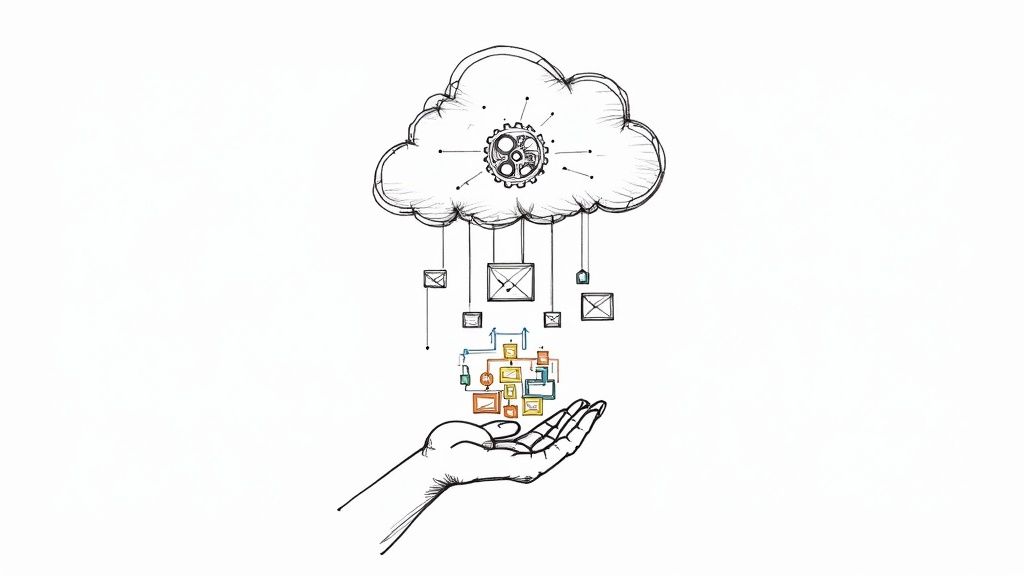
    A simple, stateless microservice might be perfectly served by the efficiency of a Rolling deployment, offering a straightforward path to incremental updates with minimal overhead. In contrast, a mission-critical, customer-facing system like an e-commerce checkout or a financial transaction processor demands the heightened safety and immediate rollback capabilities inherent in a Blue-Green or Canary deployment. Here, the ability to validate new code with a subset of live traffic or maintain a fully functional standby environment provides an indispensable safety net against catastrophic failure.
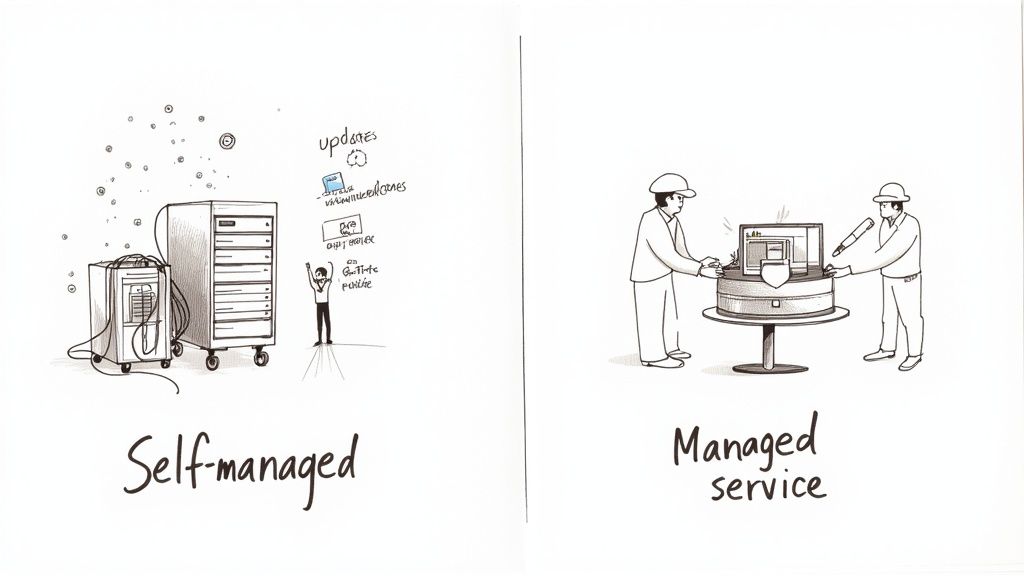
    Synthesizing Strategy with Technology

    Mastering these techniques requires more than just understanding the concepts; it demands a deep integration of automation, observability, and infrastructure management.

    • Automation is the Engine: Manually executing a Blue-Green switch or a phased Canary rollout is not only slow but also dangerously error-prone. Robust CI/CD pipelines, powered by tools like Jenkins, GitLab CI, or GitHub Actions, are essential for orchestrating these complex workflows with precision and repeatability.
    • Observability is the Compass: Deploying without comprehensive monitoring is like navigating blind. Your team needs real-time insight into application performance metrics (latency, error rates, throughput) and system health (CPU, memory, network I/O) to validate a deployment's success or trigger an automatic rollback at the first sign of trouble.
    • Infrastructure is the Foundation: Strategies like Immutable Infrastructure and Shadow Deployment rely on the ability to provision and manage infrastructure as code. Tools like Terraform and CloudFormation, combined with containerization platforms like Docker and Kubernetes, make it possible to create consistent, disposable environments that underpin the reliability of your chosen deployment model.

    Ultimately, the goal is to transform deployments from high-anxiety events into routine, low-risk operations. A critical, often overlooked component in this ecosystem is the data layer. Deploying a new application version is futile if it corrupts or cannot access its underlying database. For applications demanding absolute consistency, understanding concepts like real-time database synchronization is paramount to ensure data integrity is maintained seamlessly across deployment boundaries, preventing data-related outages.

    By weaving these zero downtime deployment strategies into the fabric of your engineering culture, you empower your team to ship features faster, respond to market changes with agility, and build a reputation for unwavering reliability that becomes a true competitive advantage.


    Ready to eliminate downtime but need the expert talent to build your resilient infrastructure? OpsMoon connects you with a global network of elite, pre-vetted DevOps and Platform Engineers who specialize in designing and implementing sophisticated CI/CD pipelines. Find the perfect freelance expert to accelerate your journey to continuous availability at OpsMoon.

  • Hiring Cloud DevOps Consultants That Deliver Results

    Hiring Cloud DevOps Consultants That Deliver Results

    In technical terms, cloud DevOps consultants are external specialists contracted to architect, implement, or remediate cloud-native infrastructure and CI/CD automation. They are engaged to resolve specific engineering challenges—such as non-performant deployment pipelines, unoptimized cloud expenditure, or complex multi-cloud migrations—by applying specialized expertise that augments an in-house team's capabilities.

    Knowing When to Bring in a DevOps Consultant

    Your platform is hitting its performance ceiling, deployment frequencies are decreasing, and your monthly cloud spend is escalating without a corresponding increase in workload. These are not merely operational hurdles; they are quantitative indicators that your internal engineering capacity is overloaded. Engaging a cloud DevOps consultant is not a reactive measure to a crisis—it is a proactive, strategic decision to inject specialized expertise.

    A team of DevOps consultants collaborating in a modern office setting, working on laptops with diagrams on a whiteboard behind them.

    This decision point typically materializes when accumulated technical debt begins to impede core business objectives. Consider a startup whose monolithic application, while successful, now causes cascading failures. The engineering team is trapped in a cycle of reactive incident response, unable to allocate resources to feature development, turning every deployment into a high-risk event.

    Before analyzing specific triggers, it's crucial to understand that these issues are rarely isolated. A technical symptom often translates directly into quantifiable, and frequently significant, business impact.

    | Key Indicators You Need a DevOps Consultant |
    | — | — | — |
    | Pain Point | Technical Symptom | Business Impact |
    | Slow Deployments | CI/CD pipeline duration exceeds 30 minutes; build success rate is below 95%; manual interventions are required for releases. | Decreased deployment frequency (DORA metric); slower time-to-market; reduced developer velocity. |
    | Rising Infrastructure Costs | Cloud expenditure (AWS, Azure, GCP) increases month-over-month without proportional user growth; resource utilization metrics are consistently low. | Eroded gross margins; capital diverted from R&D and innovation. |
    | Security Vulnerabilities | Lack of automated security scanning (SAST/DAST) in pipelines; overly permissive IAM roles; failed compliance audits (e.g., SOC 2). | Elevated risk of data exfiltration; non-compliance penalties; loss of customer trust. |
    | System Instability | Mean Time To Recovery (MTTR) is high; frequent production incidents related to scaling or configuration drift. | Negative impact on SLOs/SLAs; customer churn; reputational damage. |
    | Difficult Cloud Migration | A "lift and shift" migration results in poor performance and high costs; refactoring to cloud-native services (e.g., Lambda, GKE) is stalled. | Blocked strategic initiatives; wasted engineering cycles; failure to realize cloud benefits. |

    Identifying your organization's challenges in this matrix is the initial step. When these symptoms become chronic, it's a definitive signal that external, specialized intervention is required.

    Common Technical Triggers

    The need for a consultant often emerges from specific, quantifiable deficits in your technology stack.

    • Frequent CI/CD Pipeline Failures: If your build pipelines are characterized by non-deterministic failures (flakiness) or require manual promotion between stages, you have a critical delivery bottleneck. A consultant can re-architect these workflows for idempotency and reliability using declarative pipeline-as-code definitions in tools like Jenkins (via Jenkinsfile), GitHub Actions (via YAML workflows), or GitLab CI.

    • Uncontrolled Cloud Spending: Is your AWS, Azure, or GCP bill growing without a clear cost allocation model? This indicates a lack of FinOps maturity. An expert can implement cost-saving measures such as EC2 Spot Instances, AWS Savings Plans, automated instance schedulers, and granular cost monitoring with tools like AWS Cost Explorer or third-party platforms.

    • Security and Compliance Gaps: As systems scale, manual security management becomes untenable. A consultant can implement security-as-code with tools like Checkov or tfsec, automate compliance evidence gathering for standards like SOC 2 or HIPAA, and enforce the principle of least privilege through tightly scoped IAM roles.

    Business Inflection Points

    Sometimes, the impetus is strategic, driven by business evolution rather than technical failure. These are often large-scale initiatives for which your current team lacks prior implementation experience.

    A prime example is migrating from a VMware-based on-premise data center to a cloud-native architecture. This is a complex undertaking far beyond a simple "lift and shift." It requires deep expertise in cloud-native design patterns, containerization and orchestration with Kubernetes, and declarative infrastructure management with tools like Terraform. Without an experienced architect, such projects are prone to significant delays, budget overruns, and the introduction of new security vulnerabilities.

    An experienced cloud DevOps consultant doesn't just patch a failing pipeline; they architect a scalable, self-healing system based on established best practices. Their primary value lies in transferring this knowledge and embedding repeatable processes that empower your internal team long after the engagement concludes.

    The demand for this specialized expertise is growing rapidly. The global cloud professional services market, which encompasses this type of consultancy, was valued at approximately $30.6 billion in 2024 and is projected to reach $35 billion by 2025. With a forecasted compound annual growth rate (CAGR) of 16.5% through 2033, it is evident that businesses are increasingly relying on external experts to execute their cloud strategies effectively.

    Understanding the various use cases for agencies and consultancies can provide context for how your organization fits within this trend. Recognizing these scenarios is the first step toward making a well-informed and impactful hiring decision.

    Defining Your Project Scope and Success Metrics

    Before initiating contact with a cloud DevOps consultant, the most critical work is internal. A vague objective, such as "improve our CI/CD," is a direct path to scope creep, budget overruns, and stakeholder friction.

    Precision is paramount. A well-defined project scope serves as a technical blueprint, aligning your expectations with a consultant's deliverables from the initial discovery call.

    A detailed project plan on a tablet, with charts and metrics visible, placed next to a laptop on a desk.

    This upfront planning is not administrative overhead; it is the process of translating high-level business goals into concrete, measurable engineering outcomes. Without this clarity, you risk engaging a highly skilled expert who solves the wrong problem.

    The global DevOps market is projected to reach $25 billion by 2025, driven by the imperative for faster, more secure, and reliable software delivery. To leverage this expertise effectively, you must first define what "success" looks like in quantitative terms. You can get more context on this by exploring the full DevOps market statistics.

    Translating Business Goals Into Technical Metrics

    The first step is to convert abstract business desires into specific, verifiable metrics. This process bridges the gap between executive-level objectives and engineering execution. An experienced consultant will immediately seek these specifics to assess feasibility and provide an accurate statement of work.

    Consider the common goal of increasing development velocity. Here's how to make it actionable:

    • The Vague Request: "We need to improve our CI/CD pipeline."
    • The Specific Metric: "Reduce the average CI/CD pipeline duration for our primary monolithic service from 45 minutes to under 10 minutes by implementing test parallelization, optimizing Docker image layer caching, and introducing a shared artifact repository."

    Here is another example for infrastructure modernization:

    • The Vague Request: "We need to improve our Kubernetes setup."
    • The Specific Metric: "Implement a GitOps-based deployment workflow using ArgoCD to manage our GKE cluster, achieving 100% of application and environment configurations being stored declaratively in Git and synced automatically."

    A well-defined scope is your most effective tool against misaligned expectations. It forces clarity on the "what" and "why" of the project, enabling a consultant to execute the "how" with maximum efficiency and impact.

    Crafting a Technical Requirements Document

    With key metrics established, the next step is to create a concise technical requirements document. This is not an exhaustive treatise but a practical brief that provides prospective consultants with the necessary context to propose a viable, targeted solution.

    This document should provide a snapshot of your current state and a clear vector toward your desired future state.

    Here’s a technical outline of what it should include:

    1. Current Infrastructure Snapshot:

    • Cloud Provider(s) & Services: Specify provider(s) (AWS, Azure, GCP, multi-cloud) and core services used (e.g., EC2, RDS, S3 for data; GKE, EKS for compute; Azure App Service).
    • Architecture Overview: Provide a high-level diagram of your application architecture (e.g., monolith on VMs, microservices on Kubernetes, serverless functions). Detail key data stores (e.g., PostgreSQL, MongoDB, Redis).
    • Networking Configuration: A high-level overview of your VPC/VNet topology, subnetting strategy, security group/NSG configurations, and any existing VPNs or direct interconnects.

    2. Existing Toolchains and Workflows:

    • CI/CD: Current tooling (e.g., Jenkins, GitHub Actions, CircleCI). Identify specific pain points, such as pipeline flakiness or manual release gates.
    • Infrastructure as Code (IaC): Specify tooling (e.g., Terraform, Pulumi, CloudFormation) and the percentage of infrastructure currently under IaC management. Note any areas of significant configuration drift.
    • Observability Stack: Detail your monitoring, logging, and tracing tools (e.g., Prometheus/Grafana, Datadog, ELK stack). Assess the quality and actionability of current alerts.

    3. Security and Compliance Mandates:

    • Regulatory Requirements: List any compliance frameworks you must adhere to (e.g., SOC 2, HIPAA, PCI DSS). This is a critical constraint.
    • Identity & Access Management (IAM): Describe your current approach to user access. Are you using federated identity with an IdP, static IAM users, or a mix?

    Completing this preparatory work ensures that your initial conversations with consultants are grounded in technical reality, enabling a more productive and focused engagement from day one.

    How to Technically Vet and Select Your Consultant

    Identifying a true subject matter expert requires a vetting process that goes beyond surface-level keyword matching on a resume. The distinction between a competent cloud DevOps consultant and an elite one lies in their practical, battle-tested knowledge. The objective is to assess their problem-solving methodology, not just their familiarity with tool names.

    Your goal is to find an individual who architects for resilience and scalability. Asking "Do you know Kubernetes?" is a low-signal question; it yields a binary answer with no insight. A far more effective approach is to present specific, complex scenarios that reveal their diagnostic process and technical depth.

    Moving Beyond Basic Questions

    Generic interview questions elicit rehearsed, generic answers. To accurately gauge a consultant's capabilities, present them with a realistic problem that mirrors a challenge your team is currently facing. This forces the application of skills in a context relevant to your business.

    Let's reframe common, ineffective questions into powerful, scenario-based probes that distinguish top-tier talent.

    • Instead of: "Do you know Terraform?"

    • Ask: "Describe how you would architect a reusable Terraform module structure for a multi-account AWS Organization. How would you manage state to prevent drift across environments like staging and production? What is your strategy for handling sensitive data, such as database credentials, within this framework?"

    • Instead of: "What container orchestration tools have you used?"

    • Ask: "We are experiencing intermittent latency spikes in our EKS cluster during peak traffic. Walk me through your diagnostic methodology. Which specific metrics from Prometheus or Datadog would you analyze first? How would you differentiate between a node-level resource constraint, a pod-level issue like CPU throttling, or an application-level bottleneck?"

    These questions lack a single "correct" answer. The value is in the candidate's response structure. A strong consultant will ask clarifying questions, articulate the trade-offs between different approaches, and justify their technical choices based on first principles.

    Assessing Practical Cloud and Toolchain Experience

    A consultant's value is directly proportional to their hands-on expertise with specific cloud providers and the associated DevOps toolchain. Their ability to navigate the nuances and limitations of AWS, Azure, or GCP is non-negotiable.

    Key technical areas to probe include:

    1. Infrastructure as Code (IaC) Mastery: They must demonstrate fluency in advanced IaC concepts. This could involve managing remote state backends and locking in Terraform, using policy-as-code frameworks like Open Policy Agent (OPA) to enforce governance, or leveraging higher-level abstractions like the AWS CDK for programmatic infrastructure definition.

    2. Container Orchestration Depth: Look for experience beyond simple deployments. A top-tier consultant should be able to discuss Kubernetes networking in depth, including CNI plugins, Ingress controllers, and the implementation of service meshes like Istio or Linkerd for traffic management and observability. They should also be able to design cost-effective strategies for running stateful applications on Kubernetes.

    3. CI/CD Pipeline Architecture: Can they design a secure, high-velocity pipeline from scratch? Ask them to architect a pipeline that incorporates static application security testing (SAST), dynamic application security testing (DAST), and software composition analysis (SCA) without creating excessive developer friction. Probe their understanding of deployment strategies like blue-green versus canary releases for zero-downtime updates of critical microservices.

    To structure this evaluation, you might explore the features of technical screening platforms that provide standardized, hands-on coding challenges. For a broader perspective on sourcing talent, our guide on how to hire remote DevOps engineers offers additional valuable insights.

    The best consultants don’t just know the tools; they understand the underlying principles. They select the right tool for the job because they have firsthand experience with a technology's strengths and, more importantly, its failure modes.

    Evaluating Case Studies and Past Performance

    Ultimately, a consultant's past performance is the most reliable predictor of future success. Do not just review testimonials; critically analyze their case studies and portfolio for empirical evidence of their impact.

    Use this checklist to systematically evaluate and compare candidates' past projects, focusing on signals that align with your organization's technical and business objectives.

    Consultant Evaluation Checklist

    Evaluation Criteria Question/Check Importance (High/Medium/Low)
    Quantifiable Outcomes Did they provide specific, verifiable metrics? (e.g., "Reduced cloud spend by 30% by implementing an automated instance rightsizing strategy," "Decreased CI pipeline duration from 40 to 8 minutes.") High
    Technical Complexity Was the project a greenfield implementation or a complex brownfield migration involving legacy systems and stringent compliance constraints? High
    Problem-Solving Narrative Do they clearly articulate the initial problem statement, the technical steps taken, the trade-offs considered, and the final solution architecture? Medium
    Tooling Relevance Does the technology stack in their case studies (e.g., AWS, GCP, Terraform, Kubernetes) align with your current or target stack? High
    Knowledge Transfer Is there explicit mention of documenting architectural decisions, creating runbooks, or conducting training sessions for the client's internal team? Medium

    A strong portfolio does not just show what was built; it details why it was built that way and quantifies the resulting business outcome. This rigorous evaluation helps you distinguish between theorists and practitioners, ensuring you partner with a cloud DevOps consultant who can solve your most complex technical challenges.

    Choosing the Right Engagement Model

    Defining the operational framework for your collaboration with a cloud DevOps consultant is as critical as validating their technical expertise. A correctly chosen engagement model aligns incentives, establishes unambiguous expectations, and provides a clear path to project success. An incorrect choice can lead to miscommunication, scope creep, and budget overruns, even with a highly skilled engineer.

    Each model serves a distinct strategic purpose. The optimal choice depends on your immediate technical requirements, long-term strategic roadmap, and the maturity of your existing engineering team. Let's deconstruct the three primary models.

    Project-Based Engagements

    A project-based engagement is optimal for initiatives with a clearly defined scope, a finite timeline, and a specific set of deliverables. You are procuring a tangible outcome, not simply augmenting your workforce. The consultant or firm commits to delivering a specific result for a fixed price or within a pre-agreed timeframe.

    This model is ideal for scenarios such as:

    • Building a CI/CD Pipeline: Architecting and implementing a complete, production-grade CI/CD pipeline for a new microservice using GitHub Actions, including automated testing, security scanning, and deployment to a container registry.
    • Terraform Migration: A comprehensive project to migrate all manually provisioned cloud infrastructure to a fully automated, version-controlled Terraform codebase with remote state management.
    • Security Hardening: A thorough audit of an AWS environment against CIS Benchmarks, followed by the implementation of remediation measures to achieve SOC 2 compliance.

    The primary advantage is cost predictability, which simplifies budgeting and financial planning. The trade-off is reduced flexibility. Any significant deviation from the initial scope typically requires a formal change order and contract renegotiation.

    Staff Augmentation

    Staff augmentation involves embedding an external expert directly into your existing team to fill a specific skill gap. You are not outsourcing a project; you are integrating a specialist who works alongside your engineers. This model is highly effective when your team is generally proficient but lacks deep expertise in a niche area.

    For instance, if your development team is strong but has limited operational experience with Kubernetes, you could bring in a consultant to architect a new GKE cluster, mentor the team on Helm chart creation and operational best practices, and troubleshoot complex networking issues with the CNI plugin. The consultant functions as a temporary team member, participating in daily stand-ups, sprint planning, and code reviews.

    This model excels at knowledge transfer. The consultant's role extends beyond implementation; they are tasked with upskilling your internal team, thereby increasing your organization's long-term capabilities.

    Managed Services

    A managed services model is designed for organizations seeking continuous, long-term operational support for their cloud infrastructure. Instead of engaging for a single project, you delegate the ongoing responsibility for maintaining, monitoring, and optimizing a component of your environment to a dedicated external team.

    This is the appropriate choice when you want your internal engineering team to focus exclusively on product development, offloading the operational burden of the underlying infrastructure. A common use case is engaging a firm to provide 24/7 Site Reliability Engineering (SRE) support for production Kubernetes clusters, with a service-level agreement (SLA) guaranteeing uptime and incident response times. Many leading DevOps consulting firms specialize in this model, offering operational stability for a predictable monthly fee.

    This decision tree provides a logical framework for navigating the initial stages of sourcing and engaging a consultant.

    Infographic about cloud devops consultants

    As the infographic illustrates, the process flows from initial screening to deeper technical and cultural evaluation. However, selecting the appropriate engagement model before initiating this process ensures that your vetting criteria are aligned with your actual operational needs from the outset.

    Maximizing ROI Through Effective Collaboration

    Engaging a highly skilled cloud DevOps consultant is only the first step; realizing the full value of that investment depends entirely on their effective integration into your team. A strong return on investment (ROI) is achieved through structured collaboration and a deliberate focus on knowledge transfer.

    Without a strategic integration plan, you receive a temporary solution. With one, you build lasting institutional knowledge and capability.

    A diverse team working together on a cloud infrastructure project, pointing at a screen with code and diagrams.

    This begins with a streamlined, technical onboarding process designed for zero friction. The objective is to enable productivity within hours, not days. Wasting a consultant's initial, high-cost time on administrative access requests is a common and avoidable error.

    A Technical Onboarding Checklist

    Before the consultant's first day, prepare a standardized onboarding package. This is not about HR paperwork; it is about provisioning the precise, least-privilege access required to begin problem-solving immediately.

    Your technical checklist should include:

    • Identity and Access Management (IAM): A dedicated IAM role or user with a permissions policy scoped exclusively to the project's required resources. Never grant administrative-level access.
    • Version Control Systems: Access to the specific GitHub, GitLab, or Bitbucket repositories relevant to the project, with permissions to create branches and open pull requests.
    • Cloud Provider Consoles: Programmatic and console access credentials for AWS, Azure, or GCP, restricted to the necessary projects or resource groups.
    • Observability Platforms: A user account for your monitoring stack (e.g., Datadog, New Relic, Prometheus/Grafana) with appropriate dashboard and alert viewing permissions.
    • Communication Channels: An invitation to relevant Slack or Microsoft Teams channels and pre-scheduled introductory meetings with key technical stakeholders and the project lead.

    Managing this external relationship requires a structured approach. For a deeper understanding of the mechanics, it is beneficial to review established vendor management best practices.

    Embedding Consultants for Knowledge Transfer

    The true long-term ROI from hiring cloud devops consultants is the residual value they impart: more robust processes and a more skilled internal team. This requires their active integration into your daily engineering workflows. They should not be isolated; they must function as an integral part of the team.

    This collaborative approach is a key driver of successful DevOps adoption. By 2025, an estimated 80% of global organizations will have implemented DevOps practices. Significantly, of those, approximately 50% are classified as "elite" or "high-performing," demonstrating a direct correlation between proper implementation and measurable business outcomes.

    The most valuable consultants don't just deliver code; they elevate the technical proficiency of the team around them. Their ultimate goal should be to make themselves redundant by transferring their expertise, ensuring your team can own, operate, and iterate on the systems they build.

    Strategies for Lasting Value

    To facilitate this knowledge transfer, you must be intentional. Implement specific collaborative practices that extract expertise from the consultant and embed it within your team's collective knowledge base.

    Here are several high-impact strategies:

    • Paired Programming Sessions: Schedule regular pairing sessions for complex tasks, such as designing a new Terraform module or debugging a Kubernetes ingress controller configuration. This is a highly effective method for hands-on learning.
    • Mandatory Documentation: Enforce a "documentation-as-a-deliverable" policy. Any new infrastructure, pipeline, or automation created by the consultant must be thoroughly documented in your knowledge base (e.g., Confluence, Notion) before the corresponding task is considered complete. This includes architectural decision records (ADRs).
    • Recurring Architectural Reviews: Host weekly or bi-weekly technical review sessions where the consultant presents their work-in-progress to your team. This creates a dedicated forum for questions, feedback, and building a shared understanding of the technical rationale behind architectural decisions.

    When collaboration and knowledge transfer are treated as core deliverables of the engagement, a short-term contract is transformed into a long-term investment in your engineering organization's capabilities.

    Frequently Asked Questions

    When considering the engagement of a cloud DevOps consultant, several specific, technical questions invariably arise. Obtaining clear, unambiguous answers to these questions is fundamental to establishing a successful partnership and ensuring a positive return on investment. Let's address the most common technical and logistical concerns.

    How Should We Budget for a DevOps Consultant?

    Budgeting for a consultant requires a value-based analysis, not just a focus on their hourly rate. Rates for experienced consultants can range from $100 to over $250 per hour, depending on their specialization (e.g., Kubernetes security vs. general AWS automation) and depth of experience.

    A more effective budgeting approach is to focus on outcomes. For a project with a well-defined scope, negotiate a fixed price. For staff augmentation, budget for a specific duration (e.g., a three-month contract).

    Crucially, you must also calculate the opportunity cost of not hiring an expert. What is the financial impact of a delayed product launch, a data breach due to misconfiguration, or an unstable production environment causing customer churn? The consultant's invoice is often a strategic investment to mitigate much larger financial risks.

    A common mistake is to fixate on the hourly rate. A top-tier consultant at a higher rate who correctly solves a complex problem in one month provides a far greater ROI than a less expensive one who takes three months and requires significant hand-holding from your internal team.

    Who Owns the Intellectual Property?

    The answer must be unequivocal: your company owns all intellectual property. This must be explicitly stipulated in your legal agreement.

    Before any work commences, ensure your service agreement contains a clear "Work for Hire" clause. This clause must state that your company retains full ownership of all deliverables created during the engagement, including all source code (e.g., Terraform, Ansible scripts, application code), configuration files, technical documentation, and architectural diagrams. This is a non-negotiable term. You are procuring permanent assets for your organization, not licensing temporary solutions.

    How Do We Handle Access and Security?

    Granting a consultant access to your cloud environment must be governed by the principle of least privilege and a "trust but verify" security posture. Never provide blanket administrative access.

    The correct, secure procedure is as follows:

    • Dedicated IAM Roles: Create a specific, time-bound IAM role in AWS, a service principal in Azure, or a service account in GCP for the consultant. The associated permissions policy must be scoped to the minimum set of actions required for their tasks. For example, a consultant building a CI/CD pipeline needs permissions for CodePipeline and ECR, but not for production RDS databases.
    • Time-Bound Credentials: Utilize features that generate temporary, short-lived credentials that expire automatically. This ensures access is revoked programmatically at the end of the contract without requiring manual de-provisioning.
    • No Shared Accounts: Each consultant must have their own named user account for auditing and accountability. This is a fundamental security requirement.
    • VPN and MFA: Enforce connection via your corporate VPN and mandate multi-factor authentication (MFA) on all accounts. These are baseline security controls.

    What Happens After the Engagement Ends?

    A successful consultant works to render themselves obsolete. Their objective is to solve the immediate problem and ensure your internal team is fully equipped to own, operate, and evolve the new system independently.

    To facilitate a smooth transition, the final weeks of the contract must include a formal hand-off period.

    This hand-off process must include:

    • Documentation Deep Dive: Your team must rigorously review all documentation produced by the consultant. Assess it for clarity, accuracy, and practical utility for ongoing maintenance and troubleshooting.
    • Knowledge Transfer Sessions: Schedule dedicated sessions for the consultant to walk your engineers through the system architecture, codebase, and operational runbooks. This is not optional.
    • Post-Engagement Support: Consider negotiating a small retainer for a limited period (e.g., one month) post-contract to address any immediate follow-up questions. This provides a valuable safety net as your team assumes full ownership.

    Ultimately, the best consultants architect solutions designed for hand-off, not black boxes that create long-term vendor dependency.


    At OpsMoon, we specialize in connecting you with the top 0.7% of global DevOps talent to solve your toughest cloud challenges. From a free work planning session to expert execution, we provide the strategic guidance and hands-on engineering needed to accelerate your software delivery and build resilient, scalable infrastructure.

    Ready to build a high-performing DevOps practice? Explore our services and start your journey with OpsMoon today.

  • Your Guide to DevOps Implementation Services

    Your Guide to DevOps Implementation Services

    DevOps implementation services provide the technical expertise and strategic guidance to automate your software delivery lifecycle, transforming how code moves from a developer's machine into a production environment. The objective is to dismantle silos between development and operations, engineer robust CI/CD pipelines, and select the optimal toolchain to accelerate release velocity and enhance system reliability.

    Your Technical Roadmap for DevOps Implementation

    Executing a DevOps transformation is a deep, technical re-engineering of how you build, test, and deploy software. Without a precise, technical plan, you risk a chaotic implementation with incompatible tools, brittle pipelines, and frustrated engineering teams.

    This guide provides a direct, no-fluff roadmap for what to expect and how to execute when you engage with a DevOps implementation partner. We will bypass high-level theory to focus on the specific technical actions your engineering teams must take to build lasting, high-performance practices. The methodology is a structured path: assess, architect, and automate.

    This infographic lays out the typical high-level flow.

    Infographic about devops implementation services

    As you can see, a solid implementation always starts with a deep dive into where you are right now. Only then can you design the future state and start automating the workflows to get there.

    Navigating the Modern Delivery Landscape

    The push for this kind of technical transformation is massive. The global DevOps market hit about $13.16 billion in 2024 and is expected to climb to $15.06 billion by 2025. This isn't just hype; businesses need to deliver features faster and more reliably to stay in the game.

    The data backs it up, with a staggering 99% of adopters saying DevOps has had a positive impact on their work. You can find more real-world stats on the state of DevOps at Baytech Consulting. A well-planned DevOps strategy, often kickstarted by expert services, provides the technical backbone to make it happen.

    A successful DevOps transformation isn't about collecting a bunch of shiny new tools. It’s about building a cohesive, automated system where every part—from version control to monitoring—works together to deliver real value to your users, efficiently and predictably.

    Before jumping into a full-scale implementation, it's crucial to understand your current capabilities. The following framework can help you pinpoint where you stand across different domains, giving you a clear starting line for your DevOps journey.

    DevOps Maturity Assessment Framework

    Domain Level 1 (Initial) Level 2 (Managed) Level 3 (Defined) Level 4 (Optimizing)
    Culture & Collaboration Siloed teams, manual handoffs. Some cross-team communication. Shared goals, defined processes. Proactive collaboration, blameless culture.
    CI/CD Automation Manual builds and deployments. Basic build automation in place. Fully automated CI/CD pipelines. Self-service pipelines, continuous deployment.
    Infrastructure Manually managed servers. Some configuration management. Infrastructure as Code (IaC) is standard. Immutable infrastructure, fully automated provisioning.
    Monitoring & Feedback Basic server monitoring, reactive alerts. Centralized logging and metrics. Proactive monitoring, application performance monitoring. Predictive analytics, automated remediation.
    Security Security is a final, separate step. Some automated security scanning. Security integrated into the pipeline (DevSecOps). Continuous security monitoring and policy as code.

    Using a framework like this gives you a data-driven way to prioritize your efforts and measure progress, ensuring your implementation focuses on the areas that will deliver the most impact.

    Key Focus Areas in Your Implementation

    As we move through this guide, we'll focus on the core technical pillars that are absolutely essential for a strong DevOps practice. This is where professional services can really move the needle for your organization.

    • Maturity Assessment: First, you have to know your starting point. This means a real, honest look at your current workflows, toolchains, and cultural readiness. No sugarcoating.
    • CI/CD Pipeline Architecture: This is the assembly line for your software. We’re talking about designing a repeatable, version-controlled pipeline using tools like Jenkins, GitLab CI, or GitHub Actions.
    • Infrastructure as Code (IaC): Say goodbye to configuration drift. Automating your environment provisioning with tools like Terraform or Pulumi is non-negotiable for consistency and scale.
    • Automated Testing Integration: Quality can't be an afterthought. This means embedding unit, integration, and security tests right into the pipeline to catch issues early and often.
    • Observability and Monitoring: To move fast, you need to see what's happening. This involves setting up robust logging, metrics, and tracing to create tight, actionable feedback loops.

    Each of these pillars is a critical step toward building a high-performing engineering organization that can deliver software quickly and reliably.

    Laying the Foundation with Assessment and Planning

    Before you automate a single line of code or swipe the company card on a shiny new tool, stop. A real DevOps transformation doesn't start with action; it starts with an honest, unflinching look in the mirror. Jumping straight into implementation without a clear map of where you are is the fastest way to burn cash, frustrate your teams, and end up right back where you started.

    The first move is always to establish a data-driven baseline. You need to expose every single point of friction in your software development lifecycle (SDLC), from a developer's first commit all the way to production.

    A crucial part of this is a thorough business technology assessment. This isn't just about listing your servers; it's a diagnostic audit to uncover the root causes of slow delivery and instability. Think of it as creating a detailed value stream map that shows every step, every handoff, and every delay.

    This means getting your hands dirty with a technical deep-dive into your current systems and workflows. You have to objectively analyze what you're actually doing today, not what you think you're doing. Only then can you build a strategic plan that solves real problems.

    Your Technical Audit Checklist

    To get that clear picture, you need to go granular. This isn't a high-level PowerPoint review; it's a nuts-and-bolts inspection of how your delivery machine actually works. Use this checklist to kick off your investigation:

    • Source Code Management: How are repos structured? Is there a consistent branching strategy like GitFlow or Trunk-Based Development, or is it the Wild West? How are permissions managed?
    • Build Process: Is the build automated, or does it depend on someone's laptop? How long does a typical build take, and what are the usual suspects when it fails?
    • Testing Automation: What's your real test automation coverage (unit, integration, E2E)? Do tests run automatically on every single commit, or is it a manual affair? And more importantly, how reliable are the results?
    • Environment Provisioning: How do you spin up dev, staging, and production environments? Are they identical, or are you constantly battling configuration drift and the dreaded "it works on my machine" syndrome?
    • Deployment Mechanism: Are deployments a manual, high-stress event, or are they scripted and automated? What's the rollback plan, and how long does it take to execute when things go south?
    • Monitoring and Logging: Do you have centralized logging and metrics that give you instant insight, or is every production issue a multi-hour detective story?

    Answering these questions honestly will shine a bright light on your biggest bottlenecks—things like manual QA handoffs, flaky staging environments, or tangled release processes that are actively killing your speed. For a more structured approach, check out our guide on how to conduct a DevOps maturity assessment.

    From Assessment to Actionable Roadmap

    Once you know exactly what’s broken, you can build a roadmap to fix it. This isn't a shopping list of tools. It's a prioritized plan that ties every technical initiative directly to a business outcome. A good roadmap makes it clear how geeky goals create measurable business value.

    For example, don't just say, "We will automate deployments." Instead, aim for something like, "We will slash deployment lead time from 2 weeks to under 24 hours by implementing a blue/green deployment strategy, reducing the Change Failure Rate by 50%." That’s a specific, measurable target that leadership can actually get behind.

    A classic mistake is trying to boil the ocean. A winning roadmap prioritizes initiatives by impact versus effort. Find the low-effort, high-impact wins—like automating the build process—and tackle those first to build momentum.

    Your roadmap absolutely must define the Key Performance Indicators (KPIs) you'll use to measure success. Focus on the metrics that truly matter:

    1. Deployment Lead Time: The clock starts at the code commit and stops when it's live in production. How long does that take?
    2. Deployment Frequency: How often are you pushing changes to production? Daily? Weekly? Monthly?
    3. Change Failure Rate: What percentage of your deployments cause a production failure? The elite performers aim for a rate under 15%.
    4. Mean Time to Recovery (MTTR): When an outage hits, how fast can you restore service?

    Finally, you have to get buy-in. Show the business how these technical improvements directly impact the bottom line. Reducing MTTR isn't just a tech achievement; it's about minimizing revenue loss during a crisis. This alignment is what gets you the budget and support to turn your plan into reality.

    Building and Automating Your CI/CD Pipeline

    Think of the Continuous Integration and Continuous Deployment (CI/CD) pipeline as the engine driving your entire DevOps practice. It's the automated highway that takes code from a developer's commit all the way through building, testing, and deployment—all without anyone needing to lift a finger. A clunky pipeline becomes a bottleneck, but a well-designed one is your ticket to shipping software faster.

    A diagram showing the flow of a CI/CD pipeline

    This automation isn't just about flipping a switch; it's about methodically designing a workflow that’s reliable, scalable, and secure. This is the nuts and bolts of what a DevOps implementation service provider actually builds.

    Selecting Your Pipeline Orchestrator

    Your first big decision is picking a CI/CD orchestrator. This tool is the brain of your pipeline—it triggers jobs, runs scripts, and manages the whole flow. Honestly, the best choice usually comes down to your existing tech stack.

    • GitLab CI/CD: If your code already lives in GitLab, this is a no-brainer. The .gitlab-ci.yml file sits right in your repository, so the pipeline configuration is version-controlled from day one.
    • GitHub Actions: For teams on GitHub, Actions is a seriously powerful, event-driven framework. The marketplace is full of pre-built actions that can save you a ton of time setting up common pipeline tasks.
    • Jenkins: As the open-source veteran, Jenkins offers incredible flexibility with its massive plugin ecosystem. But that freedom comes at a price: more hands-on work for setup, configuration, and keeping it secure.

    The main goal is to pick something that integrates smoothly with your version control system. You want to reduce friction for your dev teams, not add more.

    Architecting the Core Pipeline Stages

    A solid CI/CD pipeline is built from a series of distinct, automated stages. Each one acts as a quality gate. If a job fails at any point, the whole process stops, and the team gets immediate feedback. This is how you stop bad code in its tracks.

    This level of automation is why, by 2025, an estimated 50% of DevOps adopters are expected to be recognized as elite or high-performing organizations. It's a direct response to the need for faster delivery and better software quality.

    The core idea here is to "shift left"—catch errors as early as possible. A bug found during the CI stage is exponentially cheaper and faster to fix than one a customer finds in production.

    At a minimum, your pipeline should include these stages:

    1. Commit Stage: This kicks off automatically with a git push. Solid version control best practices are non-negotiable; they're the foundation of team collaboration and code integrity.
    2. Build Stage: The pipeline grabs the code and compiles it into an executable artifact, like a Docker image or a JAR file.
    3. Test Stage: Here's where you unleash your automated test suites. This should cover static code analysis (linting), unit tests, and integration tests to make sure new changes work and don't break anything.
    4. Artifact Storage: Once the build and tests pass, the artifact gets versioned and pushed to a central repository like JFrog Artrifactory or Sonatype Nexus. This gives you a single, unchangeable source of truth for every build.
    5. Deploy Stage: The versioned artifact is then deployed to a staging environment for more testing (like UAT or performance checks) before it ever gets promoted to production.

    If you want to really dial in your workflow, check out our deep dive into CI/CD pipeline best practices.

    From Scripts to Pipeline-as-Code

    When you're starting out, it’s tempting to click around a web UI to configure your pipeline jobs. Don't do it. That approach is brittle and just doesn't scale. The modern standard is Pipeline-as-Code.

    With this approach, the entire pipeline definition is stored in a declarative file (usually YAML) right inside the project's repository.

    Here’s a quick look at a simple GitHub Actions workflow for a Node.js app:

    name: Node.js CI
    
    on:
      push:
        branches: [ "main" ]
      pull_request:
        branches: [ "main" ]
    
    jobs:
      build:
        runs-on: ubuntu-latest
    
        strategy:
          matrix:
            node-version: [18.x, 20.x]
    
        steps:
        - uses: actions/checkout@v4
        - name: Use Node.js ${{ matrix.node-version }}
          uses: actions/setup-node@v4
          with:
            node-version: ${{ matrix.node-version }}
            cache: 'npm'
        - run: npm ci
        - run: npm run build --if-present
        - run: npm test
    

    Treating your pipeline as code makes it version-controlled, repeatable, and easy to review—just like the application code it builds.

    Securing Your Deployment Process

    Finally, automation without security is a recipe for disaster. Hardcoding secrets like API keys or database credentials directly into pipeline scripts is a massive security hole. You need to use a dedicated secrets management tool.

    • HashiCorp Vault: This gives you a central place for managing secrets, handling encryption, and controlling access. Your pipeline authenticates with Vault to fetch credentials on the fly at runtime.
    • Cloud-Native Solutions: Tools like AWS Secrets Manager or Azure Key Vault are great options if you're already embedded in their cloud ecosystems, as they integrate seamlessly.

    By pulling secrets from a secure vault, you guarantee that sensitive information is never exposed in logs or source code. This creates a secure, auditable deployment process that’s absolutely essential for any professional DevOps setup.

    Weaving Code into Your Infrastructure and Configuration

    Let's talk about one of the biggest sources of headaches in any growing tech company: manual environment provisioning. It's the root cause of that dreaded phrase, "well, it worked on my machine," scaled up to wreak havoc across your entire delivery process. Inconsistencies between dev, staging, and prod environments lead to failed deployments, phantom bugs, and a whole lot of wasted time.

    This is where we draw a line in the sand. To get this chaos under control, we lean heavily on two practices that are the absolute bedrock of modern, scalable infrastructure: Infrastructure as Code (IaC) and configuration management.

    Servers and code illustrating Infrastructure as Code

    The idea is simple but powerful: treat your infrastructure—servers, networks, databases, load balancers, the whole lot—just like you treat your application code. You define everything in human-readable files, check them into version control (like Git), and let automation handle the rest. This creates a single, reliable source of truth for every environment. The result? Infrastructure that's repeatable, predictable, and ready to scale on demand.

    Laying the Foundation: Provisioning Cloud Resources with IaC

    The first step is actually creating the raw infrastructure. This is where declarative IaC tools really come into their own. Instead of writing a script that says how to create a server, you write a definition of the desired state—what you want the final environment to look like. The tool then intelligently figures out the steps to get there.

    The two heavyweights in this space are Terraform and Pulumi.

    • Terraform: Uses its own simple, declarative language (HCL) that's incredibly easy for ops folks to pick up. Its real power lies in its massive ecosystem of "providers," which offer support for virtually every cloud service you can think of.
    • Pulumi: Takes a different approach, letting you define infrastructure using the same programming languages your developers already know, like Python, Go, or TypeScript. This is a game-changer for dev teams, allowing them to use familiar logic and tooling to build out infrastructure.

    Whichever tool you choose, the state file is your most critical asset. Think of it as the tool's memory, mapping your code definitions to the actual resources running in the cloud. If you don't manage this file properly, you're opening the door to "configuration drift," where manual changes made in the cloud console cause reality to diverge from your code. Using a centralized, remote backend for your state (like an S3 bucket with locking enabled) isn't optional for teams; it's essential.

    Your IaC code must be the only way infrastructure is ever changed. Period. Lock this down with strict IAM policies that prevent anyone from making manual edits to production resources in the cloud console. This discipline is what separates a reliable system from a ticking time bomb.

    Getting the Details Right: Consistent System Configuration

    Once your virtual machines, Kubernetes clusters, and networks are up and running, they still need to be configured. This means installing software, setting up user accounts, managing services, and applying security patches. This is the job of configuration management tools like Ansible, Puppet, or Chef.

    These tools guarantee that every server in a group has the exact same configuration, right down to the last file permission.

    • Ansible: Is beautifully simple. It's agentless, operating over standard SSH, and uses easy-to-read YAML files called "playbooks." Its step-by-step, procedural nature makes it perfect for orchestration tasks.
    • Puppet & Chef: These tools are agent-based and take a more model-driven, declarative approach. They excel at enforcing a consistent state across a massive fleet of servers over the long term.

    For example, you could write a single Ansible playbook to install and configure an Nginx web server. That playbook ensures the same version, the same nginx.conf file, and the same firewall rules are applied to every single web server in your cluster. Store that playbook in Git, and you have a versioned, repeatable process for configuration.

    Putting It All Together: IaC in Your CI/CD Pipeline

    Here's where the magic really happens. When you wire these IaC and configuration tools directly into your CI/CD pipeline, you create a fully automated system for building, managing, and tearing down entire environments on demand.

    A common workflow looks something like this:

    1. A developer creates a new Git branch for a feature they're working on.
    2. Your CI/CD platform (like GitLab CI or GitHub Actions) detects the new branch and kicks off a pipeline.
    3. A pipeline stage runs terraform apply to spin up a completely new, isolated test environment just for that branch.
    4. Once the infrastructure is live, another stage runs an Ansible playbook to configure the servers and deploy the new application code.
    5. The pipeline then executes a full battery of automated tests against this fresh, production-like environment.
    6. When the branch is merged, a final pipeline job automatically runs terraform destroy to tear the whole environment down, ensuring you're not paying for idle resources.

    This integration empowers developers with ephemeral, production-mirroring environments for every single change. It dramatically improves the quality of testing and all but eliminates the risk of "it broke in prod" surprises.

    To get a better handle on the nuances, we've put together a comprehensive guide on Infrastructure as Code best practices. By mastering IaC and configuration management, you're not just automating tasks; you're building a resilient, predictable, and scalable foundation for delivering great software, fast.

    Comparison of Popular DevOps Automation Tools

    Choosing the right tools can feel overwhelming. To help clarify the landscape, here's a breakdown of some of the leading tools across the key automation categories. Each has its strengths, and the best choice often depends on your team's existing skills and specific needs.

    Tool Category Tool Example Primary Use Case Key Technical Feature
    CI/CD GitLab CI/CD All-in-one platform for source code management, CI, and CD. Tightly integrated .gitlab-ci.yml pipeline configuration within the same repo as the application code.
    CI/CD GitHub Actions Flexible CI/CD and workflow automation built into GitHub. Massive marketplace of pre-built actions, making it easy to integrate with almost any service.
    CI/CD Jenkins Highly extensible, open-source automation server. Unmatched flexibility through a vast plugin ecosystem; can be configured to do almost anything.
    Infrastructure as Code (IaC) Terraform Provisioning and managing cloud and on-prem infrastructure. Declarative HCL syntax and a provider-based architecture that supports hundreds of services.
    Infrastructure as Code (IaC) Pulumi Defining infrastructure using general-purpose programming languages. Enables use of loops, functions, and classes from languages like Python, TypeScript, and Go to build infrastructure.
    Configuration Management Ansible Application deployment, configuration management, and orchestration. Agentless architecture using SSH and simple, human-readable YAML playbooks.
    Monitoring Prometheus Open-source systems monitoring and alerting toolkit. A time-series database and powerful query language (PromQL) designed for reliability and scalability.
    Monitoring Datadog SaaS-based monitoring, security, and analytics platform. Unified platform that brings together metrics, traces, and logs from over 700 integrations.

    Ultimately, the goal is to select a stack that works seamlessly together. A common and powerful combination is using Terraform for provisioning, Ansible for configuration, and GitLab CI for orchestrating the entire workflow from commit to deployment, all while being monitored by Prometheus.

    A fast, automated pipeline is a massive advantage. But if that pipeline is shipping insecure code or failing without anyone noticing, it quickly becomes a liability. Getting DevOps right means going beyond just speed; it's about embedding security and reliability into every single step of the process.

    This is where the conversation shifts from DevOps to DevSecOps and embraces the idea of full-stack observability.

    A visual representation of a secure and observable CI/CD pipeline

    We need to stop thinking of security as the final gatekeeper that slows everything down. Instead, it should be a continuous, automated check that runs right alongside every code commit. At the same time, we have to build a monitoring strategy that gives us deep, actionable insights—not just a simple "the server is up" alert.

    Shift Security Left with Automated Tooling

    The whole point of DevSecOps is to "shift security left." All this really means is finding and squashing vulnerabilities as early as humanly possible. Think about it: a bug found on a developer's machine is exponentially cheaper and faster to fix than one found in production by a bad actor.

    So, how do we actually do this? By integrating automated security tools directly into the CI pipeline. This isn't about adding more manual review bottlenecks; it's about making security checks as normal and expected as running unit tests.

    Here are the essential scans you should bake into your pipeline:

    • Static Application Security Testing (SAST): These tools scan your source code for common security flaws, like SQL injection risks or other sketchy coding patterns. Tools like SonarQube or Snyk Code can be set up to run on every pull request, failing the build if anything critical pops up.
    • Software Composition Analysis (SCA): Let's be honest, modern apps are built on mountains of open-source dependencies. SCA tools like GitHub's Dependabot or OWASP Dependency-Check scan these libraries for known vulnerabilities (CVEs), letting you know immediately when a package needs an update.
    • Container Image Scanning: Before you even think about pushing a Docker image to your registry, it needs to be scanned. Tools like Trivy or Clair inspect every single layer of your container, flagging vulnerabilities in the base OS and any packages you've installed.

    Build a Full Observability Stack

    Old-school monitoring usually stops at system-level metrics like CPU and memory. That’s useful, but it tells you next to nothing about what your users are actually experiencing. Observability digs much deeper, giving you the context to understand why a system is acting up.

    A solid observability stack is built on three pillars: metrics, logs, and traces.

    A common trap is collecting tons of data with no clear purpose. The goal isn't to hoard terabytes of logs. It's to create a tight, actionable feedback loop so your engineers can diagnose and fix issues fast.

    You can build a powerful, open-source stack to get there:

    • Prometheus: This is your go-to for collecting time-series metrics. You instrument your application to expose key performance indicators (think request latency or error rates), and Prometheus scrapes and stores them.
    • Grafana: This is where you bring your Prometheus metrics to life by creating rich, visual dashboards. A well-designed dashboard in Grafana tells a story, connecting application performance to business results and system health.
    • Loki: For pulling together logs from every application and piece of infrastructure you have. The real magic of Loki is its seamless integration with Grafana. You can spot a spike on a metric dashboard and jump to the exact logs from that moment with a single click.
    • Jaeger: Essential for distributed tracing. In a microservices world, a single user request might bounce between dozens of services. Jaeger follows that request on its journey, helping you pinpoint exactly where a bottleneck or failure happened.

    This kind of integrated setup helps you move from constantly fighting fires to proactively solving problems before they escalate. While the technical lift is real, the cultural hurdles can be even tougher. Research points to cultural resistance (45%) and a lack of skilled people (31%) as major roadblocks.

    Focusing on security helps bridge that gap, especially when you consider the DevSecOps market is expected to hit $41.66 billion by 2030. You can find more DevOps statistics and insights on Spacelift. This just goes to show why having a partner with deep DevOps implementation expertise can be invaluable for navigating both the tech and the people-side of this transformation.

    Common Questions About DevOps Implementation

    Diving into a DevOps transformation always stirs up a ton of questions, both on the tech and strategy side. Getting straight, real-world answers is key to setting the right expectations and making sure your implementation partner is on the same page as you. Here are a few of the big questions we get asked all the time.

    What Are the First Steps in a DevOps Implementation Project?

    The first thing we do is a deep technical assessment. And I don't mean a high-level chat. We're talking about mapping your entire value stream—from the moment a developer commits code all the way to a production release—to find every single manual handoff, delay, and point of friction.

    A good DevOps implementation service will dig into your source code management, your build automation (or lack thereof), your testing setups, and how you get code out the door. The result is a detailed report and a maturity score that shows you where you stand against the rest of the industry. It gives you a real, data-driven place to start from.

    How Do You Measure the ROI of DevOps Implementation?

    Measuring the ROI of DevOps isn't just about one thing; it's a mix of technical and business metrics. On the technical side, the gold standard is the four key DORA metrics. They give you a brutally honest look at your delivery performance.

    • Deployment Frequency: How often are you pushing code to production?
    • Lead Time for Changes: How long does it take for a commit to actually go live?
    • Change Failure Rate: What percentage of your deployments blow up in production?
    • Mean Time to Recovery (MTTR): When things do break, how fast can you fix them?

    Then you've got the business side of things. Think about reduced operational costs because you've automated everything, getting new features to market faster, and happier customers because your app is more stable. A successful project will show clear, positive movement across all these numbers over time.

    A classic mistake is getting obsessed with speed alone. The real ROI from DevOps is found in the sweet spot between speed and stability. Shipping faster is great, but it's the combo of shipping faster while reducing failures and recovery times that delivers true business value.

    What Is the Difference Between DevOps and DevSecOps?

    DevOps is all about tearing down the walls between development and operations teams to make the whole software delivery process smoother. It's really a cultural shift toward shared ownership and automation to get software out faster and more reliably.

    DevSecOps is the next logical step. It's about baking security into every single part of the pipeline, right from the very beginning. Instead of security being this last-minute gatekeeper that everyone dreads, it becomes a shared responsibility for the entire team.

    In the real world, this means automating security checks right inside your CI/CD pipeline. We're talking about things like:

    • Static Application Security Testing (SAST) to scan your source code for bugs.
    • Software Composition Analysis (SCA) to check for vulnerabilities in your open-source libraries.
    • Container Vulnerability Scanning to analyze your Docker images before they ever get deployed.

    The whole point is to "shift security left." You find and fix vulnerabilities early in the development cycle when they're way cheaper and easier to deal with. It's a proactive approach that lets you build safer software without slowing down.


    Ready to accelerate your software delivery with expert guidance? At OpsMoon, we connect you with the top 0.7% of remote DevOps engineers to build and manage your CI/CD pipelines, infrastructure, and observability stacks. Start with a free work planning session to map your roadmap and find the perfect talent for your technical needs. Learn more at https://opsmoon.com.