Category: Uncategorized

  • A Technical Guide to System Design Principles

    A Technical Guide to System Design Principles

    System design principles are the architectural blueprints for engineering software that is not just functional, but also reliable, scalable, and maintainable. They provide a foundational framework for making critical architectural decisions—the ones that determine whether a system can handle current load and is prepared for future scale.

    Why System Design Principles Matter

    Building a large-scale software system without a solid architectural plan is like starting a skyscraper with no blueprint. You wouldn't just stack I-beams and hope for structural integrity. You'd begin with a detailed architectural plan accounting for load-bearing walls, material stress limits, and occupancy capacity. System design principles serve the same purpose for software architecture.

    Without this upfront design, a system might function under initial test conditions but will inevitably fail under a production load spike or during a feature expansion. A well-designed architecture must anticipate high traffic, component failures, and data growth from day one. This foresight is what separates a robust, long-lasting application from one that accrues massive technical debt and requires constant, costly re-engineering.

    The Foundation of Engineering Trade-Offs

    At its core, system design is a series of strategic engineering trade-offs. As engineers, we constantly balance competing non-functional requirements to meet specific business objectives. These principles provide the technical vocabulary and analytical framework to make these decisions methodically.

    Common trade-offs you will encounter include:

    • Consistency vs. Availability (CAP Theorem): Do you require every node in a distributed system to return the most recently written data (strong consistency), as in a banking transaction? Or is it more critical for the system to remain operational for reads and writes, even if some data is momentarily stale (eventual consistency), as in a social media feed?
    • Latency vs. Throughput: Is the primary goal to minimize the response time for a single request (low latency), crucial for real-time applications like online gaming? Or is the system designed to process a high volume of operations per second (high throughput), as required for a batch data processing pipeline?
    • Performance vs. Cost: How much infrastructure will you provision to achieve sub-millisecond latency? Can you leverage cheaper, less performant hardware and optimize at the software level to manage operational expenditure (OpEx)?

    A well-designed system is not one that excels in every metric. It's an architecture that is intentionally optimized for its specific use case. These principles help us avoid over-engineering and allocate resources where they deliver the most impact.

    From Theory to Practical Application

    These are not abstract academic concepts; they are practical tools that prevent catastrophic failures and mitigate technical debt. For example, a failure to design for scalability can lead to cascading failures during a high-traffic event like a Black Friday sale, resulting in significant revenue loss. Similarly, poor reliability planning can cause extended outages that erode user trust and violate Service Level Agreements (SLAs).

    To see these concepts in action, it's useful to review system integration best practices. Correctly applying core design principles ensures that as you compose individual services, they form a cohesive, resilient, and observable system. Ultimately, these foundational rules elevate software development from a reactive process to a predictable engineering discipline, ensuring the systems you build are not just functional today but durable and adaptable for years to come.

    Designing Systems That Grow With Demand

    Image

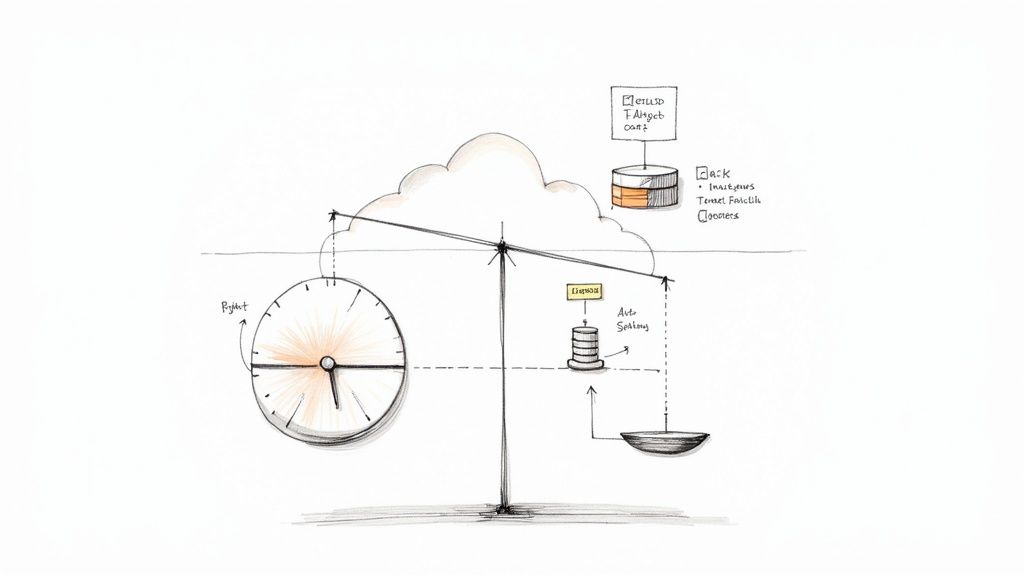
    When designing a system, scalability is a primary non-functional requirement. It is the measure of a system's ability to handle a growing amount of work by adding resources. This isn't just about surviving an ephemeral traffic spike; it's about architecting for sustained growth from inception.

    An application that performs well for 100 concurrent users may experience exponential performance degradation and collapse entirely at 101 if not designed to scale. There are two fundamental approaches to scaling a system, each with distinct technical trade-offs. Understanding these is critical for building a robust architecture.

    Vertical Scaling: The Powerful Giant

    Vertical scaling (scaling up) is the process of increasing the capacity of a single machine. This involves adding more resources like CPU cores, RAM, or faster storage (e.g., upgrading from HDDs to NVMe SSDs).

    This approach offers simplicity. It often requires no changes to the application code, as the underlying operating system and hardware handle the resource increase.

    For example, if a monolithic database server is CPU-bound, you could upgrade its EC2 instance type from a t3.large (2 vCPUs, 8GB RAM) to an m5.4xlarge (16 vCPUs, 64GB RAM). This results in an immediate performance boost for query processing.

    However, vertical scaling has inherent limitations. There is an upper physical limit to the resources you can add to a single node. Furthermore, the cost of high-end hardware increases exponentially, leading to diminishing returns. This approach also introduces a single point of failure (SPOF).

    Horizontal Scaling: The Coordinated Army

    Horizontal scaling (scaling out) involves adding more machines to a resource pool and distributing the load among them. Instead of one powerful server, you use a fleet of less powerful, commodity servers working in concert.

    This is the dominant strategy for nearly all large-scale web applications. It offers near-linear scalability and is more cost-effective. You can leverage dozens of cheaper, commodity machines instead of a single, expensive mainframe-class server.

    Horizontal scaling provides inherent fault tolerance. If one node in the cluster fails, a load balancer can redirect its traffic to healthy nodes. When a single vertically scaled machine fails, the entire system is down.

    Coordinating this "army" of servers is where advanced system design patterns come into play. You need specific strategies to distribute workloads and partition data across the cluster.

    How to Make Horizontal Scaling Actually Work

    Implementing horizontal scaling requires several key architectural components. Each solves a specific problem that arises in a distributed environment.

    Here are the essential strategies:

    • Load Balancing: A load balancer (e.g., Nginx, HAProxy, or a cloud provider's ALB/NLB) acts as a reverse proxy, distributing network traffic across multiple backend servers. Common algorithms include Round Robin (sequential distribution), Least Connections (sends traffic to the server with the fewest active connections), and IP Hash (ensures a client's requests always go to the same server).
    • Database Sharding: A single database instance will eventually become a performance bottleneck. Sharding partitions a database horizontally, breaking a large table into smaller, more manageable pieces called shards. Each shard is hosted on a separate database server, distributing the read/write load. For example, you might shard a users table based on a hash of the user_id.
    • Caching: Caching is a critical performance optimization. By storing frequently accessed data in a fast, in-memory data store like Redis or Memcached, you can serve read requests without hitting the primary database. This drastically reduces latency and alleviates load on persistent storage.
    • Stateless Architectures: In a stateless architecture, the server handling a request does not store any client session data between requests. All necessary state is passed from the client with each request or stored in a shared external data store (like a distributed cache or database). This is crucial for horizontal scaling, as it allows any server in the pool to process any request, making it trivial to add or remove servers dynamically.

    Modern cloud platforms provide managed services that simplify these patterns. For instance, understanding autoscaling in Kubernetes demonstrates how to programmatically scale a service's replica count based on real-time metrics like CPU utilization, creating a truly elastic and cost-efficient system.

    Engineering for Uptime and Fault Tolerance

    Image

    While scalability prepares a system for growth, fault tolerance prepares it for failure. In any complex distributed system, component failures are not an anomaly; they are an inevitability. Network partitions, disk failures, and software bugs will occur.

    Engineering for uptime means designing an architecture that can withstand component failures and continue to operate, perhaps at a degraded capacity, but without total collapse. This is akin to a multi-engine aircraft designed to remain airborne even after an engine failure.

    This introduces two key system design principles: reliability and availability. Reliability is a measure of a system's probability of performing its required function correctly for a specified period under stated conditions. Availability is the percentage of time a system is operational and accessible to users, typically measured by uptime.

    Availability is quantified in "nines." A system with 99.9% availability ("three nines") is down for approximately 8.77 hours per year. A "five nines" (99.999%) system is down for only 5.26 minutes per year—a significant increase in operational excellence and user experience.

    Redundancy: The Heart of Fault Tolerance

    The foundational strategy for achieving high availability is redundancy. This involves provisioning duplicate components that can take over if a primary component fails, thus eliminating any single point of failure (SPOF).

    There are two primary models for implementing redundancy:

    • Active-Passive: In this configuration, one component (active) handles the entire load while a secondary component (passive) remains on standby. The passive node is continuously monitored via a health check (heartbeat). If the active node fails, a failover mechanism reroutes traffic to the passive node, which is then promoted to active.
    • Active-Active: In this model, two or more components are simultaneously active, handling traffic and sharing the load. This not only provides redundancy but also improves scalability. If one node fails, its traffic is distributed among the remaining healthy nodes.

    The active-active approach offers better resource utilization and a seamless failover but is more complex to implement, often requiring sophisticated state synchronization. Active-passive is simpler and can be more cost-effective if the standby resources can be kept in a "warm" or "cold" state until needed.

    Preventing a Domino Effect: Cascading Failures

    Redundancy alone is insufficient. A failure in one microservice can trigger a chain reaction, overwhelming dependent services and causing a system-wide outage known as a "cascading failure."

    A key mitigation technique is graceful degradation. If a non-critical downstream service (e.g., a recommendation engine) becomes unavailable, the primary application should handle the failure gracefully. Instead of returning a 500 error, an e-commerce site might simply hide the recommendation section, preserving the core functionality of browsing and purchasing.

    Another critical pattern is the circuit breaker. When a client service detects that calls to a downstream service are repeatedly failing, the circuit breaker "trips," immediately failing subsequent calls for a configured timeout period without making a network request. This prevents the client from wasting resources on calls destined to fail and gives the failing service time to recover. Libraries like Resilience4j provide robust implementations of this pattern for JVM-based applications.

    These techniques are central to the discipline of ensuring operational stability. For a deeper dive, explore Site Reliability Engineering principles.

    By combining redundancy with failure isolation patterns, you can engineer systems that are not just robust, but truly resilient, capable of withstanding unexpected failures while maintaining service availability.

    Optimizing for Speed and Resource Efficiency

    Performance is a critical feature. A system with high latency will result in poor user experience and can directly impact business metrics. Optimizing for speed and resource efficiency involves designing an application that is responsive and cost-effective to operate.

    This requires balancing two key performance metrics: Latency, the time required to complete a single operation (e.g., an API request), and Throughput, the number of operations the system can process per unit of time (e.g., requests per second).

    A real-time trading application must prioritize ultra-low latency. A data analytics pipeline, conversely, prioritizes high throughput to process terabytes of data. Optimizing for one often comes at the expense of the other. A system with low latency but poor throughput will feel responsive to a single user but will fail under concurrent load.

    Technical Strategies for Peak Performance

    Achieving high performance requires a multi-faceted approach, applying optimizations across the entire technology stack.

    A fundamental starting point is database indexing. An index is a data structure (typically a B-Tree) that improves the speed of data retrieval operations on a database table. Without an index, the database must perform a full table scan to find a specific row. With a well-designed index on query predicates, the database can perform a much faster seek operation, reducing query times from seconds to milliseconds.

    This chart illustrates a common architectural trade-off. The choice between consistency and availability has a direct impact on system performance.

    Image

    The strong preference for availability (70%) over strict consistency (30%) reflects a common engineering decision: accepting eventual consistency to achieve lower latency and higher system responsiveness, as strong consistency often requires synchronous cross-node coordination, which introduces latency.

    Reducing Latency with Caching and Queues

    For a globally distributed user base, network latency caused by the physical distance between users and servers is a major performance bottleneck. A Content Delivery Network (CDN) mitigates this by caching static assets (images, videos, JavaScript, CSS) in a geographically distributed network of edge servers.

    When a user in Europe requests an image, it is served from a local edge server instead of fetching it from the origin server in North America, drastically reducing Round-Trip Time (RTT).

    However, some operations are inherently time-consuming, such as video transcoding or generating a complex report. Executing these tasks synchronously would block the main application thread, leading to a poor user experience.

    Asynchronous communication is the solution for handling long-running tasks. You decouple the initial request from the final execution by offloading the work to a background process. The main application remains responsive, immediately acknowledging the request.

    This is typically implemented using message queues. A user's request is serialized into a "message" and published to a queue managed by a message broker like Apache Kafka or RabbitMQ. Independent worker services subscribe to this queue, consume messages, and execute the tasks asynchronously. This decoupling is a cornerstone of modern, resilient architectures, allowing a system to absorb large traffic bursts without performance degradation.

    Different latency problems require different solutions. Here is a comparison of common techniques.

    Comparing Latency Optimization Techniques

    Technique Primary Use Case Key Benefit Common Trade-Off
    Caching Storing frequently accessed data in memory to avoid slower database or API calls. Drastically reduces read latency for common queries. Cache invalidation logic can be complex; potential for stale data.
    CDN Serving static assets (images, CSS) from geographically distributed servers. Minimizes network latency for users far from the primary server. Primarily for static content; dynamic content requires other solutions like edge computing.
    Database Indexing Speeding up data retrieval operations in a database. Exponentially faster query performance for read-heavy workloads. Increases write latency (indexes must be updated) and consumes storage space.
    Load Balancing Distributing incoming traffic across multiple servers. Prevents any single server from becoming a bottleneck, improving throughput. Adds a layer of complexity and a potential point of failure to the infrastructure.
    Asynchronous Processing Offloading long-running tasks to background workers using message queues. Keeps the primary application responsive by not blocking user requests. Introduces eventual consistency; results are not immediate, requiring a callback mechanism.

    By layering these techniques, you engineer a system that is not only perceived as fast by end-users but also operates efficiently, optimizing resource utilization and controlling operational costs.

    Building Maintainable Systems with Microservices

    Image

    A system that is performant and scalable is of little value if it cannot be maintained. Maintainability is a critical, though often overlooked, system design principle that dictates how easily a system can be modified, debugged, and evolved over time.

    For decades, the standard architectural pattern was the monolith, where all application functionality is contained within a single, tightly coupled codebase and deployed as a single unit. While simple to develop initially, monoliths become increasingly fragile and difficult to change as they grow in complexity.

    A minor change in one module can have unintended consequences across the entire application, making deployments high-risk events. This inherent rigidity led to the development of more modular architectural styles.

    The Rise of Modular Design

    The modern solution is to adopt a modular approach, breaking down a large application into a collection of small, independent, and loosely coupled services. This is the core concept behind a microservices architecture.

    Each service is responsible for a specific business capability, has its own codebase, and is deployed independently. This architectural style has become a de facto industry standard. A 2023 survey indicated that 82% of organizations have adopted microservices, compared to older modular patterns like service-oriented architecture (SOA), used by only 35%.

    Core Principles of Modular Systems

    To successfully implement a microservices architecture, two foundational principles must be adhered to:

    • Loose Coupling: Services should be as independent as possible. A change to the internal implementation of the user-profile service should not require a corresponding change and redeployment of the payment-processing service. This separation allows autonomous teams to develop, test, and deploy their services independently, increasing development velocity.

    • High Cohesion: Each service should have a single, well-defined responsibility. The inventory service should manage inventory state and nothing else—not user reviews or shipping logistics. This principle, also known as the Single Responsibility Principle, ensures that each service is easier to understand, maintain, and test.

    The combination of loose coupling and high cohesion creates a system with strong fault isolation. A bug or performance issue in one service is contained within that service's boundary, preventing a cascading failure across the entire application. This modularity is a prerequisite for building resilient systems.

    Communication Is Key

    For distributed services to function as a cohesive application, they require well-defined and reliable communication protocols. APIs (Application Programming Interfaces) serve as the contract between services.

    Each microservice exposes a stable API (e.g., REST, gRPC) that defines how other services can interact with it. As long as this API contract is maintained, the internal implementation of a service can be completely refactored or even rewritten in a different programming language without impacting its consumers. For example, a notification service could be migrated from Python to Go, and as long as its API remains backward compatible, no other service needs to be modified.

    Mastering these concepts is fundamental to building adaptable systems and is a key strategy for managing technical debt. To explore this further, see our detailed guide on microservices architecture design patterns.

    Let's move from theory to a practical design exercise.

    Applying system design principles to a concrete problem is the best way to solidify understanding. Let's walk through the architectural design of a URL shortening service, similar to Bitly or TinyURL. The system must accept a long URL and generate a short, unique alias, which, when accessed, redirects the user to the original destination URL.

    Nailing Down the Requirements and Constraints

    A precise definition of functional and non-functional requirements is the critical first step. This process informs all subsequent architectural trade-offs.

    Functional Requirements:

    • Given a long URL, the service must generate a unique short URL.
    • Accessing a short URL must result in an HTTP redirect to the original long URL.
    • Users can optionally provide a custom short alias.

    Non-Functional Requirements:

    • High Availability: The service must be highly available. Link redirection is a critical path; downtime renders all generated links useless. Target: 99.99% availability.
    • Low Latency: Redirects must be near-instantaneous. Target: p99 latency of under 100ms.
    • Scalability: The system must scale to handle a high volume of writes (link creation) and an even higher volume of reads (redirections).

    Back-of-the-Envelope Calculations

    Before architecting, we perform rough calculations to estimate the scale of the system. This helps in selecting appropriate technologies and design patterns.

    Assume the service needs to handle 100 million new URL creations per month.

    • Write Traffic (Creations): 100 million URLs / (30 days * 24 hours/day * 3600 sec/hour) ≈ 40 writes/sec.
    • Read Traffic (Redirections): A common read-to-write ratio for such a service is 10:1. This gives us 400 reads/sec.
    • Storage Estimation: Assume links are stored for 5 years. Total URLs = 100 million/month * 12 months/year * 5 years = 6 billion records. If each record (short key, long URL, metadata) is approximately 500 bytes, total storage needed = 6 billion * 500 bytes = 3 TB.

    These estimates confirm that a single-server architecture is not viable. A distributed system is required.

    Sketching Out the High-Level Architecture

    Now we can apply our principles to a high-level design.

    1. Load Balancer: An Application Load Balancer (ALB) will be the entry point. It will terminate TLS and distribute incoming HTTP requests across a pool of application servers. This is fundamental for horizontal scaling and high availability; if a server instance fails, the ALB's health checks will detect it and redirect traffic to healthy instances.

    2. Stateless Application Servers: Behind the ALB will be a fleet of identical web servers running in an auto-scaling group. They must be stateless. All state (URL mappings) will be persisted in a database or cache. This allows us to scale the application tier horizontally by adding or removing servers based on traffic load without impacting user sessions.

    3. Distributed Database: A single relational database would not handle 3 TB of data and 400+ reads/sec efficiently. A distributed NoSQL key-value store like Amazon DynamoDB or Apache Cassandra is a better fit. The short URL alias can serve as the primary key, providing O(1) lookup complexity for reads.

    The database should be partitioned (sharded) across multiple nodes. This distributes the read/write load, preventing hotspots and enabling the database to scale horizontally alongside the application tier.

    1. Caching Layer: The 10:1 read-to-write ratio strongly indicates that a caching layer will yield significant performance improvements. We will deploy a distributed cache like Redis or Memcached using a write-through caching strategy. When a redirect request for a short URL arrives, the application first checks the cache. A cache hit returns the long URL immediately, avoiding a database query. Given our latency target, this is non-negotiable.

    Common Questions About System Design

    Even with a solid grasp of core concepts, applying system design principles to real-world scenarios raises practical questions. This section addresses common challenges engineers face when translating theory into practice.

    Where Should I Start with a New Design?

    The most effective starting point is a rigorous analysis of the system's requirements, not a diagramming tool. You must differentiate between functional requirements (what the system does) and non-functional requirements (how the system behaves under load and failure conditions).

    Before designing, conduct a requirements-gathering session with stakeholders to clarify:

    • What is the core business problem? Define the primary use cases and user stories.
    • What are the non-functional constraints? Quantify the SLOs for availability (e.g., 99.95%), latency (e.g., p99 response time < 200ms), and data consistency (e.g., strong vs. eventual).
    • What is the expected scale? Perform back-of-the-envelope calculations to estimate requests per second (RPS), data storage volume, and the read/write ratio.

    This foundational work dictates every subsequent architectural decision. A system designed for high-availability reads will have a vastly different architecture from one prioritizing transactional consistency.

    How Do I Choose the Right Database?

    Database selection is a critical architectural decision with long-term consequences. The "right" choice is entirely dependent on the system's specific access patterns and consistency requirements.

    A simplified decision framework:

    • SQL (Relational): Choose for applications requiring ACID guarantees and where data has a well-defined, relational schema. Ideal for financial systems, e-commerce order management, and systems where data integrity is paramount.
    • NoSQL (Non-Relational): Choose for systems requiring high scalability, flexible data models, and high throughput. Key-value stores are excellent for caching and session management. Document stores are well-suited for content management. Wide-column stores are built for large-scale analytical workloads.

    The modern best practice is often polyglot persistence, which involves using multiple database technologies within a single application, selecting the best tool for each specific job. For example, use a SQL database for core user data but a time-series database for monitoring metrics.

    Can a System Be Perfectly Scalable and Reliable?

    No. In practice, achieving perfect scalability and reliability is impossible due to physical constraints and prohibitive costs. The goal is not abstract perfection but engineering a system that meets its defined Service Level Objectives (SLOs) within business and budget constraints.

    Achieving "five nines" (99.999%) availability is a monumental engineering effort requiring redundancy at every layer of the stack, automated failover, and extensive monitoring, which incurs significant cost and operational complexity. Perfection is an asymptote; each additional "nine" of availability costs exponentially more to achieve. The engineering task is to build a system that meets the required level of resilience for its use case, not a theoretical ideal.


    Ready to implement these principles with an expert team? OpsMoon connects you with the top 0.7% of remote DevOps engineers to build, scale, and manage your infrastructure. We provide a clear roadmap and flexible engagement models to accelerate your software delivery. Start with a free work planning session to map out your next project.

  • 10 Advanced Automated Testing Strategies for DevOps in 2025

    10 Advanced Automated Testing Strategies for DevOps in 2025

    In a high-velocity DevOps environment, surface-level testing is no longer sufficient. The difference between leading and lagging teams often lies in the sophistication of their automated testing strategies. Merely running tests isn't enough; it's about embedding quality into every stage of the software delivery lifecycle, a core component of building resilient, scalable, and high-quality software. To truly unlock the potential of DevOps velocity, teams must also consider broader actionable strategies for increasing operational efficiency across the development lifecycle.

    This article moves beyond generic advice to provide a technical deep-dive into ten powerful strategies that modern engineering teams use to accelerate delivery. We will explore the practical implementation steps, recommended toolchains, and actionable insights needed to deploy these methods effectively. This focus on advanced automated testing strategies helps reduce release cycles, minimize production defects, and gain a significant competitive edge. From writing tests before code with Test-Driven Development (TDD) to virtualizing entire service ecosystems for robust integration checks, these approaches will fundamentally change how your team approaches quality assurance. Get ready to transform your testing framework from a simple bug-finding process into a strategic driver of development velocity and product excellence.

    1. Test-Driven Development (TDD)

    Test-Driven Development (TDD) is a disciplined software development process that inverts the traditional code-first approach. Instead of writing production code and then adding tests, TDD requires developers to write a failing automated test case before writing any code to fulfill that test. This practice is one of the most fundamental automated testing strategies because it embeds quality directly into the development lifecycle from the very beginning.

    The TDD workflow follows a simple yet powerful cycle known as "Red-Green-Refactor." First, the developer writes a test for a new feature (Red phase), which fails because the corresponding code doesn't exist yet. Next, they write the minimum amount of code necessary to make the test pass (Green phase). Finally, the developer refactors the new code to improve its structure and readability without changing its external behavior (Refactor phase), all while ensuring the tests continue to pass.

    How to Implement TDD

    Successful TDD implementation relies on a strict, iterative process. It's less about tools and more about the development discipline.

    • Start Small: Begin with a single function or class method. For a Python API, you might write a pytest test first: def test_add_item_to_cart(): assert cart.item_count() == 1. This will fail until you implement the add_item_to_cart and item_count methods.
    • Focus on Behavior: Write tests that validate what the code should do, not how it does it. This prevents tests from becoming brittle. Test the public API of a class, not its private methods, to avoid tight coupling between the test and the implementation.
    • Keep Tests Independent: Each test should be self-contained and not rely on the state of a previous test. Use setup (@BeforeEach in JUnit) and teardown (@AfterEach) hooks in your testing framework to initialize and clean up state for each test run.

    Teams at companies like Amazon and Spotify leverage TDD to build robust backend services, ensuring that each microservice functions as expected before it's even fully written. This proactive approach significantly reduces regression bugs and builds a comprehensive, self-validating test suite that serves as living documentation for the codebase.

    2. Behavior-Driven Development (BDD)

    Behavior-Driven Development (BDD) is an agile software development practice that extends Test-Driven Development (TDD) by encouraging collaboration between technical and non-technical stakeholders. It frames automated tests around the application's behavior from the end-user's perspective, using natural language to create a shared understanding of requirements. This makes BDD one of the most effective automated testing strategies for aligning development with business goals.

    Behavior-Driven Development (BDD)

    BDD uses a simple, structured language format known as Gherkin, which follows a "Given-When-Then" syntax. A Given clause describes the initial context, When specifies an action or event, and Then states the expected outcome. This human-readable format allows product owners, business analysts, and QA testers to contribute to writing and reviewing test scenarios, ensuring the developed features meet user expectations precisely.

    How to Implement BDD

    Adopting BDD successfully requires shifting focus from testing code to defining system behavior through collaborative conversations.

    • Start with User Scenarios: Before writing any code, define acceptance criteria as BDD scenarios in .feature files. For a login feature, a scenario might be: Given a registered user is on the login page, When they enter valid credentials, Then they should be redirected to their dashboard.
    • Use Domain Language: Write scenarios using terminology familiar to business stakeholders. This creates a ubiquitous language across the team, reducing misunderstandings and ensuring everyone is aligned on feature requirements.
    • Implement Step Definitions: Connect the Gherkin steps to your application code. Using a framework like Cucumber (Java), Behave (Python), or SpecFlow (.NET), you will write "step definition" code that executes for each line of the Gherkin scenario, effectively turning the scenario into an automated test. Integrate these tests into your continuous integration pipeline.

    Organizations like the BBC and the UK's Government Digital Service use BDD to ensure their digital platforms meet stringent user accessibility and functionality requirements. By defining behavior in clear, unambiguous terms, they bridge the communication gap between development teams and business units, resulting in software that truly serves user needs.

    3. Data-Driven Testing

    Data-Driven Testing (DDT) is an automated testing strategy that separates the test script logic from the test data. Instead of hard-coding values into the test case, this methodology allows a single test script to execute repeatedly with different inputs and validation points from an external data source, such as a CSV file, spreadsheet, or database. This approach dramatically improves test coverage and scalability by allowing testers to validate a wide range of scenarios without writing new scripts.

    The core principle of DDT is to create a test automation framework where the test logic is a reusable template. The framework reads rows of data, passes them to the test script as variables, executes the test, and then repeats the process for the next row. This makes it an incredibly efficient method for testing functions that handle various inputs, like user login forms, payment processing gateways, or complex calculation engines.

    How to Implement Data-Driven Testing

    Implementing DDT requires setting up a framework to connect your test scripts with your data sources. It is one of the most powerful automated testing strategies for scaling test suites.

    • Choose a Data Source: Select a source that best fits your team's workflow. Common choices include CSV files for simplicity, Excel spreadsheets for readability, or a dedicated database for managing large, complex data sets.
    • Decouple Logic from Data: Design your test scripts to accept parameters. For example, in a Java/TestNG framework, you can use the @DataProvider annotation to feed data from a method that reads a CSV file. The test method would then be defined as public void testLogin(String username, String password, boolean expectedResult).
    • Version Your Test Data: Store your test data files (e.g., login_test_data.csv) in the same version control system (like Git) as your test scripts. This ensures that changes to test data are tracked, code-reviewed, and synchronized with the codebase.

    Companies like PayPal and other financial institutions rely heavily on this method to validate countless transaction scenarios, using massive datasets to test different currencies, amounts, and user account types. Similarly, e-commerce platforms use it to verify product catalog functionality across thousands of different product SKUs and attributes.

    4. Keyword-Driven Testing

    Keyword-Driven Testing (KDT) is an automated testing strategy that decouples test case design from test implementation. This approach separates the "what to test" from the "how to test" by using keywords to represent specific actions or operations. This allows both technical and non-technical team members to create robust automated tests by combining these predefined keywords in a simple, readable format, often within a spreadsheet or table.

    This methodology abstracts the underlying code complexity behind simple, action-oriented keywords like Login, VerifyElementIsVisible, or AddItemToCart. The keywords are mapped to functions or scripts that perform the actual operations, making test suites highly modular and maintainable. This framework is a powerful automated testing strategy for teams looking to empower manual testers or business analysts to contribute directly to automation efforts.

    How to Implement Keyword-Driven Testing

    Effective KDT implementation hinges on building a solid and well-documented keyword library. The goal is to create a versatile set of building blocks for test creation.

    • Design Atomic Keywords: Each keyword should perform one single, discrete action. For example, instead of a LoginAndVerifyDashboard keyword, create separate EnterUsername, EnterPassword, ClickLoginButton, and VerifyDashboardElement keywords for greater reusability. Implement these as functions in a shared library (e.g., keywords.py).
    • Maintain Clear Documentation: Create a "keyword dictionary" that clearly explains what each keyword does, what parameters it requires (e.g., EnterUsername takes one argument: username_string), and what its expected outcome is. This documentation is crucial for enabling non-programmers to build tests confidently.
    • Use a Data-Driven Approach: Your test cases, defined in a spreadsheet, will have columns like Keyword, Target, and Value. The Target column could specify a UI locator, and Value could be the data to input. A test engine script reads this spreadsheet row by row, calling the corresponding keyword function with the provided arguments.

    Companies like Nokia have famously used this approach with tools like the Robot Framework to test complex telecommunications systems. Similarly, large enterprises use it for testing SAP and other ERP systems, where business process experts can define tests using familiar business terminology, dramatically speeding up the testing lifecycle.

    5. Page Object Model (POM)

    The Page Object Model (POM) is an essential design pattern for UI test automation that dramatically improves test maintenance and readability. Instead of embedding UI locators and interaction logic directly within test scripts, POM abstracts them into separate class files, or "page objects." Each page object represents a specific page or a significant component of the application's user interface, creating a clear separation between the test logic and the page interaction code.

    Page Object Model (POM)

    This encapsulation means that if a UI element's locator (like its ID or XPath) changes, you only need to update it in one place: the corresponding page object. Your test scripts, which call methods from this object (e.g., loginPage.enterUsername("user")), remain unchanged. This makes POM one of the most scalable automated testing strategies for complex, evolving web applications.

    How to Implement POM

    Implementing POM effectively requires a disciplined approach to organizing your test automation framework. The core principle is to model your application's UI as a collection of objects.

    • Create Dedicated Page Objects: For a login page, create a LoginPage.js class. Inside, define locators: get usernameField() { return $('#username'); }. Then, add methods for actions: login(username, password) { this.usernameField.setValue(username); ... }.
    • Keep Assertions Out: Page object methods should only interact with the page or return its state (e.g., getErrorMessageText()). The actual test assertions (e.g., expect(loginPage.getErrorMessageText()).toBe('Invalid credentials');) must reside in your test files (login.spec.js) to maintain a clear separation of concerns.
    • Use Method Chaining: Have methods that result in navigation to a new page return an instance of that new page's object. For example, a successful login() method should return new DashboardPage(). This creates a fluent and readable API for your tests: loginPage.loginAsAdmin().verifyWelcomeMessage();.

    Teams at companies like Google and LinkedIn have heavily relied on POM to build maintainable and robust UI test suites. This pattern allows them to scale their testing efforts efficiently, as it drastically reduces code duplication and simplifies updates when the application's front-end evolves.

    6. Continuous Integration/Continuous Testing

    Continuous Integration/Continuous Testing (CI/CT) is a cornerstone of modern DevOps, integrating automated testing directly into the CI/CD pipeline. This strategy mandates that every time a developer commits code to a shared repository, a suite of automated tests is automatically triggered. This immediate validation provides rapid feedback, ensuring that new changes do not break existing functionality and maintaining a consistently high level of code quality throughout the development lifecycle.

    The CI/CT process automates the build, test, and validation cycle, making it one of the most effective automated testing strategies for fast-paced development environments. When a commit triggers the pipeline, unit, integration, and other relevant tests are executed automatically. This approach, pioneered by thought leaders like Martin Fowler and Jez Humble, prevents the integration issues that arise when developers work in isolation for long periods.

    This summary box highlights the primary benefits of integrating a CI/CT pipeline.

    The data clearly shows how automating tests on every commit dramatically accelerates feedback loops and optimizes overall test execution time, empowering teams to deliver features faster and more reliably.

    How to Implement CI/CT

    Implementing CI/CT effectively requires a focus on pipeline efficiency and reliability. The goal is to make testing a seamless, automated part of the development workflow.

    • Create a Multi-Stage Pipeline: Structure your pipeline in stages. A typical setup in a gitlab-ci.yml or GitHub Actions workflow file would have a build stage, a test stage (running unit and fast integration tests), and a deploy-to-staging stage followed by a e2e-test stage. Failing a stage prevents progression to the next, saving time and resources.
    • Use Parallel Execution: Configure your CI server (like Jenkins, GitLab CI, or GitHub Actions) to run independent tests in parallel. For example, you can configure Jest or Pytest to split tests across multiple runners or containers, significantly reducing total execution time.
    • Implement Smart Failure Notifications: Configure your CI tool to send notifications to a specific Slack channel or create a Jira ticket on pipeline failure. Include a direct link to the failed build logs so the responsible developer can immediately start debugging.

    Companies like Netflix and Etsy rely heavily on CI/CT to manage thousands of deployments per day. Their pipelines include automated canary analysis and multi-stage testing, ensuring that only high-quality, resilient code reaches production. By embedding testing into the delivery pipeline, they build confidence and accelerate innovation. Learn more about how to automate your software testing to achieve similar results.

    7. Risk-Based Testing

    Risk-Based Testing is a pragmatic strategy that prioritizes testing activities based on the probability and impact of potential failures. Instead of aiming for 100% test coverage, which is often impractical, this approach directs the most rigorous automated testing efforts toward high-risk areas of an application. This ensures that the most critical functionalities receive the most attention, optimizing resource allocation and maximizing the effectiveness of the testing cycle.

    This methodology involves a systematic process of identifying, analyzing, and mitigating risks. Teams assess software components based on business impact, failure probability, and complexity, allowing them to focus on areas where defects would cause the most significant harm. This makes it one of the most efficient automated testing strategies for complex systems with tight deadlines.

    How to Implement Risk-Based Testing

    Implementing this strategy requires collaboration between developers, QA, and business stakeholders to align testing with business priorities. A structured approach is key to its success.

    • Create a Risk Matrix: Start by cataloging potential risks. For each feature, create a risk score (e.g., from 1-10) by multiplying its business Impact score by its technical Likelihood of Failure score. A payment gateway would have a high impact, and a newly refactored module would have a high likelihood of failure, making it a top priority.
    • Map Test Suites to Risk Levels: Define test suites with varying depths. High-risk features should be covered by unit, integration, and end-to-end automated tests that run in the CI pipeline. Medium-risk features might only have unit and integration tests, while low-risk features (e.g., a static "About Us" page) might only have a simple smoke test. To effectively manage security risks as part of your testing strategy, consider integrating a comprehensive IT security audit checklist.
    • Continuously Re-evaluate: Use production monitoring data and bug reports to dynamically update your risk assessment. If a seemingly low-risk area starts generating frequent production errors, its Likelihood of Failure score should be increased, triggering more intensive testing in subsequent sprints.

    Industries like aerospace and healthcare heavily rely on risk-based testing to validate safety-critical systems. By concentrating testing on flight-control software or patient data management, they ensure that the most catastrophic failure points are thoroughly vetted, leading to more reliable and secure products. You can learn more about how to apply this to your projects by exploring software project risk management.

    8. Model-Based Testing

    Model-Based Testing (MBT) is an advanced automated testing strategy where test cases are automatically generated from a formal model of the system's behavior. Instead of manually scripting each test, engineers create a mathematical or state-machine model that describes how the system should function. This model then serves as a single source of truth for generating a comprehensive and optimized set of test scenarios, ensuring systematic coverage of the application's logic.

    The MBT process involves creating a precise model of the system under test, often using graphical notations like UML state diagrams or formal languages. Test generation tools then traverse this model to derive abstract test cases, which are later translated into executable scripts. This approach is highly effective for complex systems where manual test design would be impractical or error-prone, allowing teams to validate intricate system functionality with mathematical rigor.

    How to Implement Model-Based Testing

    Successful MBT implementation requires a shift from manual test case design to abstract system modeling. This discipline excels at finding edge cases that humans might overlook.

    • Start with a Critical Component: Begin by modeling a well-defined and critical stateful component of your system, such as a video player's lifecycle (e.g., states: loading, playing, paused, buffering, ended).
    • Use Appropriate Modeling Tools: Utilize tools like GraphWalker or Modbat. You can define your model as a directed graph where nodes represent states and edges represent transitions (user actions or system events). The tool then generates all possible paths through the graph, representing test cases.
    • Validate the Model: Before generating tests, ensure the model itself is accurate by reviewing it with domain experts and stakeholders. An incorrect model will generate valid-looking but functionally incorrect tests. A model of an ATM, for example, must correctly show that a user cannot withdraw cash before successfully entering a PIN.

    Companies like Microsoft have used MBT to test complex communication protocols, while the automotive industry relies on it for verifying Electronic Control Unit (ECU) software. This strategy is invaluable for systems where reliability is non-negotiable, as it provides a systematic way to verify that the implementation aligns perfectly with the specified design.

    9. Shift-Left Testing

    Shift-Left Testing is a foundational philosophy that moves testing activities earlier in the software development lifecycle. Instead of waiting for a "testing phase" after development, this approach integrates quality checks from the very beginning, often starting during requirements gathering and design. This proactive model is one of the most impactful automated testing strategies because it focuses on preventing defects rather than just finding them later, dramatically reducing the cost and effort of remediation.

    The core principle of shifting left is to empower developers and the entire team to take ownership of quality. By performing testing activities concurrently with development, teams can catch bugs, architectural flaws, and security vulnerabilities when they are cheapest and easiest to fix. This continuous feedback loop ensures that quality is built into the product, not inspected at the end, aligning perfectly with modern DevOps and CI/CD practices.

    How to Implement Shift-Left Testing

    Implementing a shift-left culture requires more than just tools; it demands a change in mindset and process across the entire development team.

    • Integrate Static Analysis: Use tools like SonarQube, ESLint, or Checkmarx directly in the developer's IDE via plugins and as a mandatory step in your CI pipeline's pre-commit hooks. This provides developers with instant feedback on code smells, bugs, and security vulnerabilities before the code is even merged.
    • Promote Developer-Led Testing: Equip developers with frameworks for different testing levels. For unit testing, provide JUnit/NUnit. For integration testing, introduce tools like Testcontainers to spin up ephemeral database or message queue instances for realistic, isolated tests.
    • Implement Pair Programming and Code Reviews: Formalize a peer review process using GitHub Pull Requests or GitLab Merge Requests. Enforce a rule that no code can be merged without at least one approval. This process serves as a manual check for logic errors, adherence to coding standards, and test coverage.

    Tech giants like Microsoft have famously integrated this philosophy into their Security Development Lifecycle, while Google's robust code review culture ensures that multiple engineers vet code for quality and correctness before it is merged. This approach makes quality a collective responsibility, significantly improving release stability and velocity.

    10. Service Virtualization Testing

    Service Virtualization Testing is a technique that simulates the behavior of unavailable or difficult-to-access system components, such as APIs, microservices, or databases. By creating virtual replicas of these dependencies, teams can test their applications in isolation without needing a fully integrated and operational environment. This strategy is crucial for complex, distributed systems where certain services might be under development, owned by third parties, or too costly to use for extensive testing.

    This approach allows development and QA teams to proceed with their work in parallel, removing bottlenecks caused by unavailable dependencies. Instead of waiting for a real service to be ready, a virtual service-configured to mimic its expected responses, performance, and data-is used as a stand-in. This enables earlier and more frequent testing, which is a cornerstone of effective automated testing strategies in a CI/CD pipeline.

    How to Implement Service Virtualization Testing

    Effective implementation requires a focus on accurately simulating dependencies to ensure tests are meaningful. It's about creating reliable stand-ins that behave just like the real components.

    • Start with Critical Dependencies: Identify the most critical, unstable, or costly dependencies to virtualize first. A third-party payment gateway that charges per API call is a prime candidate. Use tools like WireMock, Mountebank, or Hoverfly to create a mock server.
    • Use Real Service Contracts: Generate virtual services from actual service contracts like OpenAPI/Swagger specifications or recorded network traffic logs (HAR files). This ensures the mock service's endpoints, request/response structures, and headers accurately reflect the real service's behavior. For example, you can configure WireMock to respond with a specific JSON payload when it receives a GET request on /api/v1/users/123.
    • Keep Virtual Services Synchronized: Implement contract testing using a tool like Pact. This ensures that any change to the real service provider that breaks the consumer's expectation will cause a test failure in the provider's pipeline, alerting you to update your virtual service.

    Financial institutions like Capital One and Deutsche Bank use service virtualization to test their complex API integrations and core banking systems without relying on slow, expensive mainframe environments. This allows them to shift testing left, accelerate development cycles, and significantly reduce the costs associated with accessing third-party and legacy systems.

    Automated Testing Strategies Comparison Matrix

    Testing Approach Implementation Complexity Resource Requirements Expected Outcomes Ideal Use Cases Key Advantages
    Test-Driven Development (TDD) Moderate to High due to strict discipline Requires skilled developers, testing tools Improved code quality, early defect detection Unit testing, backend services, code quality focus Better design, higher test coverage, faster debugging
    Behavior-Driven Development (BDD) Moderate, requires collaboration and tools Involves technical and non-technical stakeholders Enhanced communication, living documentation User behavior validation, business-focused features Clear stakeholder communication, reduces ambiguity
    Data-Driven Testing Moderate, setup of external data sources Test data management tools and infrastructure Extensive coverage over multiple data sets Validating multiple input scenarios, boundary testing Reusable data sets, scalable test execution
    Keyword-Driven Testing High initial setup complexity Frameworks with keyword libraries Reusable, non-technical test creation Teams with non-programmers, repetitive action tests Enables non-technical testers, high reusability
    Page Object Model (POM) Moderate, requires design pattern adoption UI automation tools and skilled testers Maintainable, reusable UI test code UI automation, web applications Reduces code duplication, eases UI changes handling
    Continuous Integration/Continuous Testing (CI/CT) High, setup of infrastructure and pipelines CI/CD platforms, automation environments Rapid feedback, reduced regressions All development teams aiming for automation Early defect detection, faster releases
    Risk-Based Testing Moderate to High due to risk assessment Domain expertise for risk analysis Optimized test prioritization and resource use Critical systems, limited testing budgets Focused testing, better ROI
    Model-Based Testing High, requires modeling and tool expertise Modeling tools and experts Systematic, comprehensive test scenarios Complex systems, protocol and state-based testing Automated test generation, traceability
    Shift-Left Testing Moderate, cultural and process changes Collaboration tools, early testing practices Early defect discovery, improved quality Agile teams, continuous quality improvement Reduced cost of defects, enhanced collaboration
    Service Virtualization Testing High, simulation setup and maintenance Virtualization tools, environment management Isolated testing without dependencies Integration testing when dependencies unavailable Saves costs, enables parallel development

    Integrating Your Strategy: From Plan to Production-Ready

    Moving from theory to practice is the most critical step in revolutionizing your quality assurance process. We've explored a comprehensive suite of ten powerful automated testing strategies, from the granular control of Test-Driven Development (TDD) to the high-level business alignment of Behavior-Driven Development (BDD), and the efficiency gains of Continuous Testing within a CI/CD pipeline. Each strategy offers a unique lens through which to view and validate your application, but their true power is unlocked when they are integrated into a cohesive, multi-layered quality assurance ecosystem.

    The core takeaway is that a one-size-fits-all approach is a myth. A mature testing practice doesn't just pick one strategy; it skillfully blends several. You might use TDD to build robust, bug-resistant components at the unit level, while leveraging BDD to ensure the features you build meet precise business requirements. Simultaneously, a Page Object Model (POM) can keep your UI automation scalable and maintainable, while service virtualization tackles complex dependencies, allowing your teams to test in parallel without bottlenecks. This holistic approach transforms testing from a final-stage gatekeeper into an integral, continuous part of the development lifecycle.

    Your Actionable Roadmap to Implementation

    To translate this knowledge into tangible results, your next steps should be deliberate and strategic. Don't attempt to implement everything at once. Instead, create a phased adoption plan tailored to your team’s immediate pain points and long-term goals.

    • Assess and Prioritize: Begin by auditing your current testing process. Where are the biggest bottlenecks? Are you struggling with flaky end-to-end tests, poor test data management, or a slow feedback loop? Use a Risk-Based Testing mindset to identify the most critical areas of your application and focus your initial automation efforts there.
    • Start with a Pilot Project: Select a small, low-risk project or a single component to introduce a new strategy, such as implementing Data-Driven Testing for a specific API endpoint. This creates a safe environment to learn, refine your process, and demonstrate value to stakeholders before a full-scale rollout.
    • Build Foundational Skills and Tooling: Ensure your team has the necessary skills and tools. This might involve training engineers on a new BDD framework like Cucumber, setting up a CI server like Jenkins or GitLab CI, or configuring a service virtualization tool like WireMock. A solid foundation is essential for scaling your automated testing strategies effectively.
    • Measure, Iterate, and Expand: Continuously measure the impact of your efforts. Track key metrics like bug escape rates, test execution time, and code coverage. Use these insights to refine your approach and justify expanding the adoption of new strategies across more teams and projects.

    Mastering these sophisticated techniques is not just about catching bugs earlier; it's about building a culture of quality that accelerates innovation and delivers exceptional user experiences. By investing in a robust, intelligent, and layered testing strategy, you create a powerful competitive advantage, enabling your team to ship better software, faster and with greater confidence.


    Ready to implement these advanced automated testing strategies but need the expert talent to lead the way? OpsMoon connects you with a global network of elite, pre-vetted DevOps and SRE engineers who specialize in building and scaling sophisticated automation frameworks. Start with a free work planning session to architect your ideal testing pipeline and find the perfect freelance expert to make it a reality.

  • How to Hire a Remote DevOps Engineer: A Technical Guide

    How to Hire a Remote DevOps Engineer: A Technical Guide

    Before you post a job ad, the first critical step is to architect the role. This isn't just listing tools; it's about a deep analysis of your current infrastructure and operational pain points to define exactly what problems this engineer needs to solve. Success hinges on this initial blueprint.

    To get there, you need to start with a rigorous, honest audit of your own systems.

    Defining the Role Beyond a Job Description

    What are your biggest infrastructure bottlenecks right now? Is your Kubernetes cluster suffering from pod eviction storms due to resource contention, indicating a need for better resource management and autoscaling strategies? Or is the immediate challenge automating deployments for a monolithic legacy application using a canary or blue-green strategy without causing downtime? Pinpointing these specific, technical pain points is paramount.

    The demand for skilled DevOps talent is surging. The global market is projected to skyrocket from $13.2 billion in 2024 to $81.1 billion by 2028. With approximately 80% of companies now adopting DevOps principles, it’s no surprise that 29% of IT teams have recently hired for this role. It is a highly competitive market.

    This chart drives home the point, showing just how quickly companies are embracing remote DevOps engineers.

    Image

    The upward trend is undeniable, signaling a clear industry shift and growing trust in remote talent to manage mission-critical infrastructure.

    Distinguishing Must-Haves from Nice-to-Haves

    Once you’ve identified your core challenges, you must separate non-negotiable "must-have" skills from "nice-to-haves." An unrealistic wish list of every tool under the sun will deter qualified candidates.

    For example, if your entire infrastructure is codified in Terraform and runs on AWS, then deep, hands-on experience with both is a hard requirement. The candidate must be able to write complex modules, manage state effectively, and understand IAM policies in depth.

    However, if you use Prometheus for monitoring but are considering a migration, specific Prometheus expertise is a bonus, not a deal-breaker. A candidate with deep experience in a different observability platform like Datadog or setting up a custom OpenTelemetry stack could adapt quickly.

    To aid this process, define the seniority level you need. A junior engineer's responsibilities and technical depth will be vastly different from a principal-level architect.

    Core DevOps Competencies by Experience Level

    Experience Level Core Technical Skills Key Responsibilities
    Junior Foundational cloud services (e.g., AWS EC2, S3, IAM), shell scripting (Bash, PowerShell), CI/CD pipeline usage (Jenkins, GitLab CI), containerization (Docker). Executing predefined runbooks, maintaining CI/CD jobs, basic cloud resource provisioning via console or simple scripts, responding to tier-1 monitoring alerts.
    Mid-Level Advanced IaC (Terraform, CloudFormation), container orchestration (Kubernetes), strong observability (Prometheus, Grafana), CI/CD pipeline design, security fundamentals. Designing and implementing CI/CD pipelines, writing and maintaining complex IaC modules, improving system reliability (SLIs/SLOs), automating toil.
    Senior Deep cloud architecture expertise (multi-account strategies, VPC design), advanced Kubernetes management (custom controllers, service mesh), DevSecOps practices, cloud cost optimization. Architecting scalable and resilient cloud-native systems, leading infrastructure projects, setting technical strategy, mentoring other engineers, driving security and compliance.

    This table provides a solid baseline to help you target the precise level of expertise your specific technical challenges demand.

    Building a Precise Candidate Persona

    With your technical requirements defined, build a detailed candidate persona. This transcends a skills checklist; it encompasses the operational and cultural attributes required for success on a remote team.

    Consider these factors:

    • Level of Autonomy: Do you need a self-directed engineer who can take a high-level objective like "improve deployment velocity" and break it down into actionable epics? Or will this role have close oversight from a lead? A startup scaling its infrastructure needs the former; a large enterprise with established processes might offer more structure.
    • Communication Protocol: Remote work is defined by communication. Is your team synchronous, relying on frequent video calls and pair programming sessions? Or is it asynchronous, with a culture built on detailed RFCs, architecture decision records (ADRs), and thorough pull request descriptions in tools like Slack or Jira? Your ideal hire must thrive in your operational rhythm. We delve deeper into this in our guide on the role of a remote DevOps engineer.
    • Problem-Solving Approach: Do you need a methodical architect who designs for five-nines of availability? Or do you need a pragmatic troubleshooter who excels at incident response and can quickly diagnose production issues? Be honest about your team's current needs.

    By architecting this detailed persona, you transform your hiring process. You stop looking for a list of tool keywords and start searching for an engineer who can solve your specific architectural and operational problems within your remote culture. This foundation is the single most critical factor in a successful hire.

    Finding Elite DevOps Talent in a Crowded Market

    Image

    The best remote DevOps engineers are not endlessly scrolling job boards. They are busy resolving complex infrastructure issues, contributing to open-source projects, or engaging in deep technical debates within their peer communities.

    To hire this caliber of talent, you must operate where they do. This requires moving beyond passive job postings and actively sourcing from platforms where technical credibility is built and demonstrated. It's less like casting a wide net and more like targeted reconnaissance.

    Beyond the Job Board Horizon

    Standard job sites generate high volume but low signal. The true experts are often passive candidates—not actively looking, but open to a compelling technical challenge. Your strategy must be to identify these individuals by analyzing their digital contributions.

    These are the primary sourcing channels:

    • Open-Source Project Contributors: The contributor list for a key open-source project in your stack is a goldmine. If you rely on Kubernetes, Terraform, or Ansible, analyze the commit histories. Who is fixing complex bugs in the scheduler or storage plugins? Who is contributing significant new features? These individuals have proven, peer-reviewed expertise.
    • Niche DevOps Communities: Platforms like the HashiCorp forums, the CNCF (Cloud Native Computing Foundation) Slack workspace, or specialized Discord servers are where engineers solve real-world problems. Observing these communities reveals who provides the most insightful and helpful answers. They are the de facto experts.
    • Technical Conference Speaker Lists: Review speaker lists from past DevOps conferences like KubeCon, AWS re:Invent, or SREcon. These are recognized subject matter experts, selected for their ability to articulate complex technical concepts clearly.

    Treat sourcing like an engineering problem. Define your target profiles, identify the right channels, craft a specific and compelling message (your outreach), and measure the response rate to iterate and improve. Don't post and pray; actively pursue the engineers who can solve your specific technical challenges.

    Writing the Un-Job-Description

    Forget the generic template of responsibilities and qualifications. A top-tier DevOps engineer responds to a technical challenge, not corporate jargon. Your job description should read like a concise technical brief or mission statement.

    Structure it to answer an engineer's primary questions immediately:

    1. What's the core infrastructure challenge? Lead with the problem. "We are migrating a monolithic application to a microservices architecture on EKS and need an expert to design and implement our service mesh (Istio/Linkerd) and GitOps-based CI/CD strategy."
    2. What's the current tech stack? Be precise and transparent. List your cloud provider, IaC tools (Terraform version, state backend), container orchestrator (Kubernetes version, CNI plugin), monitoring stack (Prometheus, Grafana, Alertmanager), and primary scripting languages.
    3. What is the direct impact of this role? Connect their work to a measurable business outcome. "You will be responsible for reducing our P95 API latency by 50% by optimizing our ingress controller and service-to-service communication," or "Your work will directly improve application uptime from 99.9% to 99.99% by implementing automated failover mechanisms."
    4. What does success look like in 90 days? Provide a clear, tangible objective. "By the end of your first quarter, you will have fully automated our staging environment provisioning using Terraform and integrated it into our GitLab CI pipeline, reducing environment spin-up time from 4 hours to 15 minutes."

    This approach acts as a natural filter, attracting engineers who are genuinely excited by your technical roadmap and repelling those who are not a good fit.

    Crafting Outreach That Gets a Reply

    When you identify a promising candidate, your initial message is critical. Generic, copy-pasted outreach is instantly discarded. Your message must be personalized, concise, and centered on the technical work. For more on this, see the insights in Mastering Recruitment for Engineering in a Tough Market.

    A successful outreach message follows this pattern:

    • Subject: Question about your [Project/Contribution] & a challenge at [Your Company]
    • Body: "Hi [Candidate Name], I saw your recent PR to the [Open-Source Project] that refactored [specific component]. The approach you took to [technical detail] was impressive. At [Your Company], we're tackling a similar scaling challenge with our [describe your technical problem]. Given your expertise in [relevant technology], I thought you might find our architecture interesting. Would you be open to a brief, no-pressure technical chat about it?"

    This works because it is rooted in respect for their demonstrated skill. It frames the conversation as a peer-level technical discussion, not a recruitment pitch, and is the first step in building the rapport necessary to attract top talent for the best https://opsmoon.com/blog/remote-devops-engineer-jobs.

    Running a Technical Interview That Predicts Performance

    Image

    Generic algorithm questions are ineffective for this role.

    Knowing how to invert a binary tree offers zero insight into a candidate's ability to debug a failing CI/CD pipeline under pressure. To hire an effective remote DevOps engineer, your interview process must simulate the real-world, high-stakes challenges they will face.

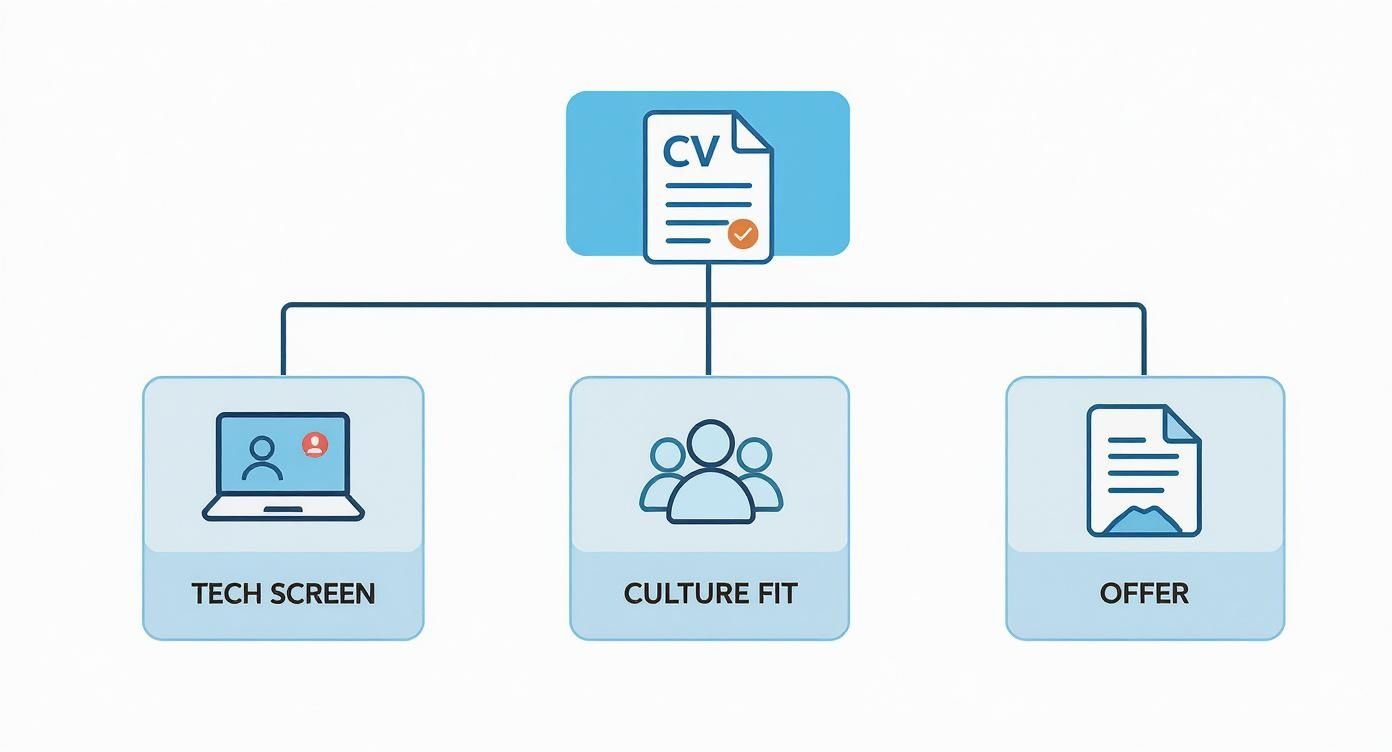
    The goal is to move beyond abstract puzzles and construct a multi-stage technical assessment that accurately predicts on-the-job performance. This requires a combination of hands-on challenges, system design discussions, and a critical evaluation of their remote collaboration skills.

    The Initial Technical Screening Call

    Before a time-intensive challenge, conduct a 30-45 minute screening call led by a senior engineer. This is not a culture-fit chat; it is a targeted conversation to validate foundational knowledge and eliminate candidates with only surface-level understanding.

    Avoid closed-ended questions like "Do you know Kubernetes?" Instead, ask open-ended, probing questions:

    • "Trace the lifecycle of a request in a Kubernetes cluster, starting from a user hitting an ingress endpoint, through the service, to the pod, and back. Describe the key components involved, like kube-proxy and CoreDNS."
    • "Describe a time you had to debug a slow terraform plan. What were the potential root causes you investigated, and what tools did you use to optimize it?"
    • "How would you securely manage sensitive secrets, such as database credentials or API keys, within a GitLab CI/CD pipeline? Discuss the pros and cons of different methods like environment variables, Vault integration, or cloud-provider secret managers."

    These questions are designed to elicit a thought process, revealing practical experience and problem-solving methodology. This screen saves significant time for both parties.

    The Hands-On Practical Challenge

    A well-designed, practical challenge is the single most effective predictor of future performance. It should be a take-home assignment that mirrors a task they would encounter in their first few months.

    This assignment must be a microcosm of your actual infrastructure and its challenges.

    Example Scenarios for a Take-Home Assignment:

    1. Containerize and Deploy an Application: Provide a simple application (e.g., a Python Flask app with a Redis dependency). The task is to write a multi-stage Dockerfile, create a docker-compose.yml for local development, and then write a basic Kubernetes manifest (Deployment, Service, ConfigMap) to run it. They must document the process thoroughly in a README.md.
    2. Architect a Monitoring and Alerting Solution: Present a scenario: "We have 50 microservices on GKE. Design a monitoring solution using the Prometheus Operator. Define a sample PrometheusRule for alerting on high error rates (HTTP 5xx) and explain how you would configure Alertmanager to route alerts to different teams." They should provide an architecture diagram and a brief technical document explaining their choices.
    3. Automate an Infrastructure Task: Describe a manual process, like provisioning a new AWS S3 bucket with specific lifecycle policies, encryption, and IAM access. Ask them to write a reusable Terraform module to automate this task, including variables for customization and outputs for consuming the resource.

    Evaluate the entire submission, not just the final code. Analyze their git commit history for logical progression. Scrutinize their README.md for clarity. Did they consider security principles like least privilege? Is their code modular and maintainable? This reveals far more than watching someone code under pressure.

    The Live System Design and Pairing Session

    The final technical stage is a live, collaborative session. This is not an interrogation; it's an opportunity to observe their thought process, communication style, and problem-solving abilities in real-time.

    First, a system design discussion, using their take-home project as a starting point. Ask them to walk through their solution and justify their technical decisions. Then, introduce new constraints to see how they adapt.

    • "Your logging solution using the ELK Stack (Elasticsearch, Logstash, Kibana) is solid. How would you modify it to handle 10TB of logs per day? What are the potential bottlenecks?"
    • "How would you implement a zero-downtime deployment strategy for your containerized application in Kubernetes?"

    Second, a live infrastructure-as-code pairing session. Share your screen and work on a small, well-defined problem together. This could be writing an Ansible playbook to configure a web server or debugging a failing Terraform module. This assesses their problem-solving methodology and collaborative skills.

    Assessing Remote Collaboration Skills

    Throughout the process, intentionally evaluate the skills essential for a remote DevOps engineer. Technical prowess is only half the equation; they must excel in an asynchronous, documentation-driven culture.

    • Written Communication: How clear, concise, and detailed was the documentation in their take-home assignment?
    • Asynchronous Problem-Solving: How did they ask for clarification on the assignment? Did they ask thoughtful, structured questions upfront?
    • Receptiveness to Feedback: During the pairing session, how did they respond to suggestions or critiques of their approach?

    By integrating these practical and collaborative evaluations, you move from resume keyword matching to accurately predicting a candidate’s ability to perform and add value to your remote team.

    Crafting a Competitive Offer for Remote Engineers

    You've successfully navigated the sourcing and interview process and identified an exceptional candidate. The final stage is making an offer they cannot refuse.

    Structuring a compelling package for a remote DevOps engineer goes beyond salary. It's about creating a total value proposition that demonstrates you understand their professional and personal needs. A well-crafted offer proves you value their expertise and are invested in their long-term growth.

    Nailing the Salary Conversation

    Compensation is the first consideration. Determining the right base salary requires analyzing global benchmarks and defining your company's compensation philosophy.

    Remote startups in the US offer an average salary for DevOps engineers of around $134,000 per year, significantly higher than the general remote startup average of $97,000. This disparity highlights the intense demand for specialized DevOps talent. You can dig into more remote DevOps salary data to analyze variations based on experience and company size.

    This data forces a critical decision: will you offer location-agnostic pay (same salary for the same level, regardless of location) or location-based pay?

    • Location-Agnostic Pay: Simpler to administer and often perceived as more equitable. It's particularly attractive to candidates in lower cost-of-living areas.
    • Cost-of-Living Adjustments: Can be more budget-friendly but adds administrative complexity and can be a point of contention for candidates who believe their value is tied to their skills, not their location.

    There is no single "right" answer, but your choice is a strong signal about your company culture.

    Before making an offer, be armed with market data. Here’s a baseline for what to expect based on experience.

    Remote DevOps Salary Benchmarks by Experience

    This overview of average salary ranges for remote DevOps engineers provides a solid baseline for a competitive offer.

    Experience Level Average Annual Salary Range (USD)
    Junior (0-2 years) $85,000 – $115,000
    Mid-Level (2-5 years) $115,000 – $150,000
    Senior (5-10 years) $150,000 – $190,000
    Lead/Principal (10+ years) $190,000+

    Note: These are general market averages. Salaries can vary based on specific skills (like Kubernetes or Terraform expertise), company size, and funding stage.

    Using this data ensures your offer is both competitive and fair, enabling you to attract and retain top talent.

    High-Value Benefits That Actually Matter to Remote Folks

    Beyond salary, certain benefits are highly valued by remote engineers and signal that you understand the remote work paradigm.

    The most common mistake is transposing an office-centric benefits package to remote roles. The key is to offer perks that tangibly improve the remote experience, supporting autonomy, professional growth, and well-being.

    Consider these high-impact benefits:

    • A Real Home Office Stipend: Provide a significant one-time or annual budget for ergonomic furniture, high-quality monitors, and other essential equipment. This is a direct investment in their productivity and health.
    • A Dedicated Professional Development Budget: DevOps is a field of continuous learning. Earmark funds for certifications (e.g., CKA, AWS Certified DevOps Engineer – Professional), conference attendance, and online training platforms. This demonstrates a commitment to their career progression.
    • Truly Flexible Hours: This is about trusting your team to manage their own schedules to achieve their objectives. It means respecting different time zones and personal commitments, fostering a culture of ownership and results over hours clocked.

    Don't Skip the Details: Essential Remote Contract Clauses

    Your employment contract must be precise to prevent future misunderstandings. When you hire a remote DevOps engineer, you are granting them privileged access to critical infrastructure. A well-drafted contract protects both parties.

    Ensure your contract explicitly covers these areas:

    Remote Contract Checklist:

    • Data Security and Confidentiality: Clearly define requirements for securing company data on personal networks and devices, such as mandatory use of a VPN, full-disk encryption, and a password manager.
    • Intellectual Property (IP): State unequivocally that all work produced during employment—code, scripts, IaC modules, documentation—is the exclusive property of the company.
    • On-Call Expectations: This is critical. Document the on-call rotation schedule, response time SLAs, and compensation for on-call duties. Ambiguity here is a primary cause of burnout.
    • Equipment Policy: Specify whether the company provides a laptop and other equipment or if the employee uses their own with a reimbursement policy.

    Getting Your New Hire Up to Speed: A Remote Technical Onboarding That Works

    Image

    A world-class DevOps engineer can become disengaged if their first week is a frustrating maze of access requests and outdated documentation. Effective onboarding is not optional; it must be a structured, repeatable, and immersive process.

    For a remote engineer, this cannot be left to chance. The first week sets the tone for their entire tenure. It's about deep technical immersion: systematically granting secure access, explaining the architectural "why," and fostering human connections.

    Your Week One Technical Immersion Checklist

    From day one, focus on empowerment and context. A remote hire feels isolated when they lack system access or architectural understanding. Your goal is to eliminate these barriers immediately.

    A practical checklist for success:

    • Provision Secure Access Pre-Day One: Accounts for cloud consoles (AWS, GCP, Azure), Git repositories (GitHub, GitLab), CI/CD platforms (Jenkins, CircleCI), and observability systems (Datadog, Prometheus) should be ready before they start. Use an identity provider (e.g., Okta) for seamless, secure access management.
    • Conduct an Architecture Deep Dive: A senior engineer should lead the new hire through infrastructure diagrams, data flow charts, and the end-to-end CI/CD pipeline. The goal is to build a mental model of the system. Record this session for future reference.
    • Assign a Technical Buddy: Pair them with a senior engineer for their first few weeks for active pairing sessions on real tasks. This is the fastest way to transfer institutional knowledge and coding standards.
    • Automate Local Dev Environment Setup: Provide a well-documented, automated process for bootstrapping a local development environment. Ideally, this is a single script or a Docker Compose configuration. No engineer should waste days fighting configuration drift.

    The most impactful action in week one is to facilitate a small, tangible win. A "first-commit goal" within their first 48-72 hours builds momentum and confirms they made the right career choice.

    The Power of the First Commit

    Merging the first commit is a critical milestone. It's less about the technical complexity of the change and more about successfully navigating the entire development lifecycle, from ticket to deployment.

    This small victory validates the process and signals their official status as a contributing team member.

    Ideal tasks for a first commit:

    • Fixing a flaky integration test in the CI pipeline.
    • Refactoring a small section of a deployment script for clarity.
    • Updating technical documentation that is known to be out of date.
    • Adding a new metric or label to an existing Prometheus exporter.

    This also serves as a test of your onboarding process. If they get stuck, it highlights a gap in your documentation or tooling that needs to be addressed.

    Building Culture from Miles Away

    Technical onboarding is only half the battle. Integrating a remote DevOps engineer into your culture requires deliberate effort. You must synthetically create the informal interactions that occur naturally in an office. For a deeper look, see this a comprehensive guide to onboarding remote employees.

    Begin by establishing clear communication protocols. How does your team use Slack? Is it for asynchronous, threaded discussions in channels, or for quick, synchronous video huddles? Our guide on remote team collaboration tools can help you refine your toolchain.

    Next, assign a non-technical "onboarding buddy" from a different department. This person is their resource for understanding company culture, key stakeholders, and the unwritten rules of the organization.

    Finally, schedule regular, informal video check-ins. These are not status updates but 15-minute coffee chats designed to build the human rapport that is the foundation of high-performing teams.

    Answering Your Top Questions About Hiring a DevOps Engineer

    When looking to hire a remote DevOps engineer, several key questions consistently arise. Addressing these effectively is crucial for making a successful hire.

    A primary concern is compensation. In 2025, the average salary for a remote DevOps engineer is approximately $110,000 per year, but this is merely a baseline.

    This figure varies significantly with experience. Entry-level roles may start around $65,000, while a principal or lead engineer can command $200,000 or more. To get precise figures, you should explore detailed salary data that breaks down compensation by specific skill sets and experience levels.

    How Do We Actually Vet Skills from a Distance?

    This is a critical challenge. While technical skills can be assessed with a practical challenge, evaluating collaborative and communication skills remotely requires a different approach. For remote roles, these soft skills are as important as the ability to write a Terraform module.

    Our recommended practices:

    • Analyze Asynchronous Communication: Scrutinize their written communication throughout the process. Is the documentation for their take-home assignment clear, concise, and thorough? This provides the best insight into their day-to-day communication style.
    • Conduct a Collaborative Problem-Solving Session: A live pairing session is invaluable. It reveals how they articulate their thought process, accept feedback, and work with a teammate to solve a technical problem.

    A candidate who can clearly document their work and ask insightful, clarifying questions in writing is often a better fit for a remote team than one who simply excels at a solo coding puzzle. It demonstrates they can operate effectively in a distributed environment.

    What Should Their First Month on the Job Look Like?

    The first 30 days are foundational for long-term success. The goal is not to assign a massive project immediately but to build context and facilitate early, meaningful contributions.

    A robust 30-day plan includes:

    1. System Immersion: Ensure they have secure access to all necessary systems on day one. Provide a thorough walkthrough of your architecture and CI/CD pipelines to help them build a mental map.
    2. Assign a Low-Risk First Task: Within the first week, give them a well-defined task like fixing a flaky test or improving a small script. Merging that first commit is a powerful confidence booster.
    3. Foster Connections: Schedule regular, informal video chats with their technical buddy and other team members. These interactions are crucial for building the professional relationships that underpin effective collaboration.

    This structured approach ensures your new remote DevOps engineer feels integrated and empowered to contribute from day one, transforming them from a new hire into a valuable team member.


    Ready to hire a top-tier remote DevOps engineer without the guesswork? OpsMoon connects you with the top 0.7% of global talent and provides a clear roadmap for success. Start with a free work planning session and let our Experts Matcher technology find the perfect fit for your team. Find your next elite engineer at https://opsmoon.com.

  • Secrets Management Best Practices for Secure DevOps in 2025

    Secrets Management Best Practices for Secure DevOps in 2025

    In a modern software delivery lifecycle, secrets like API keys, database credentials, and private certificates are the currency of automation. Yet, these sensitive credentials are often the weakest link in the security chain. A single hardcoded secret accidentally committed to a public Git repository can lead to a catastrophic breach, compromising customer data, incurring massive financial penalties, and inflicting severe reputational damage. The cost of a data breach averages millions of dollars, a figure that underscores the immediate need for robust security controls.

    This is not a theoretical risk. High-profile incidents frequently trace back to exposed secrets left in code, configuration files, or CI/CD logs. As infrastructure becomes more ephemeral and distributed across multiple cloud environments, the attack surface for credential compromise expands exponentially. Without a deliberate strategy, development velocity can inadvertently create security blind spots, turning your automated pipelines into a fast track for attackers.

    Adopting rigorous secrets management best practices is no longer optional; it is a foundational requirement for secure and scalable operations. This guide provides a comprehensive, actionable roadmap for engineering leaders, DevOps engineers, and SRE experts. We will move beyond generic advice and dive into the technical specifics of implementing a secure secrets management program. You will learn how to:

    • Select and integrate dedicated secret management tools.
    • Enforce granular access controls using the principle of least privilege.
    • Automate secret rotation to minimize the window of exposure.
    • Implement end-to-end encryption for secrets both at rest and in transit.
    • Establish comprehensive audit trails for accountability and threat detection.

    By implementing the practices detailed here, your team can build a resilient security posture that protects your most critical assets without hindering development speed. Let’s get started.

    1. Never Store Secrets in Code

    The most fundamental rule in secrets management is to keep credentials entirely separate from your application’s source code. Hardcoding sensitive information like API keys, database passwords, or OAuth tokens directly into files that are committed to a version control system (VCS) like Git is a direct path to a security breach. Once a secret is committed, it becomes part of the repository's history, making it incredibly difficult to purge completely and exposing it to anyone with access to the codebase.

    Never Store Secrets in Code

    This practice is non-negotiable because modern development workflows amplify the risk of exposure. Code is frequently cloned, forked, and shared among team members, contractors, and even public repositories. A single leaked credential can grant an attacker unauthorized access to databases, cloud infrastructure, or third-party services, leading to data exfiltration, service disruption, and severe reputational damage. Adhering to this principle is a foundational step in any robust secrets management best practices strategy.

    Why This Practice Is Critical

    Storing secrets in code creates multiple attack vectors. Public repositories on platforms like GitHub are constantly scanned by malicious bots searching for exposed credentials. Even in private repositories, a compromised developer account or an accidental leak can expose the entire commit history. Separating secrets from code ensures that your application logic can be shared and reviewed openly without compromising the security of the environments it connects to.

    Actionable Implementation Steps

    To effectively prevent hardcoded secrets, teams should adopt a multi-layered defense strategy that combines proactive prevention, automated detection, and developer education.

    1. Isolate Secrets Using Environment Variables and Configuration Files:

    • Environment Variables: Load secrets into the application's runtime environment. This is a common practice in containerized and cloud-native applications. For example, a Go application can access a secret via os.Getenv("DATABASE_PASSWORD"). In a Docker container, you can pass secrets using the -e flag (docker run -e API_KEY=...) or a dedicated env_file.
    • Configuration Files: Store secrets in local configuration files (e.g., config.json, .env, appsettings.json) that are never committed to version control. The application then reads these files at startup.

    2. Leverage .gitignore:

    • Always add the names of local configuration files containing secrets to your project’s .gitignore file. This is a simple but powerful first line of defense that prevents Git from tracking these sensitive files.
      # .gitignore
      
      # Local configuration files
      .env
      config.local.json
      appsettings.Development.json
      /secrets
      *.pem
      *.key
      

    3. Implement Automated Scanning and Prevention:

    • Pre-Commit Hooks: Use tools like gitleaks or truffleHog to configure a pre-commit hook that scans staged files for high-entropy strings and patterns matching common secret formats. If a potential secret is found, the hook blocks the commit.
      # Example gitleaks hook in .pre-commit-config.yaml
      - repo: https://github.com/gitleaks/gitleaks
        rev: v8.18.2
        hooks:
          - id: gitleaks
      
    • CI/CD Pipeline Scanning: Integrate secret scanning tools directly into your continuous integration pipeline. This acts as a secondary check to catch any secrets that might have bypassed local hooks. A typical CI job might look like:
      # GitHub Actions example
      - name: Run Gitleaks
        run: |
          docker run --rm -v $(pwd):/path gitleaks/gitleaks:latest detect --source /path -v
      
    • Platform-Level Protection: Enable built-in security features from your VCS provider. GitHub's secret scanning, for example, automatically detects over 200 token types in public repositories and can be enabled for private ones. Similarly, GitLab's push protection prevents commits containing secrets from ever reaching the remote repository. Microsoft offers CredScan to prevent credentials from leaking in Azure DevOps projects.

    2. Use Dedicated Secret Management Tools

    Once secrets are removed from your codebase, the next critical step is to store them in a secure, centralized system. Relying on makeshift solutions like encrypted files, environment variables at scale, or internal wikis introduces significant risk and operational overhead. Dedicated secret management tools are purpose-built platforms for securely storing, managing, rotating, and auditing access to credentials throughout their lifecycle.

    Use Dedicated Secret Management Tools

    These tools provide a robust, API-driven interface for applications to fetch secrets dynamically at runtime, ensuring credentials are never exposed in plaintext or left lingering in insecure locations. Platforms like HashiCorp Vault or AWS Secrets Manager offer advanced features like dynamic secret generation, where temporary, just-in-time credentials are created on-demand and automatically expire. This approach drastically reduces the attack surface, as even a compromised credential has a very short lifespan. Adopting such a tool is a cornerstone of modern secrets management best practices.

    Why This Practice Is Critical

    Secret management platforms solve the core challenges of secure storage, access control, and auditability. They encrypt secrets both at rest and in transit, enforce granular access policies based on identity (e.g., an application, a user, a container), and create a detailed audit log of every secret access request. This centralized control is essential for compliance with regulations like SOC 2, PCI DSS, and GDPR, which require strict oversight of sensitive data. Without a dedicated tool, it becomes nearly impossible to track who accessed what secret and when.

    Actionable Implementation Steps

    Implementing a secret management tool involves selecting the right platform for your ecosystem and integrating it securely into your application and infrastructure workflows.

    1. Select an Appropriate Tool:

    • Self-Hosted Solutions: Tools like HashiCorp Vault offer maximum flexibility and control, making them ideal for complex, multi-cloud, or on-premises environments. Netflix famously uses Vault to manage secrets for its vast microservices architecture. To get started with a managed, production-ready implementation, you can explore professional services for HashiCorp Vault on opsmoon.com.
    • Cloud-Native Services: Platforms like AWS Secrets Manager, Azure Key Vault, and Google Cloud Secret Manager offer seamless integration with their respective cloud ecosystems. They are often easier to set up and manage, making them an excellent starting point. For instance, Airbnb leverages AWS Secrets Manager to handle database credentials for services running on EC2.
    • Kubernetes-Integrated Solutions: For containerized workloads, native Kubernetes Secrets can be coupled with external secret operators (e.g., External Secrets Operator or the Secrets Store CSI Driver) to sync secrets from a centralized vault, combining the convenience of native secrets with the security of a dedicated manager.

    2. Define and Enforce Strict Access Policies:

    • Implement the principle of least privilege by creating highly granular access control policies. Each application or user should only have permission to read the specific secrets it absolutely needs. In HashiCorp Vault, this is done via HCL policies:
      # Allow read-only access to a specific path for the 'billing-app'
      path "secret/data/production/billing-app/*" {
        capabilities = ["read"]
      }
      
    • Use identity-based authentication mechanisms. Instead of static tokens, leverage your cloud provider's IAM roles (e.g., AWS IAM Roles for EC2/ECS) or Kubernetes Service Accounts to authenticate applications to the secrets manager.

    3. Automate Secret Rotation and Lifecycle Management:

    • Configure automated rotation for all critical secrets like database passwords and API keys. Most dedicated tools can connect to backend systems (like a PostgreSQL database) to automatically change a password and update the stored secret value without human intervention.
    • Utilize short-lived, dynamic secrets wherever possible. This just-in-time access model ensures that credentials expire moments after they are used, minimizing the window of opportunity for an attacker. For example, a Vault command to generate a dynamic AWS key would be: vault read aws/creds/my-iam-role. The returned credentials would expire after a pre-configured TTL.

    3. Implement Least Privilege Access

    The Principle of Least Privilege (PoLP) dictates that any user, program, or process should have only the minimum permissions necessary to perform its function. In the context of secrets management, this means a secret should only grant access to the specific resources required for a defined task, for the shortest time possible. This approach drastically reduces the potential blast radius if a secret is compromised, containing the damage an attacker can inflict.

    Implement Least Privilege Access

    Applying this principle is a cornerstone of a zero-trust security model. Instead of trusting an identity implicitly, you enforce strict access controls for every request. If a microservice only needs to read from a specific S3 bucket, its associated IAM role should only have s3:GetObject permission for that single bucket, nothing more. Over-provisioned credentials are a primary target for attackers, as they provide a wide-open gateway for lateral movement across your infrastructure. Adopting PoLP is a crucial step in building a resilient secrets management best practices framework.

    Why This Practice Is Critical

    Broad, permissive credentials create a significant attack surface. A single compromised secret with administrative privileges can lead to a catastrophic system-wide breach. By limiting access, you ensure that even if a specific application or user account is compromised, the attacker's capabilities are severely restricted. This containment strategy is essential in complex, distributed systems where microservices and automated processes constantly interact with sensitive resources. It moves security from a perimeter-based model to a granular, identity-centric one.

    Actionable Implementation Steps

    Implementing the Principle of Least Privilege requires a deliberate and continuous effort, combining strict policy enforcement with automation and just-in-time access controls.

    1. Start with a "Deny-All" Default Policy:

    • Begin by establishing a baseline policy that denies all access by default. Grant permissions explicitly and individually only when a clear business or operational need is justified.
    • For cloud environments, use tools like Amazon's IAM policies with explicit Deny statements and specific resource constraints (ARNs) to enforce this.
      {
        "Version": "2012-10-17",
        "Statement": [
          {
            "Effect": "Allow",
            "Action": "s3:GetObject",
            "Resource": "arn:aws:s3:::my-specific-app-bucket/*"
          }
        ]
      }
      

    2. Implement Just-in-Time (JIT) Access:

    • Avoid long-lived, standing privileges, especially for administrative tasks. Use systems that grant temporary, elevated access on demand.
    • Microsoft's Privileged Identity Management (PIM) in Azure AD is a prime example, allowing users to request elevated roles for a limited time after a justification and approval workflow.
    • Tools like HashiCorp Boundary or Teleport can provide similar JIT access for SSH, Kubernetes, and database connections. A user might run teleport db login my-db to get a short-lived certificate for a database connection.

    3. Automate Access Reviews and Auditing:

    • Manually reviewing permissions is prone to error and does not scale. Automate the process of auditing access rights regularly.
    • Configure alerts for any modifications to high-privilege roles or policies. Use cloud-native tools like AWS Config or Azure Policy to continuously monitor and enforce your defined access rules. For example, an AWS Config rule can flag any IAM policy that grants *:* permissions.

    4. Scope Secrets to Specific Applications and Environments:

    • Instead of using a single database user for multiple services, create a unique user with tightly scoped permissions for each application (e.g., CREATE USER billing_app WITH PASSWORD '...' with GRANT SELECT ON orders TO billing_app).
    • Likewise, generate distinct API keys for development, staging, and production environments. This ensures a compromised key from a lower environment cannot be used to access production data, a key tenet of modern secrets management best practices.

    4. Enable Secret Rotation

    Static, long-lived credentials represent a persistent security risk. A secret that never changes gives an attacker an indefinite window of opportunity if it is ever compromised. Enabling automated secret rotation is a critical practice that systematically invalidates old credentials by replacing them at regular, predetermined intervals. This process drastically reduces the useful lifespan of a secret, ensuring that even if one is leaked, its value to an attacker diminishes rapidly.

    Enable Secret Rotation

    This proactive defense mechanism moves security from a reactive model (revoking a secret after a breach) to a preventative one. By automating the entire lifecycle of a credential from creation to destruction, organizations can enforce strong security policies without adding manual toil for developers or operations teams. This is a core component of modern secrets management best practices, particularly in dynamic cloud environments where services and access patterns change frequently.

    Why This Practice Is Critical

    A compromised static secret can provide an attacker with long-term, undetected access to sensitive systems. Automated rotation enforces the principle of "least privilege" in the time dimension, limiting not just what a secret can access but also for how long. It minimizes the impact of a potential leak and helps organizations meet stringent compliance requirements like PCI DSS and SOC 2, which often mandate periodic credential changes.

    Actionable Implementation Steps

    Implementing a robust secret rotation strategy requires integrating it with a central secrets management platform and carefully planning the rollout to avoid service disruptions.

    1. Leverage Platform-Native Rotation Features:

    • Cloud Services: Most major cloud providers offer built-in rotation capabilities for their managed services. For example, AWS Secrets Manager can automatically rotate credentials for Amazon RDS, Redshift, and DocumentDB databases on a schedule you define (e.g., every 30 days) using a Lambda function. Similarly, Azure Key Vault supports automatic renewal and rotation for certificates and keys.
    • Secrets Management Tools: Dedicated tools are designed for this purpose. HashiCorp Vault, for instance, can generate dynamic, short-lived database credentials that are automatically created on-demand for an application and expire after a short Time-To-Live (TTL). The command vault write database/roles/my-app DB_NAME="my-db" creation_statements="..." default_ttl="1h" configures a role to generate one-hour credentials.

    2. Develop a Phased Rollout Plan:

    • Start with Non-Critical Systems: Begin your implementation with development or staging environments and non-critical applications. This allows your team to test the rotation logic, identify potential issues with application connectivity, and refine procedures in a low-risk setting.
    • Implement Monitoring and Alerting: Before rolling out to production, ensure you have robust monitoring in place. Set up alerts to trigger if an application fails to fetch a newly rotated secret or if the rotation process itself fails. Monitor application logs for AuthenticationFailed or AccessDenied errors immediately after a rotation event.

    3. Prepare for Contingencies:

    • Staged Rollouts: For critical systems, use a staged rollout where the new secret is deployed gradually across application instances. For example, use a blue/green or canary deployment strategy where new instances get the new secret first.
    • Maintain Manual Procedures: While automation is the goal, always maintain a documented, well-rehearsed emergency procedure for manual rotation. This ensures you can respond quickly if the automated system fails or if a breach is suspected. This procedure should include CLI commands and console steps, tested quarterly.

    5. Encrypt Secrets at Rest and in Transit

    A critical layer of defense in any secrets management strategy is ensuring that secrets are cryptographically protected at every stage of their lifecycle. This means encrypting them both when they are stored (at rest) and when they are being transmitted between systems (in transit). This defense-in-depth approach assumes that other security controls might fail, providing a robust last line of defense against data exposure if an attacker gains access to your storage systems or intercepts network traffic.

    Encrypting secrets at rest protects them from being read even if a physical disk, database backup, or storage volume is compromised. Similarly, encryption in transit, typically using protocols like TLS (Transport Layer Security), prevents eavesdropping or man-in-the-middle attacks as secrets move from a vault to an application or between services. Implementing both is non-negotiable for a secure architecture and is a core principle of modern DevOps security.

    Why This Practice Is Critical

    Relying solely on access controls for your secrets vault or database is insufficient. A misconfigured network firewall, an internal threat, or a compromised infrastructure component could expose the underlying storage layer. Without encryption, secrets stored in plaintext would be immediately readable. By enforcing encryption, you ensure that even if the data is stolen, it remains a useless, garbled ciphertext without the corresponding decryption keys, drastically reducing the impact of a breach.

    Actionable Implementation Steps

    To properly implement end-to-end encryption for secrets, teams must combine managed services, strong protocols, and rigorous key management policies. These steps are foundational to many other DevOps security best practices.

    1. Enforce Encryption in Transit with TLS:

    • Mandate TLS 1.2+: Configure all services, APIs, and applications to communicate exclusively over TLS 1.2 or a newer version. Disable older, vulnerable protocols like SSL and early TLS versions. In Nginx, this is done with ssl_protocols TLSv1.2 TLSv1.3;.
    • Use Mutual TLS (mTLS): For service-to-service communication, especially in microservices architectures, implement mTLS. This ensures that both the client and the server authenticate each other's identities using certificates before establishing a secure connection, preventing unauthorized services from requesting secrets. Service meshes like Istio or Linkerd can automate mTLS deployment.

    2. Implement Robust Encryption at Rest:

    • Leverage Managed Encryption Services: Use platform-native encryption capabilities wherever possible. For instance, AWS Secrets Manager uses AWS Key Management Service (KMS) to perform envelope encryption on all stored secrets. Similarly, enable transparent data encryption (TDE) in databases like PostgreSQL or SQL Server.
    • Encrypt Kubernetes Secrets: By default, Kubernetes secrets are only base64 encoded, not encrypted, within its etcd data store. Configure encryption at rest for etcd by enabling an EncryptionConfiguration object that uses a provider like AWS KMS, Google Cloud KMS, or a local aescbc key to encrypt secret data before it is written to disk.
    • Utilize Secrets Manager Features: Tools like HashiCorp Vault are designed with this principle in mind. Vault’s transit secrets engine can encrypt and decrypt data without storing it, while its storage backends are designed to be encrypted at rest. For example, vault write transit/encrypt/my-key plaintext=$(base64 <<< "sensitive-data") returns encrypted ciphertext.

    3. Practice Strong Key Lifecycle Management:

    • Key Rotation: Implement automated policies to regularly rotate the encryption keys used to protect your secrets (known as Data Encryption Keys or DEKs) and the keys that protect those keys (Key Encryption Keys or KEKs). AWS KMS supports automatic annual rotation of customer-managed keys.
    • Least Privilege for Keys: Tightly control access to KMS or key management systems. Only trusted administrators and specific service principals should have permissions to manage or use encryption keys. An IAM policy might restrict kms:Decrypt actions to a specific EC2 instance role.

    6. Implement Comprehensive Audit Logging

    Effective secrets management isn't just about controlling access; it's also about maintaining a complete, unchangeable record of every interaction with your secrets. Implementing comprehensive audit logging provides this crucial visibility, creating a detailed trail of who accessed what, when they accessed it, and what actions they performed. This practice is essential for detecting unauthorized activity, responding to security incidents, and proving compliance with regulatory standards.

    Without a reliable audit trail, security teams are effectively blind. In the event of a breach, investigators would have no way to determine the scope of the compromise, identify the attacker's movements, or understand which credentials were stolen. A robust logging strategy transforms your secrets management platform from a black box into a transparent system, which is a cornerstone of modern security and a key component of any mature secrets management best practices framework.

    Why This Practice Is Critical

    Audit logging is a non-negotiable requirement for security, operations, and compliance. It enables real-time threat detection by feeding data into Security Information and Event Management (SIEM) systems, which can then flag anomalous access patterns. For incident response, these logs are the primary source of truth for forensic analysis. Furthermore, regulations like GDPR, SOC 2, and HIPAA mandate strict auditing capabilities to ensure data integrity and accountability.

    Actionable Implementation Steps

    To build a powerful auditing capability, you must go beyond simply enabling logs. The focus should be on creating a system that is tamper-proof, easily searchable, and integrated with your broader security monitoring ecosystem.

    1. Centralize and Secure Log Data:

    • Enable Audit Devices/Backends: Configure your secrets management tool to stream logs to a secure, centralized location. For example, HashiCorp Vault can be configured with multiple audit devices to send logs to Splunk, syslog, or a file (vault audit enable file file_path=/var/log/vault_audit.log). Similarly, AWS CloudTrail captures all API calls made to AWS Secrets Manager and stores them in an S3 bucket.
    • Ensure Immutability: Send logs to a write-once, read-many (WORM) storage system or a dedicated logging platform that prevents modification or deletion. For AWS CloudTrail, enabling S3 Object Lock on the destination bucket provides this immutability.

    2. Define and Automate Alerting:

    • Establish Baselines: Understand what normal access patterns look like for your applications and users.
    • Configure Anomaly Detection: Set up automated alerts for suspicious activities, such as a secret being accessed from an unusual IP address, a user suddenly accessing a large number of secrets, or authentication failures followed by a success. For example, you can configure Amazon CloudWatch to trigger an SNS alert based on a CloudTrail event pattern for a specific sensitive secret.

    3. Structure and Analyze Logs:

    • Use Structured Formats: Ensure logs are generated in a structured format like JSON. This makes them machine-readable and far easier to parse, query, and visualize in tools like Elasticsearch or Splunk. A typical Vault audit log entry includes time, type, auth.display_name, request.path, and response.data.
    • Regularly Review Logs: Auditing is not a "set it and forget it" task. Schedule regular, systematic reviews of access logs to proactively identify potential policy violations or misconfigurations. This proactive approach is a core principle for teams seeking to improve their operational resilience, much like those who hire SRE experts for freelance projects.
    • Define Retention Policies: Establish clear log retention policies based on your organization's compliance requirements and business needs. For instance, PCI DSS requires one year of log history, with three months immediately available for analysis.

    7. Use Environment-Specific Secret Isolation

    A critical discipline in a mature secrets management strategy is maintaining strict separation of credentials across all deployment environments. Development, staging, and production environments should never share secrets. This practice, known as environment-specific secret isolation, prevents a lower-security environment compromise from escalating into a full-blown production breach. By creating distinct, walled-off secret stores for each stage of the development lifecycle, you drastically limit the blast radius of any single security incident.

    Without this separation, a developer with access to staging secrets could potentially use them to access production data, or a vulnerability in a test application could expose production database credentials. This approach ensures that even if a secret from a non-production environment is leaked, it provides zero value to an attacker seeking to compromise your live systems. Implementing environment-specific isolation is a cornerstone of effective secrets management best practices, creating security boundaries that align with your deployment workflows.

    Why This Practice Is Critical

    Cross-environment contamination is a common yet severe security anti-pattern. Lower environments like development and testing often have relaxed security controls, more permissive access policies, and a higher frequency of code changes, making them more susceptible to compromise. If these environments share secrets with production, they become a weak link that bypasses all the stringent security measures protecting your most sensitive data and infrastructure. True isolation guarantees that each environment operates in a self-contained security context.

    Actionable Implementation Steps

    To achieve robust secret isolation, teams should architect their infrastructure and secrets management tooling to enforce these boundaries programmatically. This minimizes human error and ensures the policy is consistently applied.

    1. Leverage Infrastructure and Platform-Level Separation:

    • Cloud Accounts: Use separate cloud accounts for each environment. For example, in AWS, create distinct accounts for development, staging, and production within an AWS Organization. This provides the strongest possible isolation for IAM roles, secrets, and other resources.
    • Kubernetes Namespaces: In Kubernetes, use separate namespaces for each environment (dev, staging, prod). You can then deploy a dedicated instance of a secret management tool like the Secrets Store CSI Driver to each namespace, ensuring that pods in the dev namespace can only mount secrets intended for development.
    • VPC and Network Segmentation: Isolate environments at the network level using separate Virtual Private Clouds (VPCs) or subnets with strict firewall rules (like Security Groups or NACLs) to prevent cross-environment communication.

    2. Configure Your Secrets Manager for Environment Paths:

    • Use a dedicated secrets management platform like HashiCorp Vault or AWS Secrets Manager and structure your secrets using environment-specific paths. This allows you to create fine-grained access control policies based on the path.
      # Example Vault path structure
      secret/production/database/password
      secret/staging/database/password
      secret/development/database/password
      

      An application's authentication role can then be tied to a policy that only grants access to its specific environment path.

    3. Automate Environment Provisioning and Naming:

    • IaC and Automation: Use Infrastructure as Code (IaC) tools like Terraform or Pulumi to automate the creation of environments. This ensures that secret isolation rules and naming conventions (e.g., prod-db-app, stg-db-app) are applied consistently every time a new environment is spun up.
    • Use Synthetic Data: Never use real production data or secrets in non-production environments. Populate development and staging databases with realistic but entirely synthetic test data using tools like Faker.js or Bogus, removing any incentive for developers to seek production credentials.

    7 Best Practices Comparison Matrix

    Item Implementation Complexity Resource Requirements Expected Outcomes Ideal Use Cases Key Advantages
    Never Store Secrets in Code Low to moderate; requires config and process changes Minimal infrastructure; needs config management Prevents accidental secret exposure in codebase Open-source projects, safe public repos Eliminates common vulnerabilities, enables safe reviews
    Use Dedicated Secret Management Tools High; involves deploying and integrating specialized tools Additional infrastructure and operational cost Centralized, secure secret storage with auditing Large-scale, multi-app environments Purpose-built security, scalability, compliance-ready
    Implement Least Privilege Access Moderate to high; requires RBAC setup and ongoing reviews Moderate; requires access control tooling Minimizes breach impact, reduces insider risk Any environment demanding tight security Limits attack surface, improves compliance
    Enable Secret Rotation Moderate to high; needs automation and coordination Medium; automation tooling and monitoring Limits secret exposure time, reduces manual ops Environments needing strong credential hygiene Improves security posture, supports compliance
    Encrypt Secrets at Rest and in Transit Moderate; involves encryption deployment and key management Medium; requires encryption solutions and HSMs Protects secrets from breaches and eavesdropping All environments handling sensitive data Strong defense-in-depth, meets encryption standards
    Implement Comprehensive Audit Logging Moderate; requires logging infrastructure and integration Medium to high; storage and SIEM integration Enables incident detection and compliance reporting Regulated industries, security-critical systems Provides accountability and forensic capabilities
    Use Environment-Specific Secret Isolation Moderate; requires environment segmentation and management Additional infrastructure per environment Prevents cross-environment secret contamination Multi-environment deployments (dev, prod, etc.) Limits blast radius, enables safe testing

    Putting It All Together: Master Your Secret Controls

    We've explored seven fundamental secrets management best practices, moving from foundational principles like never storing secrets in code to advanced strategies like comprehensive audit logging and environment-specific isolation. Each practice represents a critical layer in a robust security framework, but their true power emerges when they are integrated into a cohesive, automated, and continuously monitored system. Simply adopting a tool is not enough; mastering secret controls requires a strategic shift in mindset, process, and culture.

    The journey from vulnerable, hardcoded credentials to a dynamic, secure secrets management lifecycle is not instantaneous. It’s a deliberate process that transforms security from a reactive bottleneck into a proactive, embedded component of your development workflow. The ultimate goal is to make the secure path the easiest path for your developers, where compliance and safety are automated by default.

    Your Phased Implementation Roadmap

    Embarking on this journey can feel daunting, but breaking it down into manageable phases makes it achievable. Here is a practical roadmap to guide your implementation of these secrets management best practices:

    1. Phase 1: Foundational Policy and Discovery (Weeks 1-2)

      • Define Your Policies: Start by creating a clear, documented secrets management policy. Define what constitutes a secret, establish ownership, and outline access control rules based on the principle of least privilege.
      • Conduct an Audit: You can't protect what you don't know exists. Use static analysis tools (like Git-secrets or TruffleHog) to scan your codebases, configuration files, and CI/CD logs for hardcoded secrets. This initial audit provides a baseline and highlights immediate risks.
    2. Phase 2: Tool Selection and Centralization (Weeks 3-4)

      • Evaluate and Choose a Vault: Based on your audit findings and policy requirements, select a dedicated secrets management tool (e.g., HashiCorp Vault, AWS Secrets Manager, Azure Key Vault). Your choice should align with your existing tech stack and scalability needs.
      • Centralize Your Secrets: Begin the methodical process of migrating all identified secrets from disparate, insecure locations into your chosen centralized vault. Prioritize the most critical credentials first.
    3. Phase 3: Integration and Automation (Weeks 5-8)

      • Integrate with CI/CD: The most critical step is to automate secret injection into your applications and infrastructure at runtime. Configure your CI/CD pipelines to securely fetch secrets from the vault, eliminating the need for developers to handle them manually.
      • Automate Rotation: Configure your secrets management tool to automatically rotate high-privilege credentials, such as database passwords and API keys. Start with a reasonable rotation schedule (e.g., every 90 days) and gradually shorten it as your team becomes more comfortable.
    4. Phase 4: Continuous Monitoring and Refinement (Ongoing)

      • Enable Auditing: Turn on detailed audit logging to track every secret access event: who accessed what, when, and why. Integrate these logs with your SIEM (Security Information and Event Management) system for real-time alerting on suspicious activity.
      • Regularly Review and Refine: Secrets management is not a "set it and forget it" task. Schedule quarterly reviews of access policies, audit logs, and rotation schedules to ensure they remain effective and aligned with your evolving security posture.

    This structured approach transforms abstract best practices into a concrete, actionable plan. By methodically building these layers, you create a resilient system that protects your most valuable assets. To truly master your secret controls and integrate security into your modern development pipelines, explore a comprehensive guide to DevOps best practices. Mastering these broader principles ensures that your security initiatives are seamlessly woven into the fabric of your engineering culture, not just bolted on as an afterthought.


    Implementing robust secrets management can feel like a complex undertaking. The experts at OpsMoon specialize in designing and deploying secure, scalable DevOps infrastructures that make these best practices a reality. Let us help you build the automated, secure pipelines you need by visiting OpsMoon to streamline your security operations.

  • 7 Secrets Management Best practices for DevOps in 2025

    7 Secrets Management Best practices for DevOps in 2025

    In modern software development, managing sensitive credentials like API keys, database connection strings, and TLS certificates is a foundational security challenge. The fallout from a single leaked secret can be catastrophic, leading to severe data breaches, devastating financial losses, and irreparable damage to user trust. As development velocity increases with CI/CD and ephemeral environments, the risk of secret sprawl, accidental commits, and unauthorized access grows exponentially.

    Simply relying on .env files, configuration management tools, or environment variables is a fundamentally flawed approach that fails to scale and provides minimal security guarantees. This outdated method leaves credentials exposed in source control, build logs, and developer workstations, creating a massive attack surface. A robust security posture demands a more sophisticated and centralized strategy.

    This guide provides a comprehensive breakdown of seven critical secrets management best practices designed for modern engineering teams. We will move beyond high-level advice and dive into technical implementation details, specific tooling recommendations, and actionable automation workflows. You will learn how to build a secure, auditable, and scalable secrets management foundation that protects your software delivery lifecycle from end to end. By implementing these practices, you can effectively mitigate credential-based threats, enforce strict access controls, and ensure your applications and infrastructure remain secure in any environment, from local development to large-scale production deployments.

    1. Use Dedicated Secrets Management Systems

    Moving secrets out of code and simple file stores into a purpose-built platform enforces centralized control, auditing and lifecycle management. Dedicated systems treat API keys, certificates and database credentials as first-class citizens with built-in encryption, dynamic leasing and granular policy engines.

    Use Dedicated Secrets Management Systems

    What It Is and How It Works

    A dedicated secrets management system provides:

    • Central Vaults: A centralized repository for all secrets, encrypted at rest using strong algorithms like AES-256-GCM. The encryption key is often protected by a Hardware Security Module (HSM) or a cloud provider's Key Management Service (KMS).
    • Policy-as-Code: Granular access control policies, often defined in a declarative format like HCL (HashiCorp Configuration Language) or JSON. These policies control which identity (user, group, or application) can perform create, read, update, delete, or list operations on specific secret paths.
    • Audit Devices: Immutable audit logs detailing every API request and response. These logs can be streamed to a SIEM for real-time threat detection.
    • Dynamic Secrets: The ability to generate on-demand, short-lived credentials for systems like databases (PostgreSQL, MySQL) or cloud providers (AWS IAM, Azure). The system automatically creates and revokes these credentials, ensuring they exist only for the duration needed.

    When an application needs a credential, it authenticates to the secrets manager using a trusted identity mechanism (e.g., Kubernetes Service Account JWT, AWS IAM Role, TLS certificate). Upon successful authentication, it receives a short-lived token which it uses to request its required secrets. This eliminates long-lived, hardcoded credentials.

    Successful Implementations

    1. Netflix (HashiCorp Vault):
      • Utilizes Vault's dynamic secrets engine to generate ephemeral AWS IAM roles and database credentials for its microservices.
      • Integrates Vault with Spinnaker for secure credential delivery during deployment pipelines.
    2. Pinterest (AWS Secrets Manager):
      • Migrated from plaintext config files, using AWS SDKs to fetch secrets at runtime.
      • Leverages built-in rotation functions via AWS Lambda to refresh database credentials every 30 days without manual intervention.
    3. Shopify (CyberArk Conjur):
      • Implements machine identity and RBAC policies to secure its Kubernetes-based production environment.
      • Uses a sidecar injector pattern to mount secrets directly into application pods, abstracting the retrieval process from developers.

    When and Why to Use This Approach

    • You operate in a multi-cloud or hybrid environment and need a unified control plane for secrets.
    • You need to meet compliance requirements like PCI DSS, SOC 2, or HIPAA, which mandate strict auditing and access control.
    • Your architecture is dynamic, using ephemeral infrastructure (e.g., containers, serverless functions) that requires programmatic, just-in-time access to secrets.

    Adopting a dedicated system is a cornerstone of secrets management best practices when you require scalability, compliance and zero-trust security.

    Actionable Tips for Adoption

    1. Evaluate Technical Fit:
      • HashiCorp Vault: Self-hosted, highly extensible, ideal for hybrid/multi-cloud.
      • AWS Secrets Manager: Fully managed, deep integration with the AWS ecosystem.
      • Azure Key Vault: Managed service, integrates tightly with Azure AD and other Azure services.
    2. Plan a Phased Migration:
      • Start by onboarding a new, non-critical service to establish patterns.
      • Use a script or tool to perform a bulk import of existing secrets from .env files or config maps into the new system.
    3. Implement Automated Sealing/Unsealing:
      • For self-hosted solutions like Vault, configure auto-unseal using a cloud KMS (AWS KMS, Azure Key Vault, GCP KMS) to ensure high availability and remove operational bottlenecks.
    4. Codify Your Configuration:
      • Use Terraform or a similar IaC tool to manage the configuration of your secrets manager, including policies, auth methods, and secret engines. This makes your setup repeatable and auditable.

    "A dedicated secrets manager transforms credentials from a distributed liability into a centralized, controllable, and auditable asset."

    By replacing static storage with a dedicated secrets engine, engineering teams gain visibility, auditability and fine-grained control—all key pillars of modern secrets management best practices.

    2. Implement Automatic Secret Rotation

    Static, long-lived credentials are a significant security liability. Automating the rotation process systematically changes secrets without manual intervention, dramatically shrinking the window of opportunity for attackers to exploit a compromised credential and eliminating the risk of human error.

    Implement Automatic Secret Rotation

    What It Is and How It Works

    Automatic secret rotation is a process where a secrets management system programmatically revokes an old credential and generates a new one at a predefined interval. This is achieved through integrations with target systems.

    The technical workflow typically involves:

    1. Configuration: You configure a rotation policy on a secret, defining the rotation interval (e.g., 30d for 30 days) and linking it to a rotation function or plugin.
    2. Execution: On schedule, the secrets manager triggers the rotation logic. For a database, this could mean executing SQL commands like ALTER USER 'app_user'@'%' IDENTIFIED BY 'new_strong_password';. For an API key, it would involve calling the provider's API endpoint to revoke the old key and generate a new one.
    3. Update: The new credential value is securely stored in the secrets manager, creating a new version of the secret.
    4. Propagation: Applications are designed to fetch the latest version of the secret. This can be done on startup or by using a client-side agent (like Vault Agent) that monitors for changes and updates the secret on the local filesystem, triggering a graceful application reload.

    This mechanism transforms secrets from static liabilities into dynamic, ephemeral assets, a core tenet of modern secrets management best practices.

    Successful Implementations

    1. Uber (HashiCorp Vault):
      • Leverages Vault's database secrets engine for PostgreSQL and Cassandra, which handles the entire lifecycle of dynamic user creation and revocation based on a lease TTL.
      • Each microservice gets unique, short-lived credentials, drastically reducing the blast radius.
    2. Airbnb (Custom Tooling & AWS Secrets Manager):
      • Uses AWS Secrets Manager's native rotation capabilities, which invoke a specified AWS Lambda function. The function contains the logic to connect to the third-party service, rotate the API key, and update the secret value back in Secrets Manager.
    3. Capital One (AWS IAM & Vault):
      • Uses Vault's AWS secrets engine to generate short-lived IAM credentials with a TTL as low as 5 minutes for CI/CD pipeline jobs. The pipeline authenticates to Vault, gets a temporary access key, performs its tasks, and the key is automatically revoked upon lease expiration.

    When and Why to Use This Approach

    • You manage credentials for systems with APIs that support programmatic credential management (e.g., databases, cloud providers, SaaS platforms).
    • Your organization must adhere to strict compliance frameworks like PCI DSS or SOC 2, which mandate regular password changes (e.g., every 90 days).
    • You want to mitigate the risk of a leaked credential from a developer's machine or log file remaining valid indefinitely.

    Automating rotation is critical for scaling security operations. It removes the operational burden from engineers and ensures policies are enforced consistently without fail. For a deeper look at how automation enhances security, explore these CI/CD pipeline best practices.

    Actionable Tips for Adoption

    1. Prioritize by Risk:
      • Start with your most critical secrets, such as production database root credentials or cloud provider admin keys.
    2. Implement Graceful Reloads in Applications:
      • Ensure your applications can detect a changed secret (e.g., by watching a file mounted by a sidecar) and reload their configuration or connection pools without requiring a full restart.
    3. Use Versioning and Rollback:
      • Leverage your secrets manager's versioning feature. If a new secret causes an issue, you can quickly revert the application's configuration to use the previous, still-valid version while you troubleshoot.
    4. Monitor Rotation Health:
      • Set up alerts in your monitoring system (e.g., Prometheus, Datadog) to fire if a scheduled rotation fails. A failed rotation is a high-priority incident that could lead to service outages.

    "A secret that never changes is a permanent vulnerability. A secret that changes every hour is a fleeting risk."

    By making secret rotation an automated, programmatic process, you fundamentally reduce credential-based risk and build a more resilient, secure, and compliant infrastructure.

    3. Apply Principle of Least Privilege

    Granting the minimum level of access necessary for each application, service, or user to perform their required functions is a foundational security principle. Implementing granular permissions and role-based access controls for secrets dramatically reduces the potential blast radius of a compromise, ensuring a breached component cannot access credentials beyond its explicit scope.

    Apply Principle of Least Privilege

    What It Is and How It Works

    The principle of least privilege (PoLP) is implemented in secrets management through policy-as-code. You define explicit policies that link an identity (who), a resource (what secret path), and capabilities (which actions).

    A technical example using HashiCorp Vault's HCL format:

    # Policy for the billing microservice
    path "secret/data/billing/stripe" {
      capabilities = ["read"]
    }
    
    # This service has no access to other paths like "secret/data/database/*"
    

    This policy grants the identity associated with it read-only access to the Stripe API key. An attempt to access any other path will result in a "permission denied" error. This is enforced by mapping the policy to the service's authentication role (e.g., its Kubernetes service account or AWS IAM role).

    This approach moves from a permissive, default-allow model to a restrictive, default-deny model.

    Successful Implementations

    1. Google (GCP Secret Manager):
      • Uses GCP's native IAM roles at a per-secret level. A Cloud Function can be granted the roles/secretmanager.secretAccessor role for a single secret, preventing it from accessing any other secrets in the project.
    2. Spotify (HashiCorp Vault):
      • Automates policy creation via CI/CD. When a new microservice is defined, a corresponding Vault policy is templated and applied via Terraform, ensuring the service is born with least-privilege access.
    3. LinkedIn (Custom Solution):
      • Their internal secrets store uses ACLs tied to service identities. For Kafka, a service principal is granted read permission on a specific topic's credentials but denied access to credentials for other topics, preventing data spillage.

    When and Why to Use This Approach

    • You operate a microservices architecture where hundreds or thousands of services need isolated, programmatic access to secrets.
    • You need to demonstrate compliance with security frameworks like NIST CSF, SOC 2, or ISO 27001 that require strong access controls.
    • You are adopting a Zero Trust security model, where trust is never assumed and must be explicitly verified for every request.

    Applying least privilege is a non-negotiable component of secrets management best practices, as it moves you from a permissive to a deny-by-default security posture. This approach aligns with modern DevOps security best practices by building security directly into the access control layer. To deepen your understanding, you can explore more about securing DevOps workflows.

    Actionable Tips for Adoption

    1. Use Templated and Path-Based Policies:
      • Structure your secret paths logically (e.g., secret/team_name/app_name/key). This allows you to write policies that use path templating to grant access based on team or application identity.
    2. Automate Policy Management with IaC:
      • Commit your access policies to a Git repository and manage them using Terraform or Pulumi. This provides version control, peer review, and an audit trail for all permission changes.
    3. Implement Break-Glass Procedures:
      • For emergencies, have a documented and highly audited workflow for temporarily elevating permissions. This often involves a tool like PagerDuty or an approval flow that requires multiple senior engineers to authorize.
    4. Regularly Audit Permissions:
      • Use automated tools (e.g., custom scripts, open-source tools like cloud-custodian) to periodically scan policies for overly permissive rules like wildcard (*) permissions or stale access for decommissioned services.

    "A default-deny policy for secrets ensures that access is a deliberate, audited decision, not an implicit assumption."

    By enforcing the principle of least privilege, organizations transform their secrets management from a reactive to a proactive security discipline, significantly limiting the impact of any potential breach.

    4. Never Store Secrets in Code or Configuration Files

    Hardcoding secrets like API keys, database passwords, and private certificates directly into source code or configuration files is one of the most common and dangerous security anti-patterns. This practice makes secrets discoverable by anyone with access to the repository, exposes them in version control history, and complicates rotation and auditing.

    Never Store Secrets in Code or Configuration Files

    What It Is and How It Works

    This foundational practice involves completely decoupling sensitive credentials from application artifacts. Secrets should be injected into the application's runtime environment just-in-time.

    Technical decoupling mechanisms include:

    • Environment Variables: An orchestrator like Kubernetes injects secrets into a container's environment. The application reads them via os.getenv("API_KEY"). While simple, this can expose secrets to processes with access to the container's environment.
    • Mounted Files/Volumes: A more secure method where a sidecar container (like Vault Agent Injector or Secrets Store CSI Driver for Kubernetes) retrieves secrets and writes them to an in-memory filesystem (tmpfs) volume mounted into the application pod. The app reads the secret from a local file path (e.g., /vault/secrets/db-password).
    • Runtime API Calls: The application uses an SDK to authenticate to the secrets manager on startup and fetches its credentials directly. This provides the tightest control but requires adding logic to the application code.

    This approach ensures the compiled artifact (e.g., a Docker image) is environment-agnostic and contains no sensitive data.

    Successful Implementations

    1. The Twelve-Factor App Methodology:
      • Factor III: "Config" explicitly states that configuration, including credentials, should be stored in the environment and not in the code (https://12factor.net/config). This principle is a cornerstone of modern, cloud-native application development.
    2. GitHub's Secret Scanning:
      • A real-world defense mechanism that uses pattern matching to detect credential formats (e.g., AKIA... for AWS keys) in pushed commits. When a match is found, it automatically notifies the provider to revoke the key, mitigating the damage of an accidental commit.
    3. Kubernetes Secrets and CSI Drivers:
      • The Kubernetes Secrets object provides a mechanism to store secrets, but they are only base64 encoded by default in etcd. A stronger pattern is to use the Secrets Store CSI Driver, which allows pods to mount secrets from external providers like Vault, AWS Secrets Manager, or Azure Key Vault directly into the container's filesystem.

    When and Why to Use This Approach

    • You use version control systems like Git, where a committed secret remains in the history forever unless the history is rewritten.
    • You build immutable infrastructure, where the same container image is promoted across dev, staging, and production environments.
    • Your CI/CD pipeline needs to be secured, as build logs are a common source of secret leakage if credentials are passed insecurely.

    Decoupling secrets from code is a non-negotiable step in achieving effective secrets management best practices, as it immediately reduces the attack surface and prevents accidental leakage.

    Actionable Tips for Adoption

    1. Integrate Pre-Commit Hooks:
      • Use tools like talisman or gitleaks as a pre-commit hook. This scans staged files for potential secrets before a commit is even created, blocking it locally on the developer's machine.
    2. Implement CI/CD Pipeline Scanning:
      • Add a dedicated security scanning step in your CI pipeline using tools like GitGuardian or TruffleHog. This acts as a second line of defense to catch any secrets that bypass local hooks.
    3. Use Dynamic Templating for Local Development:
      • For local development, use a tool like direnv or the Vault Agent to populate environment variables from a secure backend. Avoid committing .env files, even example ones, to source control. Use a .env.template instead.
    4. Rewrite Git History for Leaked Secrets:
      • If a secret is committed, it's not enough to just remove it in a new commit. The old commit must be removed from history using tools like git-filter-repo or BFG Repo-Cleaner. After cleaning, immediately rotate the exposed secret.

    "A secret in your code is a bug. It’s a vulnerability waiting to be discovered, shared, and exploited."

    By treating your codebase as inherently untrusted for storing secrets, you enforce a critical security boundary that protects your credentials from ending up in the wrong hands.

    5. Enable Comprehensive Audit Logging

    Implementing detailed logging and monitoring for all secret-related activities provides an immutable record of access, modifications, and usage. This creates a clear trail for security incident response, forensic analysis, and compliance reporting, turning your secrets management system into a trustworthy source of truth.

    What It Is and How It Works

    Comprehensive audit logging captures every API request and response to and from the secrets management system. A good audit log entry is a structured JSON object containing:

    {
      "time": "2023-10-27T10:00:00Z",
      "type": "response",
      "auth": {
        "client_token": "hmac-sha256:...",
        "accessor": "...",
        "display_name": "kubernetes-billing-app",
        "policies": ["billing-app-policy"],
        "token_ttl": 3600
      },
      "request": {
        "id": "...",
        "operation": "read",
        "path": "secret/data/billing/stripe",
        "remote_address": "10.1.2.3"
      },
      "response": {
        "status_code": 200
      }
    }
    

    This log shows who (billing-app), did what (read), to which resource (the Stripe secret), and when. These logs are streamed in real-time to a dedicated audit device, such as a file, a syslog endpoint, or directly to a SIEM platform like Splunk, ELK Stack, or Datadog for analysis.

    Successful Implementations

    1. Financial Institutions (SOX Compliance):
      • Stream Vault audit logs to Splunk. They build dashboards and alerts that trigger on unauthorized access attempts to secrets tagged as "sox-relevant," providing a real-time compliance monitoring and reporting system.
    2. Healthcare Organizations (HIPAA Compliance):
      • Use AWS CloudTrail logs from AWS Secrets Manager to create a permanent record of every access to secrets guarding Protected Health Information (PHI). This log data is ingested into a data lake for long-term retention and forensic analysis.
    3. E-commerce Platforms (PCI DSS):
      • Configure alerts in their SIEM to detect anomalies in secret access patterns, such as a single client token reading an unusually high number of secrets, or access from an unknown IP range, which could indicate a compromised application token.

    When and Why to Use This Approach

    • You operate in a regulated industry (finance, healthcare, government) with strict data access auditing requirements.
    • You need to perform post-incident forensic analysis to determine the exact scope of a breach (which secrets were accessed, by whom, and when).
    • You want to implement proactive threat detection by identifying anomalous access patterns that could signify an active attack or insider threat.

    Enabling audit logging is a fundamental component of secrets management best practices, providing the visibility needed to trust and verify your security posture.

    Actionable Tips for Adoption

    1. Stream Logs to a Centralized, Secure Location:
      • Configure your secrets manager to send audit logs to a separate, write-only system. This prevents an attacker who compromises the secrets manager from tampering with the audit trail.
    2. Create High-Fidelity Alerts:
      • Focus on actionable alerts. Good candidates include:
        • Authentication failures from a production service account.
        • Any modification to a root policy or global configuration.
        • A user accessing a "break-glass" secret outside of a declared incident.
    3. Hash Client Tokens in Logs:
      • Ensure your audit logging configuration is set to hash sensitive information like client tokens. This allows you to correlate requests from the same token without exposing the token itself in the logs.
    4. Integrate with User and Entity Behavior Analytics (UEBA):
      • Feed your audit logs into a UEBA system. These systems can baseline normal access patterns and automatically flag deviations, helping you detect sophisticated threats that simple rule-based alerts might miss.

    “Without a detailed audit log, you are blind to who is accessing your most sensitive data and why.”

    By treating audit logs as a critical security feature, you gain the necessary oversight to enforce policies, respond to threats, and meet compliance obligations effectively.

    6. Encrypt Secrets at Rest and in Transit

    Encryption is the non-negotiable foundation of secrets security. Ensuring that secrets are unreadable to unauthorized parties, both when stored (at rest) and while being transmitted between services (in transit), prevents them from being intercepted or exfiltrated in a usable format. This dual-layered approach is a fundamental principle of defense-in-depth security.

    What It Is and How It Works

    This practice involves applying strong, industry-standard cryptographic protocols and algorithms.

    • Encryption in Transit: This is achieved by enforcing Transport Layer Security (TLS) 1.2 or higher for all API communication with the secrets manager. This creates a secure channel that protects against eavesdropping and man-in-the-middle (MitM) attacks. The client must verify the server's certificate to ensure it's communicating with the legitimate secrets management endpoint.
    • Encryption at Rest: This protects the secret data stored in the backend storage (e.g., a database, file system, or object store). Modern systems use envelope encryption. The process is:
      1. A high-entropy Data Encryption Key (DEK) is generated for each secret.
      2. The secret is encrypted with this DEK using an algorithm like AES-256-GCM.
      3. The DEK itself is then encrypted with a master Key Encryption Key (KEK).
      4. The encrypted DEK is stored alongside the encrypted secret.
        The KEK is the root of trust, managed externally in an HSM or a cloud KMS, and is never stored on disk in plaintext.

    Successful Implementations

    1. AWS KMS with S3:
      • When using AWS Secrets Manager, secrets are encrypted at rest using a customer-managed or AWS-managed KMS key. This integration is seamless and ensures that even an attacker with direct access to the underlying storage cannot read the secret data.
    2. HashiCorp Vault:
      • Vault's storage backend is always encrypted. The master key used for this is protected by a set of "unseal keys." Using Shamir's Secret Sharing, the master key is split into multiple shards, requiring a quorum of key holders to be present to unseal Vault (bring it online). This prevents a single operator from compromising the entire system.
    3. Azure Key Vault:
      • Provides hardware-level protection by using FIPS 140-2 Level 2 validated Hardware Security Modules (HSMs). Customer keys and secrets are processed within the HSM boundary, providing a very high level of assurance against physical and software-based attacks.

    When and Why to Use This Approach

    • You are subject to compliance standards like PCI DSS, HIPAA, or SOC 2, which have explicit mandates for data encryption.
    • Your threat model includes direct compromise of the storage layer, insider threats with administrative access to servers, or physical theft of hardware.
    • You operate in a multi-tenant cloud environment where defense-in-depth is critical.

    Applying encryption universally is a core component of secrets management best practices, as it provides a crucial last line of defense. The principles of data protection also extend beyond just secrets; for instance, understanding secure file sharing practices is essential for safeguarding all sensitive company data, as it often relies on the same encryption standards.

    Actionable Tips for Adoption

    1. Enforce TLS 1.2+ with Certificate Pinning:
      • Configure all clients to use a minimum TLS version of 1.2. For high-security applications, consider certificate pinning to ensure the client will only trust a specific server certificate, mitigating sophisticated MitM attacks.
    2. Use a Dedicated KMS for the Master Key:
      • Integrate your secrets manager with a cloud KMS (AWS KMS, Azure Key Vault, GCP KMS) or a physical HSM. This offloads the complex and critical task of managing your root encryption key to a purpose-built, highly secure service.
    3. Automate Root Key Rotation:
      • While less frequent than data key rotation, your master encryption key (KEK) should also be rotated periodically (e.g., annually) according to a defined policy. Your KMS should support automated rotation to make this process seamless.
    4. Use Strong, Standard Algorithms:
      • Do not implement custom cryptography. Rely on industry-vetted standards. For symmetric encryption, use AES-256-GCM. For key exchange, use modern TLS cipher suites.

    "Unencrypted secrets are a critical failure waiting to happen. Encryption at rest and in transit turns a catastrophic data breach into a non-event."

    By systematically encrypting every secret, teams can build resilient systems where the compromise of one layer does not automatically lead to the exposure of sensitive credentials.

    7. Implement Environment Separation

    Maintaining a strict logical and physical boundary between secrets for development, testing, staging, and production environments prevents credential leakage and contains the blast radius of a breach. Treating each environment as a siloed security domain ensures that a compromise in a lower-trust environment, like development, cannot be leveraged to access high-value production systems.

    What It Is and How It Works

    Environment separation is an architectural practice that creates isolated contexts for secrets. This can be achieved at multiple levels:

    • Logical Separation: Using namespaces or distinct path prefixes within a single secrets manager instance. For example, all production secrets live under prod/, while staging secrets are under staging/. Access is controlled by policies that bind an environment's identity to its specific path.
    • Physical Separation: Deploying completely separate instances (clusters) of your secrets management system for each environment. The production cluster runs in a dedicated, highly restricted network (VPC) and may use a different cloud account or subscription, providing the strongest isolation.
    • Identity-Based Separation: Using distinct service principals, IAM roles, or service accounts for each environment. A Kubernetes pod running in the staging namespace uses a staging service account, which can only authenticate to the staging role in the secrets manager.

    A compromise of a developer's credentials, which only grant access to the dev environment's secrets, cannot be used to read production database credentials.

    Successful Implementations

    1. Netflix (HashiCorp Vault):
      • Employs the physical separation model, running entirely separate Vault clusters per environment, often in different AWS accounts. This provides a hard security boundary that is simple to audit and reason about.
    2. Spotify (Kubernetes & Internal Tools):
      • Uses Kubernetes namespaces for logical separation. A pod's service account token includes a namespace claim. Their secrets manager validates this claim to ensure the pod can only request secrets mapped to its own namespace.
    3. Atlassian (AWS Secrets Manager):
      • Utilizes a multi-account AWS strategy. The production environment runs in its own AWS account with a dedicated instance of Secrets Manager. IAM policies strictly prevent roles from the development account from assuming roles or accessing resources in the production account.

    When and Why to Use This Approach

    • You manage CI/CD pipelines where artifacts are promoted through multiple environments before reaching production.
    • You must adhere to regulatory frameworks like SOC 2 or PCI DSS, which require strict segregation between production and non-production environments.
    • Your security model needs to prevent lateral movement, where an attacker who compromises a less secure environment can pivot to a more critical one.

    Isolating secrets by environment is a fundamental component of secrets management best practices because it upholds the principle of least privilege at an architectural level.

    Actionable Tips for Adoption

    1. Use Infrastructure as Code (IaC) with Workspaces/Stacks:
      • Define your secrets management configuration in Terraform or Pulumi. Use workspaces (Terraform) or stacks (Pulumi) to deploy the same configuration to different environments, substituting environment-specific variables (like IP ranges or IAM role ARNs).
    2. Prevent Cross-Environment IAM Trust:
      • When using a cloud provider, ensure your IAM trust policies are scoped correctly. A role in the dev account should never be able to assume a role in the prod account. Audit these policies regularly.
    3. Use Environment-Specific Authentication Backends:
      • Configure distinct authentication methods for each environment. For example, production services might authenticate using a trusted AWS IAM role, while development environments might use a GitHub OIDC provider for developers.
    4. Implement Network Policies:
      • Use network security groups, firewall rules, or Kubernetes NetworkPolicies to prevent applications in the staging environment from making network calls to the production secrets manager endpoint.

    "A breach in development should be an incident, not a catastrophe. Proper environment separation makes that distinction possible."

    By architecting your systems with strict boundaries from the start, you create a more resilient and defensible posture, a core tenet of modern secrets management best practices.

    Secrets Management Best Practices Comparison

    Strategy Implementation Complexity Resource Requirements Expected Outcomes Ideal Use Cases Key Advantages
    Use Dedicated Secrets Management Systems High – requires platform setup, policy definition, and client integration. Moderate to High – licensing/infra costs, operational overhead. Centralized, auditable secret storage with dynamic capabilities. Enterprise-grade security, microservices, hybrid-cloud. Centralized control, strong audit trail, dynamic secrets.
    Implement Automatic Secret Rotation Medium to High – requires integration with target systems, app support for hot-reloads. Moderate – monitoring for rotation failures, client agent overhead. Reduced risk from compromised credentials; enforces ephemeral secrets. Databases, cloud credentials, API keys with rotation APIs. Minimizes secret exposure time, eliminates manual toil.
    Apply Principle of Least Privilege Medium – requires careful policy design and ongoing maintenance. Low to Moderate – relies on policy engine of secrets manager. Minimized blast radius during a breach; enforces Zero Trust. Microservices architectures, regulated industries. Prevents lateral movement, reduces insider threat risk.
    Never Store Secrets in Code Low to Medium – requires developer training and CI/CD tooling. Low – cost of scanning tools (many are open source). Prevents accidental secret exposure in Git history and build logs. All software development workflows using version control. Stops leaks at the source, enables immutable artifacts.
    Enable Comprehensive Audit Logging Medium – requires configuring audit devices and log shipping/storage. Moderate – SIEM licensing, log storage costs. Full visibility into secret access for forensics and threat detection. Compliance-driven organizations (PCI, HIPAA, SOX). Provides immutable proof of access, enables anomaly detection.
    Encrypt Secrets at Rest and in Transit Medium – requires TLS configuration and KMS/HSM integration. Moderate – KMS costs, operational complexity of key management. Data is confidential even if storage or network layer is compromised. All use cases; a foundational security requirement. Provides defense-in-depth, meets compliance mandates.
    Implement Environment Separation Medium – requires IaC, network policies, and identity management. Moderate – may require separate infrastructure for each environment. Prevents a breach in a lower environment from impacting production. Multi-environment CI/CD pipelines (dev, stage, prod). Contains blast radius, enables safer testing.

    Operationalizing Your Secrets Management Strategy

    Navigating the landscape of modern application security requires a fundamental shift in how we handle credentials. The days of hardcoded API keys, shared passwords in spreadsheets, and unmonitored access are definitively over. As we've explored, implementing robust secrets management best practices is not merely a compliance checkbox; it is the bedrock of a resilient, secure, and scalable engineering organization. Moving beyond theory to practical application is the critical next step.

    The journey begins with acknowledging that secrets management is a continuous, dynamic process, not a "set it and forget it" task. Each practice we've detailed, from centralizing credentials in a dedicated system like HashiCorp Vault or AWS Secrets Manager to enforcing the principle of least privilege, contributes to a powerful defense-in-depth strategy. By weaving these principles together, you create a security posture that is proactive and intelligent, rather than reactive and chaotic.

    Synthesizing the Core Pillars of Secure Secrets Management

    To truly operationalize these concepts, it's essential to view them as interconnected components of a unified system. Let's distill the primary takeaways into an actionable framework:

    • Centralize and Control: The first and most impactful step is migrating all secrets out of disparate, insecure locations (code repositories, config files, developer machines) and into a dedicated secrets management platform. This provides a single source of truth, enabling centralized control, auditing, and policy enforcement.
    • Automate and Ephemeralize: Manual processes are prone to error and create security gaps. Automating secret rotation and implementing short-lived, dynamically generated credentials for applications and services drastically reduces the window of opportunity for attackers. This shifts the paradigm from protecting static, long-lived secrets to managing a fluid and temporary access landscape.
    • Restrict and Verify: Access control is paramount. The principle of least privilege ensures that any given entity, whether a user or an application, has only the minimum permissions necessary to perform its function. This must be paired with comprehensive audit logging, which provides the visibility needed to detect anomalous behavior, investigate incidents, and prove compliance.
    • Isolate and Protect: Strict environment separation (development, staging, production) is non-negotiable. This prevents a compromise in a lower-level environment from cascading into your production systems. Furthermore, ensuring all secrets are encrypted both in transit (using TLS) and at rest (using strong encryption algorithms) protects the data itself, even if the underlying infrastructure is compromised.

    From Principles to Production: Your Implementation Roadmap

    Adopting these secrets management best practices is a transformative initiative that pays immense dividends in breach prevention, operational efficiency, and developer productivity. While the initial setup can seem daunting, the long-term ROI is undeniable. A well-implemented system empowers developers to move quickly and securely, without the friction of manual credential handling.

    Your immediate next steps should focus on a phased, methodical rollout. Start by conducting a thorough audit to discover where secrets currently reside. Next, select a secrets management tool that aligns with your existing technology stack and operational maturity. Begin with a single, non-critical application as a pilot project to build expertise and refine your integration workflows before expanding across your entire organization.

    Key Insight: The ultimate goal is to make the secure path the easiest path. When requesting and using secrets is a seamless, automated part of your CI/CD pipeline, developers will naturally adopt secure practices, eliminating the temptation for insecure workarounds.

    Mastering these concepts elevates your organization's security posture from a liability to a competitive advantage. It builds trust with your customers, satisfies stringent regulatory requirements, and ultimately protects your most valuable digital assets from ever-evolving threats. The investment in a robust secrets management strategy is an investment in the long-term viability and integrity of your business.


    Ready to build a world-class secrets management foundation but need the expert engineering talent to get it done right? OpsMoon connects you with a global network of elite, pre-vetted DevOps and SRE professionals who specialize in designing and implementing secure, automated infrastructure. Find the perfect freelance expert to accelerate your security roadmap and integrate these best practices seamlessly into your workflows by visiting OpsMoon today.

  • Secrets Management Best Practices: Top 8 Technical Implementations

    Secrets Management Best Practices: Top 8 Technical Implementations

    In today's complex cloud-native environments, mishandling secrets like API keys, database credentials, and certificates is a critical vulnerability that can lead to catastrophic breaches. Simply keeping secrets out of a .env file or your Git repository is no longer sufficient. True security requires a robust, multi-layered strategy that integrates policy, technology, and automation across the entire software development lifecycle. Without a solid foundation, even the most secure infrastructure can be compromised by a single leaked credential.

    This guide moves beyond generic advice to provide a technical deep dive into eight essential secrets management best practices. We'll provide actionable, implementation-focused insights tailored for engineering leaders, DevOps teams, and security professionals. Forget surface-level tips; we will explore the practical mechanics of building a resilient and secure software delivery pipeline.

    You will learn how to:

    • Implement zero-trust architectures for credential access using workload identity.
    • Enforce the principle of least privilege with dynamic, short-lived secrets.
    • Automate the entire secret lifecycle, from provisioning to rotation and revocation.
    • Leverage dedicated secrets management tools to centralize control and auditing.

    Each practice is broken down into specific steps, code examples, and tooling recommendations to help you transition from theory to production. We will cover everything from policy design and encryption standards to comprehensive audit logging and automated workflows. By the end of this article, you'll have a clear roadmap for implementing a modern secrets management strategy that protects your applications, data, and infrastructure from credential-based attacks.

    1. Never Hardcode Secrets in Source Code

    The most foundational rule in secrets management is to never embed sensitive data directly into your source code. Hardcoding secrets like API keys, database passwords, OAuth tokens, or private certificates into application files, configuration files, or build scripts is an anti-pattern that creates significant security vulnerabilities. Once a secret is committed to a version control system like Git, it can be exposed to anyone with access to the repository, and even removing it later doesn't erase it from the commit history.

    Never Hardcode Secrets in Source Code

    This practice is a cornerstone of modern security, popularized by organizations like the OWASP Foundation and the Cloud Security Alliance. Instead of embedding credentials, the best practice is to externalize them. Your application should be designed to retrieve these secrets at runtime from a secure, external source. This decoupling allows you to rotate secrets without changing code, grant and revoke access dynamically, and maintain a clear audit trail of secret usage.

    How to Prevent Hardcoded Secrets

    To effectively implement this practice, you need a multi-layered defense combining developer education, automated tooling, and secure workflows. Here are actionable steps:

    • Implement Pre-Commit Hooks: Use tools like git-secrets or talisman to configure pre-commit hooks that automatically scan staged files for patterns matching common secret formats. If a potential secret is detected, the commit is blocked. For example, to install git-secrets and add a hook to your repository:
      git secrets --install
      git secrets --register-aws # Add common provider patterns
      git secrets --add 'AKIA[0-9A-Z]{16}' # Add custom patterns
      
    • Integrate Secret Scanning in CI/CD: Add automated secret detection tools like Gitleaks or TruffleHog into your continuous integration (CI) pipeline. This acts as a second line of defense. A typical CI job step might look like this:
      - name: Scan for secrets
        run: |
          docker run --rm -v "$(pwd):/path" zricethezav/gitleaks:latest detect --source /path -v --no-git --report-path=gitleaks-report.json
      
    • Use Placeholder Values: In your configuration templates (e.g., config.yaml.template), use placeholder variables like ${DB_PASSWORD} instead of actual values. These placeholders are then populated at runtime using environment variables or a dedicated secrets management tool.

    Key Insight: Treating secrets as code is a critical security failure. Secrets should be treated as ephemeral, injectable data, completely separate from the application's static codebase. This approach not only improves security but also makes your application more portable and easier to manage across different environments (development, staging, production).

    For example, GitHub's own secret scanning service automatically detects over 200 types of tokens and alerts providers, demonstrating the scale and importance of this problem. Adopting this "no hardcoding" rule is a non-negotiable first step in building a robust secrets management best practices strategy.

    2. Implement Principle of Least Privilege

    The Principle of Least Privilege (PoLP) is a foundational security concept stating that any user, program, or process should have only the bare minimum permissions necessary to perform its function. In secrets management, this means meticulously scoping access so that an application or user can only read, write, or manage the specific secrets they absolutely require, and nothing more. This approach drastically reduces the potential blast radius of a security breach; if a service is compromised, the attacker's access is confined to that service's limited set of secrets, preventing lateral movement across your systems.

    This principle, originally articulated by computer scientists like Jerome Saltzer, is a core tenet of modern security frameworks, including the NIST Cybersecurity Framework and Zero Trust architectures. Instead of granting broad, role-based permissions like database-admin, PoLP demands granular, identity-based policies. For instance, a specific microservice should have read-only access to a single database credential, not the entire secrets engine. This ensures your secrets management strategy is both robust and auditable.

    How to Implement Least Privilege for Secrets

    Applying this principle requires a combination of precise policy definition, identity-based access controls, and regular audits. Here are actionable steps to enforce PoLP in your secrets management workflows:

    • Start with Deny-All Policies: Configure your secrets manager (e.g., HashiCorp Vault, AWS Secrets Manager) with a default "deny-all" policy. Grant permissions explicitly and incrementally. For example, a Vault policy for a microservice might look like this, granting read-only access to a specific path:
      # policy-billing-service.hcl
      path "secret/data/billing-app/database" {
        capabilities = ["read"]
      }
      
    • Use Service Identities for Applications: Instead of sharing user credentials, assign a unique identity to each application or microservice (e.g., an AWS IAM Role, a Kubernetes Service Account). You can then attach fine-grained policies to these identities. This practice aligns perfectly with broader DevOps security best practices.
    • Implement Just-in-Time (JIT) Access: For human operators requiring temporary access to production secrets, use JIT access systems. Tools like Azure's Privileged Identity Management or HashiCorp Vault can generate dynamic, short-lived credentials that automatically expire after a set period. For example, a developer could request temporary database credentials via Vault:
      vault read database/creds/my-role
      

      This command would generate a new, unique username and password with a defined TTL.

    Key Insight: The Principle of Least Privilege shifts the security mindset from "who can access this?" to "what is the minimum access this entity needs to function?". Every permission granted is a potential attack vector, so every permission must be critically evaluated and tightly scoped. True secrets management best practices depend on this granular control.

    3. Use Dedicated Secrets Management Solutions

    While externalizing secrets from code is a crucial first step, relying on basic solutions like environment variables or simple configuration files falls short in enterprise environments. The next level of maturity in secrets management best practices involves adopting a purpose-built, dedicated secrets management platform. These solutions are specifically engineered to handle the entire lifecycle of a secret: secure storage, controlled access, dynamic rotation, and comprehensive auditing.

    Use Dedicated Secrets Management Solutions

    Pioneered by tools like HashiCorp Vault, AWS Secrets Manager, and Azure Key Vault, these platforms provide a centralized, secure vault for all sensitive credentials. They offer robust APIs and integrations that allow applications and services to fetch secrets dynamically at runtime, authenticated via trusted identities (e.g., IAM roles, Kubernetes service accounts). This approach eliminates secret sprawl and provides a single source of truth, as seen in Airbnb's migration to Vault for managing microservices secrets or Capital One's use of CyberArk for enterprise-wide credential control.

    How to Implement a Dedicated Solution

    Successfully adopting a dedicated secrets management platform requires careful planning and integration into your existing workflows. Here are the key technical steps:

    • Evaluate Solutions Based on Your Stack: Choose a platform that integrates seamlessly with your environment. For cloud-native stacks, AWS Secrets Manager or Azure Key Vault offer deep integration. For hybrid-cloud or multi-cloud scenarios, a platform-agnostic tool like HashiCorp Vault may be more suitable. Your selection should align with your compliance requirements (e.g., PCI-DSS, HIPAA) and operational needs.
    • Plan for High Availability and Disaster Recovery: A secrets manager is a critical piece of infrastructure; if it goes down, your applications may fail. Deploy your solution in a highly available configuration (e.g., a 3-5 node Raft cluster for Vault across availability zones) and establish robust backup and recovery procedures using features like Vault's integrated storage snapshots.
    • Implement a Gradual Migration Strategy: Avoid a "big bang" migration. Start with a new, non-critical service to pilot the platform and refine your processes. Gradually onboard existing applications, using patterns like the external secrets operator in Kubernetes to inject secrets without major code refactoring.

    Key Insight: A dedicated secrets management solution transforms secrets from static liabilities into dynamic, manageable assets. It provides the core capabilities of encryption-at-rest and in-transit, fine-grained access control policies, automated secret rotation, and detailed audit logs that are essential for achieving a mature security posture and meeting compliance standards.

    Integrating these tools is often a core component of a modern security strategy. For teams managing complex cloud environments, these practices are closely related to the principles found in effective infrastructure as code best practices, where both infrastructure and its credentials are managed through secure, automated, and auditable systems.

    4. Implement Secret Rotation Policies

    Static, long-lived credentials are a significant security risk. Secret rotation is the practice of systematically changing sensitive credentials like API keys, database passwords, and TLS certificates on a predefined schedule or in response to specific events. This proactive measure drastically limits the time window during which a compromised secret can be exploited, reducing the potential impact of a breach.

    This practice is a core tenet of modern security frameworks like NIST and is heavily promoted by cloud providers like AWS and Google Cloud. By treating secrets as ephemeral, you shift from a reactive security posture to a proactive one. For instance, instead of responding to a leaked key, you operate under the assumption that keys will eventually be compromised and render them useless before they can cause significant damage. This is a fundamental concept in building a zero-trust architecture.

    The following infographic illustrates the key automated workflows that enable a robust secret rotation strategy.

    Infographic showing key data about Implement Secret Rotation Policies

    This process flow highlights how a mature rotation system combines scheduled, event-triggered, and safety-oriented workflows to maintain security without disrupting service.

    How to Implement Secret Rotation

    Automating secret rotation is essential for implementing it effectively at scale. Manual rotation is error-prone, difficult to track, and often neglected. Here are actionable steps to build an automated rotation pipeline:

    • Automate Credential Generation and Deployment: Use a secrets management tool (like HashiCorp Vault or AWS Secrets Manager) to dynamically generate new credentials. For example, AWS Secrets Manager can use a Lambda function to automate the rotation of RDS database credentials. For Vault, you can configure the database secrets engine to manage user lifecycle.
    • Implement Health Checks and Rollbacks: Before decommissioning the old secret, run automated health checks to confirm the application is functioning correctly with the new one. This can be a script in your deployment pipeline that performs a simple database query or API call. If the checks fail, trigger an automated rollback procedure to revert to the previous credential, preventing an outage.
    • Start with Low-Risk Secrets: Begin your implementation journey by automating the rotation of less critical secrets, such as those in a development or staging environment. This allows your team to refine the process, build confidence, and identify potential issues before applying the same automation to production database credentials or critical API keys.

    Key Insight: The primary goal of secret rotation is to reduce the "time-to-live" (TTL) of any given credential. The shorter the lifespan of a secret, the smaller the window of opportunity for an attacker. Fully automated rotation transforms secrets from high-value, long-term targets into low-value, temporary access tokens.

    5. Enable Comprehensive Audit Logging

    Effective secrets management isn't just about controlling access; it's also about maintaining complete visibility into how secrets are used, modified, and managed. Comprehensive audit logging is the practice of recording every interaction with your secrets management system, from an application fetching a database credential to an administrator revoking a user's access. This detailed trail is non-negotiable for security forensics, compliance, and proactive threat detection.

    This practice is a core requirement of major compliance frameworks like PCI-DSS, HIPAA, and SOX, which mandate that organizations can prove who accessed sensitive data and when. Without a robust audit log, responding to a security incident becomes a guessing game. A well-maintained audit trail allows security teams to reconstruct events, identify the scope of a breach, and understand the root cause, turning an opaque system into a transparent and accountable one.

    How to Implement Comprehensive Audit Logging

    Implementing effective auditing requires more than just turning on logs. It involves a systematic approach to collecting, analyzing, and acting on the data generated by your secrets management platform.

    • Centralize and Structure Logs: Forward all audit logs from your secrets manager (like HashiCorp Vault or AWS Secrets Manager) to a centralized Security Information and Event Management (SIEM) system like Splunk, LogRhythm, or an ELK stack. Ensure logs are in a structured format (e.g., JSON) to make them easily searchable. For Vault, you can enable a socket audit device to stream logs directly to Splunk.
      vault audit enable socket address="127.0.0.1:8201" socket_type="tcp"
      
    • Implement Real-Time Alerting: Configure your SIEM to trigger real-time alerts for high-risk or anomalous activities. Examples include a secret being accessed from an unusual IP address, an excessive number of access failures from a single user, or an attempt to use a revoked token. A sample Splunk query could be:
      index=vault type=response operation=read path=secret/data/prod/* error!="" | stats count by client_token_display_name
    • Establish Clear Retention Policies: Define and enforce log retention policies based on your industry's compliance requirements and internal security policies. For example, PCI-DSS may require one year of log history, with three months immediately available for analysis. Ensure these logs are stored immutably to prevent tampering, using features like AWS S3 Object Lock.

    Key Insight: Audit logs are not just for post-incident forensics; they are a proactive security tool. Analyzing log patterns helps you identify misconfigured applications, unused secrets that can be decommissioned, and user behavior that deviates from the norm, allowing you to strengthen your security posture before a breach occurs.

    For instance, integrating AWS Secrets Manager with AWS CloudTrail provides an immutable record of every API call made to the service. This data can then be fed into Amazon GuardDuty for intelligent threat detection, demonstrating how auditing forms a critical component of a layered security strategy in modern cloud environments. This level of visibility is a hallmark of mature secrets management best practices.

    6. Encrypt Secrets at Rest and in Transit

    A critical defense-in-depth principle in secrets management best practices is to ensure secrets are encrypted both when stored (at rest) and while being transmitted (in transit). Encrypting data at rest protects against physical theft of storage media or direct database breaches, while encrypting data in transit protects against network sniffing and man-in-the-middle (MITM) attacks. This dual-layered approach ensures that sensitive credentials remain unreadable and unusable even if an attacker bypasses other security controls.

    This practice is a foundational requirement in almost every major security framework, including those from NIST (National Institute of Standards and Technology) and PCI DSS. Modern secrets management platforms are built on this principle. For instance, HashiCorp Vault encrypts all its storage backend data by default, and cloud providers like AWS Secrets Manager and Azure Key Vault leverage hardware security modules (HSMs) and robust encryption protocols to secure stored secrets. When an application requests a secret, it must be transmitted over a secure, encrypted channel like TLS 1.2 or higher.

    How to Implement Comprehensive Encryption

    Effective implementation requires a combination of strong cryptographic standards, secure protocols, and diligent key management policies. Here are actionable steps to ensure end-to-end encryption for your secrets:

    • Enforce TLS for All Communications: Mandate the use of strong Transport Layer Security (TLS) versions (preferably 1.3) for all API calls and network traffic between applications, services, and your secrets management tool. In your Vault configuration, you can specify this:
      # vault.hcl
      listener "tcp" {
        address = "0.0.0.0:8200"
        tls_min_version = "tls12"
        ...
      }
      
    • Utilize a Secrets Manager with Built-in Encryption: Adopt a solution that handles encryption at rest automatically. Tools like AWS Secrets Manager use AWS KMS for envelope encryption, while HashiCorp Vault provides a transit secrets engine that can perform encryption-as-a-service for your applications.
    • Leverage Envelope Encryption: For an additional security layer, use envelope encryption. This technique involves encrypting your data with a Data Encryption Key (DEK) and then encrypting the DEK itself with a highly secured Key Encryption Key (KEK) stored in an HSM or a service like Google Cloud KMS. This isolates the keys and strengthens protection.

    Key Insight: Encryption is not a "set it and forget it" solution. It is a continuous process that includes strong algorithm selection, secure key management, and regular rotation. Treating encryption as a lifecycle ensures that your secrets remain protected against both current and future threats, forming a non-negotiable part of your security posture.

    For example, when using Azure Key Vault, secrets are automatically encrypted with 256-bit AES encryption, with the keys themselves protected by HSMs. This layered protection model ensures that even if one layer is compromised, the secrets themselves remain secure. Implementing this dual encryption strategy is essential for building a resilient secrets management framework.

    7. Implement Zero Trust Architecture for Secrets

    Adopting a Zero Trust model for secrets management means discarding the outdated idea of a secure network perimeter. Instead, you operate under the principle of "never trust, always verify." This approach treats every request for a secret as a potential threat, regardless of whether it originates from inside or outside your network. Each access attempt must be strictly authenticated, authorized for the specific resource requested, and encrypted end-to-end.

    This security paradigm, popularized by Forrester Research and further defined in standards like NIST SP 800-207, shifts the focus from network location to identity and context. For secrets, this means a service running on a supposedly "trusted" production server doesn't get a free pass. It must prove its identity and authorization just like any external service would. This model is critical in modern cloud-native environments where traditional perimeters are non-existent.

    How to Implement Zero Trust for Secrets

    Transitioning to a Zero Trust model requires a strategic and layered approach that combines strong identity controls, granular access policies, and continuous monitoring.

    • Enforce Strong Identity-Based Authentication: Move beyond simple IP-based or static credential authentication. Use workload identity mechanisms like SPIFFE/SPIRE, AWS IAM Roles for Service Accounts (IRSA), or Azure AD Workload Identity. For example, configuring Vault's Kubernetes auth method allows a pod to authenticate using its Service Account Token, tying its identity to a specific Vault role and policy.
      vault write auth/kubernetes/role/my-app \
        bound_service_account_names=my-app-sa \
        bound_service_account_namespaces=production \
        policies=my-app-policy \
        ttl=24h
      
    • Implement Principle of Least Privilege (PoLP): Grant access based on granular, role-based policies that give an identity permission to access only the specific secrets it needs for its function. For example, a billing service should only be able to read the API key for the payment gateway, not the database root credentials. Access should be time-bound whenever possible.
    • Continuously Verify and Monitor: Log every secret access request, successful or not. Use behavioral analytics and machine learning to detect anomalous patterns, such as a service requesting a secret at an unusual time or from an unexpected location. This continuous verification helps you detect and respond to potential compromises in real-time.

    Key Insight: Zero Trust for secrets is not about building walls; it's about creating checkpoints. By assuming a breach has already occurred, you design a system where an attacker gaining a foothold in one part of your infrastructure cannot move laterally to access your most sensitive credentials. This containment is a core tenet of modern secrets management best practices.

    Pioneering implementations like Google's BeyondCorp demonstrate how this model can secure internal applications and secrets without relying on traditional VPNs. By applying these principles, you create a resilient and dynamic security posture that protects your secrets against sophisticated, modern threats.

    8. Automate Secret Provisioning and Lifecycle Management

    Relying on manual processes to manage secrets is inefficient, prone to error, and unsustainable at scale. A core tenet of modern secrets management best practices is to automate the entire lifecycle of secrets, from creation and distribution to rotation and eventual revocation. This approach eliminates the security risks associated with human intervention, such as forgotten credentials or inconsistent application of policies, ensuring secrets are handled securely and efficiently across distributed systems.

    This practice is a cornerstone of DevOps and Site Reliability Engineering (SRE), where speed and reliability are paramount. By integrating automation into your infrastructure and application workflows, you create a dynamic, self-managing system. This system can automatically provision new secrets for services, rotate them on a schedule without downtime, and instantly revoke access when a service is decommissioned or a potential compromise is detected.

    How to Implement Secret Lifecycle Automation

    Effective automation requires integrating dedicated tools into your existing infrastructure and CI/CD pipelines. Here are the key steps to implement this practice:

    • Integrate Secrets Management with IaC: Use Infrastructure as Code (IaC) tools like Terraform or Pulumi to manage secrets alongside your infrastructure resources. For example, you can use the Terraform Vault Provider to dynamically generate database credentials for a new server instance.
      data "vault_database_secret_backend_role" "db" {
        backend = "database"
        name    = "my-role"
      }
      
      resource "aws_instance" "app" {
        # ...
        user_data = <<-EOF
        export DB_USERNAME=${data.vault_database_secret_backend_role.db.username}
        export DB_PASSWORD=${data.vault_database_secret_backend_role.db.password}
        # ... launch application
        EOF
      }
      
    • Automate Secret Injection in CI/CD: Leverage integrations between your secrets manager and your CI/CD platform. Tools like the GitHub Actions integration for Azure Key Vault or the Jenkins Vault Plugin allow your pipeline to securely fetch temporary credentials needed for a build or deployment. Our in-depth guide to CI/CD pipeline best practices covers how to securely handle credentials in these environments.
    • Utilize Kubernetes Secret Operators: In cloud-native environments, use tools like the External Secrets Operator (ESO). This operator automatically synchronizes secrets from an external store (like AWS Secrets Manager, GCP Secret Manager, or Vault) directly into native Kubernetes Secret objects, making them securely available to pods without custom application logic.

    Key Insight: Treat secret management as a dynamic, automated system, not a static, manual task. The goal is to make the "secure way" the "easy way" by building automation that handles provisioning, rotation, and revocation transparently. This reduces operational overhead and strengthens your security posture simultaneously.

    To truly automate secret provisioning and lifecycle management, mastering user provisioning and deprovisioning is paramount, as secrets are often tied to user or service identities. Automating identity lifecycle management ensures that when an identity is removed, its associated secrets are automatically and immediately revoked, closing a common security gap.

    8 Best Practices Comparison Guide

    Practice Implementation Complexity Resource Requirements Expected Outcomes Ideal Use Cases Key Advantages
    Never Hardcode Secrets in Source Code Moderate (requires infra setup) Secure storage systems, scanning tools Eliminates secret exposure; supports env-specific configs Development teams managing code repositories Prevents accidental secret leaks; version control safe
    Implement Principle of Least Privilege High (permission granularity) Access control systems, ongoing review Minimizes breach impact; improves compliance Organizations with role-based access needs Limits insider threats; strong audit trails
    Use Dedicated Secrets Management Solutions High (infra and licensing) Secrets management platforms, licensing Professional security; audit and lifecycle management Enterprises managing multiple apps/environments Centralized secret control; scalable
    Implement Secret Rotation Policies Moderate to High (coordination) Automation tools, monitoring Limits compromised secret exposure window Security-focused orgs; regulated industries Reduces impact of credential leaks
    Enable Comprehensive Audit Logging Moderate Logging infrastructure, SIEM systems Supports incident response and compliance Organizations with strict audit requirements Rapid incident detection; accountability
    Encrypt Secrets at Rest and in Transit Moderate to High Encryption tools, key management Protects against breaches and network attacks All organizations handling sensitive data Data confidentiality; regulatory compliance
    Implement Zero Trust Architecture for Secrets Very High Identity & access systems, monitoring Eliminates implicit trust; granular controls Large distributed systems; high-security orgs Reduces lateral movement; adaptive security
    Automate Secret Provisioning and Lifecycle Management High Automation tools, CI/CD integration Reduces manual errors; scales management DevOps teams; large-scale environments Improved consistency & rapid scaling

    Operationalizing Your Secrets Management Strategy

    Navigating the landscape of modern application development requires more than just innovative features and rapid deployment cycles; it demands an unwavering commitment to security. We've journeyed through eight critical secrets management best practices, moving from foundational principles to advanced, automated frameworks. Adopting these practices is not a singular event but a continuous process of refinement, integration, and cultural reinforcement. The goal is to weave security so deeply into your development lifecycle that it becomes an invisible, frictionless default, not a cumbersome afterthought.

    The principles outlined, such as never hardcoding secrets and enforcing least privilege, serve as the bedrock of your security posture. They are non-negotiable starting points. From there, layering on dedicated secrets management solutions, mandatory rotation policies, and comprehensive audit logs transforms your strategy from passive defense to active, intelligent oversight. This visibility is crucial, not just for incident response but for proactive threat hunting and identifying potential weaknesses before they can be exploited.

    From Theory to Tangible Implementation

    Translating these concepts into a resilient, automated system is where the real work begins. The most mature security programs embrace the advanced practices we discussed:

    • End-to-End Encryption: Ensuring secrets are encrypted both at rest within your vault and in transit across your network is a fundamental requirement. This dual-layered approach mitigates risks from both internal and external threats, protecting data even if one layer of defense is compromised.
    • Zero Trust Architecture: Shifting from a network-perimeter-based security model to a Zero Trust framework is a paradigm shift. Every request for a secret, regardless of its origin, must be authenticated, authorized, and continuously verified. This approach treats every service and user as a potential threat, dramatically reducing the attack surface.
    • Lifecycle Automation: The ultimate goal is to remove human intervention from the secrets lifecycle entirely. Automating the provisioning, injection, rotation, and revocation of secrets eliminates the risk of human error, reduces credential sprawl, and ensures policies are enforced consistently and at scale.

    Implementing this level of sophistication requires a strategic roadmap. Start by assessing your current state. Where are secrets currently stored? How are they accessed? Who has access? Answering these questions will reveal immediate vulnerabilities and help prioritize your efforts. A phased rollout, starting with a single critical application or environment, can provide valuable lessons before a broader implementation.

    Integrating Security into Your Broader Governance

    A robust secrets management program doesn't exist in a vacuum. It is a critical component of your organization's overall governance, risk, and compliance (GRC) strategy. The comprehensive audit trails generated by your secrets management solution provide invaluable evidence for compliance audits, whether for SOC 2, ISO 27001, or HIPAA. For organizations navigating complex regulatory landscapes, integrating these security controls with dedicated software for compliance management can streamline reporting and provide a unified view of your security posture. This integration ensures that your technical controls directly support and validate your compliance claims, turning a security necessity into a strategic business enabler.

    Ultimately, mastering these secrets management best practices is about building trust: trust with your customers that their data is safe, trust within your teams that they can build and deploy securely, and trust in your systems' resilience against an ever-evolving threat landscape. It's a journey from reactive security measures to a proactive, automated, and deeply embedded culture of security excellence.


    Ready to transform your secrets management strategy from a liability into a competitive advantage? The expert DevOps and DevSecOps engineers at OpsMoon specialize in designing and implementing the sophisticated, automated systems discussed in this guide. Schedule a free work planning session to build a clear, actionable roadmap for securing your infrastructure.

  • Mastering Autoscaling in Kubernetes: A Technical Guide

    Mastering Autoscaling in Kubernetes: A Technical Guide

    Autoscaling in Kubernetes is not a single feature but a cooperative system of components designed to dynamically align compute resources with application demand. This process is governed by three primary controllers: the Horizontal Pod Autoscaler (HPA), the Vertical Pod Autoscaler (VPA), and the Cluster Autoscaler (CA). Each serves a distinct purpose in achieving cluster elasticity.

    A precise understanding of these controllers is crucial before defining scaling policies in YAML. They are the mechanisms that allow a Kubernetes cluster to respond to fluctuating workloads, ensuring resource availability without incurring unnecessary costs from idle infrastructure. Mastering this trio is a cornerstone of modern cloud-native application development, where workload predictability is often low.

    Understanding the Kubernetes Autoscaling Trio

    Before writing a line of YAML, it's essential to understand how these three controllers function and interact. They form a layered approach to resource management, enabling a Kubernetes cluster to be truly elastic. Each controller addresses a different dimension of scaling, ensuring applications have the resources they need while minimizing waste.

    The Three Layers of Scaling

    Think of these as three layers of automated resource management for your applications.

    • Horizontal Pod Autoscaler (HPA): This controller adjusts the number of pod replicas in a Deployment, ReplicaSet, or StatefulSet. It is the primary mechanism for reacting to changes in load, such as traffic spikes. The HPA makes scaling decisions based on observed metrics like CPU utilization or custom metrics exposed via the Metrics API. It answers the question: "Do I need more or fewer instances of my application running?"

    • Vertical Pod Autoscaler (VPA): The VPA focuses on resource efficiency by adjusting the CPU and memory requests and limits for the containers within your pods. It analyzes historical resource usage to recommend or automatically apply optimal values, ensuring individual pods are right-sized. It answers the question: "Are my running pods configured with the correct resource allocations?"

    • Cluster Autoscaler (CA): This controller operates at the infrastructure level. When the Kubernetes scheduler cannot place a pod due to insufficient resources on any existing nodes (a Pending state with a FailedScheduling event), the CA provisions new nodes from the underlying cloud provider. Conversely, it decommissions underutilized nodes to reduce costs. Its job is to answer the question: "Does the cluster itself have sufficient node capacity for all scheduled and pending workloads?"

    This diagram illustrates the distinct responsibilities of each autoscaler.

    Image

    As you can see, each tool has a specific role: scaling pod replicas, resizing container resource requests, or adjusting the node count. This multi-faceted strategy is a key reason for Kubernetes' dominance. With over 5.6 million developers now using Kubernetes and enterprise adoption reaching 96%, these intelligent autoscaling capabilities are a significant driver of its success. You can learn more about these Kubernetes adoption statistics here.

    To provide a more technical comparison, here is a breakdown of their functions.

    Kubernetes Autoscaler Comparison

    Autoscaler Target Resource Scaling Trigger Primary Use Case
    Horizontal Pod Autoscaler (HPA) Pod Replicas (in a Deployment/ReplicaSet) Real-time metric utilization (CPU, memory, custom metrics) exceeding a defined threshold. Responding to fluctuating load for stateless, horizontally scalable applications.
    Vertical Pod Autoscaler (VPA) Container CPU/Memory requests & limits Analysis of historical resource consumption patterns. Right-sizing resource allocations for stateful applications or determining optimal settings for any workload.
    Cluster Autoscaler (CA) Cluster Nodes (in a managed node group) Pods in a Pending state due to insufficient cluster-wide resources. Dynamically adjusting the size of the cluster's node pool to match overall workload demands.

    Each autoscaler is a critical component of a comprehensive scaling strategy. The HPA adds more workers, the VPA ensures each worker is appropriately equipped, and the CA makes sure there's enough physical space for all the workers.

    Setting Up Your Cluster for Autoscaling

    Image

    Effective autoscaling in Kubernetes is a data-driven process. The fundamental prerequisite for both HPA and VPA is a reliable stream of resource metrics. This is provided by the Kubernetes Metrics Server.

    The Metrics Server is a cluster-level component that aggregates resource usage data from each node's Kubelet. It collects CPU and memory metrics and exposes them through the Kubernetes Metrics API (metrics.k8s.io). This API is the data source that HPA and VPA controllers query to make scaling decisions. Without a functioning Metrics Server, these autoscalers are inoperative as they have no data to act upon.

    Deploying the Metrics Server

    In most environments, deploying the Metrics Server is straightforward using the official manifest provided by the Kubernetes SIGs project.

    This command deploys the necessary components, including the Deployment, ServiceAccount, and required RBAC roles, into the kube-system namespace.

    kubectl apply -f https://github.com/kubernetes-sigs/metrics-server/releases/latest/download/components.yaml
    

    This manifest is generally sufficient for standard Kubernetes installations on major cloud providers. However, certain environments, particularly local clusters like Docker Desktop or clusters with strict network policies, may require a configuration modification. The Metrics Server attempts to communicate with Kubelets over TLS, and if it cannot verify their self-signed certificates, it will fail.

    To resolve this, you must add the --kubelet-insecure-tls argument to the container's command in the Metrics Server deployment manifest. This can be done by patching the deployment post-installation or by modifying the YAML file before applying it.

    Verifying Your Installation

    After applying the manifest, allow a minute for the pod to initialize. Verify its status:

    kubectl get pods -n kube-system -l k8s-app=metrics-server
    

    You should see a pod with a Running status. If the pod is in a CrashLoopBackOff state, inspect its logs (kubectl logs -n kube-system <metrics-server-pod-name>). The most common issue is the TLS verification failure mentioned previously.

    The definitive test is querying the Metrics API using kubectl top. This command directly consumes the API exposed by the Metrics Server.

    First, verify node metrics:

    kubectl top nodes
    

    Next, verify pod metrics across all namespaces:

    kubectl top pods -A
    

    Critical Takeaway: If kubectl top returns an error such as "Metrics API not available," you must halt and troubleshoot the Metrics Server installation. No autoscaling controller that relies on resource metrics will function until this API is accessible.

    Successful output from both commands confirms that your data pipeline is operational. The HPA and VPA controllers can now query the Metrics API to retrieve the real-time data needed for intelligent autoscaling in Kubernetes.

    Implementing Horizontal Pod Autoscaling

    Image

    With the Metrics Server providing the necessary data, we can implement the most common form of autoscaling in Kubernetes: the Horizontal Pod Autoscaler (HPA). The HPA is ideal for scaling stateless workloads, such as web servers or APIs, by adjusting the replica count in response to demand.

    First, we require a workload to scale. The following manifest deploys a simple PHP application designed to perform CPU-intensive calculations. Note the critical resources.requests block; the HPA uses this value as the denominator when calculating the utilization percentage (currentCPU / requestedCPU).

    apiVersion: apps/v1
    kind: Deployment
    metadata:
      name: php-apache
    spec:
      selector:
        matchLabels:
          run: php-apache
      replicas: 1
      template:
        metadata:
          labels:
            run: php-apache
        spec:
          containers:
          - name: php-apache
            image: k8s.gcr.io/hpa-example
            ports:
            - containerPort: 80
            resources:
              requests:
                cpu: 200m
    

    Apply this manifest to your cluster to create the deployment that the HPA will manage.

    Creating the HPA Imperatively

    For quick tests or development work, the kubectl autoscale command provides an imperative way to create an HPA without writing a YAML file. This is useful for rapidly verifying that the autoscaler targets the correct workload and receives metrics.

    The following command creates an HPA targeting the php-apache deployment. It is configured to maintain an average CPU utilization of 50% across all pods, with a replica range of one to ten.

    kubectl autoscale deployment php-apache --cpu-percent=50 --min=1 --max=10
    

    This command creates a fully functional HPA resource. While efficient, a declarative approach is recommended for production environments.

    The Declarative YAML Approach for Production

    For production systems, defining the HPA declaratively in a YAML manifest is best practice. This approach enables version control, auditing, and repeatable deployments across multiple environments, adhering to GitOps principles.

    Here is the declarative equivalent of the imperative command above:

    apiVersion: autoscaling/v2
    kind: HorizontalPodAutoscaler
    metadata:
      name: php-apache-hpa
    spec:
      scaleTargetRef:
        apiVersion: apps/v1
        kind: Deployment
        name: php-apache
      minReplicas: 1
      maxReplicas: 10
      metrics:
      - type: Resource
        resource:
          name: cpu
          target:
            type: Utilization
            averageUtilization: 50
    

    Save this as hpa.yaml and apply it. This manifest explicitly defines the scaleTargetRef, scaling boundaries (minReplicas, maxReplicas), and the metric trigger. Using the autoscaling/v2 API version is highly recommended as it supports scaling on multiple metrics simultaneously, including custom and external metrics.

    Generating Load and Observing HPA in Action

    The HPA controller queries metrics at a default interval of 15 seconds. To trigger a scale-up event, we must generate load against our application to increase its CPU usage. A simple method is to run a temporary pod that continuously sends requests to the service.

    # Create a temporary pod with networking tools and get a shell
    kubectl run -i --tty load-generator --rm --image=busybox -- /bin/sh
    
    # From inside the load-generator pod's shell, execute a request loop
    # First, you'll need to expose the php-apache deployment via a service.
    # In another terminal: kubectl expose deployment php-apache --port=80
    # Then, back in the load-generator shell:
    while true; do wget -q -O- http://php-apache; done
    

    With the load generator running, open a second terminal and watch the HPA status using the -w (watch) flag.

    kubectl get hpa php-apache-hpa -w
    

    You will observe the TARGETS column, which shows current versus target utilization (<current>/<target>), increase beyond the 50% threshold. Within moments, the REPLICAS count will increment as the HPA controller adds pods to distribute the load and bring the average CPU utilization back toward the 50% target.

    Expert Tip: The HPA's decision-making process is transparent. To understand why a scaling event occurred (or did not), use the describe command: kubectl describe hpa php-apache-hpa. The Events section provides a detailed log of its scaling decisions and metric observations.

    For deeper analysis, integrating HPA metrics into one of the best infrastructure monitoring tools allows you to correlate scaling events with application-level performance indicators.

    Once the load generator is stopped, CPU utilization will decrease. After a configurable cooldown period (defaulting to five minutes), the HPA will begin to scale the deployment back down to its minimum replica count, ensuring cost efficiency by de-provisioning unused resources.

    Adding Nodes with the Cluster Autoscaler

    Image

    HPA and VPA manage workloads within the existing capacity of the cluster. However, when the HPA attempts to create a new pod replica and the Kubernetes scheduler cannot find a node with sufficient allocatable resources, the pod will become stuck in a Pending state.

    This scenario is the trigger for the Cluster Autoscaler (CA). This controller operates at the infrastructure level, interfacing directly with your cloud provider's API to dynamically adjust the number of nodes in the cluster.

    When the CA detects pods in a Pending state due to resource constraints, it evaluates whether adding a new node from a pre-configured node group would allow the pod to be scheduled. If so, it initiates a scale-up operation, provisions a new virtual machine, and joins it to the cluster.

    How it Thinks

    The CA's logic is fundamentally predictive. It constantly monitors for unschedulable pods and simulates the scheduling of these pods onto new, hypothetical nodes from its managed node groups. If the simulation is successful, it triggers a scale-up.

    Conversely, the CA optimizes costs by identifying and removing underutilized nodes. If a node's resource utilization drops below a configurable threshold (typically 50%) and all of its running pods can be safely rescheduled onto other nodes in the cluster, the CA will cordon and drain the node before terminating the underlying cloud instance.

    This dual functionality makes autoscaling in Kubernetes a powerful tool for both performance assurance and cost optimization. The 2024 Kubernetes Benchmark Report highlights the widespread adoption of this controller in production environments, often paired with HPA for a comprehensive scaling solution. You can review the data in the full Kubernetes Benchmark Report analysis.

    Provider-Specific Setups

    The implementation of the Cluster Autoscaler is provider-specific. While the core logic remains consistent, the configuration for AWS, GCP, and Azure differs significantly, particularly regarding IAM permissions and node group discovery mechanisms.

    • On AWS, the CA interacts with Auto Scaling Groups (ASGs). It requires an IAM role with specific permissions (e.g., autoscaling:SetDesiredCapacity) and identifies manageable ASGs via resource tags like k8s.io/cluster-autoscaler/enabled.
    • On GCP, it integrates with Managed Instance Groups (MIGs). The setup is often simplified in GKE, where enabling cluster autoscaling through the console or gcloud CLI automatically configures the necessary IAM roles.
    • On Azure, it works with Virtual Machine Scale Sets (VMSS). Similar to AWS, it requires a service principal with appropriate permissions and relies on tags to identify target scale sets.

    The goal across all providers is to grant the CA controller the minimum required permissions to modify the size of your underlying compute instance groups.

    Defining Your Scaling Boundaries

    A critical configuration aspect is setting the minimum and maximum size for each node group the CA manages. These boundaries are your primary defense against uncontrolled scaling and unexpected costs. This is typically configured via command-line flags in the CA deployment manifest.

    • --nodes=<min>:<max>:<nodegroup_name>

    For example, --nodes=1:10:default-pool instructs the CA that the node group named default-pool can scale down to a single node but must not exceed ten nodes.

    Setting a realistic max value is a crucial safety mechanism. A misconfigured HPA or a buggy application can trigger a cascading scale-up event, leading to significant cloud expenditure. Cost control is a key benefit of autoscaling; see our guide on cloud computing cost reduction for more strategies.

    Protecting Critical Workloads with PDBs

    The scale-down function, while beneficial for cost savings, poses a risk to application availability if not managed carefully. The CA might attempt to terminate a node running a critical singleton pod or the last replica of a service.

    Pod Disruption Budgets (PDBs) are the Kubernetes-native solution to this problem.

    A PDB is an API object that specifies the minimum number of replicas for a given application that must remain available during a voluntary disruption, such as a node drain initiated by the CA. The Cluster Autoscaler respects PDBs. If draining a node would violate a workload's PDB, the CA will not terminate that node.

    Here is an example PDB for an application with three replicas:

    apiVersion: policy/v1
    kind: PodDisruptionBudget
    metadata:
      name: critical-app-pdb
    spec:
      minAvailable: 2
      selector:
        matchLabels:
          app: my-critical-app
    

    This PDB enforces the rule: "At least two replicas of my-critical-app must be available at all times." When the CA considers a node for termination, it simulates the eviction of its pods and checks if any PDBs would be violated. If so, the scale-down operation on that node is aborted. Implementing PDBs is a non-negotiable best practice for stateful or critical services in any production cluster.

    Getting Pod Sizes Just Right with the Vertical Pod Autoscaler

    Horizontal scaling addresses load fluctuations, but it doesn't solve the fundamental problem of defining accurate CPU and memory requests for your pods. This is a persistent challenge: under-provisioning leads to CPU throttling or OOMKilled events, while over-provisioning wastes cloud resources and inflates costs.

    The Vertical Pod Autoscaler (VPA) is designed specifically to solve this resource right-sizing problem.

    Unlike the HPA, which adds more pod replicas, the VPA adjusts the CPU and memory requests of existing pods. It analyzes the historical consumption patterns of an application's containers and provides recommendations for optimal resource allocations, automating the otherwise manual and error-prone tuning process.

    Getting VPA Up and Running

    To use VPA, you must first install its components into your cluster. The official installation script from the Kubernetes autoscaler project deploys three controllers: the Recommender (which analyzes metrics and calculates recommendations), the Updater (which can evict pods to apply new resource requests), and the Admission Controller (which injects the new resource requests into pods as they are recreated).

    Once installed, you configure VPA by creating a VerticalPodAutoscaler custom resource. This object specifies a targetRef (e.g., a Deployment) and an updateMode.

    The updateMode is the most critical setting, controlling VPA's behavior:

    • Off: VPA operates in a recommendation-only mode. The Recommender analyzes usage and populates the VPA object with its findings, but no pods are evicted or modified.
    • Recreate: VPA actively manages pod resources. If a running pod's requests deviate significantly from the recommendation, the Updater will evict the pod, allowing its parent controller (e.g., Deployment) to recreate it. The Admission Controller then applies the new, optimized resource requests to the replacement pod.

    VPA in Action: Using It as a Recommendation Engine

    Because the Recreate mode is inherently disruptive (it requires pod termination), a common and safe pattern is to use VPA solely as a recommendation engine. This provides the benefits of data-driven resource analysis without introducing automated, potentially disruptive changes to a production environment.

    The following manifest configures a VPA in this recommendation-only mode:

    apiVersion: "autoscaling.k8s.io/v1"
    kind: VerticalPodAutoscaler
    metadata:
      name: my-app-vpa
    spec:
      targetRef:
        apiVersion: "apps/v1"
        kind:       Deployment
        name:       my-app
      updatePolicy:
        updateMode: "Off"
    

    After applying this manifest, allow the VPA to run for a period (e.g., 24-48 hours) to observe a representative load cycle. You can then inspect its recommendations:

    kubectl describe vpa my-app-vpa
    

    The output will contain a Recommendation section with lowerBound, target, and upperBound values for CPU and memory. The target value represents VPA's data-driven recommendation for the optimal resource request.

    Warning: Don't Cross the Streams!
    You must never configure VPA in an automated update mode (Recreate) to manage the same metric (CPU or memory) that an HPA is using as a scaling trigger. This creates a conflicting control loop: HPA will try to scale horizontally based on utilization, while VPA simultaneously tries to adjust the resource requests of individual pods, altering the utilization percentage. The two controllers will fight, leading to system instability.

    The Best of Both Worlds: Combining VPA and HPA

    To leverage both autoscalers effectively without conflict, use them sequentially in a two-phase process. This is the established best practice for achieving a mature autoscaling posture.

    1. VPA for Intelligence: Deploy a VPA with updateMode: "Off" targeting your workload. Allow it to run and collect data, generating stable resource recommendations without any operational impact.
    2. HPA for Action: Periodically review the target recommendations provided by the VPA. Manually update the resources.requests in your Deployment's manifest with these optimized values and deploy the changes through your standard CI/CD pipeline. With correctly sized pods as a baseline, the HPA can now function more effectively and predictably, scaling horizontally in response to load.

    This methodology creates a clear separation of concerns, which is fundamental to a robust autoscaling in Kubernetes strategy. VPA performs the strategic, long-term task of resource optimization, while HPA handles the tactical, real-time response to load changes.

    Building a Production-Ready Autoscaling Strategy

    Enabling autoscalers is the first step; configuring them for production resilience and cost-effectiveness requires a more sophisticated approach. This involves moving beyond basic metrics and implementing safeguards to handle edge cases and prevent undesirable behavior.

    A production-ready system must be predictable, stable, and resilient to unexpected application behavior or load patterns, all while preventing runaway costs.

    Preventing Autoscaler Thrashing

    A common issue is "thrashing," where the HPA rapidly scales replicas up and down in response to noisy or fluctuating metrics. This constant pod churn can degrade application performance and cause instability.

    The solution is to configure stabilization windows and scaling policies.

    The HPA behavior field allows you to define a stabilizationWindowSeconds for scale-down events. Setting this value instructs the HPA to wait for a specified period after a scale-up event before considering a scale-down, preventing it from reacting to transient dips in load. A value of 300 seconds is a common starting point.

    You can further control scaling velocity with policies. For example, you can configure a policy to remove only one pod per minute during a scale-down, ensuring a gradual and controlled response to decreasing load.

    The Critical Role of Health Probes

    Autoscaling decisions are only as reliable as their input metrics. If the HPA includes pods in its metric calculations before they are fully initialized and ready to serve traffic, the average utilization metric will be skewed downward, potentially leading to incorrect scaling decisions.

    Therefore, correctly configured readiness probes are an absolute requirement for effective autoscaling in Kubernetes.

    • Readiness Probes: A readiness probe signals to Kubernetes (and by extension, the Service and HPA) when a container is ready to accept traffic. The HPA will not consider a pod's metrics in its scaling calculations until its readiness probe passes. This prevents a new pod, with its initially low CPU usage, from prematurely suppressing a scale-up event.
    • Liveness Probes: While not directly used by the HPA, liveness probes are crucial for overall system health. They detect unresponsive pods, prompting Kubernetes to restart them. This removes unhealthy pods from service, preventing them from serving errors and ensuring they do not contribute faulty metrics to the autoscaler.

    A well-configured readiness probe is non-negotiable for any production HPA deployment. Without it, you are providing the HPA controller with inaccurate data, which will result in suboptimal or potentially harmful scaling behavior.

    Continuous Monitoring and Refinement

    An autoscaling strategy is not a "set it and forget it" configuration. It is a dynamic system that requires continuous monitoring and tuning. You must observe both the behavior of the autoscalers and the performance of your application to achieve an optimal balance between performance, cost, and stability.

    The financial incentive for this refinement is significant. Effective autoscaling directly improves operational efficiency and can lead to substantial cost savings. In 2025, auto-scaling infrastructure is projected to save $11.2 billion globally by reducing overprovisioning. With 94% of organizations using cloud services, this impact will continue to grow. You can explore more data on cloud adoption trends and their financial impact.

    Establish a feedback loop by regularly reviewing HPA events (kubectl describe hpa) and correlating them with application performance metrics in your monitoring dashboards. This process is essential for fine-tuning your configurations and building a truly robust and efficient system.

    Common Kubernetes Autoscaling Questions

    As you implement autoscaling in Kubernetes, several common technical questions and challenges will arise. Addressing these is key to building a stable, efficient, and predictable system.

    Can HPA And VPA Work Together

    Yes, but with a critical caveat: they must not manage the same resource on the same workload simultaneously in an automated fashion. Doing so creates a conflicting control loop.

    The industry-standard best practice is to use them sequentially:

    • Phase 1: Recommendation (VPA): Deploy VPA with updateMode: "Off". This configures it as a passive recommendation engine. It will analyze historical resource usage and populate its status with recommendations without affecting running pods.
    • Phase 2: Application (Manual): After a sufficient data collection period (e.g., several days), use the target recommendation from the VPA status to manually update the resources.requests in your Deployment manifest.
    • Phase 3: Horizontal Scaling (HPA): With the pods now right-sized based on empirical data, the HPA can operate effectively. Its utilization calculations will be based on a stable and accurate resource request value, leading to more predictable horizontal scaling.

    Why Is My Cluster Autoscaler Not Adding Nodes

    If the Cluster Autoscaler (CA) is not provisioning new nodes despite Pending pods, the root cause is typically related to permissions or configuration. The primary trigger for the CA is a pod with a FailedScheduling event due to insufficient resources (cpu, memory, etc.).

    Begin your troubleshooting by confirming the presence of unschedulable pods. If they exist, investigate the following:

    • Cloud Provider Permissions: This is the most common failure point. Inspect the logs of the Cluster Autoscaler pod (kubectl logs -n kube-system <ca-pod-name>). Look for API error messages from your cloud provider. These often indicate that the IAM role or service principal associated with the CA lacks the necessary permissions to describe or modify node groups (e.g., AWS Auto Scaling Groups, GCP Managed Instance Groups).
    • Node Group Configuration: Verify that the target node groups are correctly tagged for discovery by the CA. Also, confirm that the node group has not already reached its configured maximum size. The CA will not scale a group beyond the --nodes=<min>:<max>:<name> boundaries defined in its startup arguments.

    In practice, the vast majority of CA failures are due to misconfigured cloud provider permissions. Always start by cross-referencing the IAM role or service principal policies with the official Cluster Autoscaler documentation for your specific cloud provider before investigating more complex issues.


    At OpsMoon, our expert DevOps engineers specialize in designing, implementing, and optimizing complex Kubernetes environments. We help organizations build resilient, cost-effective autoscaling strategies tailored to their specific workloads. Book a free work planning session to map out your infrastructure roadmap today at https://opsmoon.com.

  • Master the Release Life Cycle: Key Stages & Technical Best Practices

    Master the Release Life Cycle: Key Stages & Technical Best Practices

    The release life cycle is the technical blueprint that governs how software evolves from an initial concept to a production-grade application serving users, and how it is maintained and improved over time. It is the essential engineering framework that structures every phase, from architectural planning and coding to automated deployment and operational monitoring.

    What Is a Software Release Life Cycle?

    The software release life cycle (SRLC) is an engineering process model, not a loose set of guidelines. It's the architectural plan that imposes order on the inherent complexity of software development. Without a defined SRLC, teams operate reactively, leading to release delays, production instability, and technical debt. With one, a complex project becomes a predictable, repeatable, and optimizable engineering process.

    The primary objective of the release life cycle is to manage complexity, mitigate deployment risk, and ensure that technical execution is tightly aligned with product requirements. By decomposing the software delivery process into discrete, manageable phases, engineering teams can focus on specific technical objectives at each stage, ensuring critical activities like code review, security scanning, and performance testing are never bypassed.

    The Foundational Stages

    The SRLC is architected around distinct stages, each with specific inputs, outputs, and quality gates. This structured methodology builds quality into the development process from the outset, rather than treating it as a final, pre-deployment checklist. For a deeper dive into the operational mechanics, review this guide on Application Deployment and Release Management.

    At a high level, the process is segmented into five core technical stages:

    • Planning: The architectural and scoping phase where functional requirements are translated into a technical specification, user stories, and an engineering roadmap.
    • Development: The implementation phase where engineers write, review, and merge code into a central version control repository.
    • Testing: The quality assurance (QA) phase where automated tests—unit, integration, and end-to-end—are executed to validate functionality and prevent regressions.
    • Deployment: The release phase where the tested software artifact is deployed to the production environment and made available to end-users.
    • Maintenance: The operational phase focused on monitoring the application's health, responding to incidents, fixing bugs, and deploying patches.

    This diagram illustrates how these stages are logically grouped within the overarching release life cycle.

    Image

    This demonstrates a clear, logical flow: pre-release encompasses all development and testing; the release stage is the deployment event; and post-release is the continuous operational support required to ensure system reliability.

    To get a quick overview of the technical activities within each stage, consult the table below.

    Core Stages of the Release Life Cycle at a Glance

    Stage Primary Objective Key Technical Activities
    Planning Define technical scope, architecture, and engineering tasks. Decomposing epics into user stories, technical design, dependency analysis, resource allocation.
    Development Implement features according to technical specifications. Writing code, peer code reviews, adhering to branching strategy (e.g., GitFlow), static code analysis.
    Testing Validate code quality and prevent regressions through automation. Writing unit tests, integration testing against services, E2E testing user flows, security scanning (SAST/DAST).
    Deployment Release the application to production safely and reliably. Building artifacts (e.g., Docker images), running CI/CD pipelines, executing blue-green or canary deployments.
    Maintenance Ensure production stability and performance. Application performance monitoring (APM), log aggregation, incident response, hotfix deployments.

    This table provides a concise summary of the engineering journey from a technical specification to a live, monitored product. Adhering to this structure is what differentiates a disciplined, high-velocity engineering organization from one plagued by chaotic releases.

    A Technical Breakdown of Each Release Stage

    A well-defined release life cycle is not an abstract framework; it is a sequence of concrete technical executions. Each stage requires specific tools, methodologies, and engineering discipline to function effectively. Let's dissect the five core stages to examine the technical mechanics that drive a release from concept to production.

    Image

    Stage 1: Planning and Technical Scoping

    The planning stage is where technical strategy is defined to meet business objectives. This is more than deciding what to build; it’s about architecting how it will be built and identifying engineering risks before a line of code is written.

    A primary output is a well-groomed backlog. In a tool like Jira, this means translating high-level features into granular user stories with explicit, testable acceptance criteria. Each story must be small enough to be completed by a single developer within a sprint, ensuring a continuous flow of work.

    Equally critical is the technical risk assessment, which involves:

    • Dependency Mapping: Identifying all external API dependencies, third-party libraries, and internal microservices. This analysis informs contract testing and potential performance bottlenecks.
    • Complexity Analysis: Evaluating algorithmic complexity (Big O notation) for performance-critical components and identifying areas requiring new technologies or specialized expertise.
    • Scalability Projections: Performing back-of-the-envelope calculations for expected load (e.g., requests per second) and designing the system architecture to handle peak capacity without performance degradation.

    A robust planning phase is proactive, not reactive. It's where you solve problems on a whiteboard, which is far cheaper and faster than solving them in a production environment.

    Stage 2: Development and Version Control

    With a technical plan in place, implementation begins. This phase is defined by disciplined coding practices and, most critically, a rigorous version control strategy to manage concurrent contributions from multiple engineers.

    The choice of a Git branching strategy is fundamental. A battle-tested model is GitFlow, which provides a structured approach using dedicated branches:

    • main branch: Represents the production-ready state of the codebase. Direct commits are forbidden; changes are only merged from release or hotfix branches.
    • develop branch: Serves as the primary integration branch where all completed feature branches are merged.
    • feature/* branches: Branched from develop for new, isolated feature development.
    • release/* branches: Created from develop to prepare for a new production release, allowing for final testing and bug fixing.
    • hotfix/* branches: Branched from main to address critical production bugs, then merged back into both main and develop.

    To maintain code quality, teams enforce coding standards programmatically using linters (like ESLint for JavaScript or Black for Python) and static analysis tools. These are configured as pre-commit hooks to catch issues before code ever reaches the central repository.

    Stage 3: Automated Testing and Quality Assurance

    The testing stage is where quality assurance is transformed from a manual, error-prone activity into an automated, integral part of the development pipeline. The objective is to create a robust safety net that detects defects early and prevents regressions.

    This is achieved by constructing a comprehensive automated test suite.

    • Unit Tests: The first line of defense, verifying that individual functions, methods, or components operate correctly in isolation. They are executed on every commit and must be fast.
    • Integration Tests: Validate the interaction between different components or services. For example, testing whether an API endpoint correctly fetches data from a database and formats the response.
    • End-to-End (E2E) Tests: Simulate real user workflows in a production-like environment. Frameworks like Cypress or Selenium are used to automate browser interactions, verifying critical paths like user authentication or the checkout process.

    These tests are integrated into the CI/CD pipeline, acting as automated quality gates. A pull request that breaks any test is automatically blocked from being merged, enforcing a high standard of quality.

    Stage 4: Automated Deployment Strategies

    Deployment is the technical process of releasing new code to users. Modern deployment strategies focus on minimizing risk and eliminating downtime, replacing the "big bang" releases of the past. Two key technical approaches are dominant.

    Blue-Green Deployment

    This strategy leverages two identical production environments, designated "Blue" and "Green."

    1. The "Blue" environment is live, serving 100% of user traffic.
    2. The new application version is deployed to the "Green" environment, which receives no live traffic.
    3. Automated tests and health checks are run against the "Green" environment.
    4. Once validated, the load balancer or router is reconfigured to switch all incoming traffic from "Blue" to "Green."

    The key benefit is near-instantaneous rollback. If an issue is detected, traffic can be switched back to the "Blue" environment immediately, minimizing impact.

    Canary Deployment

    This strategy involves a phased rollout where the new version is gradually exposed to a subset of users.

    1. The new version (the "canary") is deployed to a small portion of the production infrastructure.
    2. A small percentage of traffic (e.g., 5%) is routed to the canary.
    3. Monitoring systems closely observe the canary's error rates, latency, and resource utilization.
    4. If metrics remain healthy, traffic is incrementally increased until 100% of users are on the new version.

    Both strategies are orchestrated within CI/CD platforms like GitLab CI or Jenkins, automating the entire release process. This level of automation is central to modern software delivery, and specialized CI/CD services can accelerate your pipeline development and ensure deployment reliability.

    Stage 5: Maintenance and Monitoring

    The release life cycle is continuous; it does not end at deployment. The maintenance stage is an ongoing loop of monitoring system health, responding to incidents, and optimizing performance.

    Robust Application Performance Monitoring (APM) is essential. Tools like Datadog or New Relic provide deep visibility into application health by tracking key metrics:

    • Request latency (p95, p99) and error rates (per endpoint)
    • CPU and memory utilization per service
    • Database query performance and transaction traces

    When production bugs are identified, a formal hotfix process is executed. This typically involves creating a hotfix branch from main, implementing the fix, deploying it immediately, and critically, ensuring the fix is also merged back into the develop branch to prevent regression in future releases. This discipline ensures production stability without disrupting ongoing feature development.

    Choosing the Right Release Methodology

    Selecting a release methodology is a critical technical and cultural decision. It functions as the operating system for an engineering team, defining the cadence of work, communication patterns, and the process for delivering value.

    The right choice acts as a force multiplier, accelerating delivery and improving quality. The wrong choice introduces friction, delays, and developer frustration. This decision is not merely about process; it's a philosophical choice that dictates how teams collaborate, respond to change, and manage technical risk. Let's analyze the three primary models.

    The Waterfall Model: Structured and Sequential

    Waterfall is the traditional, linear approach to software development. It operates like a manufacturing assembly line where each phase—requirements, design, implementation, verification, and maintenance—must be fully completed before the next begins. Progress flows sequentially downwards, like a waterfall.

    This rigid structure is well-suited for projects with fully defined, static requirements where changes are not anticipated. Examples include developing firmware for embedded systems or software for mission-critical hardware where requirements are fixed from the start.

    • Best For: Projects with immutable requirements and a low degree of uncertainty.
    • Key Characteristic: A strict, phase-gated progression.
    • Major Drawback: Extreme inflexibility. Adapting to changes mid-project is costly and often impossible.

    Because all planning is done upfront, there is no mechanism for incorporating feedback or altering course once development is underway. This makes it unsuitable for most modern software products in competitive markets.

    The Agile Framework: Iteration and Feedback

    Agile is an iterative framework designed to thrive in environments where change is constant. Instead of a single, long-term plan, Agile breaks down work into short, time-boxed cycles called "sprints," typically lasting one to four weeks. At the end of each sprint, the team delivers a potentially shippable increment of the product.

    The entire methodology is built on a tight feedback loop, enabling continuous adaptation based on stakeholder input. Frameworks like Scrum and Kanban provide the structure for managing this iterative flow, allowing teams to pivot as new information emerges. It is the dominant methodology in modern software, with 71% of organizations reporting its use.

    Agile is not just a process; it's a mindset that embraces uncertainty. It accepts that you won't have all the answers at the start and provides a framework to discover them along the way.

    This makes it the standard for most software products, from mobile applications to complex SaaS platforms, where market responsiveness is a key competitive advantage.

    The DevOps Culture: Automation and Collaboration

    DevOps is a cultural and engineering practice that extends Agile's principles by breaking down the silos between Development (Dev) and Operations (Ops) teams, fostering a single, collaborative unit responsible for the entire application lifecycle.

    The technical foundation of DevOps is automation, implemented through Continuous Integration and Continuous Delivery (CI/CD) pipelines. DevOps doesn't replace Agile; it accelerates it. While Agile focuses on iterating the product, DevOps focuses on automating and optimizing the release process itself.

    • Continuous Integration (CI): Developers merge code changes into a central repository multiple times a day. Each merge triggers an automated build and a suite of tests to detect integration errors quickly.
    • Continuous Delivery (CD): Once code passes all automated tests, it is automatically deployed to a staging or production environment, ensuring it is always in a releasable state.

    The objective is to ship higher-quality software faster and more reliably by treating infrastructure as code and automating every repetitive task. This focus on automation is central to modern operations. Teams adopting this model must master declarative infrastructure, and can streamline your operations with GitOps as a service.

    A product's position in the software product lifecycle—Introduction, Growth, Maturity, Decline—also influences the choice of methodology. A new product may benefit from Agile's flexibility, while a mature, stable product might require the stringent process controls of a DevOps culture.

    Methodology Comparison: Waterfall vs. Agile vs. DevOps

    To understand the practical differences, it's best to compare these models directly across key engineering attributes.

    Factor Waterfall Agile DevOps
    Pace of Delivery Very slow; single monolithic release. Fast; frequent releases on a sprint cadence. Very fast; on-demand, continuous releases.
    Flexibility Extremely rigid; changes are resisted. Highly flexible; change is expected and managed. Extremely flexible; built for rapid adaptation.
    Feedback Loop Late; feedback only after final product delivery. Early and continuous; feedback after each sprint. Constant; real-time monitoring and user feedback.
    Team Structure Siloed teams (Dev, QA, Ops). Cross-functional, self-organizing teams. A single, integrated Dev & Ops team.
    Risk High; integration issues discovered late. Low; risks are identified and mitigated each sprint. Very low; automated gates catch issues instantly.
    Core Focus Adherence to the initial plan. Responding to changing requirements. Automating the entire software delivery pipeline.
    Best For Projects with fixed, well-defined requirements. Projects with evolving requirements and uncertainty. Complex systems requiring high speed and reliability.

    Each methodology has a valid use case. Waterfall provides predictability for stable projects, Agile offers the adaptability required for innovation, and DevOps delivers the velocity and reliability demanded by modern digital services. The optimal choice depends on project goals, team culture, and market dynamics.

    Essential Metrics to Measure Release Performance

    You cannot optimize what you do not measure. A data-driven approach to the release life cycle is a necessity for any high-performing engineering organization.

    By tracking key performance indicators (KPIs), you replace subjective assessments with objective data, enabling you to pinpoint bottlenecks, quantify deployment risk, and systematically improve your delivery process. This is where engineering excellence is forged.

    Image

    The industry standard for measuring software delivery performance is the set of metrics defined by the DevOps Research and Assessment (DORA) team. These four metrics provide a comprehensive view of both development velocity and operational stability.

    The Four DORA Metrics

    The DORA metrics are widely adopted because they are strongly correlated with high-performing organizations. They provide a clear framework for teams to ship better software, faster.

    1. Deployment Frequency: Measures how often an organization successfully releases to production. Elite performers deploy on-demand, multiple times a day. This can be measured by querying the API of your CI/CD tool (GitLab, Jenkins, etc.) to count successful pipeline executions on the main branch.

    2. Lead Time for Changes: Measures the time it takes for a commit to get into production. This is calculated from the first commit on a feature branch to the successful deployment of that code. Measuring this requires correlating commit timestamps from Git with deployment timestamps from pipeline logs.

    3. Mean Time to Recovery (MTTR): Measures how long it takes to restore service after a production failure. This is calculated from the time an incident is detected (e.g., a monitoring alert is triggered) to the time a fix is deployed.

    4. Change Failure Rate: Measures the percentage of deployments that cause a failure in production, requiring a hotfix or rollback. This is calculated by dividing the number of failed deployments by the total number of deployments. A "failure" is typically defined as any deployment that results in a P1 or P2 incident.

    Beyond DORA: Other Vital Engineering Metrics

    While DORA provides a high-level view, other granular metrics offer deeper insight into the development process itself, acting as leading indicators of potential issues.

    • Cycle Time: A subset of Lead Time, measuring the duration from when an engineer begins active work on a task (e.g., ticket moved to "In Progress" in Jira) to when the code is merged. It helps identify bottlenecks in the development and code review stages.
    • Escaped Defect Rate: The number of bugs that are not caught by QA and are discovered in production post-release. A high rate indicates weaknesses in the automated testing strategy or QA processes.

    Instrumenting your pipelines to automatically collect these metrics is the first step toward continuous improvement. Data, not opinions, should drive changes to your release life cycle.

    Implementing this level of tracking requires a robust monitoring and observability platform. For teams looking to build this capability, professional observability services can provide the expertise needed to achieve a clear, data-driven view of the entire system.

    How to Instrument and Track KPIs

    Manual tracking of these metrics is not scalable or reliable. Automation is the only viable solution.

    Here is a technical implementation plan:

    1. Integrate Your Tools: Use webhooks and APIs to link your version control system (GitHub), CI/CD platform, and project management software.
    2. Tag Everything: Enforce a policy that all commit messages must reference a ticket ID. Deployment scripts should tag each release with a version number and timestamp.
    3. Build a Central Dashboard: Ingest this data into a centralized visualization tool like Grafana or a dedicated engineering intelligence platform. This allows you to visualize trends and correlate process changes with performance metrics.

    How Modern Technology Is Reshaping Releases

    The release life cycle is not static; it is continually evolving with technological advancements. Artificial intelligence, low-code platforms, and sophisticated automation are fundamentally reshaping how software is built, tested, and deployed, leading to compressed timelines and more intelligent workflows.

    Image

    These are not incremental improvements but paradigm shifts that embed intelligence directly into the engineering process. Let's examine how these technologies are making a practical impact.

    AI in Development and QA

    Artificial intelligence has moved from a theoretical concept to a practical tool integrated into the developer's workflow. AI-powered assistants are directly accelerating code implementation and quality assurance.

    Tools like GitHub Copilot function as an AI pair programmer, suggesting entire functions and code blocks in real-time. This significantly reduces the time spent on writing boilerplate code and common algorithms, allowing engineers to focus on higher-level architectural challenges.

    Beyond code generation, AI is revolutionizing QA. Instead of relying solely on predefined test scripts, AI-driven testing tools can:

    • Predict high-risk areas by analyzing the complexity and history of code changes to focus testing efforts where they are most needed.
    • Automate test generation by observing user interaction patterns to create realistic E2E test scenarios.
    • Perform visual regression testing with pixel-level accuracy, identifying subtle UI defects that human testers would likely miss.

    The impact is substantial. A recent survey found that 92% of US developers are using AI coding tools, with some codebases reportedly containing up to 95% AI-generated code.

    The Rise of Low-Code Platforms

    Low-code and no-code platforms are another significant trend, abstracting away much of the underlying code complexity through visual interfaces and pre-built components.

    For specific use cases like internal tooling or basic customer-facing applications, this approach drastically shortens the release life cycle. By empowering non-technical users to build their own solutions, these platforms offload work from core engineering teams, freeing them to concentrate on complex, high-performance systems that provide a competitive advantage.

    Low-code doesn't replace traditional development; it complements it. It enables rapid delivery for standard business needs, allowing expert developers to focus their efforts on complex, high-performance code that drives unique value.

    Advanced CI/CD and DevSecOps

    Automation, the core of a modern release life cycle, continues to advance in sophistication. For a look at some practical applications, you can find great workflow automation examples that show what’s possible today.

    A transformative development is Infrastructure as Code (IaC). Using tools like Terraform or Pulumi, operations teams define their entire infrastructure—servers, databases, networks—in declarative configuration files stored in Git. This eliminates manual configuration, prevents environment drift, and allows for the reproducible creation of environments in minutes.

    Simultaneously, security is "shifting left" by integrating directly into the CI/CD pipeline through DevSecOps. Security is no longer a final gate but a continuous, automated process:

    • Static Application Security Testing (SAST) tools scan source code for vulnerabilities on every commit.
    • Software Composition Analysis (SCA) tools check open-source libraries for known vulnerabilities.
    • Dynamic Application Security Testing (DAST) tools probe the running application for security flaws in a staging environment.

    By integrating these automated checks into the pipeline, teams can identify and remediate security issues early in the development cycle, building a more secure and resilient product by design.

    Common Release Management Pitfalls and How to Fix Them

    Even disciplined teams encounter technical challenges. A resilient release life cycle is designed to manage these issues, but several common pitfalls can derail releases, extend timelines, and compromise quality. Addressing these technical weak points is critical for building a reliable delivery process.

    Let's examine the most frequent technical problems that disrupt software releases and discuss specific, actionable solutions.

    Poor Version Control and Merge Conflicts

    Symptom: The main branch is frequently broken. Developers spend significant time resolving complex merge conflicts instead of developing features. There is no single source of truth for stable code.

    This is a direct result of a lack of a standardized Git branching strategy. Uncontrolled commits directly to main or the use of long-lived, divergent feature branches inevitably lead to code collisions and integration hell.

    The fix is to enforce a strict branching model like GitFlow. Mandate that all new development occurs on isolated feature/* branches, which are then merged into a develop branch. Protect the main branch using repository rules, requiring pull requests and successful CI builds before any code can be merged. This ensures main remains pristine and perpetually deployable.

    The Dangers of Manual Deployments

    Symptom: Deployments are high-stress, manual events that rely on lengthy checklists and direct server access (SSH). This results in configuration drift between environments and production outages caused by human error.

    The root cause is a reliance on manual, imperative actions. Any process that requires an engineer to manually execute commands on a server is neither repeatable nor scalable and carries a high risk of error.

    The fix is to begin automating the deployment process with a simple script. A shell script that automates the core steps (git pull, npm install, pm2 restart) is a significant improvement. The next step is to integrate this script into a CI/CD tool like GitLab CI or Jenkins to create a one-click deployment pipeline. This ensures every release follows an identical, version-controlled process.

    The goal is to make deployments boring. When a process is fully automated, repeatable, and predictable, it removes the fear and risk associated with releasing new code.

    Ignoring Technical Debt and Scope Creep

    Symptom: The team is bogged down by maintenance tasks and bug fixes in legacy code, slowing down new feature development. Simultaneously, product stakeholders frequently introduce "small" requests mid-sprint, causing churn and release delays.

    This is a combination of two issues: Technical debt, which accumulates when expediency is prioritized over code quality, and scope creep, which occurs without a formal process for managing new requests during an active sprint.

    Both must be addressed systematically.

    • For Tech Debt: Allocate a fixed capacity in every sprint—typically 10-20%—exclusively for refactoring and paying down technical debt. This prevents it from compounding into an unmanageable problem.
    • For Scope Creep: Implement a formal change request process. All new requests must be added to the backlog for prioritization in a future sprint. This protects the team's focus and ensures the predictability of the release schedule.

    Frequently Asked Questions

    A deep dive into the release life cycle often raises practical, implementation-specific questions. Addressing these technical details is crucial for transforming theory into a smooth, predictable engineering process. Here are answers to common questions from engineers and technical leads.

    How Do You Choose the Right Release Cadence?

    The choice between a weekly or monthly release cadence represents a fundamental trade-off between velocity and stability.

    A weekly cadence maximizes the speed of the feedback loop, allowing for rapid feature delivery and user validation. This is common in early-stage startups where market adaptation is paramount. However, it significantly compresses testing cycles and requires a high degree of test automation to mitigate the risk of shipping defects.

    A monthly cadence provides more time for comprehensive regression testing, manual QA, and stakeholder reviews, generally resulting in more stable releases. This is often preferred in enterprise environments where system stability and reliability are non-negotiable. The optimal choice depends on the maturity of your automation, the risk tolerance of your business, and user expectations.

    What Is the Role of a Release Manager in a DevOps Environment?

    In a mature DevOps culture, the role of a release manager evolves from a gatekeeper to a process architect. They no longer manually approve deployments but instead focus on designing, building, and optimizing the automated release pipeline.

    Their responsibilities shift to monitoring release health using DORA metrics, coordinating complex releases that span multiple teams, and ensuring the automated quality gates (e.g., test suites, security scans) are effective. Their goal is to empower development teams with a self-service, safe, and efficient path to production, not to act as a bottleneck.

    How Can a Small Team Implement a Formal Release Process?

    A formal release process does not require a large team or expensive tooling. For small teams, the key is to adopt foundational practices that build discipline.

    • Adopt a consistent Git workflow: Start with a simple model like GitHub Flow, which mandates that all changes go through a pull request for peer review. This single practice dramatically improves code quality.
    • Set up a simple CI pipeline: Use free tiers of tools like GitHub Actions or GitLab CI to automatically run unit tests on every commit. This establishes your first automated quality gate.
    • Create a deployment checklist: Even for manual deployments, a version-controlled checklist ensures critical steps are not forgotten and reduces human error.

    These fundamental practices provide the necessary structure to build a scalable and reliable release life cycle.


    Ready to build a high-performing release pipeline without the overhead? OpsMoon connects you with the top 0.7% of remote DevOps engineers to accelerate your delivery, optimize your infrastructure, and implement best practices from day one. Start with a free work planning session and see how our experts can transform your process. Learn more at OpsMoon.

  • Find Your Expert Cloud Migration Consultant Today

    Find Your Expert Cloud Migration Consultant Today

    A cloud migration consultant is a technical expert who architects and executes the migration of an organization's applications, data, and infrastructure from on-premises data centers to a cloud environment. They are responsible for the strategic planning, architectural design, and hands-on implementation to ensure the migration is secure, cost-effective, and minimally disruptive to business operations. Their role is to translate business objectives into a technical execution plan, mitigating risks and optimizing the target cloud environment for performance and scale.

    Laying the Groundwork for a Successful Migration

    Image

    Before engaging a consultant, your organization must perform critical internal due diligence. Approaching a consultant without a baseline understanding of your technical landscape is analogous to asking an architect to design a building with no site survey or programmatic requirements. It leads to inaccurate proposals, flawed strategies, and wasted effort.

    This initial deep dive is about building a solid business case and developing a precise technical inventory of your current state. This data becomes the foundational input for the entire migration strategy.

    Thorough preparation enables you to receive accurate proposals, perform an apples-to-apples comparison of consultants, and engage a partner who can immediately add value. It elevates the initial conversation from a generic sales pitch to a data-driven strategy session focused on solving your specific technical challenges.

    Conduct a Rigorous Technical Self-Assessment

    A comprehensive self-assessment is not a simple server checklist; it is a deep, technical excavation of your environment to identify dependencies, performance bottlenecks, and potential migration blockers. This process creates the technical blueprint from which a consultant will architect the future state.

    Begin by mapping your application portfolio with an emphasis on inter-service communication. For each application, you must document:

    • Upstream and Downstream Dependencies: Which services, APIs, or databases does this application consume? What other services consume this application? Accurate visualization of these dependencies is critical for creating logical "move groups"—collections of services that must be migrated together to maintain functionality.
    • Data Sources and Repositories: Pinpoint every database instance, file share, and external API endpoint the application interacts with. Understanding these connections is key to addressing "data gravity," the principle that large datasets are inherently difficult to move and often dictate application placement.
    • Performance Benchmarks: Establish a quantitative baseline of your current operational state. Capture metrics like CPU utilization (average and 95th percentile), memory usage, disk I/O operations per second (IOPS), and network throughput. These metrics are not just informational; they are the objective criteria against which the success of the migration will be measured (e.g., "post-migration application response time must be ≤ 110% of the on-premises baseline").

    A detailed dependency map is your single most powerful tool. I've seen six-figure projects derailed because a single, overlooked legacy API endpoint was missed during discovery, resulting in a production outage post-cutover. A consultant can help you refine this map with specialized tools, but the initial knowledge must come from your internal teams who possess the deep institutional knowledge of your systems.

    This checklist provides a starting point for your internal team to gauge your technical readiness and identify knowledge gaps before engaging an external expert.

    Cloud Migration Readiness Checklist

    Assessment Area Key Questions to Answer Success Metric Example
    Application Inventory Have we cataloged all applications, including runtime versions, dependencies, and business owners? 95% of production workloads documented in a CMDB with a designated technical and business owner.
    Dependency Mapping Are all TCP/UDP connections and API calls for critical applications mapped and verified? A complete Layer 4/Layer 7 dependency graph for the "Billing" application is generated and validated by the lead engineer.
    Infrastructure Baseline Do we have performance metrics (CPU, RAM, IOPS, Network Throughput) for the last 90 days? Peak CPU utilization for the primary database server did not exceed 70% during the last month-end close.
    Security & Compliance What are our data residency, encryption (in-transit/at-rest), and regulatory requirements (e.g., HIPAA, PCI-DSS)? All data classified as PII must be encrypted at rest using AES-256 and reside within EU data centers.
    Internal Skills Does our team possess skills in cloud networking (VPC/VNet), IaC (Terraform/ARM), and CI/CD? What are the major gaps? At least two engineers have completed professional-level AWS/Azure/GCP certification training.
    Data Governance What are the RPO and RTO for our critical data stores? How will this be achieved and tested in the cloud? RPO (Recovery Point Objective) of 4 hours and RTO (Recovery Time Objective) of 1 hour for Tier-1 applications.

    Completing this assessment will not provide all the answers, but it will arm you with the critical data needed to have a productive, technical discussion with potential consultants.

    Classify Your Workloads Strategically

    With a clear inventory, you can begin to classify applications using a strategic framework like the "6 R's." This is not an academic exercise; it directly dictates the cost, timeline, and complexity of your migration project.

    Different applications require different migration treatments:

    • Rehost (Lift-and-Shift): This involves moving an application to the cloud with minimal or no changes, typically by migrating a virtual machine to a cloud instance. It's the fastest approach, suitable for legacy systems that cannot be easily modified or when facing a hard deadline like a data center closure.
    • Replatform (Lift-and-Tinker): This strategy involves making minor cloud-specific optimizations without altering the core application architecture. A common example is migrating an on-premises Oracle database to a managed service like Amazon RDS for Oracle or Azure SQL Database. This reduces operational overhead without requiring a full rewrite.
    • Refactor (Re-architect): This is the most complex strategy, involving a complete redesign of the application to be cloud-native. This often means breaking a monolithic application into microservices, utilizing serverless functions (e.g., AWS Lambda), and adopting managed container orchestration (e.g., Kubernetes). It offers the greatest benefits in scalability, resilience, and long-term cost efficiency but requires significant investment.

    Leading consultants are moving beyond basic lift-and-shift projects, especially for enterprises in regulated industries like finance and healthcare. For these clients, who must adhere to stringent regulations like HIPAA or GDPR, consultants are leveraging cloud-native architectures and robust automation to address complex compliance and scalability challenges.

    Build a Data-Driven Business Case

    Finally, translate your technical findings into a compelling business case backed by Key Performance Indicators (KPIs). Vague goals like "improving agility" are insufficient; you need quantifiable metrics.

    Even for smaller organizations, this financial rigor is crucial. Our guide on small business cloud migration provides tailored advice for teams with limited resources.

    Your business case must be built on a Total Cost of Ownership (TCO) analysis. Compare your current capital expenditures (hardware refreshes) and operational expenditures (power, cooling, software licensing, staff time) with the projected cloud consumption costs. Model how features like auto-scaling can reduce waste by aligning infrastructure spend with actual demand, directly impacting customer experience and revenue during peak traffic events.

    When you present a consultant with this level of technical and financial detail, you signal that you are a serious partner ready for a strategic, execution-focused engagement.

    Finding and Vetting Your Technical Partner

    Selecting the right cloud migration consultant is a critical decision that can determine the success or failure of your project. After completing your internal assessment, the next phase is to identify a partner with demonstrable technical depth. This process must go beyond marketing materials and sales presentations to rigorously evaluate their real-world expertise and ability to navigate your specific technical environment.

    The cloud migration services market is projected to grow from USD 21.66 billion in 2025 to USD 197.51 billion by 2034, indicating a crowded and often noisy marketplace. A disciplined, technical vetting process is essential to identify a true expert.

    Look Beyond the Paperwork

    Certifications are a useful baseline but do not guarantee practical expertise. They validate theoretical knowledge but not the ability to troubleshoot a complex live migration at 3 AM. Focus on advanced, professional-level credentials that demonstrate architectural and design capabilities.

    Key certifications that indicate a higher level of expertise include:

    • AWS Certified Solutions Architect – Professional: This exam validates advanced skills in designing distributed systems and applications on the AWS platform, focusing on cost-optimization, resilience, and performance.
    • Azure Solutions Architect Expert: This two-exam certification proves mastery in designing and implementing solutions on Microsoft Azure, covering compute, network, storage, and security.
    • Google Cloud Professional Cloud Architect: This certification demonstrates the ability to design, develop, and manage robust, secure, scalable, and dynamic solutions on the Google Cloud Platform.

    However, verified experience is far more valuable than certifications. Demand case studies that are technically analogous to your project. If you are migrating a monolithic Java application with an Oracle backend, a case study about a WordPress migration is irrelevant.

    Here's a pro tip: Request to speak directly with the technical lead or solution architect from a previous, relevant project. A salesperson can describe what was done. An engineer can explain how it was done, what unexpected technical challenges arose, and how they were resolved. This is where you uncover their true problem-solving capabilities.

    Ask the Tough Questions

    The interview and RFP stages are your opportunity to bypass marketing rhetoric and engage in a substantive technical dialogue. Your questions should be designed to probe their hands-on experience, tooling preferences, and architectural methodologies. A top-tier consultant will not only expect this scrutiny but will welcome it.

    Here are several technical questions to initiate the conversation:

    1. Methodology: "Describe your process for application dependency mapping. What specific tools do you use—native services like AWS Application Discovery Service or Azure Migrate, or third-party tools like Faddom? Crucially, how do you validate the accuracy of the generated dependency graph?"
    2. Automation: "Provide a specific example of how you used Infrastructure as Code to automate a migration task. I want to understand your proficiency with tools like Terraform or Bicep, including how you manage state and handle module composition."
    3. Platform Choice: "For a workload with highly variable traffic patterns and a relational database backend, what are the key technical trade-offs between a container-based solution on EKS/AKS and a serverless approach using Lambda/Functions? Our team has done some initial research, which you can see in our AWS vs Azure vs GCP guide."
    4. Compliance: "Describe a project where you migrated workloads subject to HIPAA (or GDPR/PCI-DSS). What specific technical controls—such as VPC endpoint policies, encryption key management, and logging configurations—did you implement to ensure and demonstrate compliance in the cloud?"

    Listen for precise, confident answers filled with technical specifics. Vague, high-level responses are a significant red flag. Reviewing established service offerings, such as these UK Cloud Migration Services for Business Growth, can provide a useful benchmark for the level of detail and professionalism you should expect.

    Make Your RFP a Technical Challenge

    A well-structured Request for Proposal (RFP) should function as a technical audition, not merely a price sheet. Design it to compel potential partners to demonstrate their problem-solving skills.

    Require respondents to outline a high-level proposed architecture for one of your specific applications. Ask for a sample target architecture diagram, a recommendation for a migration strategy (rehost, replatform, etc.) with a clear justification, and the specific tools they would employ for each phase of the project. This forces them to invest effort and provides you with a tangible preview of their technical acumen and working style.

    Crafting a Bulletproof Statement of Work

    Image

    Every successful cloud migration is underpinned by a meticulously detailed Statement of Work (SOW). This document is the legal and technical constitution for your project, defining scope, deliverables, responsibilities, and the objective criteria for success. It is the primary tool for mitigating scope creep and ensuring alignment between your team and the cloud migration consultant.

    Co-authoring this document is non-negotiable. A vague SOW is an invitation for budget overruns and missed deadlines, whereas a specific, granular SOW forms the bedrock of a successful partnership.

    Defining Clear Migration Phases and Deliverables

    A robust SOW deconstructs the project into discrete, logical phases, creating natural checkpoints for review and approval. While naming conventions may vary, migrations typically follow a standard sequence.

    The SOW must specify the exact, tangible deliverables for each phase:

    • Discover: This phase is about deep technical analysis. The key deliverable is a comprehensive assessment report containing a complete CMDB of in-scope assets, a validated application dependency map, performance baselines, and a detailed TCO analysis.
    • Plan: Using the discovery data, the consultant develops the migration strategy. Deliverables must include detailed target cloud architecture diagrams (using a standard like the C4 model), the selected migration strategy ("6 R's") for each application, and a project plan with specific milestones and timelines.
    • Migrate: This is the execution phase. Deliverables must be tied to specific workloads and environments. For example: "Production Oracle database 'PRODDB01' successfully migrated to an Azure SQL Managed Instance with data validation completed" or "Application 'BillingSvc' deployed to the production Kubernetes cluster with all integration tests passing."
    • Optimize: Post-migration, the focus shifts to operational excellence. Deliverables should include a cost optimization report with specific right-sizing recommendations, configured monitoring dashboards in CloudWatch/Azure Monitor, and operational runbooks for incident response.

    A common failure mode is accepting ambiguous deliverables. "Migrate server" is meaningless. A proper deliverable reads: "Migrate web server VM-WEB-01 to an m5.large EC2 instance in us-east-1, configured via a Terraform module, with security group rules defined in ticket SEC-123, and passing all performance tests outlined in the Test Plan document." This level of specificity is non-negotiable.

    Establishing Roles and Responsibilities with a RACI Matrix

    Ambiguity regarding roles is a primary cause of project friction. A RACI (Responsible, Accountable, Consulted, Informed) matrix is a simple yet powerful tool for eliminating this confusion. It maps every major task from the SOW to the individuals or teams involved.

    For the task "Configure Production VPC Networking," the RACI matrix would specify:

    • Responsible: Consultant's Network Engineer (executes the task).
    • Accountable: Your Head of Infrastructure (owns the outcome and has veto power).
    • Consulted: Your Security Team (provides input on firewall rules and NACLs).
    • Informed: Project Manager (kept updated on status).

    This matrix should be a formal appendix to the SOW, ensuring clear communication channels and preventing bottlenecks.

    Setting Measurable Acceptance Criteria

    Acceptance criteria are the objective, quantifiable conditions that must be met for a deliverable to be considered complete. They must be binary—a criterion is either met or it is not. Subjectivity has no place here.

    For the migration of a critical application, the acceptance criteria might include:

    1. The average application response time under a simulated peak load of 1000 concurrent users must be within 10% of the on-premises baseline.
    2. All 157 automated end-to-end tests in the Cypress test suite must pass without error in the target environment.
    3. A checksum comparison of the source and target databases must confirm zero data loss post-migration.
    4. The application must run for 48 hours post-cutover with a 99.9% availability rate and zero P1/P2 errors logged in the monitoring system.

    These concrete, testable benchmarks provide an unambiguous definition of "done."

    Choosing the Right Engagement Model

    Finally, the SOW must define the commercial engagement model. The chosen model should align with the project's complexity and your organization's risk tolerance.

    • Fixed-Price: Best suited for projects with a clearly defined, immutable scope, such as a small-scale rehosting migration. This model provides budget predictability but offers little flexibility for changes.
    • Time and Materials (T&M): Ideal for complex projects where the scope is expected to evolve, such as an application refactoring engagement. It offers maximum flexibility but requires rigorous project management and oversight to control costs.
    • Managed Services: A retainer-based model for ongoing post-migration management and optimization. This is focused on long-term operational support rather than the migration project itself.

    Selecting the appropriate model is a strategic decision. A top-tier cloud consultant will collaborate with you to choose the model that best fits the technical realities and business objectives of the project.

    With a signed SOW, the project transitions from planning to execution. This is where the cloud migration consultant applies their technical expertise to methodically orchestrate the move to the cloud.

    This is not a chaotic process but a structured execution, divided into distinct phases that transform architectural diagrams into a functioning, production-ready cloud environment.

    It begins with a tool-driven discovery process to establish an objective, data-backed source of truth.

    The Discovery Phase: Uncovering The Ground Truth

    Before any migration activity begins, the consultant must develop a precise understanding of the source environment. They will deploy agent-based or agentless discovery tools to scan your network, cataloging every asset, mapping network dependencies, and profiling performance.

    This process creates an exhaustive inventory and often uncovers "shadow IT"—unmanaged or forgotten servers that manual audits frequently miss.

    Common tools for this phase include:

    • AWS Application Discovery Service: Gathers detailed server specifications, performance data, and running processes to inform a migration plan to AWS.
    • Azure Migrate: Provides a centralized hub for discovery, assessment, and migration to Azure. Its agentless dependency analysis feature is particularly powerful for visualizing communication flows.
    • Third-party Tools: Solutions like Faddom or Device42 offer platform-agnostic discovery, providing flexibility for multi-cloud or hybrid cloud strategies.

    The output is not merely a server list; it is a dynamic dependency graph showing how applications communicate at the network level. This data is critical for logically grouping workloads into "move groups" to minimize disruption during migration.

    The Planning Phase: Architecting The Future State

    With a complete inventory of the current state, the consultant designs the target cloud architecture. This is where key strategic decisions are made, particularly the selection of the appropriate migration pattern for each application.

    Most consultants use the "6 R's" framework to structure these decisions.

    The consultant's role is to balance technical feasibility with business objectives. For a fragile legacy application, a simple Rehost might be recommended to minimize risk. For a core, revenue-generating application, a full Refactor to a serverless, event-driven architecture may be proposed to maximize scalability and long-term agility.

    This detailed planning phase is where a high-quality consulting firm demonstrates its value. The market for migration and deployment services held a 23.23% share in 2025, underscoring the critical role experts play in preventing costly missteps and operational disruption.

    An experienced cloud migration consultant will challenge your assumptions. You may believe an application is a candidate for a simple lift-and-shift, but they might identify a dependency on a specific hardware security module (HSM) that necessitates a 'Replatform' approach involving a cloud-native key management service. This foresight prevents critical failures during the execution phase.

    The infographic below outlines the core security considerations that must be integrated throughout the migration lifecycle—a key focus for any competent consultant.

    Image

    As shown, a robust security posture is not a one-time configuration but a continuous cycle of identification, protection, detection, and response.

    Comparing the 6 R's of Cloud Migration

    Selecting the right migration strategy per workload is one of the most consequential decisions in the process. An incorrect choice can lead to cost overruns, poor performance, and technical debt. The "6 R's" provide a strategic framework for these decisions.

    Strategy Technical Description Best For Typical Consultant Role
    Rehost "Lift-and-shift." Migrating virtual machines to cloud instances (e.g., EC2, Azure VMs) with no code changes. Large-scale legacy migrations, disaster recovery scenarios, or data center evacuations with tight deadlines. Automates infrastructure provisioning (IaC) and data replication (e.g., CloudEndure), ensuring a 1:1 environment mapping.
    Replatform "Lift-and-tinker." Making targeted cloud optimizations without changing the core application architecture. Migrating a self-managed database to a managed service (e.g., RDS, Azure SQL) or containerizing an application. Identifies low-effort, high-impact changes, such as swapping a component for a managed service to reduce operational burden.
    Repurchase Moving from a licensed, on-premises product to a Software-as-a-Service (SaaS) solution. Decommissioning an on-premise CRM for Salesforce, an email server for Microsoft 365, or an HR system for Workday. Manages the data migration between systems, advises on API integration, and oversees the decommissioning of the legacy system.
    Refactor Re-architecting an application for a cloud-native design, often using microservices, serverless, and containers. Core, high-growth business applications that require maximum scalability, resilience, and agility. Leads architectural design sessions, writes proof-of-concept code, establishes CI/CD pipelines, and guides development teams.
    Retain Keeping specific applications on-premises due to technical constraints, cost, or compliance. Ultra-low latency systems, applications tied to specialized on-prem hardware, or workloads with strict data residency rules. Justifies the decision with a cost-benefit analysis and architects the hybrid connectivity (e.g., VPN, Direct Connect).
    Retire Decommissioning applications that are no longer providing business value. Redundant, obsolete, or low-value software identified during the discovery phase. Validates application redundancy, develops a data archival strategy, and executes the formal decommissioning process.

    Each strategy presents a unique set of trade-offs regarding cost, time, and long-term benefit. A skilled consultant guides you through these decisions, ensuring you are solving business problems, not just relocating them.

    The Execution Phase: The Technical Heavy Lifting

    This is the implementation phase where the migration plan is executed. A critical decision is the cutover strategy: a "big bang" approach (migrating everything in a single event) or a phased migration (moving workloads in waves).

    The consultant manages the technical execution of either strategy. A phased migration, for example, requires establishing robust data replication and synchronization mechanisms to maintain consistency between on-premises and cloud environments during the transition period.

    Key tools and techniques used in this phase include:

    • Database Migration Services: Leveraging native tools like AWS DMS or Azure Database Migration Service for heterogeneous or homogeneous data replication with minimal downtime.
    • Infrastructure as Code (IaC): Using declarative tools like Terraform or AWS CloudFormation to provision the target cloud environment in a repeatable, automated, and version-controlled manner. Our list of the best cloud migration tools offers a deeper dive into the consultant's toolkit.

    Rigorous, automated testing is non-negotiable. Before any production cutover, the consultant will lead performance testing, security penetration testing, and user acceptance testing (UAT) to validate that the new environment meets or exceeds the acceptance criteria defined in the SOW.

    The Optimization Phase: Reaping The Cloud Benefits

    The migration is not complete when the last server is moved. The final phase involves post-migration optimization to ensure you are maximizing the value of the cloud. This is where the consultant helps transition the organization from a "migration project" mindset to a continuous "cloud operations" model.

    Key activities include right-sizing, where performance data from the new environment is analyzed to adjust instance sizes and storage tiers to match actual workload demands, eliminating wasteful over-provisioning.

    Next, the consultant helps implement cost governance and controls by establishing budgets, cost allocation tagging strategies, and automated alerts to ensure financial accountability.

    Finally, they establish comprehensive monitoring and observability using platforms like Amazon CloudWatch or Azure Monitor. This provides your team with the necessary visibility to manage performance, troubleshoot issues, and operate the new environment with confidence long after the consultant's engagement concludes.

    Ensuring a Smooth Handover and Knowledge Transfer

    Image

    A migration project is not successful until your internal team can operate, troubleshoot, and evolve the new cloud environment autonomously. The final and most critical responsibility of an elite cloud migration consultant is to systematically transfer knowledge, making themselves redundant.

    Rushing this phase creates a long-term dependency on the consultant, undermining the primary goal of achieving cloud self-sufficiency. A deliberate, structured handover is essential for long-term success.

    Co-Developing Operational Runbooks

    Generic documentation is of little use during a production incident. The most valuable artifacts a consultant can provide are detailed, co-developed operational runbooks. These are not technical manuals; they are step-by-step playbooks for specific, predictable failure scenarios.

    The term "co-developed" is critical. Your team must be actively involved in creating these runbooks, contributing their institutional knowledge and asking "what if" questions. This collaborative process ensures the runbooks are practical and integrated into your team's existing workflows.

    A high-quality runbook must include:

    • Clear Triage Steps: A checklist of initial diagnostic commands and actions to take within the first five minutes of a specific alert (e.g., a database CPU saturation alert or a failing application health check).
    • Escalation Paths: A defined procedure detailing who to contact, in what order, and what specific data points they require to begin troubleshooting effectively.
    • Rollback Procedures: A precise, pre-tested sequence of scripts or manual steps to safely revert a failed deployment or a breaking configuration change.

    This process transforms tacit knowledge into explicit, actionable procedures, empowering your team to respond to incidents with confidence rather than panic.

    Structuring Hands-On Training That Sticks

    Passive learning through PowerPoint presentations is ineffective for building technical skills. Effective knowledge transfer requires hands-on, interactive training that simulates the real-world tasks your team will perform. A top-tier consultant will facilitate guided workshops, not deliver lectures.

    For example, instead of merely discussing auto-scaling, the consultant should have your engineers configure and test an auto-scaling group in a staging environment. They should guide your team through deploying a new application version via the CI/CD pipeline, troubleshooting a failed build, and analyzing cost and usage reports to identify optimization opportunities.

    The objective is to build confidence, not just transfer information. The most effective training culminates in your team successfully resolving a simulated production outage, proving they can apply theoretical knowledge under pressure.

    These practical, hands-on exercises are where durable learning occurs, bridging the gap between knowing what to do and knowing how to do it.

    Establishing a Cloud Center of Excellence

    For organizations committed to long-term cloud maturity, a consultant can be instrumental in establishing a Cloud Center of Excellence (CCoE). This is typically a small, cross-functional team that serves as the internal governing body for your cloud strategy.

    The CCoE is responsible for:

    • Setting Governance and Best Practices: Defining and enforcing enterprise-wide standards for resource tagging, IAM policies, security configurations, and architectural patterns.
    • Managing Cloud Costs (FinOps): Monitoring cloud spend, promoting cost-conscious engineering practices, and managing commitments like Reserved Instances or Savings Plans to optimize TCO.
    • Driving Continuous Optimization: Acting as internal consultants, the CCoE helps other teams adopt new cloud services, refactor workloads for improved performance, and implement best practices.

    An exceptional consultant doesn't just deliver a completed project; they help you build the internal capability to manage and optimize your cloud environment indefinitely. By embedding these practices and structures within your organization, they ensure the migration delivers compounding value long after the engagement ends.

    Common Questions Answered

    When considering a cloud migration consultant, several key questions regarding cost, risk, and partner selection inevitably arise. Obtaining clear, technical answers is crucial before committing to an engagement.

    How Much Does a Cloud Migration Consultant Cost?

    The cost of a cloud migration consultant varies significantly based on project scope, complexity, duration, and the consultant's experience level.

    A brief, advisory engagement might cost a few thousand dollars. A large-scale enterprise migration involving significant application refactoring and data migration can easily exceed six or seven figures.

    Consultants typically use two primary pricing models:

    • Hourly/Daily Rates: Common for projects with evolving scopes. Rates can range from $150 to over $400 per hour, depending on the consultant's seniority and specialization (e.g., a certified Kubernetes security specialist will command a higher rate).
    • Fixed Project Fee: Used for well-defined projects with a locked-down scope, such as a lift-and-shift of a specific number of VMs. This model provides budget predictability but offers no flexibility for scope changes.

    To obtain an accurate estimate, you must issue a detailed RFP and request granular proposals that break down costs by project phase, role, and deliverable.

    What Are The Biggest Risks When Hiring a Consultant?

    Engaging the wrong consultant can introduce significant risk. The primary danger is an ambiguous Statement of Work (SOW). A poorly defined SOW is the leading cause of scope creep, budget overruns, and disputes.

    Another critical risk is insufficient knowledge transfer. A consultant who executes the migration but fails to empower your internal team creates a long-term operational dependency, negating a key benefit of the project.

    Finally, a technical mismatch poses a serious threat. Hiring a consultant with general cloud knowledge for a specialized task, such as migrating a mainframe workload or a highly regulated healthcare application, can lead to catastrophic compliance failures and technical debt.

    I can't stress this enough: a rigorous vetting process is your best defense. Don't just check their references. You need to have deep, technical conversations with the actual engineers who will be on your project, not just the sales reps.

    Should I Choose a Large Firm or a Boutique Consultant?

    The choice between a large system integrator and a specialized boutique firm depends on your project's scale and specific technical requirements.

    Large consulting firms like Accenture or Deloitte offer comprehensive services, established methodologies, and vast resources. They are well-suited for large, multi-faceted enterprise transformations that require extensive program management and coordination across multiple business units.

    Conversely, a boutique cloud migration consultant provides deep, focused expertise in a specific domain. They may specialize exclusively in AWS or Azure, or have a niche focus such as SAP migrations or FinOps implementation. They often offer greater flexibility, direct access to senior experts, and can be more cost-effective for targeted projects with a well-defined technical scope. Evaluate which model best aligns with your technical needs, internal culture, and budget.


    Ready to ensure your cloud migration is a success from day one? The experts at OpsMoon connect you with the top 0.7% of DevOps engineers to plan, execute, and optimize your move to the cloud. Start with a free work planning session to build your migration roadmap. Get started with OpsMoon today.

  • Top Remote Team Collaboration Tools for Seamless Productivity

    Top Remote Team Collaboration Tools for Seamless Productivity

    In a distributed workforce, selecting the right remote team collaboration tools is not just a matter of preference—it's a critical infrastructure decision that directly impacts velocity, code quality, and operational efficiency. Moving beyond generic feature lists, this guide provides a technical and actionable analysis of the top platforms designed for modern engineering and DevOps teams. We'll dissect each tool's core architecture, integration capabilities via APIs and webhooks, and specific use cases, from managing complex CI/CD pipelines to fostering asynchronous knowledge sharing.
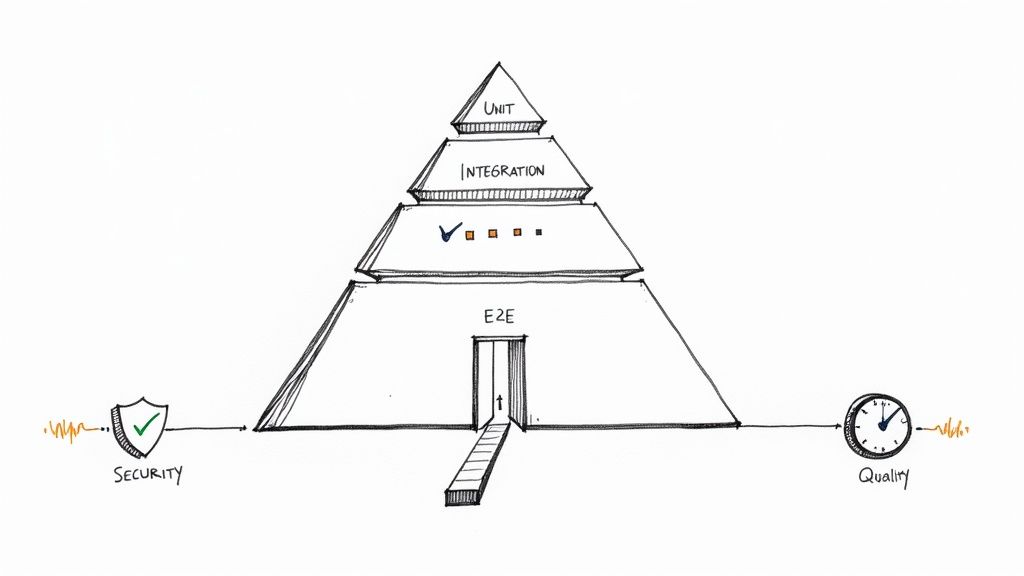
    This deep dive is structured to help startup founders, CTOs, and engineering leaders make informed decisions. We focus on practical implementation considerations, such as configuring integrations, setting up automated workflows, and managing permissions at scale. For a broader perspective on the evolving landscape of remote collaboration, you can explore other comprehensive guides like the 12 Best Remote Work Collaboration Tools for 2025 for additional insights.

    You'll learn how to evaluate these platforms based on your team’s specific technical stack, workflow maturity, and security requirements. Our analysis, complete with screenshots and direct links, will help you implement a solution that scales with your ambitions and empowers your engineers to build, ship, and innovate faster, regardless of location.

    1. OpsMoon

    OpsMoon provides a unique, service-based approach to remote technical collaboration. Instead of offering a SaaS tool, it delivers pre-vetted, elite DevOps engineering teams as a managed service. This is particularly effective for organizations needing to implement complex infrastructure projects—like a Kubernetes migration or establishing a robust CI/CD pipeline with Terraform—without the long lead times of direct hiring. The platform's value proposition is its ability to deploy a cohesive, high-functioning remote team that integrates directly into your existing toolchain and workflows.

    OpsMoon

    The collaboration protocol begins with a technical deep-dive and work planning session, where your existing architecture (e.g., cloud provider, container orchestration, IaC tools) is analyzed to create a detailed project roadmap with clear deliverables and SLOs. OpsMoon’s proprietary Experts Matcher algorithm then assembles a team with certified expertise in your specific stack. This technical alignment is paramount for remote work, ensuring the team can immediately contribute to your codebase and infrastructure without a steep learning curve.

    Strategic Advantages and Use Cases

    OpsMoon is engineered for scenarios where deep, specialized technical execution is required, and off-the-shelf tools are insufficient.

    • Best For: Companies needing to execute specific, high-stakes DevOps projects, such as building out observability stacks with Prometheus and Grafana, automating cloud infrastructure with Infrastructure as Code (IaC), or augmenting an existing team with specialized SRE skills.
    • Key Feature: The inclusion of free architect hours provides senior-level technical oversight, ensuring that the remote team's tactical work aligns with broader architectural goals and security best practices. This is crucial for maintaining architectural integrity during rapid development.
    • Practical Tip: To maximize the value of the initial planning session, prepare a repository with your current Terraform or CloudFormation scripts, CI/CD pipeline configurations (e.g., .gitlab-ci.yml or Jenkinsfile), and any existing architectural diagrams. This enables a more precise and actionable roadmap.

    OpsMoon’s operational model is designed for technical integration, offering engagement flexibility from advisory roles to full project ownership. This makes it one of the most effective remote team collaboration tools when the "tool" needed is actually a highly specialized, remote-native engineering unit. You can explore a curated list of DevOps instruments and how they integrate into a cohesive strategy by checking out the expert-recommended toolsets on Opsmoon.com.

    Pros & Cons

    Pros Cons
    Elite Talent Access: Connects you with the top 0.7% of vetted global DevOps engineers via its Experts Matcher technology. Opaque Pricing: Cost information is not public; a customized quote is required.
    Strategic Onboarding: A free, comprehensive work planning session ensures strategic alignment and a clear project roadmap. Remote-Only Model: May not be suitable for organizations that require an on-site presence.
    Flexible Engagement: Offers models from consulting and hourly capacity to full project delivery, with free architect hours included.
    High Transparency: Provides real-time progress tracking and a focus on continuous improvement cycles for project control.

    Website: https://opsmoon.com

    2. Microsoft Teams (Microsoft 365 + Teams Essentials)

    For engineering teams operating within the Azure and Microsoft 365 ecosystem, Teams offers a tightly integrated collaboration hub. Its core technical advantage is its native integration with Azure DevOps and GitHub Enterprise. Development teams can create channels that receive real-time notifications from ADO pipelines for build successes or failures, pull request updates, and work item assignments. This transforms the chat interface into a functional command center, reducing the need to switch contexts between communication and development tools.

    Architecturally, Teams leverages SharePoint for file storage and Exchange for calendaring, ensuring robust, enterprise-grade data management and security policies. The ability to embed Power BI dashboards or SharePoint lists as tabs within a channel allows for the creation of project-specific cockpits that display key metrics and data without leaving the application. For organizations prioritizing security, Microsoft's compliance and data governance features, inherited from the broader M365 suite, are a significant differentiator.

    Key Considerations

    • Best Use Case: Development teams standardized on Azure DevOps for CI/CD and work item tracking, and organizations that require stringent, centralized security and compliance controls.
    • Pros: Vendor consolidation and simplified billing within the Microsoft ecosystem; powerful, native integrations with Azure services; robust security features including eDiscovery and data loss prevention (DLP).
    • Cons: The most powerful integrations require a full Microsoft 365 E3/E5 subscription. The user interface can feel less streamlined than competitors like Slack, especially for non-technical users.

    Website: https://www.microsoft.com/en-us/microsoft-teams/essentials/

    3. Slack (by Salesforce)

    Slack is a developer-centric communication platform that excels at integrating a heterogeneous toolchain into a unified, actionable stream of events. Its power lies in a vast ecosystem of applications and a robust API that allows for the creation of custom workflows and "slash" commands. Technical teams can configure integrations to pipe alerts from monitoring systems like Datadog or Prometheus, receive deployment notifications from Jenkins or CircleCI, and manage Jira tickets directly from a chat channel.

    Slack (by Salesforce)

    The platform’s "Workflow Builder" provides a no-code interface for automating routine processes, such as creating a standardized incident response channel when a PagerDuty alert is triggered. For more complex automation, Slack's APIs enable developers to build custom bots and applications that can interact with internal services. Slack Connect extends this collaborative fabric to external partners, providing a secure, shared workspace that is more efficient and auditable than email.

    Key Considerations

    • Best Use Case: Agile engineering teams with a diverse, best-of-breed toolchain who need a central hub for notifications, automation, and real-time incident response.
    • Pros: Unmatched app ecosystem and powerful APIs for custom integrations; intuitive UX for chat and asynchronous communication; Slack Connect enables secure external collaboration.
    • Cons: Message history is severely limited on the free plan, hindering its use as a long-term knowledge base. Per-user costs on paid plans can become significant for large teams.

    Website: https://slack.com/pricing

    4. Zoom Workplace (Meetings, Team Chat, Whiteboard, Phone add-ons)

    While known for its best-in-class video conferencing, Zoom Workplace has evolved to become a more integrated collaboration platform. Its primary technical advantage is the seamless transition between asynchronous and synchronous communication modes. A discussion in a Team Chat channel can be escalated to a high-fidelity video call with a single click, preserving the chat history and context. This is highly effective for remote pair programming or urgent troubleshooting sessions where text-based communication is insufficient.

    For remote engineering teams, the platform's reliability and low-latency video are critical for daily stand-ups, sprint planning, and retrospectives. The integrated Whiteboard feature is useful for system design sessions and architectural diagramming. While its app ecosystem is not as extensive as Slack's, it offers key integrations with project management tools like Asana and Jira. The AI Companion feature, which can summarize meetings and generate action items, provides a tangible productivity boost by reducing manual documentation overhead.

    Key Considerations

    • Best Use Case: Teams that prioritize high-quality video for daily synchronous collaboration and want to consolidate their communication tools under a single, familiar vendor.
    • Pros: Industry-leading video quality and reliability; Team Chat is included with paid meeting licenses, offering immediate value; simple, intuitive user experience minimizes training requirements.
    • Cons: The integration marketplace is less mature than competitors. Advanced features, particularly for telephony and large-scale webinars, are expensive add-ons.

    Website: https://www.zoom.com/en/products/team-chat/

    5. Google Workspace (Gmail, Drive, Meet, Chat)

    Google Workspace is a fully cloud-native suite designed for real-time, browser-based collaboration. Its key technical strength is the deep, seamless integration between its component services. For example, users can collaborate on a Google Doc directly within a Chat space, initiate a Meet call from a calendar invite, and leverage powerful search capabilities across Gmail and Drive. This frictionless experience minimizes context switching and eliminates version control issues associated with desktop applications.

    Google Workspace (Gmail, Drive, Meet, Chat)

    For technical teams, Google Colab and the ability to use Google Apps Script provide powerful ways to extend the platform's functionality. Apps Script, a JavaScript-based platform, allows for the creation of custom add-ons and automation workflows across the entire suite. The platform's security model is robust, with granular sharing controls in Drive, data loss prevention (DLP) policies, and security analytics available in higher-tier plans. For teams evaluating total cost, a breakdown of Google Workspace pricing shows its competitive positioning.

    Key Considerations

    • Best Use Case: Fast-moving teams that depend on real-time document co-authoring and prefer a unified, browser-first environment for all productivity and communication needs.
    • Pros: Unparalleled real-time collaboration in Docs, Sheets, and Slides; simplified, transparent per-user pricing; robust cloud-native security and admin controls.
    • Cons: Less suitable for organizations with heavy dependencies on Microsoft Office desktop features or complex macros. The third-party app marketplace is not as extensive as those of Microsoft or Slack.

    Website: https://workspace.google.com/pricing?hl=us

    6. Atlassian Cloud (Jira Software + Confluence)

    The Atlassian suite, centered around Jira and Confluence, is the de facto standard for structured agile software development at scale. Jira's power lies in its highly customizable workflows, which can be tailored to model any development process from simple Kanban to complex, multi-stage release cycles. Its use of Jira Query Language (JQL) allows for the creation of sophisticated filters and dashboards to track metrics like cycle time, lead time, and bug velocity.

    Atlassian Cloud (Jira Software + Confluence)

    Confluence serves as the integrated knowledge base, providing a single source of truth for technical specifications, architectural decision records (ADRs), and sprint retrospectives. The deep, two-way integration between the two is critical: Jira epics can be linked to Confluence requirements pages, and code commits in Bitbucket or GitHub can automatically update the status of Jira tickets. This creates a fully traceable and auditable record of work from ideation to deployment, which is essential for regulated industries and large engineering organizations.

    Key Considerations

    • Best Use Case: Software development teams that require a prescriptive, auditable system for managing the entire software development lifecycle (SDLC) in an agile framework.
    • Pros: Best-in-class for structured issue and project tracking; powerful integration with CI/CD and Git hosting platforms; strong compliance and security features for enterprise use.
    • Cons: Can be perceived as overly complex or rigid for smaller, faster-moving teams. The per-user pricing model can become expensive as teams scale and require marketplace add-ons.

    Website: https://www.atlassian.com/software/jira/pricing

    7. Asana (Work Management for teams)

    Asana excels at translating high-level strategic objectives into actionable, trackable tasks for distributed teams. Its technical strength is its robust data model, which allows for the creation of dependencies between tasks across different projects. This is crucial for remote teams, providing clear visibility into how a delay in one area will impact timelines elsewhere. The "Portfolio" and "Goals" features allow engineering leaders to monitor the real-time status of multiple projects and initiatives against strategic business outcomes.

    For development workflows, Asana's automation engine ("Rules") can be used to streamline processes, such as moving a task to a "QA" column when a corresponding pull request is merged in GitHub. Its API is well-documented, enabling custom integrations with internal systems. While not as developer-centric as Jira, Asana's user-friendly interface makes it an excellent choice for cross-functional teams where engineers, product managers, and marketers need to collaborate within a single system.

    Key Considerations

    • Best Use Case: Cross-functional teams that need to manage complex projects with interdependencies and require a clear line of sight from individual tasks to company-wide goals.
    • Pros: Highly intuitive interface with multiple project views (list, board, timeline, calendar); powerful automation capabilities to reduce manual work; strong reporting and portfolio management features.
    • Cons: Not specifically designed for agile software development methodologies like Scrum (e.g., lacks native story points). Advanced features like workflow branching are tied to expensive higher-tier plans.

    Website: https://www.forbes.com/advisor/business/asana-pricing/

    8. monday.com Work Management

    monday.com is a highly customizable Work OS that allows teams to build their own applications and workflows using a visual, low-code interface. Its technical advantage is its extreme flexibility. Teams can create boards with custom column types (e.g., status, timeline, numbers, formulas) to precisely model their specific processes, whether for bug tracking, sprint planning, or marketing campaigns. The platform’s robust automation and integration recipes allow for deep connections with external tools.

    monday.com Work Management

    For development teams, the monday dev product offers specialized features like sprint management and roadmap planning, with native integrations for GitHub, GitLab, and Jira. This allows managers to visualize data from multiple sources on a single dashboard. A key technical feature is its GraphQL API, which provides more efficient and flexible data retrieval compared to traditional REST APIs, empowering developers to build sophisticated custom integrations and reporting tools.

    Key Considerations

    • Best Use Case: Teams that require a highly visual and customizable platform to manage a wide variety of workflows and consolidate data from multiple sources into centralized dashboards.
    • Pros: Extremely flexible and visually intuitive interface; extensive library of automation and integration recipes; a powerful GraphQL API for custom development.
    • Cons: The seat-bundle pricing model (minimum of 3 seats) can be cost-prohibitive for very small teams. The sheer number of customization options can be overwhelming without a clear implementation plan.

    Website: https://www.monday.com/pricing

    9. ClickUp

    ClickUp's core technical proposition is consolidation. It aims to provide a single, unified platform with a feature set that spans project management, document collaboration, whiteboarding, and even internal chat. Its hierarchical structure (Spaces > Folders > Lists > Tasks) allows for a high degree of organizational granularity, making it suitable for mapping complex organizational structures and project portfolios. The ability to create custom fields and statuses at different levels of this hierarchy provides significant flexibility.

    ClickUp

    For technical teams, ClickUp offers multiple views, including Gantt, Kanban, and workload charts, to manage sprints and allocate resources. Its API is comprehensive, allowing for programmatic interaction with nearly every aspect of the platform. Features like "Goals" for tracking objectives and key results (OKRs) and integrated time tracking make it a powerful tool for managers needing to monitor team performance and project progress in one place.

    Key Considerations

    • Best Use Case: Cost-conscious teams looking for an all-in-one solution to reduce the number of subscribed SaaS tools and centralize all work management activities.
    • Pros: An extensive, all-encompassing feature set at a competitive price point; highly customizable structure and views; a public API that enables deep integration.
    • Cons: The breadth of features can lead to a steep learning curve and a cluttered user interface. Performance can sometimes be sluggish, particularly on large or complex boards.

    Website: https://help.clickup.com/hc/en-us/articles/10129535087383-Intro-to-pricing

    10. Notion

    Notion's technical architecture is built around a flexible, database-driven structure where every piece of content is a "block." This allows for the creation of interconnected wikis, task lists, and project roadmaps that are far more dynamic than traditional documents. For engineering teams, this means you can create a project brief that directly links to a Kanban board of tasks, which in turn links to detailed technical specification pages. This relational database model is Notion’s core differentiator.

    Notion

    The platform has a public API, allowing for the automation of page and database entry creation, which is useful for integrating with other systems like GitHub or Jira. Notion AI can be used to summarize lengthy technical documents, generate boilerplate code, or draft meeting agendas, accelerating routine tasks. The ability to create team-specific templates ensures consistency in documentation, such as for architectural decision records (ADRs) or incident post-mortems.

    Key Considerations

    • Best Use Case: Teams that prioritize knowledge management and documentation and want a single, highly customizable tool to serve as their "team brain."
    • Pros: Unmatched flexibility for creating custom workflows and documentation systems; a powerful relational data model for linking information; a clean, minimalist user interface.
    • Cons: Lacks the robust, dedicated project management features of tools like Jira or Asana (e.g., advanced reporting, resource management). Can become disorganized without strong governance and standardized templates.

    Website: https://www.notion.com/pricing

    11. Miro (Visual Collaboration & Whiteboarding)

    Miro provides a persistent, infinite digital canvas that is essential for remote technical collaboration, particularly during the ideation and design phases. It goes beyond basic whiteboarding by offering a rich set of tools and templates specifically for software development, such as user story mapping, dependency mapping, and system architecture diagramming using standard notations like C4 or UML. The ability for multiple users to collaborate in real-time on these complex diagrams is its core function.

    Miro (Visual Collaboration & Whiteboarding)

    A key technical feature is its two-way synchronization with issue-tracking systems like Jira and Azure DevOps. This allows teams to convert digital sticky notes from a brainstorming session directly into actionable tickets in their backlog. The Miro Developer Platform enables the creation of custom applications and integrations, allowing teams to embed Miro boards into other applications or pull data from external services onto a board.

    Key Considerations

    • Best Use Case: Distributed engineering, product, and design teams that need a shared visual space for workshops, system architecture planning, and agile ceremonies like sprint retrospectives.
    • Pros: Extensive template library for technical and agile workflows; powerful, real-time visual collaboration features; deep two-way integrations with key development tools.
    • Cons: The free plan's limit of three editable boards is highly restrictive for active teams. Can become another "silo" of information if not tightly integrated with a system of record like Jira or Confluence.

    Website: https://miro.com/pricing/

    12. AWS Marketplace (Collaboration & Productivity category)

    The AWS Marketplace is a procurement and deployment channel rather than a collaboration tool itself. Its technical value lies in streamlining the acquisition, billing, and governance of third-party SaaS tools for organizations heavily invested in the AWS cloud. By procuring software through the Marketplace, companies can consolidate their SaaS spending onto their AWS bill, simplifying budget management and potentially leveraging existing Enterprise Discount Programs (EDPs).

    AWS Marketplace (Collaboration & Productivity category)

    For a remote DevOps engineer, this model accelerates access to necessary tools by bypassing lengthy, traditional procurement cycles. The Marketplace also simplifies security and compliance, as many listed products have been vetted by AWS. Furthermore, private offers allow organizations to negotiate custom pricing and licensing terms directly with vendors, all managed within the AWS ecosystem. This operational efficiency allows engineering teams to focus on development rather than administrative overhead.

    Key Considerations

    • Best Use Case: Large organizations with significant AWS spend and established procurement processes looking to simplify vendor management and consolidate billing for their software stack.
    • Pros: Centralized billing and procurement under the AWS umbrella; simplified security and compliance vetting; potential for cost savings through negotiated private offers and EDPs.
    • Cons: Tool selection is limited to vendors who have chosen to list on the Marketplace. Pricing may not always be more competitive than purchasing directly from the vendor.

    Website: https://docs.aws.amazon.com/marketplace/latest/buyerguide/buyer-product-categories.html

    Top 12 Remote Collaboration Tools Feature Comparison

    Platform Core Features User Experience / Quality Value Proposition Target Audience Price Points
    OpsMoon Top 0.7% remote DevOps talent, Experts Matcher, Kubernetes, Terraform, CI/CD, observability Free planning session, real-time progress tracking, continuous improvement Flexible models, free architect hours, tailored roadmap, remote-first Startups, SMEs, enterprises needing DevOps expertise Custom pricing, quote required
    Microsoft Teams (Microsoft 365 + Teams Essentials) Team chat, meetings (up to 300 users), Office integration, file collaboration Familiar UI, integrated Office apps All-in-one communication & productivity Teams using Microsoft Office Teams Essentials from $4/user/month+
    Slack (by Salesforce) Channels, calls, 2600+ apps & integrations, Slack Connect Best-in-class chat UX, rich integrations Flexible pricing, external collaboration Teams needing rich chat & integrations Free tier, paid from $6.67/user/month
    Zoom Workplace Video meetings, team chat, whiteboarding, phone add-ons Reliable video, chat included, AI companion Extend Zoom meetings to full collaboration Video meeting heavy teams Pricing varies by plan and add-ons
    Google Workspace Gmail, Drive, Docs/Sheets, Meet, Chat Seamless real-time collaboration All-in-one cloud productivity suite Cloud-centric teams From $6/user/month
    Atlassian Cloud (Jira + Confluence) Issue tracking, agile boards, wikis, permissions, integrations Structured work tracking, centralized docs Agile management, knowledge base Agile teams, dev & documentation users Free tier, paid from $7.75/user/month
    Asana Tasks, boards, timelines, automation, reporting Intuitive UI, templates, onboarding options Project & task management with automation Cross-functional teams Free tier, paid from $10.99/user/month
    monday.com Work Management Visual boards, timelines, automations, CRM & dev modules Visual, template-rich, AI features Flexible modules for projects & CRM Teams needing visual management From $8/user/month (seat bundles)
    ClickUp Tasks, docs, whiteboards, goals, chat, dashboards Broad features, aggressive roadmap All-in-one collaboration platform Teams replacing multiple tools Free tier, paid from $5/user/month
    Notion Docs, wikis, databases, AI writing/search Flexible building blocks, simple pricing Unified knowledge & lightweight PM Teams needing flexible docs Free tier, paid from $8/user/month
    Miro Infinite canvas, templates, timers, voting, enterprise security Strong facilitation tools, integrations Visual collaboration & workshops Remote/hybrid teams Free tier, paid from $8/user/month
    AWS Marketplace (Collab & Productivity) Curated SaaS apps, consolidated billing, procurement Centralized vendor management Simplifies AWS-centric software procurement Large orgs with AWS spend Varies by vendor

    Making Your Final Decision: Integrating the Right Tools for Your DevOps Workflow

    Choosing the right stack of remote team collaboration tools is a critical strategic decision that directly impacts your team's culture, efficiency, and technical output. The optimal solution is rarely a single platform but an integrated ecosystem where communication, project management, and knowledge sharing are connected via robust APIs and automated workflows. The objective is to architect a digital workspace that minimizes friction and provides a high-fidelity signal of project status and team health.

    Synthesizing Your Tooling Strategy

    For highly technical teams, particularly within a DevOps or SRE context, the selection criteria go far beyond simple chat or video conferencing features. The emphasis must be on platforms with robust APIs, deep integrations with your existing developer toolchain (like Git repositories, CI/CD pipelines, and observability platforms), and granular permission controls. When evaluating options like Atlassian's Jira and Confluence versus a more flexible platform like Notion or ClickUp, consider your team's existing software delivery lifecycle. A tool should not force a new, cumbersome process; it should augment and streamline the workflows you already have in place.

    Key Factors for Technical Implementation

    As you move from evaluation to implementation, consider these critical factors:

    • Integration Debt: How much custom development or third-party middleware (like Zapier or Make) will be required to connect your chosen tools? A platform with native, deep integrations into your core stack (e.g., Slack's Git and Jenkins apps) will always be superior to one requiring brittle, custom-built connectors. Analyze the quality of the API documentation and the availability of webhooks for event-driven automation.
    • Security and Compliance: For any team handling sensitive data or operating in regulated industries, security is paramount. Scrutinize each tool's compliance certifications (SOC 2, ISO 27001), data residency options, and role-based access control (RBAC) capabilities. Can you integrate it with your SSO provider (e.g., Okta, Azure AD) and enforce MFA? Ensure the tool can enforce the principle of least privilege effectively.
    • Scalability and Performance: Will this tool scale with your team and your infrastructure? A project management tool that becomes sluggish with 10,000 tasks or a communication platform that falters during a major incident is a liability. Look for enterprise-grade performance guarantees and proven case studies from companies at a similar or larger scale. Test the platform's API rate limits to ensure they can support your automation needs.

    Ultimately, the best suite of remote team collaboration tools is one that fades into the background. It should remove cognitive overhead, enhance transparency across engineering functions, and empower every team member to focus on their primary objective: building and maintaining exceptional software. This isn't just about buying software; it's about investing in your team's productivity and long-term success.


    Ready to bridge the gap between powerful tools and the expert talent needed to leverage them? OpsMoon provides elite, pre-vetted remote DevOps engineers who integrate seamlessly with your team and toolchain. Stop just managing your infrastructure and start optimizing it for peak performance and scalability by visiting OpsMoon to learn how we connect you with the world's top cloud and DevOps experts.