Author: opsmoon

  • A Technical Guide to Cloud Native Application Development

    A Technical Guide to Cloud Native Application Development

    When you hear the term cloud native, it’s easy to think it's just about running your apps in the cloud. But that's only part of the story. It’s a complete shift in how you design, build, and deploy software to take full advantage of the cloud's elastic, distributed, and automated nature. It's about building applications that are born for the cloud environment.

    This approach isn't just a technical detail—it's what allows engineering teams to achieve high-velocity CI/CD, improve system resilience, and ship better software faster and more reliably than ever before.

    More Than a Buzzword, It's a Strategic Shift

    Moving to cloud native is less about picking a new tool and more about adopting a whole new engineering mindset. Let's break it down with a technical analogy.

    Think of a traditional, monolithic application as a single, tightly-coupled binary deployed on a fleet of virtual machines. Its architecture is rigid. To update a single feature, you must re-compile, re-test, and re-deploy the entire application. A fault in one module can cascade, bringing the entire system down. Scaling is coarse-grained—you scale the entire monolith, even if only one small component is under load.

    Now, imagine a cloud native application. It's not one monolithic binary but a distributed system composed of small, specialized, independent services. Each service is a microservice with a well-defined API boundary. If one service needs a security patch or a performance upgrade, it can be deployed independently without affecting the others. This modular, decoupled architecture makes the entire system more resilient, highly scalable, and dramatically faster to iterate on.

    To truly understand what makes a system "cloud native," it's helpful to look at the foundational technologies and methodologies that make it all work. These aren't just trendy add-ons; they are the core pillars that support the entire structure.

    Core Pillars of Cloud Native Development

    Pillar Technical Function Primary Business Benefit
    Microservices Decomposing large applications into small, independently deployable services that communicate via lightweight protocols like gRPC or HTTP/REST APIs. Faster innovation, as teams can update individual services without redeploying the entire app.
    Containerization Packaging application code and its runtime dependencies into a portable, immutable artifact, most often with Docker. Consistent deployments across any environment (dev, staging, prod), eliminating the classic "it works on my machine" problem.
    DevOps & CI/CD Automating the software delivery pipeline for continuous integration and continuous delivery (CI/CD), managed as code (e.g., Jenkinsfile, GitLab CI YAML). Increased release velocity and improved stability, as code changes are automatically built, tested, and deployed.

    Each of these pillars builds on the others, creating a powerful, interconnected system for modern software engineering.

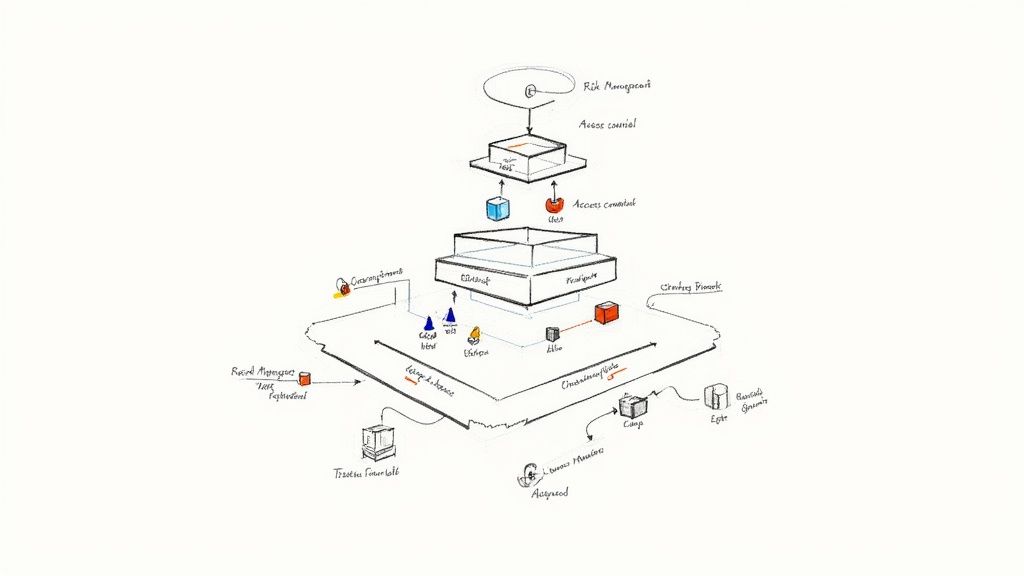
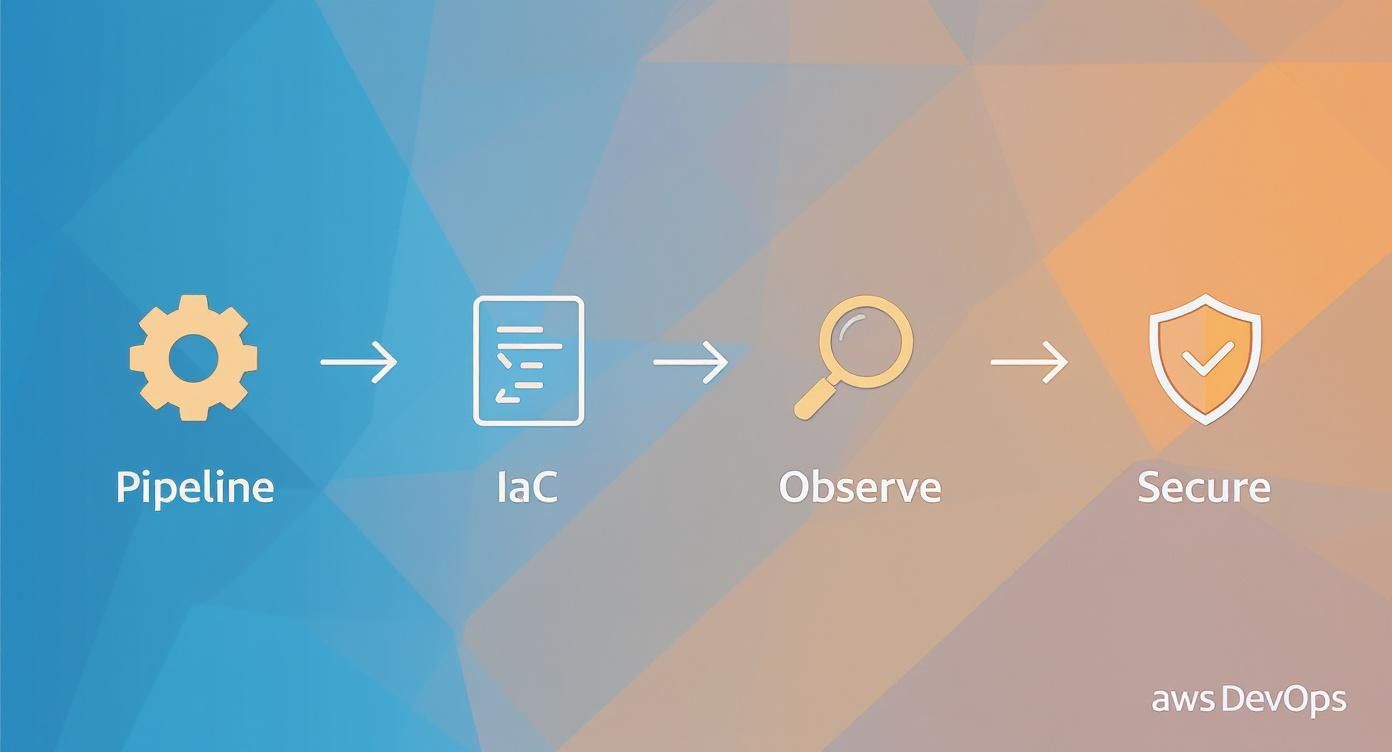
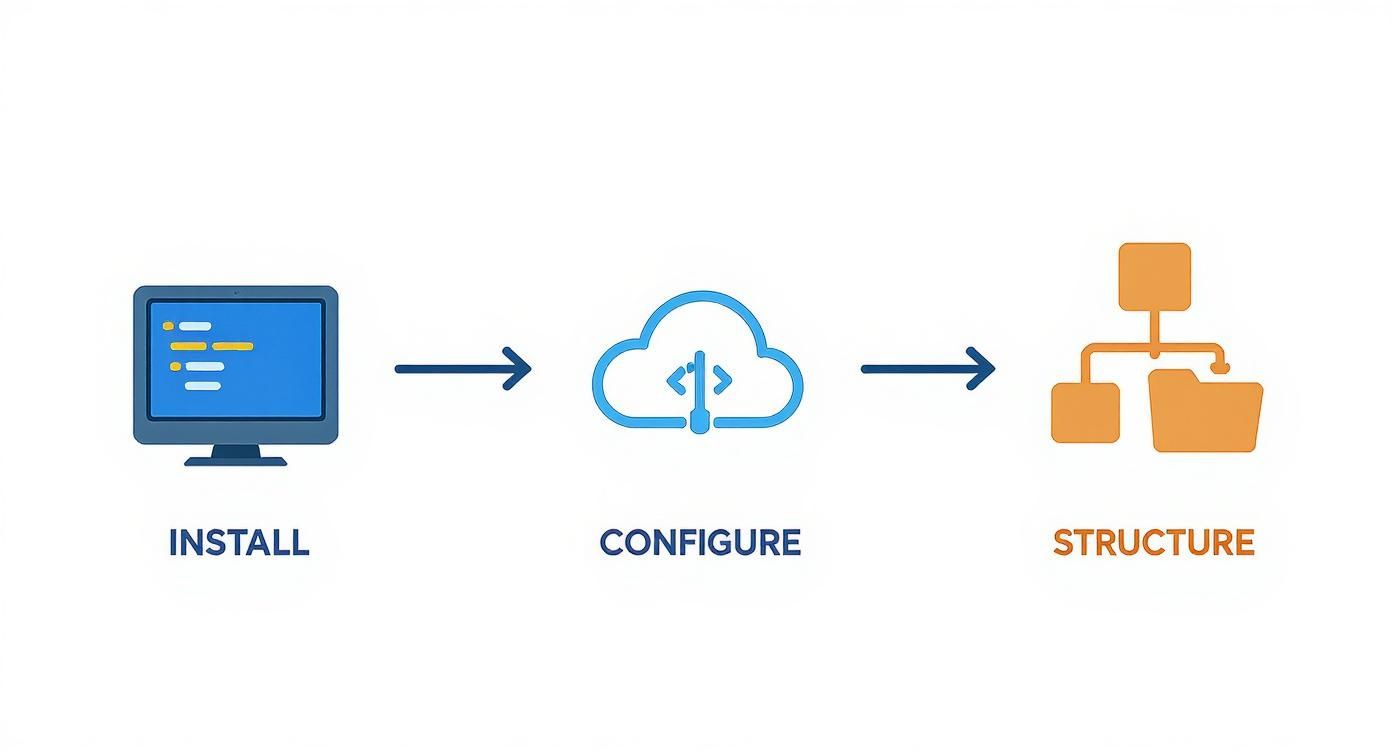
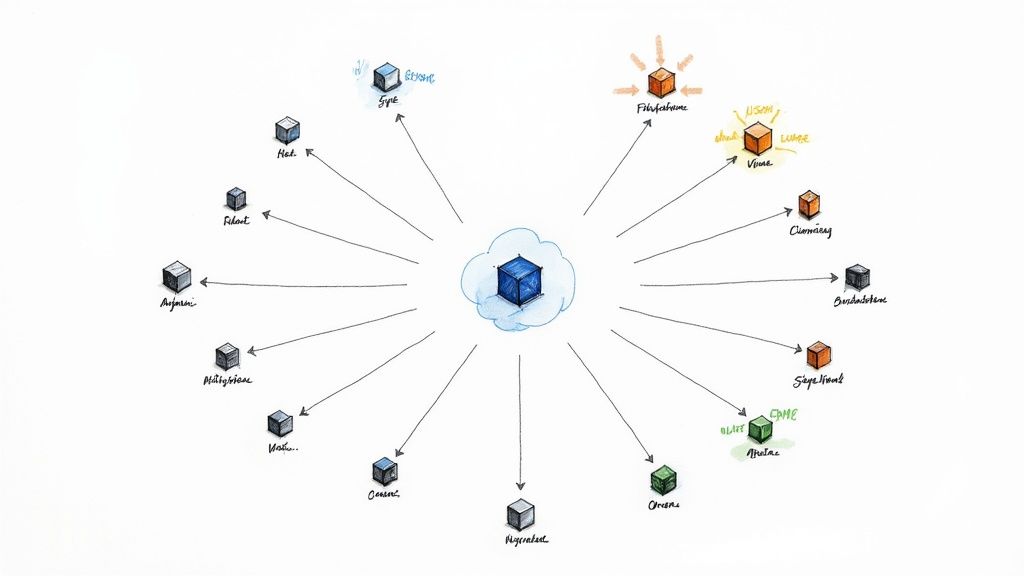
    This diagram shows how concepts like containerization and microservices are the bedrock of cloud native development, with orchestration managing all the moving parts.

    Image

    As you can see, orchestration is the critical layer that coordinates all these independent services, allowing them to work together seamlessly at scale. This combination of technology and process is why the market is exploding.

    The global cloud native applications market was valued at USD 7.06 billion in 2023 and is projected to hit USD 30.24 billion by 2030. That’s not just hype; it’s a reflection of a massive industry-wide shift toward more agile and responsive systems.

    The cultural element here, especially DevOps, is what ties everything together. It tears down the old walls between development and operations teams. If you want to dig deeper, our guide on what the DevOps methodology truly entails explains how this collaboration is the engine for speed.

    Ultimately, this collaborative approach is what allows teams to build, test, and release software faster and more frequently, which is the entire point of going cloud native.

    Building Your Foundation with Microservices

    Image

    At the heart of any solid cloud-native application lies the microservices architecture. This isn't just a fancy way of saying "break up a big application into smaller ones." It's a fundamental architectural pattern for building complex, distributed systems.

    Imagine an e-commerce platform built as a monolith. The user authentication, product catalog, inventory management, and payment processing logic are all compiled into a single deployable unit. Now, picture that same platform built with microservices. You'd have discrete, independently deployable services: auth-service, product-service, inventory-service, and payment-service.

    Each service is a standalone application. It has its own database schema and can be developed, tested, and deployed in isolation. This means the inventory team can deploy a critical database migration without coordinating with—or blocking—the payments team. This architectural decoupling is a game-changer for velocity and system resilience. If one service experiences a failure, it doesn't cascade and bring the entire platform down with it.

    Core Principles for Designing Microservices

    To prevent your microservices from degrading into a "distributed monolith," you must adhere to several key design principles. These are the guardrails that ensure your architecture remains clean, scalable, and maintainable.

    • Single Responsibility Principle: This is a core tenet of software design, applied at the service level. Every microservice should have one, and only one, reason to change. Your auth-service should only handle user identity and access control. It should have no knowledge of shopping carts; that's the domain of another service. This principle ensures services are small, focused, and easy to understand.
    • Decentralized Data Management: Each service is the sole owner and authority for its data. The product-service manages the product database, and no other service is allowed to query its tables directly. All data access must happen through its public API. This "database-per-service" pattern prevents hidden data coupling and allows each service to choose the best persistence technology for its needs (e.g., SQL for transactions, NoSQL for documents).
    • Design for Failure: In any distributed system, failures are inevitable. Networks partition, services crash, and latency spikes. Your application must be architected to handle these transient faults gracefully. This means implementing patterns like exponential backoff for retries, request timeouts, and circuit breakers to isolate failures and prevent them from cascading across the system.

    Synchronous vs. Asynchronous Communication

    So you've got all these independent services. How do they communicate? The communication pattern you choose has a massive impact on your system's performance, coupling, and reliability. The two main approaches are synchronous and asynchronous.

    Synchronous communication is a blocking, request-response pattern. One service sends a request and blocks until it receives a response. This is typically implemented with REST APIs over HTTP or with gRPC. For instance, when a customer adds an item to their cart, the cart-service might make a synchronous gRPC call to the inventory-service to check stock levels.

    It's straightforward but creates tight temporal coupling between services. If the inventory-service is slow or offline, the cart-service is stuck waiting, leading to increased latency and reduced availability for the end-user.

    Asynchronous communication, on the other hand, is a non-blocking, event-based model. A service sends a message and immediately moves on, without waiting for a reply. It simply publishes an event to a message broker, and any interested services can subscribe to that event and process it on their own time.

    This is where tools like Apache Kafka or RabbitMQ are essential. When an order is placed, the order-service publishes an OrderCreated event to a Kafka topic. The shipping-service, billing-service, and notification-service can all subscribe to this topic, acting on the event independently and asynchronously. This decouples your services, making the entire system far more resilient and scalable.

    Want to go deeper on this? We break down these strategies and more in our guide to microservices architecture design patterns.

    The Role of an API Gateway

    When you have tens or even hundreds of services running, you can't just expose them all directly to external clients (like your web or mobile app). That would be a security and management nightmare. You need a single, controlled entry point—and that's the job of an API Gateway.

    Think of it as the reverse proxy for your entire microservices ecosystem. The gateway receives all incoming client requests, handles cross-cutting concerns like authentication (e.g., validating JWTs), and then routes each request to the correct downstream service.

    This approach dramatically simplifies your client-side code, as it only needs to know the address of the gateway. It also provides a centralized point for implementing security policies, rate limiting, and collecting metrics, keeping that logic out of your individual business-focused microservices. Building on concepts like these is how you can create powerful, scalable applications, including interesting Micro SaaS ideas. Getting these architectural pieces right is the key to winning with modern software.

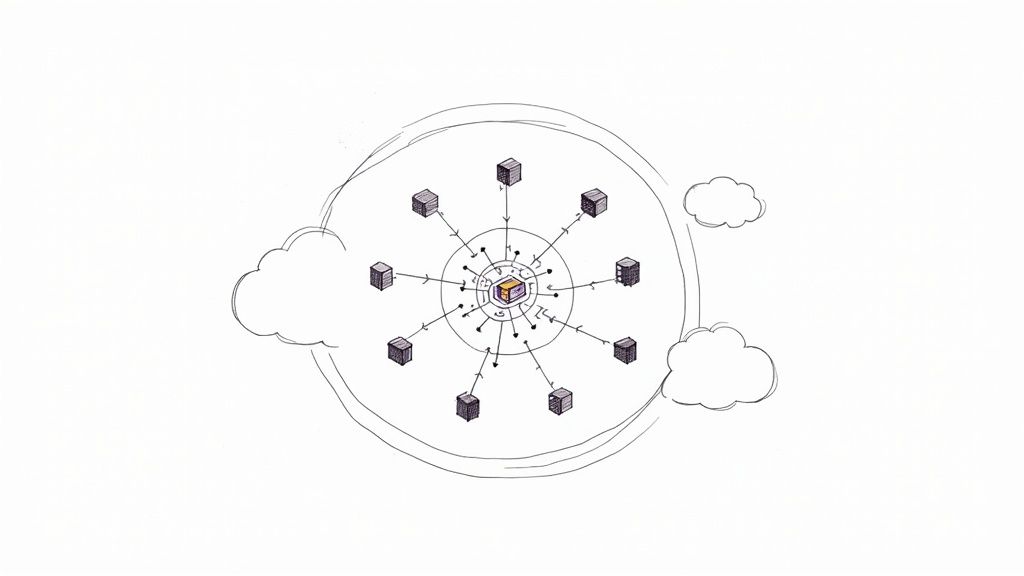
    Using Containers and Kubernetes to Orchestrate Apps

    Image

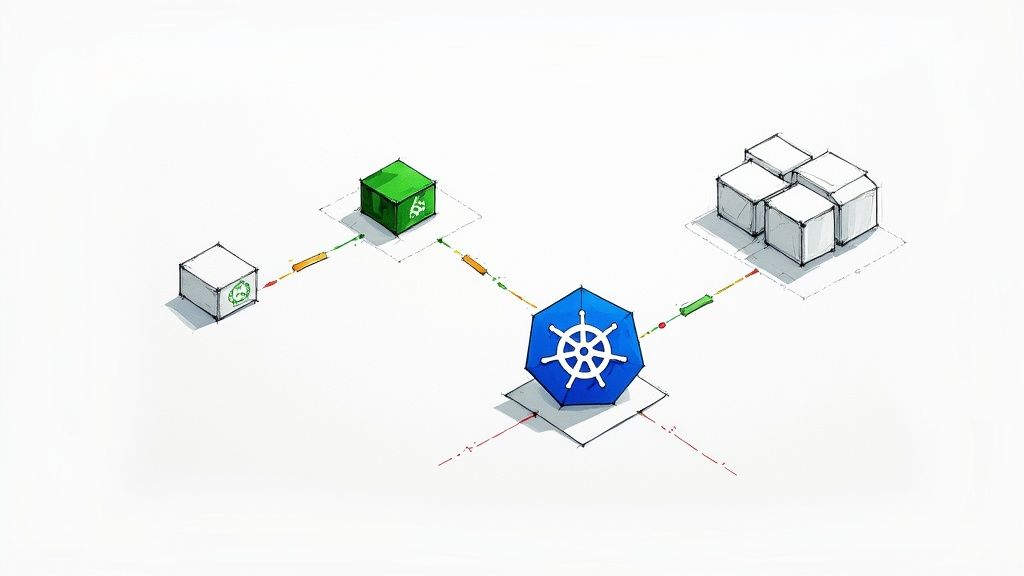
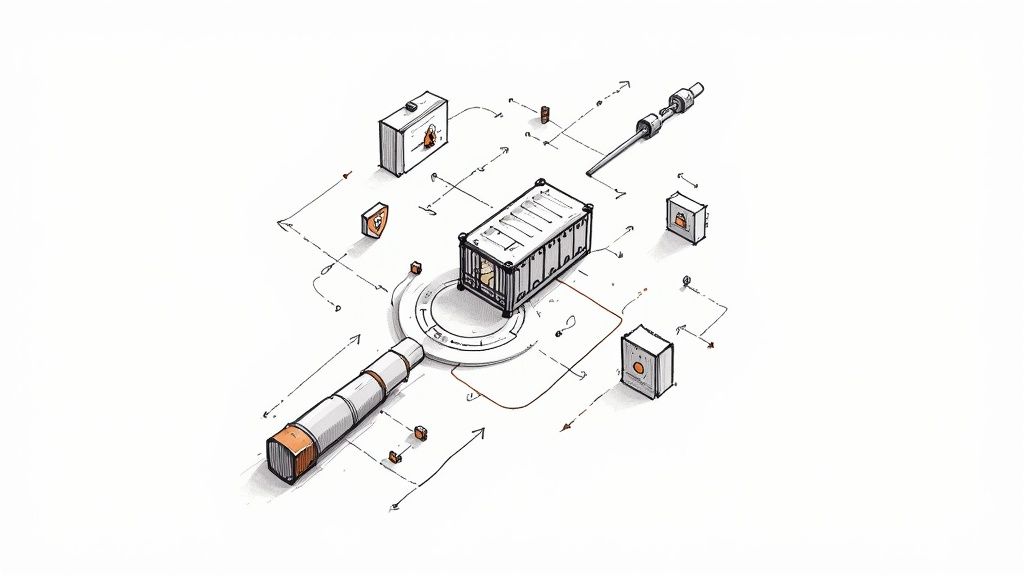
    Once you've decomposed your application into a collection of microservices, you face the next challenge: how do you package, deploy, and run them consistently across different environments? This is where containerization, specifically with Docker, provides the definitive solution. It’s the answer to that chronic developer headache, "but it works on my machine!"

    A container is a lightweight, standalone, executable package that includes everything needed to run a piece of software: the compiled code, a runtime, system tools, and libraries. It achieves OS-level virtualization by leveraging Linux kernel features like cgroups and namespaces. Just as a physical shipping container allows goods to be moved by truck, train, or ship without repackaging, a software container ensures your application runs identically everywhere.

    This immutability and portability are foundational to cloud native application development. By bundling an application and its dependencies into a single artifact, containers guarantee that what you test on a developer's laptop is exactly what gets deployed to a production server. If you're looking to put these skills to work, you might want to check out some remote Docker jobs.

    From One Container to an Orchestra

    Running a single container is simple: docker run my-app. But what happens when you’re managing hundreds of microservice instances? They all need service discovery, load balancing, health checks, and a way to recover from host failures. Managing this distributed system manually is operationally untenable.

    You need a container orchestrator. And in the cloud native ecosystem, the de facto standard is Kubernetes.

    Kubernetes automates the deployment, scaling, and management of containerized applications. It’s the distributed operating system for your cluster, making sure every microservice runs in its desired state. It handles the complex operational tasks—like load balancing traffic, managing persistent storage, and executing automated rollouts and rollbacks—so your teams can focus on writing code.

    Understanding Core Kubernetes Objects

    To work with Kubernetes, you define your application's desired state using declarative configuration files, typically in YAML format. These files describe objects, which are the primitive building blocks of a Kubernetes cluster.

    Here are the essential objects you’ll work with constantly:

    • Pods: The smallest deployable unit of computing in Kubernetes. A Pod encapsulates one or more containers, storage resources, and a unique network IP. While a Pod can run multiple containers, the single-container-per-Pod model is most common.
    • Services: Pods are ephemeral and have dynamic IP addresses. A Kubernetes Service provides a stable network endpoint (a single DNS name and IP address) for a set of Pods. This allows your microservices to discover and communicate with each other reliably using a fixed address.
    • Deployments: A Deployment is a higher-level object that manages Pods. It lets you declaratively specify the number of replicas (instances) of a Pod you want running, and it automates the process of updating them via rolling updates. It ensures your application remains available during deployments.
    • Ingress: Services are designed for internal, cluster-to-cluster communication. To expose an application to the outside world, you use an Ingress. It acts as an application-layer (L7) load balancer, routing external HTTP and HTTPS requests to the correct services based on hostnames or URL paths.

    Putting It All Together: A Practical Example

    Let's walk through a typical deployment workflow for a user-service microservice.

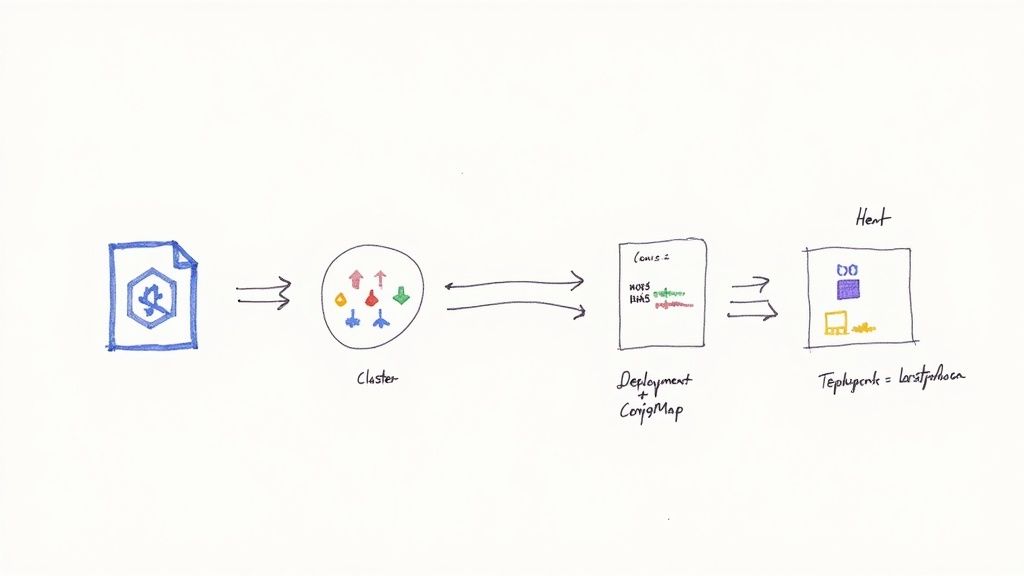
    1. Define the Deployment: First, you'd create a deployment.yaml file. In it, you'd specify the container image (my-registry/user-service:v1.2.0), the number of replicas (replicas: 3), and resource requests/limits (CPU and memory). Applying this manifest with kubectl apply -f deployment.yaml tells the Kubernetes control plane to schedule three Pods, each running an instance of your service, across the nodes in the cluster.

    2. Expose with a Service: Next, you'd create a service.yaml manifest that uses a label selector to target the Pods created by your Deployment. Kubernetes then assigns a stable internal IP and DNS name (e.g., user-service.default.svc.cluster.local) to this Service. Now, any other microservice inside the cluster can communicate with the user-service using this DNS name, and Kubernetes will load-balance the requests across the three running Pods.
    3. Allow External Access: Finally, to allow external traffic, you create an ingress.yaml. You'd define a rule that maps the public host api.yourcompany.com and path /users to the user-service Service on its designated port. An Ingress controller (like NGINX or Traefik) running in the cluster will then configure itself to route all incoming traffic for that URL to your Service, which in turn distributes it to your Pods.

    This declarative, desired-state model is what makes Kubernetes so powerful. You simply tell it what you want, and Kubernetes handles the complex orchestration to make it happen and maintain that state, even in the face of node failures or other disruptions. It's the operational engine that makes cloud native truly scale.

    Automating Delivery with DevOps and CI/CD Pipelines

    Having a brilliant microservices architecture and a robust Kubernetes cluster is only half the battle. To realize the full potential of cloud native development, you must automate the process of getting code from a developer's commit into that cluster.

    This is where a DevOps culture and CI/CD pipelines become the critical enablers. They are the automated assembly line that turns your well-designed architecture into a high-velocity delivery machine.

    More Than Just Tools: It's a Cultural Shift

    Going cloud native is as much about how your teams work as it is about the technology they use. It means tearing down the organizational silos between development (Dev) and operations (Ops) teams.

    The goal is to create a single, unified workflow where teams take end-to-end ownership of their services, from code to production. This "you build it, you run it" mindset is what truly powers the whole cloud native ecosystem.

    This isn’t just some niche trend; it’s now the standard for high-performing tech organizations. Recent industry analysis shows nearly 75% of companies have adopted DevOps practices. That's a huge leap from just 47% five years ago, a shift driven by the rise of hybrid and multi-cloud strategies. You can dig into the specifics in the latest cloud native market analysis.

    Anatomy of a Cloud Native CI/CD Pipeline

    So, what does this automation look like in practice? It's all orchestrated by a CI/CD (Continuous Integration/Continuous Delivery) pipeline—an automated workflow defined as code.

    For a containerized application deploying to Kubernetes, a typical pipeline consists of these stages:

    1. Code Commit: The pipeline is triggered automatically when a developer pushes code changes to a specific branch in a Git repository like GitHub or GitLab.

    2. Automated Build: A CI server—like Jenkins, GitLab CI, or GitHub Actions—fetches the latest code. It compiles the application, runs static code analysis, and builds a new Docker container image.
    3. Testing and Scanning: This new image is subjected to a suite of automated tests: unit tests, integration tests, and contract tests. Concurrently, the image is scanned for known security vulnerabilities (CVEs) using tools like Trivy or Clair. A failure at this stage stops the pipeline immediately.

    4. Push to Registry: Once the image passes all quality and security gates, it is tagged with a unique identifier (e.g., the Git commit SHA) and pushed to a container registry, such as Docker Hub, Amazon ECR, or Google Artifact Registry. This registry serves as the single source of truth for your deployable artifacts.

    5. Automated Deployment: In the final stage, the pipeline tool updates the Kubernetes deployment manifest, changing the image tag to the newly built version. It then applies this change to the cluster, often using a GitOps tool like Argo CD or Flux. Kubernetes then executes a zero-downtime rolling update to bring the new version live.

    The entire process is automated, version-controlled, and auditable.

    The shift from a manual, step-by-step release process to an automated, pipeline-driven one is fundamental to cloud native. Here's a quick comparison of how the development lifecycle changes:

    Monolithic vs Cloud Native Development Lifecycle

    Lifecycle Stage Monolithic Approach Cloud Native Approach
    Planning Long-term, feature-heavy release cycles planned months in advance. Short, iterative sprints focused on small, incremental features.
    Development All developers work on a single, large codebase, leading to merge conflicts. Small, autonomous teams work on independent microservices, reducing coordination overhead.
    Build & Test A slow, complex build process for the entire application. Testing is a separate, lengthy QA phase. Fast, parallelized builds for individual services. Testing is continuous and integrated into the pipeline.
    Deployment Infrequent, high-risk "release day" events requiring significant coordination and downtime. Frequent, low-risk, automated deployments (e.g., Canary or Blue/Green) with zero downtime.
    Operations Operations team manages a large, static application server with manual scaling. Ops team manages a dynamic platform (like Kubernetes) that provides self-healing and auto-scaling.
    Monitoring Monitoring focuses on server health (CPU, memory) and overall application performance. Observability focuses on distributed tracing, metrics, and logs across many services to debug complex issues.

    As you can see, the cloud native approach builds speed and reliability into every stage, from the first line of code to production monitoring.

    The Real-World Impact of Automation

    This level of automation isn't just about developer convenience; it delivers measurable business value.

    By eliminating manual hand-offs and error-prone human intervention, teams can deploy changes far more frequently and with much higher confidence. A solid pipeline is the bedrock of operational excellence. If you're looking to level up your own setup, we’ve put together a guide on CI/CD pipeline best practices to help you sidestep common issues.

    The ultimate goal of a CI/CD pipeline is to make deployments a non-event. It transforms a risky, all-hands-on-deck process into a routine, automated workflow that happens multiple times a day.

    This directly reduces your lead time for changes. Instead of batching hundreds of changes into a quarterly release, you can ship small updates the moment they’re ready and validated. This not only delivers value to customers faster but also dramatically lowers the risk of each deployment, making your entire system more stable and predictable.

    Advanced Cloud Native Implementation Strategies

    Image

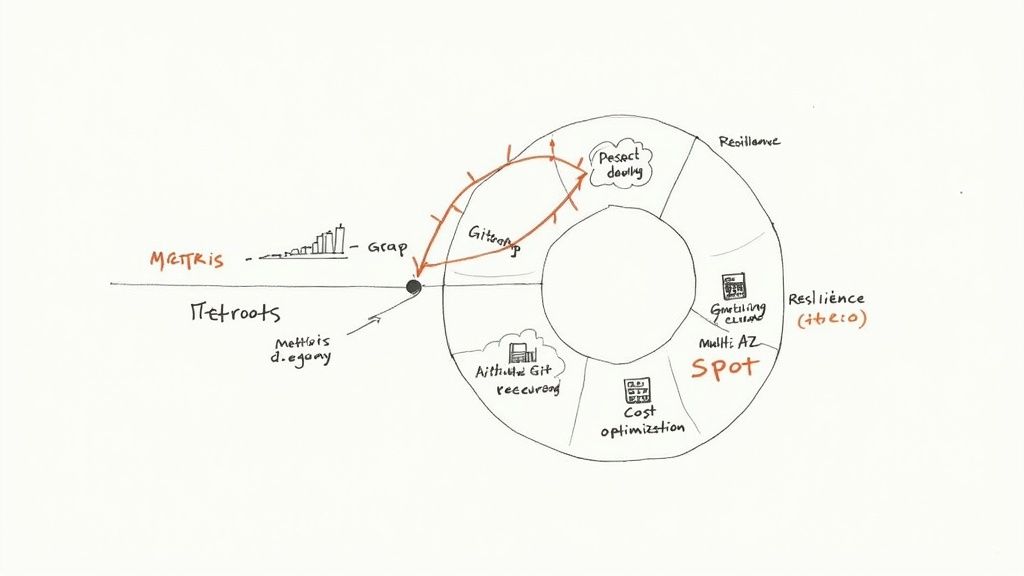
    Once you've mastered the fundamentals of microservices, containers, and CI/CD, it's time to implement the patterns that define a production-grade system. A mature cloud native application development strategy is about building systems that are observable, secure, and resilient by design.

    This is where you move beyond simply deploying features and start engineering for operational excellence. These strategies are what enable you to diagnose issues, withstand attacks, and automatically recover from failures at scale.

    And the market reflects this shift. The entire cloud native development market is on a rocket ship, expected to hit USD 1.08 trillion in 2025—up from USD 881.98 billion in 2024. Projections show it nearly tripling to USD 2.56 trillion by 2029. This boom is directly tied to teams going all-in on agile, microservices, and DevOps. You can get the full scoop by checking out the cloud native development market report.

    Implementing the Three Pillars of Observability

    In a complex distributed system, traditional monitoring (checking CPU and memory) is insufficient. You need Observability—the ability to ask arbitrary questions about your system's behavior without having to ship new code. It is built on three key data types.

    • Metrics: These are time-series numerical data, such as request latency, error rates, or queue depth. A tool like Prometheus scrapes these metrics from your services, allowing you to build dashboards (e.g., in Grafana) and configure alerts to detect known failure modes in real time.
    • Logs: These are immutable, timestamped records of discrete events. Using a log aggregator like Fluentd, you can collect logs from all your services, parse them, and ship them to a centralized platform like Elasticsearch. This allows you to perform complex queries to debug specific issues after they occur.
    • Traces: A trace represents the end-to-end journey of a single request as it propagates through your microservices. By instrumenting your code with a distributed tracing system like Jaeger or OpenTelemetry, you can visualize the entire request path, identifying performance bottlenecks and sources of error with precision.

    Combining metrics, logs, and traces provides a comprehensive view of system health. You go from basic monitoring of known-unknowns to being able to explore and debug the unknown-unknowns that inevitably arise in complex systems.

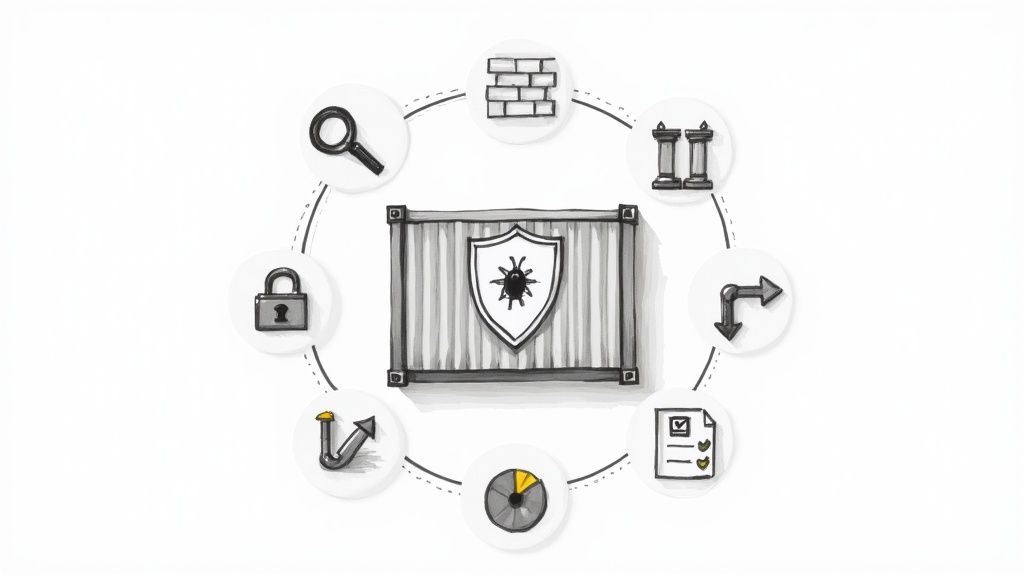
    Critical Security Patterns for Containerized Environments

    The distributed and dynamic nature of cloud native architectures requires a shift from perimeter-based security to a zero-trust model. You must secure your application from the inside out.

    First, eliminate hardcoded secrets like API keys and database credentials from your code and configuration files. Instead, use a dedicated secrets management tool like HashiCorp Vault. It provides a central, encrypted store for secrets, with features like dynamic secret generation, leasing, and revocation.

    Next, implement least-privilege networking between your services. Kubernetes Network Policies act as a distributed firewall for your pods. You can define explicit ingress and egress rules, specifying exactly which services are allowed to communicate with each other over which ports. For example, you can create a policy that allows the order-service to connect to the payment-service but denies all other inbound traffic.

    Finally, enforce security best practices at the pod level using Pod Security Policies (or their successor, Pod Security Admission). These policies can enforce constraints like preventing containers from running as the root user, disallowing host filesystem mounts, and restricting the use of privileged containers.

    Building Self-Healing Applications with Resilience Patterns

    In a cloud native system, failures are not exceptional events; they are expected. The goal is to build applications that can tolerate failures and recover automatically, without human intervention. This is achieved by implementing resilience patterns directly in your services.

    Here are two essential patterns for building self-healing applications:

    1. Circuit Breakers: A service repeatedly calling a failing downstream dependency can cause cascading failures. A circuit breaker, often implemented with a library like Resilience4j (Java) or Polly (.NET), monitors for failures. After a configured threshold of failures, the circuit "trips" and subsequent calls fail fast without even making a network request. This isolates the failing service and gives it time to recover.
    2. Rate Limiting: This pattern protects your services from being overwhelmed by excessive requests, whether from a misbehaving client or a denial-of-service attack. By implementing a rate limiter (e.g., using a token bucket algorithm), you can control the number of requests a service will accept in a given time window, ensuring fair resource allocation and preventing overload.

    When you weave these strategies into your development process, you're not just building apps that are scalable and agile. You're building systems that are fundamentally robust, secure, and ready for the demands of production.

    Frequently Asked Questions About Cloud Native

    As your team starts digging into cloud native application development, you're bound to run into some common questions and technical roadblocks. It happens to everyone. This section tackles some of the most frequent challenges head-on, giving you direct, practical answers to help you move forward with confidence.

    Cloud Native vs. Cloud Ready

    One of the first points of confusion is the distinction between "cloud ready" and "cloud native." The difference is fundamental and impacts everything from cost to agility.

    Cloud-ready applications are typically monolithic systems that have been re-platformed to run on cloud infrastructure. This is often called a "lift and shift" migration. For example, taking a legacy Java application and running it on an EC2 virtual machine. The application works, but it's not designed to leverage core cloud capabilities like auto-scaling, self-healing, or managed services.

    Cloud-native applications are architected specifically to exploit the cloud's capabilities. They are composed of microservices, packaged as containers, and managed by an orchestrator like Kubernetes. This design allows them to scale horizontally on demand, survive infrastructure failures gracefully, and be deployed frequently and independently.

    Managing Data Consistency Across Microservices

    Maintaining data consistency is a significant challenge in a distributed microservices architecture. Since each microservice owns its own database, you cannot use traditional ACID transactions that span multiple services. Such distributed transactions create tight coupling and are a performance bottleneck.

    The cloud native approach is to embrace eventual consistency using an event-driven architecture. When one microservice completes a business operation (e.g., a customer places an order), it publishes an event. Other services subscribe to this event and update their own local data stores accordingly. There's a brief period where the system is in an inconsistent state, but it eventually converges.

    A popular implementation for this is the Saga pattern. A Saga is a sequence of local transactions. Each transaction updates the database of one service and publishes an event that triggers the next transaction in the sequence. If a transaction fails, the Saga executes a series of compensating transactions to roll back the preceding changes, ensuring the system returns to a consistent state.

    Is Kubernetes Always Necessary?

    Kubernetes is the dominant container orchestrator, but its power comes with significant operational complexity. For many use cases, it can be overkill.

    For simpler applications or teams without dedicated platform engineers, other options can provide a faster path to production:

    • Serverless Platforms: Services like AWS Lambda or Azure Functions abstract away all infrastructure management. You provide the code, and the platform handles scaling, availability, and execution. This is ideal for event-driven or stateless workloads.
    • Managed Container Services: Platforms like AWS Fargate or Google Cloud Run provide a middle ground. They allow you to run containers without managing the underlying Kubernetes nodes or control plane. You get the benefits of containerization without the full operational burden of Kubernetes.

    The choice depends on your requirements for scale, control, and operational capacity. Kubernetes excels at managing complex, large-scale distributed systems, but don't overlook simpler, higher-level abstractions that can deliver value more quickly for smaller projects.

    Biggest Cloud Native Security Challenges

    Security in a cloud native environment is a multi-layered problem. The attack surface expands significantly with distributed services, ephemeral containers, and complex network configurations.

    Here are the primary technical challenges you must address:

    • Container Security: Your CI/CD pipeline must include automated image scanning for known vulnerabilities (CVEs) in both your application code and its third-party dependencies. You should also enforce policies to build from trusted base images.
    • Runtime Security: Once deployed, you need to monitor container behavior for anomalies. This includes enforcing least-privilege (e.g., read-only root filesystems), using network policies to segment traffic, and employing runtime security tools to detect suspicious activity like unexpected process execution or network connections.
    • Secrets Management: Hardcoding secrets is a critical vulnerability. Integrating a dedicated secrets management solution like HashiCorp Vault is essential for securely storing and dynamically injecting credentials into your running containers.
    • Misconfigurations: The declarative nature of cloud and Kubernetes configurations means a simple typo in a YAML file can expose a major security hole. Use infrastructure-as-code (IaC) scanners and Cloud Security Posture Management (CSPM) tools to automatically audit your configurations against security best practices.

    Despite these hurdles, companies all over the world are making this model work. Businesses in finance, healthcare, and retail are using cloud native software to slash infrastructure costs and innovate faster, with major growth happening across North America, Europe, and Asia-Pacific. You can discover more insights about the cloud native software market and see the trends for yourself.


    Making the jump to cloud native application development is a serious undertaking that requires real expertise. At OpsMoon, we connect you with the top 0.7% of DevOps engineers who can build, secure, and scale your infrastructure the right way. Let's map out your path to success with a free work planning session. Get started with OpsMoon.

  • 9 Best Practices for Software Deployment in 2025

    9 Best Practices for Software Deployment in 2025

    Software deployment is no longer a simple act of moving code from a developer’s machine to a server. It has evolved into a sophisticated, high-stakes process that directly impacts user experience, system stability, and business velocity. In a competitive market, a flawed deployment can trigger costly downtime, introduce critical security vulnerabilities, and damage brand reputation. The core differentiator between high-performing engineering teams and their counterparts often boils down to a disciplined, automated, and resilient deployment strategy.

    This guide moves beyond generic advice to offer a curated roundup of the most essential and actionable best practices for software deployment. We will dissect the technical specifics of modern release methodologies, providing concrete implementation details, practical code examples, and strategic insights to help you engineer a deployment workflow that is both fast and robust. Whether you're a startup CTO or an enterprise IT leader, mastering these techniques will transform your release process from a source of anxiety into a strategic advantage.

    The goal is to build a system where shipping code is a routine, low-risk event, not a monumental effort. As you master the modern deployment workflow, it's worth exploring platforms that simplify DevOps tasks, potentially reducing the need for extensive dedicated DevOps efforts. From advanced CI/CD pipelines and Infrastructure as Code (IaC) to sophisticated strategies like canary releases and feature flags, this article provides a comprehensive blueprint. We will cover:

    • Continuous Integration and Continuous Deployment (CI/CD)
    • Blue-Green Deployment
    • Canary Deployment
    • Infrastructure as Code (IaC)
    • Automated Testing in Deployment Pipelines
    • Feature Flags and Toggle Management
    • Proactive Monitoring and Alerting
    • Database Migration and Schema Versioning
    • Secure Configuration Management

    Prepare to gain the technical knowledge needed to build a deployment machine that supports rapid innovation while ensuring rock-solid reliability.

    1. Continuous Integration and Continuous Deployment (CI/CD)

    At the core of modern software delivery lies the practice of Continuous Integration and Continuous Deployment (CI/CD). This methodology automates the software release process, transforming it from a high-risk, infrequent event into a routine, low-risk activity. CI/CD establishes an automated pipeline that builds, tests, and deploys code changes, enabling development teams to deliver value to users faster and more reliably. This approach is fundamental among the best practices for software deployment because it directly addresses speed, quality, and efficiency.

    How CI/CD Pipelines Work

    The process begins when a developer commits code to a version control repository like Git. This action automatically triggers a series of orchestrated steps:

    • Continuous Integration (CI): The system automatically builds the application (e.g., compiling code, creating a Docker image) and runs a comprehensive suite of automated tests (unit, integration, static code analysis). A failed build or test immediately alerts the team via Slack or email, enabling rapid fixes before the faulty code is merged into the main branch.
    • Continuous Deployment (CD): Once the CI phase passes successfully, the pipeline automatically deploys the validated artifact to a staging environment for further testing (e.g., end-to-end tests, performance load tests). Upon passing all checks, it can then be promoted and deployed directly to production without manual intervention.

    The following infographic illustrates the essential stages of a CI/CD pipeline and the key metrics used to measure its health and efficiency.

    This visualization highlights how successful pipelines depend on high test pass rates and deployment success rates to maintain a high frequency of builds moving through the system. By monitoring these metrics, teams can quickly identify bottlenecks and improve the reliability of their release process, creating a virtuous cycle of improvement. Companies like Netflix and Amazon leverage highly sophisticated CI/CD pipelines to deploy thousands of times per day, demonstrating the scalability and power of this practice.

    2. Blue-Green Deployment

    Blue-Green deployment is a powerful release strategy that minimizes downtime and reduces risk by maintaining two identical, isolated production environments named "Blue" and "Green." At any given moment, only one environment, the active one (e.g., Blue), serves live user traffic. The other, idle environment (e.g., Green), acts as a staging ground for the next software version. This technique is a cornerstone among the best practices for software deployment because it provides an immediate, one-step rollback capability, making releases significantly safer.

    Blue-Green Deployment diagram showing traffic routed to the 'Blue' (active) environment while the 'Green' (inactive) environment is updated. The router then switches traffic to 'Green' after successful validation.

    How Blue-Green Deployment Works

    The deployment process follows a structured, controlled sequence. When a new version is ready, it is deployed to the idle Green environment. Here, it undergoes a full suite of automated tests, smoke tests, and quality assurance checks, all while being completely isolated from live users. Once the new version is fully validated, the magic happens:

    • Traffic Routing: A router or load balancer is reconfigured to instantly switch all incoming traffic from the old Blue environment to the new Green environment. In a Kubernetes environment, this can be achieved by updating a Service's selector to point to the pods with the new version's label.
    • Instant Rollback: If any issues arise post-release, rolling back is as simple as switching the router back to the original Blue environment, which is still running the stable, previous version. The old Blue environment is kept on standby until the new Green version is deemed stable.

    This near-instantaneous switchover ensures zero downtime for users and provides a robust safety net. Organizations like Netflix and platforms like AWS CodeDeploy leverage this technique to manage updates across their distributed systems reliably.

    The following video from Martin Fowler offers a deeper technical explanation of the mechanics and strategic benefits of implementing this deployment pattern.

    Implementing this strategy requires careful planning, particularly around stateful applications and database migrations, but the resulting increase in deployment reliability is a significant advantage. It transforms high-stakes release events into low-stress, routine operations.

    3. Canary Deployment

    Canary deployment is a strategic, risk-averse release technique where a new software version, the "canary," is incrementally rolled out to a small subset of production traffic. This method allows teams to test new features and monitor performance in a live environment with a limited user base, significantly reducing the blast radius of potential bugs or performance issues. Originating from the "canary in a coal mine" analogy, this practice is a cornerstone among the best practices for software deployment because it provides a safety net for introducing change, enabling teams to validate stability and gather real-world feedback before a full-scale release.

    This gradual exposure is a powerful way to de-risk deployments. By directing a small percentage of users (e.g., 1%, 5%, or even just internal employees) to the new version while the majority remains on the stable version, teams can compare performance metrics like error rates, latency, and resource utilization side-by-side. If the canary version performs as expected against predefined success metrics, traffic is progressively shifted until 100% of users are on the new version. If issues arise, the traffic can be quickly redirected back to the old version with minimal user impact.

    A diagram illustrating the Canary Deployment process, showing a small percentage of user traffic being routed to the new 'Canary' version of the application while the majority remains on the stable 'Production' version.

    Implementing a Canary Strategy

    A successful canary deployment depends on a well-defined process and robust automation. The key is to establish objective criteria for promoting the canary, rather than relying on manual checks or gut feelings.

    • Define Clear Metrics: Before deployment, establish specific Service Level Objectives (SLOs) for key performance indicators. This could include a 99.9% success rate for HTTP requests, a P95 latency below 200ms, and a CPU utilization below 75%. The canary must meet or exceed these SLOs to be considered successful.
    • Automate Analysis and Rollback: Use monitoring and observability tools (like Prometheus and Grafana) to automatically compare the canary’s performance against the stable version. If the canary violates the predefined SLOs (e.g., error rate spikes by more than 2%), an automated rollback mechanism should be triggered immediately to reroute all traffic back to the stable version.
    • Segment Your Audience: Start the rollout with low-risk user segments. Service mesh tools like Istio or Linkerd can route traffic based on HTTP headers, allowing you to target internal users (X-Internal-User: true) or users in a specific geographic region before expanding to a wider audience.

    Organizations like Google use canary releases for Chrome browser updates, and Netflix gradually rolls out new recommendation algorithms to subsets of users. These tech giants demonstrate how canary deployments can facilitate rapid innovation while maintaining exceptional system reliability and a positive user experience.

    4. Infrastructure as Code (IaC)

    A pivotal best practice for software deployment is managing infrastructure through code. Infrastructure as Code (IaC) is the practice of provisioning and managing computing infrastructure (like servers, databases, and networks) using machine-readable definition files, rather than manual configuration. This approach treats infrastructure with the same discipline as application code, enabling versioning, automated testing, and repeatable deployments, which eliminates configuration drift and ensures consistency across environments.

    How IaC Transforms Infrastructure Management

    The process begins when an engineer defines the desired state of their infrastructure in a declarative language like HCL (HashiCorp Configuration Language) for Terraform or YAML for Kubernetes manifests. This code is stored in a version control system such as Git, providing a single source of truth and a complete audit trail of all changes.

    • Declarative Provisioning: Tools like Terraform, Pulumi, or AWS CloudFormation read these definition files and automatically provision the specified resources in the target cloud or on-premise environment. The tool manages the state, understanding what resources currently exist and calculating the necessary changes (create, update, or destroy) to match the desired state. For example, a Terraform plan (terraform plan) shows a preview of changes before they are applied.
    • Immutable Infrastructure: IaC promotes the concept of immutable infrastructure, where servers are never modified after deployment. Instead of patching a running server, a new server is built from an updated image (e.g., an AMI built with Packer) defined in code, tested, and swapped into the production pool. This drastically reduces configuration errors and simplifies rollbacks.

    By codifying infrastructure, teams achieve unprecedented speed and reliability. Companies like Uber leverage Terraform to manage complex, multi-cloud infrastructure, while NASA uses Ansible playbooks for automated configuration management. This practice is foundational for scalable DevOps because it makes infrastructure provisioning a predictable, automated part of the CI/CD pipeline. Implementing Infrastructure as Code necessitates robust IT infrastructure management practices. Learn more about effective IT infrastructure management to build a solid foundation.

    5. Automated Testing in Deployment Pipeline

    Automated testing is the practice of integrating a comprehensive suite of tests directly into the deployment pipeline to validate code quality at every stage. This approach systematically catches bugs, regressions, and performance issues before they can impact users, serving as a critical quality gate. By automating unit, integration, functional, and performance tests, teams can move with speed and confidence, knowing that a safety net is in place. This makes automated testing one of the most essential best practices for software deployment, as it directly underpins the reliability and stability of the entire release process.

    An illustration showing different types of automated tests like unit, integration, and end-to-end tests integrated into a CI/CD pipeline, with green checkmarks indicating successful passes.

    This process ensures that every code commit is rigorously vetted, transforming quality assurance from a manual, end-of-cycle bottleneck into a continuous, automated activity. Successful implementation, like at Google or Microsoft, involves building a culture where developers own the quality of their code by writing and maintaining tests alongside their features.

    How to Implement Automated Testing Effectively

    Integrating automated tests requires a strategic approach that balances test coverage with pipeline speed. The goal is to maximize defect detection without creating an overly slow feedback loop for developers.

    • Implement the Testing Pyramid: Structure your tests according to the classic pyramid model. Focus on a large base of fast, isolated unit tests (e.g., using Jest or JUnit), a smaller layer of integration tests that verify component interactions (e.g., testing a service and its database in a Docker Compose setup), and a very small number of comprehensive end-to-end (E2E) tests for critical user workflows (e.g., using Cypress or Selenium).
    • Parallelize Test Execution: To keep the pipeline efficient, run independent tests in parallel. Most CI/CD platforms like Jenkins, GitLab CI, and GitHub Actions support test sharding and parallel execution, which can reduce a 40-minute test suite down to 10 minutes by running it across four parallel jobs.
    • Manage Test Environments and Data: Ensure your testing environments are consistent and closely mirror production. Use IaC to spin up ephemeral test environments for each pull request. For test data, use libraries like Faker.js to generate realistic data or tools like Testcontainers to spin up real dependencies like databases in a controlled, isolated manner. For microservices, consider contract testing with a tool like Pact to validate API interactions without needing to spin up every dependent service.

    6. Feature Flags and Toggle Management

    Feature flags, also known as feature toggles, are a powerful technique that decouples code deployment from feature release. This practice allows teams to turn specific functionalities on or off during runtime without deploying new code. By wrapping new features in a conditional block (a flag), developers can deploy dark code to production safely. This approach is a cornerstone among the best practices for software deployment because it dramatically reduces the risk associated with releases and enables more dynamic, controlled rollouts.

    How Feature Flags Work

    The core concept involves a centralized configuration service that the application queries to determine whether a feature should be enabled for a specific user, a group of users, or globally. This allows for dynamic control over application behavior without code changes.

    • Decoupled Releases: Code can be deployed to production long before it is ready for users. The feature remains "off" until it is complete and has been tested in the production environment by internal teams. This eliminates the need for long-lived feature branches, reducing merge conflicts.
    • Controlled Rollouts: Instead of a high-risk "big bang" release, features can be gradually rolled out. A team might enable a feature for 1% of users, then 10%, then 50%, monitoring for issues at each stage. This is often called a percentage-based rollout.
    • A/B Testing and Experimentation: Flags enable running experiments by showing different versions of a feature to different user segments. This provides valuable data to make informed product decisions. For example, if (featureFlags.isNewCheckoutEnabled(userId)) { // show new checkout } else { // show old checkout }.

    Pioneered by companies like Flickr and Facebook for continuous deployment and gradual rollouts, this methodology is now widely adopted. GitHub, for example, uses feature flags to test new functionality with internal staff and a small subset of users before a full public release. For a deeper dive into implementation strategies, you can learn more about feature flag best practices on opsmoon.com. Proper management, including regular cleanup of old flags to prevent technical debt, is crucial for long-term success with this powerful deployment strategy.

    7. Monitoring and Alerting

    Deploying software successfully is only half the battle; ensuring it performs as expected in production is equally critical. Comprehensive monitoring and alerting provide the necessary visibility into an application's health and behavior post-deployment. This practice involves setting up systems to track key performance indicators (KPIs), infrastructure metrics, and user experience data in real-time. By establishing automated alerts for anomalies, teams can proactively identify and address issues before they impact users, making this a non-negotiable component of modern software deployment.

    How to Implement Effective Monitoring

    A robust monitoring strategy begins with identifying what to measure. The Google SRE team popularized the "Four Golden Signals" as a starting point for monitoring any user-facing system. These signals provide a high-level overview of system health and serve as a foundation for more detailed observability.

    • Latency: The time it takes to service a request. Monitor the P95 and P99 latencies for key API endpoints, not just the average.
    • Traffic: A measure of demand on your system, typically measured in requests per second (RPS) for web services.
    • Errors: The rate of requests that fail, either explicitly (e.g., HTTP 5xx status codes) or implicitly (e.g., a 200 OK response with malformed JSON). Monitor this as a percentage of total traffic.
    • Saturation: How "full" your service is, focusing on its most constrained resources like CPU, memory, or database connection pool utilization. A common metric is queue depth for asynchronous workers.

    By instrumenting your application to collect these metrics using libraries like Prometheus client or OpenTelemetry and feeding them into platforms like DataDog, New Relic, or a Prometheus/Grafana stack, you can build dashboards that provide immediate feedback during and after a deployment. A sudden spike in the error rate or P99 latency right after a release is a clear indicator that the new code has introduced a problem, triggering an automated alert to an on-call engineer via PagerDuty. For a deeper dive into setting up these systems, you can learn more about infrastructure monitoring best practices.

    8. Database Migration and Schema Versioning

    While application code deployments have become highly automated, database changes often remain a source of significant risk and downtime. Database migration and schema versioning addresses this challenge by treating database changes with the same rigor as application code. This practice involves managing and applying database schema modifications through a series of version-controlled, incremental scripts, ensuring that the database state is consistent, repeatable, and aligned with the application version across all environments. This is a critical component among the best practices for software deployment as it decouples database evolution from application deployment risk.

    How Database Migrations Work

    The core idea is to codify every database schema change (like adding a table, altering a column, or creating an index) into a script. These scripts are versioned alongside the application code in a source control system. An automated migration tool (like Flyway, Liquibase, or the migration tool built into a framework like Django) then applies these scripts in a specific order to bring the database schema from its current version to the desired new version.

    • Version Control: Each migration script is given a unique, sequential version number (e.g., V1__Create_users_table.sql). The database maintains a special table (e.g., schema_version) to track which migrations have already been applied.
    • Automated Execution: During the deployment pipeline, the migration tool checks the database's current version and automatically applies any pending migration scripts in sequential order to bring it up to date before the new application code is deployed.
    • Rollback Capability: Each migration script should ideally have a corresponding "down" script that can reverse its changes, allowing for controlled rollbacks if a deployment fails. For zero-downtime deployments, favor additive, backward-compatible changes (e.g., add a new column but make it nullable) over destructive ones.

    This systematic process prevents manual database errors and ensures that every environment is running a consistent schema. For instance, tools like GitHub's gh-ost and Percona's pt-online-schema-change enable large-scale, zero-downtime migrations on massive tables by performing changes on a copy of the table and then swapping it into place. This structured approach is essential for any application that requires high availability and data integrity.

    9. Configuration Management

    Effective configuration management is a critical practice that involves systematically handling application and infrastructure settings. This approach decouples configuration from the codebase, allowing for dynamic adjustments across different environments like development, staging, and production without requiring code changes. As one of the core best practices for software deployment, it ensures that an application's behavior can be modified reliably and securely, which is essential for building scalable and maintainable systems. Adhering to this principle prevents sensitive data from being hardcoded and simplifies environment-specific deployments.

    How Configuration Management Works

    The fundamental principle of modern configuration management is to store configuration in the environment, a concept popularized by the Twelve-Factor App methodology. Instead of embedding settings like database credentials, API keys, or feature flags directly into the code, these values are supplied externally to the application at runtime. This separation provides several key benefits, including improved security and enhanced portability between environments.

    Key techniques and tools for implementing this practice include:

    • Environment Variables: For simple configurations, using environment variables is a straightforward and platform-agnostic method. They can be easily set in container orchestration platforms like Kubernetes (via env in the pod spec) or loaded from .env files for local development.
    • Centralized Configuration Services: For complex systems, especially microservices architectures, centralized services like HashiCorp Vault for secrets, AWS Parameter Store, or Azure App Configuration provide a single source of truth. These tools manage configuration for all services, support dynamic updates without a restart, and encrypt secrets at rest.
    • Configuration Validation: At startup, the application should validate its required configuration using a library like Pydantic (Python) or Viper (Go). If a necessary variable is missing or malformed, the application should fail fast with a clear error message, preventing runtime failures in production.

    This systematic approach makes deployments more predictable and less error-prone. For instance, many organizations leverage Kubernetes ConfigMaps for non-sensitive configuration data and Secrets (often populated from a tool like Vault) to inject configuration and sensitive information into their application pods, cleanly separating operational concerns from application logic. By adopting these strategies, teams can ensure their deployment process is both flexible and secure.

    Best Practices Deployment Comparison

    Item Implementation Complexity Resource Requirements Expected Outcomes Ideal Use Cases Key Advantages
    Continuous Integration and Continuous Deployment (CI/CD) High – initial setup and cultural shift Moderate – automation tools, robust testing Faster delivery, higher code quality Frequent releases, collaborative teams Automated pipelines, quick rollback, fast feedback
    Blue-Green Deployment Moderate – managing dual environments High – double infrastructure needed Zero downtime, reduced deployment risk High-availability systems Instant traffic switch, easy rollback
    Canary Deployment High – complex traffic and monitoring Moderate – advanced monitoring and traffic control Early issue detection, gradual rollout Risk-sensitive deployments Reduced blast radius, real user feedback
    Infrastructure as Code (IaC) Moderate to High – learning curve for tools Moderate – automation infrastructure Consistent, repeatable infrastructure provisioning Multi-cloud, scalable infrastructure Version control, faster provisioning, reduced errors
    Automated Testing in Deployment Pipeline High – test automation setup and maintenance Moderate to High – test environments and tools Early defect detection, improved quality Ensuring code quality in CI/CD Fast feedback, consistent tests, quality gates
    Feature Flags and Toggle Management Moderate – requires flag lifecycle management Low to Moderate – runtime controls Safer, decoupled feature releases Gradual rollouts, A/B testing Quick rollback, controlled experiments
    Monitoring and Alerting Moderate – complex setup and tuning Moderate to High – metrics storage and tools Faster incident response, improved reliability Production systems requiring stability Real-time metrics, alert automation
    Database Migration and Schema Versioning Moderate – coordination and tooling Low to Moderate – migration scripts and backups Consistent database state, safe rollbacks Frequent schema changes Versioned changes, automated migrations
    Configuration Management Moderate – managing environment configs Low to Moderate – config stores and validation Environment consistency, easier deployments Multi-environment setups Dynamic updates, externalized secrets

    Synthesizing Your Strategy for Elite Deployment Performance

    Navigating the complex landscape of modern software delivery requires more than just good code; it demands a strategic, disciplined approach to deployment. Throughout this guide, we have explored a comprehensive suite of practices designed to transform your release process from a source of anxiety into a competitive advantage. These are not isolated tactics but interconnected components of a holistic system, each reinforcing the others to build a resilient, predictable, and highly efficient delivery pipeline.

    Moving beyond theory, the true value of these best practices for software deployment emerges when they are synthesized into a cohesive strategy. Your CI/CD pipeline is the automated backbone, but its effectiveness is magnified by the risk mitigation strategies of blue-green and canary deployments. Infrastructure as Code (IaC) provides the stable, version-controlled foundation upon which these automated processes run, ensuring consistency from development to production.

    From Individual Tactics to a Unified System

    The journey to deployment excellence is not about adopting every practice overnight. Instead, it's about understanding how these elements work in concert to create a virtuous cycle of improvement.

    • Automation as the Foundation: CI/CD pipelines (Item 1) and IaC with tools like Terraform or Pulumi (Item 4) are the non-negotiable starting points. They eliminate manual toil and create a repeatable, auditable process that serves as the bedrock for all other practices.
    • De-risking the Release: Progressive delivery techniques like blue-green (Item 2) and canary deployments (Item 3) are your primary tools for minimizing the blast radius of a failed release. They allow you to validate changes with a subset of users before committing to a full rollout, turning deployments into controlled experiments rather than all-or-nothing events.
    • Building Inherent Quality Gates: Automated testing (Item 5) is the immune system of your pipeline. Integrating unit, integration, and end-to-end tests ensures that code quality is continuously validated, catching regressions and bugs long before they impact users. This is not a post-deployment activity; it is an integral gate within the deployment process itself.
    • Decoupling Deployment from Release: Feature flags (Item 6) represent a paradigm shift. By separating the technical act of deploying code from the business decision of releasing a feature, you empower product teams, reduce merge conflicts, and enable safer, more frequent deployments.
    • Closing the Feedback Loop: A deployment is not "done" when the code is live. Comprehensive monitoring and alerting (Item 7) provide the real-time visibility needed to understand application performance and user impact. This data is the critical feedback that informs your rollback decisions and validates the success of a release.

    Your Actionable Path Forward

    Adopting these best practices for software deployment is an iterative journey, not a destination. The goal is to cultivate a culture of continuous improvement where deployments become a routine, low-stress, and frequent activity that accelerates innovation. Start by assessing your current state and identifying the most significant bottleneck or source of risk in your process.

    Is it manual infrastructure provisioning? Begin with IaC. Are releases causing frequent downtime? Implement a blue-green strategy. Is your team afraid to deploy? Introduce feature flags to build confidence. By focusing on one area at a time, you can build momentum and demonstrate value, making the case for broader adoption. Ultimately, mastering these practices means transforming your engineering organization into a high-velocity, quality-driven engine capable of delivering exceptional value to your users, reliably and at scale.


    Ready to implement these advanced strategies but lack the specialized in-house expertise? OpsMoon connects you with the world's top 0.7% of elite, remote DevOps and SRE engineers who specialize in architecting and optimizing these exact systems. Let us help you build a world-class deployment pipeline by visiting OpsMoon to schedule a free work planning session today.

  • How to Automate Software Testing: A Technical Guide

    How to Automate Software Testing: A Technical Guide

    Automating software testing isn't just about writing scripts; it's about engineering a resilient quality gate. The objective is to strategically implement automation for the highest return on investment (ROI), starting with a concrete plan that pinpoints repetitive, high-risk test cases and sets clear, quantifiable goals. A robust strategy ensures your test suite becomes a core asset, not technical debt, enabling faster, more reliable software delivery.

    Building Your Test Automation Strategy

    Initiating automation without a technical blueprint leads to a brittle, high-maintenance test suite. A well-architected strategy is your north star, guiding every technical decision, from selecting the right framework to integrating tests into your CI/CD pipeline.

    The goal isn't to eliminate manual testing. Instead, it's to augment your QA team, freeing them from repetitive regression checks to focus on high-impact activities that require human intuition, such as exploratory testing, usability analysis, and complex edge-case validation.

    This shift is a market imperative. The pressure to accelerate delivery cycles without compromising quality is immense. The global test automation market is projected to reach $49.9 billion by 2025, a significant leap from $15.87 billion in 2019, underscoring automation's role as a competitive necessity.

    Pinpoint High-ROI Automation Candidates

    Your first task is a technical audit of your existing manual test suite to identify high-ROI candidates. Automating everything is a classic anti-pattern that leads to wasted engineering effort. A selective, data-driven approach is critical.

    Analyze your manual testing process to identify bottlenecks and prime automation targets:

    • Repetitive and Tedious Tests: Any deterministic, frequently executed test case is a prime candidate. Regression suites that run before every release are the most common and valuable target. Automating these provides an immediate and significant reduction in manual effort.
    • Critical-Path User Journeys: Implement "smoke tests" that cover core application functionality. For an e-commerce platform, this would be user registration, login, product search, adding to cart, and checkout. A failure in these flows renders the application unusable. These tests should be stable, fast, and run on every commit.
    • Data-Driven Tests: Scenarios requiring validation against multiple data sets are ideal for automation. A script can iterate through a CSV or JSON file containing hundreds of input combinations (e.g., different user profiles, product types, payment methods) in minutes, a task that is prohibitively time-consuming and error-prone for a manual tester.

    The most successful automation initiatives begin by targeting the mundane but critical tests. Automating your regression suite builds a reliable safety net, giving your development team the confidence to refactor code and ship features rapidly.

    Define Tangible Goals and Metrics

    With your initial scope defined, establish what success looks like in technical terms. Vague goals like "improve quality" are not actionable. Implement SMART (Specific, Measurable, Achievable, Relevant, Time-Bound) goals. Truly effective software quality assurance processes are built on concrete, measurable metrics.

    Implement the following key performance indicators (KPIs) to track your automation's effectiveness:

    • Defect Detection Efficiency (DDE): Calculate this as (Bugs found by Automation) / (Total Bugs Found) * 100. An increasing DDE demonstrates that your automated suite is effectively catching regressions before they reach production.
    • Test Execution Time: Measure the wall-clock time for your full regression suite run. A primary objective should be to reduce this from days to hours, and ultimately, minutes, by leveraging parallel execution in your CI pipeline.
    • Reduced Manual Testing Effort: Quantify the hours saved. If a manual regression cycle took 40 hours and the automated suite runs in 1 hour, you've reclaimed 39 engineering hours per cycle. This is a powerful metric for communicating ROI to stakeholders.

    Deciding what to automate first requires a structured approach. Use a prioritization matrix to objectively assess candidates based on business criticality and technical feasibility.

    Prioritizing Test Cases for Automation

    Test Case Type Automation Priority Justification
    Regression Tests High Executed frequently; automating them saves significant time and prevents new features from breaking existing functionality. The ROI is immediate and recurring.
    Critical Path / Smoke Tests High Verifies core application functionality. A failure here is a showstopper. These tests form the essential quality gate in a CI/CD pipeline.
    Data-Driven Tests High Involves testing with multiple data sets. Automation removes the tedious, error-prone manual effort and provides far greater test coverage.
    Performance / Load Tests Medium Crucial for scalability but requires specialized tools (e.g., JMeter, k6) and expertise. Best tackled after core functional tests are stable.
    Complex User Scenarios Medium Tests involving multiple steps and integrations. High value, but can be brittle and complex to maintain. Requires robust error handling and stable locators.
    UI / Visual Tests Low Prone to frequent changes, making scripts fragile. Often better suited for manual or exploratory testing, though tools like Applitools can automate visual validation.
    Exploratory Tests Not a Candidate Relies on human intuition, domain knowledge, and creativity. This is where manual testing provides its highest value.

    This matrix serves as a technical guideline. By focusing on the high-priority categories first, you build a stable foundation and demonstrate value early, securing buy-in for scaling your automation efforts.

    Choosing the Right Automation Tools and Frameworks

    Selecting your automation toolchain is the most critical technical decision in this process. The right choice empowers your team; the wrong one creates a maintenance nightmare that consumes more resources than it saves.

    This decision must be driven by your technical requirements—your application's architecture, your team's programming language proficiency, and your long-term scalability goals.

    Matching Tools to Your Application Architecture

    Your application's tech stack dictates your toolset. A tool designed for web UI testing is useless for validating a backend Kafka stream.

    • For Web Applications: Industry standards are open-source drivers like Selenium and modern alternatives like Playwright. Selenium has a vast ecosystem and language bindings. Playwright offers modern features like auto-waits and network request interception out-of-the-box, which significantly reduces test flakiness.
    • For Mobile Apps: Use a cross-platform framework like Appium (which leverages native drivers) for testing across iOS and Android with a single codebase. For deeper, platform-specific testing, use native frameworks: Espresso for Android (offering fast, reliable in-process tests) and XCUITest for iOS.
    • For APIs: This layer offers the highest ROI for automation. API tests are fast, stable, and decoupled from UI changes. Use tools like Postman for exploratory testing and collection runs, or code-based libraries like Rest-Assured (Java) or Playwright's API testing module for full integration into your test framework.

    A common architectural mistake is attempting to force one tool to test all layers. A "best-of-breed" approach is superior. Use Playwright for the UI, Rest-Assured for the REST APIs, and a specialized library for message queues. This ensures you are using the most efficient tool for each specific task.

    Open Source vs. Integrated Platforms

    The next decision is between the flexibility of open-source libraries and the convenience of commercial, all-in-one platforms.

    Open-source tools like Selenium provide maximum control but require you to build your framework from scratch, integrating test runners, assertion libraries, and reporting tools yourself.

    Integrated platforms like Katalon bundle an IDE, execution engine, and reporting dashboard. They often include low-code and record-and-playback features, which can accelerate script creation for teams with mixed technical skill sets.

    This unified environment can lower the barrier to entry, but may come at the cost of flexibility and control compared to a custom-built open-source framework.

    The Non-Negotiable Role of a Testing Framework

    This is a critical architectural point. A tool like Selenium is a browser automation library; it knows how to drive a browser. A testing framework like Pytest (Python), TestNG (Java), or Cypress (JavaScript) provides the structure to organize, execute, and report on tests.

    Attempting to build an automation suite using only a driver library is an anti-pattern that leads to unmaintainable code.

    Frameworks provide the essential scaffolding for:

    • Test Organization: Structuring tests into classes and modules.
    • Assertions: Providing rich libraries for clear pass/fail validation (e.g., assertThat(user.getName()).isEqualTo("John Doe")).
    • Data-Driven Testing: Using annotations like @DataProvider (TestNG) or pytest.mark.parametrize to inject test data from external sources like YAML or CSV files.
    • Fixtures and Hooks: Managing test setup and teardown logic (e.g., @BeforeMethod, @AfterMethod) to ensure tests are atomic and independent.

    For example, using TestNG with Selenium allows you to use annotations like @BeforeMethod to initialize a WebDriver instance and @DataProvider to feed login credentials into a test method. This separation of concerns between test infrastructure and test logic is fundamental to building a scalable and maintainable automation suite.

    Writing Your First Maintainable Automated Tests

    With your toolchain selected, the next phase is implementation. The primary goal is not just to write tests that pass, but to write code that is clean, modular, and maintainable. This initial engineering discipline is what separates a long-lasting automation asset from a short-lived liability.

    Your first technical hurdle is reliably interacting with the application's UI. The stability of your entire suite depends on robust element location strategies.

    Image

    Mastering Element Location Strategies

    CSS Selectors and XPath are the two primary mechanisms for locating web elements. Understanding their technical trade-offs is crucial.

    • CSS Selectors: The preferred choice for performance and readability. Prioritize using unique and stable attributes like id. A selector for a login button should be as simple and direct as "#login-button".
    • XPath: More powerful and flexible than CSS, XPath can traverse the entire Document Object Model (DOM). It is essential for complex scenarios, such as locating an element based on its text content (//button[text()='Submit']) or its relationship to another element (//div[@id='user-list']/div/h3[text()='John Doe']/../button[@class='delete-btn']). However, it is generally slower and more brittle than a well-crafted CSS selector.

    Technical Best Practice: Collaborate with developers to add stable, test-specific attributes to the DOM, such as data-testid="submit-button". This decouples your tests from fragile implementation details like CSS class names or DOM structure, dramatically improving test resilience. Locating an element by [data-testid='submit-button'] is the most robust strategy.

    Implementing the Page Object Model

    Placing element locators and interaction logic directly within test methods is a critical anti-pattern that leads to unmaintainable code. A change to a single UI element could require updates across dozens of test files. The Page Object Model (POM) is the standard design pattern to solve this.

    POM is an object-oriented pattern where each page or significant component of your application is represented by a corresponding class.

    • This class encapsulates all element locators for that page.
    • It exposes public methods that represent user interactions, such as login(username, password) or searchForItem(itemName).

    This creates a crucial separation of concerns: test scripts contain high-level test logic and assertions, while page objects handle the low-level implementation details of interacting with the UI. When a UI element changes, the fix is made in one place: the corresponding page object class. This makes maintenance exponentially more efficient.

    Managing Test Data and Version Control

    Hardcoding test data (e.g., usernames, passwords, search terms) directly into test scripts is a poor practice. Externalize this data into formats like JSON, YAML, or CSV files. This allows you to easily run tests against different environments (dev, staging, prod) and add new test cases without modifying test code.

    All automation code, including test scripts, page objects, and data files, must be stored in a version control system like Git. This is non-negotiable. Using Git enables collaboration through pull requests, provides a full history of changes, and allows you to integrate your test suite with CI/CD systems.

    The field is evolving rapidly, with AI-powered tools emerging to address these challenges. In fact, 72% of QA professionals now use AI to assist in test script generation and maintenance. These tools promise to further reduce the effort of creating and maintaining robust tests. You can explore more test automation statistics to understand these industry shifts.

    Integrating Automation into Your CI/CD Pipeline

    A suite of automated tests provides maximum value only when it is fully integrated into the development workflow. Continuous Integration/Continuous Delivery (CI/CD) transforms your test suite from a periodic check into an active, automated quality gate that provides immediate feedback.

    Integrating tests into a CI/CD pipeline means they execute automatically on every code change. This creates a tight feedback loop, enabling developers to detect and fix regressions within minutes, not weeks. This velocity is a key driver of DevOps adoption; 54% of developers use DevOps to release code faster, with nearly 30% citing test automation as a primary enabler. You can learn more about how DevOps is shaping testing trends at globalapptesting.com.

    Image

    As this diagram illustrates, pipeline integration is the capstone of the automation process. It's the mechanism that operationalizes your test scripts into a continuous quality engine.

    Configuring Your Pipeline Triggers

    Your first step is to configure the pipeline's execution triggers in your CI/CD tool, whether it's Jenkins, GitLab CI, or GitHub Actions. The most effective trigger for quality assurance is a pull/merge request to your main development branches (e.g., main or develop).

    For example, in a GitHub Actions workflow YAML file, you would define this trigger:

    on:
      pull_request:
        branches: [ main, develop ]
    

    This configuration ensures that no code can be merged until the associated test suite passes, effectively preventing regressions from entering the primary codebase.

    For more granular control, use test tagging (e.g., @smoke, @regression) to run different test suites at different stages. A fast smoke suite can run on every push to a feature branch, while the full, time-consuming regression suite runs only on pull requests to main. For a deeper technical guide, review our article on CI/CD pipeline best practices.

    Crucial Advice: Configure your pipeline to fail loudly and block merges on test failure. A broken build must be an immediate, high-priority event. This creates a culture of quality where developers own the stability of the test suite because it is a direct gatekeeper to their code delivery.

    Deciding when to run tests is a strategic choice with clear technical trade-offs.

    CI/CD Trigger Strategy Comparison

    Trigger Event Pros Cons Best For
    On Every Commit Immediate feedback, catches bugs instantly. Can be resource-intensive, may slow down developers if tests are long. Teams practicing trunk-based development with fast, targeted test suites (unit & integration tests).
    On Pull/Merge Request Validates changes before merging, keeps the main branch clean. Feedback is slightly delayed compared to on-commit. The most common and balanced approach for teams using feature branches. Ideal for running end-to-end tests.
    Nightly/Scheduled Runs comprehensive, long-running tests without blocking developers. Feedback is significantly delayed (up to 24 hours). Running full regression or performance tests that are too slow for the main pipeline.
    Manual Trigger Gives full control over when resource-intensive tests are run. Relies on human intervention, negates the "continuous" aspect. Kicking off pre-release validation or running specialized test suites on demand against a staging environment.

    A hybrid approach is often optimal: run unit and integration tests on every commit, run end-to-end tests on pull requests, and run full performance and regression suites nightly.

    Slashing Feedback Times with Parallel Execution

    As your test suite grows, execution time becomes a critical bottleneck. A two-hour regression run is unacceptable for rapid feedback. The solution is parallel execution.

    Modern test runners (like TestNG, Pytest, and Jest) and CI/CD tools natively support parallelization. This involves sharding your test suite across multiple concurrent jobs or containers. For example, you can configure your pipeline to spin up four Docker containers and distribute your tests among them. This can reduce a 60-minute test run to a 15-minute run, providing much faster feedback to developers.

    Setting Up Automated Alerting

    Fast feedback is useless if it's not visible. The final step is to integrate automated notifications into your team's communication tools.

    CI/CD platforms provide native integrations for services like Slack or Microsoft Teams. Configure your pipeline to send a notification to a dedicated engineering channel only on failure. The alert must include the committer's name, a link to the failed build log, and a summary of the failed tests. This enables developers to immediately diagnose and resolve the issue, making continuous testing a practical reality.

    Analyzing Results and Scaling Your Automation

    A running test suite is the beginning, not the end. The goal is to transform test execution data into actionable quality intelligence. This is the feedback loop that drives continuous improvement in your product and processes.

    Image

    Standard test framework reports are a starting point. To truly scale, integrate dedicated reporting tools like Allure or ReportPortal. These platforms aggregate historical test data, providing dashboards that visualize test stability, failure trends, and execution times. This allows you to identify problematic areas of your application and flaky tests that need refactoring, moving beyond single-run analysis to longitudinal quality monitoring.

    Integrating robust reporting and analysis is a hallmark of a mature DevOps practice. For more on this, see our guide to the top 10 CI/CD pipeline best practices for 2025.

    Tackling Test Flakiness Head-On

    A "flaky" test—one that passes and fails intermittently without any code changes—is the most insidious threat to an automation suite. Flakiness erodes trust; if developers cannot rely on the test results, they will begin to ignore them.

    Implement a rigorous process for managing flakiness:

    • Quarantine Immediately: The moment a test is identified as flaky, move it to a separate, non-blocking test run. A flaky test must never be allowed to block a build.
    • Root Cause Analysis: Analyze historical data. Does the test fail only in a specific browser or environment? Does it fail when run in parallel with another specific test? This often points to race conditions or test data contamination.
    • Refactor Wait Strategies: The most common cause of flakiness is improper handling of asynchronicity. Replace all fixed waits (sleep(5)) with explicit, conditional waits (e.g., WebDriverWait in Selenium) that pause execution until a specific condition is met, such as an element becoming visible or clickable.

    A flaky test suite is functionally equivalent to a broken test suite. The purpose of automation is to provide a deterministic signal of application quality. If that signal is unreliable, the entire investment is compromised.

    Scaling Your Test Suite Sustainably

    Scaling automation is an software engineering challenge. It requires managing complexity and technical debt within your test codebase.

    Treat your test code with the same rigor as your production code. Conduct regular code reviews and refactoring sessions. Identify and extract duplicate code into reusable helper methods and utility classes.

    A more advanced technique is to implement self-healing locators. This involves creating a wrapper around your element-finding logic. If the primary selector (e.g., data-testid) fails, the wrapper can intelligently attempt to find the element using a series of fallback selectors (e.g., ID, name, CSS class). This can make your suite more resilient to minor, non-breaking UI changes.

    Finally, be disciplined about test suite growth. Every new test adds to the maintenance burden. Prioritize new tests based on code coverage gaps in high-risk areas and critical new features.

    Common Software Test Automation Questions

    Even with a robust strategy and modern tools, you will encounter technical challenges. Understanding common failure modes can help you proactively architect your suite for resilience.

    Answering these key questions at the outset will differentiate a trusted automation suite from a neglected one.

    What Is the Biggest Mistake to Avoid When Starting Out?

    The most common mistake is attempting to automate 100% of test cases from the start. This "boil the ocean" approach inevitably leads to a complex, unmaintainable suite that fails to deliver value before the team loses momentum and stakeholder buy-in.

    This strategy results in high initial costs, engineer burnout, and a loss of faith in automation's potential.

    Instead, adopt an iterative, value-driven approach. Start with a small, well-defined scope: 5-10 critical-path "smoke" tests. Engineer a robust framework around this small set of tests, ensuring they run reliably in your CI/CD pipeline. This delivers early, demonstrable wins and builds the solid technical foundation required for future expansion.

    How Should You Handle Intermittent Test Failures?

    Flaky tests are the poison of any automation suite because they destroy trust. A deterministic, reliable signal is paramount.

    When a flaky test is identified, immediately quarantine it by moving it to a separate, non-blocking pipeline job. This prevents it from impeding developer workflow.

    Then, perform a technical root cause analysis. The cause is almost always one of three issues:

    • Asynchronicity/Timing Issues: The test script is executing faster than the application UI can update.
    • Test Data Dependency: Tests are not atomic. One test modifies data in a way that causes a subsequent test to fail.
    • Environment Instability: The test environment itself is unreliable (e.g., slow network, overloaded database, flaky third-party APIs).

    Refactor tests to use explicit, conditional waits instead of fixed sleeps. Ensure every test is completely self-contained, creating its own required data before execution and cleaning up after itself upon completion to ensure idempotency.

    A small suite of 100% reliable tests is infinitely more valuable than a huge suite of tests that are only 90% reliable. Consistency is the cornerstone of developer trust.

    Can You Completely Automate UI Testing?

    While technically approaching 100% UI automation coverage is possible, it is a strategic anti-pattern. UI tests are inherently brittle, slow to execute, and expensive to maintain.

    The optimal strategy is the "testing pyramid." The base should be a large volume of fast, stable unit tests. The middle layer should consist of integration and API tests that validate business logic without the overhead of the UI. The top of the pyramid should be a small, carefully selected set of end-to-end UI tests that cover only the most critical user journeys.

    Human-centric validation, such as exploratory testing, usability analysis, and aesthetic evaluation, cannot be automated. Reserve your manual testing efforts for these high-value activities where human expertise is irreplaceable.


    At OpsMoon, we build the robust CI/CD pipelines and DevOps frameworks that bring your automation strategy to life. Our top-tier remote engineers can help you integrate, scale, and maintain your test suites for maximum impact. Plan your work with us for free and find the right expert for your team.

  • Top 12 Best Infrastructure Monitoring Tools for 2025

    Top 12 Best Infrastructure Monitoring Tools for 2025

    In today's complex, multi-cloud environments, infrastructure monitoring is no longer a luxury—it's the foundation of reliability engineering and high-performance operations. With countless platforms on the market, each promising total visibility, selecting the right one is a critical engineering decision. This guide moves beyond generic marketing claims to provide a deeply technical and actionable breakdown of the 12 best infrastructure monitoring tools for today's demanding workloads.

    We will dissect the core architecture of each solution, from agent-based models that run on your hosts to agentless collectors that use APIs and protocols like SNMP. We will also analyze pricing structures down to the per-unit cost for hosts, containers, custom metrics, and data ingest/retention policies. For each platform, you'll find a detailed analysis covering:

    • Key Features: A technical look at capabilities like distributed tracing implementation (e.g., OpenTelemetry vs. proprietary agents), log management query languages, and AIOps for automated root cause analysis.
    • Ideal Use Cases: Specific scenarios where each tool excels, such as high-cardinality metric analysis in Kubernetes observability or serverless function monitoring with cold start detection.
    • Practical Limitations: An honest assessment of potential drawbacks, from the performance overhead of certain agents to vendor lock-in risks associated with proprietary data formats.

    Whether you're an SRE managing bare-metal servers with Ansible, a DevOps lead orchestrating complex Kubernetes clusters with ArgoCD, or a CTO evaluating scalable solutions with predictable cost models, this in-depth comparison is designed to help you make an informed, data-driven choice. Each entry includes direct links and representative screenshots to clarify functionality, enabling you to build the most effective monitoring stack for your specific technical and budgetary needs.

    1. Datadog

    Datadog is a comprehensive, full-stack observability platform renowned for its extensive integration library and powerful analytics engine. It stands out by unifying metrics, traces, and logs from your entire stack into a single SaaS solution, making it one of the best infrastructure monitoring tools for teams needing a consolidated view without managing disparate backends. Its architecture relies on a lightweight, unified agent that collects data locally and forwards it to the Datadog backend, minimizing network overhead.

    Datadog dashboard showing infrastructure monitoring metrics

    The agent-based data collection is simple to deploy via package managers, Docker containers, or as a DaemonSet in Kubernetes. A key advantage is its modular pricing, which allows you to enable specific products like Infrastructure Monitoring, APM, or Log Management. However, this flexibility can lead to unpredictable costs, as custom metrics, ingested log volumes, and APM host counts are all billed separately. For a deeper understanding of the core concepts, you can find a comprehensive guide on what infrastructure monitoring is.

    Key Information

    • Best For: Enterprises and engineering teams needing a unified, all-in-one observability platform with deep integration support for both modern and legacy systems.
    • Pricing: Modular, based on usage (e.g., per host, per GB of logs, custom metric counts). A free tier is available for basic monitoring of up to 5 hosts.
    • Pros: Over 900 integrations, highly customizable dashboards with advanced query capabilities, and a mature feature set covering the full observability spectrum.
    • Cons: Can become expensive quickly, especially with high-cardinality custom metrics; the sheer number of features can present a steep learning curve.
    • Website: https://www.datadoghq.com

    2. New Relic

    New Relic offers a powerful, all-in-one observability platform that simplifies how teams monitor their entire technology stack. It stands out by consolidating all telemetry data—metrics, events, logs, and traces (MELT)—into a single time-series database (NRDB), which allows for powerful querying and correlation using its SQL-like query language, NRQL. This unified backend makes it one of the best infrastructure monitoring tools for organizations looking to break down data silos and perform complex cross-domain analysis.

    New Relic dashboard showing infrastructure monitoring metrics

    The platform is built with a strong emphasis on open standards, offering native OpenTelemetry support and extensive integrations to ensure easy data ingestion from any source via its Telemetry Data Platform. A key differentiator is its transparent, usage-based pricing model, which charges based on data ingest (per GB) and per-user fees, simplifying cost management. For organizations with strict compliance needs, the Data Plus offering provides enhanced security, governance, and availability features, including FedRAMP and HIPAA eligibility, making it suitable for highly regulated industries.

    Key Information

    • Best For: Teams of all sizes seeking a simplified, usage-based pricing model with a generous free tier and strong compliance capabilities for regulated workloads.
    • Pricing: Usage-based pricing based on data ingest (GB) and users. A perpetual free tier includes 100 GB of data ingest per month.
    • Pros: Simple onboarding and a generous free tier, transparent and predictable pricing model, strong governance and compliance offerings via Data Plus.
    • Cons: Costs can become unpredictable with high or spiky data volumes; some advanced features like high-performance querying are locked behind higher-tier plans.
    • Website: https://newrelic.com

    3. Dynatrace

    Dynatrace offers an enterprise-grade, all-in-one observability platform heavily focused on automation and AI-powered answers. Its core strength lies in the Davis AI engine, which moves beyond simple correlation-based alerting to provide deterministic, topology-aware root cause analysis. This makes it one of the best infrastructure monitoring tools for teams looking to minimize manual troubleshooting and reduce mean time to resolution (MTTR) in complex, dynamic environments like Kubernetes and microservices.

    Dynatrace

    Deployment is streamlined through its OneAgent technology, a single binary that automatically discovers and instruments all components of your technology stack, from infrastructure hosts and processes to services and front-end applications, using bytecode injection and other techniques. This approach significantly simplifies setup and ensures comprehensive data collection with minimal configuration. Dynatrace's unique pricing, based on hourly usage for different monitoring tiers (e.g., Host Units, DEM Units), offers flexibility but requires careful management to control costs in large-scale, elastic deployments.

    Key Information

    • Best For: Large enterprises and DevOps teams that require deep, automated root cause analysis and have complex, cloud-native environments demanding high-fidelity data.
    • Pricing: Based on hourly usage across various modules like Full-stack Monitoring, Infrastructure Monitoring, and Application Security.
    • Pros: Powerful AI-driven diagnostics with Davis, simplified deployment via OneAgent, and robust auto-discovery and real-time topology mapping (Smartscape).
    • Cons: Premium pricing can be prohibitive for smaller teams; the platform's depth and complexity can present a significant learning curve.
    • Website: https://www.dynatrace.com

    4. Grafana Cloud

    Grafana Cloud offers a fully managed observability stack built around the popular open-source Grafana visualization tool. It bundles hosted metrics (Prometheus and Graphite), logs (Loki), and traces (Tempo) into a cohesive platform, making it one of the best infrastructure monitoring tools for teams committed to open standards and avoiding vendor lock-in. This approach allows organizations to leverage powerful, community-driven technologies without managing the underlying infrastructure for storage, replication, and high availability.

    Grafana Cloud dashboard showing various infrastructure metrics

    The platform is particularly strong for those already using Prometheus or seeking to adopt OpenTelemetry, as it provides a seamless, managed backend that is fully API-compatible. Its pay-as-you-go pricing model is granular, billed on distinct units like active series for metrics, log gigabytes ingested and stored, and trace gigabytes. While this offers flexibility and a generous free tier, it requires careful monitoring of usage—especially metric cardinality—to manage costs effectively as systems scale. The detailed documentation on billing helps teams forecast and control their observability spend.

    Key Information

    • Best For: Teams that favor open-source standards like Prometheus and OpenTelemetry and need a managed, scalable platform for visualization and alerting.
    • Pricing: Pay-as-you-go based on data usage (metrics, logs, traces). A generous "Free Forever" tier is available with usage limits.
    • Pros: Excellent support for open standards, a powerful and generous free tier, transparent and flexible pricing model that scales with usage.
    • Cons: Managing multiple pricing units (series, logs, traces) can be complex; advanced enterprise features like SSO and reporting often require annual commitments.
    • Website: https://grafana.com

    5. Elastic Observability (Elastic Cloud, Serverless)

    Elastic Observability leverages the powerful search and analytics foundation of the Elastic Stack (Elasticsearch, Logstash, Kibana) to deliver comprehensive infrastructure monitoring. It excels at unifying logs, metrics, and traces, offering deep visibility into complex, multi-cloud environments. Its primary strength lies in its exceptional data correlation and root cause analysis capabilities powered by Elasticsearch's indexing engine, making it one of the best infrastructure monitoring tools for teams that prioritize rapid, data-driven troubleshooting and forensic analysis.

    Elastic Observability (Elastic Cloud, Serverless)

    Delivered via Elastic Cloud, its serverless architecture simplifies deployment across AWS, Azure, and GCP, removing operational overhead associated with managing an Elasticsearch cluster. A key technical advantage is its fine-grained, per-GB pricing for data ingest and retention, which provides cost predictability. However, this model necessitates disciplined data hygiene and effective use of index lifecycle management (ILM) policies to tier data to less expensive storage or delete it, preventing costs from escalating. The platform also offers advanced features like an AI assistant and managed synthetics as optional add-ons.

    Key Information

    • Best For: Teams needing powerful log analytics and search capabilities integrated with their infrastructure metrics and traces, particularly those already familiar with the ELK stack.
    • Pricing: Serverless, usage-based pricing determined by per-GB data ingest and retention, with different tiers for features.
    • Pros: Competitive and granular pricing for ingest and retention, powerful search capabilities via Kibana Query Language (KQL), and AI-enhanced operational workflows.
    • Cons: Per-GB pricing requires careful data management and ILM policies to control costs; some advanced AIOps features are locked behind higher-tier plans.
    • Website: https://www.elastic.co

    6. Splunk Observability Cloud

    Splunk Observability Cloud is a comprehensive SaaS suite designed for real-time, end-to-end visibility across hybrid and multi-cloud environments. It stands apart with its powerful stream-processing architecture, allowing for immediate analysis and alerting on metrics, traces, and logs as they are ingested—before they are indexed. This makes it one of the best infrastructure monitoring tools for teams that require high-fidelity, no-sample monitoring and rapid root cause analysis in complex, distributed systems.

    Splunk Observability Cloud

    The platform’s strength lies in its native support for OpenTelemetry, ensuring vendor-neutral data collection and simplified instrumentation across diverse technology stacks. It combines infrastructure monitoring, APM, real user monitoring, and log management into an integrated solution with built-in incident response workflows. To explore how such integrated systems function, you can learn more about observability services. While its tiered, host-based pricing is straightforward, it can be less cost-effective for highly elastic, containerized workloads compared to usage-based models.

    Key Information

    • Best For: Organizations requiring real-time streaming analytics and full-fidelity data processing without sampling, especially those heavily invested in OpenTelemetry.
    • Pricing: Edition-based, with infrastructure monitoring starting from $15 per host/month. Free trials are available for different editions.
    • Pros: Mature, real-time analytics capability; comprehensive feature set across all monitoring domains; clear pricing tiers and native OpenTelemetry support.
    • Cons: Host-based pricing may be less cost-effective for bursty, auto-scaling container workloads; advanced features are locked into higher-priced editions.
    • Website: https://www.splunk.com

    7. SolarWinds

    SolarWinds offers a powerful suite of observability and monitoring solutions catering to both traditional on-premises infrastructures and modern hybrid cloud environments. It stands out by providing both a comprehensive SaaS platform, SolarWinds Observability, and a set of well-established self-hosted tools like the Network Performance Monitor (NPM) and Server & Application Monitor (SAM). This flexibility makes SolarWinds one of the best infrastructure monitoring tools for organizations transitioning to the cloud or requiring deep, device-centric visibility into their existing network hardware using protocols like SNMP, WMI, and ICMP.

    SolarWinds dashboard showing network and server monitoring

    The platform is known for its strong SNMP-based monitoring, providing granular detail on network devices, servers, and applications. Many network and systems administrators are already familiar with its Orion-based ecosystem, which can reduce the learning curve. While its modular pricing allows you to build a tailored solution, it requires careful planning to manage costs as you add capabilities like network traffic analysis or configuration management. The self-hosted options offer greater control over data sovereignty but demand more initial setup and maintenance compared to pure SaaS alternatives.

    Key Information

    • Best For: IT departments in mid-to-large enterprises with hybrid or on-premises environments needing robust network and server monitoring.
    • Pricing: Modular, with both perpetual licenses for self-hosted products and subscription plans for its SaaS offering.
    • Pros: Strong SNMP-based and device-centric monitoring capabilities, familiar toolset for many IT professionals, large existing ecosystem and user base.
    • Cons: Modular pricing can become costly when expanding capabilities; requires more setup effort and infrastructure management compared to cloud-native SaaS.
    • Website: https://www.solarwinds.com

    8. Zabbix

    Zabbix is a mature, enterprise-grade open-source infrastructure monitoring solution offering a powerful and cost-effective alternative to commercial SaaS products. It provides comprehensive monitoring for servers (Linux, Windows), networks, cloud services, and applications from a self-hosted platform. The primary appeal of Zabbix lies in its complete freedom from licensing fees, allowing organizations to monitor an unlimited number of devices and metrics without incurring escalating software costs, making it one of the best infrastructure monitoring tools for budget-conscious teams with the requisite technical skills.

    Zabbix dashboard showing problem analysis and event details

    The platform's strength is its high degree of customizability, supported by a rich templating system and powerful low-level discovery (LLD) features that can automatically find and start monitoring network devices, filesystems, and other resources. Zabbix can use both agent-based and agentless (e.g., SNMP, IPMI) collection methods. While the software itself is free, Zabbix offers paid technical support tiers with defined SLAs for enterprises that require guaranteed assistance. This model provides the flexibility of open-source with the reliability of commercial support, though it places the burden of hosting, scaling, and maintaining the backend database on the user's team.

    Key Information

    • Best For: Organizations with in-house technical expertise seeking a highly customizable, no-cost monitoring solution they can fully control.
    • Pricing: Free and open-source software. Optional paid enterprise support plans are available via custom quote.
    • Pros: No licensing costs for unlimited devices, highly customizable platform with strong community support, and optional enterprise-level support with SLAs.
    • Cons: Requires self-hosting and significant ongoing maintenance of the Zabbix server and backend database; obtaining pricing for support requires a direct sales inquiry.
    • Website: https://www.zabbix.com

    9. Prometheus (Official Project)

    Prometheus is the cornerstone of modern, open-source monitoring, particularly within cloud-native and Kubernetes ecosystems. As a CNCF-graduated project, it provides a powerful, metrics-based time-series database (TSDB) and a flexible query language called PromQL. It operates on a pull-based model, where the Prometheus server scrapes metrics from HTTP endpoints on configured targets, making it highly resilient and straightforward to manage in dynamic environments with service discovery. Its vendor-neutral approach and extensive ecosystem of exporters make it one of the best infrastructure monitoring tools for teams wanting ultimate control and customization.

    Prometheus (Official Project)

    While the official project provides the core components (server, Alertmanager, client libraries), a production implementation requires self-management of long-term storage (e.g., via Thanos or Cortex), high availability, and scaling. Prometheus excels at collecting numerical metrics but is not designed for logging or tracing, which requires integrating separate tools like Loki and Jaeger to complete the observability triad. For teams looking to leverage this powerful system without the operational overhead, various managed services and expert support are available. If you're considering this tool, you can get help with Prometheus consulting and implementation to streamline your setup.

    Key Information

    • Best For: Organizations committed to an open-source, cloud-native stack that require a highly customizable and scalable metrics-based monitoring solution.
    • Pricing: Completely free and open-source. Costs are associated with the underlying infrastructure (compute, storage) and operational management.
    • Pros: Zero licensing cost and highly flexible, extensive community and comprehensive documentation, foundation for most modern monitoring stacks.
    • Cons: Users must manage scaling, long-term storage, and high availability themselves; focused on metrics, requiring separate tools for logs and traces.
    • Website: https://prometheus.io

    10. AWS Marketplace (Observability & Monitoring)

    For teams deeply embedded in the AWS ecosystem, the AWS Marketplace offers a streamlined and integrated way to procure and deploy some of the best infrastructure monitoring tools. Instead of being a single tool, it’s a digital catalog that centralizes thousands of software listings, including top-tier observability platforms like New Relic, Grafana Cloud, and LogicMonitor. Its primary advantage is simplifying the procurement and billing process, consolidating all software costs into a single AWS bill and allowing spend to count towards enterprise discount commitments.

    AWS Marketplace (Observability & Monitoring)

    This approach is highly efficient for organizations that want to leverage their existing AWS Enterprise Discount Program (EDP) commitments for third-party software purchases. Deployment is often simplified with one-click options via CloudFormation templates, reducing setup friction and ensuring resources are provisioned according to best practices. While it provides immense variety, the marketplace itself can be complex to navigate, and not all listings offer transparent, pay-as-you-go pricing, sometimes requiring direct contact with the vendor for a private offer tailored to your usage.

    Key Information

    • Best For: Organizations heavily invested in AWS seeking simplified procurement, consolidated billing, and quick deployment of third-party monitoring tools.
    • Pricing: Varies by vendor; many offer pay-as-you-go, annual subscriptions, and free trials. Billing is integrated with your AWS account.
    • Pros: Centralized procurement and billing, wide selection of leading tools, leverages existing AWS agreements (EDP), and simplifies deployment via CloudFormation.
    • Cons: Pricing is not always transparent, and navigating the vast catalog to find the right tool can be challenging.
    • Website: https://aws.amazon.com/marketplace/solutions/devops/observability-and-monitoring

    11. Microsoft Azure Marketplace (Monitoring & Diagnostics)

    For organizations heavily invested in the Microsoft Azure ecosystem, the Azure Marketplace serves as a centralized hub for discovering and deploying some of the best infrastructure monitoring tools. Rather than a single product, it is a curated catalog of first-party (e.g., Azure Monitor) and third-party observability solutions, including prominent names like Datadog, Dynatrace, and Grafana. This streamlines procurement and deployment by integrating directly with Azure subscriptions and billing, simplifying vendor management and cost allocation.

    Microsoft Azure Marketplace (Monitoring & Diagnostics)

    The key advantage is the native deployment experience. You can provision and configure monitoring solutions as managed applications directly into your Azure resource groups with just a few clicks, significantly reducing setup friction. Many offerings feature pay-as-you-go (PAYG) pricing tied to your Azure bill, making it easier to manage costs and scale resources alongside your Azure consumption. However, the sheer volume of options can be overwhelming, and pricing models vary significantly between publishers, necessitating careful evaluation of each solution to find the right fit for your specific technical and business requirements.

    Key Information

    • Best For: Azure-centric organizations looking to simplify procurement and deployment of pre-vetted, integrated monitoring solutions.
    • Pricing: Varies by publisher; includes SaaS, PAYG, and bring-your-own-license (BYOL) models integrated with Azure billing.
    • Pros: Streamlines procurement for Azure customers, offers Azure-native integrations reducing setup friction, many products provide trials and flexible pricing.
    • Cons: Pricing and terms vary by publisher; some require contacting the vendor, large catalog can be overwhelming, requiring careful vetting.
    • Website: https://azuremarketplace.microsoft.com/en-us/marketplace/apps/category/monitoring-and-diagnostics

    12. G2 (Cloud Infrastructure Monitoring Category)

    While not a monitoring tool itself, G2’s Cloud Infrastructure Monitoring category is an indispensable resource for evaluating and comparing the market's top solutions. It functions as a peer-review aggregator, providing user-driven rankings and detailed feedback that offer a crucial layer of validation when shortlisting the best infrastructure monitoring tools. This platform allows you to cut through marketing claims and understand how tools perform in real-world scenarios, from ease of setup to the quality of technical support.

    Its unique Grid reports visually map out market leaders, contenders, and niche players based on user satisfaction and market presence. This allows technical leaders to quickly identify validated solutions that fit their specific requirements, whether filtering by company size, industry, or required technical capabilities like Kubernetes monitoring or AIOps. The ability to perform side-by-side comparisons of features and pricing using verified user reviews is invaluable for making an informed purchasing decision without committing to multiple vendor demos upfront.

    Key Information

    • Best For: IT managers and engineering leads validating vendor claims and shortlisting tools based on peer reviews and user satisfaction.
    • Pricing: Free to browse and compare all listed software solutions.
    • Pros: Access to authentic, verified customer feedback, powerful filtering to match tools to specific use cases, and visual comparison grids for quick evaluation.
    • Cons: Ratings can sometimes lag behind the latest product updates or releases; it's a research aggregator, not a direct vendor.
    • Website: https://www.g2.com/categories/cloud-infrastructure-monitoring

    Key Features Comparison of Top 12 Infrastructure Monitoring Tools

    Product Core Architecture & Data Collection Technical Strengths Target Audience Pricing Model
    Datadog Unified agent (metrics, traces, logs) 900+ integrations, mature UX, broad feature set Enterprises needing modular tools Modular, can escalate with usage
    New Relic OpenTelemetry-native, unified backend (NRDB) Unified querying (NRQL), simple pricing, strong compliance Dev teams needing usage-based fees Usage-based (GB ingest)
    Dynatrace Single agent (OneAgent) with auto-instrumentation AI-powered root cause analysis (Davis), Smartscape topology Enterprises with advanced needs Hourly pricing (Host Units)
    Grafana Cloud Managed open-source stack (Prometheus, Loki, Tempo) Open standards, flexible pricing, generous free tier Cloud-native and Kubernetes users Component-based, pay-as-you-go
    Elastic Observability Elastic Stack backend (Elasticsearch) Powerful log search (KQL), cost-effective ingest/retention Multi-cloud operators Serverless, per-GB ingest
    Splunk Observability Cloud Real-time stream processing, OpenTelemetry-native No-sampling analytics, real-time insights, incident mgmt Large enterprises Host-based, tiered pricing
    SolarWinds SaaS & self-hosted (Orion Platform), SNMP/WMI-centric Deep network/device monitoring, large ecosystem On-prem & hybrid environments Modular, volume discounts
    Zabbix Self-hosted server/database, agent & agentless collection Highly customizable, no license fees, LLD Cost-conscious with self-hosting Free core, paid support
    Prometheus (Official Project) Pull-based metrics scraping, self-managed TSDB Flexible PromQL, CNCF standard, strong community Cloud-native, DIY monitoring Free, self-managed
    AWS Marketplace Aggregator platform, deploys via CloudFormation Simplified procurement, EDP spenddown, AWS integration AWS users Pay-as-you-go, varies by tool
    Microsoft Azure Marketplace Aggregator platform, deploys as Managed Apps Streamlined Azure integration, unified billing Azure customers Pay-as-you-go, varies by vendor
    G2 (Cloud Infra Monitoring) Peer-review aggregator Real user feedback, visual comparison grids Tool buyers & researchers Free to browse

    Implementing Your Choice: From Selection to Actionable Insights

    Navigating the landscape of the best infrastructure monitoring tools can feel overwhelming, but the detailed analysis in this guide provides a clear starting point. We've explored everything from the all-in-one SaaS powerhouses like Datadog and New Relic to the specialized, open-source flexibility of Prometheus and Grafana. The key takeaway is that the "best" tool is not a universal title; it's the one that aligns most precisely with your technical stack, operational maturity, and business objectives.

    For a startup with a cloud-native architecture running on Kubernetes, a combination of Grafana Cloud and Prometheus might offer the perfect blend of cost-efficiency and deep container visibility. Conversely, a large enterprise with complex hybrid environments and stringent compliance needs may find the AI-driven root cause analysis of Dynatrace or the extensive device-level integration library of SolarWinds more suitable. Your decision-making process must be a technical exercise, not a marketing one.

    From Tool Selection to Operational Value

    Choosing a tool is just the initial step. The real challenge, and where the most significant value is unlocked, lies in its implementation and integration into your engineering workflows. A poorly configured, best-in-class tool will always underperform a well-implemented, simpler one. True observability is achieved when your monitoring platform transitions from a passive data repository to an active, intelligent partner in your operations.

    To ensure a successful deployment, focus on these critical technical pillars:

    • Define Actionable SLOs: Before configuring a single dashboard, define your Service Level Objectives (SLOs) and Service Level Indicators (SLIs). What specific, measurable metrics define "good" performance for each service (e.g., p95 latency < 200ms, error rate < 0.1%)? These will become the foundation of your monitoring strategy.
    • Establish a Signal-to-Noise Ratio: Alert fatigue is the primary enemy of effective incident response. Implement a tiered alerting strategy based on SLO burn rates. Use high-severity, page-worthy alerts only for critical, customer-impacting SLO breaches. Leverage lower-priority channels like Slack or email for warnings and non-urgent signals.
    • Build Contextual Dashboards: Avoid creating "data graveyard" dashboards. Instead, build purpose-driven views for specific teams or services. An SRE dashboard should focus on system health and SLOs, while a developer's dashboard might highlight application performance metrics (APM), error rates, and deployment markers from the CI/CD pipeline.
    • Integrate into CI/CD: Connect your monitoring tool to your deployment pipeline (e.g., Jenkins, GitLab CI, GitHub Actions). By automatically annotating dashboards and time-series graphs with deployment events, you can immediately correlate code changes with performance degradation, dramatically shortening the mean time to resolution (MTTR).

    Final Thoughts: Monitoring as a Practice, Not a Purchase

    Ultimately, selecting one of the best infrastructure monitoring tools is about more than just buying software; it's about adopting a culture of proactive observability and reliability engineering. The right platform, when implemented strategically, empowers your teams to move from reactive firefighting to proactive optimization. It transforms raw telemetry data into actionable insights, ensuring your systems are not only stable but also resilient and performant, directly contributing to a superior end-user experience and your bottom line.


    Implementing and managing a sophisticated observability stack requires deep, specialized expertise. OpsMoon connects you with the top 0.7% of remote DevOps and SRE professionals who can design, deploy, and optimize your monitoring infrastructure. Start with a free work planning session to build a clear roadmap for achieving end-to-end visibility with the right tools.

  • What Is Infrastructure Monitoring A Practical Guide

    What Is Infrastructure Monitoring A Practical Guide

    Infrastructure monitoring is the continuous, real-time collection and analysis of telemetry data—metrics, logs, and traces—from every component of an IT environment. Its primary function is to ensure the health, performance, and availability of the underlying systems that support applications.

    Think of it as the instrumentation and control system for your entire tech stack—from physical or virtual servers, databases, and network devices, to container orchestrators like Kubernetes and the cloud services you depend on.

    The core objective is to detect and resolve performance degradation and service outages before they impact end-users or disrupt business operations, by transforming raw operational data into actionable signals.

    Understanding the Core of Infrastructure Monitoring

    Image

    Operating a modern, distributed application without infrastructure monitoring is analogous to flying an airliner without an instrument panel. You would have zero visibility into critical system states like altitude (resource utilization), airspeed (throughput), or engine temperature (component health). Monitoring provides the real-time telemetry required to understand system behavior under load and make informed operational decisions.

    On a technical level, this process involves deploying agents or leveraging APIs to collect telemetry data from every layer of the stack. This data stream is then ingested by a centralized platform for processing, analysis, visualization, and alerting. This is how raw data points, such as node_cpu_seconds_total from a Prometheus exporter or a 5xx error code in a web server log, are converted into actionable intelligence that drives incident response and system optimization.

    Infrastructure monitoring is not merely a defensive measure against outages. It is a foundational practice for Site Reliability Engineering (SRE) and DevOps, enabling the creation of resilient, high-performance systems that can scale and evolve with business demands. It provides the feedback loop essential for operational excellence.

    Why Monitoring Is a Business Necessity

    This practice has evolved far beyond observing server status indicators. The digital infrastructure monitoring market was valued at a substantial USD 4.51 billion in 2022 and is projected to reach USD 10.26 billion by 2030. This significant growth highlights its critical role in maintaining the availability and performance of digital services that are the backbone of modern enterprises.

    The ultimate objective is to transition from a reactive "break-fix" operational model to a proactive, and ultimately predictive, one. A well-implemented monitoring strategy empowers engineering teams to:

    • Anticipate Failures: Identify performance degradation and resource saturation (e.g., disk I/O wait times increasing) long before they trigger a system-wide failure.
    • Optimize Resource Allocation: Analyze historical utilization data to inform capacity planning, preventing over-provisioning and reducing cloud spend.
    • Accelerate Troubleshooting: When an incident occurs, correlated metrics, logs, and traces enable engineers to pinpoint the root cause in minutes instead of hours, significantly reducing Mean Time to Resolution (MTTR).

    By implementing a robust monitoring strategy, you create a data-driven feedback loop that informs the entire software development lifecycle. Our guide on infrastructure monitoring best practices provides the actionable steps required to build this foundation.

    The Architecture of a Modern Monitoring System

    To fully grasp what infrastructure monitoring is, it's essential to understand its architecture. How does a raw metric from a server's kernel translate into a meaningful alert that prevents a production outage? Modern monitoring systems are sophisticated data pipelines, engineered to convert high-volume, noisy telemetry into clear, actionable signals about system health.

    This entire process is structured in distinct layers, each performing a specific function.

    It begins at the source with data collection. Lightweight software agents (e.g., Prometheus node_exporter, Datadog Agent) or collectors (e.g., OpenTelemetry Collector) are deployed across the infrastructure—on bare-metal servers, VMs, inside container sidecars, or on network switches via SNMP. These agents are responsible for gathering high-cardinality telemetry: metrics (numerical measurements), logs (timestamped event records), and traces (request lifecycle data).

    From there, the raw data is pushed or pulled to the next stage. It's important to note that the underlying system architecture—such as the difference between a Monolith Vs Microservices Architecture—dramatically impacts the complexity and design of the required monitoring solution.

    Data Processing And Storage

    Once collected, telemetry data is transmitted to a central processing and storage layer. This is the core of the monitoring system. Here, raw data is parsed, normalized, enriched with metadata (e.g., adding Kubernetes pod labels), and aggregated to optimize storage and query performance. For instance, high-frequency CPU metrics collected every second might be downsampled into one-minute averages for long-term trend analysis.

    This processed data is then written to a specialized database optimized for handling time-stamped information, known as a time-series database (TSDB). Well-known examples include Prometheus, InfluxDB, and VictoriaMetrics. These databases are engineered for extremely high write throughput and efficient querying of time-series data, which is critical for real-time dashboards and alert evaluation.

    This data flow, from collection to alerting, represents the fundamental workflow of any modern monitoring system.

    Image

    Ultimately, the goal is to transform a high-volume stream of raw inputs into intelligent, useful outputs that drive operational action.

    Analysis And Alerting Engine

    The final layers are where data is transformed into insight. The analysis and visualization layer connects to the TSDB, enabling engineers to execute complex queries (e.g., using PromQL) and construct dashboards. These dashboards utilize graphs, heatmaps, and stat panels to translate vast amounts of performance data into a human-readable format for at-a-glance analysis.

    Running in parallel is the alerting and notification engine. This component continuously evaluates the incoming data stream against predefined rules.

    An alerting rule is a logical expression that defines a failure condition. For example, a PromQL rule might be avg_over_time(node_load1[5m]) > 0.8 * count(node_cpu_seconds_total) without (cpu, mode). This rule triggers an alert if the 5-minute average server load exceeds 80% of its CPU core count.

    When a condition is met, the engine triggers a notification, routing it to the appropriate teams via integrations with services like Slack, PagerDuty, or OpsGenie. Key components of this engine include:

    • Thresholds: Static or dynamic numerical limits that define normal operating parameters.
    • Anomaly Detection: Machine learning algorithms that establish a baseline of normal behavior and can detect statistically significant deviations, catching issues that static thresholds would miss.
    • Routing Rules: The logic that directs specific alerts to the correct on-call personnel based on labels, severity, or service ownership (e.g., team=database alerts route to the DBA PagerDuty schedule).

    Key Metrics You Must Track for Optimal Performance

    Effective infrastructure monitoring is not about collecting every possible metric; it is about focusing on the specific signals that accurately reflect system health and user experience. Being overwhelmed by low-signal data is as detrimental as having no data at all.

    To achieve true visibility, you must track specific, actionable metrics. These are the quantitative measurements that provide a clear view into component behavior, particularly under load.

    We can categorize these into three critical domains: servers (compute), networks, and applications. This layered approach provides a structured methodology for analyzing the entire stack, from the physical hardware or hypervisor up to the end-user interaction.

    Image

    Core Server Metrics

    Your servers represent the foundational compute layer. Their core resources—CPU, memory, and disk—are the primary indicators of system health. These metrics answer a fundamental question: does the hardware have sufficient capacity to handle the current workload?

    • CPU Utilization: The percentage of time the CPU is not in an idle state. Consistently high utilization (e.g., >80%) indicates the server is overloaded, leading to increased processing latency for all running applications.
    • Memory Usage: The amount of physical RAM being consumed. When available memory is exhausted, the operating system resorts to "swapping" memory pages to disk, which is orders of magnitude slower and can severely degrade application performance.
    • Disk I/O (Input/Output): Monitors the rate of read/write operations and the latency of those operations. High disk I/O wait times can create a bottleneck for the entire application, particularly for database-intensive workloads.

    Essential Network Metrics

    The network is the connective tissue of your infrastructure. Even with perfectly healthy servers and applications, network degradation can render services slow or completely unavailable to users.

    Key metrics to monitor include:

    • Latency: The round-trip time (RTT) for a packet to travel from source to destination and back. For end-users, high latency manifests directly as slow page loads or API responses.
    • Packet Loss: The percentage of data packets that are lost in transit across the network. Even a small amount of packet loss (1-2%) can have a catastrophic impact on TCP-based applications, causing retransmissions and severely reducing throughput.
    • Bandwidth Utilization: The current data transfer rate as a percentage of the network interface's maximum capacity. Sustained high utilization can lead to network congestion, queuing delays, and dropped packets.

    A powerful mental model for this is Google's "Four Golden Signals" framework from their SRE handbook. It advocates focusing on Latency, Traffic, Errors, and Saturation. These four signals provide the most critical indicators of service health without creating excessive noise.

    Application Performance Metrics (APM)

    Finally, APM metrics bridge the gap between infrastructure health and the actual user experience. They measure the performance of the application code itself and are directly tied to business outcomes.

    • Response Time: The total duration from when an application receives a request to when it completes its response. This is arguably the most critical indicator of user-perceived performance.
    • Error Rate: The percentage of incoming requests that result in an error, typically measured by HTTP status codes (e.g., 5xx server errors). A sudden increase in the error rate is a clear indicator of a production issue.

    Once you’ve instrumented your code to collect the right metrics, they must be visualized. A well-designed dashboard is essential for rapid analysis and incident detection. To learn more, you can explore how to create a KPI dashboard that enables your team to spot trends and anomalies effectively.

    To consolidate this information, here is a reference table of essential infrastructure monitoring metrics.

    Essential Infrastructure Monitoring Metrics

    Category Metric Why It's Important Example 'Warning' Threshold
    Server CPU Utilization Indicates if the server is overloaded. High CPU leads to slow processing and delays for all applications running on it. Consistently > 80%
    Server Memory Usage Shows if the server has enough RAM. When memory is full, the system resorts to slow disk "swapping," which kills performance. Consistently > 90%
    Server Disk I/O Wait Time Measures the time the CPU waits for disk operations. High wait times mean storage is a bottleneck, slowing down data access. > 20ms
    Network Latency The delay in data transmission. High latency directly translates to a slow and frustrating user experience. > 100ms for web apps
    Network Packet Loss Percentage of data packets lost during transit. Even low packet loss can break real-time applications and cause data corruption. > 1%
    Network Bandwidth Utilization Tracks how much network capacity is being used. Maxed-out bandwidth creates a traffic jam for all services. Consistently > 85%
    Application Response Time (Latency) The total time to fulfill a user request. This is the primary measure of user-perceived performance. > 500ms average
    Application Error Rate The percentage of requests that result in an error (e.g., HTTP 5xx). A spike is a clear signal that something is broken. > 2% of requests

    Establishing intelligent thresholds is the first step. The ultimate goal is to build a deep understanding of your systems' baseline performance characteristics to enable rapid detection of anomalous behavior before it impacts users.

    How to Choose the Right Infrastructure Monitoring Tools

    Selecting the right infrastructure monitoring tool is a critical engineering decision. The right choice empowers your team with proactive insights and operational efficiency. The wrong choice leads to alert fatigue, slow troubleshooting, and a tool that engineers actively avoid.

    The market is saturated with options, from powerful open-source projects to comprehensive commercial platforms. The decision can be simplified by evaluating options against a clear set of technical criteria.

    The primary decision point is often between open-source software and a commercial Software-as-a-Service (SaaS) platform. Each approach presents significant trade-offs regarding cost, flexibility, and operational overhead. The optimal choice depends entirely on your team's technical expertise, budget, and long-term scalability requirements.

    Open-Source vs Commercial SaaS Platforms

    Open-source tools like Prometheus and Zabbix offer maximum flexibility and control. They are free to use, highly extensible, and supported by large, active communities.

    However, this control comes at the cost of engineering time. Your team is responsible for the entire lifecycle of the monitoring platform: initial deployment, configuration, scaling, high availability, and long-term data storage. In a growing organization, this can easily become a full-time responsibility for a dedicated team of engineers.

    Conversely, commercial SaaS platforms like Datadog and New Relic provide managed, all-in-one solutions. They offer polished user interfaces, extensive libraries of pre-built integrations, and enterprise-level support. This allows your engineers to focus on using the data for problem-solving rather than managing the monitoring tool itself.

    The primary disadvantage is the cost structure. Pricing models are often based on data ingestion volume, host count, or custom metrics, which can become substantial in large-scale environments.

    The right tool isn't just about features; it's about total cost of ownership (TCO). When comparing options, factor in the engineering headcount and salary costs required to manage an open-source solution versus the subscription fees for a commercial platform to understand the true financial impact.

    Key Technical Criteria for Evaluation

    To make an informed decision, evaluate each potential tool against a consistent set of technical requirements. This ensures a fair comparison and helps you select a solution that meets your specific operational needs.

    Here is a checklist of critical questions to ask during the evaluation process:

    • Scalability & High Availability: Can this tool scale to handle our projected data ingestion rate over the next 3-5 years? What is its high-availability architecture? How does it handle data replication and failover?
    • Integration Ecosystem: Does it provide out-of-the-box integrations for our core technology stack (e.g., Kubernetes, AWS services, PostgreSQL, Kafka)? For our custom applications, what are the available SDKs and APIs for instrumentation?
    • Feature Depth (The Three Pillars): Does the platform unify metrics, logs, and traces into a single, correlated view to enable true observability? Does it support advanced features like Application Performance Monitoring (APM), Real User Monitoring (RUM), and synthetic monitoring?
    • Cost Model: Is the pricing based on hosts, data ingestion per GB, users, or a combination? What are the potential hidden costs associated with long-term data retention, custom metric cardinality, or premium support tiers?
    • Alerting and Automation: How sophisticated is the alerting engine? Can we define multi-condition, composite alerts to reduce false positives? Does it offer integrations with our incident management and automation tools (e.g., PagerDuty, Ansible Tower)?

    The objective is to find the optimal balance between technical capability, usability, and cost. Real-time data visibility is non-negotiable for operating reliable systems. For a deeper dive, explore our guide on what is continuous monitoring and its role in a modern DevOps practice.

    Putting Your Monitoring Strategy Into Action

    A powerful monitoring tool is only effective when supported by a well-defined strategy. Real value is derived from a deliberate implementation that integrates monitoring into the daily workflows and culture of your engineering organization.

    The first principle of a modern strategy is to eliminate manual configuration. This is where monitoring-as-code becomes a critical practice. By defining dashboards, alert rules, and data collection configurations in version-controlled text files (e.g., YAML, Terraform HCL), your entire monitoring setup becomes repeatable, auditable, and transparent. Monitoring configurations are treated like application code—they are subject to peer review, automated testing, and CI/CD deployment.

    For organizations that prefer to offload the management of their operational technology, partnering with managed IT infrastructure solutions can provide the necessary expertise and execution.

    Designing for People, Not Just Machines

    A common pitfall is creating a monolithic, one-size-fits-all monitoring view. This approach is ineffective. Different roles have distinct needs, and your strategy must cater to them by creating role-based dashboards and alert policies:

    • SREs and DevOps Teams: Require high-density, real-time dashboards focused on service-level objectives (SLOs), error budgets, resource saturation, and system-level performance indicators.
    • Developers: Need application-centric dashboards displaying APM data, such as transaction traces, database query latency, and error rates for the specific microservices they own.
    • Business Stakeholders: Require high-level views that abstract away technical complexity. These dashboards should display key performance indicators (KPIs) like service uptime, user experience scores (Apdex), and conversion funnels.

    This tailored approach ensures that all stakeholders receive relevant, actionable information, transforming monitoring from a niche engineering tool into a shared source of truth for the entire organization.

    The ultimate goal is not just data collection; it's creating a high-velocity feedback loop. By integrating monitoring data directly into your CI/CD pipeline, you can perform automated performance testing and immediately detect regressions with each new deployment. This enables faster, safer, and data-informed releases.

    Scaling and Refining Your Strategy

    It is crucial to start small and iterate. Do not attempt to monitor every component of your infrastructure from day one. Begin by instrumenting your most critical services, establishing performance baselines, and then methodically expanding coverage. This iterative process allows you to fine-tune alert thresholds and dashboard designs based on real-world operational data.

    Market data supports this strategic imperative. The global infrastructure monitoring sector was valued at USD 5.59 billion in 2024 and is projected to expand to USD 15.70 billion by 2034. This explosive growth reflects the increasing importance of reliable and secure digital infrastructure worldwide. You can explore more of these market trends on Precedence Research. As your infrastructure scales in complexity, your monitoring strategy must evolve in parallel to adapt to new technologies and increased data volume.

    The Future of Infrastructure Monitoring: AIOps and Observability

    The field of infrastructure monitoring is undergoing a significant paradigm shift. Traditional methods relying on static thresholds and manual log analysis are insufficient for managing the scale and complexity of modern, distributed systems. The future is defined by two major trends that make monitoring more intelligent and effective: AIOps and observability.

    Image

    AIOps (AI for IT Operations) integrates machine learning and data science into the monitoring workflow. It applies advanced algorithms to the massive streams of telemetry data generated by your systems. Instead of reacting to predefined alert conditions, AIOps platforms learn the normal operational baseline of your specific environment.

    This enables the system to detect subtle anomalies and correlate disparate events across the stack that a human engineer might miss. For example, AIOps can automatically link a spike in application latency to a specific database query slowdown and an underlying increase in disk I/O wait time, pinpointing the root cause in seconds. The goal is to shift from reactive firefighting to a proactive, and often automated, problem-resolution model.

    The Rise of Observability

    If traditional monitoring tells you that a system is broken, observability is the practice that enables you to understand why. This is not merely a new marketing term; it is a fundamental evolution required for debugging complex, ephemeral systems like microservices and serverless architectures.

    Observability is built upon the "three pillars"—metrics, logs, and traces—but its true power lies in the ability to ask arbitrary, exploratory questions about your system's state without having to pre-define a metric or dashboard. It is the toolkit for investigating "unknown unknowns."

    In today's dynamic, containerized environments, you cannot possibly anticipate every potential failure mode. Observability provides the high-cardinality data and analytical tools necessary to explore system behavior in real-time, making it possible to debug novel issues you have never encountered before.

    This shift towards more intelligent, exploratory tools is transformative. It aligns perfectly with the principles of automation, which is why understanding the benefits of Infrastructure as Code is essential for any modern engineering team. By embracing both AIOps and observability, organizations can build systems that are not just monitored, but are deeply understood and inherently resilient.

    Even with a solid strategy in place, several technical questions frequently arise during implementation. Let's address some of the most common queries from engineers and IT leaders.

    What’s the Real Difference Between Monitoring and Observability?

    This distinction is a common point of confusion, but it is critical to understand.

    Monitoring is the practice of collecting and analyzing data based on a predefined set of metrics and failure modes. It is about asking known questions, such as "What is the current CPU utilization?" or "Is our web server responding to requests?"

    Observability, conversely, is a property of a system. It describes the ability to infer a system's internal state from its external outputs (telemetry). It enables you to ask questions you didn't know you needed to ask, allowing for the exploration of unknown failure modes.

    Analogy: Monitoring tells you that a patient has a fever. Observability gives you the diagnostic tools (rich telemetry) to investigate why they have a fever, even if the underlying cause is a novel pathogen you've never seen before.

    How Do I Actually Stop Alert Fatigue?

    Alert fatigue, where on-call engineers become desensitized to a constant stream of low-signal notifications, is a serious threat to operational stability. Combating it requires making alerts meaningful and actionable.

    • Make it Actionable: Every alert that triggers a page should require immediate human intervention. If it's something that can wait until business hours, it should be a ticket or an email, not a page.
    • Use Severity Tiers: Implement a clear alert severity hierarchy (e.g., P1/Critical, P2/Warning, P3/Info). A 95% CPU saturation on a critical production database at 3 AM is a P1. A 70% spike on a non-critical batch processing server is a P2 at best.
    • Group and Correlate: Utilize monitoring tools that can group related alerts from a single cascading failure into one consolidated incident. This provides context instead of overwhelming the on-call engineer with dozens of individual notifications.

    What’s Better: Agent-Based or Agentless Monitoring?

    This question concerns the data collection methodology. There are two primary approaches, and most modern monitoring strategies employ a hybrid model.

    Agent-based monitoring involves installing a dedicated software agent on each host or in each container. This agent has privileged access to the system kernel and application processes, enabling it to collect extremely detailed, high-resolution telemetry that is inaccessible remotely. This includes application performance traces, custom business metrics, and granular system-level data.

    Agentless monitoring collects data remotely by querying APIs (e.g., the AWS CloudWatch API) or using standard network protocols like SNMP (Simple Network Management Protocol) or WMI (Windows Management Instrumentation). This approach is often faster to deploy as it requires no software installation on the target hosts. However, the data collected is typically less granular and may have higher latency. It is ideal for network devices, cloud provider services, and systems where agent installation is not feasible.


    Ready to build a monitoring strategy that actually works, with people who've done it a thousand times before? OpsMoon connects you with the top 0.7% of remote DevOps engineers who can build, automate, and manage your infrastructure right. Start with a free work planning session and find the talent you need to make your systems bulletproof.

  • AWS vs Azure vs GCP Comparison: A Deep-Dive Technical Guide

    AWS vs Azure vs GCP Comparison: A Deep-Dive Technical Guide

    When you're comparing AWS vs Azure vs GCP, the fundamental difference really boils down to their core DNA. AWS has the most extensive service portfolio because they were first to market, offering mature, battle-tested solutions for nearly any use case. Azure shines in hybrid cloud and enterprise integration, leveraging its deep roots in corporate IT. And GCP is the undisputed leader in data analytics, Kubernetes, and machine learning, built on the same infrastructure that powers Google Search and YouTube.

    The choice you make hinges on your technical priorities. Do you need the absolute widest array of instance types and managed services? Are you integrating with an existing on-premises Windows Server and Active Directory environment? Or are you building a data-intensive, container-native platform from scratch? Each path points to a different provider.

    The State of the Cloud in the AI Era

    Before we get into the nitty-gritty technical details, it's worth taking a step back to look at the big picture. The AI arms race is shaking things up, forcing each of the big three to double down on what makes them unique. Knowing who's leading, who's catching up, and why that even matters is the first real step in making a smart decision for your team.

    As of the first quarter of 2025, Amazon Web Services (AWS) still holds the top spot in the global cloud infrastructure game, commanding a 32% market share and pulling in a staggering $29.3 billion in quarterly revenue.

    But don't let that fool you—Microsoft Azure and Google Cloud are closing the gap, and fast. Together, these three giants capture about 63% of all enterprise spending on cloud services. It's their world; we're just building in it. For a deeper dive, check out this cloud market share report on CRN.com.

    This fierce competition means each provider has to carve out its own niche to win. AWS got a massive head start, allowing it to build a mature and incredibly broad ecosystem that’s hard to beat on sheer volume.

    To give you a quick lay of the land, I've put together a high-level snapshot. Think of this as your cheat sheet for understanding where each provider stands before we jump into the detailed comparisons.

    High-Level Cloud Provider Snapshot

    Provider Market Position Primary Strengths Best For
    AWS Leader (32%) The most comprehensive and mature portfolio of services, massive global footprint. Organizations that need the widest array of proven tools, granular control, and the most reliable infrastructure available.
    Azure Challenger Deep integration with Microsoft enterprise software, powerful hybrid cloud capabilities (Azure Arc). Enterprises heavily invested in the Microsoft stack (Windows Server, AD) who need seamless on-premises integration.
    GCP Niche Leader Unmatched excellence in Kubernetes (GKE), data analytics (BigQuery), AI/ML, and open-source tooling. Data-first companies and startups focused on modern containerization, advanced analytics, and global networking.

    This table frames the core identity of each platform. Now, with this context in mind, let's break down how they stack up in the areas that truly matter for your day-to-day operations.

    Comparing Core Compute and Storage Services

    At the end of the day, any cloud setup boils down to two things: compute and storage. This is where you see the real technical differences pop up when you stack AWS, Azure, and GCP side-by-side. Getting these foundational blocks right is everything—it impacts performance, scalability, and, of course, your monthly bill. For any architect or engineer, this is ground zero.

    The main players in the compute space are AWS EC2, Azure Virtual Machines, and Google Compute Engine. They all give you virtual servers, sure, but how they handle instance types, networking, scaling, and pricing tells you a lot about their core philosophies.

    Image

    Azure's approach to compute really clicks with organizations already deep in the Microsoft world. The seamless integration with existing tools like Active Directory for authentication is a huge plus for them.

    A Technical Look at Compute Services

    When it comes to sheer variety, AWS EC2 is the undisputed king. It offers over 400 instance types, including specialized hardware like Graviton (ARM-based) processors for cost-performance optimization and FPGAs for custom hardware acceleration. Its Auto Scaling Groups are incredibly mature, allowing you to build complex scaling policies based on custom CloudWatch metrics, SQS queue depth, or predictive scaling. That's a game-changer for apps with unpredictable traffic. If you want to get your hands dirty optimizing these services, our guide to AWS services and solutions has some great, actionable tips.

    Azure VMs play a different game. Their strength lies in hybrid cloud setups, powered by Azure Arc, and that tight integration with the wider Microsoft stack. Their Virtual Machine Scale Sets are solid for auto-scaling, but the real draw for many is the first-class support for both Linux and Windows servers, including Azure Hybrid Benefit which lets you use on-premises Windows Server licenses. It makes lifting and shifting legacy enterprise workloads much less painful.

    Google Compute Engine carves out its own niche with custom machine types. You can dial in the exact vCPU and memory you need (e.g., 6 vCPUs and 24 GB RAM), which is a massive advantage. This level of control can slash costs by avoiding the all-too-common problem of over-provisioning with fixed instance sizes from AWS or Azure. GCE's live migration for VMs during host maintenance is also a major operational win, reducing downtime.

    Breaking Down Object Storage Tiers

    Object storage is another major battleground, with AWS S3, Azure Blob Storage, and Google Cloud Storage going head-to-head. They might look similar on the surface, but the devil is in the details—specifically, in their storage tiers, data lifecycle rules, and API consistency models, which have huge cost and performance implications.

    • AWS S3: This is the most established player, and it shows. S3 offers the most comprehensive set of storage classes, from S3 Standard for hot data (sub-millisecond first-byte latency) to S3 Glacier Deep Archive for long-term cold storage. Its lifecycle policies are incredibly powerful for automatically moving data between tiers, and its S3 Intelligent-Tiering class automates cost savings by analyzing access patterns.

    • Azure Blob Storage: Azure keeps things a bit simpler with its Hot, Cool, and Archive tiers. A standout feature here is the premium tier, which leverages high-performance SSDs for object storage. It’s built for workloads like interactive video editing or high-frequency data logging that absolutely cannot tolerate latency and need high transaction rates.

    • Google Cloud Storage: Google’s approach is all about simplicity, offering Standard, Nearline, Coldline, and Archive tiers. The big win here is that a single API works across all storage classes. This means you can change a bucket's storage class without rewriting your application code, which is a huge relief for developers and ops teams managing data across different access patterns.

    Analyzing Database and Networking Architectures

    When you get deeper into the technical stack, the choice between AWS, Azure, and GCP really starts to boil down to their database and networking services. These are the components that dictate your application's performance, scalability, and resilience. Looking at the architectural philosophies behind each platform reveals some critical differences that will absolutely impact how you design and deploy your systems.

    Image

    For relational databases, you’re looking at AWS RDS, Azure SQL Database, and Google Cloud SQL as the main managed offerings. They all handle the basics like automated patching, backups, and failover, but that’s where the similarities end. Their serverless options, performance characteristics, and how they plug into their respective ecosystems are worlds apart.

    The same story applies to NoSQL. AWS DynamoDB, Azure Cosmos DB, and Google's Firestore/Bigtable each bring something unique to the table in terms of consistency models, APIs, and how they promise to scale.

    Contrasting Database Services and Performance

    Looking at relational databases, AWS RDS is the undisputed champion of variety. It supports just about every engine you can think of—PostgreSQL, MySQL, Oracle, SQL Server, and MariaDB. RDS also offers Aurora, a MySQL and PostgreSQL-compatible database with superior performance and scalability.

    Azure SQL Database, on the other hand, is a highly optimized, platform-as-a-service offering built for the Microsoft world. Its integration with tools like Power BI and Active Directory is seamless, and its serverless tier is excellent for unpredictable workloads. If you're navigating complex, hybrid cloud setups, OpsMoon offers expert guidance on Azure services to make that integration smooth.

    Google Cloud SQL has a reputation for simplicity and rock-solid performance, especially with its PostgreSQL and MySQL options. Google also offers AlloyDB (PostgreSQL-compatible) for high-performance transactional workloads and Spanner, a globally-distributed relational database that provides strong consistency at planet scale. The differences get even more pronounced when you step into the NoSQL arena.

    • AWS DynamoDB: It’s all about predictable low latency. DynamoDB delivers single-digit millisecond latency at any scale, but it demands that you model your data carefully around your access patterns (single table design). Get it wrong, and you're looking at some costly table scans.
    • Azure Cosmos DB: This is the multi-tool of databases. As a multi-model database, it supports APIs for SQL (Core), MongoDB, Cassandra, Gremlin, and Table. That gives you incredible flexibility, but be prepared for a more complex pricing structure based on Request Units (RUs).
    • Google Firestore/Bigtable: Firestore is a document database fantastic for mobile and web app backends that need real-time synchronization. Bigtable is a completely different beast—a wide-column NoSQL store built for massive analytical and operational workloads (e.g., time-series data) where scale is everything.

    The real takeaway here is that your choice has to be driven by your application's data model and performance requirements—latency, consistency, and query patterns should be your guide.

    A critical differentiator in networking architecture is GCP’s global VPC model. Unlike AWS and Azure, which use regional VPCs/VNets by default, a GCP VPC is a global resource. This simplifies cross-region communication and management, allowing you to create a single private network with subnets in different regions, all communicating over Google's private backbone without complex peering configurations.

    Unpacking Networking and Global Footprints

    That global VPC design from Google is a massive architectural advantage for globally distributed applications. It just cuts down on so much operational overhead.

    With AWS and Azure, you’re provisioning separate VPCs or VNets in each region and then manually stitching them together. You’ll use tools like VPC Peering or Transit Gateway in AWS, or VNet Peering and Virtual WAN in Azure. These regional models are great for strong isolation and meeting strict data sovereignty rules, but they definitely add layers of complexity to network management when scaling globally.

    Content Delivery Networks (CDNs) also show off each provider's strengths. AWS CloudFront is mature and packed with features, like Lambda@Edge for running code at the edge. Azure CDN offers a choice between Microsoft's own network or Verizon's, giving you some flexibility. Google's Cloud CDN taps into its premium global network, the same one that serves YouTube and Google Search, which is known for exceptional performance and low latency.

    Ultimately, in this aws vs azure vs gcp comparison, the best choice really hinges on your specific performance goals and whether your architecture is regional or global.

    Evaluating the AI and Machine Learning Ecosystem

    Image

    AI and machine learning aren't just features anymore; they're the main event. This is where you can really see the strategic playbook of each cloud provider. Forget simple API shootouts—we're talking about a full-stack evaluation. When you're running an aws vs azure vs gcp comparison here, you have to look at everything from high-level, plug-and-play APIs to the deep, custom model development platforms.

    If your team just needs to get AI features into an app fast, pre-trained models are a godsend. AWS gives you services like Rekognition for image analysis, Azure has its well-regarded Cognitive Services, and GCP offers its Vision AI. These tools let developers who aren't ML PhDs add some pretty sophisticated capabilities with simple REST API calls.

    But for organizations building their own proprietary models from the ground up, the real fight is over the comprehensive ML platforms. AWS brings Amazon SageMaker to the table, Microsoft has Azure Machine Learning, and Google’s offering is Vertex AI. Each one is designed to be a one-stop shop for the entire MLOps lifecycle, from data labeling and feature engineering to training, deployment, and monitoring.

    Platform Differentiators and Strategic Advantages

    AWS SageMaker’s biggest strength is its sprawling toolset and tight integration across the entire AWS universe. It includes everything from SageMaker Studio for a full IDE experience to specialized features like SageMaker JumpStart for pre-built models. For any organization already deep in the AWS ecosystem, it's a natural and powerful choice.

    Azure's trump card is its exclusive partnership with OpenAI. This gives enterprises turnkey access to models like GPT-4 via the Azure OpenAI Service, offering a massive head start for anyone building generative AI applications within a secure, enterprise-grade environment. When looking at the AI and Machine Learning ecosystems, it's clear that services like Microsoft Azure's Cognitive Services deliver powerful, pre-built AI. For a closer look at Cognitive Services integration, other resources can provide some great implementation examples.

    Google's strength in AI is baked into its DNA, built on decades of pioneering research. GCP's Vertex AI is deeply connected to its homegrown models like Gemini and its specialized hardware, particularly the Tensor Processing Units (TPUs). For training massive-scale models, TPUs can offer a significant cost-performance advantage over GPUs that's hard to ignore.

    This all-in bet on AI is backed by staggering investment. In 2025, AWS, Microsoft, and Google Cloud are planning a combined capital expenditure of over $240 billion. The bulk of that is going straight into building new data centers and beefing up their AI services. What's wild is that these services are only projected to bring in about $25 billion in revenue. That tells you this isn't about short-term profit; it's a long-term strategic war for who will dominate the future of the cloud.

    So, how do you choose? It really boils down to your own AI roadmap.

    • If you need a mature, do-it-all platform with maximum flexibility, SageMaker is a rock-solid contender.
    • For getting to market quickly with advanced generative AI, Azure's OpenAI hookup is unparalleled.
    • And if you're chasing raw training performance and want access to bleeding-edge models and hardware, GCP has a clear technical edge.

    The DevOps and Kubernetes Implementation Showdown

    How you deliver modern applications comes down to the quality of your DevOps toolchain and your approach to container orchestration. In an AWS vs Azure vs GCP comparison, this is where the cloud provider’s core philosophy directly shapes your team's CI/CD velocity and the operational stability of your systems.

    Azure DevOps is a standout for its highly integrated, all-in-one approach. It packs everything—source control (Repos), CI/CD (Pipelines), and agile planning (Boards)—into a single, unified platform. This makes it a fantastic choice for teams, especially those already in the Microsoft world, who want a cohesive experience without bolting together multiple third-party tools.

    On the other hand, AWS gives you the CodeSuite family (CodeCommit, CodeBuild, CodeDeploy, CodePipeline). Think of these as modular "building blocks." This gives you a ton of flexibility to swap components (e.g., use GitHub instead of CodeCommit), but it also means you'll spend more time writing YAML and IAM policies to connect the pieces into a complete pipeline. Google Cloud Build carves its own path by focusing on speed and simplicity, especially for container-native workflows, and it plugs in perfectly with other GCP services like Cloud Source Repositories and Artifact Registry.

    A Technical Look at Managed Kubernetes

    When you get into container orchestration, the battle between Amazon EKS, Azure Kubernetes Service (AKS), and Google Kubernetes Engine (GKE) is where things get really interesting. GKE is often seen as the gold standard, and for good reason—it’s where Kubernetes was born. It provides the most automated and opinionated cluster management out there, with game-changing features like Autopilot mode that handles the entire cluster infrastructure for you.

    • Google Kubernetes Engine (GKE): GKE absolutely shines with its top-tier automation, handling things like node upgrades and repairs automatically. Its Autopilot mode takes this a step further by managing nodes, scaling, and security configurations, which is perfect for teams who just want to focus on their workloads.
    • Azure Kubernetes Service (AKS): AKS strikes a great balance, offering strong features and fantastic developer tooling integrations, particularly with Visual Studio Code and GitHub Actions. Its security posture, backed by Azure Policy and Azure AD integration for RBAC, is a major plus for enterprises.
    • Amazon Elastic Kubernetes Service (EKS): EKS delivers the most "vanilla" upstream Kubernetes experience. This gives your team maximum control and flexibility, but it also means you carry more of the operational burden for configuring add-ons (like networking and observability) and managing node groups.

    Of course, no matter which cloud you choose, building efficient DevOps practices is key. Understanding the best strategies for optimizing your software project workflow is fundamental to making any of these tools work well for you.

    To give you a clearer picture, here's a technical breakdown of how the managed Kubernetes services stack up.

    Managed Kubernetes Service Feature Comparison

    This table dives into the nitty-gritty differences between the "big three" managed Kubernetes offerings. Pay close attention to the level of automation and control each one provides, as that’s often the deciding factor.

    Feature Amazon EKS (AWS) Azure Kubernetes Service (AKS) Google Kubernetes Engine (GKE)
    Control Plane Management Fully managed, but requires more user configuration for add-ons (e.g., CNI plugins, ingress controllers). Fully managed by Azure with a strong focus on security and policy integration. Free control plane. Fully managed, with an optional Autopilot mode that also manages worker nodes and their configuration.
    Node Management Self-managed or managed node groups. High degree of user control over AMIs and instance types. Managed node pools with auto-scaling and automatic OS patching (unattended-upgrades). Fully automated node management in Standard mode (auto-repair, auto-upgrades), fully abstracted in Autopilot.
    Upstream Alignment Closest to upstream Kubernetes, offering maximum portability and control. Certified Kubernetes Conformant. Largely aligned with upstream but includes Azure-specific integrations (e.g., Azure AD). Opinionated, with advanced features (e.g., Workload Identity) and optimizations beyond upstream Kubernetes.
    Ease of Use Steeper learning curve; requires more hands-on operational management using tools like eksctl. Balanced; simplified cluster creation and strong developer tooling integrations. Easiest to get started, especially with Autopilot abstracting away infrastructure concerns.
    Ecosystem Integration Deeply integrated with AWS services like IAM (via IRSA), VPC, and ELB. Tightly integrated with Azure AD, Azure Monitor, and Azure Policy. Seamless integration with GCP's monitoring (Cloud Operations), logging, and IAM (Workload Identity).

    As you can see, the "best" choice really depends on what your team is trying to achieve.

    When it comes to serverless containers, the choice between AWS Fargate, Azure Container Instances (ACI), and Google Cloud Run is just as important. Fargate is deeply woven into the AWS ecosystem (ECS and EKS), ACI is ideal for simple, single-container jobs, and Cloud Run is a beast at request-based scaling (including scale-to-zero), making it super cost-effective for event-driven or HTTP microservices.

    So, what's the bottom line? GKE's advanced automation makes it a top pick for teams going all-in on Kubernetes. AKS is a powerful contender if you're prioritizing developer experience and enterprise security integrations. And EKS is the right fit for organizations that need fine-grained control and want an environment that stays close to the upstream Kubernetes project.

    Choosing the Right Cloud for Your Technical Use Case

    Alright, let's get down to brass tacks. You've seen the feature lists, the pricing models, and the performance charts. Now it's time to map your actual engineering challenges to the right platform. This is where the rubber meets the road in the AWS vs Azure vs GCP debate—moving beyond specs and into real-world scenarios.

    If you're a large enterprise staring down a mountain of legacy systems, Azure often feels like the path of least resistance. Its native integration with the Microsoft world—think Active Directory and Windows Server—can turn a potentially brutal lift-and-shift migration into a much smoother process. On the flip side, startups that need a massive, mature toolbox from day one usually gravitate toward AWS. It's the incumbent for a reason; there’s a proven, ready-made service for just about any problem you can throw at it.

    Data-Intensive and Hybrid Strategies

    But what if your world revolves around data? For workloads heavy on analytics and machine learning, GCP has a serious technical edge. Its leadership in Kubernetes with GKE, its phenomenal serverless data warehouse BigQuery, and its AI/ML services make it a true powerhouse for any data-first application. If you're building in that space, exploring our deep dive into https://opsmoon.com/services/gcp is a great starting point for your architecture team.

    This decision tree gives you a simplified visual for how to think through the process based on your workload, compliance needs, and budget.

    Image

    As you can see, budget and compliance can easily push you toward one provider, even if the workloads look similar on the surface. While you're weighing the options, it’s always a good idea to step back and appreciate the broader cloud computing benefits and how they impact your team’s efficiency.

    Don't forget, it's not always an all-or-nothing game. Hybrid and multi-cloud strategies are becoming the norm, with tools like Google's Anthos and Azure Arc designed to give you a single pane of glass across different environments. Anthos offers a consistent Kubernetes platform that can run anywhere, while Arc extends Azure's management and governance tools (like Azure Policy) into your on-premise servers and even other clouds.

    The AI explosion has also shaken things up quite a bit. Since OpenAI dropped GPT-4, Azure's market share has jumped, cementing its place as the go-to for AI-driven enterprises, though Google Cloud has also made some impressive gains.

    Got Questions? We've Got Answers

    When you're comparing AWS, Azure, and GCP, the final choice often boils down to a few very specific, nitty-gritty questions. I've pulled together the most common ones I hear from engineers and architects to help you nail down that final decision.

    Which Cloud is Actually the Cheapest for a Startup?

    For startups, GCP often has the edge on pricing. The big reason is its per-second billing for all VMs and a pretty generous free tier that includes an e2-micro instance.

    Google's Sustained Use Discounts also kick in automatically after a VM runs for more than 25% of a month. This is a huge deal for startups because you get lower costs for long-running workloads without having to commit upfront via Reserved Instances (AWS) or Savings Plans (Azure)—perfect when cash flow is unpredictable.

    How Do the Serverless Options Really Stack Up?

    When we're talking serverless functions, it's all about cold start latency and ecosystem integration. AWS Lambda is the most mature platform with the broadest feature set and integrations, but you can still feel those cold starts, especially for languages like Java within a VPC. Azure Functions has excellent integration with the Microsoft developer ecosystem, including Visual Studio.

    But honestly, Google Cloud Functions (2nd gen) often feels a bit snappier and is built on top of Cloud Run and Eventarc, giving it more power under the hood.

    If you're running containerized microservices and want serverless simplicity with minimal cold start pain, Google Cloud Run is the clear winner. It's built on Knative, can scale down to zero, and is incredibly cost-effective for request-based workloads. AWS Fargate is a close competitor but doesn't scale to zero, making it more expensive for idle services.

    Who's Got the Best Tools for Multi-Cloud and Hybrid Setups?

    Azure is the undisputed leader here with Azure Arc. Arc lets you use the Azure control plane to manage resources running anywhere—on-prem, at the edge, even on AWS and GCP. It gives you a single pane of glass for applying Azure Policy for governance and using Azure Monitor for observability.

    Google Anthos is in the same ballpark, but it's very Kubernetes-focused, designed to manage K8s clusters across environments. Arc, on the other hand, can manage a much wider variety of resources, including VMs, SQL databases, and Kubernetes clusters, which is a huge plus for most hybrid enterprises.

    For Enterprise Governance and Compliance, Who's the Safest Bet?

    This one's easy: Azure has a clear advantage for enterprise governance. Thanks to its deep roots with Active Directory and powerhouse tools like Azure Policy and Management Groups, you get incredibly detailed, hierarchical control over security and compliance.

    Microsoft has been in the enterprise game for decades. It shows. Their services feel like they were built from day one with tough regulatory requirements in mind, making them the go-to for banking, healthcare, and other highly regulated industries that require extensive audit trails and policy enforcement.


    Ready to turn your cloud strategy into reality with the right team? OpsMoon connects you with the top 0.7% of global DevOps engineers to build and manage your infrastructure. Book a free work planning session and let's map out your next steps.

  • Top 10 Best Cloud Migration Tools for 2025

    Top 10 Best Cloud Migration Tools for 2025

    Transitioning infrastructure to the cloud is no longer a strategic option; it's a core operational necessity for scalability, resilience, and performance. However, a successful migration is far from a simple lift-and-shift operation. It's a complex, multi-stage process where selecting the right tooling can mean the difference between a seamless transition and a costly failure marked by extended downtime, data loss, and security vulnerabilities. This is precisely why a deep understanding of the best cloud migration tools is critical for any technical leader, from startup CTOs to enterprise IT managers.

    This guide moves beyond generic marketing claims to provide a technical, actionable breakdown of the top-tier solutions available today. We dissect the capabilities of native hyperscaler services like AWS Application Migration Service and Azure Migrate, specialized third-party platforms such as Zerto and RackWare, and crucial planning tools like Flexera One and Device42. Our goal is to equip you with the specific insights needed to map your technical requirements, from application dependency mapping to post-migration validation, to the right toolset.

    Each entry in this listicle includes a detailed analysis of key features, practical use-case scenarios, and an honest look at potential limitations. As you evaluate these tools, remember that data governance and security are paramount. It's crucial to review privacy policies related to cloud migration to ensure compliance and data protection throughout the process. This comprehensive resource, complete with direct links and screenshots, will help you navigate the intricate landscape and select the optimal tools for a successful, efficient, and secure cloud migration.

    1. AWS Application Migration Service (AWS MGN)

    AWS Application Migration Service (MGN) is the primary "lift-and-shift" tool recommended by Amazon for rehosting a wide range of applications into its ecosystem. It excels at replicating physical, virtual, or other cloud-based servers into native Amazon EC2 instances with minimal disruption. The service is designed for speed and simplicity, making it a cornerstone of many large-scale AWS migration projects and one of the best cloud migration tools for teams committed to the AWS platform.

    AWS Application 'Migration Service (AWS MGN)

    The core mechanism of AWS MGN is its continuous, block-level data replication. After installing a lightweight agent on a source server, MGN begins copying the entire disk volume to a staging area in your target AWS account. This process happens in the background without impacting source machine performance, ensuring data consistency right up to the point of cutover. This approach is highly effective for migrating complex, stateful applications like databases or legacy enterprise systems where downtime must be kept to an absolute minimum.

    Key Features & Use Cases

    • Automated Conversion & Cutover: MGN automatically converts source machine boot volumes to run natively on EC2, handling driver and system configuration changes. This significantly reduces manual effort.
    • Non-disruptive Testing: You can launch test instances at any time from the replicated data without affecting the source environment, allowing for thorough validation of application performance and dependencies.
    • Centralized Management: A single console allows you to manage migrations for hundreds of servers across multiple AWS accounts, streamlining large-scale projects.
    • Post-Migration Modernization Hooks: MGN integrates with other AWS services like App2Container, providing a pathway to containerize and modernize applications after the initial lift-and-shift is complete.

    Pricing & Implementation

    AWS offers MGN free of charge for a 90-day period for each server you migrate. However, you are responsible for the costs of the underlying AWS resources provisioned during this time, such as staging area EC2 instances and EBS volumes. For a detailed breakdown of how these costs are structured, you can learn more about small business cloud migration strategies. After 90 days, you will be billed per hour for each active source server.


    Pros Cons
    Deep, native integration with the AWS ecosystem. Tightly coupled to AWS; not a cloud-agnostic solution.
    Significant reduction in cutover downtime and manual processes. Replication and testing can incur significant AWS resource costs.
    Highly scalable for migrating hundreds of servers simultaneously. The lightweight agent still requires access and installation on all source machines.

    Best for: Organizations of any size that are committed to migrating workloads into the AWS cloud and prioritize minimizing downtime and manual reconfiguration. It is especially powerful for rehosting traditional enterprise applications, databases, and multi-tier systems.

    Visit AWS Application Migration Service (MGN) Website

    2. Azure Migrate

    Azure Migrate is Microsoft's centralized hub for managing the entire cloud migration and modernization journey into the Azure cloud. It serves as a unified platform that brings together native Azure tools and integrated third-party ISV offerings to handle discovery, assessment, and migration of on-premises infrastructure, applications, and data. This comprehensive approach makes it one of the best cloud migration tools for organizations standardizing on the Microsoft ecosystem.

    Azure Migrate

    The platform's strength lies in its extensive assessment capabilities. Before moving a single workload, Azure Migrate can perform agentless discovery of your VMware or Hyper-V environments, physical servers, and even other public clouds. It then provides detailed readiness assessments, performance-based right-sizing recommendations, and granular cost estimations, allowing you to build a data-driven business case for your migration. This robust planning phase is crucial for avoiding unexpected costs and performance issues post-migration.

    Key Features & Use Cases

    • Integrated Toolset: Provides a single portal for server, database, data box, web app, and virtual desktop migrations, creating a cohesive user experience.
    • Agentless Discovery & Dependency Mapping: Identifies on-premises servers and visualizes application dependencies without requiring agent installation on every machine, simplifying the assessment of complex environments.
    • Comprehensive Assessment: Delivers detailed reports on Azure readiness, right-sizing recommendations for VMs, and cost projections to inform your migration strategy.
    • Third-Party Tool Integration: Seamlessly integrates with tools from vendors like Carbonite and RackWare, allowing teams to use familiar solutions within the Azure Migrate framework.

    Pricing & Implementation

    The core Azure Migrate discovery and assessment tools are provided free of charge. However, costs are incurred for the underlying Azure resources used during the migration process itself, such as replication storage and test instances. While many first-party migration tools have free tiers, some third-party ISV tools integrated into the platform may require separate licensing. You can learn more about how to structure your Azure migration to optimize these costs.


    Pros Cons
    Central dashboard simplifies management of complex migrations. Third-party ISV add-ons can increase overall cost and complexity.
    Powerful, free assessment tools for planning and cost analysis. Primarily designed for Azure; not a multi-cloud migration solution.
    Deep integration with the entire Azure and Microsoft ecosystem. Replication costs for services like Azure Site Recovery can apply after initial free periods.

    Best for: Businesses heavily invested in the Microsoft stack or those planning a comprehensive, large-scale migration to Azure. Its powerful, free assessment capabilities are invaluable for organizations that need to build a detailed, data-driven migration plan before committing resources.

    Visit Azure Migrate Website

    3. Google Cloud Migration Center + Migrate to Virtual Machines

    Google Cloud Migration Center serves as a comprehensive hub integrated directly into the Google Cloud Console, designed to guide organizations through their entire migration journey. It combines assessment, planning, and execution tools, with Migrate to Virtual Machines acting as its primary engine for "lift-and-shift" operations. This unified approach provides a centralized platform to discover on-premises or other cloud assets, analyze total cost of ownership (TCO), and execute migrations into Google Compute Engine, making it one of the best cloud migration tools for teams adopting the GCP ecosystem.

    The core technology behind Migrate to Virtual Machines leverages streaming and caching capabilities to decouple the migration process from the source environment. This allows for near-zero downtime during cutover, as workloads can be running in the cloud from replicated data while the final data synchronization completes in the background. This methodology is particularly effective for migrating business-critical applications where minimizing service interruption is a top priority.

    Key Features & Use Cases

    • Integrated Discovery & Assessment: The Migration Center can automatically discover assets in your environment (like vSphere), assess their readiness for GCP, and provide rightsizing recommendations and cost estimates.
    • Test-Clone Functionality: You can create a fully functional clone of a source VM in Google Cloud for testing purposes without impacting the production environment, ensuring application compatibility and performance validation.
    • Phased, Controlled Cutover: The service enables a "wave-based" migration strategy, allowing you to move groups of servers in controlled phases with built-in rollback capabilities for a secure transition.
    • End-to-End Migration Management: From initial discovery and TCO analysis to the final cutover, the entire process is managed and monitored within a single, unified interface in the Google Cloud Console.

    Pricing & Implementation

    The Migrate to Virtual Machines service itself is offered at no charge for migrating workloads into Google Cloud. However, you are responsible for the costs of all standard GCP resources used during the migration and for running the migrated workloads. This includes Compute Engine instances, Persistent Disk storage, and networking resources consumed during testing and post-cutover.


    Pros Cons
    Tightly integrated, end-to-end migration tooling within GCP. Purpose-built for Google Cloud; not a multi-cloud migration solution.
    No additional licensing fees for the migration service itself. Standard GCP resource charges for compute and storage apply during the process.
    Enables near-zero downtime migrations through data streaming. Relies on access to the source environment (e.g., vCenter) for discovery.

    Best for: Businesses migrating virtualized workloads, particularly from VMware vSphere environments, into Google Cloud. Its integrated assessment, planning, and execution capabilities make it ideal for organizations seeking a streamlined, all-in-one migration experience managed directly from the GCP console.

    Visit Google Cloud Migration Center Website

    4. VMware HCX

    VMware HCX (Hybrid Cloud Extension) is an application mobility platform designed for simplifying workload migration, rebalancing, and business continuity across data centers and clouds. It specializes in large-scale, live migrations of vSphere workloads, making it a powerful tool for organizations heavily invested in the VMware ecosystem. By abstracting the vSphere environment from the underlying physical hardware or cloud provider, HCX enables seamless workload movement without significant reconfiguration or downtime.

    VMware HCX

    The platform's strength lies in its ability to create a secure and optimized network fabric between disparate environments. This allows for live vMotion of single virtual machines or bulk migration of hundreds of VMs simultaneously. Its built-in WAN optimization and traffic engineering capabilities ensure that migration performance is maximized, even over connections with high latency. This makes it one of the best cloud migration tools for complex data center evacuations or hybrid cloud deployments.

    Key Features & Use Cases

    • Advanced Migration Types: Supports multiple migration methods including live vMotion, bulk migration for parallel moves, and Replication Assisted vMotion (RAV) for moving workloads with minimal downtime.
    • Layer-2 Network Extension: Stretches Layer-2 networks from an on-premises data center to the cloud, allowing VMs to be migrated without changing their IP addresses, which drastically simplifies the process.
    • WAN Optimization: Includes integrated WAN conditioning to reduce the impact of latency and improve data transfer rates over the interconnect between sites.
    • Multi-Cloud Mobility: Facilitates workload movement between on-premises vSphere environments and VMware-based clouds like VMware Cloud on AWS, Azure VMware Solution, and Google Cloud VMware Engine.

    Pricing & Implementation

    VMware HCX is typically bundled as part of broader VMware software-defined data center (SDDC) packages or cloud provider offerings, such as VMware Cloud Foundation. Its availability and licensing costs are often integrated into the subscription for a VMware-based cloud service. Implementation requires deploying the HCX Manager appliance at both the source and destination sites and establishing a service mesh between them.


    Pros Cons
    Large-scale, low-downtime migration across mixed vSphere versions. Best fit for VMware-centric environments; not a cloud-agnostic tool.
    Strong, native integration with the entire VMware ecosystem. Licensing and cost can be complex, often tied to larger VMware bundles.
    Eliminates the need to re-IP applications via network extension. Initial setup of the service mesh can be technically intensive.

    Best for: Enterprises with significant investments in VMware vSphere looking to migrate workloads to a VMware-based public or private cloud. It is ideal for data center consolidation projects, disaster recovery planning, and establishing long-term hybrid cloud architectures.

    Visit VMware HCX Website

    5. OpenText Migrate (formerly Carbonite Migrate)

    OpenText Migrate, built on the well-regarded Carbonite Migrate technology, provides a versatile, hardware-agnostic solution for moving workloads with near-zero downtime. It specializes in migrating physical, virtual, and cloud-based servers to any target environment, including AWS, Azure, Google Cloud, and private data centers. This flexibility makes it one of the best cloud migration tools for complex, hybrid, and multi-cloud strategies where vendor lock-in is a primary concern.

    OpenText Migrate (formerly Carbonite Migrate)

    The platform leverages continuous, real-time, byte-level replication to create an exact replica of the source server's data, applications, and operating system on the target system. This process occurs in the background with minimal performance impact, ensuring business continuity. Its strength lies in its ability to orchestrate complex cutovers, allowing teams to pre-configure and automate the entire migration sequence for multi-tier applications, ensuring all components come online in the correct order.

    Key Features & Use Cases

    • Any-to-Any Migration: Supports a wide array of source and target platforms, including physical servers, VMware, Hyper-V, AWS, Azure, and Google Cloud Platform.
    • Orchestrated Cutover: Automates migration workflows, allowing for repeatable and predictable cutovers that can be tested non-disruptively before the final switch.
    • Data Throttling & Compression: Provides granular control over bandwidth usage to minimize the impact of data replication on production network performance.
    • Automated Rollback: Offers a safety net by enabling quick and easy rollback to the original source system if any issues arise post-migration.

    Pricing & Implementation

    OpenText does not publish pricing for Migrate publicly. Costs are quote-based and depend on the scope of the migration project, including the number of servers and the support level required. Implementation typically involves deploying lightweight agents on source servers and a central management console to configure and monitor replication jobs. You must contact their sales team for a personalized quote.


    Pros Cons
    Platform-agnostic, supporting virtually any source and target. Pricing is not transparent and requires direct sales engagement.
    Repeatable workflows are ideal for large-scale migration programs. OpenText’s broader product portfolio can be complex to navigate.
    Strong reputation for reliability from its Carbonite heritage. Requires agent installation on all source machines.

    Best for: Enterprises executing complex, large-scale migrations across hybrid or multi-cloud environments. Its powerful orchestration and any-to-any flexibility are particularly valuable for moving interdependent, multi-tier applications with stringent uptime requirements.

    Visit OpenText Migrate Website

    6. Zerto (by HPE) – Migration & Workload Mobility

    Zerto, an HPE company, offers a platform built on a foundation of Continuous Data Protection (CDP) that excels in workload mobility and disaster recovery. While renowned for its DR capabilities, Zerto’s core technology makes it one of the best cloud migration tools for scenarios demanding near-zero downtime and high resilience. It enables seamless migration of virtualized applications across on-premises data centers, private clouds, and major public cloud providers like AWS and Azure.

    Zerto (by HPE) – Migration & Workload Mobility

    The platform operates using "always-on" replication, capturing and sending every data change from a source VM to a target site with a recovery point objective (RPO) of seconds. This hypervisor-based replication is application-agnostic, meaning it can protect and move complex, multi-VM applications without requiring in-guest agents. This approach ensures that entire application stacks, including their intricate dependencies and boot order, are migrated as a single, consistent entity.

    Key Features & Use Cases

    • Vendor-Agnostic Mobility: Zerto is not locked into a single ecosystem, allowing you to migrate workloads between VMware, Hyper-V, AWS, and Azure environments as your business needs evolve.
    • Non-disruptive Testing & Failover: You can conduct unlimited migration tests in isolated network "bubbles" at the target site without impacting production workloads, ensuring predictable cutover outcomes.
    • One-Click Rollback: In the event of a migration issue, Zerto’s journal-based recovery allows you to instantly roll back to the pre-cutover state, providing a powerful safety net.
    • Unified Platform: Zerto combines disaster recovery, backup, and cloud migration into a single management interface, reducing tool sprawl and simplifying IT operations.

    Pricing & Implementation

    Zerto is an enterprise-grade solution typically sold through partners and licensed based on the number of virtual machines being protected or migrated. Pricing is not publicly listed and requires a custom quote based on your specific environment and use case. Implementation involves deploying Zerto Virtual Managers and Virtual Replication Appliances (VRAs) at both the source and target sites. For complex workloads, understanding database migration best practices can help ensure data integrity during the process.


    Pros Cons
    Extremely low RPOs (seconds) minimize data loss during cutover. Enterprise licensing model can be a significant investment.
    Excellent support for hybrid and multi-cloud mobility. Requires careful planning to align protection groups with migration waves.
    Powerful, non-disruptive testing and one-click rollback capabilities. The initial setup of replication appliances can be complex in large environments.

    Best for: Enterprises executing complex, multi-cloud, or hybrid-cloud migrations where minimizing downtime and data loss is a critical business requirement. It is especially effective for migrating stateful, multi-VM enterprise applications that require strong recovery and testing assurances.

    Visit Zerto Website

    7. RackWare Migration (RMM)

    RackWare Migration (RMM) is a highly versatile and cloud-agnostic migration platform known for its ability to handle complex, heterogeneous environments. Unlike tools tied to a specific cloud provider, RMM provides an agentless "any-to-any" migration capability, allowing businesses to move physical servers, VMs, and even Kubernetes workloads between different public clouds like AWS, Azure, GCP, OCI, and on-premises data centers with a single solution. This flexibility makes it one of the best cloud migration tools for enterprises managing hybrid or multi-cloud strategies.

    RMM operates by taking a complete snapshot of a live source machine, including its OS, applications, and data, without installing persistent agents. It then provisions a target VM in the destination cloud and synchronizes the data. The platform’s delta sync feature ensures data remains current until the final cutover, which minimizes downtime and allows for scheduled migration waves. This method is particularly effective for large-scale, phased migrations where control and planning are paramount.

    Key Features & Use Cases

    • Any-to-Any Replication: Supports migrations between any combination of physical servers, hypervisors (VMware, Hyper-V), and major cloud platforms, offering true infrastructure freedom.
    • Assessment & Cost Modeling: Includes a free assessment module that analyzes source workloads to provide right-sized server recommendations and detailed cost projections for the target cloud.
    • Automated Runbook & Scheduling: Enables the creation of migration "waves," allowing teams to automate and schedule large-scale moves with pre-defined cutover windows and rollback plans.
    • Disaster Recovery Integration: The same replication technology can be used to configure a cloud-based disaster recovery (DR) solution, providing additional value beyond the initial migration project.

    Pricing & Implementation

    RackWare’s pricing is license-based and is often available through the marketplaces of major cloud providers like AWS, Azure, and Oracle. This allows organizations to leverage existing cloud commitments and simplify procurement. The licensing model is typically structured per server migrated, with different tiers available based on the scale and complexity of the migration program. The initial assessment and discovery functions are often provided free of charge.


    Pros Cons
    Truly cloud-agnostic, supporting complex hybrid and multi-cloud moves. Higher operational overhead makes it less ideal for small, one-off projects.
    Agentless approach simplifies deployment on locked-down or legacy systems. The feature set can be overwhelming for teams needing a simple lift-and-shift tool.
    Strong capabilities for regulated industries requiring detailed planning and rollback. Licensing costs are an added expense on top of cloud resource consumption.

    Best for: Large enterprises, managed service providers, and organizations in regulated industries that need a robust, unified platform for complex, multi-workload migrations across diverse cloud and on-premises environments. It excels in scenarios requiring detailed planning, scheduling, and disaster recovery capabilities.

    Visit RackWare Migration (RMM) Website

    8. RiverMeadow Workload Mobility Platform

    RiverMeadow offers a comprehensive Workload Mobility Platform designed to handle the entire migration lifecycle, from discovery and assessment to the final cutover. Available as both a SaaS and a private-deployable solution, it provides a flexible framework for rehosting and replatforming workloads, with a particular strength in complex VMware-to-cloud migrations. Its holistic approach, combining discovery, rightsizing, and migration execution, positions it as one of the best cloud migration tools for enterprises seeking a structured, multi-phase migration strategy.

    RiverMeadow Workload Mobility Platform

    The platform stands out by giving users a choice between a self-service model, where internal IT teams drive the process, and fully managed migration services. This flexibility allows organizations to tailor their approach based on internal expertise and resource availability. RiverMeadow’s discovery capabilities provide deep application insights and dependency mapping, which are crucial for creating logical move groups and orchestrating migration waves with minimal business disruption.

    Key Features & Use Cases

    • Multi-Cloud/Multi-Platform Support: Supports migrations from any source (physical, virtual, cloud) to any major cloud, including AWS, Azure, and Google Cloud.
    • Discovery & Wave Planning: Automates the collection of workload inventory and dependency data to facilitate rightsizing and the strategic planning of migration waves.
    • Self-Service & Managed Options: Offers migration entitlements for self-service use or can be paired with managed services for a hands-off, expert-led experience.
    • Integrated Bundles: Partners with companies like MontyCloud to offer joint fixed-price bundles that cover both the migration and post-migration operational management.

    Pricing & Implementation

    RiverMeadow’s pricing is primarily enterprise-focused and often involves minimum purchase requirements. The platform is available directly through the AWS Marketplace, which can simplify procurement and billing for organizations already using AWS. Due to its tailored nature, detailed public pricing is limited, and prospective users will need to engage with their sales team for a custom quote based on the scope and scale of their migration project.


    Pros Cons
    Provides both self-service and expert-led managed service migration options. Public pricing is limited; enterprise minimums apply.
    Streamlined procurement via availability on the AWS Marketplace. May be less accessible or cost-effective for small-scale migration needs.
    Strong discovery and dependency mapping for strategic wave planning. The comprehensive feature set can have a steeper learning curve for self-service.

    Best for: Enterprises and mid-sized companies executing complex, large-scale migrations, particularly from VMware environments, who require a versatile platform that supports both self-service and fully managed engagement models.

    Visit RiverMeadow Workload Mobility Platform Website

    9. Flexera One – Cloud Migration & Modernization (Planning)

    Flexera One specializes in the critical, yet often overlooked, initial phases of a cloud migration: assessment and planning. Rather than a direct data replication tool, it serves as a powerful discovery and decision-making engine. It provides the deep visibility and financial modeling needed to build a data-driven migration strategy, making it one of the best cloud migration tools for enterprises seeking to de-risk complex, large-scale transformations before moving a single server.

    Flexera One – Cloud Migration & Modernization (Planning)

    The platform excels at creating a comprehensive inventory of your on-premises and hybrid IT estate, automatically mapping intricate application dependencies. This dependency mapping is crucial for grouping applications into logical "migration waves," ensuring that interconnected systems are moved together to prevent broken communication paths. Flexera One then analyzes these workloads and recommends optimal cloud placements and instance types based on performance data and cost, preventing common issues like overprovisioning.

    Key Features & Use Cases

    • Application Dependency Mapping: Automatically discovers and visualizes communication paths between servers and applications, which is essential for planning migration groups.
    • Multi-Cloud TCO Modeling: Generates detailed total cost of ownership (TCO) comparisons across AWS, Azure, and Google Cloud, helping businesses build a compelling financial case for migration.
    • Cloud Right-Sizing: Analyzes workload utilization to recommend the most cost-effective cloud instance size and type, avoiding wasteful spending post-migration.
    • Migration Wave Planning: Provides the tools to group applications and infrastructure into logical, manageable move groups to streamline the migration execution process.

    Pricing & Implementation

    Flexera One operates on an enterprise licensing model, with pricing tailored to the scale and complexity of the IT environment being analyzed. The cost is not publicly listed and requires direct engagement with their sales team for a custom quote. Implementation involves deploying data collectors within your environment to begin the discovery and analysis process.


    Pros Cons
    Reduces risk and time compared to manual migration planning. Focuses on the planning phase; execution requires separate migration tools.
    Excellent for complex enterprises with diverse workloads. Enterprise licensing costs are not publicly available and can be significant.
    Provides strong, data-driven business case and TCO modeling. The data collection and analysis phase requires time before yielding results.

    Best for: Large enterprises with complex, interdependent application portfolios that need to build a strategic, financially-sound migration plan before beginning the technical execution. It is ideal for IT leaders and Cloud Centers of Excellence (CCoE) tasked with creating a comprehensive migration roadmap.

    Visit Flexera One Website

    10. Device42 (Discovery, ADM, and Move-Group Planning)

    Device42 provides a critical first step in any successful cloud migration: deep, automated discovery and application dependency mapping (ADM). It is not a data mover but rather a powerful planning and assessment platform that gives teams the visibility needed to de-risk complex migrations. By creating a comprehensive inventory of your IT estate, including hardware, software, and inter-service communications, Device42 helps you understand what you have before you attempt to move it.

    Device42 (Discovery, ADM, and Move-Group Planning)

    The platform's core strength is its agentless discovery, which scans the network to map out every component and its relationships. This data feeds into its affinity grouping feature, which automatically bundles interdependent servers and applications into logical "move groups." This technical insight is invaluable, preventing the common migration pitfall of moving a server only to find a critical dependency was left behind. It transforms migration from guesswork into a data-driven, strategic process.

    Key Features & Use Cases

    • Application Dependency Mapping: Automatically visualizes all TCP/UDP connections between applications and infrastructure, enabling the creation of technically sound move groups.
    • Cloud Recommendation Engine: Analyzes discovered workload utilization to provide rightsized instance recommendations for AWS, Azure, and Google Cloud, helping to prevent overprovisioning and control costs.
    • Move Group Planning: Allows users to build, validate, and schedule migration waves based on the discovered dependency data, streamlining project management.
    • Integration with Mover Tools: Natively integrates with AWS Migration Hub and Azure Migrate, allowing you to export your planned move groups directly to the execution tools.

    Pricing & Implementation

    Device42 is a commercial tool with pricing that is typically based on the number of devices under management. Specific pricing details are available through a direct quote from their sales team or via the AWS Marketplace, where it can be procured directly. It is deployed as an on-premises virtual appliance, giving organizations full control over sensitive discovery data.


    Pros Cons
    Provides strong pre-migration visibility for complex environments. Not a migration execution tool; requires pairing with a mover tool.
    Agentless discovery simplifies deployment and reduces overhead. Pricing details are not publicly listed and require a direct inquiry.
    On-premises deployment keeps sensitive discovery data controlled. Initial setup and network configuration can be complex in segmented environments.

    Best for: Medium to large enterprises with complex, poorly documented legacy environments who need to perform a thorough pre-migration assessment. It is an essential planning tool for organizations looking to minimize risk and optimize cloud costs from day one of their migration.

    Visit Device42 Website

    11. AWS Marketplace – Migration Solutions

    The AWS Marketplace serves as a centralized digital catalog, not as a single tool, but as a curated hub for discovering, procuring, and deploying a vast array of third-party migration software. It simplifies the often-complex process of sourcing specialized tools for assessment, workload mobility, and data transfer by integrating them directly into the AWS billing and governance ecosystem. This makes it an essential resource for teams looking for the best cloud migration tools that fit specific technical needs while maintaining procurement consistency.

    AWS Marketplace – Migration Solutions

    Instead of vetting and onboarding multiple vendors individually, engineering leaders can use the Marketplace to find solutions from providers like RiverMeadow, Flexera, and Tidal. The platform offers a unified procurement experience, allowing organizations to leverage existing AWS commitments, such as the AWS Migration Acceleration Program (MAP), to offset software costs. This streamlines the financial and operational overhead associated with multi-tool migration strategies.

    Key Features & Use Cases

    • Diverse Tool Selection: The marketplace lists software across all migration phases, including application discovery, data mobility, project monitoring, and cost management.
    • Integrated Procurement: Offers flexible purchasing options like Pay-As-You-Go (PAYG), private offers, and standard SaaS contracts, all consolidated on a single AWS bill.
    • Simplified Deployment: Many listed solutions feature 1-Click deployment or automated setup via AWS CloudFormation templates, significantly reducing initial configuration time.
    • Governance and Control: Enables organizations to use AWS Identity and Access Management (IAM) and procurement policies to control which tools are available to their teams.

    Pricing & Implementation

    Pricing is determined by the individual third-party vendors whose products are listed on the Marketplace. Models vary widely, from hourly PAYG rates to annual SaaS subscriptions. The primary benefit is the unified billing through your AWS account, simplifying vendor management. Implementation varies by tool but is often accelerated by pre-configured deployment options available directly through the Marketplace interface.


    Pros Cons
    Centralized discovery and procurement of diverse migration tools. Heavily focused on solutions for migrating workloads into AWS.
    Streamlined billing and governance integrated with AWS. Not an exhaustive list; some migration tools may not be available.
    Potential to use AWS spending commitments (like MAP) for costs. Requires careful evaluation to choose the right tool for the job.

    Best for: Organizations already operating within the AWS ecosystem that need to source specialized third-party migration tools without the overhead of separate procurement and billing cycles. It is ideal for teams building a tailored, multi-vendor migration toolkit.

    Visit AWS Marketplace – Migration Solutions Website

    12. Google Cloud Marketplace

    While not a standalone tool, the Google Cloud Marketplace is a critical hub for organizations planning a migration to Google Cloud Platform (GCP). It serves as a centralized, curated platform for discovering, procuring, and deploying third-party migration software and professional services that are validated for the GCP ecosystem. This approach simplifies procurement by consolidating billing through a single GCP account and streamlines the discovery of specialized solutions.

    Google Cloud Marketplace

    The marketplace provides a direct line to powerful third-party tools like RackWare Management Module for lift-and-shift migrations or professional services from certified Google Cloud partners. For technical teams, this means having a single, trusted source to find solutions that are pre-configured and optimized for GCP, reducing the risk and complexity of integrating external tools. The ability to apply marketplace purchases against existing GCP spending commitments is a significant financial incentive for enterprises.

    Key Features & Use Cases

    • Diverse Tooling Catalog: Offers a wide range of migration tools, from VM migration and disaster recovery solutions to database replication software, available as VMs, SaaS, or GKE applications.
    • Integrated Procurement: Simplifies the purchasing process with consolidated billing through your GCP account, enabling streamlined budget management and governance controls.
    • GCP Commitment Spend-down: Eligible purchases made through the marketplace can be applied toward your organization's committed use discounts with Google Cloud.
    • Professional Services Integration: Connects you with certified migration specialists and consulting partners to assist with planning and execution, directly within the same platform.

    Pricing & Implementation

    Pricing varies significantly as the marketplace hosts products from numerous independent vendors. Each listing details its own pricing model, which can be pay-as-you-go, subscription-based, or bring-your-own-license (BYOL). Implementation involves selecting the desired tool or service and deploying it directly from the marketplace into your GCP project, often with just a few clicks.


    Pros Cons
    Consolidated billing and flexible procurement options. Tightly coupled to the GCP ecosystem; not a cloud-agnostic platform.
    Broad catalog including migration specialists and professional services. Some niche or newer tools may still be sold directly by vendors outside the marketplace.
    Access to pre-validated and optimized solutions for GCP. Discovering the right tool among many options can still require significant research.

    Best for: Organizations committed to a Google Cloud migration that need a streamlined way to find, purchase, and deploy a wide range of third-party tools and services while leveraging their existing GCP financial commitments.

    Visit Google Cloud Marketplace Website

    Top 12 Cloud Migration Tools Comparison

    Solution Core Features User Experience & Quality Value Proposition Target Audience Price Points / Licensing
    AWS Application Migration Service (AWS MGN) Block-level replication, automated EC2 conversion Deep AWS integration, multi-account Minimizes downtime, AWS-native AWS-focused migrations Costs for AWS resources during replication
    Azure Migrate Agentless discovery, dependency mapping, cost est. Central dashboard, guided workflows Free assessments, first-party integrations Azure migration users Free basic use; replication fees may apply
    Google Cloud Migration Center + Migrate to VMs Estimation, assessment, test-clone, rollback Centralized workflows, free migration service Streamlined GCP migrations Google Cloud users Free migration service; standard GCP charges
    VMware HCX Bulk/live migration, network extension Low downtime, VMware ecosystem Large-scale vSphere migrations VMware environments Licensing varies by VMware bundle
    OpenText Migrate (formerly Carbonite Migrate) Byte-level replication, AWS/Azure/GCP/VMware support Orchestrated cutovers, rollback Multi-cloud, near-zero downtime Enterprises with complex workloads Pricing on request; portfolio complexity
    Zerto (by HPE) – Migration & Workload Mobility Continuous data protection, one-click rollback Fast cutovers, testing safety nets Vendor-agnostic, DR & migration unified Enterprise cloud and on-premises Enterprise licensing, can be costly
    RackWare Migration (RMM) Any-to-any replication, wave scheduling Free assessment, delta sync Flexible, multi-cloud migration Large, hybrid or regulated migrations Flexible licenses, marketplace available
    RiverMeadow Workload Mobility Platform Discovery, wave planning, managed/self-service Fixed-price bundles, AWS Marketplace SaaS/private options, jointly managed VMware-to-AWS & modernization Enterprise minimums; pricing not public
    Flexera One – Cloud Migration & Modernization Dependency mapping, TCO modeling, workload placement Reduces risk and time in planning Supports complex, hybrid cloud portfolios Large enterprises Enterprise licensing; execution tools separate
    Device42 (Discovery, ADM, Move-Group Planning) Dependency mapping, cloud recommendations On-premises control, integrations Pre-migration visibility Complex infrastructures Pricing via inquiry or marketplace access
    AWS Marketplace – Migration Solutions Discovery, mobility, data migration tools Consolidated billing, 1-click deploy Broad solution selection, streamlined procurement AWS migration projects PAYG, SaaS, private offers
    Google Cloud Marketplace SaaS, VM, GKE apps; procurement controls Consolidated billing, flexible Catalog of third-party migration tools GCP migration projects Aligned with GCP commitments

    Making the Final Call: How to Select and Implement Your Migration Toolset

    Navigating the landscape of cloud migration tools can feel overwhelming, but making an informed choice is the critical final step in your journey to the cloud. We've explored a wide array of options, from the tightly integrated ecosystems of AWS, Azure, and Google Cloud to specialized third-party powerhouses like Zerto, RackWare, and OpenText Migrate. The key takeaway is that there is no single "best" tool; there is only the best tool for your specific technical requirements, operational constraints, and strategic goals.

    Your decision hinges on a clear understanding of your current environment and your desired future state. The native hyperscaler tools, such as AWS Application Migration Service (MGN) and Azure Migrate, offer deep integration, simplified billing, and a lower barrier to entry for organizations already committed to a specific cloud. However, they can create vendor lock-in and may lack the cross-platform flexibility that multi-cloud strategies demand. This is where tools like VMware HCX and RiverMeadow shine, providing the abstraction layer needed to move workloads between disparate environments with greater consistency.

    A Strategic Framework for Your Tool Selection

    To move from analysis to action, your selection process should be a structured evaluation, not a gut feeling. A systematic approach will ensure you account for all critical variables before committing resources.

    Here’s a practical framework to guide your final decision:

    • 1. Finalize Your Migration Strategy: First, reaffirm your chosen migration path (Rehost, Replatform, Refactor). A simple "lift-and-shift" rehosting project has vastly different tooling needs than a complex application refactoring initiative. Tools like AWS MGN excel at rehosting, while discovery and planning platforms like Flexera One or Device42 are essential for mapping dependencies before a major refactor.
    • 2. Define Your Technical Non-Negotiables: Create a checklist of essential technical capabilities. Do you require near-zero downtime using block-level replication, as offered by Zerto? Is agentless discovery a mandatory security requirement? Do you need to migrate physical servers, virtual machines, and containerized workloads? Answering these questions will immediately narrow your list of contenders.
    • 3. Conduct a Total Cost of Ownership (TCO) Analysis: Look beyond the initial licensing fees. Factor in the cost of professional services, potential downtime during migration, and the engineering hours required for implementation and management. Remember that many native cloud tools are "free" to use, but you pay for the underlying resources consumed during the migration process.
    • 4. Plan a Proof of Concept (PoC): Never commit to a tool without a hands-on trial. Select a small, non-critical application and execute a PoC with your top two or three tool candidates. This real-world test will expose unforeseen complexities and reveal which tool's workflow best fits your team's skillset.

    Implementation: Beyond the Tool Itself

    Selecting one of the best cloud migration tools is only half the battle; successful implementation is where value is truly realized. A disciplined project management approach is non-negotiable. To ensure a smooth transition and successful deployment of your chosen cloud migration tools, a comprehensive SaaS implementation checklist can prove invaluable. This structured approach helps guarantee that all stakeholders are aligned, security protocols are met, and user training is adequately addressed.

    Ultimately, the right toolset acts as a powerful accelerator, reducing manual effort, minimizing risk, and ensuring your migration project stays on schedule and within budget. By methodically aligning your unique needs with the specific capabilities of the tools we've covered, you can move forward with confidence, transforming a complex technical challenge into a strategic business victory.


    Executing a complex cloud migration requires more than just the right tools; it demands specialized expertise. For organizations seeking to augment their teams with elite, vetted DevOps and SRE talent, OpsMoon connects you with freelance experts who have deep experience with these migration platforms. Find the specialized engineering talent you need to ensure your cloud journey is a success at OpsMoon.

  • DevOps as a Services: A Technical Implementation Guide

    DevOps as a Services: A Technical Implementation Guide

    DevOps as a Service (DaaS) is a delivery model where an external provider manages the end-to-end software delivery lifecycle for an organization. Instead of building and maintaining an in-house DevOps team, you partner with a specialized firm that provides the necessary toolchains, automated workflows, and engineering expertise as a managed service.

    This partnership is designed to implement and operate a robust, automated workflow that bridges the gap between software development and IT operations, accelerating the entire delivery process from code commit to production deployment.

    What Is DevOps as a Service, Technically?

    From a technical standpoint, DevOps as a Service is the operationalization of DevOps principles through a third-party managed platform. It's an abstraction layer that allows your development teams to focus on writing application code without being burdened by the underlying complexities of CI/CD, infrastructure provisioning, and production monitoring.

    A DaaS provider delivers a pre-configured, yet customizable, platform that integrates the disparate tools required for modern software delivery. They take ownership of the entire toolchain, ensuring that processes like continuous integration, delivery, infrastructure automation, and observability function as a cohesive system. This model closes the gap between development and operations by providing a single, managed service that handles the operational heavy lifting.

    Core Functions of a DaaS Provider

    A DaaS engagement is not merely about providing access to tools; it's about taking ownership of specific operational outcomes. The provider becomes an extension of your engineering team, responsible for the health, efficiency, and security of your software delivery pipeline.

    Key technical responsibilities include:

    • CI/CD Pipeline Implementation and Management: Building, managing, and optimizing declarative CI/CD pipelines using YAML-based configurations in tools like GitLab CI, GitHub Actions, or Jenkins (via Jenkinsfile). This ensures that every code merge automatically triggers a build, runs a battery of tests (unit, integration, E2E), and executes a deployment strategy (e.g., blue-green, canary).
    • Infrastructure as Code (IaC) Automation: Utilizing declarative IaC tools like Terraform or CloudFormation to define, provision, and manage cloud infrastructure. This ensures that every environment—from development to production—is reproducible, version-controlled in Git, and auditable, eliminating configuration drift.
    • Observability Stack Implementation: Deploying and managing a full observability stack (e.g., Prometheus for metrics, Fluentd/Loki for logs, Jaeger for traces) to provide deep, real-time visibility into application performance and system health. This allows for proactive issue detection and rapid root cause analysis.
    • Integrated Security (DevSecOps): Embedding automated security controls directly into the CI/CD pipeline. This includes Static Application Security Testing (SAST), Software Composition Analysis (SCA) for dependency scanning, and container image vulnerability scanning at build time.

    By encapsulating these complex functions into a single managed service, DevOps as a Service acts as a force multiplier for engineering teams, removing operational bottlenecks and allowing developers to focus on feature velocity and innovation.

    Why DaaS Is a Technical Imperative

    Adopting mature DevOps practices has become a key indicator of an organization's technical capability. As software systems become more complex and distributed, the demand for specialized operational expertise has grown exponentially. Market projections show that by 2025, 80-81% of companies globally will have integrated DevOps practices.

    The technical outcomes are significant. Studies show that 99% of organizations adopting DevOps report positive results, with 61% observing a measurable improvement in software quality and stability. DevOps is no longer a "nice-to-have" but a competitive necessity for building and shipping reliable software at scale.

    To understand the skillset a DaaS provider embodies, review this DevOps Engineer job application template. The DaaS model provides access to this level of talent without the significant overhead and challenges of recruiting and retaining a specialized in-house team.

    The Technical Stack Powering a DaaS Solution

    To fully grasp what DevOps as a Service delivers, it's essential to analyze its underlying technical architecture. A DaaS solution is not an arbitrary collection of software; it is a tightly integrated system of tools and automated workflows designed to manage the entire software lifecycle, from code commit to production monitoring.

    Image

    This integrated stack is what translates DevOps theory into operational reality. Let's perform a technical teardown of the four primary components that constitute a robust DaaS solution and examine how they deliver concrete engineering value.

    The table below provides a structured overview of a typical DaaS technical stack, mapping each component to its function, enabling technologies, and the engineering value it generates.

    Core Components of a DaaS Solution

    Component Core Function Key Technologies Technical Value
    Managed CI/CD Automates the build, test, and release process for every code change. Jenkins, GitLab CI, GitHub Actions, CircleCI Reduces deployment lead time, eliminates manual release errors, ensures consistent deployment artifacts.
    IaC Management Defines and provisions all infrastructure (servers, databases, networks) using declarative code. Terraform, AWS CloudFormation, Pulumi, Ansible Guarantees environment parity (dev/staging/prod), enables automated disaster recovery, makes infrastructure changes auditable via Git.
    Observability Collects and correlates metrics, logs, and traces to monitor system health and performance. Prometheus, ELK Stack (or EFK), Grafana, Jaeger, OpenTelemetry Enables proactive anomaly detection, reduces Mean Time to Detection (MTTD) and Mean Time to Resolution (MTTR), provides deep performance insights.
    Integrated DevSecOps Embeds automated security gates and vulnerability scanning directly into the CI/CD pipeline. SAST (SonarQube, Snyk Code), SCA (Snyk, Dependabot), Container Scanning (Trivy, Clair) "Shifts security left" to find vulnerabilities early, reduces security risk exposure, automates compliance checks.

    It's the tight integration of these components that creates a powerful, automated software delivery platform. They are not isolated services but interconnected systems working in concert.

    Managed CI/CD Pipelines

    The core of any DaaS platform is the managed Continuous Integration and Continuous Delivery (CI/CD) pipeline. This is the automated assembly line that transforms source code into a deployable artifact. When a developer merges code into a main branch, a webhook triggers the pipeline, initiating a sequence of automated jobs.

    A typical pipeline sequence includes:

    1. Build: Compiling the code and packaging it into an executable or a container image (e.g., Docker).
    2. Test: Running automated test suites (unit, integration, and end-to-end tests) to validate code quality and functionality.
    3. Deploy: Pushing the artifact to a container registry and deploying it to various environments (staging, production) using strategies like canary or blue-green deployments.

    Providers leverage powerful, declarative tools like GitLab CI or GitHub Actions to define these workflows as code (.gitlab-ci.yml, .github/workflows/main.yml), ensuring the entire process is version-controlled and transparent.

    Infrastructure as Code (IaC) Management

    Modern applications require dynamic, elastic infrastructure that is impossible to manage manually. Infrastructure as Code (IaC) is the practice of managing and provisioning infrastructure through machine-readable definition files. DaaS providers use tools like Terraform or AWS CloudFormation to define all cloud resources—from VPCs and subnets to Kubernetes clusters and databases—in declarative code.

    An engineer simply writes configuration files specifying the desired state of the infrastructure. Running terraform apply translates this desired state into reality by making the necessary API calls to the cloud provider. This approach delivers:

    • Reproducibility: Spin up identical development, staging, and production environments with a single command.
    • Version Control: Track every infrastructure change through Git, enabling rollbacks and audits.
    • Automation: Eliminate manual configuration, which is slow and prone to human error.

    This methodology effectively solves the "it works on my machine" problem by ensuring perfect parity between all environments. A great technical deep-dive on managing infrastructure with Terraform, ECS, and AWS demonstrates the power of this approach.

    Automated Observability and Monitoring

    You cannot operate a system reliably without deep visibility into its internal state. A comprehensive observability and monitoring system is a critical pillar of DaaS. This goes beyond simple uptime checks to provide detailed, real-time insights into system performance and application health.

    A typical DaaS observability stack includes:

    • Metrics: A time-series database like Prometheus scrapes metrics from applications and infrastructure (CPU, memory, request latency).
    • Logs: A log aggregation system like the ELK Stack (Elasticsearch, Logstash, Kibana) or Loki centralizes logs from all services, making them searchable for troubleshooting.
    • Traces: A distributed tracing tool like Jaeger or OpenTelemetry follows a single request as it travels through multiple microservices, identifying performance bottlenecks.

    This data is visualized in dashboards (typically using Grafana), providing a single pane of glass for monitoring the entire system's health.

    Integrated DevSecOps

    Modern DevOps integrates security as a continuous, automated process throughout the software lifecycle, a practice known as DevSecOps. Security is "shifted left," meaning it is addressed early in the development process rather than being a final gate before release.

    A DaaS provider automates several critical security checks directly within the CI/CD pipeline:

    1. Static Application Security Testing (SAST): Tools like SonarQube scan source code for common security vulnerabilities (e.g., SQL injection, XSS) on every commit.
    2. Software Composition Analysis (SCA): Tools like Snyk scan open-source dependencies for known vulnerabilities (CVEs).
    3. Container Scanning: Tools like Trivy or Clair inspect container images for OS-level vulnerabilities before they are pushed to a registry.

    By automating these checks, DevSecOps ensures security is a shared responsibility, not a bottleneck, hardening the application without slowing down development velocity. Explore the DevOps services offered by OpsMoon for a real-world example of this integrated approach.

    Translating DaaS Into Business and Technical Wins

    Adopting DevOps as a Service is a strategic technical decision designed to produce measurable improvements in engineering efficiency and business outcomes. The value is realized when the implementation of automated pipelines and infrastructure management directly translates into enhanced velocity, stability, and security. It's about converting complex engineering practices into a quantifiable return on investment.

    Image

    The market reflects this urgency. The DevOps market is projected to grow from USD 12.54 billion in 2024 to USD 38.11 billion by 2029, a clear signal that optimizing the software delivery lifecycle is a top priority for modern enterprises. You can explore the data in this detailed DevOps market report.

    Accelerated Time-to-Market

    The most immediate technical benefit of a DaaS partnership is a dramatic reduction in the software delivery lifecycle. Deployments that previously required weeks of manual coordination can be executed in hours or even minutes. This is a fundamental shift in an organization's ability to deliver value to users.

    This acceleration is achieved through a fully automated CI/CD pipeline that handles everything from code compilation to production deployment. This allows engineering teams to ship features multiple times a day, enabling rapid iteration based on user feedback and giving them a significant competitive advantage.

    Enhanced Code Quality and System Stability

    Velocity without stability is a recipe for failure. A core principle of DaaS is to improve software quality by embedding automated validation throughout the development process. A DaaS provider implements comprehensive, automated test suites (unit, integration, end-to-end) that run on every commit, catching bugs before they reach production.

    This focus on proactive quality assurance leads to greater system stability. Practices like canary deployments and automated rollbacks minimize the impact of faulty releases. This significantly reduces the Mean Time to Recovery (MTTR), ensuring that when an issue does occur, its blast radius is contained and resolution is swift.

    The objective is to engineer a resilient system where quality is not an afterthought but an intrinsic part of the delivery process. This creates a positive feedback loop: higher quality enables more frequent and confident deployments.

    Reduced Operational Overhead

    Building and maintaining an expert in-house DevOps team is a significant financial and operational investment. It involves high salaries for specialized engineers, ongoing training budgets, and the persistent challenge of recruitment in a competitive market. DaaS provides a more predictable and cost-effective alternative.

    By partnering with a DaaS provider, you gain access to a team of specialists for a fixed operational cost, converting a large capital expenditure into a manageable operating expense. This frees your internal engineering team to focus on their primary objective: building your core product, not managing CI/CD pipelines or Kubernetes clusters. To understand the financial impact, explore our guide on the benefits of workflow automation.

    Improved Security Posture

    In an environment of escalating cyber threats, security must be integrated into every stage of the software lifecycle. DaaS providers implement DevSecOps practices, shifting security "to the left" and making it a shared responsibility across the engineering organization.

    Automated security tools are embedded directly into the CI/CD pipeline to perform:

    • Static Code Analysis: Identifying security vulnerabilities in your application source code.
    • Dependency Scanning: Detecting known vulnerabilities (CVEs) in third-party libraries.
    • Container Image Scanning: Ensuring your container images are free from known security flaws before deployment.

    This continuous security validation closes vulnerabilities, simplifies compliance audits, and strengthens your application's defense against attacks from the outset.

    Your Technical Roadmap for Implementing DaaS

    Transitioning to a DevOps as a Service model is a structured engineering project, not an overnight switch. A clear technical roadmap is essential to guide your organization from its current state to a future of automated, efficient software delivery. This roadmap ensures alignment, mitigates risk, and establishes a framework for scalable success.

    The implementation journey can be broken down into four distinct, actionable phases, each building upon the last to systematically transform how you build, test, and deploy software.

    The diagram below illustrates this cyclical process, from initial assessment to continuous optimization.

    Adopting DaaS is an iterative process of planning, execution, and refinement.

    Phase 1: Audit and Goal Definition

    Before building a new system, you must conduct a thorough analysis of the existing one. This initial phase is about deep technical discovery and establishing quantifiable goals. You cannot improve what you do not measure, and this step is crucial for establishing a baseline to demonstrate ROI.

    Conduct a comprehensive audit of your current software delivery lifecycle. Map out the entire process, from code commit to production deployment, identifying every manual handoff, bottleneck, and source of friction.

    Focus on collecting hard data for the four key DevOps metrics:

    • Deployment Frequency: How often do you successfully release to production?
    • Lead Time for Changes: What is the average time from code commit to production deployment?
    • Change Failure Rate: What percentage of deployments result in a production failure requiring a rollback or hotfix?
    • Mean Time to Recovery (MTTR): How long does it take to restore service after a production failure?

    With this baseline data, you can set specific, measurable Key Performance Indicators (KPIs). Instead of a vague goal like "improve speed," aim for a concrete objective such as, "Reduce Lead Time for Changes from 14 days to less than 24 hours within Q3" or "Decrease Change Failure Rate by 50% in six months."

    Phase 2: Provider Vetting and Onboarding

    With clear objectives defined, the next step is to select the right technical partner. This phase requires rigorous due diligence to evaluate a DaaS provider's technical capabilities beyond their marketing materials.

    The primary focus should be on toolchain and platform compatibility. The DaaS provider must integrate seamlessly with your existing technology stack.

    A provider's inability to support your primary cloud platform (AWS, GCP), programming languages, or container orchestration system is a non-negotiable deal-breaker. The provider must adapt their solution to your environment, not force you into a proprietary, rigid framework.

    Develop a technical requirements document and conduct deep-dive architectural reviews. Discuss specifics: how will their CI/CD solution handle your monorepo or microservices architecture? How will their IaC modules integrate with your existing network topology and security policies? Scrutinize their support model, Service Level Agreements (SLAs), and incident response procedures.

    Phase 3: Pilot Project Implementation

    With a provider selected, it's time to transition from planning to execution. However, avoid a "big bang" migration. Instead, initiate a pilot project with a single, non-critical application to validate the DaaS model in a controlled environment.

    Choose an application that is complex enough to be a meaningful test but not so critical that a failure would impact the core business. This pilot serves as a live-fire exercise to test the CI/CD pipeline, IaC configurations, and collaborative workflows.

    The key technical objectives of the pilot are to:

    1. Validate the Pipeline: Successfully build, test, and deploy the pilot application through the new automated pipeline, from code commit to a staging environment.
    2. Test IaC Scripts: Use the provider's Terraform or CloudFormation modules to provision and de-provision the application's infrastructure. Verify that environments are identical and reproducible.
    3. Confirm Observability Integration: Ensure that metrics, logs, and traces from the pilot application are being correctly ingested and visualized in the new observability platform.
    4. Establish Collaboration Protocols: Fine-tune communication channels (e.g., shared Slack channels, JIRA boards) and workflows between your internal team and the provider's engineers.

    Phase 4: Scaling and Continuous Optimization

    A successful pilot project provides the validation needed to scale the DaaS model across your organization. This final phase involves methodically migrating the rest of your applications and services while embracing a culture of continuous improvement.

    Create a prioritized backlog of applications to onboard and migrate them in logical cohorts. Each migration will refine the process, making subsequent rollouts faster and smoother. This iterative approach minimizes disruption and builds momentum.

    Simultaneously, leverage the rich data from your new observability platform to drive continuous optimization. Analyze deployment metrics, performance data, and system health dashboards to identify new opportunities for improvement. This data-driven feedback loop is the essence of DevOps, enabling you to constantly refine your pipelines, optimize infrastructure costs, and enhance system resilience.

    How to Choose the Right DaaS Provider

    Selecting a DevOps as a Service (DaaS) provider is a critical technical decision. You are not just procuring a service; you are integrating an external engineering team into your core operations. A methodical evaluation process is essential to cut through marketing claims and identify a partner whose technical expertise and operational model align with your specific requirements.

    Image

    The decision hinges on four key pillars: technology stack compatibility, verifiable security posture, a robust support model, and the ability to scale with your organization. A mismatch in any of these areas can lead to vendor lock-in, architectural friction, and operational inefficiencies that negate the benefits of the partnership.

    Technology Stack and Tooling Flexibility

    Technical compatibility is the foundational requirement. A DaaS provider's technology stack must integrate seamlessly with your existing environment. If their solution is incompatible with your team's established tools and platforms, the partnership will introduce friction rather than reduce it.

    Drill down into these technical specifics:

    • Cloud Provider Expertise: Do they possess deep, demonstrable experience with your primary cloud platform (AWS, GCP, Azure)? Request case studies or reference architectures of complex systems they have managed on that platform.
    • Container Orchestration: In modern environments, this almost exclusively means Kubernetes. Verify their hands-on experience in deploying, managing, scaling, and securing Kubernetes clusters. Do they have expertise with managed services like EKS, GKE, and AKS, as well as self-hosted clusters?
    • IaC and CI/CD Tooling: A provider should be tool-agnostic. If your team has standardized on Terraform for IaC and GitLab CI for CI/CD, a provider insisting on their proprietary tooling will create significant technical debt and retraining overhead.

    An ideal DaaS partner brings best-practice patterns and applies them to your technology stack. They should adapt to your environment, not force you to conform to theirs.

    Security Certifications and Compliance

    Entrusting an external provider with access to your infrastructure demands a high degree of confidence in their security practices. This confidence must be earned through third-party audits and adherence to recognized industry standards.

    Request evidence of relevant certifications, such as:

    • SOC 2 Type II: This audit report verifies that the provider has effective controls for security, availability, processing integrity, confidentiality, and privacy over an extended period.
    • ISO 27001: This international standard specifies the requirements for an information security management system (ISMS), demonstrating a formal, risk-based approach to security.
    • HIPAA or PCI DSS: If your organization handles protected health information (PHI) or payment card data, compliance with these regulations is non-negotiable.

    Beyond certifications, probe their internal DevSecOps practices. How do they manage secrets? What is their process for vulnerability management? How do they enforce the principle of least privilege for both their employees and your infrastructure? A mature provider will have well-documented policies and procedures for these critical areas.

    Support Model and Escalation Procedures

    When a production system fails, the quality of your DaaS provider's support model is put to the test. Their Service Level Agreements (SLAs) and incident response procedures are critical components of the partnership.

    Demand absolute clarity on these points:

    1. Response Times: What are the contractually guaranteed response times for different incident severity levels (e.g., P1, P2, P3)?
    2. Engineering Expertise: Does a support request go to a first-level agent or directly to a qualified DevOps engineer who can begin technical troubleshooting immediately?
    3. Escalation Path: What is the defined process for escalating a complex or unresolved issue to senior engineers or architects?
    4. Proactive Support: Does the service include proactive guidance, such as performance tuning recommendations, cost optimization analysis, and architectural reviews? This level of engagement distinguishes a true partner from a simple vendor. A DevOps consulting service often embodies this strategic, proactive approach.

    DaaS Provider Evaluation Checklist

    Use a structured checklist to conduct a side-by-side comparison of potential providers against your specific technical and operational requirements. This data-driven approach helps you move beyond sales pitches and make an informed decision.

    Evaluation Criteria Provider A Provider B Your Requirements
    Cloud Expertise (AWS, GCP, Azure) e.g., Deep AWS experience
    Kubernetes Management (EKS, GKE, etc.) Must support Amazon EKS
    IaC/CI/CD Tool Flexibility Must support Terraform & GitLab
    Security Certifications (SOC 2, ISO 27001) SOC 2 Type II required
    Industry Compliance (HIPAA, PCI DSS) N/A
    SLA for Critical Incidents (P1) < 15-minute response
    Access to Senior Engineers Direct access on P1 issues
    Proactive Optimization & Guidance Yes, quarterly reviews
    Onboarding Process & Timeline 4-week pilot implementation
    Pricing Model & Scalability Predictable, tiered pricing

    By methodically completing this evaluation for each contender, you create an objective basis for selecting a partner that is not only technically proficient today but also capable of supporting your long-term growth.

    The Future of DevOps: AIOps and Platform Engineering

    DevOps as a Service is not a static endpoint but an evolving practice. As organizations master CI/CD and Infrastructure as Code, the focus shifts toward building more intelligent, resilient, and developer-centric systems. This evolution is driven by two transformative trends: AIOps and platform engineering.

    The market is aggressively moving in this direction. The global DaaS market, valued at USD 13.16 billion in 2024, is projected to reach USD 81.14 billion by 2033, growing at a CAGR of 19.95%. This rapid growth, detailed in the IMARC Group's market analysis, reflects a deep industry investment in advanced operational capabilities.

    The Rise of AIOps

    AIOps (Artificial Intelligence for IT Operations) represents the next evolution of automation. It involves embedding machine learning (ML) algorithms directly into the DevOps toolchain to move from reactive problem-solving to predictive and preventative operations.

    Instead of waiting for a threshold-based alert to signal a failure, AIOps models analyze vast streams of telemetry data (metrics, logs, traces) to detect anomalies and predict potential issues before they impact users.

    Key capabilities of AIOps include:

    • Predictive Analytics: Identifying subtle deviations from normal system behavior that are precursors to failure.
    • Intelligent Root Cause Analysis: Correlating alerts across multiple systems to pinpoint the single underlying cause of an outage, reducing Mean Time to Resolution (MTTR).
    • Automated Remediation: Triggering self-healing actions—such as scaling a service, restarting a pod, or rolling back a deployment—without human intervention.

    AIOps transforms observability from a passive monitoring tool into an active, intelligent system. For DaaS providers, it enables the management of highly complex, distributed systems with unprecedented accuracy and efficiency.

    Platform Engineering and Developer Self-Service

    The other significant trend is the emergence of platform engineering. This discipline focuses on building and maintaining an Internal Developer Platform (IDP), which provides a paved road for development teams.

    An IDP is a curated set of tools, services, and automated workflows that abstracts away the complexity of the underlying infrastructure. It allows developers to self-service their operational needs through a simple, standardized interface.

    With an IDP, a developer can provision a new microservice, spin up a testing environment, or access a database with a single API call or CLI command, without needing to file a ticket or understand the intricacies of Kubernetes or Terraform. This model aligns perfectly with DaaS, where the provider builds and operates the underlying platform. It empowers developers with autonomy and speed while enforcing organizational standards for security, compliance, and cost management.

    Got Questions About DaaS? Let's Clear a Few Things Up.

    Evaluating DevOps as a Service inevitably raises critical questions from both engineering and business stakeholders. Addressing these concerns with technical clarity is essential for determining if this model is the right fit for your organization. Here are direct answers to the most common questions from technical leaders considering a DaaS partnership.

    What's the Real Difference Between DevOps and DaaS?

    The distinction lies in philosophy versus implementation.

    DevOps is a cultural philosophy and a set of practices adopted internally. It involves breaking down organizational silos between development and operations, fostering shared ownership, and building a DIY toolchain to automate the software delivery lifecycle. This requires a significant, long-term investment in hiring, training, and tool management.

    DevOps as a Service (DaaS), in contrast, is a managed operational model. It is the implementation of DevOps principles delivered as a service. Instead of building the capability from the ground up, you partner with a provider that supplies the entire operational framework—the integrated toolchain, the proven automation workflows, and the specialized engineers—as a turnkey solution. DaaS is a way to achieve the outcomes of DevOps without the extensive upfront investment and learning curve.

    Can DaaS Even Work in a Hybrid Environment?

    Yes, absolutely. A competent DaaS provider is architected for heterogeneity and has deep expertise in managing complex infrastructure topologies. This includes hybrid-cloud (a mix of on-premises data centers and public cloud) and multi-cloud (leveraging services from multiple providers like AWS, Azure, and GCP) environments.

    The provider's role is to create a unified control plane—a single CI/CD pipeline and observability stack—that abstracts away the underlying infrastructure's location.

    Through the consistent application of Infrastructure as Code (IaC) and container orchestration with Kubernetes, a DaaS provider can enforce uniform deployment and management patterns regardless of where the application workload is running. This creates a single, coherent operational view across a distributed and diverse infrastructure landscape.

    How Does a DaaS Provider Handle Security?

    Security is not a separate service; it is an integral, non-negotiable component of a mature DaaS offering. The core principle is DevSecOps, which involves embedding automated security controls throughout the entire software delivery lifecycle. This proactive, "shift-left" approach is far more effective than traditional, late-stage security gates.

    This is implemented through multiple automated layers:

    • Pipeline Security: Automated Static Application Security Testing (SAST) and Software Composition Analysis (SCA) tools are integrated directly into the CI/CD pipeline. These tools scan code and dependencies for vulnerabilities on every commit, providing immediate feedback to developers.
    • Infrastructure Hardening: The provider uses IaC to codify and enforce security best practices, such as network security group rules, IAM policies, and encrypted data storage. This ensures secure, consistent configurations across all environments and prevents configuration drift.
    • Continuous Monitoring: An advanced monitoring and alerting system is configured to detect and respond to security threats and compliance deviations in real time, such as unauthorized access attempts or suspicious API calls.

    Ready to see what an expert-led DevOps practice can do for your delivery speed? The team at OpsMoon delivers specialized DevOps services built around your specific technical needs. Book a free work planning session and let's start mapping your path to operational excellence.

  • A Guide to Software Project Risk Management

    A Guide to Software Project Risk Management

    Let's be honest, software project risk management isn't about filling out forms or creating endless paperwork. It’s a strategic game of navigating uncertainty to make sure your project actually delivers a return on investment.

    At its core, it's the systematic process of identifying, analyzing, and responding to potential threats before they have a chance to blow up your project. This is the real difference between just crossing your fingers and hoping for the best versus actively engineering for a successful outcome.

    The Strategic Value of Risk Management

    Imagine you're building a skyscraper in downtown San Francisco. You wouldn't just start digging without architects and structural engineers who have a rock-solid plan for handling earthquakes. These experts don't sit around waiting for the ground to shake—they anticipate it. They meticulously calculate load tolerances, model every conceivable stress point, and build in redundancies to keep the structure standing.

    That's exactly what effective software project risk management is for your project. It's your engineering plan for the digital world, giving you a technical, actionable framework that moves you beyond pure guesswork. Instead of frantically reacting to disasters, you can systematically get ahead of threats like scope creep, technical debt, and budget overruns before they crack your project's foundation.

    Protecting Your Project Investment

    Taking a proactive stance on risk pays off in tangible ways that go far beyond just dodging problems. Think of it as an investment in efficiency, predictability, and, ultimately, your project's success.

    When you bake risk management into your process, you empower your team to:

    • Safeguard the Budget and Timeline: Spot potential financial or scheduling risks early using CI/CD pipeline checks and financial forecasting models.
    • Improve Decision-Making: Leverage quantitative data—like Expected Monetary Value (EMV) calculations and Monte Carlo simulations—to choose technologies based on risk exposure, not buzz.
    • Increase Stakeholder Confidence: Publish a real-time risk dashboard (e.g., Grafana + Prometheus) to prove you're on top of threats and earning trust with transparent metrics.

    A formal risk management process completely shifts your team's mindset from reactive firefighting to proactive problem-solving. It builds a culture of foresight, where everyone is empowered to flag potential hurdles before they become full-blown crises, ensuring the project stays resilient and on track to hit its goals.

    The Proactive Risk Management Framework

    Effective risk management in a software project isn't a one-off meeting you can check off a list. It's a disciplined, continuous cycle. The goal is to shift from scrambling to put out fires (reactive) to having a clear, repeatable process for handling uncertainty before it blows up your project (proactive).

    This whole process breaks down into four essential phases. Each one builds on the last, creating a logical flow that turns abstract worries into a concrete, actionable plan. This is how you systematically de-risk a project and stay in control.

    Image

    Phase 1: Risk Identification

    First things first, you have to find potential threats before they find you. This isn't about gazing into a crystal ball; it's a systematic discovery process. The idea is to create a master list of anything and everything that could derail your project's budget, timeline, or quality.

    Key techniques:

    • Automated Code Analysis: Integrate tools like SonarQube, OWASP Dependency-Check, and Snyk in your CI pipeline to detect security vulnerabilities and outdated libraries.
    • Brainstorming Sessions: Get devs, architects, security engineers, and stakeholders in a virtual room (or use Miro) to map out risks by system component.
    • Service Logs & Metrics Review: Analyze historical metrics (CPU, memory, error rates) via Prometheus/Grafana to identify recurring performance or availability issues.
    • Documentation Reviews: Examine past post-mortems, architecture decision records (ADRs), and incident reports to surface gremlins that have bitten you before.

    Phase 2: Risk Analysis

    Okay, you have your list. Now what? The next step is to analyze and prioritize. Not all risks are created equal—some are minor bumps in the road, while others are full-blown project killers. This is where you figure out which ones deserve your immediate attention.

    Activities:

    1. Qualitative Analysis: Rate each risk on a 1–5 scale for Probability and Impact, then plot them on a heatmap. Use tools like Excel or a JavaScript library (e.g., D3.js) to generate real-time charts.
    2. Quantitative Analysis: For high-priority risks, calculate the Expected Monetary Value (EMV):
      EMV = Probability (%) × Potential Cost ($)
      

      Example:
      Probability = 0.40, Cost = $50,000 → EMV = 0.40 × 50,000 = $20,000

    3. Monte Carlo Simulation: Run thousands of project schedule scenarios (using Python packages like uncertainties or specialized modules in your RMIS) to forecast realistic completion dates and confidence intervals.

    Phase 3: Risk Response Planning

    With your risks analyzed and stacked by priority, it's time to decide what you're actually going to do about them. This is where you build your action plan. For any significant threat, you generally have four strategic options.

    Your main strategies are:

    • Avoid: Eliminate the risk at the source. For example, replace an experimental microservice framework with a proven one (e.g., switching to Node.js Express + REST standards).
    • Mitigate: Implement specific countermeasures, such as adding circuit breakers (Hystrix) or canary releases to limit blast radius.
    • Transfer: Offload risk via SLAs or insurance. Craft contractual clauses per best practices in mastering the contract risk management process.
    • Accept: Acknowledge low-impact risks and build budget buffers for them. Document acceptance criteria and contingency triggers in your risk register.

    Phase 4: Risk Monitoring and Control

    This final phase isn't really a "final" phase at all—it’s an ongoing process that lasts for the entire project. It’s all about tracking your identified risks, keeping an eye out for new ones, and checking if your response plans are actually working.

    Tactics:

    • Real-Time Dashboards: Use Grafana to visualize risk score trends and alert on threshold breaches (e.g., total EMV > $100K).
    • Automated Alerts: Configure Slack or email notifications when a risk’s status changes or a metric drifts into the danger zone.
    • Risk Audits: Schedule bi-weekly risk health checks—review the Risk Register, validate residual risk levels, and retire closed items.

    Organizations with mature project management practices hit their goals 77% of the time versus 63% for less mature teams. Investing in a solid framework is a direct investment in your project's success. If you're curious about maturity models, read more here: https://opsmoon.com/blog/devops-maturity-levels.

    How to Identify and Analyze Technical Risks

    Alright, let's move from theory to the trenches. Having a vague idea of what might go wrong isn't enough. You need to get your hands dirty with structured, repeatable methods for digging up and evaluating the real threats lurking in your project. It’s about being a detective, not just a worrier.

    Start with a Map: The Risk Breakdown Structure

    A Risk Breakdown Structure (RBS) organizes your search by category, ensuring comprehensive coverage. Example (YAML format):

    RBS:
      Technical:
        - Architecture & Design:
          - Scalability wall
          - Legacy integration complexity
          - Unstable API contracts
        - Technology Stack:
          - Niche framework skill gap
          - Unpatched dependencies
        - Security:
          - Injection vulnerabilities
          - Weak encryption
      Organizational:
        - Resources:
          - Key dev departure
          - Budget cuts in cloud services
        - Communication:
          - Misaligned stakeholder requirements
      External:
        - Vendor Dependencies:
          - Third-party service bankruptcy
        - Market Changes:
          - Competitor feature launch
    

    Dig Deeper: Getting to the Root of the Problem

    Root Cause Analysis (RCA) separates symptoms from true issues:

    1. Ishikawa (Fishbone) Diagrams: Visualize cause categories (People, Process, Technology, Environment).
    2. The 5 Whys: Iteratively ask "Why?" until you uncover the fundamental flaw.

    Blend this with strategies for identifying and analyzing technical debt, such as static code metrics (cyclomatic complexity, code churn) to quantify hidden liabilities.

    Common Software Project Risks and Initial Analysis

    Risk Category Specific Risk Example Potential Impact Typical Probability Early Warning Signs
    Technical Unforeseen Integration Complexity Delays, scope creep, budget overruns Medium to High Vague API docs, no sandbox environments, mismatched data models
    Technical Performance Bottlenecks Poor UX, system crashes, inability to scale Medium High CPU/memory usage, slow CI performance, complex DB queries
    Organizational Scope Creep Missed deadlines, burnout, budget exhaustion High Frequent change requests, feature bloat, unclear acceptance criteria
    Organizational Key Personnel Loss Knowledge gaps, project slowdown, low morale Low to Medium Single point of failure, declining team engagement
    External Third-Party Vendor Failure Outages, data loss, emergency replacement dev Low Vendor financial instability, poor support SLAs

    From "Maybe" to "How Bad?": Using a Risk Matrix

    A Probability & Impact Matrix assigns numerical values (1–5) and computes a Risk Score (Probability × Impact). For example:

    • Probability = 4, Impact = 5 → Score = 20 → Red zone
    • Probability = 2, Impact = 1 → Score = 2 → Low priority

    Image

    This flows directly into your DevOps pipeline, tying risk levels to deployment gates and quality checks. To see how this fits, check our guide on the 5 phases of the software development life cycle.

    Building Your Risk Mitigation Strategy

    You've mapped out the minefield and pinpointed the biggest threats. Now it's time for action. This is your risk response playbook—granular instructions for when a threat pops up.

    Image

    The Four Core Risk Response Strategies

    1. Avoid: Change scope/tech. E.g., choose React or Angular instead of an unstable experimental framework.
    2. Transfer: Offload via SaaS/SLAs. E.g., use Amazon RDS or Azure SQL Database to transfer backup and patch responsibilities.
    3. Mitigate: Reduce probability/impact. E.g., implement caching layers (Redis), optimize database indices, add load-test suites (JMeter, k6).
    4. Accept: For negligible risks, document acceptance and budget a small contingency fund.

    Research shows nearly 10% of every project dollar is wasted on poor risk management. Over 85% of PMs juggle multiple projects, making it easy to overlook threats. Dive into project management statistics for more context.

    Centralizing Your Strategy: The Risk Register

    Your Risk Register is the single source of truth. A technical, actionable schema:

    Field Description
    Risk ID Unique code (e.g., TECH-001)
    Risk Description Concise problem summary
    Category Technical, Organizational, External
    Probability & Impact Numeric ratings (1–5)
    Risk Score Probability × Impact
    Response Strategy Avoid, Transfer, Mitigate, Accept
    Mitigation Plan Step-by-step actions (e.g., “Implement Redis cache on payment API by Sprint 5”)
    Risk Owner Single accountable individual (role and name)
    Status Open, In Progress, Closed

    You can automate entries via a simple Jira API script:

    curl -X POST -H "Content-Type: application/json" -u user:token \
     'https://your-jira-instance/rest/api/2/issue' \
     -d '{
       "fields": {
         "project": {"key": "PROJ"},
         "summary": "TECH-001: Unforeseen Integration Complexity",
         "issuetype": {"name": "Risk"},
         "customfield_10000": 4,  // Probability
         "customfield_10001": 5,  // Impact
         "description": "API docs incomplete; vendor sandbox unavailable."
       }
     }'
    

    By meticulously documenting each risk and its response plan in one central place, you turn abstract worries into a concrete playbook. This creates accountability and gives your team the clarity they need to navigate the inevitable project storms.

    Embedding Risk Management in Agile Workflows

    Trying to manage risk with a big, upfront plan that you never touch again just doesn't fly in Agile. The old waterfall approach is broken for modern development. You need to weave risk management directly into your Agile ceremonies.

    Integrating Risk into Agile Ceremonies

    Leverage existing meetings:

    • Sprint Planning: Add a “risk check” question per user story: “What dependencies or unknowns could block this?”
    • Backlog Grooming: Tag uncertain stories with a “Spike” issue type and allocate 1–2 days to research.

    By making risk a standard part of sprint planning and grooming, you shift the team's focus from what to build to how to build it successfully.

    Using Retrospectives for Continuous Improvement

    In retrospectives, ask:

    • “Which risks caught us off guard this sprint?”
    • “How effective were our mitigation steps?”
    • “What process tweak can prevent recurrence?”

    This feedback loop sharpens your risk controls every sprint.

    Visualizing Progress with a Risk Burndown Chart

    A Risk Burndown Chart tracks total risk exposure over time:

    1. Quantify: Sum all active risk scores (Probability × Impact).
    2. Chart: Plot total exposure at the end of each sprint.
    3. Monitor: Watch the trend—declining slope indicates effective mitigation.

    This chart provides transparency and motivates the team by visualizing risk reduction.

    Using Software to Automate Risk Management

    Managing modern project risks with a static spreadsheet is like navigating with a paper map. You need dynamic, data-driven tools.

    Tools like Jira (with Risk Register plugins) and Asana become your RMIS:

    • Link Risks to Work Items: Associate risks directly with epics, stories, or tasks for traceability.
    • Real-Time Dashboards: Visualize risk exposure trends and overdue countermeasures.
    • Advanced Simulation: Use built-in Monte Carlo features to forecast schedule and cost uncertainty.
    • Automated Reminders: Configure email/Slack alerts for pending mitigation tasks or status changes.

    The global project management software market is valued at $7.24 billion, projected to exceed $12 billion by 2030. Yet 23% of organizations still use manual methods, leaving huge gains on the table.

    This level of integration is a cornerstone of effective DevOps. By automating processes, you free engineers to focus on building great software. For more, see the benefits of workflow automation.

    Software Risk Management FAQs

    Image

    What is the biggest mistake in software project risk management?
    Treating risk management as a one-time setup at project start. A register that gathers dust is worse than useless.

    Tactics to avoid this:

    • Enforce risk reviews in each sprint ceremony.
    • Embed daily standup checks: “Anything new we should flag?”
    • Automate reminders in your PM tool for overdue risk entries.

    How do you get stakeholder buy-in for a formal risk process?
    Speak their language: time and money. Present the cost of inaction with data, propose a small pilot on one critical feature, and share outcomes to demonstrate ROI.

    What makes a good risk owner and why is it essential?
    A risk owner is accountable for monitoring and executing the response plan. They must have authority to trigger mitigation actions and communicate status. Without dedicated owners, risks slip through the cracks.

    What is the difference between a risk and an issue?

    Aspect Risk (Potential) Issue (Materialized)
    Occurrence May happen in the future Happening now
    Impact Timing Future uncertainty Immediate problem
    Example Third-party API pricing might spike API provider just increased costs by 300%

    Understanding this distinction helps teams stay proactive instead of reactive.


    OpsMoon helps you implement robust software project risk management with expert DevOps support. Start a free work planning session to see how we can help.

  • 6 Technical Best Practices for Feature Flags in 2025

    6 Technical Best Practices for Feature Flags in 2025

    In modern software development, feature flags have evolved from simple on/off switches into a strategic tool for mitigating risk, enabling progressive delivery, and driving data-informed decisions. While their utility is clear, implementing them without a disciplined, technical approach can introduce significant technical debt, operational complexity, and production instability. Unmanaged flags become a minefield of forgotten code paths and unpredictable behavior, undermining the very systems they were meant to improve.

    This guide moves beyond the basics to offer a technical deep-dive into the essential feature flag best practice frameworks that separate high-performing DevOps teams from the rest. We will explore six critical, actionable strategies that empower you to build more resilient, scalable, and manageable systems. Forget generic advice; we are focusing on the tactical details that matter.

    You will learn how to:

    • Implement granular, short-lived flags to minimize code complexity.
    • Automate flag lifecycle management to prevent technical debt.
    • Leverage flags for sophisticated progressive rollouts and canary deployments.
    • Establish clear naming conventions and documentation standards.
    • Integrate robust monitoring and alerting for flag-driven behavior.
    • Secure flag configurations with granular access control.

    By adopting these practices, you can transform your feature delivery pipeline from a source of anxiety into a competitive advantage. This article provides the technical blueprints needed to master feature flags, ensuring they enhance, rather than hinder, your development velocity and system reliability. Let's get started.

    1. Keep Feature Flags Small and Focused: The Single Responsibility Principle

    The most foundational feature flag best practice is adopting the Single Responsibility Principle (SRP) for every flag you create. Just as SRP dictates that a class or module in software design should have only one reason to change, a feature flag should control only one discrete piece of functionality. This deliberate granularity is the cornerstone of a scalable and manageable feature flagging strategy.

    Instead of a monolithic flag like enable-new-checkout-v2, which might control changes to the UI, payment processing logic, and shipping calculation API simultaneously, you should create multiple, focused flags. Each flag isolates a single, testable change.

    Why Granularity Matters

    Large, multi-purpose flags create a web of dependencies that are difficult to reason about and even harder to debug. When a single toggle controls multiple unrelated behaviors, you introduce significant risk. A bug in one part of the new functionality forces you to disable the entire feature, even the stable parts, causing a major rollback.

    Small, focused flags transform this scenario. They allow you to isolate issues with surgical precision, disabling only the problematic component while leaving the rest of the new experience active. This approach minimizes user impact and simplifies the debugging process for developers.

    Key Insight: Treat each feature flag not as a switch for a user story or an epic, but as a control for a single, testable hypothesis about your system. This mindset shift is crucial for implementing this feature flag best practice effectively.

    Practical Implementation and Examples

    Let's break down the enable-new-checkout-v2 example into a set of SRP-compliant flags:

    • use-new-checkout-ui: Controls only the visibility of the new React-based checkout components.
    • enable-stripe-v3-payment-gateway: Manages the logic to route payments through the new Stripe integration instead of the legacy provider.
    • use-fedex-shipping-rate-api: Toggles the backend service call from the old shipping calculator to the new FedEx API.

    Code-Level Example:

    Instead of a single, complex conditional block, your code becomes a series of clean, independent checks.

    Bad Practice (Monolithic Flag):

    if (featureFlags.isEnabled('enable-new-checkout-v2')) {
      // Renders new UI
      renderNewCheckoutComponent();
      // Calls new payment logic
      processPaymentWithStripeV3();
      // Uses new shipping API
      getShippingRatesFromFedEx();
    } else {
      // Legacy code paths
      renderOldCheckoutComponent();
      processPaymentWithLegacyGateway();
      getShippingRatesFromInternalCalculator();
    }
    

    Good Practice (Granular Flags):

    // UI Logic
    if (featureFlags.isEnabled('use-new-checkout-ui')) {
      renderNewCheckoutComponent();
    } else {
      renderOldCheckoutComponent();
    }
    
    // Payment Logic
    let paymentProcessor = featureFlags.isEnabled('enable-stripe-v3-payment-gateway')
      ? processPaymentWithStripeV3
      : processPaymentWithLegacyGateway;
    paymentProcessor();
    
    // Shipping Logic
    let shippingRates = featureFlags.isEnabled('use-fedex-shipping-rate-api')
      ? getShippingRatesFromFedEx()
      : getShippingRatesFromInternalCalculator();
    

    Actionable Tips for Implementation

    • Align Flags with Code, Not Tickets: Name flags based on the technical change they control (e.g., use-redis-for-session-cache), not the Jira ticket number (e.g., PROJ-123-enable-feature). This makes their purpose self-documenting within the codebase itself.
    • Decompose Features During Planning: Before writing any code, break down the feature into its smallest logical components. Each component that can be toggled independently should get its own flag. Use a dependency graph to map out how flags might interact, ensuring you avoid circular dependencies.
    • Automate Flag Cleanup: Small flags are easier to remove. Integrate flag cleanup into your workflow, using tools that can identify and help you remove flags that are 100% rolled out and no longer needed. A good practice is to create a "cleanup" ticket in your issue tracker at the same time the flag is created.

    By adhering to the Single Responsibility Principle, you create a system that is more resilient, easier to maintain, and significantly less risky to operate. This discipline sets the stage for all other advanced feature flag practices.

    2. Implement Proper Flag Lifecycle Management

    A feature flag's value lies in its temporary nature. A flag left in the codebase indefinitely ceases to be a tool for dynamic control and becomes permanent technical debt. This is why a core feature flag best practice is to establish a clear and formal lifecycle for every flag, from its creation to its systematic retirement. Proper lifecycle management ensures flags serve their purpose without cluttering your code and creating long-term maintenance burdens.

    This process treats each flag as a short-lived artifact with distinct stages: active development, progressive rollout, and planned removal. Neglecting this lifecycle is a common pitfall that leads to a codebase littered with stale flags, creating confusion for developers and introducing unnecessary complexity. Companies like Atlassian and Facebook have built robust internal processes specifically to manage this lifecycle, preventing flag-related technical debt from accumulating.

    Why Lifecycle Management Matters

    Without a defined lifecycle, feature flags become a one-way street. They are easy to add but difficult and risky to remove. An old, forgotten flag can create unexpected side effects during future development or cause production incidents if its context is lost. A formal lifecycle turns flag removal from a risky archaeological dig into a predictable, low-effort engineering task.

    This disciplined approach ensures that your codebase remains clean and that the logic paths controlled by flags are eventually simplified. It transforms flags from a potential source of long-term risk into a consistently powerful tool for short-term, strategic change. By planning for a flag's removal from the moment of its creation, you maintain a healthy and understandable system.

    Key Insight: A feature flag without a retirement plan is not a best practice; it's a future bug waiting to happen. The goal is to use flags to deliver a feature, not to have the flag become the feature itself.

    Practical Implementation and Examples

    A well-defined flag lifecycle integrates directly into your team's existing development workflow. The process should feel natural, not like an administrative burden. For teams seeking to quantify the impact of such lingering code, there are various strategies to measure technical debt that can provide clarity and justify the investment in cleanup processes.

    Let's consider the lifecycle of a flag like use-new-search-algorithm:

    • Creation & Development: The flag is created with a clear description, an owner, and a tentative "kill-by" date. It's initially enabled only for the development team.
    • Testing & QA: The flag is enabled in staging environments for QA validation.
    • Progressive Rollout: The flag is enabled for a small percentage of production users (e.g., 1%, 10%, 50%), with close monitoring of performance and error metrics.
    • Full Rollout & Stabilization: Once the new algorithm is validated at 100% traffic and deemed stable for a set period (e.g., one week), the flag is considered "permanent."
    • Retirement: A ticket is created to remove the flag and the old code path. The if/else block is replaced entirely with the new logic.

    The following infographic illustrates the three core phases of this critical lifecycle management process.

    Infographic showing key data about Implement Proper Flag Lifecycle Management

    This simple flow from creation to retirement underscores that removal is not an afterthought but an integral part of the flag's planned journey.

    Actionable Tips for Implementation

    • Set Expiration Dates on Creation: When a developer creates a new flag, require them to set a target retirement date or link it to a specific sprint. This creates immediate accountability.
    • Automate Flag State Monitoring: Use feature management platforms like LaunchDarkly or build custom scripts to track flag age and usage. Create alerts for flags that haven't changed their state in over 90 days or are past their expiration date. For example, a simple cron job could run a script: python check_stale_flags.py --max-age 90 --api-key $FM_API_KEY.
    • Integrate Cleanup into Sprints: Make "flag removal" a standard ticket type in your project management tool. Schedule these tickets for the sprint immediately following a successful 100% rollout.
    • Document Retirement Criteria: For each flag, explicitly state the conditions under which it can be removed. For example, "Retire after the feature has been at 100% production traffic for 7 days with an error rate below 0.1%." Learn more about effective feature toggle management strategies.

    By embedding lifecycle management into your daily operations, you ensure that this powerful feature flag best practice is consistently applied, keeping your system agile and maintainable.

    3. Use Progressive Rollouts and Canary Deployments

    A critical feature flag best practice is to move away from binary, "all-or-nothing" releases. Instead, embrace progressive rollouts and canary deployments by gradually exposing new features to increasing percentages of your user base. This strategy transforms a high-risk, single-event deployment into a controlled, low-risk process of observation and validation, allowing you to make data-driven decisions at every step.

    Use Progressive Rollouts and Canary Deployments

    This method involves a phased release, starting with internal teams, moving to a small segment of real users (e.g., 1%), and incrementally expanding the audience (5%, 25%, 50%) until you reach 100% rollout. This approach, popularized by tech giants like Google and Amazon, minimizes the potential blast radius of a bug or performance issue.

    Why Gradual Exposure is a Non-Negotiable Practice

    Flipping a switch for 100% of your users simultaneously is a high-stakes gamble. A single unforeseen bug can cause a site-wide outage, damage user trust, and lead to frantic, high-pressure rollbacks. Progressive delivery mitigates this risk by turning deployment into a scientific experiment where you can observe effects on a small, controlled group before committing to a full launch.

    If your monitoring tools detect an increased error rate or latency spike when the feature is active for just 1% of traffic, you can instantly disable the flag. The impact is contained to a tiny user segment, and your team can analyze the issue without the pressure of a full-scale incident. This makes it an essential strategy for maintaining high availability and a superior user experience.

    Key Insight: A feature flag's power is not just in if a feature is on, but for whom it's on. Progressive rollouts leverage this targeting capability to de-risk the entire software delivery lifecycle, transforming releases from moments of fear into moments of learning.

    Practical Implementation and Examples

    Let's imagine you are releasing a new, AI-powered search algorithm. A big-bang release could overwhelm your new infrastructure or deliver poor results to your entire user base. A progressive rollout offers a much safer path.

    • Phase 1 (Internal & 1%): Enable the use-ai-search-algorithm flag for internal employees and 1% of public beta users. Monitor API response times, search result relevance metrics, and infrastructure load.
    • Phase 2 (10%): If metrics are stable, increase the user percentage to 10%. Pay close attention to business KPIs like conversion rates for users seeing the new search.
    • Phase 3 (50%): With continued positive signals, expand the rollout to 50% of users. This is a critical stage to check for scalability issues under significant load.
    • Phase 4 (100%): Once all success criteria are met, roll the feature out to all users and schedule the cleanup of the old code path.

    Code-Level Example:

    Modern feature flagging platforms handle the percentage-based logic, so your code remains clean. The check is straightforward, relying on the user's context (like a user ID) to ensure they consistently get the same experience.

    Bad Practice (Manual, Unstable User Assignment):

    // Prone to flipping users between experiences on different requests
    if (Math.random() < 0.1) { // 10% chance
      return newAiSearchService.search(query);
    } else {
      return legacySearchService.search(query);
    }
    

    Good Practice (SDK-Managed Rollout):

    // The SDK uses the user's ID for consistent assignment
    user := lduser.NewUserBuilder(userID).
        Custom("plan", userPlan).
        Build()
    
    if client.BoolVariation("use-ai-search-algorithm", user, false) {
        // Flag service handles the 1%, 10%, 50% logic
        return newAiSearchService.Search(query)
    } else {
        return legacySearchService.Search(query)
    }
    

    Actionable Tips for Implementation

    • Define Success Metrics First: Before starting a rollout, define what success looks like. This includes technical metrics (error rates < 0.1%, p95 latency < 200ms) and business metrics (user engagement +5%, conversion rate stable).
    • Automate Monitoring and Rollbacks: Configure your monitoring tools to alert on anomalies tied to the feature flag. For advanced safety, use a CI/CD pipeline step (e.g., in Jenkins or GitHub Actions) to automatically call the feature flag API to disable the flag if error rates exceed a predefined threshold.
    • Use a Consistent User Identifier: To ensure a user doesn't flip-flop between the old and new feature, always use a stable identifier (like a UUID) for the percentage rollout calculation.
    • Combine with Other Deployment Strategies: Progressive rollouts are highly effective when used alongside other patterns. For a deep dive into a related deployment methodology, discover more about blue-green deployments on Opsmoon.

    4. Establish Clear Naming Conventions and Documentation

    As your organization scales, the number of feature flags can grow from a handful to hundreds or even thousands. Without a disciplined approach, this proliferation leads to a confusing and unmanageable system. This is why establishing clear, consistent naming conventions and maintaining comprehensive documentation is a critical feature flag best practice. A well-named and documented flag is self-explanatory, reducing cognitive load and preventing costly mistakes.

    Think of your feature flag system as a codebase. Just as you demand clean, readable, and documented code, you must apply the same rigor to your flags. A flag named test-feature-x provides zero context, while a name like billing-checkout-enable-paypal-wallet immediately tells any developer its purpose, scope, and behavior. This clarity is essential for long-term maintainability and safe operation.

    Why Naming and Documentation Matter

    An ambiguous flag is a dangerous flag. When a developer encounters a poorly named flag like new-api-true, they have to dig through the code to understand its function, what systems it impacts, and whether it's safe to modify or remove. This wastes valuable time and increases the risk of unintended consequences, such as disabling a critical revenue-generating feature.

    Good documentation and standardized naming conventions create a "system of record" for your flags. This system enables anyone on the team to quickly understand a flag's purpose, ownership, expected lifespan, and potential interactions with other flags. It turns a potential source of chaos into a well-organized, predictable, and powerful engineering tool.

    Key Insight: Treat your feature flags as first-class citizens of your architecture, not as temporary afterthoughts. Their names and documentation are the API through which developers interact with your system's dynamic behavior. An unclear API leads to bugs and outages.

    Practical Implementation and Examples

    Let's establish a robust naming convention and documentation template. A popular and effective convention follows a [team-or-domain]-[component]-[action] pattern.

    • [team-or-domain]: Who owns this flag? (e.g., search, billing, auth)
    • [component]: What part of the system does it affect? (e.g., api, ios-results-page, payment-modal)
    • [action]: What does the flag do when enabled? (e.g., enable-fuzzy-search, use-new-card-view, route-to-stripe-v3)

    Bad Practice (Ambiguous Names):

    • enable-new-search
    • PROJ-451-flag
    • temp-toggle-checkout

    Good Practice (Descriptive, Standardized Names):

    • search-api-enable-fuzzy-search-v2
    • auth-web-use-mfa-via-sms
    • billing-checkout-add-paypal-payment-option

    For documentation, maintain a central registry, either in your feature flag management tool or a dedicated wiki space. Each flag's entry should include:

    • Flag Name: billing-checkout-add-paypal-payment-option
    • Owner: @team-billing
    • Created Date: 2023-10-26
    • Status: Active - 50% Rollout
    • Description: "Controls the visibility of the 'Pay with PayPal' button in the checkout flow. Routes payment processing to the new PayPal integration service."
    • Dependencies: "Requires billing-api-enable-paypal-service to be 100% enabled in the backend."
    • Cleanup Ticket: [Link to JIRA-TICKET-123]

    Actionable Tips for Implementation

    • Automate Convention Enforcement: Use linters or pre-commit hooks to check new feature flag names against a defined regex pattern (e.g., ^[a-z]+(-[a-z0-9]+)+$). This enforces consistency from the start. A simple pre-commit hook in .pre-commit-config.yaml can do this.
    • Integrate Documentation with Tooling: Choose a feature flagging platform that has rich metadata fields for owners, descriptions, and ticket links. Use webhooks to automatically post flag change notifications to a dedicated Slack channel (#feature-flags-prod).
    • Establish a Flag Lifecycle Policy: Document the expected states a flag can be in (e.g., temporary, permanent, experimental) and the process for deprecating and removing temporary flags once they are fully rolled out or abandoned.
    • Conduct Regular Audits: Schedule quarterly reviews of all active feature flags. This is a dedicated time to identify and remove stale flags, update outdated documentation, and ensure ownership is current.

    By implementing strict naming and documentation standards, you transform your feature flag system from a potential source of technical debt into a scalable, safe, and transparent operational lever.

    5. Implement Robust Monitoring and Alerting

    Activating a feature flag without a robust monitoring strategy is like launching a rocket blindfolded. You might reach your destination, but you have no way to confirm success, detect deviations, or react to catastrophic failures in real-time. Implementing comprehensive monitoring and alerting is a critical feature flag best practice that transforms flagging from a deployment tactic into a data-driven operational tool.

    This practice involves instrumenting your application to track not just the state of a flag, but its direct impact on both technical performance and business outcomes. It means moving beyond simple "on/off" visibility to a holistic view of how a flagged change affects error rates, latency, user engagement, and revenue. Without this feedback loop, you are essentially guessing about the impact of your changes.

    Why Granularity Matters

    A lack of targeted monitoring can lead to "silent failures," where a new feature degrades performance or negatively impacts user behavior in subtle ways that aren't immediately obvious. For example, a new recommendation algorithm behind a flag might increase API latency by 200ms, causing a 5% drop in user session duration. Without flag-aware monitoring, you might chase this performance issue for days, never correlating it to the recent feature rollout.

    Robust monitoring connects cause and effect directly. It allows you to instantly see that users with use-new-recommendation-engine enabled are experiencing higher latency and lower engagement. This enables you to make an immediate, informed decision: kill the flag, investigate the root cause, and protect the user experience without a frantic, all-hands-on-deck emergency. Building this capability is a core principle of effective operations, and you can learn more about how this integrates into your overall strategy with continuous monitoring.

    Key Insight: A feature flag is not just a release mechanism; it is an active experiment. Every experiment requires measurement. Treat monitoring as an integral part of the flag's lifecycle, not an afterthought.

    Practical Implementation and Examples

    Effective monitoring requires tagging your telemetry data with the status of relevant feature flags. This allows you to segment and compare metrics for users in the "treatment" group (flag on) versus the "control" group (flag off).

    • Technical Metrics: Instrument logs, traces, and metrics with flag context. Track error rates (e.g., Sentry), API latency (e.g., New Relic, Datadog), and resource consumption (e.g., CPU, memory).
    • Business Metrics: Send flag evaluation data to your product analytics tools (e.g., Amplitude, Mixpanel). Track conversion rates, user engagement funnels, and revenue per user.
    • A/B Testing Platforms: For formal experiments, platforms like Optimizely provide built-in dashboards that correlate flag variants with statistical significance on predefined goals. LinkedIn's internal tooling is famous for providing real-time dashboards on flag performance against key business metrics.

    Code-Level Example:

    Here’s how you can enrich your monitoring data with flag context.

    Bad Practice (No Context):

    # A generic error log that is hard to debug
    try:
        process_payment()
    except Exception as e:
        logger.error('Payment processing failed', extra={'error': e})
    

    Good Practice (Flag-Aware Monitoring):

    # Enriching logs with feature flag context for easy filtering
    use_new_gateway = feature_flags.is_enabled('enable-stripe-v3-payment-gateway')
    try:
        process_payment()
    except Exception as e:
        # Log includes which code path was active, enabling precise debugging
        logger.error(
            'Payment processing failed',
            extra={
                'error': e,
                'feature_flags': {
                    'enable-stripe-v3-payment-gateway': use_new_gateway
                }
            }
        )
    

    This simple enrichment allows you to build a dashboard widget in Datadog or Grafana that shows the error rate specifically for the feature_flags.enable-stripe-v3-payment-gateway:true cohort.

    Actionable Tips for Implementation

    • Define Metrics Before Rollout: Before enabling a flag for even 1% of users, define its success (and failure) metrics. What are the key performance indicators (KPIs) you expect to change?
    • Set Automated Alerts: Configure alerts for critical thresholds. For example, "Alert if the 5xx error rate for users with use-new-cache-layer enabled is 2% higher than the control group for more than 5 minutes."
    • Create a Central Dashboard: Build a dedicated dashboard that visualizes the health of all active feature flags. This gives your entire team a single source of truth during rollouts.
    • Correlate, Don't Assume: Use your monitoring tools to find statistical correlations between a flag's state and system behavior. Don't rely on gut feelings.
    • Monitor the Monitors: Ensure your observability pipeline can handle the increased cardinality from adding flag data to your telemetry.

    By integrating monitoring and alerting directly into your feature flagging workflow, you create a powerful safety net. This essential feature flag best practice de-risks releases, accelerates data-driven decision-making, and builds a culture of operational excellence.

    6. Secure Flag Configuration and Access Control

    Feature flags are powerful tools, but with great power comes great responsibility. Treating flag management as a critical security domain is a feature flag best practice that prevents unauthorized changes, mitigates risk, and ensures system stability. Proper security involves a multi-layered approach, including strict access controls, comprehensive audit trails, and secure storage for your flag configurations.

    Imagine a scenario where a junior developer accidentally enables a half-finished, data-intensive feature in production for all users. The resulting database overload could cause a site-wide outage. A robust security model, such as one requiring an approval workflow for production changes, would prevent this disaster entirely, making security a non-negotiable aspect of any mature feature flagging strategy.

    Why Security and Governance Matter

    Without strong governance, a feature flag system can become a significant vector for operational risk and security vulnerabilities. Anyone with access could potentially disable a critical payment gateway, expose sensitive user data, or enable a buggy feature that corrupts data. This risk is amplified for flags that act as "kill switches" for essential services or control access to regulated data.

    Implementing role-based access control (RBAC), audit logging, and secure configuration practices transforms feature flags from a potential liability into a safe, auditable control plane. This is especially crucial in regulated industries like finance, where companies like PayPal enforce stringent access controls to comply with financial service regulations.

    Key Insight: Treat your feature flag management system with the same level of security rigor as your production infrastructure. An unauthorized change to a feature flag can have the same impact as unauthorized code deployment or a direct database modification.

    Practical Implementation and Examples

    A secure feature flag setup integrates access control directly into your team's operational workflow. It ensures that only the right people can make the right changes in the right environments.

    • Role-Based Access Control (RBAC): Define roles (e.g., Developer, QA, Product Manager, Admin) with specific permissions. A developer might be able to create flags and toggle them in a dev environment, but require a Product Manager’s approval to change a flag in production.
    • Audit Logging: Every change to a flag’s state (toggled on/off, percentage rollout changed, targeting rules modified) must be logged. The log entry should include the "who, what, when, and where": the user who made the change, the exact change made, a timestamp, and the environment affected.
    • Secure Storage and SDK Keys: The keys your applications use to fetch flag configurations are sensitive credentials. They must be stored securely, never hardcoded in client-side code, and rotated regularly. This is part of a broader security discipline, and you can learn more about securing sensitive configurations like API keys to protect your entire application stack.

    Bad Practice (Overly Permissive System):

    A system where any authenticated user can log in and toggle any flag in any environment. There is no log of who changed what, making incident response a painful guessing game.

    Good Practice (Secure, Auditable System):

    A system like Salesforce’s enterprise-grade platform, which uses granular permissions to control not just who can change flags, but also which specific flags or projects they can modify.

    • A flag controlling a new payment integration requires two-factor authentication and a manager's approval before its production state can be changed.
    • The team receives a Slack notification every time a production flag is modified, providing real-time visibility.
    • All changes are streamed to a central security information and event management (SIEM) tool for long-term retention and analysis.

    Actionable Tips for Implementation

    • Implement the Principle of Least Privilege: By default, users should have no permissions. Grant access explicitly and only for the environments and flags they absolutely need to manage.
    • Require Approval Workflows: For production or other sensitive environments, enforce a mandatory approval process. A change should require sign-off from at least one other team member, such as a tech lead or product owner.
    • Use Environment-Specific Keys: Use different SDK keys for each environment (dev, staging, production). This allows you to revoke a key for one environment without affecting the others if it is compromised. Store these keys in a secret manager like HashiCorp Vault or AWS Secrets Manager.
    • Establish an Emergency Plan: Define and document a clear procedure for "break glass" scenarios. This plan should outline who can make emergency changes, how they are authorized, and how the action is documented and reviewed post-incident.

    By embedding strong security and access control into your feature flagging process, you build a resilient system that empowers teams to move fast without compromising on safety or compliance.

    Feature Flag Best Practices Comparison

    Practice Implementation Complexity Resource Requirements Expected Outcomes Ideal Use Cases Key Advantages
    Keep Feature Flags Small and Focused Moderate (more flags to manage) Moderate (flag creation, maintenance) Easier testing, rollback, and maintainability Projects requiring fine control and isolation Reduced risk, simplified debugging, clear scope
    Implement Proper Flag Lifecycle Management High (requires discipline, tooling) High (automation tools and process setup) Reduced technical debt, cleaner codebase Long-term projects with many evolving flags Prevents flag sprawl, enforces cleanup
    Use Progressive Rollouts and Canary Deployments High (complex rollout management) High (monitoring, segmentation tools) Minimized risk, data-driven releases Features with risk-sensitive or broad user base Reduces blast radius, enables feedback loops
    Establish Clear Naming Conventions and Documentation Low to moderate (process overhead) Low to moderate (documentation effort) Improved team understanding and reduced errors Teams needing collaboration and onboarding support Consistency, faster onboarding, better decisions
    Implement Robust Monitoring and Alerting High (infrastructure intensive) High (monitoring and alert tools) Early issue detection, data-driven flag management Critical features requiring stability assurance Improved reliability, actionable insights
    Secure Flag Configuration and Access Control High (security measures required) Moderate to high (access systems setup) Prevents unauthorized changes, ensures compliance Highly regulated or sensitive environments Security, auditability, risk reduction

    From Practice to Proficiency: Elevating Your DevOps Maturity

    Embarking on the journey of feature flagging is one thing; mastering it is another. The six core practices we've explored represent the critical transition from using feature flags as simple on/off switches to leveraging them as a sophisticated, strategic asset within your DevOps toolchain. By moving beyond ad-hoc toggles and embracing a structured, disciplined approach, you are not just managing features; you are engineering a more resilient, agile, and data-informed software delivery lifecycle.

    Each practice builds upon the others to create a compounding effect. Keeping flags small and focused prevents technical debt, which is then managed by a robust flag lifecycle management process. This clean foundation enables you to execute sophisticated progressive rollouts and canary deployments with confidence. All of this is made possible and scalable through clear naming conventions and documentation, which provide the essential context for your entire team. To ensure these dynamic releases are safe, you must implement robust monitoring and alerting, turning unknown risks into known, observable behaviors. Finally, underpinning this entire system is a non-negotiable layer of secure flag configuration and access control, protecting your application and your customers from unauthorized changes.

    Synthesizing Best Practices into a Cohesive Strategy

    Adopting any single feature flag best practice will yield benefits, but the true transformation occurs when they are integrated into a unified strategy. Think of it not as a checklist to complete, but as a set of interconnected principles that reinforce one another. For example, a well-defined naming convention (Practice #4) directly supports effective monitoring (Practice #5), as engineers can create precise alerting rules based on predictable flag identifiers like exp-checkout-v2-us-east. Similarly, a strict lifecycle policy (Practice #2) is the only sustainable way to prevent the proliferation of short-lived flags used for canary deployments (Practice #3).

    This holistic view transforms feature flagging from a reactive tool used to hide unfinished work into a proactive mechanism for risk mitigation, A/B testing, and operational control. The goal is to build a system where releasing software is a low-stress, high-confidence event, driven by data and controlled with precision. This is the essence of elevated DevOps maturity: turning a complex, high-risk process into a routine, manageable workflow.

    Your Actionable Next Steps to Mastery

    To move from theory to implementation, focus on incremental adoption. You don't need to perfect all six practices overnight.

    1. Conduct a Flag Audit: Start by assessing your current state. Catalog all existing feature flags and evaluate them against the practices of naming conventions, documentation, and lifecycle management. Identify stale flags and create a plan to remove them.
    2. Standardize One Workflow: Pick a single, high-impact area, like canary deployments, and build a standardized playbook around it. Define the exact process for creating the flag, rolling it out to 1%, 10%, and 50% of traffic, and monitoring the associated metrics.
    3. Automate Flag Hygiene: Integrate a linter or a script into your CI/CD pipeline that checks for flags without an owner, a creation date, or a Trello/Jira ticket reference. This enforces good hygiene from the moment a flag is created.

    Mastering each feature flag best practice is an investment in your team’s velocity, your product’s stability, and your organization’s ability to innovate safely at scale. As you weave these technical patterns into your daily rituals, you are not just adopting a new tool; you are cultivating a culture of continuous improvement, observability, and data-driven decision-making that will serve as a powerful competitive advantage.


    Ready to implement these advanced strategies but need the specialized expertise to accelerate your journey? OpsMoon connects you with a global network of elite, pre-vetted DevOps and SRE professionals who can help you design, build, and optimize a world-class feature flagging system. Find the expert talent you need to elevate your DevOps maturity by visiting OpsMoon today.