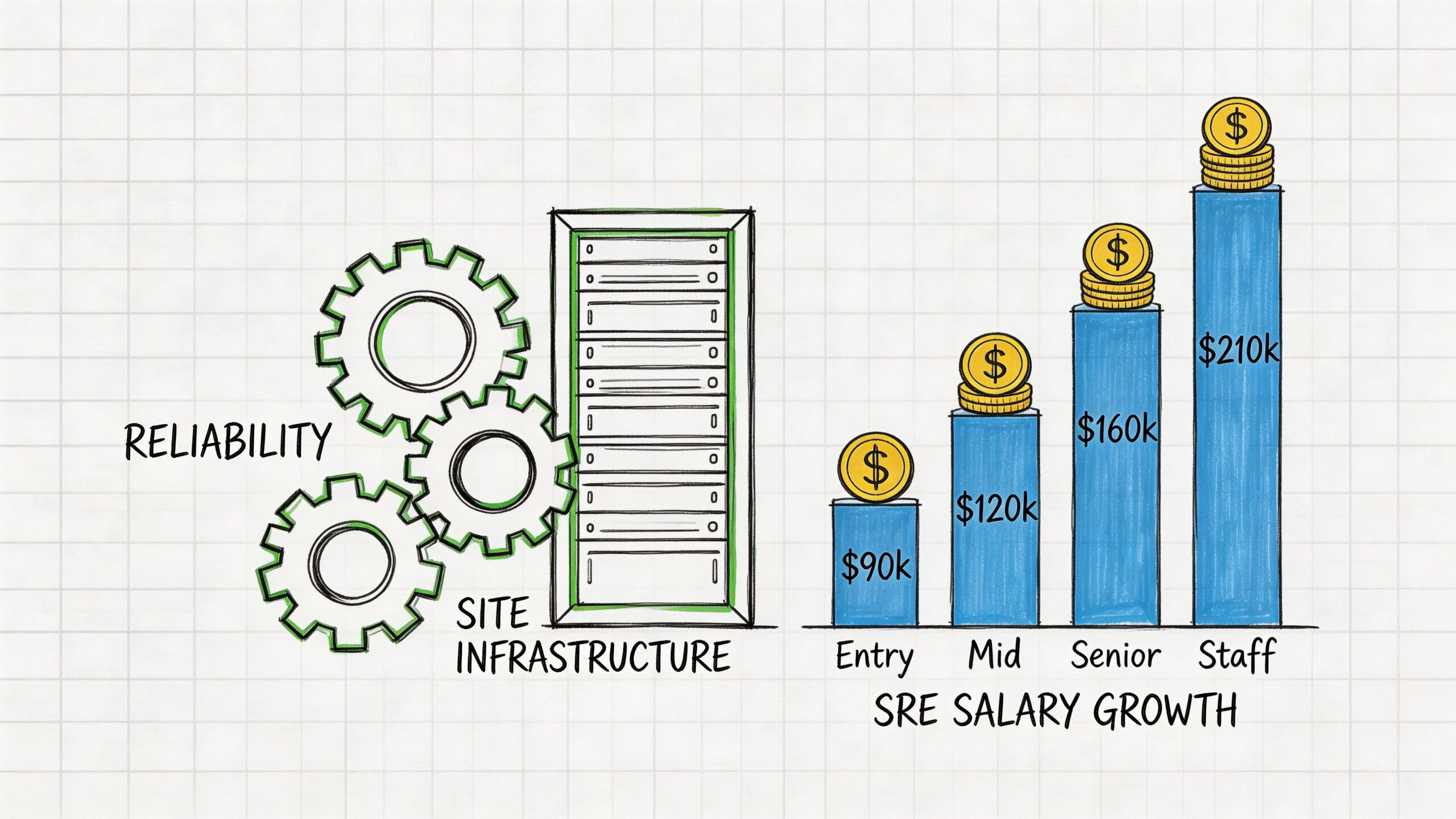
A principal SRE can earn $203,000 to $308,000 in the US, and director roles can reach $219,000 to $340,000 according to Coursera’s compilation of Glassdoor salary data: https://www.coursera.org/articles/site-reliability-engineer-salary. That number changes how various teams should think about site reliability engineer salaries.
This is not just pay for “keeping servers up.” It is pay for engineers who can keep distributed systems predictable under load, reduce operational toil with automation, shape release velocity through error budgets, and keep incidents from turning into customer-facing failures. When a company hires a strong SRE, it is buying engineering judgment in production, not just headcount.
For engineers, that means compensation usually tracks the scale of systems you can own and improve. For CTOs, it means salary benchmarking without a reliability model is incomplete. If you do not understand what kind of reliability work you need, you will either overpay for the wrong profile or underhire and push outages, on-call pain, and deployment friction back onto the rest of engineering.
Why SRE Salaries Command a Premium in Tech
The fastest way to understand site reliability engineer salaries is to stop treating SRE as a support function. SRE sits where revenue, user trust, platform complexity, and engineering discipline intersect.

A software engineer can ship features that create demand. An SRE makes sure demand does not collapse the system. That matters more as teams move deeper into Kubernetes, cloud-native infrastructure, CI/CD, and service sprawl. The cost of mistakes rises fast when a single release can affect dozens of services and every service has its own dependencies, alerts, and failure modes.
Reliability work protects both speed and stability
Teams often think they need to choose between shipping quickly and keeping systems stable. Skilled SREs remove that trade-off by designing safer delivery paths, better observability, and clearer operating thresholds.
That work usually includes:
- Defining reliability targets: SLOs, SLIs, and alerting rules that map to user experience instead of infrastructure noise.
- Reducing toil: Replacing repetitive operational work with scripts, pipelines, runbooks, and self-healing patterns.
- Improving incident response: Building systems, dashboards, and on-call processes that shorten diagnosis and recovery.
- Making scale less fragile: Hardening capacity, rollout patterns, dependency management, and failure isolation.
If a team has not internalized those practices, the role can look expensive. Once systems are under real traffic and release pressure, the salary makes much more sense.
Premium pay follows business risk
The companies that pay most for SRE talent are usually paying for consequence. They have customer-facing systems, operational complexity, compliance pressure, or a release cadence that leaves little room for manual operations.
A strong SRE does not just react well during incidents. They change the system so the same class of incident is less likely to happen again.
If you want a good refresher on the operating model behind that mindset, Google-influenced SRE concepts such as error budgets and toil reduction are covered well in this overview of site reliability engineering principles.
Decoding SRE Total Compensation Beyond the Base Salary
Many individuals compare offers by looking at one number. That is a mistake. Site reliability engineer salaries only make sense when you separate base salary from total compensation.
Built In puts average US SRE total compensation at $144,814, made up of $130,542 base salary plus $14,272 cash compensation: https://builtin.com/salaries/us/site-reliability-engineer

A useful mental model is to treat compensation like a distributed system. Each component behaves differently. Some parts are stable. Some are bursty. Some only matter if the system keeps scaling.
Base salary is the core service
Base salary is your steady-state layer. It is the predictable component that lands every pay cycle and carries the most weight for day-to-day financial planning.
For engineers, this is the number that determines whether the role works for your life before upside is considered. For hiring managers, this is the part that has to align with market reality for level, geography, and problem scope.
Base matters more than candidates sometimes admit. A startup may pitch upside aggressively, but if the base is weak and the on-call burden is heavy, retention gets shaky fast.
Cash bonuses are burst capacity
Bonuses act more like burstable resources. They can be meaningful, but they are not guaranteed in the same way as base salary unless the plan is very clearly defined.
In practice, bonus value depends on questions many candidates forget to ask:
- Is the bonus formula documented?
- Is it tied to company performance, team performance, or individual goals?
- Has the company historically paid out close to target?
- Is there a sign-on bonus offsetting a lower first-year base?
A sign-on bonus can help if you are leaving unvested equity or taking a role with high transition cost. It should not distract from a below-market core package.
Equity is the long-horizon layer
Equity is where offers diverge sharply.
At a public company, RSUs are usually easier to value because the underlying shares have a real market price. At a startup, stock options can be valuable, but the range between “meaningful” and “theoretical” is wide. Engineers should ask about dilution, vesting, exercise terms, and the company’s path to liquidity. CTOs should expect knowledgeable candidates to push on those details.
Here, many comparisons go wrong. A lower base paired with strong RSUs at a stable public company may beat a higher-cash startup offer. The reverse can also be true if the startup’s equity story is weak or too uncertain to price.
If you cannot explain an equity package in plain language, you do not understand the offer yet.
Benefits are not fluff
Benefits are the part teams often hand-wave away, then regret under stress. Health coverage, retirement contributions, parental leave, training budgets, and call compensation policies change the effective value of an SRE role.
For SRE specifically, one policy matters more than many recruiters realize: how the company handles on-call load. If a team says the rotation is “light” but has weak automation, noisy alerts, and poor runbooks, no benefit package will make that feel light for long.
A practical offer review checklist
When comparing offers, I look for these signals first:
- Role shape: Is this SRE, or an operations catch-all with a nicer title?
- Incident expectations: Will you own production engineering or just absorb operational debt?
- Comp mix: How much of the package is certain versus contingent?
- Growth path: Is there a credible path from IC to staff, principal, or management?
Good compensation aligns with the technical difficulty of the environment. Bad compensation often hides behind title inflation, vague equity promises, or an underdescribed on-call model.
SRE Salary Benchmarks by Experience and Geography
The cleanest way to read site reliability engineer salaries is to separate two variables that move compensation the most in practice. Experience and location.
Market averages vary by source. ZipRecruiter reports $132,583, Indeed reports $154,133, Glassdoor reports $166,123, and Levels.fyi reports a $207,000 median at top-tier companies, which is a reminder that salary data depends heavily on who is sampled and what compensation mix is included: https://www.ziprecruiter.com/Salaries/Site-Reliability-Engineer-Salary
Salary ranges by experience
Coursera’s summary of Glassdoor data shows a steep progression tied to seniority and the ability to own harder reliability problems: https://www.coursera.org/articles/site-reliability-engineer-salary
| Experience Level | Typical Years | Tier 2 Location (Base Salary) | Tier 1 Location (Base Salary) |
|---|---|---|---|
| Entry-level SRE | Up to 1 year | $95,000 | $161,000 |
| Early-career SRE | 1 to 3 years | $106,000 | $178,000 |
| Mid-level SRE | 4 to 6 years | $122,000 | $196,000 |
| Senior SRE | 7 to 9 years | $129,000 | $204,000 |
| Principal SRE | 8+ years | $203,000 | $308,000 |
| Senior Manager, SRE | Leadership track | $215,000 | $329,000 |
| Director, SRE | Leadership track | $219,000 | $340,000 |
This table is useful, but it only becomes actionable when you map the salary band to what the engineer can do.
What the bands usually mean in practice
An entry-level SRE can often operate established systems, improve scripts, support incident response, and learn production habits. A mid-level SRE usually starts to own service reliability end to end, including automation, deployment safety, and monitoring quality.
At the senior and principal levels, companies pay for maximum engineering impact. These engineers are expected to shape platform direction, rationalize observability, reduce pager noise, improve release safety, and turn recurring failures into structural fixes. They are not just handling tickets. They are changing the operating economics of production.
That is why hiring managers who say “we need an SRE” often mean very different things. Some need a mid-level operator who can mature existing tooling. Others need a principal who can redesign reliability practices across teams. The title may be the same. The salary should not be.
Geography still matters, even in remote environments
Indeed lists the highest-paying US cities for SREs as San Jose ($205,544), Seattle ($190,793), San Francisco ($188,578), New York ($178,873), and San Diego ($177,787): https://www.indeed.com/career/site-reliability-engineer/salaries
Those numbers are not random. These markets concentrate large tech employers, expensive labor pools, and systems with enough scale to justify experienced SRE hires. Employers in those regions also tend to compete on total compensation more aggressively.
How to interpret Tier 1 versus Tier 2 markets
I use a simple operating distinction:
- Tier 1 markets usually involve major tech hubs, deeper employer competition, and companies that already understand reliability as a strategic function.
- Tier 2 markets often have fewer direct bidders for high-end SRE talent, but they can still support strong salaries when the infrastructure is critical.
This matters for both sides of the table.
For engineers, location can raise your ceiling, but only if your skills travel well. A senior engineer who can lead Kubernetes reliability, Terraform-based infrastructure design, and observability architecture is easier to price into a premium market than someone with a narrower operations background.
For CTOs, geography forces a strategic choice. You can hire locally in a premium market and compete directly on compensation, or you can broaden the search and optimize for skill fit, remote maturity, and cost structure. What does not work is pretending premium SRE capability should be available at low-cost generalist rates.
Salary data is useful only after you define the problem. “Need an SRE” is not a benchmarkable hiring plan.
The Technical Skills That Maximize SRE Earnings
The biggest driver behind higher site reliability engineer salaries is not title inflation. It is technical impact. Employers pay more when an SRE can improve system behavior, not just operate the current stack.

The salary premium in the highest-paying cities tends to show up where systems are more distributed, release velocity is higher, and production engineering expectations are sharper. As noted earlier through Indeed’s city data, places like San Jose, Seattle, and San Francisco pay more because companies there need engineers who can handle that complexity, not because they know a few extra commands.
Kubernetes skill is valuable when it goes beyond administration
A lot of candidates say they know Kubernetes. Fewer can explain how they use it to improve reliability.
The higher-paid version of this skill includes:
- Workload resilience: readiness and liveness strategy, pod disruption handling, and safe rollout patterns
- Capacity and scheduling judgment: knowing when resource requests, limits, autoscaling behavior, and node design are hurting reliability
- Failure isolation: designing namespaces, network policies, and multi-service boundaries that reduce blast radius
A company does not get much salary return from someone who can only deploy manifests. It gets real value from someone who can make Kubernetes predictable during incidents and releases.
Terraform matters when it enforces standards
Terraform becomes salary-relevant when it stops being “infrastructure provisioning” and starts being an operating control plane.
The valuable pattern is not writing one-off modules. It is using Terraform to standardize environments, reduce drift, enforce conventions, and make changes reviewable. That is what lowers operational ambiguity. It also shortens recovery when teams need to reproduce or repair infrastructure cleanly.
I trust higher salary bands when the engineer can show they used IaC to make production safer, not just faster.
Observability separates tool users from reliability engineers
Prometheus, Grafana, Splunk, logs, traces, and dashboards are common. Useful observability is rare.
The hard part is deciding what should be measured and how alerts should map to service health. Teams overpay for metrics volume all the time and still miss the signals that matter. Strong SREs tie observability to SLOs, incident response, and service ownership. They make dashboards answer operating questions instead of just looking complete.
The market pays more for engineers who design feedback loops than for engineers who install tools.
A good practical companion to this topic is the discussion below on modern SRE work:
The skills that usually move compensation upward
The strongest salary progression usually follows engineers who can combine several of these capabilities:
Production incident leadership
They can coordinate response, stabilize systems, and write post-incident actions that prevent recurrence.Automation with judgment
They remove repetitive work without creating brittle hidden complexity.Distributed systems reasoning
They understand dependencies, backpressure, partial failure, and graceful degradation.CI/CD reliability
They improve deployment confidence through rollback design, progressive delivery, and pipeline hardening.SLO-based operations
They can connect user impact to operational policy and make trade-offs visible to product and engineering teams.
For engineers, the lesson is simple. Learn tools, but optimize for ownership. For CTOs, write job descriptions around outcomes, not logo lists of technologies.
Negotiation Strategies for SREs and Budgeting for CTOs
Salary conversations get easier when both sides stop pretending the role is generic. Built In reports average SRE total compensation at $144,814 in the US, with $130,542 base salary plus $14,272 cash compensation, and notes $136,141 for companies with 1,000+ employees alongside Robert Half’s US range of $114,250 to $170,500: https://builtin.com/salaries/us/site-reliability-engineer
That spread tells you something important. Compensation is not only about title. It is about company scale, production complexity, and how directly the role touches incident response, root cause analysis, and SLO enforcement.
For SREs, negotiate on operating impact
Strong SRE candidates do better when they present themselves as force multipliers for product and platform teams, not as system caretakers.
Use evidence like this in your narrative:
- Incident ownership: Describe the classes of incidents you handled and what changed after your fixes.
- Toil reduction: Show which recurring manual tasks you automated and how that changed team capacity.
- Reliability governance: Explain where you introduced SLOs, error budgets, or better alerting discipline.
- Delivery safety: Point to rollout, rollback, or pipeline changes that made releases less risky.
Do not negotiate from effort. Negotiate from avoided pain and improved system behavior.
If you want a practical companion for the conversation itself, this guide on how to master salary negotiation with proven scripts and strategies is useful because it focuses on actual offer-stage communication instead of generic confidence advice.
For CTOs, budget for the reliability problem you have
Many teams budget for an SRE as if they are hiring a platform engineer with pager duty. That usually fails.
A better approach is to answer three questions first:
| Budget question | What to look for |
|---|---|
| What is breaking today | Release instability, alert noise, poor observability, weak incident response, scaling bottlenecks |
| What level of engineer fixes it | Mid-level implementer, senior systems owner, or principal-level architect |
| What is the alternative cost | Slower releases, burnt-out developers, longer incidents, and delayed platform work |
If your developers spend too much time firefighting, the issue is not just staffing. It is production design debt. The right SRE hire can reduce that debt. The wrong one absorbs it for a while.
What usually works and what usually does not
What works
- Define the reliability scope before opening the role: Teams hire better when they know whether the work is observability cleanup, platform maturity, incident response, or Kubernetes hardening.
- Benchmark by capability, not title: A senior SRE who has led production operations is different from a senior engineer rotating into ops.
- Be honest about on-call and service ownership: Good candidates can spot vagueness quickly.
What does not
- Posting a laundry-list job description: Listing every cloud, CI/CD, and monitoring tool does not clarify the role.
- Underpricing a role with broad accountability: If the engineer is expected to own incidents, automation, and platform standards, budget accordingly.
- Treating remote hiring as a discount mechanism: It works better as a broader access strategy than as a race to the bottom.
For leaders hiring distributed talent, this roundup of remote SRE jobs is a good reality check on how the role is being packaged and described in the market.
A compensation plan only works if the role definition is real. Ambiguity is expensive on both sides.
The Future of SRE Compensation and How OpsMoon Can Help
The most important thing about site reliability engineer salaries is that there is no single market number. The US salary picture ranges from $132,583 on ZipRecruiter to $154,133 on Indeed, $166,123 on Glassdoor, and a $207,000 median on Levels.fyi for top-tier companies, reflecting different sampling methods and company profiles: https://www.ziprecruiter.com/Salaries/Site-Reliability-Engineer-Salary
That variation is likely to persist because the role itself keeps splitting into more specialized forms. Some SREs focus on platform reliability. Others work closer to infrastructure automation, observability architecture, release engineering, or resilience for highly regulated systems. The more a role combines deep technical ownership with direct production consequence, the harder it is to benchmark with a simple average.
What compensation is likely to reward
The clearest long-term pattern is not “more tools.” It is broader systems ownership.
Expect compensation to stay strongest for engineers who can:
- Run reliability through software, not manual process
- Own Kubernetes and cloud complexity at service and platform layers
- Build observability that informs action, not just dashboards
- Operate across development and operations boundaries without pushing responsibility sideways
Remote work also continues to reshape compensation logic. Not because geography disappears, but because more companies can now hire for difficult reliability work without restricting themselves to one metro area. That changes access to talent more than it changes the need for premium skill.
Where OpsMoon fits
If you need high-level SRE capability without spending months searching for the right full-time hire, OpsMoon offers a practical route. Their SRE services are built around pre-vetted remote engineers, flexible engagement models, and hands-on support for work such as Kubernetes orchestration, Terraform-based infrastructure, CI/CD reliability, and observability stacks.
That matters because many teams do not need “an SRE” in the abstract. They need someone who can stabilize production, untangle deployment risk, mature incident response, or build a reliability roadmap that the rest of engineering can execute.
The salary market will keep moving. The underlying rule will not. Companies pay for SRE talent when that talent turns system complexity into controlled operations.
Frequently Asked Questions About SRE Salaries
Is SRE paid more than DevOps
Sometimes yes, sometimes no. The title alone does not settle it.
In practice, SRE compensation tends to move higher when the role includes direct ownership of production reliability, incident management, SLOs, and service behavior under failure. Many “DevOps” roles are really platform engineering or CI/CD implementation roles. Some are highly strategic and can pay at the same level. Others are narrower and pay less because the business consequence is lower.
A better comparison is scope. If the engineer owns reliability outcomes in production, pay usually reflects that.
How should remote SRE salaries be adjusted
There is no single clean formula. Some companies anchor pay to headquarters. Others anchor to the employee’s location. Others use broad geo-bands.
The practical answer is to price the problem first. If you need someone to own high-stakes production systems, lead incidents, and improve platform reliability, severe discounting usually backfires. Remote hiring works best when it increases access to the right engineer, not when it is used as a blunt cost-cutting move.
Why do salary sources disagree so much
They measure different populations and compensation definitions.
One source may skew toward broad job-posting averages. Another may capture self-reported total compensation at larger or top-tier firms. That is why salary numbers can look far apart while still being directionally useful. Use multiple sources, then map them to your level, company type, and location assumptions.
What should engineers bring into a salary negotiation
Bring evidence of production impact.
Useful material includes incident leadership, toil reduction work, infrastructure automation, observability improvements, and reliability policies you introduced or enforced. Engineers who explain the business effect of their work usually negotiate better than engineers who just list tools.
What should companies do about gender pay equity in SRE
Do internal audits. Do not rely only on broad market summaries.
6figr reports that female Staff Site Reliability Engineers average $326k while males average $285k, a 14% premium that stands out against common assumptions about tech compensation: https://6figr.com/us/salary/staff-site-reliability-engineer–t
That does not mean every company is equitable by default. It means broad averages can hide as much as they reveal. The useful response is not to speculate. It is to review leveling, promotion paths, equity allocation, and total compensation decisions with real internal data.
Are top salaries mostly about years of experience
Not by themselves. Years help, but they are not the core signal.
Higher compensation usually follows the ability to own harder systems and produce reliability outcomes others cannot. Two engineers can both have senior tenure. The one who can redesign alerting, improve rollout safety, lead incident recovery, and remove operational drag across teams will usually command the stronger package.
If you need elite reliability expertise without the drag of a long hiring cycle, OpsMoon can help. They connect teams with top-tier remote DevOps and SRE talent for Kubernetes, Terraform, CI/CD, observability, and broader production engineering work. Whether you need advisory support, project delivery, or added engineering capacity, their model gives CTOs and engineering leaders a faster path to reliable systems and better software delivery.
Leave a Reply