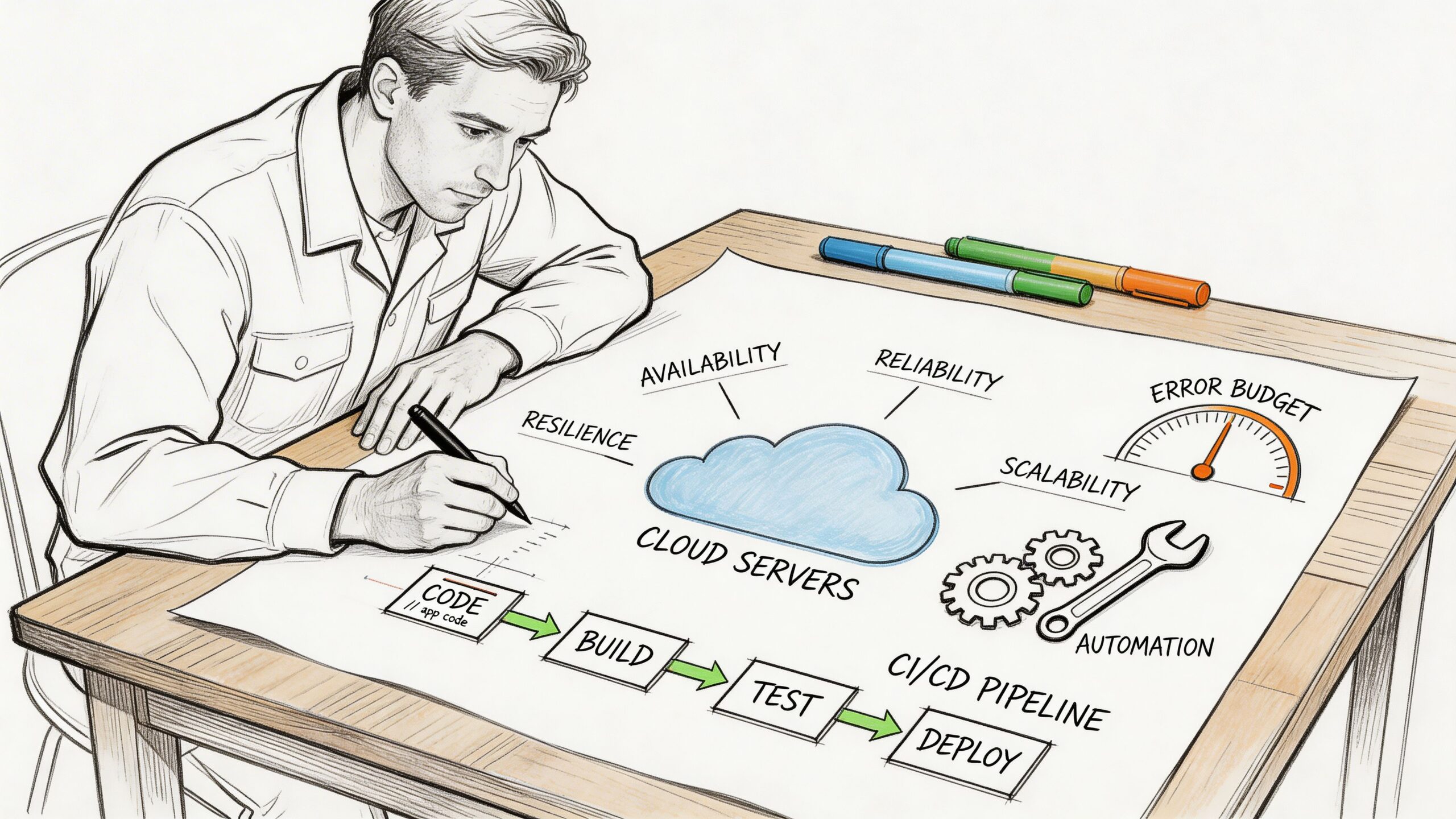
If your team is shipping less because production keeps interrupting roadmap work, you do not have an isolated ops problem. You have a reliability design problem.
Most CTOs notice it in the same places. Deployments need too many humans in the loop. Incidents repeat with slightly different symptoms. Engineers spend more time watching dashboards than improving the system that created the alert load in the first place. At that point, hiring a senior site reliability engineer is not about adding another pair of hands for on-call. It is about adding someone who can change how the whole engineering organization handles risk, automation, capacity, and recovery.
A strong senior SRE does two things at once. They make today’s platform safer, and they make tomorrow’s engineering work easier to do correctly.
Beyond Firefighting Defining the Senior SRE Role
The difference between an SRE and a senior SRE shows up in where they spend their attention.
A less experienced engineer often works from symptoms backward. CPU is high. A queue is backed up. A deployment failed. They investigate, patch, and move on. That work matters, but it does not change the system’s default behavior.
A senior site reliability engineer works from system behavior forward. They ask why the queue can grow unbounded, why the deploy path has too many manual gates, why the alert fired late, and why recovery depended on tribal knowledge. Their job is to remove classes of failure, not just close tickets.

What seniority changes
At senior level, reliability work provides organizational advantage.
- System design influence means they shape architecture before incidents happen. They push for clear failure domains, graceful degradation, dependency timeouts, and rollback paths during design reviews.
- Operational scale means they replace one-off runbooks with automation, policy, and paved roads. A team should not need a platform expert present for every release.
- Risk communication means they translate technical fragility into business terms. A leadership team does not need a lecture on thread pools. It needs a plain answer on release safety, customer impact, and recovery confidence.
What this looks like in practice
A senior SRE usually becomes the person who can say:
- This service should fail open, not fail closed.
- This alert should page only on user-visible impact.
- This deployment process is unsafe because rollback is slower than the blast radius expands.
- This team is spending too much effort on repetitive ops work that should be codified in Terraform, CI policy, or controller logic.
- This architecture can scale, but the data store or network boundary will become the actual bottleneck first.
A good senior SRE reduces the number of decisions engineers must improvise under stress.
That is why the role has outsized value in growing companies. As systems get larger, the cost of inconsistency rises fast. Different teams make different assumptions about retries, observability, ownership, and release safety. A senior SRE creates standards that keep those differences from turning into incidents.
Hiring one is not plugging a gap in operations. It is investing in a more resilient engineering culture where developers can ship faster because the platform is predictable.
The Pillars of Reliability SLOs Error Budgets and Toil
Reliability gets vague fast unless you force it into numbers and operating rules.
The three concepts that matter most are SLIs, SLOs, and error budgets. If your team treats these as dashboard jargon, reliability work will drift into opinion. A senior site reliability engineer turns them into a contract between product velocity and operational discipline.

Think like a service business
A simple analogy helps. Think about a premium meal delivery service.
Customers do not care that your kitchen is busy. They care whether the food arrives on time, warm, and correct. In software, those customer-visible outcomes are what your reliability targets should reflect.
- An SLI is the measurement. Request success rate. Latency. Queue drain time. Job completion success.
- An SLO is the target. What level of performance you commit to internally.
- An SLA is the external commitment, usually commercial or contractual.
If the team picks the wrong SLI, the whole reliability program drifts. Measuring node CPU when users care about checkout latency is how teams congratulate themselves during an outage.
For a practical grounding in how to set targets, this guide on service level objective is worth reviewing before you define new reliability metrics.
Error budgets make trade-offs explicit
An SLO without an error budget is just a wish.
When a service has an SLO of 99.9% availability, the allowable downtime is about 43 minutes per month, and if that budget is exhausted, deployments stop until reliability is restored, as described by Splunk’s overview of SRE practice at https://www.splunk.com/en_us/blog/learn/site-reliability-engineer-sre-role.html.
That matters because it connects engineering behavior to service health. Teams do not argue in the abstract about whether to keep releasing. The budget answers it. If the service has spent too much reliability capital, the organization slows feature change and fixes the system.
Error budgets offer significant value by preventing two unhealthy extremes:
- Overprotection, where teams block useful change because they fear any incident.
- Recklessness, where teams keep shipping into an unstable system and call it agility.
The budget is not a punishment tool. It is a control system for balancing delivery speed with operational reality.
Toil is the hidden tax
Senior SREs also obsess over toil, which is manual, repetitive, operational work with low long-term value.
Examples are easy to spot:
- Re-running the same deployment fix by hand.
- Copying infrastructure settings between environments.
- Manually correlating logs across services during every incident.
- Restarting a common failure path instead of eliminating it.
- Acting as the human bridge between application teams and cloud primitives.
The problem with toil is not just that it consumes time. It also makes systems fragile because knowledge stays in people instead of code, policy, and tooling.
Splunk notes that this SRE framework can reduce manual toil by over 50% and cut MTTR from hours to minutes by shifting effort to automation, runbooks, and better incident handling at https://www.splunk.com/en_us/blog/learn/site-reliability-engineer-sre-role.html.
What senior engineers do differently
A mid-level engineer often automates a task. A senior SRE removes the need for the task.
That usually means working across boundaries:
| Reliability problem | Weak response | Senior SRE response |
|---|---|---|
| Alert floods | Tune thresholds after each page | Redesign alerting around user impact and symptom aggregation |
| Slow incident diagnosis | Ask experts to join every call | Build dashboards, traces, and runbooks that shorten first response |
| Unsafe releases | Add more manual approval | Improve canarying, rollback, and deployment health checks |
| Capacity surprises | Buy more infrastructure reactively | Model demand trends and automate scaling behavior |
Start with a narrow reliability contract
If you are early in your SRE practice, do not define dozens of SLOs at once.
Start with one critical user journey. Pick one latency measure and one success measure. Set a realistic target. Review incidents against it. Then ask where engineers are burning time on repetitive operational work around that service. That is the first automation roadmap.
A senior site reliability engineer earns trust by making this measurable, boring, and enforceable.
The Senior SRE Toolkit Mastering Cloud-Native Systems
Tool familiarity is cheap. Tool mastery is what prevents real outages.
A senior site reliability engineer needs enough depth to understand how infrastructure definitions, orchestration layers, delivery systems, and telemetry interact under stress. In modern environments, failures rarely stay inside one tool boundary. A broken Terraform change can create the network condition that triggers a Kubernetes reschedule storm that surfaces as elevated latency in a service that your CI pipeline just rolled out.

Infrastructure as code needs discipline, not just files
Terraform is not valuable because it writes cloud resources as code. It is valuable because it creates repeatable state transitions with reviewable changes.
The senior-level questions are tougher than “Do you know Terraform?”
Ask whether the engineer can structure modules, isolate blast radius, handle state safely, and encode IAM and network policy in a way other teams can reuse. Good Terraform reduces drift and ambiguity. Weak Terraform becomes a second production environment full of undocumented side effects.
Experian’s senior SRE hiring profile notes that strong Terraform practice can reduce configuration drift by 90% compared to manual scripting, and frames it as part of reliable cloud-native operations at https://jobs.experian.com/job/senior-site-reliability-engineer-remote-in-united-states-jid-1884.
What works:
- Shared modules for common patterns such as VPC layout, cluster baselines, and observability plumbing.
- Clear ownership for state and promotion paths between environments.
- Policy checks before apply, especially around IAM, exposure, and tagging.
What fails:
- Copy-pasted modules with local edits.
- Human-only knowledge about apply order.
- Mixing urgent production surgery with long-lived infrastructure definitions.
Kubernetes depth means understanding failure modes
A lot of candidates can deploy to Kubernetes. Fewer understand why clusters become unstable.
A senior SRE should be comfortable reasoning about scheduler pressure, pod disruption behavior, ingress and service networking, resource requests, autoscaling signals, storage semantics, and the operational cost of every controller you introduce. They should know that many “application incidents” are really cluster policy or runtime issues wearing an application mask.
The same Experian reference highlights Kubernetes autoscaling tuned to custom metrics, with Horizontal Pod Autoscalers capable of supporting spikes of 10k+ requests per second with minimal latency when implemented properly at https://jobs.experian.com/job/senior-site-reliability-engineer-remote-in-united-states-jid-1884.
A useful interview prompt is simple: “Your service scales on CPU, but user latency still spikes during traffic bursts. Walk me through what you would inspect.” Senior answers usually move beyond CPU into queue depth, downstream saturation, connection pooling, cold starts, readiness gates, and whether the chosen metric tracks user pain at all.
CI CD should lower risk, not hide it
A mature pipeline is more than build, test, deploy.
Senior SREs care about the controls around change: progressive rollout, canary analysis, health-based promotion, rollback speed, artifact provenance, and environment parity. They treat CI/CD as an operational safety system.
That changes how they evaluate tools like ArgoCD, GitLab CI, Jenkins, or GitHub Actions. The important question is not which platform you use. It is whether the pipeline can reliably answer:
- What changed?
- Who approved the risk?
- How far has the change rolled out?
- What metric would stop or reverse it?
- Can we restore the prior state quickly without improvisation?
A pipeline is mature when it lets teams move fast without depending on heroics during rollback.
The same source notes that expertise in these systems can reduce on-call alerts by up to 70% when resilience is embedded into automation and delivery workflows at https://jobs.experian.com/en_us/blog/learn/site-reliability-engineer-sre-role.html.
Observability must support decisions under pressure
Observability is not a dashboard wall. It is the ability to explain a symptom quickly enough to act.
Senior SREs design telemetry with incident response in mind. They make sure metrics, logs, and traces can be joined around a real question: which dependency got slower, which deployment changed behavior, which tenant or route is impacted, and what action should the responder take first?
A practical stack often includes Prometheus, Grafana, OpenTelemetry, and log aggregation tooling. The stack matters less than the operating model around it:
- Metrics for saturation, errors, latency, and demand.
- Traces that make service boundaries visible.
- Structured logs that preserve request and correlation context.
- Alerting that routes by ownership and customer impact.
What does not work is collecting everything and naming nothing. If teams cannot tell which dashboards are authoritative during an incident, observability has become storage, not clarity.
Core systems still separate seniors from tool operators
Cloud-native tooling does not replace fundamentals.
The most reliable senior SREs usually have deep instincts around Linux behavior, POSIX basics, networking, TLS failure modes, DNS dependencies, process lifecycle, storage performance, and database backpressure. They can move between Kubernetes and the substrate underneath it.
That matters because many outages are multi-layer events. A container restart loop may come from secret rotation behavior, not the app itself. A latency incident may start in a shared database, not the service that paged. A rollout issue may be a network policy regression, not a bad binary.
If you are evaluating candidates, look for engineers who can explain systems end to end, not just recite tool names.
From Tactical Fixes to Strategic Impact
The hardest part of becoming a senior site reliability engineer is not learning another tool. It is changing what kind of problems you own.
At mid-level, engineers often prove value by being fast in the moment. They close incidents, unblock deployments, and handle noisy operational work. That is useful, but it can trap someone in a reactive loop.
At senior level, the expectation changes. You are measured by whether the same class of problem returns.
The shift in mindset
A strategic SRE asks different questions:
- Why did this outage survive earlier design reviews?
- Which dependency lacked a clear failure mode?
- What ownership boundary allowed the issue to recur?
- Which team needs a better default, not another reminder?
Many strong engineers often stall at this point. The promotion gap is real. A 2025 Stack Overflow survey cited in an Indeed-based summary notes that 68% of DevOps engineers struggle with promotion to senior roles due to missing strategic experience, especially around designing SLOs and showing cross-team influence in remote environments, at https://www.indeed.com/q-senior-site-reliability-engineer-l-remote-jobs.html.
What senior impact looks like
The clearest signal of seniority is systemic change.
One engineer fixes a bad rollout. A senior SRE changes deployment policy so rollback, health checks, and blast-radius controls are built into the delivery path.
One engineer joins every high-severity incident because they know the system. A senior SRE reduces that dependency by improving runbooks, telemetry, and team readiness.
One engineer reports that a service ran out of capacity. A senior SRE builds a capacity planning model, ties it to growth assumptions, and gets product and infrastructure leaders to treat capacity as roadmap input rather than emergency procurement.
Seniority shows up when other teams ship and recover better because of standards you introduced.
Soft skills are not optional
This role is technical, but its impact comes from influence.
The same source also points out that teams often overvalue tool proficiency and undervalue skills such as mentorship and explaining incidents well in remote settings at https://www.indeed.com/q-senior-site-reliability-engineer-l-remote-jobs.html.
That is accurate. The engineers who rise fastest usually do three things well:
- Run blameless postmortems that identify system causes instead of hunting for a person to blame.
- Tell outage stories clearly so executives, product managers, and engineers all understand what changed and what must happen next.
- Mentor through design, not just through code review. They help teams make safer architectural choices before production sees the consequences.
A true senior site reliability engineer is not the one with the most terminal tabs open. It is the one whose decisions reduce surprise across the organization.
Career Path and Compensation for Senior SREs
The career path in SRE is usually less linear than software engineering titles suggest, but the progression is still clear. Responsibility moves from service ownership to system-wide reliability, then into platform strategy, architecture, or management.
The compensation curve reflects that jump in impact.
A practical career ladder
A common progression looks like this:
| Role level | Typical focus |
|---|---|
| Junior or early-career SRE | Runbooks, alert response, operational basics, tooling support |
| Mid-level SRE | Service ownership, automation, incident handling, improvement work inside a team |
| Senior SRE | Cross-team standards, architecture review, reliability programs, capacity and risk management |
| Principal SRE | Organization-wide technical direction, platform strategy, reliability governance |
| Engineering manager or director track | Team leadership, staffing, operating model, investment decisions |
The important shift is scope. Senior engineers do not just own more tasks. They own larger consequences.
What the market pays for seniority
According to MentorCruise’s salary summary, senior site reliability engineers in the US earn a median base salary of $160,000, which is a 33% increase over mid-level SREs at $120,000 and typically reflects 5 to 8 years of experience. The same summary notes total compensation for senior roles often ranges from $129,000 to $204,000, while principal SREs with 12+ years can reach $240,000 or more at https://mentorcruise.com/salary/site-reliability-engineer/.
SRE Salary Progression in the US 2026
| Role Level | Years of Experience | Median Base Salary (USD) |
|---|---|---|
| Mid-level SRE | Not specified in the source beyond being below senior level | $120,000 |
| Senior SRE | 5 to 8 years | $160,000 |
| Principal SRE | 12+ years | $240,000 |
Those numbers matter for two reasons.
First, they confirm that companies pay for reliability judgment, not just tool operation. Second, they help hiring managers avoid writing job descriptions that ask for senior-level impact at mid-level compensation.
Budgeting and sourcing candidates
If you are building a remote search, compare compensation against companies already competing for distributed infrastructure talent. Lists of top remote companies help benchmark the kind of employers senior candidates will compare you against.
If you want to calibrate role scope before making an offer, reviewing current patterns in remote SRE jobs can help separate market expectations from internal title inflation.
A common hiring mistake is paying for years while interviewing for judgment. A stronger approach is the reverse. Define the reliability outcomes you need first, then price the role at the level required to deliver them.
How to Hire and Engage a Senior SRE
The fastest way to waste time in SRE hiring is to screen for tool lists.
A candidate can mention Kubernetes, Terraform, Prometheus, and incident response and still be weak at the work that matters: reducing systemic risk, enhancing operational effectiveness, and helping product teams ship safely. Hiring well means testing for judgment, communication, and execution under ambiguity.
What to look for on a resume
Look for evidence of changed systems, not just maintained systems.
Good signals include:
- Reliability ownership: They introduced SLOs, changed paging policy, redesigned deployment safety, or improved incident response workflows.
- Cross-team influence: They worked with product, platform, and application teams rather than sitting only in a central ops lane.
- Automation with organizational effect: They built modules, controllers, templates, or paved-road workflows that other teams adopted.
- Clear incident learning: They can describe what broke, why it broke, and what changed afterward.
Weak resumes are often long lists of tools with no described operating impact.
A useful companion read for structuring the process is this roundup of talent acquisition best practices, especially if your internal recruiting team is less familiar with infrastructure roles.
Interview the candidate through scenarios
Skip trivia. Use system and operational prompts.
Try questions like these:
- Design prompt: Design a notification service that must tolerate downstream provider failures and support safe deploys.
- Debugging prompt: Latency rose right after a rollout, but CPU stayed flat. Where do you look first?
- Behavioral prompt: Tell me about a time you changed another team’s roadmap because of a reliability risk.
- Postmortem prompt: Walk through an incident you handled. What did you change that prevented recurrence?
Senior answers usually show prioritization. They define what to measure, where the customer impact is, how to reduce blast radius, and which trade-offs are acceptable.
Use an outcome-based job description
A strong description asks for decisions and outcomes, not a warehouse of keywords.
Sample brief
We need a senior site reliability engineer to improve release safety, incident response, and platform resilience across a cloud-native stack. The role includes defining service reliability targets, improving observability, reducing manual operational work, and guiding architecture decisions for services running on containers and infrastructure as code. Success means fewer repeated incident patterns, safer deployments, clearer ownership, and a platform that application teams can use without constant hand-holding.
That wording attracts engineers who think in systems.
Full-time versus flexible engagement
Not every reliability problem needs a permanent hire first.
If you need long-term ownership of platform standards, on-call leadership, and engineering culture change, full-time is usually the right model. If you need to fix a Kubernetes operating model, define SLOs for a critical service, harden CI/CD, or audit observability before a scale event, a flexible senior expert can be the faster move.
The freelance market for senior SRE work is growing. FlexJobs-based summary data notes a 35% year-on-year rise in demand, $120 to $250 per hour for top freelance SREs, and that over 50% of SaaS teams report integration failures without a proper vetting and matching platform. The same summary adds that hybrid advisory models can cut those risks by 28% through pre-vetted talent and structured roadmaps at https://www.flexjobs.com/remote-jobs/site-reliability-engineer.
Those numbers match what engineering leaders already feel in practice. Contracting senior infrastructure talent can go very well, but only if the engagement is scoped tightly.
What works in freelance SRE engagements:
- A narrow charter: Define whether the expert is there to assess, implement, advise, or augment delivery.
- A named counterpart: Internal ownership must remain clear.
- Concrete artifacts: Expect architecture decisions, runbooks, Terraform modules, rollout plans, and documented handoff.
- Time-boxed reviews: Re-scope every few weeks based on risk retired, not hours consumed.
What fails:
- Vague asks like “improve reliability.”
- No internal decision-maker.
- Mixing emergency incident support with open-ended architecture work in one contract.
- Treating a senior freelancer like a generic extra engineer.
If you are exploring flexible help, DevOps engineers for hire is a useful starting point for framing scope and expectations. One option in this category is OpsMoon, which connects companies with remote DevOps and SRE engineers, offers work planning support, and supports flexible engagement models for advisory, project delivery, and capacity extension.
The right hiring model depends on whether you need durable ownership, immediate specialized remediation, or both.
Integrating Reliability into Your Engineering DNA
Reliability does not become part of the company because you buy better monitoring or hire one person to carry the pager. It becomes part of the company when engineering teams change how they design, release, observe, and recover systems.
That is why a senior site reliability engineer matters. The role connects technical rigor to operating discipline. SLOs stop reliability from becoming opinion. Error budgets create a workable contract between product speed and production safety. Cloud-native tooling becomes useful when someone applies it with judgment. Hiring improves when you screen for system change, not keyword density.
The deeper point is cultural. A strong senior SRE teaches teams to think in failure modes, not just features. They turn postmortems into design input. They make delivery safer by default. They reduce the amount of operational knowledge trapped in individual heads.
If your platform still depends on a few people remembering the right fixes at the right moment, the next step is not another dashboard. It is a reliability operating model led by someone senior enough to enforce it.
If you need to assess your current reliability gaps, define the right engagement model, or connect with experienced remote SRE and DevOps talent, OpsMoon provides a practical starting point with work planning, talent matching, and support for cloud infrastructure, CI/CD, Kubernetes, and observability initiatives.
Leave a Reply