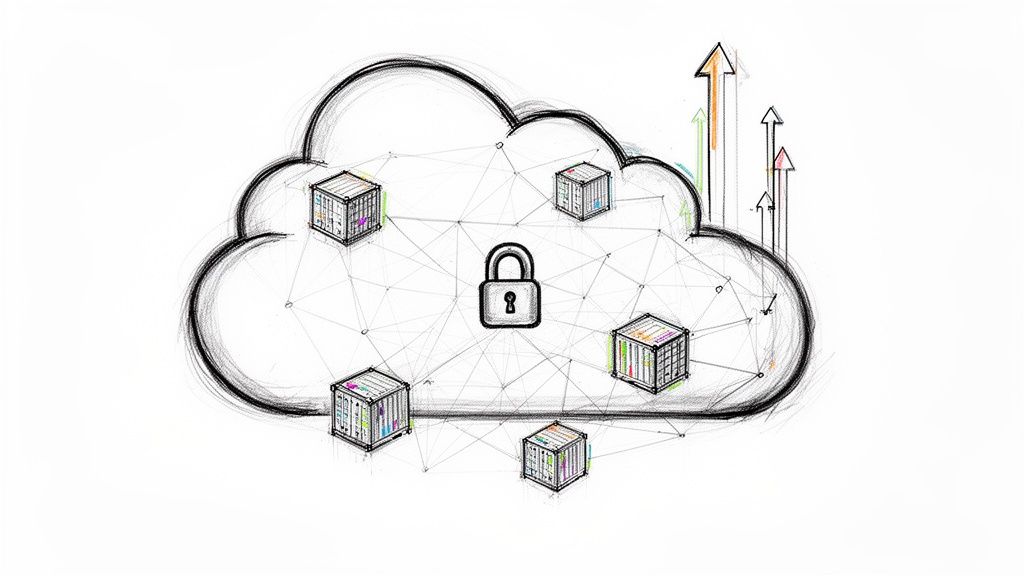
Cloud-native cybersecurity is a technical security discipline built from the ground up for the dynamic, distributed nature of modern cloud environments. It focuses on securing the application workload itself by embedding security controls directly into the application lifecycle.
This is a fundamental shift from perimeter-based security. It requires assuming a breach from day one and integrating automated security checks into every stage of the development and operations process, from code commit to runtime execution.
Understanding The New Security Paradigm
Think of traditional security like defending a medieval castle. You build high walls (firewalls), dig a deep moat (a DMZ), and post guards at a single gate (the corporate network entry). If you control north-south traffic, you're mostly safe. This model worked when applications were monolithic and deployed within a stable, on-premise data center.
But cloud-native architecture blows that castle-and-moat model to pieces.
Instead of one fortress, you’re now managing a fleet of ephemeral workloads—containers, microservices, and serverless functions—all scattered across a vast ocean of public and private clouds. These components are created and destroyed programmatically, often in minutes or seconds. The perimeter is no longer a static boundary; it's a fluid, dynamic edge that exists around every single workload.
The Old Rules No Longer Apply
In this environment, perimeter defense alone is a recipe for failure. An attacker who gains a foothold in one container can move laterally (east-west) to other services because the internal network is often trusted by default. This fundamental shift demands a new security mindset based on Zero Trust principles and a different set of technical controls.
This isn't just a niche problem. The global cybersecurity market is expected to hit a staggering $663.24 billion by 2033, with cloud deployments making up a dominant 67.7% share as early as 2025. This growth is driven by the urgent need for visibility and control over complex, distributed systems.
To get a better handle on the differences, let's compare the two models side-by-side.
Traditional Security vs Cloud Native Security
| Aspect | Traditional Security (The Castle) | Cloud Native Cybersecurity (The Fleet) |
|---|---|---|
| Focus | Protecting the network perimeter (North-South traffic). | Securing individual applications and workloads (East-West traffic). |
| Scope | Static, on-premise infrastructure with long-lived servers. | Dynamic, ephemeral, and distributed environments with short-lived workloads. |
| Core Idea | Trust, but verify (trust internal traffic). | Never trust, always verify (Zero Trust). |
| Tooling | Firewalls, IDS/IPS, VPNs, perimeter scanners. | CI/CD scanners, container security, service mesh, Infrastructure as Code (IaC) security, CNAPP. |
| Process | Security as a final, manual gate before production. | Security integrated throughout the entire lifecycle ("Shift Left") via automation. |
Seeing them laid out like this really drives home that you can't just apply the old castle-building rules to your new fleet. You have to learn to think differently.
Core Principles Of Cloud Native Security
To protect this dynamic fleet, engineering leaders need to internalize a new set of rules. This paradigm is built on three simple but powerful principles that should guide every security decision you make. A huge part of this is adopting effective Cybersecurity Risk Management to properly assess and handle these new types of threats.
Cloud native cybersecurity isn't about building stronger walls; it's about making every component of your application resilient enough to withstand attacks from both inside and outside.
This is what truly separates "cloud native security" from generic "cloud security." It’s not just about securing the AWS or GCP platform—it's about securing the applications that run on it. Mastering this starts with these guiding principles:
- Assume Breach (Zero Trust): Trust nothing by default. Every single user, service, or network request must be authenticated and authorized via strong identity, regardless of its origin.
- Automate Security Controls: Manual security reviews cannot keep up with CI/CD pipelines deploying multiple times a day. You must embed security checks, policy enforcement, and threat responses directly into your automated workflows.
- Shift Security Left: Integrate security into the earliest stages of development. It is far cheaper and more effective to find and fix a vulnerability via a SAST scan on a developer's laptop than to patch it in production after a breach.
Building a Secure Foundation with DevSecOps and CI/CD Hardening
Moving from a classic "castle-and-moat" security model to protecting a dynamic fleet of services means rethinking everything. Real cloud-native security starts long before your application ever hits production. It begins by baking security directly into your development and delivery pipelines.
This philosophy is what we call "Shift Left." It’s about moving security from the end of the line—where it’s a bottleneck—to the very beginning. Instead of a separate security team acting as a final, often-dreaded gatekeeper, you empower developers to find and fix issues while they're still writing code. Security becomes a continuous, automated part of your CI/CD pipeline, not an afterthought.
Embracing DevSecOps Principles
DevSecOps is a cultural and technical shift that weaves security practices directly into the fabric of DevOps. The goal is simple: make security a shared responsibility that's automated and visible across the entire application lifecycle.
Instead of grinding development to a halt with manual security reviews, DevSecOps automates security checks at every single stage. For example, a pre-commit hook can run a static analysis scan, providing immediate feedback to the developer. Research shows that integrating security early can reduce the cost of fixing vulnerabilities by up to 100 times compared to remediating them in production. This approach turns your CI/CD pipeline into one of your most powerful, proactive security assets.
The core idea of DevSecOps is pretty straightforward: If you're deploying multiple times a day, you need to be running security checks multiple times a day. Automation is the only way to pull that off without killing your velocity.
This visual captures that shift perfectly. We're moving away from the old, monolithic security model (the castle) and toward a modern, integrated approach that protects the entire fleet.

As you can see, security is no longer a single checkpoint. It's a continuous flow of automated checks that ensures every piece of your system is secure, from the moment it's created to the moment it's running in production.
Actionable Steps for CI/CD Hardening
Hardening your CI/CD pipeline involves implementing specific, automated security gates that validate your code, dependencies, and artifacts before they're allowed to move to the next stage. Here are three critical steps you can take to build that secure foundation:
Automate Code Scanning (SAST & DAST): Integrate Static Application Security Testing (SAST) tools directly into your pipeline. These tools scan your source code for common vulnerabilities like SQL injection or cross-site scripting (XSS) on every single commit. This provides developers immediate feedback. Later in the pipeline, use Dynamic Application Security Testing (DAST) to scan the running application in a staging environment to find runtime-specific vulnerabilities.
Scan for Vulnerable Dependencies (SCA): Modern applications are assembled from open-source libraries. Software Composition Analysis (SCA) tools automatically check those dependencies against vulnerability databases (like the NVD). When integrated into your pipeline, you can automatically fail builds that introduce dependencies with critical security flaws (CVEs), preventing supply chain attacks.
Secure Container Images: Containers are fundamental to cloud-native architecture, but their base images can contain outdated packages and vulnerabilities. Integrate an image scanner like Trivy or Grype into your pipeline to scan container images before they are pushed to a registry. Your build should fail automatically if the scanner discovers vulnerabilities above a defined severity threshold (e.g., 'CRITICAL').
For engineering teams looking to implement these practices, you can learn more about building a robust DevSecOps CI/CD pipeline and how it transforms security posture.
Managing Secrets The Right Way
A common and critical mistake is hardcoding secrets like API keys, database passwords, and TLS certificates directly into source code or Git repositories. A hardened pipeline is incomplete without a robust secret management strategy.
Instead of storing secrets in plain text, use a dedicated secrets management tool like HashiCorp Vault or a cloud-native service like AWS Secrets Manager or Azure Key Vault. These tools provide centralized, encrypted storage, fine-grained access control (ACLs), and detailed audit logs. Your CI/CD pipeline can then be configured to securely retrieve and inject secrets into the application environment at runtime, ensuring they are never exposed in your codebase. For a deeper dive, this guide to software testing in DevOps offers great strategies for integrating these kinds of security practices into your development lifecycle.
By implementing these automated security gates and proper secrets management, your DevOps teams can build a resilient CI/CD process that becomes the first line of defense in your cloud-native security strategy.
Securing Cloud Native Architectures in Practice

Once you’ve hardened your CI/CD pipeline, the next battleground is the running infrastructure itself. It's time to move beyond theory and get our hands dirty with the technical controls that actually protect modern applications. This really boils down to three architectural pillars: Kubernetes, Service Mesh, and Serverless.
Each one brings its own unique set of headaches. With Kubernetes, you’re wrestling with how to control access and communication inside a sprawling, dynamic cluster. For a service mesh, the game is all about securing the chatter between your microservices. And with serverless, the focus shifts to locking down those short-lived functions and the events that trigger them.
The explosive growth of these technologies completely reshaped the security market. As DevSecOps became the standard, the cloud segment ballooned to 67.7% of what was a $271.88 billion cybersecurity market back in 2025. Organizations were scrambling to secure their microservices, pushing global cybersecurity spending up to $454 billion annually to fend off a new wave of attacks.
Locking Down Kubernetes Clusters
Kubernetes is the de facto standard for container orchestration, but its flexibility is a double-edged sword. A misconfiguration can expose the entire cluster. Securing a K8s environment means applying the principle of least privilege at every layer, from the pod's security context to the cluster API server.
Start with Role-Based Access Control (RBAC). By default, many components have excessive permissions. Use RBAC to create specific Roles and ClusterRoles, then bind them to users or ServiceAccounts so they can only perform necessary API actions (e.g., get, list, watch pods in a specific namespace).
Next, manage traffic flow between pods using Network Policies. Think of a Network Policy as a stateful, layer 4 firewall for pods. The best practice is to implement a default-deny policy that blocks all ingress and egress traffic, then explicitly allow required communication paths. For example, allow the frontend pods to communicate with the api-gateway pods on port 443, and nothing else. For more in-depth strategies, check out our guide on essential Kubernetes security best practices.
Finally, enforce pod security standards. While Pod Security Policies (PSPs) are deprecated, the built-in Pod Security Admission (PSA) controller is the modern replacement. Alternatively, policy engines like Kyverno or OPA/Gatekeeper provide more granular control. Use these tools to enforce policies such as preventing pods from running as the root user, disabling privilege escalation, and mounting a read-only root filesystem.
Encrypting Communication with a Service Mesh
While Kubernetes Network Policies control if pods can communicate, a service mesh controls how they do it. In a microservices architecture, this "east-west" traffic is often unencrypted and untrusted, creating a significant attack surface. A service mesh, like Istio or Linkerd, solves this problem.
The core of service mesh security is mutual TLS (mTLS). The mesh injects a sidecar proxy into each pod, which intercepts all ingress and egress traffic. These proxies establish encrypted mTLS connections with each other, ensuring all internal service-to-service communication is authenticated and encrypted without requiring application code changes.
A service mesh essentially creates a private, encrypted network inside your Kubernetes cluster. It forces a Zero Trust mindset where no service trusts another by default, and every connection has to be proven and secured.
Beyond encryption, a service mesh provides fine-grained authorization policies. For example, you can write an AuthorizationPolicy in Istio that allows the order-service to issue a GET request to the /api/v1/inventory endpoint of the inventory-service, but denies any POST or DELETE requests. This provides application-layer (L7) security that is far more powerful than network-layer (L3/L4) controls alone.
Securing Ephemeral Serverless Functions
Serverless computing, like AWS Lambda, abstracts away infrastructure but introduces unique security challenges, primarily over-privileged functions and event injection attacks.
Every serverless function requires an IAM role to grant it permissions to access other cloud resources. It is absolutely critical to adhere to the principle of least privilege. Create a unique, tightly-scoped IAM role for every single function. Never use a broad, shared role. For example, if a function only needs to write to a specific DynamoDB table, its role should only grant the dynamodb:PutItem permission on that specific table's ARN.
The other major risk is event injection. Serverless functions are triggered by events from sources like API Gateway, S3, or SQS. An attacker can inject malicious payloads into these events to exploit the function logic. Always treat event data as untrusted user input. Validate the schema, sanitize the data, and use parameterized queries or SDKs to interact with downstream services to prevent injection attacks.
Achieving Runtime Protection and Threat Detection

Once a workload is running, security shifts from prevention to active defense. This is the domain of runtime protection, where the goal is to detect and respond to active threats in real-time.
In dynamic, ephemeral environments, an undetected attacker can cause significant damage. Effective cloud-native cybersecurity at runtime is about deep visibility and automated response. The core assumption is that a breach will eventually occur. Your objective is to detect malicious activity instantly and neutralize the threat before an attacker can escalate privileges, move laterally, or exfiltrate data.
This requires a new class of tools designed to understand application behavior at a granular level. Traditional EDR and IDS/IPS solutions are often blind to intra-container and inter-pod activity, creating dangerous visibility gaps.
Advanced Techniques for Real-Time Threat Detection
To achieve the necessary visibility, modern security platforms utilize advanced monitoring techniques that go beyond simple log analysis.
One of the most effective methods is behavioral analysis. Instead of relying on static signatures of known malware, this technique establishes a baseline of normal behavior for each workload. It learns what processes a container should run, what network connections it should make, and which files it should access.
When an anomaly occurs—such as a shell being spawned in a web server container (nginx executing /bin/bash), a process making an outbound connection to an unknown IP address, or a sensitive file like /etc/shadow being read—the system flags it as a potential threat. This approach is highly effective at detecting zero-day attacks and novel threats that signature-based tools miss.
Another key component is File Integrity Monitoring (FIM). FIM tools create a cryptographic hash of critical system files and configurations and continuously monitor them for unauthorized changes. If an attacker modifies a binary or alters a configuration file to establish persistence, FIM will detect the change and trigger an alert.
The Power of eBPF for Kernel-Level Observability
Perhaps the single most important technology for modern runtime security is the extended Berkeley Packet Filter (eBPF). eBPF allows for running sandboxed programs directly within the OS kernel, providing unprecedented visibility into system calls, network activity, and process execution without the performance overhead of traditional agents.
With eBPF, you're essentially getting a high-speed, microscopic camera pointed directly at the kernel. It lets you trace every system call and inspect every network packet without slowing your application to a crawl.
This kernel-level telemetry provides the high-fidelity data needed for powerful security analysis. Tools built on eBPF can:
- Trace System Calls: Observe all interactions between processes and the kernel, enabling the detection of actions like privilege escalation or unexpected file access.
- Monitor Network Flows: Gain visibility into all network traffic at the kernel level, identifying anomalous connections between pods or to external command-and-control servers.
- Enforce Security Policies: Proactively block forbidden system calls at the kernel level, preventing malicious actions before they can be executed.
Implementing Automated Response Actions
Detecting a threat is only half the battle. In a cloud-native environment that can scale in seconds, manual intervention is too slow. The only viable solution is automated response.
When a security tool detects a high-confidence threat, it must be able to take immediate, autonomous action.
Common automated responses include:
- Isolating a Compromised Pod: The system can automatically apply a quarantine network policy that severs all network connections to and from a suspicious pod.
- Killing a Rogue Process: If an unauthorized process (e.g.,
cryptominer) is detected inside a container, the system can terminate it instantly. - Triggering a Re-deployment: For stateless applications, the fastest remediation is often to kill the compromised container instance and let Kubernetes reschedule a fresh, clean one from a known-good image.
Building this kind of sophisticated observability and response system requires serious expertise. Expert SREs, like the ones you can access through platforms such as OpsMoon, can help you design, implement, and manage these advanced runtime defenses, giving you the confidence that your running applications are truly protected.
Automating Compliance and Governance with Infrastructure as Code
Managing compliance in a traditional data center was a manual, checklist-driven process. In the cloud-native world, where infrastructure is ephemeral and defined by code, this approach is completely untenable.
How can you prove compliance with standards like GDPR, HIPAA, or SOC 2 when your environment changes multiple times per day?
The answer is to treat compliance as a software engineering problem. This is the core of compliance-as-code. By codifying security and governance policies, you transform compliance from a periodic, manual audit into a continuous, automated process integrated directly into your software delivery lifecycle.
This automated-first mindset is becoming non-negotiable, especially as money pours into cloud-native cybersecurity. The total cyber market is on track to hit $522 billion by 2026. And get this: cloud tech is expected to make up a staggering 67.7% of the $271.88 billion market in 2025. This explosion is driven by regulatory heat and the desperate need for automated security.
Enforcing Rules with Infrastructure as Code
The foundation of compliance-as-code is Infrastructure as Code (IaC). Tools like Terraform and CloudFormation allow you to define your entire cloud environment—VPCs, subnets, security groups, IAM roles, and compute instances—in declarative configuration files. This provides a version-controlled, auditable source of truth for your infrastructure.
Instead of an engineer manually configuring resources in the AWS console—where they might accidentally create a public S3 bucket or misconfigure a security group—every change is defined in code. That code is then reviewed, scanned, and tested through an automated pipeline before it is applied to your production environment. For a deeper dive, check out our guide on how to check IaC for security flaws.
This code-first approach makes audits dramatically simpler. When auditors request evidence of a control, you can point directly to the IaC templates and pipeline logs that prove the control is enforced consistently and automatically.
Integrating Policy as Code for Automated Guardrails
If IaC defines what your infrastructure looks like, Policy as Code (PaC) defines the rules of what is allowed. This is where automation becomes a powerful enforcement mechanism.
Tools like Open Policy Agent (OPA) act as a decoupled policy engine that can enforce custom policies across your entire stack. You write policies in a declarative language called Rego, which are then evaluated at key points in your CI/CD pipeline to prevent misconfigurations before they are deployed.
With Policy as Code, you're not just hoping developers follow the rules; you're programmatically preventing them from breaking the rules in the first place. It’s like having an automated security architect review every single change.
This allows you to enforce highly specific security and compliance policies without slowing down development. For example, you can write OPA policies that:
- Prevent Public S3 Buckets: Automatically fail any Terraform plan that attempts to create an
aws_s3_bucketwith a public ACL. - Enforce Database Encryption: Ensure that any
aws_db_instanceresource hasstorage_encrypted = true. - Restrict Network Configurations: Block any
aws_security_grouprule that allows ingress from0.0.0.0/0on sensitive ports like22(SSH) or3389(RDP).
When you combine IaC and PaC, you build a system where compliance is an automated, unavoidable outcome of your development process. Audits become a simple demonstration of the continuous controls that keep you secure and compliant.
Here's a breakdown of the common questions I hear from CTOs, founders, and engineering managers as they start digging into cloud-native security.
Let's get straight to the practical answers you need.
We're A Startup. What's The Absolute First Thing We Should Do For Cloud Security?
Secure your CI/CD pipeline. Full stop.
Before getting overwhelmed by runtime security and complex threat models, ensure the artifacts you ship are as secure as possible. This is the highest-leverage activity because it prevents vulnerabilities from ever reaching production.
Integrate three automated checks into your build process immediately:
- Static Application Security Testing (SAST): Scans your proprietary source code for common bugs (e.g., OWASP Top 10).
- Software Composition Analysis (SCA): Scans your open-source dependencies for known vulnerabilities (CVEs). This is critical, as open-source often comprises over 80% of a modern application's codebase.
- Container Image Scanning: Scans your Docker images for OS-level vulnerabilities before they are pushed to a registry.
This whole "shift left" idea is more than a buzzword; it's about making your pipeline the first line of defense. Catching a problem here is exponentially cheaper and faster than fixing it in production.
You can get started with fantastic open-source tools. Plug something like SonarQube for code analysis and Trivy for image scanning directly into your Jenkins, GitLab CI, or GitHub Actions workflow.
How Does "Zero Trust" Actually Work In Kubernetes?
Think of Zero Trust in Kubernetes less as a product you buy and more as a mindset you enforce with specific tools. The core idea is simple: never trust, always verify. Just because a request comes from inside the cluster doesn't mean it's friendly.
You build this up in layers.
First, lock down your Role-Based Access Control (RBAC). Get ruthless with it. Give every user and every service account the absolute minimum permissions they need to do their job. Nothing more. This is the principle of least privilege in action.
Second, use Network Policies to create a "default-deny" rule for all communication between pods. This means that by default, no pod can talk to any other pod. You then have to explicitly whitelist the connections that are absolutely necessary, creating tiny firewalls around your services.
Finally, bring in a Service Mesh like Istio or Linkerd. This is the key to enforcing mutual TLS (mTLS) for all your microservices. It encrypts all that "east-west" traffic moving around inside your cluster and, just as importantly, verifies the identity of every single service. If one pod gets compromised, mTLS stops it from impersonating another service to move laterally and attack something else.
Should We Buy A CNAPP Or Just Use Open Source Tools?
This is the classic "buy vs. build" question, and for a small team, it's a big one. It's a trade-off between having one throat to choke and having ultimate control.
A Cloud Native Application Protection Platform (CNAPP) gives you a single pane of glass for everything from code scanning to runtime security.
- CNAPP Pros: The biggest win is simplicity. For a small team without a dedicated security person, a CNAPP gets you a lot of visibility, fast. Less tool fatigue, less integration headache.
- CNAPP Cons: The flip side is potential vendor lock-in, higher cost, and the risk of getting a "jack of all trades, master of none." Some of its individual tools might not be as good as the best standalone option.
The open-source route (think Terraform + Open Policy Agent + Trivy + Falco) gives you total control and costs nothing in licensing.
- Open Source Pros: You get to pick the absolute best tool for every job. It’s flexible, powerful, and you can customize it to your heart's content.
- Open Source Cons: Don't underestimate the engineering time needed to stitch it all together and keep it running. For a small team, managing this zoo of tools can quickly become a full-time job.
Honestly, a hybrid approach often works best. Start with powerful open-source tools for the core jobs, but bring in an expert to help you wire it all up and manage it. You get the best-of-breed power without drowning your team in operational overhead.
Ready to build a secure, scalable cloud native environment without overwhelming your team? OpsMoon connects you with the top 0.7% of global DevOps and security engineers. From architecting a Zero Trust Kubernetes environment to hardening your CI/CD pipeline, we provide the expert talent to make it happen. Start with a free work planning session to map your roadmap to success. Learn more at opsmoon.com.
Leave a Reply