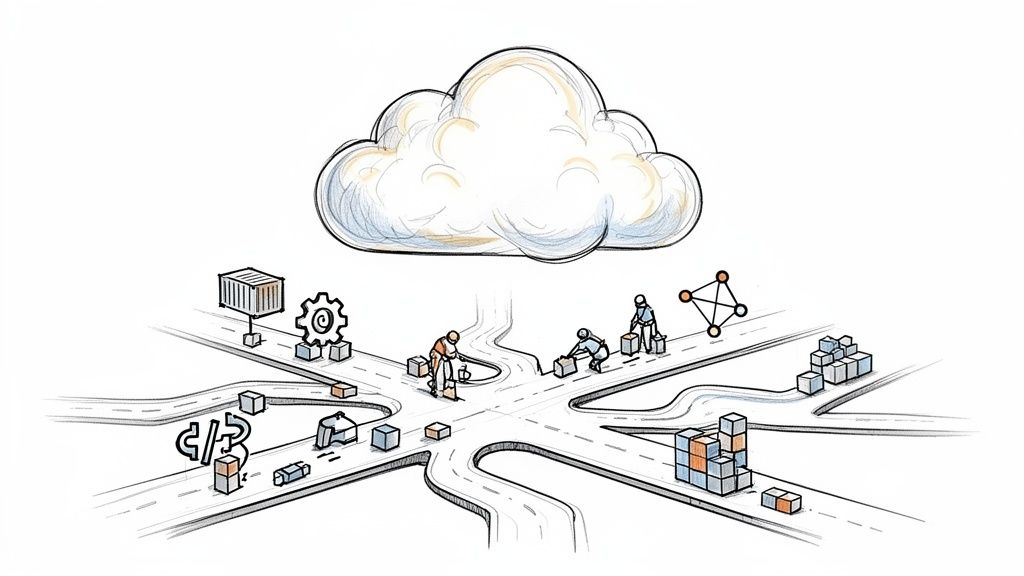
Cloud platform engineering is the discipline of building and operating a standardized, self-service Internal Developer Platform (IDP). The objective is to provide developers a paved road—a set of pre-configured tools, automated workflows, and golden paths—that enables them to ship applications rapidly and securely without deep infrastructure expertise. The core principle is to treat the internal platform as a product, with your developers as its customers.
This guide provides a technical and actionable breakdown of how to implement cloud platform engineering, from core architectural components to measuring success with tangible KPIs.
From DevOps Toil to Developer Enablement
The traditional "doing DevOps" model often made individual development teams responsible for their own infrastructure, CI/CD pipelines, and operational tooling. While this promoted autonomy, it created significant overhead and cognitive load.
Teams spent valuable cycles building bespoke, non-reusable infrastructure for each project. This resulted in fragmented toolchains, duplicated effort, and the expectation that developers become experts in everything from Kubernetes configuration to cloud IAM policies.
Cloud platform engineering is a strategic pivot away from this decentralized model. Instead of each team building its own bumpy dirt road, a dedicated platform team engineers a single, high-quality, paved highway—the Internal Developer Platform (IDP). The IDP is a curated set of tools, services, and automated workflows that codifies a "golden path" for the entire software delivery lifecycle.
What Is a Golden Path?
A "golden path" is the officially supported, well-documented, and most efficient route for building and deploying software within an organization. It is not a restrictive mandate but a low-friction default that handles complex, undifferentiated heavy lifting.
A technical implementation of a golden path typically automates:
- Infrastructure Provisioning: Self-service portals or CLI tools that leverage Infrastructure as Code (IaC) to spin up standardized environments with a single command or API call.
- CI/CD Pipelines: Pre-configured, reusable pipeline templates for building, testing, and deploying containerized applications using tools like Terraform for infrastructure changes and GitOps for application sync.
- Observability: Integrated agents and configurations for monitoring, logging, and tracing that are automatically injected into workloads, sending telemetry data to a centralized stack.
- Security & Compliance: Automated guardrails and policy-as-code checks embedded directly into the CI/CD pipeline to enforce security standards, compliance requirements, and cost controls.
This redefines the role of the operations team. The objective shifts from managing servers to enabling developer velocity at scale. This is a fundamental change in operational philosophy with a direct, measurable impact on business outcomes.
Industry adoption is accelerating. Projections show that by 2026, 80% of software engineering organizations will have established platform engineering teams. This is driven by proven results: elite organizations with platform models deploy 208 times more frequently and achieve lead times that are 2,604 times faster than their lower-performing peers.
Traditional DevOps vs Cloud Platform Engineering
To understand the evolution, it's crucial to compare the two approaches. Platform engineering builds on DevOps principles but applies them with a different focus and execution model.
Our guide on platform engineering vs. DevOps offers a full analysis, but this table provides a high-level technical comparison.
| Aspect | Traditional DevOps | Cloud Platform Engineering |
|---|---|---|
| Primary Goal | Break down silos between Dev and Ops on a per-project basis. | Enable organization-wide developer self-service and productivity through a centralized platform. |
| Core Artifact | Project-specific CI/CD pipelines and infrastructure scripts (Jenkinsfile, terraform.tfvars). |
A shared, reusable Internal Developer Platform (IDP) with a defined API and service catalog. |
| Developer Focus | Writing application code and managing the underlying infrastructure YAML, scripts, and pipelines. | Writing application code and interacting with the IDP's abstractions to handle infrastructure, deployment, and ops. |
| Operations Focus | Providing reactive support and bespoke tooling for specific applications and development teams. | Proactively building, maintaining, and improving the IDP as a product for all internal developer customers. |
| Scalability | Difficult to scale due to the proliferation of custom, non-standardized infrastructure per project. | Highly scalable by design, enforcing consistency and reducing redundant engineering work. |
| Governance | Often manual, ticket-based, or inconsistently applied via ad-hoc scripts across different teams. | Embedded directly into the platform through automated, code-based guardrails (Policy-as-Code). |
Ultimately, cloud platform engineering abstracts the immense complexity of modern cloud-native ecosystems. It grants developers the autonomy to innovate within a structured, secure, and automated framework, enabling the entire organization to ship higher-quality software at a much greater velocity.
The Core Components of a High-Impact Cloud Platform
An effective Internal Developer Platform (IDP) is not a single off-the-shelf tool. It is a custom-integrated system where each component is chosen and configured to create "golden paths" that abstract infrastructure complexity. This enables developers to self-serve resources and deploy code without friction.
A robust platform is architected in four distinct layers, each handling a specific part of the software delivery lifecycle. Understanding how these layers interoperate is critical to successful cloud platform engineering.
This diagram illustrates the platform team's position as an essential intermediary, connecting the underlying infrastructure (managed by DevOps/SRE) with the application developers.

The platform team acts as a force multiplier, enabling both operational stability and developer velocity. Let's dissect the technical layers that make this possible.
The Infrastructure Orchestration Layer
This is the foundational layer managing the compute, storage, and networking resources where applications run. Today, this means containers and a powerful orchestrator.
- Container Orchestration (Kubernetes): Kubernetes is the de facto standard for container orchestration at scale. It handles automated deployment, scaling, and self-healing of applications. The platform team's role is to configure hardened, multi-tenant clusters with appropriate resource quotas, network policies (e.g., Calico), and Pod Security Standards to create a stable and secure shared environment.
- Container Runtimes (containerd): While Docker was once dominant, leaner runtimes like containerd are now the standard CNI-compatible choice. They perform the low-level work of starting, stopping, and managing container lifecycles on each node within the Kubernetes cluster.
The Declarative Infrastructure as Code Layer
This layer ensures that all infrastructure components—from VPCs and subnets to the Kubernetes clusters themselves—are defined as version-controlled code. This practice makes infrastructure provisioning repeatable, auditable, and less prone to human error.
An Infrastructure as Code (IaC) approach transforms infrastructure management from a manual, imperative process into a declarative, software-driven discipline, enabling both consistency and velocity.
Tools like Terraform and Pulumi are dominant in this space. Platform engineers use them to create reusable modules that encapsulate best practices. A developer can then invoke a simple module, passing in a few variables via a terraform.tfvars file (e.g., app_name = "my-service", db_instance_size = "db.t3.micro"), and Terraform handles the complex API interactions to provision the required resources securely and consistently.
The Automation and GitOps Layer
This layer automates the entire software delivery pipeline, connecting code repositories directly to the underlying infrastructure, creating the "paved road."
- CI/CD Pipelines: Tools like GitLab CI, Jenkins, or GitHub Actions are the engines of this layer. They automate the building of container images (
docker build), running unit and integration tests, and executing vulnerability scans (e.g., Trivy, Snyk) on every commit. - GitOps (ArgoCD): This extends CI/CD for continuous deployment. With GitOps tools like ArgoCD or Flux, the Git repository becomes the single source of truth for the desired state of the application. When a manifest in Git is updated, the GitOps controller detects the drift and automatically synchronizes the live Kubernetes environment to match the state defined in the repo.
This combination creates a powerful, self-service deployment mechanism. Engineering these components for robustness and scalability is a significant technical challenge, often handled by specialists like a Staff Software Engineer, Platform Architecture.
The Observability Stack
You cannot manage what you cannot measure. The observability layer provides deep visibility into the health and performance of both the platform and the applications running on it.
A modern, open-source-based observability stack typically consists of:
- Metrics (Prometheus): Gathers time-series data (e.g., CPU utilization, request latency, error rates) from all services via instrumented endpoints.
- Visualization (Grafana): Transforms raw Prometheus data into meaningful dashboards, graphs, and alerts that are comprehensible to human operators.
- Tracing (OpenTelemetry): The emerging CNCF standard for collecting traces, metrics, and logs in a unified, vendor-agnostic format. It is essential for debugging performance bottlenecks in complex, distributed microservices architectures.
The demand for this underlying infrastructure is immense. The cloud infrastructure market, which powers these platforms, surged to US $106.9 billion in Q3 2025, a 28% year-over-year growth. With the core IaaS and PaaS markets growing at nearly 30% quarterly, this industry is projected to reach $1 trillion by 2026, signifying a fundamental shift in software architecture.
Architecting Your Platform Team For Success
A high-performing platform depends as much on the team structure as it does on the technology stack. A brilliant tech stack with the wrong team topology will simply create new, more sophisticated silos. Implementing cloud platform engineering requires a fundamental redesign of how engineering teams collaborate.
The most critical change is adopting a "platform as a product" mindset, where your internal developers are treated as customers.
With this mindset, the platform team's mission is to identify the greatest sources of friction for developers and build durable, scalable solutions. This is not a one-time project but an iterative product lifecycle, driven by user feedback and a data-informed roadmap. When executed correctly, the platform team evolves from a cost center into a powerful force multiplier, enabling all other teams to ship features faster and more reliably.
The Platform As a Product Mindset
This is the single most important cultural shift. Treating your internal platform like a commercial product ensures you build something engineers want to use. This means structuring the platform team like a product team.
The key roles include:
- Platform Product Manager: Acts as the voice of the developer customer. They conduct interviews, run surveys, and analyze data to identify pain points and user needs. They own the product roadmap and prioritize features based on impact.
- Platform Engineers: The core builders. They are hybrid software and infrastructure engineers who design and implement the reusable tools, automation, and components of the IDP. They possess deep expertise in areas like Kubernetes, IaC, and CI/CD.
- Site Reliability Engineers (SREs): Focused on the reliability, performance, and scalability of the platform itself. They define Service Level Objectives (SLOs), manage error budgets, and automate operational tasks to ensure the platform is a stable foundation for all development.
This mindset forces you to move from making assumptions to validating needs with data. The result is higher adoption and measurable impact.
Choosing the Right Team Topology
The organizational structure of your platform team significantly influences its effectiveness. The Team Topologies model provides an excellent framework for designing teams to minimize cognitive load and optimize workflow. For a deeper analysis, see our guide on modern DevOps team structures.
This diagram illustrates how a platform team fits within the broader ecosystem, based on the Team Topologies model.

The platform team provides a well-defined service boundary—a "thick" API—that abstracts underlying complexity from stream-aligned teams.
The three most common team structures are:
- Centralized Platform Team: A single, dedicated team that builds and operates the entire IDP. This model centralizes expertise and ensures consistency, making it suitable for many organizations. The primary risk is becoming a bottleneck if not managed with a product mindset.
- Enabling Team: A consultative model where the team acts as internal experts, coaching other teams on platform tools and best practices. This is effective for disseminating knowledge and upskilling the organization but is less suited for building a single, cohesive platform.
- Hybrid Model: Often the most practical approach for larger organizations. This combines a central team for core platform services with embedded "platform advocates" or smaller enabling teams within product-aligned business units. This structure balances centralized governance with decentralized expertise and faster feedback loops.
Your choice of topology must align with your organization's scale and technical maturity. A startup can succeed with a small, centralized team, whereas a large enterprise will likely require a hybrid model to serve diverse needs effectively.
Measuring Success with Platform Engineering KPIs
How do you prove that your investment in cloud platform engineering is delivering value? Many teams make the mistake of tracking traditional infrastructure metrics like server uptime or CPU utilization. While important, these fail to capture the true purpose of a platform.
The value of a modern platform is not measured by its own health, but by its direct impact on developer productivity and software delivery performance. The goal is to improve developer experience and enable them to ship better code, faster. That is the return on investment.
To demonstrate business value, you must shift from system-level metrics to developer-centric outcomes. Your platform is a product; its success is measured by the success of its customers—your developers.

This impact is driving massive market growth. The platform engineering market is projected to expand from USD 5.76 billion in 2025 to USD 47.32 billion by 2035, a 23.4% CAGR. The reason is clear: companies leveraging platforms are reducing deployment times by up to 50% and cutting downtime by 30-40%. You can find more data in Cervicorn Consulting's latest market report.
Key Developer-Centric Metrics
To build a compelling business case, focus on the DORA metrics, as they directly connect platform capabilities to business performance.
- Lead Time for Changes: The time from a code commit to it running in production. A short lead time is a direct indicator that your "golden path" is efficient and low-friction.
- Deployment Frequency: How often you deploy to production. Elite teams deploy on-demand, multiple times per day. High frequency demonstrates that your platform has successfully automated and de-risked the release process.
- Mean Time to Recovery (MTTR): How quickly you can restore service after a production failure. A low MTTR proves your platform provides effective tools for rapid recovery, such as one-click rollbacks and integrated observability.
- Change Failure Rate: The percentage of deployments that result in a service degradation or require remediation. A low failure rate reflects the effectiveness of the automated quality and security guardrails built into your platform.
Embedding Governance Without Friction
A key, yet often underestimated, benefit of a platform is its ability to automate governance. This replaces slow, manual security reviews and compliance checklists with rules embedded directly into the developer workflow.
The goal is to make the secure and compliant path the easiest path.
A well-designed platform achieves both control and autonomy. It makes the "right way" the "easy way" by embedding security, compliance, and cost management policies directly into its automated workflows.
Policy-as-Code (PaC) is the core technology for achieving this. Using a tool like Open Policy Agent (OPA), the platform team can express governance rules in a declarative language (Rego). For example, you can write policies that automatically:
- Block a container image from being deployed if a vulnerability scan reports critical CVEs.
- Enforce the presence of specific resource tags (e.g.,
cost-center,owner) on all new cloud infrastructure for cost allocation. - Prevent deployments to specific cloud regions to comply with data sovereignty regulations like GDPR.
These policies are executed as part of the CI/CD pipeline or by a Kubernetes admission controller, providing developers with immediate, actionable feedback. This proactive approach prevents misconfigurations before they reach production, transforming governance from a bureaucratic bottleneck into an automated co-pilot.
Building Your Internal Developer Platform Roadmap
Simply assembling a collection of cloud-native tools is not a strategy. A successful cloud platform engineering initiative requires a deliberate, strategic roadmap that guides decisions on what to build, what to buy, and where to focus initial efforts. Without a clear plan, platform projects often fail to gain traction and deliver value.
The first critical decision is the build vs. buy vs. partner trade-off. Each path has significant implications for your budget, timeline, and engineering team. The correct choice depends on your organization's technical maturity, available resources, and core competencies.
The First Big Question: Build, Buy, or Partner?
This foundational decision will shape your entire platform strategy. A misstep here can result in wasted engineering effort or vendor lock-in with a tool that doesn't meet developer needs.
Build: Creating a bespoke Internal Developer Platform (IDP) from scratch offers maximum control and customization. This path is suitable for large enterprises with unique, complex workflows and a dedicated, long-term engineering team to treat the platform as a first-class product. The major risks are high upfront investment, long time-to-value, and significant ongoing maintenance overhead.
Buy: Adopting a commercial IDP product offers the fastest time-to-value. This is ideal for organizations that want to leverage a battle-tested solution immediately and offload maintenance and feature development to a vendor. The primary trade-offs are less flexibility, potential for vendor lock-in, and recurring licensing costs.
Partner: Engaging a specialized consultancy like OpsMoon provides a hybrid approach. This is optimal for companies that require a solution tailored to their specific needs but lack the in-house expertise to build it themselves. You gain the benefits of a custom-fit platform without the long-term commitment of hiring a full-time platform team.
The right strategy is not about chasing the latest technology. It requires an honest assessment of your team's skills, your budget constraints, and the urgency of your developers' pain points.
For many organizations, a partnership model is the most pragmatic starting point. OpsMoon’s free work planning session is designed to help you analyze your current state and build a clear roadmap that aligns your technical goals with the most effective solution.
Start Small with a Minimum Viable Platform
A common failure pattern is attempting to build the "perfect" all-encompassing platform from day one. This "big bang" approach is slow, high-risk, and often fails to deliver any value for months or even years. A far more effective strategy is to begin with a Minimum Viable Platform (MVP).
An MVP is not just a scaled-down version of your end-state vision. It is a thin, functional slice of the platform that solves the single most acute problem your developers face today.
Find the Biggest Pain Point: Conduct interviews and surveys with your developers. Is it the manual, error-prone process of provisioning a test environment? The inconsistent and brittle CI/CD pipelines? The lack of visibility into application performance? Identify the number one source of friction.
Pave a "Golden Path" for That One Problem: Focus all initial effort on creating a single, smooth, automated workflow that solves that specific issue. For example, if environment provisioning is the top pain point, your MVP might be a simple CLI tool or self-service portal powered by Terraform modules that can spin up a standardized development environment with one command.
Get It in Front of Users and Iterate: Release the MVP to a small, friendly pilot group of developers. Their feedback is invaluable. Use it to iterate and refine the platform, proving its value before expanding its scope. Improving developer productivity is an iterative process, and this tight feedback loop is essential.
Starting with an MVP secures a quick win, builds organizational momentum, and ensures you are building a product that developers will actually adopt. To see how other companies have successfully executed their platform journeys, you can explore customer stories.
Matching Your Roadmap to Talent and Solutions
As your MVP proves its value, your roadmap will naturally expand to address the next most pressing pain points. This is where you must align your technical ambitions with your team's capabilities. If you decide to build more complex features in-house, you will need to acquire specialized talent.
OpsMoon's Experts Matcher can connect you with the top 0.7% of global talent for these specific roles, whether you need a Kubernetes networking specialist or a CI/CD pipeline architect.
By adopting a phased approach—starting with a strategic build/buy/partner decision, launching a focused MVP, and scaling with the right expertise—you can create an achievable roadmap. This turns the daunting goal of "cloud platform engineering" into a series of manageable, value-driven steps.
Answering Your Top Cloud Platform Engineering Questions
As engineering leaders adopt cloud platform engineering, several common questions arise. This paradigm shift requires a different way of thinking about operations and development. Here are technical answers to the most frequent inquiries.
Is Platform Engineering Just Rebranded DevOps?
No. It is the logical evolution and implementation of DevOps principles at scale. DevOps culture successfully broke down organizational silos, but in practice, it often shifted operational burdens (the "you build it, you run it" model) directly onto development teams. This led to high cognitive load and widespread inconsistency, as each team managed its own complex toolchain.
Cloud platform engineering operationalizes DevOps goals by delivering a tangible "product": the Internal Developer Platform (IDP). The platform team abstracts away the complexity of the toolchain, providing a standardized, self-service foundation that empowers every developer.
Platform engineering shifts the focus from team-specific DevOps chores to building a reusable, product-like platform. It standardizes the tools and codifies the best practices so the entire organization can move faster and more reliably—not just one team.
In short, while DevOps is the cultural "how," platform engineering delivers the technical "what"—a concrete platform that makes the culture a scalable reality.
What Is a Minimum Viable Platform?
A Minimum Viable Platform (MVP) is the thinnest possible slice of an IDP that solves one high-impact problem for developers. It is a strategic alternative to the high-risk "big bang" approach of building a comprehensive platform from the start, which often results in long delays and little-to-no initial value.
A practical MVP approach follows these steps:
- Identify the Primary Bottleneck: Use developer interviews and workflow analysis to pinpoint the single greatest point of friction in the software delivery lifecycle. This could be slow environment provisioning, inconsistent CI/CD configurations, or difficulty debugging in production.
- Build a "Thin Slice" Solution: Focus all initial engineering effort on creating a "golden path" that solves only that one problem. For example, if environment setup is the issue, an MVP could be a simple web UI that uses Terraform modules to provision a standardized development environment via an API call.
- Ship, Gather Feedback, and Iterate: Release the MVP to a small pilot group of developers. Collect qualitative and quantitative feedback to validate its usefulness and guide the next iteration before committing more resources.
The purpose of a platform MVP is to deliver tangible value quickly, validate assumptions with real users, and build momentum for the platform initiative. It ensures that engineering efforts are focused on solving real-world developer problems from day one.
How Does Platform Engineering Affect Developer Autonomy?
It is a common misconception that a platform restricts developer freedom by mandating specific tools. When implemented correctly, a platform enhances developer autonomy by abstracting away non-creative, complex toil.
Without a platform, a developer deploying a new microservice is forced to become a part-time expert in Kubernetes YAML, IAM policies, VPC networking, and CI/CD scripting. This cognitive load detracts from their primary role: designing and writing business logic.
A well-designed platform provides "paved roads" for these undifferentiated tasks.
- Freedom from Toil: Developers are freed from the heavy lifting of configuring, securing, and operating infrastructure.
- Focus on What Matters: By using the platform's self-service APIs and tools, they can provision resources and deploy code without needing to understand the intricate details of the underlying implementation.
- Innovation Within Guardrails: The platform provides freedom through structure. Developers have the autonomy to build and deploy their services as they see fit, as long as they operate on the "paved roads" that have security, compliance, and best practices built-in.
This provides the best of both worlds: the velocity to innovate quickly and the confidence of operating within a secure, reliable, and compliant framework.
Can a Small Company Benefit From Platform Engineering?
Yes, absolutely. While platform engineering is often associated with large enterprises managing complexity, its principles are equally valuable for startups and smaller businesses. For a small company, the goal is less about taming existing complexity and more about preventing technical debt and operational chaos from emerging in the first place.
Here's how small teams benefit:
- Build a Scalable Foundation: Implementing a lightweight platform early on ensures that tools, workflows, and infrastructure configurations remain consistent as the company grows. This helps avoid the "snowflake server" problem, where each piece of infrastructure is a unique, fragile, and undocumented liability.
- Maximize Engineering Focus: In a small team, every engineer's time is critical. A simple platform automates repetitive infrastructure tasks, keeping developers focused on building the product.
- Accelerate Onboarding: A platform with a clear "golden path" dramatically reduces ramp-up time for new hires. They can become productive and ship code within days instead of weeks.
For a startup, this does not mean building a complex, custom IDP. It could be as simple as standardizing on an open-source developer portal framework like Backstage or adopting a commercial PaaS/IDP solution. The objective is to gain the benefits of standardization and automation without incurring the overhead of building and maintaining the entire platform from scratch.
Ready to map out your own cloud platform engineering journey? The experts at OpsMoon can help you assess your current maturity, identify key developer pain points, and build a pragmatic roadmap. Start with a free work planning session to see how our top-tier engineers can accelerate your software delivery.
Leave a Reply