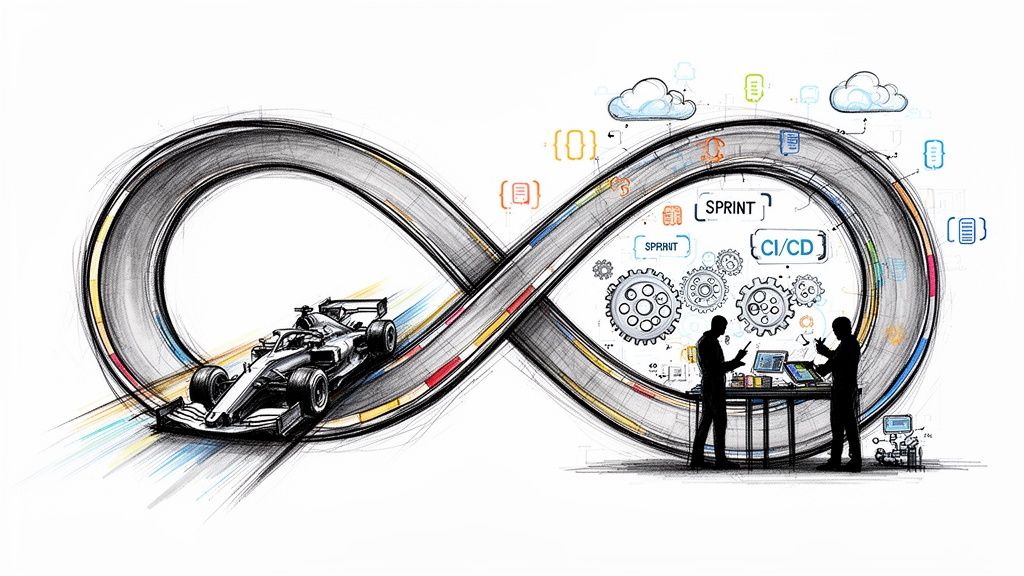
Integrating DevOps and Agile development methodologies creates a highly efficient framework for modern software delivery. Think of it as a Formula 1 team's synergy between race strategy and pit crew engineering.
Agile is the race strategy—it defines iterative development cycles (sprints) to adapt to changing track conditions and competitive pressures. DevOps is the high-tech pit crew and telemetry system, using automation, CI/CD, and infrastructure as code to ensure the car's peak performance and reliability.
When merged, these two philosophies enable the rapid, reliable release of high-quality software. This resolves the classic conflict between the business demand for new features and the operational need for system stability.
Unifying Speed and Stability in Software Delivery
Traditionally, software development and IT operations functioned in isolated silos. Development teams, incentivized by feature velocity, would "throw code over the wall" to operations teams, who were measured by system uptime and stability.
This created inherent friction. Developers pushed for frequent changes, while operations resisted them due to the risk of production incidents. This siloed model resulted in slow release cycles, late-stage bug discovery, and a blame-oriented culture when failures occurred.
The convergence of DevOps and Agile development represents a paradigm shift away from this adversarial model. Instead of a linear, siloed process, these philosophies create a continuous, integrated feedback loop. Agile provides the iterative framework for breaking down large projects into manageable sprints. DevOps supplies the technical engine—automation, tooling, and collaborative practices—to build, test, deploy, and monitor the resulting software increments reliably and at scale.
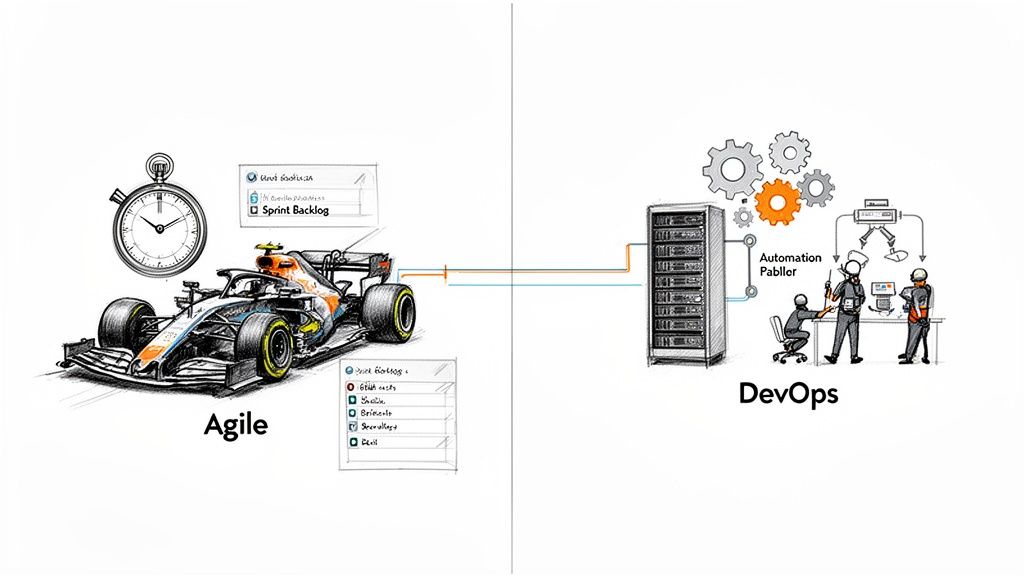
Core Principles of Agile and DevOps
This combination is effective because both methodologies share core principles like collaboration, feedback loops, and continuous improvement. While their primary domains differ, their ultimate goals are perfectly aligned.
- Agile Development is a project management philosophy focused on iterative progress and adapting to customer feedback. Its primary goal is to deliver value in short, predictable cycles called sprints, enabling rapid response to changing requirements.
- DevOps Culture is an engineering philosophy focused on breaking down organizational silos through shared ownership, automation, and measurement. Its goal is to increase the frequency and reliability of software releases while improving system stability.
The technical synergy occurs when Agile's adaptive planning meets DevOps' automated execution. An Agile team can decide to pivot its sprint goal based on user feedback, and a mature DevOps practice means the resulting code changes can be built, tested via an automated pipeline, and deployed to production within hours, not weeks.
This table provides a technical breakdown of their respective domains and practices.
Agile vs DevOps At A Glance
| Aspect | Agile Development | DevOps |
|---|---|---|
| Primary Focus | The software development lifecycle (SDLC), from requirements gathering to user story completion. | The entire delivery pipeline, from code commit to production monitoring and incident response. |
| Core Goal | Adaptability and rapid feature delivery through iterative cycles. | Speed and stability through automation and collaboration. |
| Key Practices | Sprints, daily stand-ups, retrospectives, user stories, backlog grooming. | Continuous Integration (CI), Continuous Delivery/Deployment (CD), Infrastructure as Code (IaC), observability (monitoring, logging, tracing). |
| Team Structure | Small, cross-functional development teams (e.g., Scrum teams). | Breaks down silos between Development (Dev), Operations (Ops), and Quality Assurance (QA) teams. |
| Measurement | Velocity, burndown/burnup charts, cycle time. | DORA metrics: Deployment Frequency, Lead Time for Changes, Mean Time to Recovery (MTTR), Change Failure Rate. |
While the table highlights their distinct functions, the key insight is their complementarity. Agile defines the "what" and "why" through user stories and sprint planning; DevOps provides the technical implementation of "how" and "how fast" through automated pipelines and infrastructure.
Why This Integration Matters Now
In a competitive landscape defined by user expectations, the ability to release high-quality features rapidly is a critical business advantage. Combining DevOps and Agile is a strategic imperative that enables organizations to respond to market demands with both speed and confidence. This guide provides a technical, actionable roadmap for implementing this synergy, from foundational concepts to advanced operational strategies.
The Technical Foundations of Agile and DevOps
To effectively implement DevOps and Agile development, it's crucial to understand the specific technical frameworks and tools that underpin them. These are not just abstract concepts but practical methodologies built on concrete processes that enable software delivery.
Agile frameworks provide the structure for managing development work. Methodologies like Scrum and Kanban offer the rhythm and visibility necessary for steady, iterative progress.
Agile in Practice: Sprints and Boards
A Scrum sprint is a fixed-length iteration—typically one or two weeks—during which a team commits to completing a specific set of work items from their backlog. It establishes a predictable cadence for development.
A typical two-week sprint follows a structured cadence:
- Sprint Planning: The team selects user stories from the product backlog, decomposes them into technical tasks, and commits to a realistic scope for the sprint.
- Daily Stand-ups: A 15-minute daily sync to discuss progress on tasks, identify immediate blockers, and coordinate the day's work.
- Development Work: Engineers execute the planned tasks, including coding, unit testing, and peer reviews, typically using Git-based feature branching workflows.
- Sprint Review: The team demonstrates the completed, functional software increment to stakeholders to gather feedback.
- Sprint Retrospective: The team conducts a process-focused post-mortem on the sprint to identify what went well, what didn't, and what concrete actions can be taken to improve the next sprint.
Kanban, in contrast, is a continuous flow methodology visualized on a Kanban board. Work items (cards) move across columns representing stages (e.g., "Backlog," "In Progress," "Code Review," "Testing," "Done"). Kanban focuses on optimizing flow and limiting Work-In-Progress (WIP) to identify and resolve bottlenecks. These iterative cycles are a prerequisite for the high-frequency releases enabled by Agile and continuous delivery.
The Technical Pillars of DevOps
While Agile organizes the work, DevOps provides the technical engine for its execution. The CAMS framework (Culture, Automation, Measurement, Sharing) defines the philosophy, but Automation is the technical cornerstone.
The global DevOps market reached $10.4 billion in 2023, with 80% of organizations reporting some level of adoption. However, many are still in early stages, highlighting a significant opportunity for optimization through expert implementation. For a deeper analysis, you can understand the latest DevOps statistics.
Three technical practices are fundamental to any successful DevOps implementation.
DevOps is not about purchasing a specific tool; it's about automating the entire software delivery value stream—from a developer's IDE to a running application in production. The objective is to make releases predictable, repeatable, and low-risk.
1. CI/CD Pipelines
Continuous Integration and Continuous Delivery (CI/CD) pipelines are the automated assembly line for software. They automate the build, test, and deployment process triggered by code commits.
- Continuous Integration (CI): Developers frequently merge code changes into a central repository (e.g., a
mainbranch in Git). Each merge triggers an automated build and execution of unit/integration tests, enabling early detection of integration issues. Key tools include Jenkins, GitLab CI, and CircleCI. - Continuous Delivery (CD): This practice extends CI by automatically deploying every validated build to a testing or staging environment. The goal is to ensure the codebase is always in a deployable state.
2. Infrastructure as Code (IaC)
Infrastructure as Code (IaC) is the practice of managing and provisioning infrastructure (servers, load balancers, databases, networks) through machine-readable definition files rather than manual configuration.
- Tools: Terraform (declarative) and AWS CloudFormation are industry standards.
- Benefit: IaC enables reproducible, version-controlled environments. This eliminates "environment drift" and the "it works on my machine" problem by ensuring that development, staging, and production environments are programmatically identical.
3. Containerization and Orchestration
Containerization packages an application and its dependencies into a single, isolated unit called a container.
- Docker: The de facto standard for creating container images. It guarantees that an application will run consistently across any environment that supports Docker, from a developer's laptop to a cloud production server.
- Kubernetes: A container orchestration platform that automates the deployment, scaling, and management of containerized applications at scale. Kubernetes handles concerns like service discovery, load balancing, self-healing, and zero-downtime rolling updates.
Integrating DevOps into the Agile Workflow
This is the critical integration point: embedding DevOps technical practices directly into the Agile framework to create a powerful devops and agile development synergy. This involves more than improved communication; it requires weaving automated quality gates and deployment mechanisms into the core Agile artifacts and ceremonies.
When implemented correctly, an abstract user story from a Jira ticket is transformed into a series of automated, verifiable actions, creating a seamless flow from concept to production code.
A foundational step is redefining the team's Definition of Done (DoD). In Agile, the DoD is a checklist that formally defines when a user story is considered complete. A traditional DoD might include "code written," "unit tests passed," and "peer-reviewed." This is insufficient for a modern workflow.
An integrated DoD acts as the technical contract between development and operations. A user story is only "done" when it has successfully passed through an automated CI/CD pipeline and is verifiably functional and stable in a production-like environment.
Evolving the Definition of Done
To be actionable, your DoD must be updated with criteria reflecting a DevOps and DevSecOps mindset. This builds quality, security, and deployability into the development process from the outset.
A robust, modern DoD should include technical checkpoints like:
- Code is successfully built and passes all unit and integration tests within the Continuous Integration (CI) pipeline.
- Code coverage metrics meet the predefined threshold (e.g., >80%).
- Automated security scans (SAST/DAST) complete without introducing new critical or high-severity vulnerabilities.
- The feature is automatically deployed via the Continuous Delivery (CD) pipeline to a staging environment.
- A suite of automated end-to-end and acceptance tests passes against the staging environment.
- Infrastructure as Code (IaC) changes (e.g., Terraform plans) are peer-reviewed and successfully applied.
- Performance tests show no degradation of key application endpoints.
This enhanced DoD establishes shared ownership of release quality. It is no longer just a developer's responsibility to write code, but to write deployable code that meets operational standards. We explore this concept in our guide on uniting Agile development with DevOps.
The Automated Git-Flow Pipeline
This integrated process is anchored in a version-controlled, automated workflow. At its core is strategic automation in DevOps, triggered by actions within a Git-based branching strategy (e.g., GitFlow or Trunk-Based Development).
Here is a technical breakdown of a typical workflow:
- Create a Feature Branch: A developer selects a user story and creates an isolated Git branch from
main(e.g.,git checkout -b feature/JIRA-123-user-auth). - Commit and Push: The developer writes code, including application logic and corresponding unit tests. They commit changes locally (
git commit) and push the branch to the remote repository (git push origin feature/JIRA-123-user-auth). - Pull Request Triggers CI: Pushing the branch or opening a Pull Request (PR) in GitHub/GitLab triggers a webhook that initiates the Continuous Integration (CI) pipeline. A CI server (e.g., Jenkins) executes a predefined pipeline script (e.g.,
Jenkinsfile):- Provisions a clean build environment (e.g., a Docker container).
- Compiles the code, runs linters, and executes unit and integration test suites.
- Performs static application security testing (SAST).
- Receive Fast Feedback: If any stage fails, the pipeline fails, and the PR is blocked from merging. The developer receives an immediate notification (via Slack or email), allowing for rapid correction.
- Merge to Main: After the CI pipeline passes and a teammate approves the code review, the PR is merged into the
mainbranch. - Trigger Continuous Delivery: This merge event triggers the Continuous Delivery (CD) pipeline, which automates the release process:
- The pipeline packages the application into a versioned artifact (e.g., a Docker image tagged with the Git commit SHA).
- It deploys this artifact to a staging environment.
- It then runs automated acceptance tests, end-to-end tests, and performance tests against the staging environment.
- Upon success, it can trigger an automated deployment to production (Continuous Deployment) or pause for a manual approval gate (Continuous Delivery).
This automated workflow creates a direct, traceable, and reliable link between the Agile planning activity (the user story) and the DevOps execution engine (the CI/CD pipeline).
The diagram below illustrates the cultural feedback loop that this technical process enables: a continuous cycle of Automation, Measurement, and Sharing.
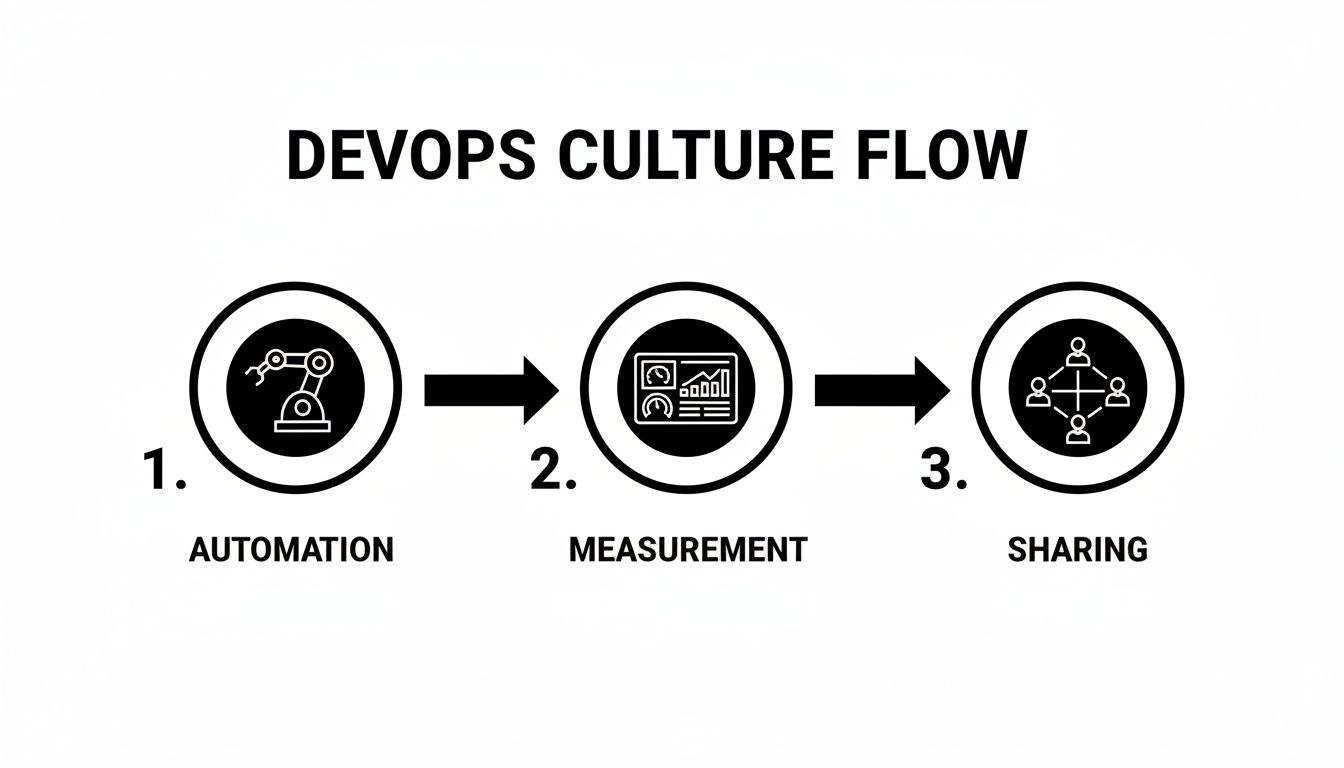
Automation is the enabler. The data generated by the pipeline (measurement) is then shared with the team, creating a tight feedback loop that drives continuous improvement in both the product and the process.
A Real-World Integrated Workflow Example
To make this tangible, let's trace a single feature from a business requirement to a live deployment, demonstrating how Agile and DevOps integrate at each step.
Scenario: A team needs to build a new user authentication module for a SaaS application. The workflow is a precise orchestration of Agile planning ceremonies and DevOps automation.
The process begins in a project management tool like Jira. The Product Owner creates a user story: "As a new user, I want to sign up with my email and password so that I can access my account securely." This story is added to the product backlog, prioritized, and scheduled for an upcoming two-week sprint.
From Sprint Planning to the First Commit
During sprint planning, the development team pulls this user story into the current sprint. They decompose it into technical sub-tasks (e.g., "Create user DB schema," "Build sign-up API endpoint," "Develop frontend form"). A developer self-assigns the first task and creates a new feature branch from main in their Git repository, named feature/user-auth.
This branch provides an isolated environment for development within their repository on GitLab. After implementing the initial API endpoint and writing corresponding unit tests, the developer executes a git push. This action triggers a webhook configured in GitLab, which notifies a CI/CD server like Jenkins. This is the first automated handshake between the Agile task and the DevOps pipeline.
Jenkins executes the predefined CI pipeline, which performs a series of automated steps:
- Build: It clones the
feature/user-authbranch and compiles the code within a clean, ephemeral Docker container to ensure a consistent build environment. - Test: It executes the unit test suite. A test failure immediately halts the pipeline and sends a failure notification to the developer, typically within minutes.
- Analyze: It runs static code analysis tools (e.g., SonarQube) to check for code quality issues, style violations, and security vulnerabilities.
Automating the Path to Staging
After several commits and successful CI builds, the feature's code is complete. The developer opens a pull request (PR) in GitLab, signaling that the code is ready for peer review. The PR triggers the CI pipeline again, and a successful "green" build is a mandatory quality gate before merging. Once a teammate approves the code, the feature/user-auth branch is merged into main.
This merge event is the trigger for the Continuous Delivery (CD) phase. Jenkins detects the new commit on the main branch and initiates the deployment pipeline.
This automated handoff from CI to CD is the core of DevOps efficiency. It eliminates manual deployment procedures, drastically reduces the risk of human error, and ensures that every merged commit is systematically validated and deployed. This transforms Agile's small, iterative changes into tangible, testable software increments.
The CD pipeline executes the following automated steps:
- It builds a new Docker image containing the application, tagging it with the Git commit SHA for traceability (e.g.,
myapp:a1b2c3d). - It pushes this immutable image to a container registry (e.g., Amazon ECR, Docker Hub).
- Using Infrastructure as Code principles, it executes a script that instructs the staging environment's Kubernetes cluster to perform a rolling update, deploying the new image.
Kubernetes manages the deployment, ensuring zero downtime by gradually replacing old application containers with new ones. Within minutes, the new authentication feature is live in the staging environment—a high-fidelity replica of production. The QA team and Product Owner can immediately begin acceptance testing, providing rapid feedback that aligns perfectly with Agile principles.
Measuring Success with Key Performance Metrics
To optimize a combined DevOps and Agile strategy, you must move from subjective assessments to objective, data-driven measurement. Without tracking the right Key Performance Indicators (KPIs), you are operating without a feedback loop.
The market data confirms the value of this approach. The global DevOps market was valued at $10.4B and is projected to reach $12.2B, with North America accounting for 36.5-42.9% of the DevSecOps market. This growth is driven by the measurable competitive advantage gained from elite software delivery performance. You can explore these trends in the expanding scope of DevOps adoption.
Blending Agile and DevOps Metrics
A common pitfall is to track Agile and DevOps metrics in isolation. The most valuable insights emerge from correlating these two sets of data. Agile metrics measure the efficiency of your planning and development workflow, while DevOps metrics measure the speed and stability of your delivery pipeline.
For example, a high Agile Velocity (story points completed per sprint) is meaningless if your DevOps Change Failure Rate is also high, indicating that those features are introducing production incidents. The real goal is to achieve high velocity with a low failure rate.
The objective is to create a positive feedback loop. Improving a DevOps metric like Lead Time for Changes should directly improve an Agile metric like Cycle Time. This correlation proves that your automation and process improvements are delivering tangible value.
The DORA Metrics for DevOps Performance
The DORA (DevOps Research and Assessment) metrics are the industry standard for measuring software delivery performance. They provide a quantitative, technical view of your team's throughput and stability.
- Deployment Frequency: How often does your organization deploy code to production? Elite performers deploy on-demand, multiple times per day.
- Lead Time for Changes: What is the median time it takes to go from code commit to code successfully running in production? This measures the efficiency of your entire CI/CD pipeline.
- Mean Time to Recovery (MTTR): What is the median time it takes to restore service after a production incident or failure? This is a key measure of system resilience.
- Change Failure Rate: What percentage of deployments to production result in a degraded service and require remediation (e.g., a rollback or hotfix)? This measures the quality and reliability of your release process.
Essential DevOps And Agile Performance Metrics
Tracking a balanced set of metrics is crucial for a holistic view of your integrated Agile and DevOps practice. This table outlines key metrics, what they measure, and their technical significance.
| Metric | What It Measures | Why It Matters |
|---|---|---|
| Agile Velocity | The average amount of work (in story points) a team completes per sprint. | Provides a basis for forecasting and helps gauge the predictability of the development team. |
| Cycle Time | The time from when development starts on a task to when it is delivered to production. | A direct measure of how quickly value is being delivered to customers; a key focus for value stream optimization. |
| Deployment Frequency | How often code is successfully deployed to production. | A primary indicator of delivery pipeline throughput and team agility. |
| Lead Time for Changes | The time from a code commit to its deployment in production. | Measures the total efficiency of the CI/CD pipeline and release process. Elite teams measure this in minutes or hours. |
| Mean Time to Recovery (MTTR) | The average time to restore service after a production failure. | A critical measure of operational maturity and system resilience. Lower MTTR is achieved through robust monitoring, alerting, and automated rollback capabilities. |
| Change Failure Rate | The percentage of deployments that cause a production failure. | A direct measure of release quality. A low rate indicates effective automated testing, quality gates, and deployment strategies (e.g., canary releases). |
By monitoring these metrics, you can foster a data-driven culture of continuous improvement, optimizing both your development processes and delivery infrastructure. For a deeper technical perspective, review our guide on how to approach engineering productivity measurement.
Common Challenges and How to Solve Them
Adopting a unified DevOps and Agile model is a significant organizational transformation that often encounters predictable challenges. Addressing these cultural and technical hurdles proactively is key to a successful implementation.
One of the primary obstacles is cultural resistance to change. Developers may be hesitant to take on operational responsibilities (like writing Terraform code), and operations engineers may be unfamiliar with Agile ceremonies like sprint planning.
Overcoming Cultural and Technical Hurdles
The most effective strategy for overcoming resistance is to demonstrate value through a successful pilot project. Select a well-defined, low-risk project and use it to showcase the benefits of the integrated approach. When the wider organization sees a team delivering features to production in hours instead of weeks, with higher quality and less manual effort, skepticism begins to fade.
Another common technical challenge is toolchain fragmentation. Organizations often adopt a collection of disparate tools for CI, CD, IaC, and monitoring that are poorly integrated, creating new digital silos and a significant maintenance burden.
A fragmented toolchain is merely a technical manifestation of the organizational silos you are trying to eliminate. The goal is a seamlessly integrated value stream, not a collection of disconnected automation islands.
Establish a clear technical strategy before adopting new tools:
- Map Your Value Stream: Visually map every step of your software delivery process, from idea to production. Identify all manual handoffs and points where automation and integration are needed.
- Standardize Core Tools: Select and standardize a primary tool for each core function (e.g., Jenkins for CI/CD, Terraform for IaC). Ensure chosen tools have robust APIs to facilitate integration.
- Prioritize Integration: Evaluate tools based not only on their features but also on their ability to integrate with your existing ecosystem (e.g., Jira, Slack, security scanners).
Modernizing Legacy Systems and Upskilling Teams
Legacy systems, which were not designed for automation, often lack the necessary APIs and modularity for modern CI/CD pipelines. A complete rewrite is typically infeasible due to cost and risk.
A proven technical strategy is the strangler fig pattern. Instead of replacing the monolith, you incrementally build new, automated microservices around it. You gradually "strangle" the legacy system by routing traffic and functionality to the new services over time, eventually allowing the monolith to be decommissioned. This approach minimizes risk and delivers incremental value.
Finally, addressing skill gaps is the most critical investment. Your team likely has deep expertise in either development or operations, but rarely both. Implement a structured upskilling program: provide formal training, encourage peer-to-peer knowledge sharing, and facilitate cross-functional pairing. Have developers learn to write and review IaC. Have operations engineers learn Git and participate in code reviews. This investment in human capital is what truly enables a sustainable DevOps culture.
Got Questions? We've Got Answers
Even with a clear plan, practical questions often arise during the implementation of DevOps and Agile development. Here are technical answers to some of the most common inquiries.
Can You Do DevOps Without Being Agile?
Technically, yes, but it would be a highly inefficient use of a powerful engineering capability. You could build a sophisticated, fully automated CI/CD pipeline (DevOps) to deploy a large, monolithic application once every six months (a Waterfall-style release). However, this misses the fundamental point of DevOps.
DevOps automation is designed to de-risk and accelerate the release of small, incremental changes. Agile methodologies provide the very framework for producing those small, well-defined batches of work. Without Agile's iterative cycles, your DevOps pipeline remains underutilized, waiting for large, high-risk "big bang" deployments.
Agile defines the "what" (small, frequent value delivery), and DevOps provides the technical "how" (an automated, reliable pipeline to deliver that value).
Which Comes First, DevOps or Agile?
Most organizations adopt Agile practices first. This is a logical progression, as Agile addresses the project management and workflow layer. Adopting frameworks like Scrum or Kanban using tools like Jira teaches teams to break down large projects into manageable, iterative sprints.
DevOps typically follows as the technical enabler for Agile's goals. Once a team establishes a rhythm of two-week sprints, the bottleneck becomes the manual, error-prone release process. This naturally leads to the question, "How do we ship the output of each sprint quickly and safely?" This is the point where investment in CI/CD pipelines, Infrastructure as Code, and automated testing becomes a necessity, not a luxury.
Agile creates the demand for speed and iteration; DevOps provides the engineering platform to meet that demand.
A practical way to view it: Agile adoption builds the team's "muscle memory" for iterative development. DevOps then provides the strong "skeleton" of automation and infrastructure to support this new way of working, preventing a regression to slower, siloed practices.
What's the Scrum Master's Role in a DevOps World?
In a mature DevOps culture, the Scrum Master's role expands significantly. They evolve from a facilitator of Agile ceremonies into a process engineer for the entire end-to-end value stream—from idea inception to production delivery and feedback.
Their focus shifts from removing intra-sprint blockers to identifying and eliminating bottlenecks across the entire CI/CD pipeline.
A Scrum Master in a DevOps environment will:
- Coach the team on technical practices, such as integrating security scanning into the CI pipeline or improving test automation coverage.
- Facilitate collaboration between developers, QA, and operations engineers to streamline the deployment process.
- Advocate for technical investment to improve tooling, reduce technical debt, or enhance monitoring capabilities.
The Scrum Master becomes a key agent of continuous improvement for the entire system. They ensure that the principles of DevOps and Agile development are implemented cohesively, helping the team optimize their flow of value delivery from left to right.
Ready to stop talking and start doing? OpsMoon brings top-tier remote engineers and sharp strategic guidance right to your team, helping you build elite CI/CD pipelines and scalable infrastructure. Forget the hiring grind and integrate proven experts who get it done. Book a free work planning session and let's get started!
Leave a Reply