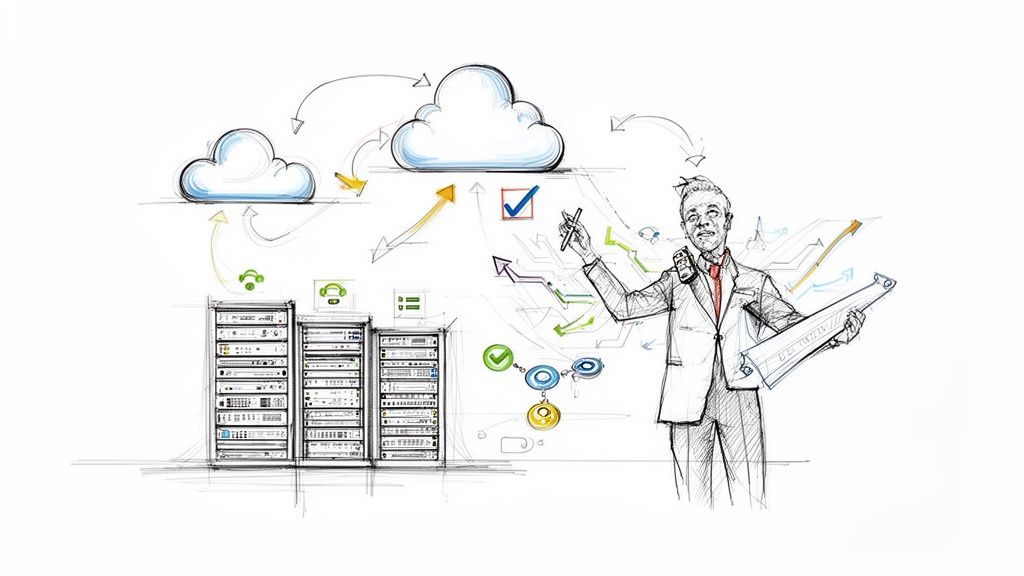
Engaging cloud migration consultants without a detailed technical blueprint is like hiring a contractor and saying, "build me a house." The result is wasted budget, extended timelines, and a final product that fails to meet business requirements.
A comprehensive migration blueprint is your most critical asset. It converts high-level business goals into a concrete, technically-vetted roadmap. When you perform this due diligence upfront, you engage consultants with a data-backed plan, enabling them to provide accurate proposals and execute a precise strategy from day one.
Build Your Migration Blueprint Before Hiring Consultants
Initiating consultant interviews without a clearly defined strategy inevitably leads to scope creep, budget overruns, and suboptimal outcomes. Successful cloud migrations begin with rigorous internal planning.
This involves more than just a server inventory. It requires building a robust business and technical case for the migration that directly aligns with your product roadmap and financial projections.
The market for this expertise is immense. The global cloud migration services market was valued at USD 257.38 billion in 2024 and is projected to reach USD 1,490.12 billion by 2033. This growth underscores the necessity of a well-architected strategy from the outset.
Define Specific Business and Technical Outcomes
Before analyzing your technology stack, you must quantify success. Vague objectives like "improve performance" or "reduce costs" are insufficient. You must provide consultants with precise, measurable targets to architect a viable plan.
Here’s how to translate business goals into technical specifications:
- Latency Reduction: "Reduce P95 latency for the
/api/v2/checkoutendpoint from 250ms to sub-100ms under a load of 5,000 concurrent users." - Cost Optimization: "Achieve a 20% reduction in infrastructure spend for our Apache Spark analytics workload by implementing AWS Graviton instances and a spot instance strategy for non-critical jobs."
- Scalability: "The user authentication service must handle a 5x increase in peak RPS (requests per second) during promotional events with a zero-downtime scaling mechanism, such as a Kubernetes Horizontal Pod Autoscaler (HPA)."
- Developer Velocity: "Reduce the provisioning time for a full staging environment from 48 hours to under 30 minutes using a parameterized Terraform module and a CI/CD pipeline."
Achieving this level of specificity requires collaboration between engineering leads, product managers, and finance stakeholders to ensure technical objectives directly support business imperatives.
This entire process—from defining quantifiable outcomes to in-depth technical analysis and financial modeling—constitutes your migration blueprint.
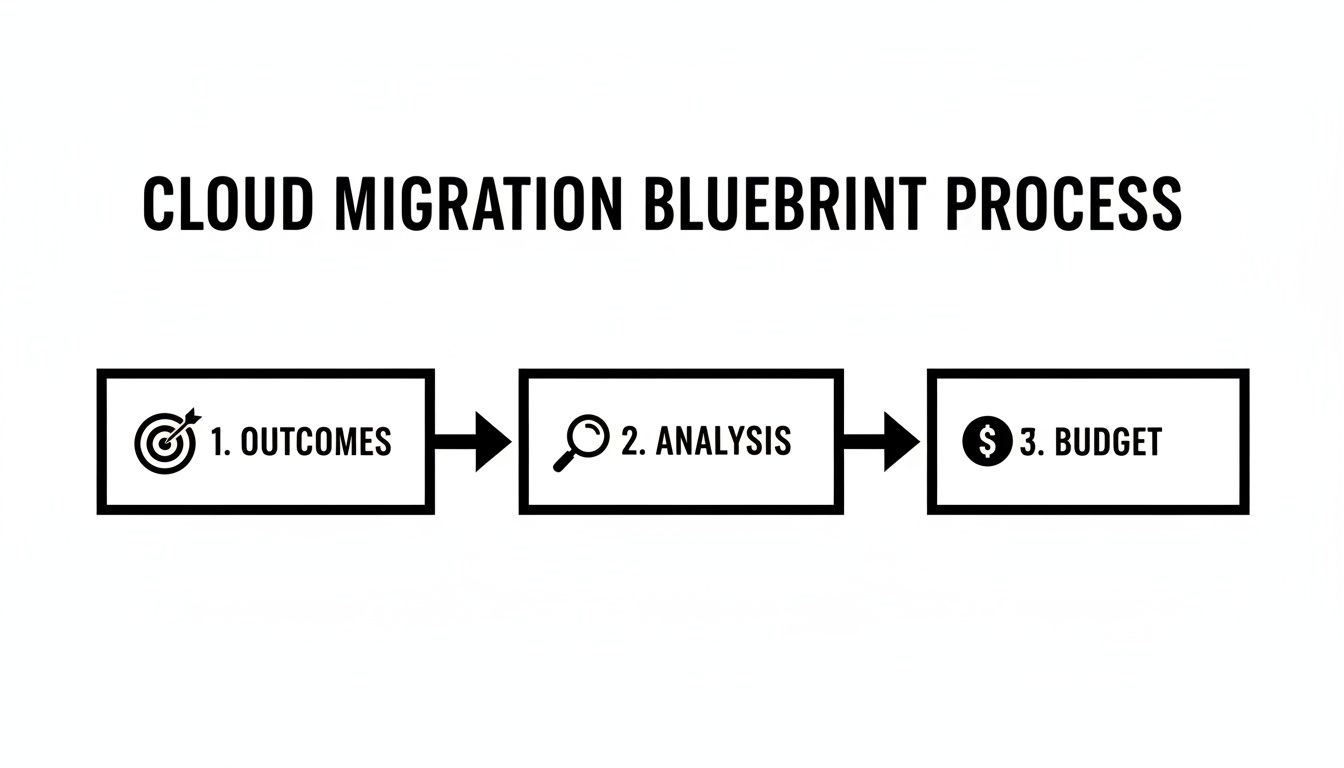
As illustrated, clear, measurable outcomes are the bedrock upon which all subsequent technical analysis and financial planning are built.
Conduct a Deep Application Portfolio Analysis
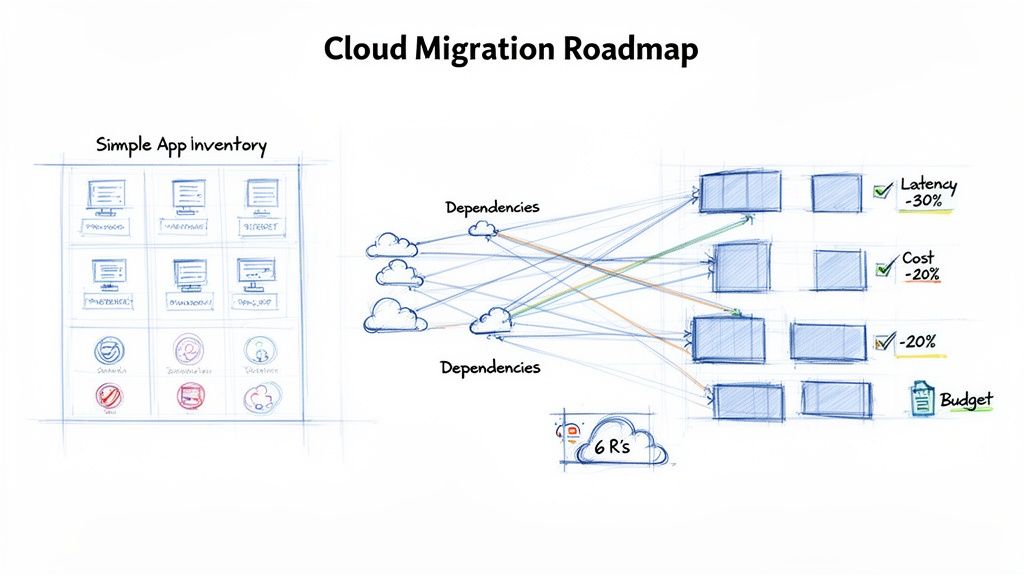
With outcomes defined, conduct a thorough analysis of your applications and infrastructure. This extends beyond a simple asset inventory to mapping all inter-service dependencies, performance characteristics, and business criticality for each component.
A common failure is treating all applications monolithically. A legacy Java application with high-traffic dependencies on a central Oracle database requires a fundamentally different migration strategy than a self-contained Go microservice. The analysis must differentiate these workloads.
Begin by mapping all critical dependencies between applications, databases, message queues, and third-party APIs. A dependency graph is essential for sequencing migration waves and preventing cascading failures.
Next, classify each workload using the "6 R's" framework to determine the optimal migration path:
- Rehost (Lift and Shift): Migrate as-is to IaaS. Fast but accrues technical debt.
- Replatform (Lift and Reshape): Migrate with minor modifications to leverage cloud-managed services (e.g., move a self-hosted PostgreSQL to Amazon RDS).
- Refactor/Re-architect: Substantial code and architectural changes to become cloud-native.
- Repurchase: Replace with a SaaS solution.
- Retire: Decommission the application.
- Retain: Keep on-premises, often due to compliance or latency constraints.
As you assemble this blueprint, consider leveraging modern talent acquisition software platforms to streamline the subsequent search for qualified consultants.
For a more granular examination of these technical steps, consult our comprehensive guide on how to migrate to the cloud.
How to Technically Vet Cloud Migration Consultants
The success of your migration is directly proportional to the technical competence of your consultants. A compelling presentation and a list of certifications are merely prerequisites. You are paying for proven, hands-on expertise in navigating complex technical landscapes. This vetting process must distinguish genuine architects from individuals who can only recite documentation.
A partner must possess deep, nuanced knowledge of platform-specific behaviors, data migration complexities, and production-grade orchestration. A superficial understanding is a direct path to performance bottlenecks, security vulnerabilities, and costly rework.
Your vetting process must be rigorous, practical, and focused on demonstrated problem-solving abilities, not theoretical knowledge.
Dissecting Case Studies and Verifying Outcomes
Every consultant will present case studies. Your task is to treat these not as marketing collateral but as technical evidence to be cross-examined. Move beyond the high-level ROI figures and probe the technical execution.
Ask questions that require specific, technical answers:
- "Describe the most significant unforeseen technical challenge in that project. What specific steps, tools, and code changes did your team implement to resolve it?"
- "Walk me through the structure of the Infrastructure as Code modules you developed. How did you manage state, handle secrets, and ensure modularity for multi-environment deployments?"
- "What specific performance tuning was required post-migration to meet the client's latency SLOs? Detail any kernel-level adjustments, database query optimizations, or CDN configurations you implemented."
A consultant with direct experience will provide detailed, verifiable accounts. Ambiguous, high-level responses are a significant red flag. Identifying these deficiencies is as crucial as recognizing strengths, a principle detailed in this guide on red flags to avoid when selecting a consulting partner.
Probing Real-World Experience with Technical Questions
Your interview process must be designed to evaluate practical expertise. Scenario-based questions are highly effective at revealing a consultant's thought process and depth of knowledge.
Key Areas to Probe:
- Cloud Platform Nuances: Avoid simple "Do you know AWS?" questions. Ask comparative questions that expose true familiarity. For example: "For a containerized .NET application, contrast the technical trade-offs of using Azure App Service for Containers versus AWS Fargate, specifically regarding VNet integration, IAM role management, and observability."
- Infrastructure as Code (IaC) Proficiency: Go beyond "Do you use Terraform?" Test their best practices. A strong question is: "Describe your strategy for structuring a multi-account AWS organization with Terraform. How would you use
Terragruntor workspaces to manage shared modules for networking and IAM while maintaining environment isolation?" - Container Orchestration: Kubernetes is a common element. Test their knowledge of stateful workloads: "You need to migrate a stateful application like Kafka to Kubernetes. Detail your approach for managing persistent storage. What are the operational pros and cons of using an operator with local persistent volumes versus a managed cloud storage class via a
StorageClassandPersistentVolumeClaim?"
Elite consultants not only know the 'what' but can defend the 'why' and 'how' with data and real-world examples. They justify architectural decisions with performance benchmarks and cost models, not just vendor whitepapers.
Implementing a Practical Technical Challenge
To validate their capabilities, assign a small, well-defined technical challenge. This is not about soliciting free work but observing their analytical and design process. The exercise should be a microcosm of a problem you are facing.
Sample Take-Home Challenge:
"We have a monolithic on-premises Java application using a large Oracle database, requiring 99.95% uptime. Provide a high-level migration plan (2-3 pages) that outlines:
- Your recommended migration strategy (e.g., Replatform to RDS with DMS, Re-architect to microservices on EKS). Justify your choice based on technical trade-offs.
- A target architecture diagram on a preferred cloud provider (AWS, Azure, or GCP), including networking, security, and CI/CD components.
- The top three technical risks you foresee and a detailed mitigation plan for each, including specific tools and validation steps."
Evaluate the response for strategic thinking, architectural soundness, and risk awareness. A strong submission will be pragmatic and highly tailored to the constraints provided. A generic, boilerplate response indicates a lack of depth.
This multi-faceted approach provides a comprehensive view of a consultant's true technical acumen, ensuring you hire a genuine expert. For further insights, see our guide on finding a premier cloud DevOps consultant.
Choosing the Right Engagement and Contract Model
Once you have vetted your top candidates, the next critical step is defining the engagement model. This is not a mere administrative detail; the contractual structure dictates the operational dynamics of the partnership.
A mismatched model can lead to friction, budget overruns, and a final architecture that is misaligned with your team's capabilities. The contract serves as the operational rulebook for the migration. A well-defined contract fosters a transparent, accountable partnership, while a vague one invites scope creep and technical debt.
There are three primary models, each suited to different phases and levels of technical ambiguity in a cloud migration project.
Matching the Model to Your Migration Phase
Selecting the appropriate model requires an objective assessment of your project's maturity, your team's existing skill set, and your desired outcomes.
Cloud Consultant Engagement Model Comparison
This table provides a comparative overview of common engagement models. Evaluate your position in the migration lifecycle and the specific type of support you require—be it strategic architectural validation, hands-on project execution, or specialized skill injection.
| Model Type | Best For | Pros | Cons |
|---|---|---|---|
| Strategic Advisory (Retainer) | Architectural design/review, technology selection, and high-level strategy formulation. | Cost-effective access to senior expertise; high flexibility. | Not suitable for implementation; requires strong internal project management. |
| Fixed-Scope Project (Deliverable-Based) | Well-defined work packages like migrating a specific application or implementing a CI/CD pipeline. | Predictable budget and timeline; clear accountability for deliverables. | Inflexible to scope changes; requires an exhaustive Statement of Work (SOW). |
| Staff Augmentation (Time & Materials) | Projects with evolving requirements or when augmenting your team with a niche skill set (e.g., Kubernetes networking). | Maximum flexibility; facilitates deep knowledge transfer to your team. | Potential for budget unpredictability; requires significant management overhead. |
The optimal model is contingent on your specific project needs. A project might begin with a strategic advisory retainer to develop the roadmap and then transition to a fixed-scope model for execution.
A Closer Look at the Models
1. Strategic Advisory (Retainer Model)
This model is ideal for the initial planning phase. You are developing the migration blueprint and require expert validation of your architecture or guidance on complex compliance issues. You are effectively purchasing a fractional allocation of a senior architect's time to serve as a technical advisor.
2. Fixed-Scope Project (Deliverable-Based)
This is the standard model for executing well-defined migration tasks. Examples include migrating a specific application suite or building out a cloud landing zone. The consultant is contractually obligated to deliver a specific, measurable outcome for a predetermined price.
Refactoring is a common activity in these projects. The market for refactoring services is growing at a 19.4% CAGR as companies modernize for cloud-native performance, while fully automated migration services are expanding at a 19.9% CAGR. You can explore more data on public cloud migration trends for further market insights.
3. Staff Augmentation (Time & Materials – T&M)
Under a T&M model, a consultant is embedded within your team, operating under your direct management. This is ideal for filling a critical skill gap, accelerating a project with evolving scope, or facilitating intensive knowledge transfer to your permanent staff.
Crafting a Bulletproof Statement of Work
The Statement of Work (SOW) is the most critical document governing the engagement. A poorly defined SOW is a direct invitation to scope creep and budget disputes. It must be technically precise and unambiguous.
A robust SOW does not merely list tasks; it defines "done" with measurable, technical criteria. It should function as a technical specification, not a marketing document.
Your SOW must include these technical clauses:
- Performance Acceptance Criteria: Be explicit. Instead of "the application must be fast," specify "The migrated CRM application must maintain a P95 API response time of under 200ms and an Apdex score of 0.95 or higher, measured under a sustained load of 1,000 concurrent users for 60 minutes."
- Security and Compliance Guardrails: Define the exact standards. State: "All infrastructure provisioned via IaC must pass all critical and high-severity checks from the CIS AWS Foundations Benchmark v1.4.0, as validated by an automated scan using a tool like Checkov."
- IP Ownership of IaC Modules: Clarify intellectual property rights. A standard clause is: "All Terraform modules, Ansible playbooks, Kubernetes manifests, and other custom code artifacts developed during this engagement shall become the exclusive intellectual property of [Your Company Name] upon final payment."
- Firm Deliverable Schedule: Attach a detailed project plan with specific technical milestones, dependencies, and delivery dates. This establishes clear accountability and a framework for tracking progress.
Onboarding Consultants for Maximum Impact
Executing the Statement of Work is the beginning, not the end. The success of the partnership is determined in the first 48 hours of engagement.
A disorganized onboarding process creates immediate friction, reduces velocity, and places the project on a reactive footing. A structured, technical onboarding process is mandatory to integrate external experts into your engineering workflows, enabling immediate productivity.
Establishing Secure Access and Communication
Your first priority is provisioning secure access based on the principle of least privilege. Granting broad administrative permissions is a significant security risk. Create a dedicated IAM role for the consultant team with granular permissions scoped exclusively to the resources defined in the SOW.
They require immediate, controlled access to:
- Code Repositories: Read/write access to specific Git repositories relevant to the migration.
- CI/CD Tooling: Permissions to view build logs, trigger pipelines for their feature branches, and access deployment artifacts in non-production environments.
- Cloud Environments: Scoped-down IAM roles for development and staging environments. Production access must be heavily restricted, requiring just-in-time (JIT) approval for specific, audited actions.
- Observability Platforms: Read-only access to dashboards and logs in platforms like Datadog or New Relic to analyze baseline application performance.
Simultaneously, establish clear communication protocols.
Create a dedicated, shared Slack or Teams channel immediately for asynchronous technical communication and status updates. Mandate consultant participation in your daily stand-ups, sprint planning, and retrospectives. This embeds them within your team's operational rhythm and prevents siloed work.
The Project Kickoff Checklist
The formal kickoff meeting is the forum for aligning all stakeholders on technical objectives and rules of engagement. A generic agenda is insufficient; a detailed checklist is required to drive a productive discussion.
Your kickoff checklist must cover:
- SOW Review: A line-by-line review of technical deliverables, acceptance criteria, and timelines to eliminate ambiguity.
- Architecture Deep Dive: A session led by your principal engineer to walk through the current-state architecture, including known technical debt, performance bottlenecks, and critical dependencies.
- Tooling and Process Intro: A demonstration of your CI/CD pipeline, Git branching strategy (e.g., GitFlow), and any internal CLI tools or platforms they will use.
- Security Protocol Briefing: A clear explanation of your secrets management process (e.g., HashiCorp Vault), access request procedures, and incident response contacts.
- RACI Matrix Agreement: Finalize and gain explicit agreement on the roles and responsibilities for every major migration task.
This process is not bureaucratic overhead; it is a critical investment in ensuring operational alignment from day one. For teams still sourcing talent, our guide on streamlining consultant talent acquisition can be a valuable resource.
Defining Roles with a RACI Matrix
A RACI (Responsible, Accountable, Consulted, Informed) matrix is a simple yet powerful tool for eliminating ambiguity and establishing clear ownership.
| Task / Deliverable | Responsible (Does the work) | Accountable (Owns the outcome) | Consulted (Provides input) | Informed (Kept up-to-date) |
|---|---|---|---|---|
| Provisioning New VPC | Consultant Lead | Your Head of Infrastructure | Your Security Team | Product Manager |
| Refactoring Auth Service | Consultant & Your Sr. Engineer | Your Engineering Lead | Your Principal Architect | Entire Engineering Team |
| Updating Terraform Modules | Consultant DevOps Engineer | Your DevOps Lead | Application Developers | QA Team |
| Final Production Cutover | Consultant & Your SRE Team | CTO | Head of Product | Company Leadership |
This level of role clarity is essential. When this strategic integration is executed correctly, the ROI is significant. Post-migration, organizations frequently realize IT cost reductions of up to 50% and operational efficiency gains around 30%. You can explore the impact of cloud migration services for further data on these outcomes.
Managing the Migration and Measuring Technical Success
After the consultants are onboarded, your role transitions from planner to project governor. This phase is about active technical oversight to prevent the project from deviating into a chaotic and costly endeavor.
This requires maintaining control, making data-driven architectural decisions, and holding all parties accountable to the engineering standards and outcomes defined in the SOW.
A critical component of this is deeply understanding cloud migration patterns. You must be able to critically evaluate and challenge the strategies proposed by your consultants for different application workloads.
Choosing the Right Migration Pattern (The 6 R's)
The migration strategy for each application has long-term implications for cost, operational complexity, and technical debt. The fundamental choice is often between a simple rehosting ("lift and shift") and a more involved modernization effort.
Your consultants must justify their chosen pattern for each workload with a quantitative cost-benefit analysis. A successful migration employs a mix of strategies tailored to the technical and business requirements of each application.
Below is a technical summary of the common "6 R's" of cloud migration patterns.
| Strategy | Description | Use Case | Key Risk |
|---|---|---|---|
| Rehost (Lift & Shift) | Move applications to cloud VMs without code changes. Fastest path to the cloud. | Data center evacuation with a hard deadline; migrating COTS applications with no source code access. | Poor cost-performance in the cloud; perpetuates existing technical debt and scalability issues. |
| Replatform (Lift & Reshape) | Make targeted cloud optimizations, like moving to managed services, without changing core architecture. | Migrating a self-managed Oracle database to Amazon RDS or replacing a self-hosted RabbitMQ with SQS. | Scope creep is high. Minor tweaks can expand into a larger refactoring effort if not tightly managed. |
| Repurchase (Drop & Shop) | Replace an on-premises system with a SaaS solution. | Migrating from an on-premise CRM like Siebel to Salesforce or an HR system to Workday. | Data migration complexity and loss of custom functionality built into the legacy system. |
| Refactor / Rearchitect | Fundamentally re-architect the application to be cloud-native, often adopting microservices and serverless. | Breaking down a monolith to improve scalability, developer velocity, and fault tolerance. | Highest cost and time commitment. Essentially a new software development project with significant risk. |
| Retire | Decommission applications that are no longer providing business value. | Eliminating redundant or obsolete applications identified during the portfolio analysis. | Failure to correctly archive data for regulatory compliance before decommissioning. |
| Retain | Keep specific applications in their current environment. | Applications with extreme low-latency requirements, specialized hardware dependencies, or major compliance hurdles. | Can increase operational complexity and security risks as the on-prem island becomes more isolated. |
Your role is to ensure that each strategic choice is deliberate, technically sound, and justified by business value.
Establishing KPIs That Actually Matter
Technical success must be measured by concrete Key Performance Indicators (KPIs) that validate the migration delivered tangible improvements. These KPIs must be part of the consultant's contractual obligations.
Avoid vanity metrics. Focus on indicators that reflect application performance, cost efficiency, and security posture.
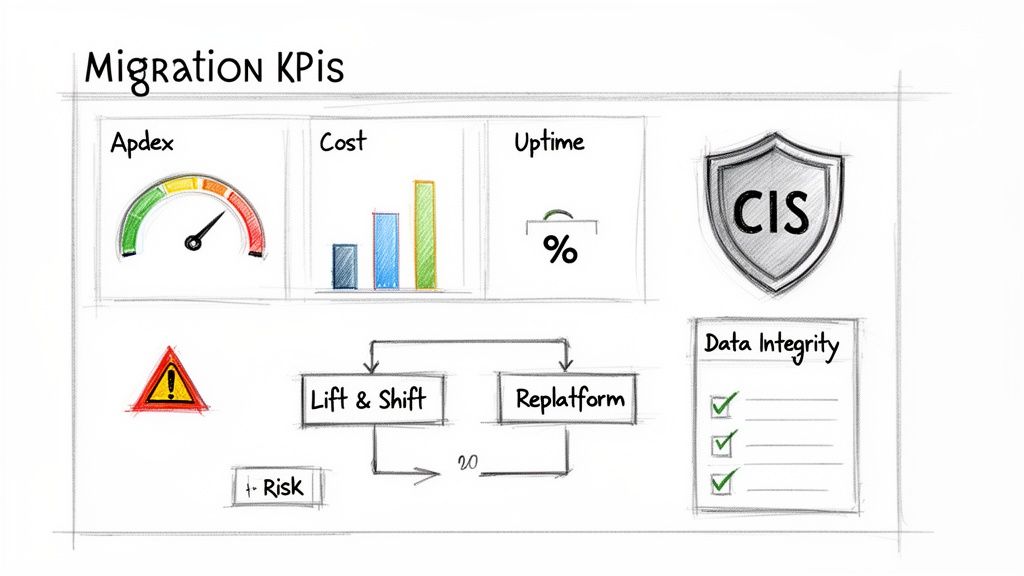
- Application Performance Metrics: The Apdex (Application Performance Index) score is an industry standard for measuring user satisfaction with application response times. For critical APIs, track P95 latency and error rates (e.g., percentage of 5xx responses). A regression in these metrics post-migration indicates a failure.
- Infrastructure Cost-to-Serve Ratios: Tie cloud spend directly to business metrics. For an e-commerce platform, this could be infrastructure cost per 1,000 orders processed. This ratio should decrease, demonstrating improved efficiency.
- Security Compliance Posture: Use automated tools to continuously assess your environment. The CIS (Center for Internet Security) benchmark score for your cloud provider, reported by a CSPM (Cloud Security Posture Management) tool, is an excellent KPI. Target a score of 90% or higher for all production environments.
Your SOW must explicitly define target KPIs and acceptance criteria. If a stated goal is a 20% cost reduction for a specific workload, this must be a measurable deliverable tied to payment.
Mitigating Common Technical Migration Risks
Despite expert planning, technical issues will arise. A proactive risk mitigation strategy differentiates a minor incident from a major outage.
1. Data Corruption During Transfer
Large-scale data transfer is fraught with risk. Network interruptions or misconfigured transfer jobs can lead to silent data corruption that may go undetected for weeks.
- Mitigation Strategy: Enforce checksum validation on all data transfers. Use tools like
rsync --checksumfor file-based transfers and leverage the built-in integrity checking features of cloud-native services like AWS DataSync. For database migrations, perform post-migration data validation using tools likept-table-checksumor custom scripts to verify record counts and data consistency.
2. Unexpected Performance Bottlenecks
An application that performs well on-premises can encounter significant performance degradation in the cloud due to subtle differences in network latency, storage IOPS, or CPU virtualization.
- Mitigation Strategy: Conduct rigorous pre-migration performance testing in a staging environment that is an exact replica of the target production architecture. Use load testing tools like k6 or JMeter to simulate realistic traffic patterns and identify bottlenecks before the production cutover. Never assume on-prem performance will translate directly to the cloud.
3. Security Misconfigurations
The most common source of cloud security breaches is not sophisticated attacks, but simple human error, such as an exposed S3 bucket or an overly permissive firewall rule.
- Mitigation Strategy: Implement security as code by integrating automated security scanning into your CI/CD pipeline. Use tools like Checkov or Terrascan to scan Infrastructure as Code (IaC) templates for misconfigurations before deployment. This "shift-left" approach makes security a proactive, preventative discipline rather than a reactive cleanup effort.
Frequently Asked Questions About Hiring Consultants
When engaging cloud migration consultants, numerous technical and strategic questions arise. Clear, early answers are critical for managing expectations, controlling costs, and ensuring a successful partnership.
Here are direct answers to the most common questions from engineering leaders.
What Are The Most Common Hidden Costs?
Beyond the consultant fees and cloud provider bills, several technical costs frequently surprise teams. A competent consultant should identify and budget for these upfront.
Be prepared for:
- Data Egress Fees: Transferring large datasets out of your existing data center or another cloud provider can incur significant, often overlooked, costs. This must be calculated, not estimated.
- New Observability Tooling: On-premises monitoring tools are often inadequate for dynamic, distributed cloud environments. Budget for new SaaS licenses for logging (e.g., Splunk, Datadog), metrics (e.g., Prometheus, Grafana Cloud), and distributed tracing (e.g., Honeycomb, Lightstep).
- Team Retraining and Productivity Dips: There is a tangible cost associated with your team's learning curve on new cloud-native technologies, CI/CD workflows, and architectural patterns. Plan for a temporary decrease in development velocity as they ramp up.
How Do I Ensure Knowledge Transfer To My Team?
You must prevent the consultants from becoming a single point of failure. If their departure results in a knowledge vacuum, the engagement has failed. Knowledge transfer must be an explicit, contractual obligation.
Mandate knowledge transfer as a specific, line-item deliverable in the SOW. Require mandatory pair programming sessions, the creation of Architectural Decision Records (ADRs) for all major design choices, and hands-on training workshops. The objective is not just documentation, but building lasting institutional capability.
The most effective method is to embed your engineers directly into the migration team. They should co-author IaC modules, participate in incident response drills, and contribute to runbooks. This hands-on involvement is the only way to build the deep, internal expertise required to own and operate the new environment.
What Is The Single Biggest Red Flag?
The most significant red flag is a cloud migration consultant who presents a pre-defined solution before conducting a thorough discovery of your specific applications, business objectives, and team skill set.
Be highly skeptical of any consultant who advocates for a one-size-fits-all methodology or a preferred vendor without a data-driven justification tailored to your unique context.
Elite consultants begin with a deep technical assessment. They ask probing questions about your stack, dependencies, and performance baselines. Their proposed strategy should feel bespoke and highly customized. If a consultant's pitch is generic enough to apply to any company, they are a salesperson, not a technical partner. A bespoke strategy is the hallmark of an expert; a canned solution is a reason to walk away.
Ready to partner with experts who build strategies tailored to your unique challenges? At OpsMoon, we connect you with the top 0.7% of DevOps talent to ensure your cloud migration delivers on its technical and business promises. Start with a free work planning session to map out your migration with confidence at https://opsmoon.com.
Leave a Reply