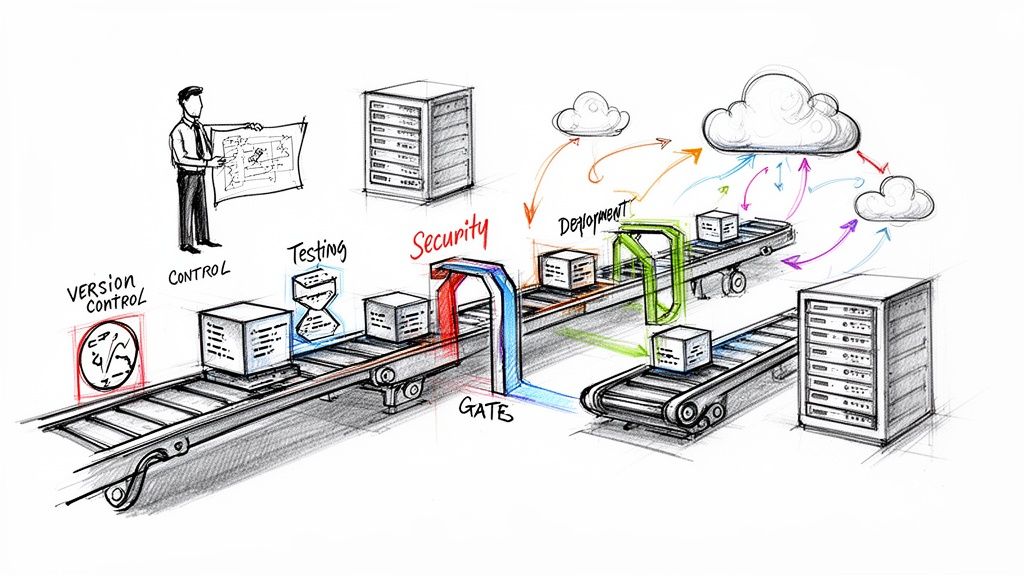
CI/CD consulting isn't just about tool installation. It’s the expert-led engineering service that re-architects and implements your automated software delivery pipelines. The objective is to replace slow, error-prone manual processes with a high-velocity, resilient system—a critical move for any organization that needs to innovate faster and slash operational risk by shipping reliable code.
What Is CI/CD Consulting?
Many engineering teams fall into the trap of viewing CI/CD as a tooling problem. The reality is that a robust CI/CD pipeline is the central nervous system for modern software delivery. It dictates the velocity, quality gates, and security posture for every single deployment.
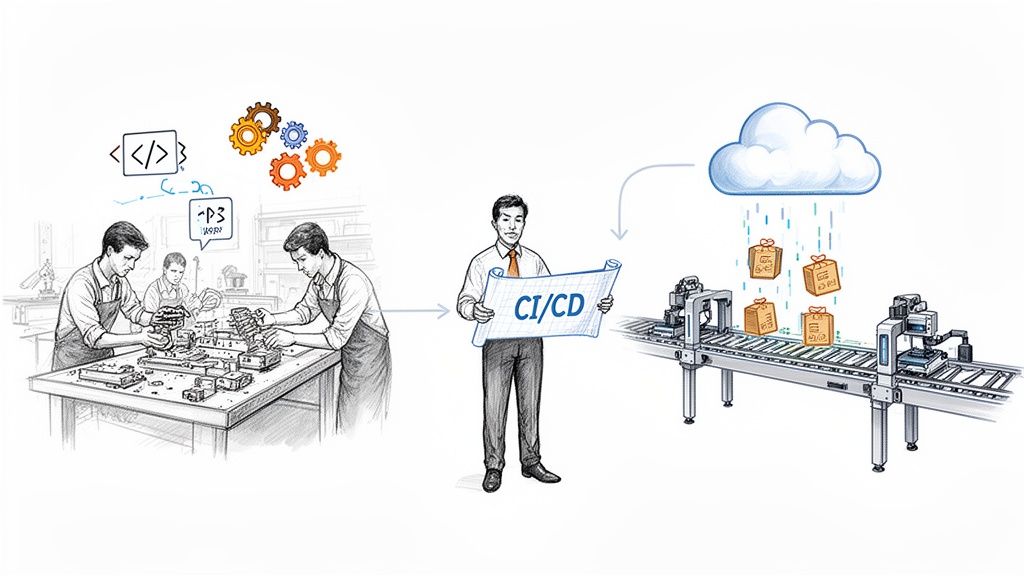
An old-school software process resembles an artisan workshop: skilled developers hand-crafting each component. It produces software, but it's slow, wildly inconsistent, and dangerously prone to human error. Each deployment is a high-stakes event, managed with manual checklists and hope-driven engineering.
CI/CD consulting provides the architectural and software engineering expertise to replace that workshop with a fully automated, observable, and resilient software factory. A consultant acts as the lead systems architect, blue-printing every stage of the software development lifecycle (SDLC) to eliminate toil and reduce cognitive load.
Re-Architecting Your Development and Deployment Process
The goal extends far beyond simple automation. We’re talking about a fundamental re-architecture of the workflow, from the moment a developer runs git commit to the second that code is handling live production traffic.
This transformation focuses on engineering a system that is:
- Fast: Automating builds, static analysis, unit/integration testing, and deployments to shrink the cycle time from a pull request to a production release. This means reducing the time it takes to get feedback on a change from hours or days to minutes.
- Reliable: Implementing immutable infrastructure and version-controlled, repeatable deployment processes to eliminate the "it works on my machine" class of errors and drastically cut down on deployment failures.
- Secure: Embedding automated security controls directly into the pipeline (DevSecOps) to detect vulnerabilities, secrets, and dependency issues early, not during a post-breach incident response.
This is why high-performing organizations no longer view CI/CD as an IT cost center. They recognize it as a fundamental investment in their ability to out-maneuver competitors and respond to market demands in near real-time.
A well-designed CI/CD pipeline isn't just about shipping code faster. It's about building an engineering culture of quality, feedback, and continuous improvement, where developers can focus on innovation instead of manual, repetitive tasks.
The demand for this level of expertise is accelerating. Between 2023 and 2034, global spending on CI/CD tools and services is projected to grow at a compound annual rate of 15–19%. This is no longer a niche practice; it's a mainstream strategic investment for any company building software. You can discover more insights about this growing market and its massive projected expansion.
Diagnosing a Broken Software Delivery Lifecycle
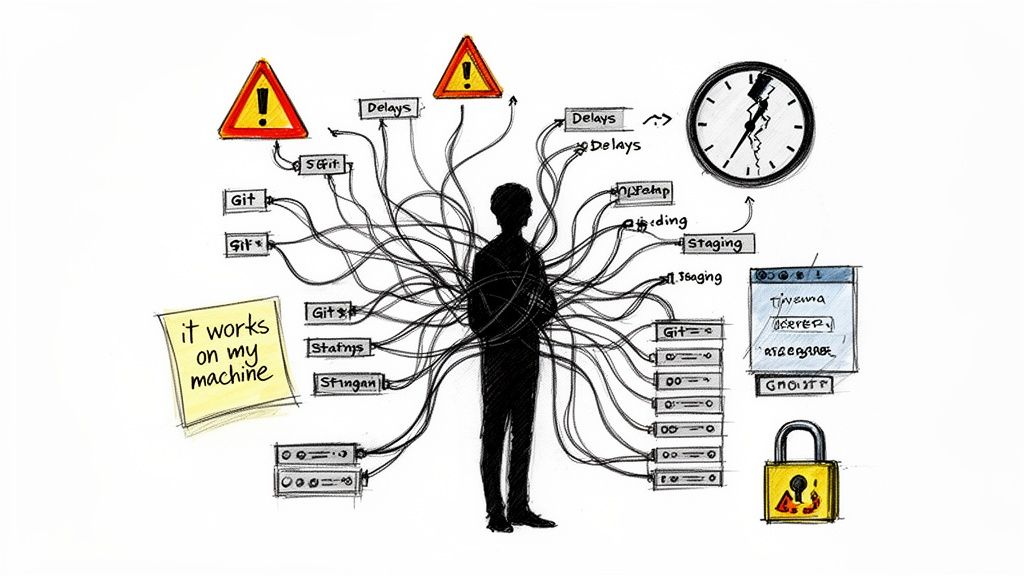
Before you can architect a solution, you must diagnose the specific failures in the system. A broken software delivery lifecycle (SDLC) is rarely a single catastrophic event. It’s a slow accumulation of technical debt, process flaws, and brittle infrastructure that grinds engineering velocity to a halt.
The symptoms manifest as daily, high-friction frustrations for your engineering teams, not just "slow releases."
These issues are more than minor annoyances. They directly inhibit innovation, crater developer morale, and kill product velocity. Pinpointing these specific failure modes is the first step in understanding the value that expert ci cd consulting can deliver.
The Anatomy of 'Merge Hell'
A classic symptom of a broken CI process is "merge hell." This state occurs when feature branches diverge significantly from the main branch over long periods, making the eventual integration a high-risk, bug-prone exercise.
Your most senior engineers, who should be architecting new systems, are instead forced to spend hours—sometimes days—resolving complex merge conflicts and untangling dependencies. This is a massive productivity sink that burns out top talent and stalls forward momentum. A core goal of CI is to integrate frequently (git pull --rebase becomes a reflex) to prevent this divergence.
Configuration Drift and Deployment Anxiety
Another clear indicator is the friction caused by environmental inconsistency. When development, staging, and production environments are configured manually, they inevitably experience configuration drift. This is the root cause of the infamous "it works on my machine" problem, which erodes trust between development, QA, and operations.
This inconsistency breeds a culture of deployment anxiety. Each release becomes a high-stakes, "all hands on deck" event managed by manual runbooks and last-minute heroics. The process is so painful and risky that teams actively avoid deploying, directly contradicting the principles of agility.
A healthy CI/CD pipeline transforms deployments from a source of fear into a routine, low-risk, and fully automated business-as-usual activity. It makes releasing new value to customers a non-event.
Manual Security Gates and Undetected Vulnerabilities
In a broken SDLC, security is often treated as a final, manual gate before production. This approach is not just slow; it's dangerously ineffective. Manual code reviews are prone to human error and cannot scale with the pace of modern development.
The result is that vulnerabilities are deployed to production. Common but critical issues, like hardcoded secrets in source code (AWS_SECRET_ACCESS_KEY="..."), go completely undetected. Research consistently shows that internal repositories can contain 8-10 times more secrets than public ones, creating a massive, unmonitored attack surface.
A proper DevSecOps pipeline integrates automated security scanning at multiple stages. It catches these issues early, providing developers with immediate feedback long before the code is merged.
If these symptoms are painfully familiar, you're not alone. Each represents a clear opportunity for improvement through intelligent automation and process re-engineering—the exact focus of a CI/CD consulting engagement.
What You Actually Get: Core CI/CD Consulting Deliverables
When you hire a CI/CD consultant, you're not just buying meetings and slide decks. You're investing in tangible engineering assets that enable your business to ship software faster and more reliably. The engagement moves beyond theory and into producing concrete, technical deliverables that solve real-world problems in your SDLC.
This is a structured process for engineering a better delivery engine, starting with a deep diagnosis and ending with a fully automated pipeline your team can own, operate, and extend with confidence.
A Data-Driven Assessment and Actionable Technical Roadmap
The first deliverable is a comprehensive DevOps maturity assessment. You cannot build the right solution without a precise understanding of the current state. This involves a deep technical audit of existing tools, workflows, code repositories, branching strategies, infrastructure, and deployment artifacts.
From this audit, the consultant produces a phased implementation roadmap. This is a strategic, step-by-step plan that prioritizes actions based on impact versus effort. It clearly defines technical milestones (e.g., "Phase 1: Implement Pipeline as Code for Service X"), success metrics (e.g., "Reduce build time from 45 mins to <10 mins"), and ensures every engineering action aligns with strategic business goals.
The roadmap is the architectural blueprint for your entire CI/CD transformation. It’s all about delivering incremental value at each stage, preventing a risky "big bang" approach that stalls progress and leaves everyone waiting for results.
So, how do high-level business pains map to the actual work a consultant does? Here’s a technical breakdown:
Mapping Business Problems To CI/CD Consulting Deliverables
This table shows how common frustrations in software delivery are directly addressed by specific, technical solutions from a CI/CD expert.
| Business Problem | Technical Root Cause | CI/CD Consulting Deliverable |
|---|---|---|
| "Our releases are slow and unpredictable." | Manual deployment processes, inconsistent environments, lack of automation. | Automated Deployment Pipelines defined with Pipeline as Code (Jenkinsfile, gitlab-ci.yml, GitHub Actions YAML). |
| "Bugs keep slipping into production." | Insufficient testing, no automated quality gates, long feedback loops for devs. | Integrated Quality Gates (unit tests, static code analysis with SonarQube, code coverage reports) and a Test Automation Framework. |
| "Our developers are bogged down by process." | Manual environment setup, complex build configurations, siloed security reviews. | Ephemeral Test Environments (spun up per PR via Terraform/Pulumi) and a Self-Service Developer Platform. |
| "We had a security breach from a leaked key." | Secrets are hardcoded in source control, no automated scanning. | DevSecOps Implementation with automated secrets scanning (e.g., Git-leaks) and SAST (e.g., Snyk, Checkmarx). |
| "Our teams can't easily reproduce issues." | "Works on my machine" syndrome, configuration drift between environments. | Version-Controlled Environments using Infrastructure as Code (IaC) tools like Terraform. |
As you can see, the deliverables are direct, technical solutions to frustrating and costly business problems. Let's dig into what some of those key deliverables look like.
Version-Controlled Pipeline as Code Artifacts
A core principle of modern DevOps is treating your pipeline configuration as code. A key deliverable from any credible consultant is Pipeline as Code (PaC).
This means your entire build, test, and deployment logic is defined in version-controlled text files that live alongside your application code in Git. This provides:
- Traceability: Every change to the pipeline is a Git commit. You can see who changed what, when, and why.
- Repeatability: Onboard a new microservice by reusing a standardized pipeline template. This eliminates configuration drift between services.
- Disaster Recovery: If your CI server is lost, you can rebuild the entire pipeline configuration from code in minutes.
Your consultant will deliver these artifacts using the standard formats for your CI/CD platform, like .gitlab-ci.yml files for GitLab CI/CD, workflow YAMLs for GitHub Actions, or Jenkinsfiles (declarative or scripted) for Jenkins.
Built-in Security and Quality Gates
In a modern SDLC, security is not a final step; it's a continuous process. A critical set of deliverables involves embedding automated security and quality checks directly into the pipeline itself.
This is the core of DevSecOps. The consultant will implement tools to catch vulnerabilities before code is merged. Key deliverables include:
- Static Application Security Testing (SAST): Tools like SonarQube or Snyk Code scan source code for known anti-patterns and vulnerabilities.
- Dynamic Application Security Testing (DAST): Tools like OWASP ZAP probe the running application in a test environment to find exploitable vulnerabilities.
- Secrets Scanning: Automated checks (e.g., truffleHog, gitleaks) that run pre-commit or on the CI server to prevent developers from committing credentials.
Beyond security, they will implement automated quality gates—such as enforcing unit test coverage thresholds and running linters—to ensure every commit meets your team’s engineering standards. There are many ways to approach CI/CD pipeline optimization to ensure these gates are fast and effective.
Automated Test Environments and Artifact Management
Finally, a consultant builds the supporting infrastructure for a truly automated workflow. This includes setting up ephemeral testing environments—fully functional, on-demand environments created automatically for every pull request. This allows developers and QA to test changes in a clean, isolated, production-like setting, which is one of the most powerful CI/CD pipeline best practices.
Another crucial component is configuring an artifact repository using tools like JFrog Artifactory or Sonatype Nexus. This provides a centralized, versioned storage for all build outputs (Docker images, Java JARs, npm packages), ensuring you have a single source of truth for every deployable component.
How to Measure the ROI of Your CI/CD Investment
A world-class CI/CD pipeline is a significant engineering asset. To justify the investment, you must speak the language of the business: Return on Investment (ROI).
Proving the value of CI/CD isn't about vague promises like "we'll go faster." It's about drawing a direct line from specific technical improvements to measurable business outcomes.
To achieve this, we rely on the four key DORA metrics. These are not vanity metrics for engineers; they are the industry standard for measuring the performance of elite software delivery teams. A successful CI/CD consulting engagement will demonstrably improve every single one.
From Technical Metrics to Financial Gains
Each DORA metric provides critical data about your team's velocity and stability. By establishing a baseline before a CI/CD implementation and tracking these metrics afterward, you can build a powerful, data-backed business case.
- Deployment Frequency: How often do you successfully release to production? Elite teams deploy on-demand, multiple times a day.
- Lead Time for Changes: What is the median time from code commit to production release? This is a raw measure of your entire delivery process efficiency.
- Change Failure Rate: What percentage of deployments to production result in a degraded service and require remediation? This is a direct measure of release quality.
- Mean Time to Recovery (MTTR): How long does it take to restore service after a production failure? This measures the resilience of your systems and processes.
The entire point of CI/CD is to increase Deployment Frequency and decrease Lead Time for Changes, while simultaneously driving down your Change Failure Rate and MTTR.
This is precisely what a consulting engagement is engineered to accomplish. It begins with a data-driven assessment, builds a strategic roadmap, and executes on the pipeline implementation that drives these numbers in the right direction.
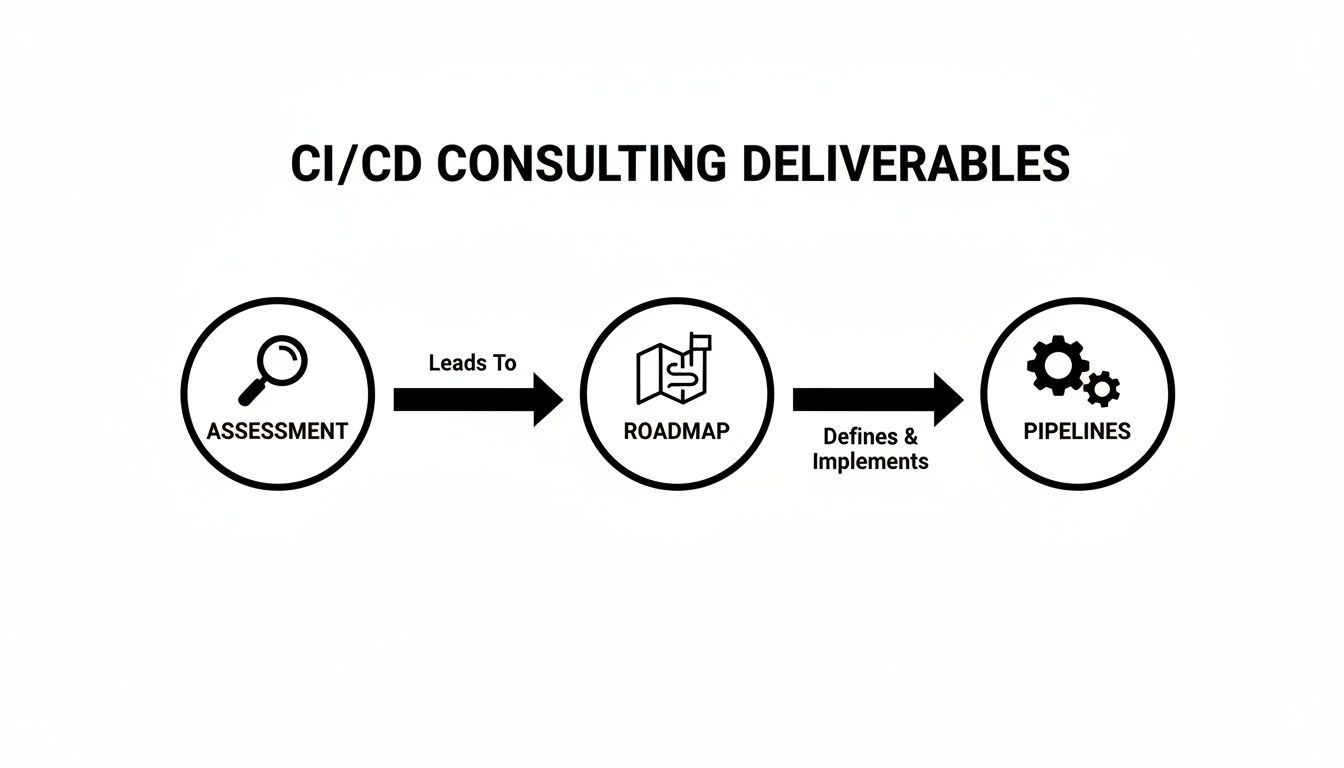
This flow ensures the work is not just technical tinkering; it's a deliberate process designed to deliver on the goals identified during the assessment phase.
Calculating the Financial Impact of Improved MTTR
Let's translate one of these metrics—MTTR—into a concrete financial calculation.
Assume your e-commerce platform generates $50,000 per hour. Before CI/CD, a production rollback is a manual, high-stress fire drill that takes, on average, a painful 90 minutes (1.5 hours) to resolve.
The cost of a single outage is:Revenue per Hour * MTTR in Hours = Cost of Downtime$50,000 * 1.5 = $75,000 per incident
Now, a CI/CD consultant implements a fully automated, one-click rollback capability. This is a standard deliverable. Your new MTTR drops to just 15 minutes (0.25 hours).
The new cost for the same outage is:$50,000 * 0.25 = $12,500 per incident
With this single automated process, you are now saving $62,500 per incident. This is the kind of hard data that makes the value of CI/CD impossible to ignore. Getting a handle on these numbers is a cornerstone of effective engineering productivity measurement.
Quantifying Speed and Stability Gains
The same logic applies across all DORA metrics. Reducing your Change Failure Rate from 15% to 3% means fewer incidents and less revenue lost to downtime. Increasing Deployment Frequency allows you to ship value to customers faster, capturing market share while your competitors are stuck in manual release cycles.
The data supports this. Over 49% of companies report a faster time-to-market after adopting CI/CD. When you shift from monthly releases to multiple daily deployments, you can execute hundreds more product experiments and feature releases per year. That’s hundreds more opportunities to win.
Your Vetting Checklist for Hiring a CI/CD Consultant
Choosing the right CI/CD partner is the most critical decision in this process. A great consultant will accelerate your DevOps transformation. A poor fit will leave you with technical debt and a brittle, hard-to-maintain system.
The key is to look beyond tool certifications and assess their fundamental understanding of modern, resilient engineering practices. This checklist is designed to help you distinguish true systems architects from tool operators—those who build for future scalability, not just a quick fix.
Beyond Tool Expertise
Any consultant can claim expertise in Jenkins, GitLab CI, or GitHub Actions. That is the bare minimum. True expertise lies in understanding how to integrate these tools into a larger ecosystem of reliability, security, and developer experience. You need a partner who thinks in systems, not just scripts.
A full-stack CI/CD firm will offer a spectrum of services, recognizing that these domains are deeply interconnected.
This illustrates that mature CI/CD consulting does not exist in a vacuum. It is intrinsically linked to Kubernetes, IaC, observability, and security.
Critical Questions for Your Interview Process
Use these questions to probe deeper than a resume. You are looking for their thought process, hard-won experience, and strategic architectural instincts.
-
Observability and Resilience: "How do you build observability into a CI/CD pipeline from day one? Give me an example of how you'd instrument a deployment to give us immediate feedback on its health in production—something more meaningful than just a 'success' or 'fail' status."
-
DevSecOps Integration: "Walk me through how you embed security into a pipeline from the very first commit. What specific tools or gates would you put in place at the commit, build, and deploy stages to catch vulnerabilities before they ever see the light of day?"
-
Infrastructure as Code (IaC) Mastery: "Tell me about a complex project where you used Terraform or Pulumi to manage the infrastructure that the CI/CD pipeline was deploying to. How did you handle state, and what was your strategy for promoting changes across different environments like dev, staging, and prod?"
-
Kubernetes and Container Orchestration: "We run on Kubernetes. How would you design a CI/CD pipeline that uses canary or blue-green strategies to make our deployments safer? What tools are your go-to for managing manifests and automating the rollout?"
-
Failure and Recovery: "Tell me about a time a pipeline you built failed spectacularly. What was the root cause, what did you learn from it, and what specific architectural changes did you make to ensure that entire class of failure could never happen again?"
A top-tier consultant won’t just talk about their wins. They'll have valuable war stories about failures and, more importantly, the resilient systems they built in response. How they talk about failure is a massive indicator of their true expertise.
Answering these questions well requires a deep, cross-functional understanding that you don't get from a certification course. For a broader perspective, our guide on choosing the right DevOps consulting company offers more evaluation criteria.
The answers will reveal whether they think about the entire software delivery lifecycle or are narrowly focused on a single tool. A true partner connects every technical decision back to your core goals: velocity, stability, and security.
Accelerate Your DevOps Journey with OpsMoon
Knowing you need to improve your DevOps capabilities is one thing; having the elite engineering talent to execute is another. OpsMoon was founded to close that gap. We connect you with the top 0.7% of pre-vetted global talent to solve the real-world challenges of modern software delivery.
Our model is designed for technical leaders who cannot afford hiring risks and require guaranteed results. You can bypass the months-long recruitment cycle and directly access a network of specialists in Kubernetes, Terraform, and advanced CI/CD automation.
Your Technical Roadmap Starts Here
Every engagement begins with a complimentary, in-depth work planning session. This is not a sales call. Our senior architects collaborate with you to define a concrete technical roadmap that maps directly to your business objectives. We will diagnose your current pipeline, identify high-impact areas for improvement, and define success with clear, measurable metrics.
This isn't a sales call; it's a strategic architectural session. We deliver actionable insights from the very first conversation, making sure we’re aligned on a clear vision for your CI/CD transformation before anyone signs anything.
This structured kickoff process eliminates ambiguity and establishes the foundation for a successful partnership, moving you from discussion to implementation.
Matched Expertise for Hands-On Results
Once the roadmap is established, our Experts Matcher technology pairs you with the ideal engineer for your project's specific technical requirements. We don't just find an engineer; we find the specialist with a proven track record of solving the exact problems you face.
Our engagement models are flexible to support your needs, whether you require:
- Strategic Advisory: High-level guidance to direct your internal teams.
- Hands-On Implementation: Dedicated engineers to architect, build, and deploy your new pipelines.
- Team Augmentation: Specialized talent to fill critical skill gaps and accelerate your existing projects.
To achieve meaningful progress, you must think strategically about initiatives like DevOps Integration Modernization services. OpsMoon provides the expert engineering capacity to execute that modernization. We handle the heavy lifting of pipeline architecture, security integration, and infrastructure automation, freeing your team to focus on building exceptional products.
Stop letting pipeline bottlenecks and manual toil dictate your release schedule. Book your free planning session today and start building a CI/CD capability that provides a true competitive advantage.
Burning Questions About CI/CD Consulting
If you're an engineering leader considering a CI/CD consultant, you likely have practical questions. Here are direct answers to common queries from CTOs and VPs of Engineering.
How Long Does a Typical CI/CD Consulting Engagement Last?
The duration depends entirely on your starting point and objectives. There is no one-size-fits-all answer.
A foundational assessment and strategic roadmap typically takes 2-4 weeks. A full pipeline implementation for a single application or service should be budgeted for 1-3 months.
For larger organizations with complex legacy systems, a phased transformation could extend over 6 months or more. The best approach is modular, delivering tangible value at each stage of the project.
What Is the Typical Cost of CI/CD Consulting Services?
The cost of CI/CD consulting depends on the engagement model (e.g., hourly, fixed-price), the consultant's experience level, and the technical complexity.
However, the cost must be evaluated in the context of ROI. A robust CI/CD strategy can generate hundreds of thousands of dollars in annual savings through reduced engineering toil, fewer production outages, and accelerated feature delivery.
The most important financial metric isn't the consultant's rate, but the value they create. Focus on the projected savings from reduced MTTR and the revenue gains from increased deployment frequency.
Viewed this way, consulting is not an operational expense but an investment in your team's delivery capability.
How Much Involvement Is Required From My Internal Team?
The level of involvement is flexible and depends on your goals. For a turnkey solution, your team's primary role might be providing architectural context and participating in the final hand-off and training.
However, the most successful engagements are collaborative. We strongly recommend embedding your engineers with our consultants. This is the most effective way to facilitate knowledge transfer and ensure your team can confidently own, operate, and evolve the new pipelines long after the engagement ends.
This collaborative model achieves two critical goals:
- It builds lasting in-house expertise, reducing future dependency on external consultants.
- It ensures the solutions are tailored to your team's specific workflows and culture.
Ultimately, this partnership approach makes the transformation sustainable, leaving your team self-sufficient and more effective.
Ready to transform your software delivery lifecycle? OpsMoon connects you with the top 0.7% of pre-vetted DevOps experts to build the CI/CD pipelines that drive business results. Book your free work planning session today.
Leave a Reply