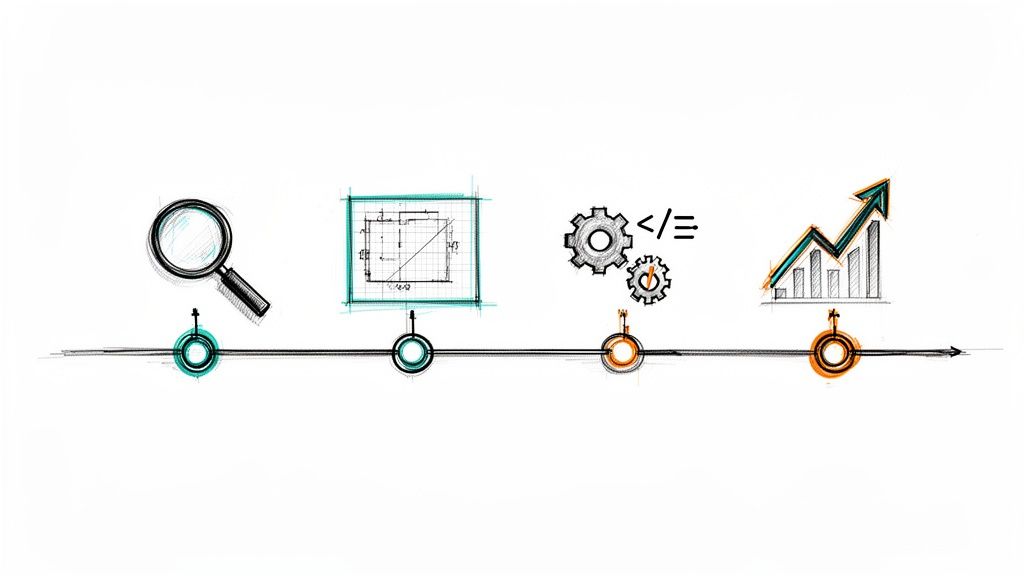
A data strategy consultation is a formal engagement to architect a company's data ecosystem. It defines the technical blueprint for how a business will ingest, store, model, secure, and operationalize its data to achieve specific, measurable outcomes. It is the methodical process of engineering a high-performance data platform, moving from ad-hoc data handling to a deliberate, value-generating machine.

Why a Data Strategy Consultation Is Critical for Growth
Without a defined strategy, most companies suffer from data entropy. Information becomes trapped in application-specific silos (e.g., Salesforce, a production PostgreSQL database, Google Analytics), reporting is inconsistent, and engineering teams miss critical insights because the underlying data infrastructure is a fragmented and brittle mess. A data strategy consultation architects a unified roadmap that directly couples data technology to measurable business objectives.
This is not a high-level software selection exercise. It's a hands-on technical audit of your entire data ecosystem. We perform deep-dive analyses to identify performance bottlenecks, security vulnerabilities, and non-scalable architectures. The objective is to design and implement a coherent infrastructure that transforms raw data into a reliable, high-integrity strategic asset.
From Technical Chaos to a Coherent Advantage
Without a formal strategy, I’ve seen countless technical teams trapped in a reactive loop of firefighting. They spend engineering cycles reconciling conflicting reports from disparate systems, manually debugging fragile data pipelines that fail silently, and struggling to answer complex business queries because their toolchain is inadequate. This creates a state of high operational drag that throttles innovation.
A data strategy consultation transitions the organization from reactive to proactive. It establishes a "single source of truth" by designing a centralized repository for your data, such as a cloud data warehouse or a data lakehouse. This technical alignment ensures all stakeholders—from data analysts to C-level executives—operate from the same validated, governed dataset. This accelerates decision-making velocity and improves its accuracy.
A consultant provides the technical blueprint and governance framework needed to transform data from a simple byproduct of operations into a core driver of business innovation and competitive advantage.
This architectural shift delivers quantifiable performance improvements. The big data consulting market is projected to reach $36.75 billion by 2030, a clear indicator that businesses are realizing direct ROI from improved data infrastructure and operational efficiency.
Comparing the Before and After
To quantify the impact, let's examine a technical breakdown of the before-and-after states. This transformation affects everything from daily engineering tasks to long-term R&D. For a deeper dive into how information architecture drives growth, see the ultimate guide to data for business growth.
Here’s a practical look at this transformation:
Business Transformation Before and After a Data Strategy
| Business Function | Before Data Strategy (Reactive) | After Data Strategy (Proactive & Optimized) |
|---|---|---|
| Decision-Making | Gut-feel decisions supported by siloed, often contradictory Excel exports. | Data-driven decisions based on a unified BI dashboard with real-time, validated data models. |
| IT/Engineering Focus | Manually maintaining brittle, point-to-point data integrations and scripts. | Engineering automated, scalable data pipelines with CI/CD, integrated testing, and observability. |
| Operational Efficiency | High manual overhead in data preparation, ad-hoc querying, and report generation. | Automated ELT/ETL workflows that liberate engineering teams for high-value analysis and feature development. |
| Scalability | On-premise servers and databases with high TCO, poor elasticity, and slow provisioning cycles. | Cloud-native architecture (e.g., Snowflake, BigQuery) that scales elastically with business demand and usage. |
This table illustrates the fundamental architectural shift: you transition from a system that generates technical debt to one that generates tangible business value. Similarly, our guide on cloud solution consulting details how expert-led implementation accelerates this transition.
Ultimately, a data strategy consultation delivers the technical architecture and strategic implementation plan required to build a sustainable competitive advantage.
The Phases of a Technical Data Consultation
A professional data strategy consultation is a structured, technical engagement, not a series of high-level meetings. It moves from deep architectural analysis to an executable implementation plan. For CTOs and engineering leaders, understanding these phases demystifies the process, clarifies deliverables, and ensures the output integrates directly into your engineering roadmap.
The process unfolds in four distinct technical phases. Each phase builds on the last, systematically moving from a current-state audit to a clear, value-driven implementation path. This is analogous to a software development lifecycle: discovery, design, implementation, and maintenance.
Phase 1: Technical Discovery and Maturity Assessment
The engagement begins with a deep, technical audit of your existing data ecosystem. This is a hands-on-keyboard investigation to profile data assets, map data lineage, and analyze system performance. The consultant gains access to your infrastructure to map every significant data source—from production databases (e.g., MySQL, Postgres) and SaaS APIs like Salesforce to event streams (e.g., Kafka, Kinesis) and third-party data feeds.
Key technical activities include:
- Data Source Auditing: Cataloging all data inputs and profiling them for schema, quality, volume, and velocity. This involves running SQL queries, using data profiling tools, and analyzing API documentation to identify data gaps, inconsistencies, and formats.
- Infrastructure Analysis: A thorough review of your current data stack—databases, ETL/ELT pipelines, orchestration tools, and analytics platforms. The focus is on identifying performance bottlenecks, scalability ceilings, security vulnerabilities, and cost inefficiencies.
- Maturity Evaluation: Benchmarking your current data practices against established industry models (e.g., CMMI for data). This produces a quantitative score of your capabilities in areas like data governance, analytical maturity, and operational excellence, providing an objective baseline.
The primary deliverable is a Data Maturity Assessment Report. This is a detailed technical document presenting a "current-state architecture" and a gap analysis that specifies your most critical technical challenges and strategic opportunities.
Phase 2: Architectural Blueprint and Roadmap Design
With a clear "as-is" state defined, the next phase is to design the "to-be" architecture. This is where high-level strategy translates into a detailed technical blueprint. The consultant collaborates with your engineering and product leadership to design a target data architecture aligned with specific business goals, such as powering a new machine learning model or enabling real-time operational dashboards.
This involves making critical architectural decisions, such as selecting between a centralized data warehouse, a data lake, or a hybrid data lakehouse architecture. The consultant will model data flows, define data storage layers (e.g., raw, staging, modeled), and design an architecture optimized for performance, scalability, and cost-effectiveness.
The output is a Prioritized Initiative Roadmap. This is your step-by-step implementation plan to reach the target state. It decomposes the project into manageable, sequenced initiatives, each with clearly defined technical objectives, timelines, resource requirements, and dependencies.
This roadmap is a tactical defense against monolithic "big bang" projects, which have a high failure rate. Instead, you get a clear path for delivering incremental value, achieving quick wins, and building momentum toward the long-term architectural vision.
Phase 3: Technology Stack and Governance Framework
With the blueprint and roadmap established, this phase focuses on selecting the optimal toolchain and codifying the rules of data management. This involves creating a detailed technology selection matrix and a robust data governance framework.
On the technology side, the consultant will conduct a technical evaluation of various solutions based on your specific requirements. For example, if a cloud data warehouse is the chosen architecture, they will run a technical proof-of-concept (POC) comparing options like Snowflake, Google BigQuery, and Amazon Redshift, weighing factors like query performance, concurrency scaling, data sharing capabilities, and integration with your existing ecosystem.
Simultaneously, we design and document a Data Governance Model. This is not a theoretical policy document but a practical, implementable framework defining:
- Data Ownership: Clear assignment of responsibility for the quality, security, and lifecycle management of specific data domains.
- Access Controls: A plan for implementing role-based access control (RBAC) to ensure data is secure and used appropriately.
- Data Quality Standards: Definition of automated checks, tests, and processes to be integrated into data pipelines to maintain data integrity and trustworthiness.
This framework is critical for preventing architectural drift and ensuring the data ecosystem remains organized, secure, and reliable as it scales.
Phase 4: Implementation Oversight and Value Measurement
A strategy's value is realized only through its execution. In this final phase, the consultant transitions from architect to technical advisor, providing oversight to ensure the roadmap is implemented correctly. This can involve helping your team bootstrap the initial sprints, providing architectural guidance during development, and assisting in troubleshooting complex integration challenges.
Crucially, this phase defines how success will be measured. The consultant helps you establish specific Key Performance Indicators (KPIs) to track the ROI of your data initiatives. These are not vague business metrics but concrete, measurable indicators such as "reduction in data pipeline failure rate," "improvement in P95 query performance," or "decrease in time-to-insight" for business intelligence reports.
This final step ensures the value of your data strategy consultation is tangible, quantifiable, and continuously monitored.
How to Select the Right Data Strategy Consultant
Choosing the right data strategy consultant is a critical technical procurement decision. The wrong choice results in an expensive, abstract slide deck and a stalled project. The right choice delivers an executable technical blueprint that drives measurable growth.
The key is to look beyond marketing claims and focus on specific, verifiable technical expertise.
Do not be swayed by promises of "digital transformation." Instead, verify their hands-on experience with the cloud platforms you use or intend to use—AWS, GCP, or Azure. Demand to see anonymized case studies or architectural diagrams where they have built real-world solutions using services like Amazon S3, Google BigQuery, or Azure Synapse Analytics.
This level of technical diligence is why, despite the proliferation of self-service tools, Fortune 500 companies still rely on expert consultancies. They require credible, deeply technical partners who can design and build systems that their internal teams may lack the specialized expertise or bandwidth for.
Evaluating Technical and Methodological Expertise
A top-tier consultant is fluent in modern data engineering principles. A key area to probe is their approach to DataOps.
Do they integrate data transformation logic into CI/CD pipelines? Can they articulate the pros and cons of using Infrastructure as Code (IaC) tools like Terraform or Pulumi for provisioning and managing data platforms? Their answers will rapidly differentiate those who build robust, automated systems from those who only create PowerPoint architectures.
You should also evaluate their experience with modern data modeling techniques. A proficient consultant's knowledge extends beyond traditional star schemas. They should be able to discuss the practical application of concepts like Data Vault 2.0 for building auditable, scalable data warehouses or the implementation of a domain-driven data mesh for facilitating decentralized data ownership in large enterprises.
A consultant's real value is their ability to connect high-level business goals to specific, executable engineering tasks. They should be able to explain not just what to build, but how to build it in a way that is scalable, secure, and maintainable.
Their ability to enable your team is equally critical. In our guide on effective consultant talent acquisition, we emphasize that the best consultants are also mentors. Their goal should be to upskill your engineers and make them self-sufficient, not to create a long-term dependency.
Understanding Pricing Models
The pricing model for a data strategy consultation directly impacts budget and project agility. Understanding the trade-offs is crucial before committing.
Here is a technical comparison of the most common models.
Comparison of Data Strategy Consultation Pricing Models
| Pricing Model | How It Works | Best For | Potential Pitfalls |
|---|---|---|---|
| Fixed-Price | A single, predetermined cost for a clearly defined scope of work (SOW) and deliverables. | Projects with well-understood requirements and a finite scope, such as a technical maturity assessment or a technology selection POC. | Inflexibility. Unforeseen technical complexity or scope changes can lead to costly change orders or a rushed, lower-quality deliverable. |
| Time & Materials (T&M) | You are billed at an hourly or daily rate for the consultant's time, plus any direct expenses. | Exploratory or agile projects where the scope is expected to evolve, such as initial architectural design and roadmap development. | Lack of cost certainty. Requires diligent project management and frequent check-ins to prevent budget overruns. |
| Retainer | A recurring monthly fee for a pre-defined number of hours or ongoing access for advisory services. | Long-term engagements requiring continuous implementation oversight, architectural reviews, and strategic guidance. | Potential for underutilization. You pay the fee regardless of whether you use the full block of hours. |
Each model serves a purpose. A fixed-price model is ideal for a well-defined assessment. However, for a complex architectural design that will iterate based on findings, a T&M or retainer model provides the necessary flexibility to achieve the optimal outcome.
Critical Questions for Your Vetting Process
To make an informed decision, you need questions that cut directly to technical competence. These questions force candidates to move beyond buzzwords and provide concrete, verifiable evidence of their skills.
Here are four essential questions to ask:
- Data Security & Governance: How do you approach implementing security protocols like network policies, encryption, and data masking in a cloud data warehouse? Describe a specific project where you designed and implemented a role-based access control (RBAC) model.
- Infrastructure & Automation: What is your experience integrating data pipeline code (e.g., dbt models) into an existing CI/CD framework? Provide a specific example of how you have used tools like dbt or Airflow to automate data quality testing and deployment.
- Knowledge Transfer: What is your methodology for documenting architectural decisions and technical processes? How do you ensure our internal team can operate, maintain, and extend the system independently after the engagement concludes?
- Vendor Neutrality: Walk me through your process for creating a technology selection matrix. How do you evaluate and weigh criteria like performance benchmarks, pricing models, and ecosystem integration to avoid bias toward specific vendors?
Their responses will provide a clear signal of their technical depth, strategic thinking, and their capacity to function as a true technical partner.
Building Your Technical Data Strategy Roadmap
A data strategy consultation culminates in a tangible, phased technical roadmap—not a theoretical document. This is an actionable, quarter-by-quarter implementation plan that provides your engineering team with precise instructions on how to evolve your data stack from its current state to a high-value, future-state architecture.
Think of it as the master project plan for your data platform. It decomposes a large, complex initiative into manageable, sequential phases, each with its own specific technical objectives, technologies, and measurable outcomes. This methodology mitigates the risk of "big bang" project failure by delivering incremental value and building momentum.
Here is an example of what a three-quarter roadmap might look like, progressing from foundational infrastructure to advanced analytics.

The logical progression is clear: Q1 establishes the architectural and governance foundation. Q2 focuses on building the central data warehouse. By Q3, you are positioned to launch advanced analytics programs.
Phase 1: Laying the Foundation (Q1)
You cannot build a high-performance data platform on a chaotic, ungoverned foundation. The primary objective of this phase is to establish control, automate infrastructure, and create a scalable environment.
Key technical deliverables for this quarter include:
- Data Governance Framework: Defining and documenting data ownership, access control policies, and data quality standards. This translates into implementing roles and permissions within your data platforms and setting up initial data quality monitors.
- Infrastructure as Code (IaC) Setup: Using tools like Terraform or CloudFormation to automate the provisioning of core data infrastructure (e.g., cloud storage buckets, networking, compute clusters). This ensures your environment is repeatable, version-controlled, and scalable.
- Initial Data Source Integration: Begin by connecting your most critical data sources—such as your main production database and CRM—to a cloud storage staging area using modern ELT tools, establishing the initial data ingestion pipelines.
The outcome is a stable, documented, and automated foundation, ready for the centralization of data in the next phase.
Phase 2: Building the Data Warehouse and BI Layer (Q2)
With a solid foundation, it's time to build your "single source of truth." This phase focuses on constructing a centralized cloud data warehouse where all structured data is consolidated, modeled, and made available for analysis. A modern enterprise data strategy is crucial for architecting this layer correctly.
The technical work includes:
- Data Warehouse Deployment: Provisioning and configuring a cloud data warehouse like Snowflake, Google BigQuery, or Amazon Redshift using the IaC scripts developed in Q1.
- Data Modeling and Transformation: Using tools like dbt to build robust, tested, and documented data models. This process transforms raw, disparate data into clean, analysis-ready dimensional models (e.g., star schemas).
- Business Intelligence (BI) Tool Connection: Connecting your BI platform (e.g., Tableau, Looker, Power BI) to the new data warehouse and building the first set of core dashboards for key business functions.
The result of this phase is immediate, tangible business value. Your teams gain self-service access to trusted, unified data, eliminating manual report generation and data reconciliation efforts.
Phase 3: Launching an Advanced Analytics Pilot (Q3)
Once your core data is clean, centralized, and modeled, you can ascend the data value chain to advanced analytics and machine learning. This phase involves executing small, targeted pilot projects to demonstrate the ROI of predictive insights and solve more complex business problems.
A roadmap without metrics is just a wishlist. The crucial final step is connecting every technical initiative to specific, measurable Key Performance Indicators (KPIs) that prove the value of your investment.
These pilots might include building a customer churn prediction model using logistic regression, developing a sales demand forecasting model using time-series analysis, or creating a customer segmentation model using clustering algorithms. The objective is to prove the ROI of advanced analytics on a small, controlled scale before committing to larger investments.
Connecting the Roadmap to Measurable KPIs
A technical roadmap's success is determined by your ability to measure its impact. A key component of any effective data strategy consultation is defining engineering-focused KPIs to track progress and demonstrate ROI. These are not abstract business goals but hard metrics that reflect technical and operational improvements.
Here are examples of technical KPIs that are critical to track:
- Data Processing Latency: The end-to-end time from data generation in a source system to its availability in an analytical dashboard. A key objective is to reduce this from hours or days to minutes, enabling near real-time decision-making.
- Data Quality Score: The percentage of records in critical datasets that pass automated data quality tests (e.g., for nulls, duplicates, referential integrity). A common goal is to improve this score from a baseline of 70% to >99%.
- Time-to-Insight: The time required for a business user to answer a new analytical question. By implementing a self-service BI platform on a modeled data warehouse, you can aim to reduce report generation time by 90%, from weeks to hours.
- Data Asset Utilization Rate: A measure of how frequently key data models and dashboards are being queried. This KPI validates that you are building assets that provide tangible business value.
Connecting Strategy to Execution with DataOps
A data strategy remains a theoretical exercise until it is operationalized. After a data strategy consultation defines the "what" and "why," the focus must shift to the "how." This is where engineering execution begins—transforming architectural diagrams into a high-performance, resilient data platform.
The critical bridge between strategic vision and working reality is a robust DataOps culture.
DataOps is the application of DevOps principles—automation, CI/CD, version control, and testing—to the entire data lifecycle. It is the engineering discipline that ensures the data infrastructure designed by your consultant is not a one-off project but a durable, scalable platform that can adapt to changing business needs. This is how you operationalize your strategy, making it resilient, observable, and maintainable.

This engineering-centric mindset is vital. Market research indicates that 81% of technology buyers plan to increase their reliance on external consulting for project execution, and 84% are planning infrastructure upgrades. This highlights a clear trend: companies require specialized engineering skills to build the systems their strategies demand. You can learn more about how firms are leaning on consulting for technology execution from recent industry analysis.
Automating Infrastructure with IaC
A core tenet of DataOps is managing your data platforms as code. This practice, known as Infrastructure as Code (IaC), involves defining and provisioning your entire infrastructure—from servers and databases to networking and permissions—using configuration files stored in a version control system like Git. Tools like Terraform and CloudFormation are industry standards for this.
Instead of an engineer manually clicking through a cloud console to configure a new data warehouse, they execute a script. The benefits are significant:
- Repeatability: You can deterministically provision identical development, staging, and production environments with a single command, eliminating "works on my machine" issues.
- Version Control: Every change to your infrastructure is tracked in Git, providing a complete audit trail. If a change introduces an error, you can instantly roll back to a known-good state.
- Scalability: Scaling your infrastructure, such as increasing the size of a Kubernetes cluster or provisioning a new database, is achieved by updating a configuration file, not by following a lengthy manual process.
For example, a data engineer can use a Terraform module to automatically provision a Snowflake data warehouse, configuring databases, user roles, virtual warehouses, and access permissions in a predictable, secure, and repeatable manner.
Building Resilient Data Pipelines with CI/CD
The other pillar of DataOps is applying Continuous Integration and Continuous Deployment (CI/CD) to data pipelines. This means automating the testing and deployment of your data transformation code, such as the SQL models developed in dbt (data build tool).
A data strategy remains a theoretical exercise until it is supported by automated, tested, and observable engineering practices. DataOps provides the technical framework to deliver on the promises made during the consultation.
A robust CI/CD pipeline for dbt models typically looks like this:
- Code Commit: An analyst or engineer commits a change to a dbt model and pushes it to a Git repository.
- Automated Build: A CI server (e.g., GitHub Actions, Jenkins) detects the commit and triggers a build process.
- Automated Testing: The pipeline executes a suite of tests against a staging environment. This includes not just unit tests on the code but also data quality tests on the output, such as asserting uniqueness on a primary key or checking for accepted values in a column.
- Deployment: Only if all tests pass does the pipeline automatically deploy the new or updated models to your production data warehouse.
This level of automation drastically reduces the risk of human error and ensures that bad data or broken code does not reach production. It elevates data pipeline development from a fragile, manual task to a reliable, professional engineering discipline. To accelerate this implementation, expert assistance can be invaluable; our DevOps advisory services are specifically designed to implement these types of automated workflows.
Got Questions About Data Strategy Consulting? We’ve Got Answers.
Even with a clear technical path forward, it’s common for CTOs, founders, and engineering leaders to have specific questions about the engagement process. You want to ensure full alignment before committing resources.
These are not high-level business queries. These are the practical, technical questions we hear frequently regarding cost, preparation, and expected outcomes.
How Much Does a Data Strategy Consultation Typically Cost?
This is a critical question, and the answer is: it depends on the scope and complexity. The cost of a data strategy consultation varies significantly based on the technical depth required.
A narrowly focused assessment for a single business unit or application might start around $25,000. At the other end of the spectrum, a comprehensive, enterprise-wide transformation plan for a large organization with complex legacy systems can exceed $300,000.
Several technical factors are key drivers of cost:
- Scope of Engagement: Are we architecting a single-domain analytics solution or a complete, multi-domain enterprise data platform?
- Ecosystem Complexity: The number of data sources, their formats (structured, semi-structured, unstructured), data volume, and the presence of brittle legacy systems all increase the hours required for discovery, design, and validation.
- Project Duration: Most engagements range from 6 to 16 weeks. Longer projects that include deeper hands-on technical guidance and POC development will have a higher cost.
- Consultant Expertise: Elite consultants with a verifiable track record of designing and overseeing the implementation of successful data platforms command higher rates than generalist business advisors.
A word of advice: evaluate proposals on the depth of the technical deliverables, not just the sticker price. A cheap, generic PowerPoint strategy is a lot more expensive in the long run than a well-priced, actionable technical roadmap your engineers can actually build.
What Internal Prep Should We Do Before Hiring a Consultant?
To maximize the value of the engagement, some preparatory work is essential. Arriving prepared allows the consultant to bypass basic discovery and immediately focus on high-impact architectural and strategic tasks.
Before the first kickoff meeting, your team should:
- Define the Business Problem: Articulate the specific technical or business challenge you aim to solve. Is it to reduce customer churn by 5%? To optimize supply chain logistics by improving forecast accuracy? To increase marketing ROI through better attribution modeling?
- Identify Key Stakeholders: Assemble a small, cross-functional team that includes representatives from engineering, product, and key business units who are directly impacted by current data challenges.
- Inventory Your Technical Assets: Create a preliminary inventory of your major data sources (e.g., your Salesforce instance, ERP system, production databases), existing analytics tools (e.g., Tableau, Power BI), and core infrastructure platforms (e.g., AWS, GCP).
- Secure an Executive Sponsor: Ensure you have a senior leader with budgetary authority who understands the project's strategic importance and is prepared to champion it internally and remove roadblocks.
This preparation ensures the consultation is focused and efficient from day one.
What’s the Difference Between a Data Strategy Consultant and a Data Engineer?
The distinction is best understood through the architect vs. builder analogy. Both roles are critical for success, but they have different functions.
A data strategy consultant is the architect. Their primary role is to design the blueprint. They translate high-level business objectives into a specific technical vision, creating a detailed roadmap that defines the target architecture, data governance policies, and technology stack. They answer the "what" and "why."
A data engineer is the expert builder. They are the hands-on practitioner who takes the architectural blueprint and implements it. They write the code to build data pipelines (ELT/ETL), deploy and manage the data warehouse, and ensure the data infrastructure is reliable, performant, and scalable. They deliver the "how."
A successful project requires a seamless partnership between both. The consultation provides the strategic and architectural direction, while the engineering team provides the execution power to bring that vision to life.
How Long Does It Take to See ROI from a New Data Strategy?
The ROI from a new data strategy is not monolithic; it is realized in stages. A well-designed roadmap prioritizes initiatives to deliver incremental value, providing quick wins that build momentum and justify further investment.
A realistic ROI timeline is as follows:
- Quick Wins (3-6 Months): The initial returns are typically from operational efficiencies. Automating manual reporting processes, unifying siloed data sources for a single department, or improving data quality can yield significant time savings and enable smarter, faster decisions within the first two quarters.
- Strategic ROI (12-24 Months): The larger, transformative returns take longer to materialize. This is where you see a measurable impact on top-line revenue or product innovation—for example, a machine learning model that measurably improves customer retention or a new data-powered feature that creates a competitive advantage.
One of the most critical deliverables from a quality data strategy consultation is a set of KPIs designed to track both the short-term operational improvements and the long-term strategic value. This provides a clear, data-driven view of your ROI throughout the entire journey.
Ready to turn your data strategy from a document into a reality? The expert engineers at OpsMoon specialize in the hands-on execution needed to build, automate, and scale the data infrastructure your strategy demands. Start with a free work planning session to map your technical roadmap and get matched with the top 0.7% of global talent. Visit https://opsmoon.com to begin.
Leave a Reply