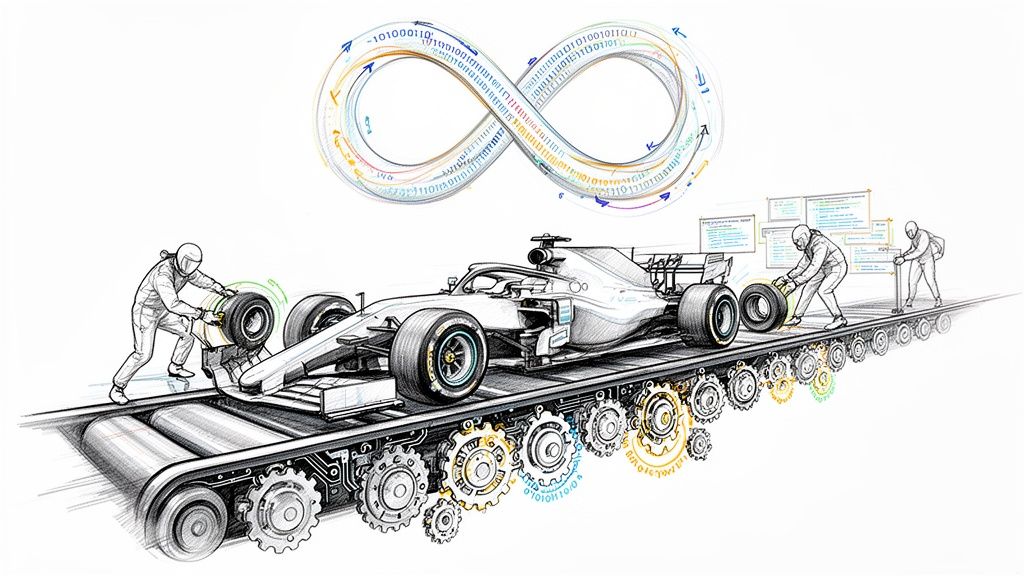
How do you ship features faster without blowing up production? The answer is a technical one: you integrate the rapid, iterative cycles of Agile with the automated, infrastructure-as-code principles of DevOps. This combination, DevOps agile development, is how high-performing engineering teams continuously deploy value to users while maintaining system stability through rigorous automation.
Merging Agile Speed with DevOps Stability
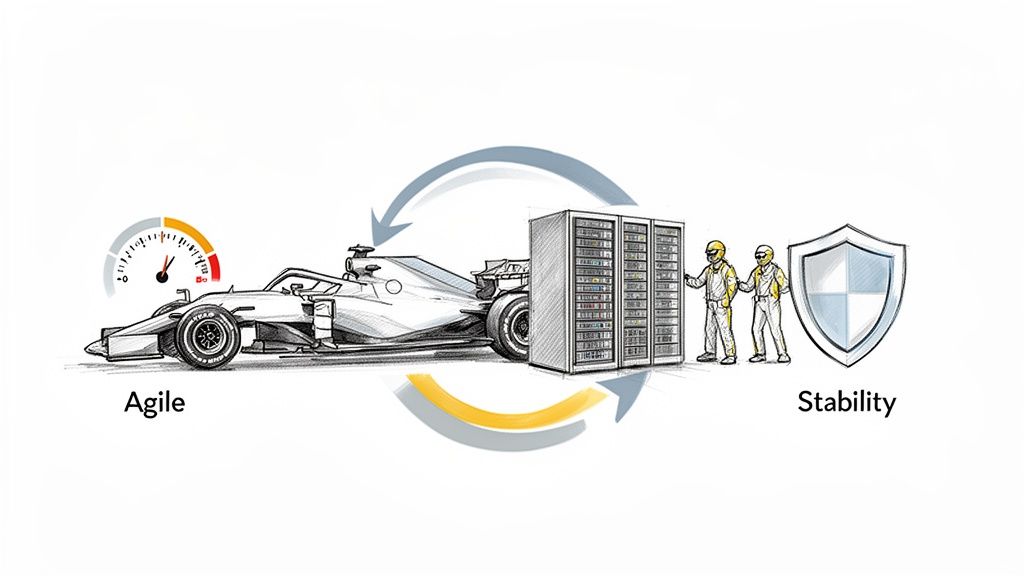
Think of it in engineering terms. Agile is the methodology for organizing the development work. It uses frameworks like Scrum to break down complex features into small, testable user stories that can be completed within a short sprint (typically two weeks). This produces a constant stream of validated, production-ready code.
DevOps provides the automated factory that takes that code and deploys it. It’s the CI/CD pipeline, the container orchestration, and the observability stack that make seamless, frequent deployments possible. DevOps isn't a separate team; it's a practice where engineers own the entire lifecycle of their code, from commit to production monitoring, using a shared, automated toolchain.
The Technical Synergy
The integration point is where Agile’s output (a completed user story) becomes the input for a DevOps pipeline. Agile provides the what—a small, well-defined code change. DevOps provides the how—an automated, version-controlled, and observable path to production.
This synergy resolves the classic operational conflict between feature velocity and production stability. Instead of a manual handoff from developers to operations, a single, automated workflow enforces quality and deployment standards.
- Agile Sprints Feed the Pipeline: Each sprint concludes, delivering a merge request with code that has passed local tests and is ready for integration.
- DevOps Pipelines Automate Delivery: This merge request triggers a CI/CD pipeline that automatically builds, tests, scans, and deploys the code, providing immediate feedback on its production-readiness.
- Feedback Loops Improve Both: If a deployment introduces a bug (e.g., a spike in HTTP 500 errors), observability tools send an alert. The rollback is automated, and a new ticket is created in the backlog for the Agile team to address in the next sprint. This tight integration is the core of Agile and continuous delivery in our related article.
At its heart, DevOps agile development creates a high-performance engine for software delivery. It’s not just about speed; it's about building a system where speed is the natural result of quality, automation, and reliability.
This guide provides the technical patterns, integration points, and key metrics required to build this engine. Understanding how these two methodologies connect at a technical level is what transforms your software delivery lifecycle from a bottleneck into a competitive advantage.
Deconstructing the Core Technical Principles
To effectively integrate Agile and DevOps, you must understand their underlying technical mechanisms. Agile is more than meetings; its technical function is to decompose large features into small, independently deployable units of work, or user stories.
This decomposition is a critical risk management strategy. Instead of a monolithic, months-long development cycle, Agile delivers value in small, verifiable increments. This creates a high-velocity feedback loop, enabling teams to iterate based on production data, not just assumptions.
Agile: The Engine of Iteration
Technically, Agile’s role is to structure development to produce a continuous stream of small, high-quality, and independently testable code changes. It answers the "what" by providing a prioritized queue of work ready for implementation.
- Iterative Development: Building in short cycles (sprints) ensures you always have a shippable, working version of the software.
- Continuous Feedback: Production metrics and user feedback directly inform the next sprint's backlog, preventing engineering effort on low-value features.
- Value-Centric Delivery: Work is prioritized by business impact, ensuring engineering resources are always allocated to the most critical tasks.
This iterative engine constantly outputs tested code. However, Agile alone doesn't solve the problem of deploying that code. That is the domain of DevOps.
DevOps: The Automated Delivery Pipeline
If Agile is the "what," DevOps is the "how." It's the technical implementation of an automated system that moves code from a developer's IDE to production. At its core, DevOps is a cultural and technical shift that unifies development and operations to shorten development cycles and increase deployment frequency. To grasp its mechanics, you must understand the DevOps methodology.
DevOps transforms software delivery from a manual, high-risk ceremony into an automated, predictable, and repeatable process. Its technical pillars are designed to build a software assembly line that is fast, stable, and transparent.
This assembly line is built on three foundational technical practices:
- Continuous Integration/Continuous Delivery (CI/CD): This is the automated workflow for your code. CI automatically builds and runs tests on every commit. CD automates the release of that validated code to production.
- Infrastructure as Code (IaC): Using tools like Terraform or CloudFormation, infrastructure (servers, networks, databases) is defined in version-controlled configuration files. This eliminates manual configuration errors and enables the creation of identical, ephemeral environments on demand.
- Monitoring and Observability: This is about gaining deep, real-time insight into application and system performance by collecting and analyzing metrics, logs, and traces. This allows teams to detect and diagnose issues proactively.
Together, these principles form a powerful system. Agile feeds the machine with small, valuable features, and DevOps provides the automated factory to build, test, and ship them reliably and safely.
Integrating Sprints With CI/CD Pipelines
This is the critical integration point where Agile development directly triggers the automated DevOps pipeline. The objective is to create a seamless, machine-driven workflow that takes a user story from the backlog to production with minimal human intervention.
The process begins when a developer commits code for a user story to a feature branch in Git. The git push command is the trigger that initiates a Continuous Integration (CI) pipeline in a tool like Jenkins, GitLab CI, or CircleCI.
This CI stage is a gauntlet of automated quality gates designed to provide developers with immediate, actionable feedback.
The Automated Quality Gauntlet
Before any peer review, the pipeline enforces a baseline of code quality and security, catching issues when they are cheapest to fix.
A typical CI pipeline stage executes the following jobs:
- Unit Tests: Small, isolated tests verify that individual functions behave as expected (e.g., using Jest for Node.js or JUnit for Java). A failure here immediately points to a specific bug.
- Static Code Analysis: Tools like SonarQube or linters (e.g., ESLint) scan the source code for bugs, security vulnerabilities (like hardcoded secrets), and maintainability issues ("code smells").
- Container Vulnerability Scans: For containerized applications, the pipeline scans the Docker image layers for known vulnerabilities (CVEs) in OS packages and language dependencies using tools like Trivy or Snyk.
Only code that passes every gate receives a "green" build. This automated validation is the prerequisite for a developer to open a merge request (or pull request), formally proposing to integrate the feature into the main branch.
This automation is the foundation of the Agile and DevOps partnership. Data shows that teams mastering this integration achieve a 49% faster time-to-market and a 61% increase in quality. With global DevOps adoption at 80%, success hinges on correctly implementing this core technical workflow.
From Merge To Production Deployment
Once the merge request is approved and merged into the main branch, the Continuous Delivery (CD) part of the pipeline takes over. This triggers the next automated sequence, designed to deploy the new feature to users safely and predictably.
The diagram below illustrates how Agile's iterative output feeds the CI/CD pipeline, which in turn relies on Infrastructure as Code for environment provisioning.
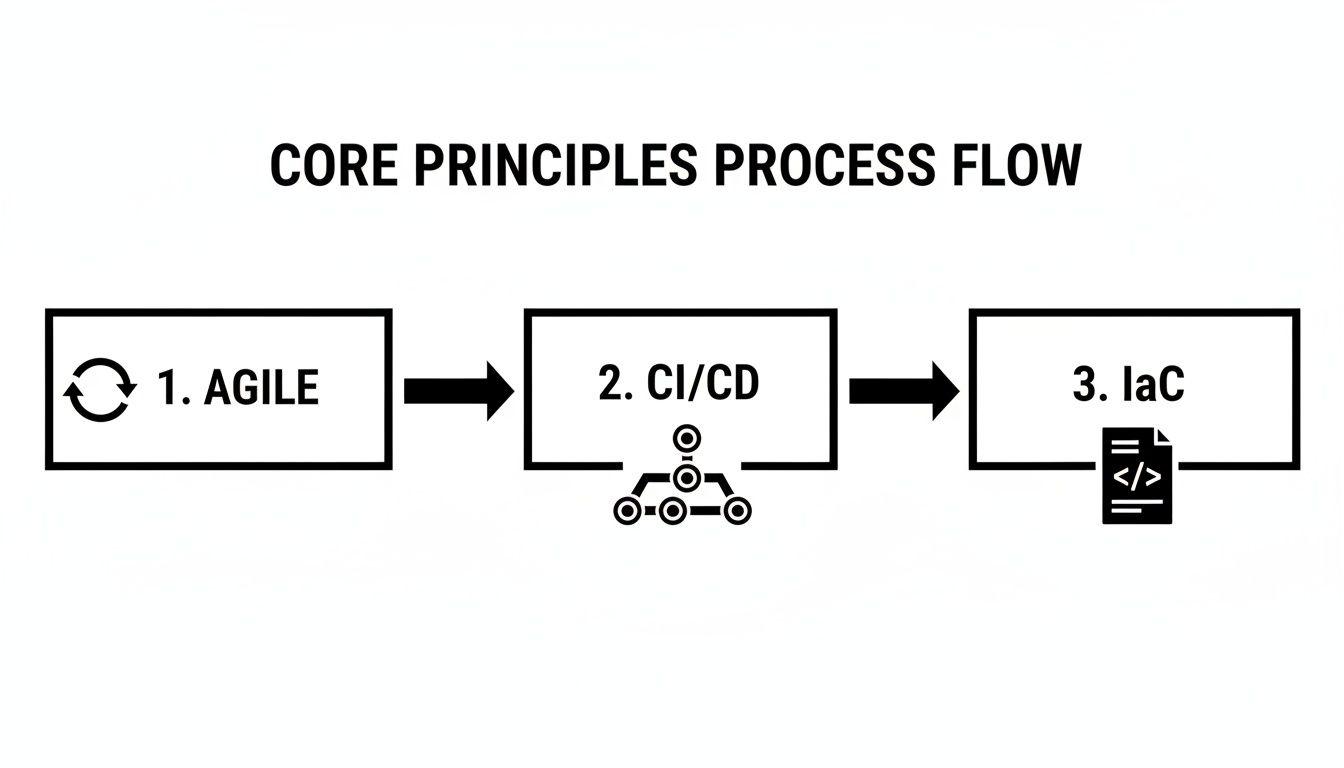
This demonstrates a continuous loop where each component enables the next. For a deeper dive into the mechanics, see our guide on what a deployment pipeline is.
The CD pipeline automates what was once a high-stress, error-prone manual process. The goal is to make deployments boring by making them repeatable, reliable, and safe through automation.
The pipeline first deploys to a staging environment—an exact replica of production provisioned via IaC. Here, it executes more extensive automated tests, such as integration and end-to-end tests, to validate system-wide behavior. Upon success, the pipeline proceeds to a controlled production rollout. To effectively manage the iterative work feeding this pipeline, many teams utilize dedicated Agile Sprints services.
Modern deployment strategies mitigate risk to users:
- Blue-Green Deployment: The new version is deployed to an identical, idle production environment ("green"). After verification, a load balancer redirects 100% of traffic from the old environment ("blue") to the new one, enabling instant rollback if needed.
- Canary Release: The new version is released to a small subset of users (e.g., 1%). The team monitors key performance indicators (KPIs) like error rates and latency. If stable, traffic is gradually shifted to the new version until it serves 100% of users.
This entire automated workflow, from git push to a live production deployment, creates a rapid, reliable feedback loop that embeds quality into every step, turning the promise of Agile and DevOps into a daily operational reality.
How to Assess Your DevOps and Agile Maturity
To implement a successful DevOps and Agile strategy, you first need to benchmark your current technical capabilities. This assessment isn't about judgment; it's a technical audit to identify specific gaps in your processes and toolchains, allowing you to prioritize your efforts for maximum impact.
The journey to high-performance software delivery progresses through four distinct maturity stages. Each stage is defined by specific technical markers that indicate your evolution from manual, siloed operations to a fully automated, data-driven system. Understanding these stages allows you to pinpoint your current position and identify the next technical challenges to overcome.
The Four Stages of Maturity
1. Initial Stage
Operations are manual and reactive. Development and operations are siloed. Developers commit code and then create a ticket for the operations team to deploy it, often days later.
- Technical Markers: Deployments involve SSHing into a server and running manual scripts. Environments are inconsistent, leading to "it works on my machine" issues. There is no automated testing pipeline.
2. Managed Stage
Automation exists in pockets but is inconsistent. Teams are discussing DevOps, but there are no standardized tools or practices across the organization.
- Technical Markers: A basic CI server like Jenkins automates builds. However, deployments to staging or production are still manual or rely on fragile custom scripts. Version control is used, but branching strategies are inconsistent.
Many companies stall here. The DevOps market is projected to grow from $10.4 billion in 2023 to $25.5 billion by 2028. While 80% of organizations claim to practice DevOps, a large number are stuck in these middle stages, unable to achieve full automation.
3. Defined Stage
Practices are standardized and repeatable. The focus shifts from ad-hoc automation to building a complete, end-to-end software delivery pipeline where Agile sprints seamlessly feed into DevOps automation.
- Technical Markers: Standardized CI/CD pipelines are used for all major services. Infrastructure as Code (IaC) tools like Terraform are used to provision identical, reproducible environments. Automated integration testing is a mandatory pipeline stage.
4. Optimizing Stage
This is the elite level. The delivery process is not just automated but also highly instrumented. Teams leverage deep observability to make data-driven decisions to improve performance, reliability, and deployment frequency.
- Technical Markers: The entire path to production is a zero-touch, fully automated process. Observability is integrated, with tools tracking key business and system metrics. Deployments are frequent (multiple times per day), low-risk, and utilize advanced strategies like canary releases.
Use this framework for a self-assessment. If your team uses Jenkins for CI but still performs manual deployments, you are in the 'Managed' stage. If you have defined your entire infrastructure in Terraform and automated staging deployments, you are moving into the 'Defined' stage.
For a more granular analysis, use our detailed guide for a comprehensive DevOps maturity assessment.
Building Your Phased Implementation Roadmap
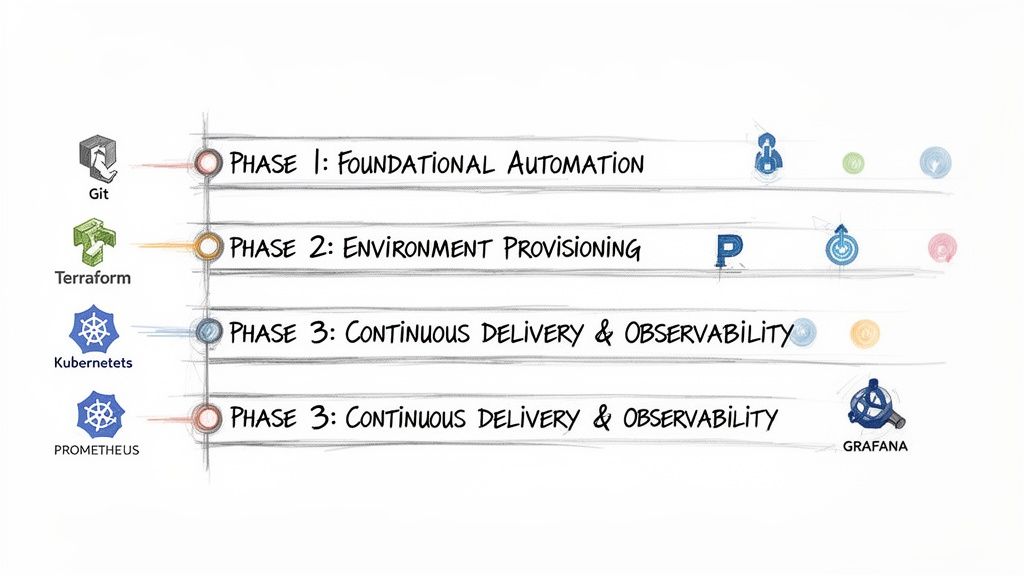
Attempting a "big bang" DevOps transformation is a common failure pattern that leads to chaos and burnout. A more effective approach is a phased evolution, treating the transformation as an iterative product delivery.
This three-phase roadmap provides a practical path to building a high-performing DevOps agile development model. Each phase builds upon the last, establishing a solid foundation for continuous improvement.
Phase 1: Foundational Automation
This phase focuses on establishing a single source of truth for all code and implementing automated quality checks. The goal is to eliminate manual handoffs and create an immediate, automated feedback loop for developers.
The focus is on two core practices: universal version control with Git using a consistent branching strategy (e.g., GitFlow or Trunk-Based Development) and implementing Continuous Integration (CI).
- Technical Objectives:
- Required Skills: Proficiency in Git, CI/CD tool configuration (e.g., YAML pipelines), and automated testing frameworks.
- Success Metrics: Track the percentage of commits triggering an automated build (target: 100%) and the average pipeline execution time (target: < 10 minutes).
This stage is non-negotiable. It solves the "it works on my machine" problem and establishes the CI pipeline's result as the objective source of truth for code quality.
Phase 2: Automated Environment Provisioning
Once CI is stable, the next bottleneck is typically inconsistent environments. Phase 2 addresses this by implementing Infrastructure as Code (IaC).
The objective is to make environment creation a deterministic, repeatable, and fully automated process. Using tools like Terraform, you define your entire infrastructure in version-controlled configuration files. This allows you to spin up an identical staging environment for every feature branch, ensuring that testing mirrors production precisely.
- Technical Objectives:
- Develop reusable Terraform modules for core infrastructure components (e.g., VPC, Kubernetes cluster, RDS database).
- Integrate
terraform applyinto the CI/CD pipeline to automatically provision ephemeral test environments for each merge request.
- Required Skills: Deep knowledge of a cloud provider (AWS, Azure, GCP) and expertise in an IaC tool like Terraform or OpenTofu.
- Success Metrics: Measure the time required to provision a new staging environment. The goal is to reduce this from hours or days to minutes.
Phase 3: Continuous Delivery and Observability
With a reliable CI pipeline and automated environments, you are ready to automate the final step: production deployment. This phase extends your CI pipeline to a full Continuous Delivery (CD) system, making releases low-risk, on-demand events.
This is also where you integrate observability. It's insufficient to just deploy code; you must have deep visibility into its real-world performance. This involves instrumenting your application and deploying monitoring tools like Prometheus for metrics and Grafana for visualization.
- Technical Objectives:
- Automate production deployments using a controlled strategy like blue-green or canary releases.
- Instrument applications to export key performance metrics (e.g., latency, error rates) in a format like Prometheus.
- Deploy a full observability stack (e.g., Prometheus for metrics, Grafana for dashboards, Loki for logs) to monitor application and system health in real-time.
- Required Skills: Expertise in container orchestration (Kubernetes), advanced deployment patterns, and observability tools.
- Success Metrics: Track the four core DORA metrics. Specifically, focus on improving Deployment Frequency and Lead Time for Changes.
Measuring Success with DORA Metrics
To justify your investment in DevOps agile development, you must demonstrate its impact using objective, quantifiable data. Vague statements like "we feel faster" are insufficient.
The industry standard for measuring software delivery performance is the four DORA (DevOps Research and Assessment) metrics.
These metrics provide a clear, data-driven view of both delivery speed and operational stability. Tracking them allows you to identify bottlenecks, measure improvements, and prove the ROI of your DevOps initiatives.
The business impact is significant: 99% of organizations report positive results from adopting DevOps, and 83% of IT leaders identify it as a primary driver of business value. You can explore more data in the latest DevOps statistics and trends.
Measuring Throughput and Velocity
Throughput metrics measure the speed at which you can deliver value to users.
- Deployment Frequency: How often do you successfully deploy to production? Elite teams deploy multiple times per day. High frequency indicates a mature, low-risk, and highly automated release process.
- Lead Time for Changes: What is the elapsed time from code commit to production deployment? This metric measures the efficiency of your entire delivery pipeline.
Technical Implementation: To measure this, script API calls to your toolchain. Use the Git API to get commit timestamps and the CI/CD platform's API (GitLab, Jenkins) to get deployment timestamps. The delta is your Lead Time for Changes.
Measuring Stability and Quality
Velocity is meaningless without stability. These metrics act as guardrails, ensuring that increased speed does not compromise service reliability.
- Change Failure Rate: What percentage of production deployments result in a degraded service and require remediation (e.g., a rollback or hotfix)? A low rate validates the effectiveness of your automated testing and quality gates.
- Time to Restore Service (MTTR): When a production failure occurs, how long does it take to restore service to users? This metric measures your team's incident response and recovery capabilities.
Creating Your Performance Dashboard
Data collection is only the first step. You must visualize this data by creating a real-time performance dashboard. By ingesting data from your toolchain (Git, Jira, your CI/CD system), you can create a single source of truth that quantifies your team's progress and makes the business impact of your DevOps agile development transformation undeniable.
To provide a clear target, the industry has established benchmarks for DORA metrics.
DORA Metrics Performance Benchmarks
This table defines the four performance tiers for DORA metrics, providing data-backed benchmarks to guide your improvement efforts.
| DORA Metric | Elite Performer | High Performer | Medium Performer | Low Performer |
|---|---|---|---|---|
| Deployment Frequency | On-demand (multiple deploys per day) | Between once per day and once per week | Between once per week and once per month | Less than once per month |
| Lead Time for Changes | Less than one hour | Between one day and one week | Between one month and six months | More than six months |
| Change Failure Rate | 0-15% | 16-30% | 16-30% | 46-60% |
| Time to Restore Service | Less than one hour | Less than one day | Between one day and one week | More than one week |
Tracking your metrics against these benchmarks provides an objective assessment of your capabilities and a clear roadmap for leveling up your software delivery performance.
When implementing Agile and DevOps, engineers inevitably encounter common technical challenges. Here are answers to the most frequent questions.
How Do We Handle Database Changes in CI/CD?
This is a critical challenge. Manually applying database schema changes is a common source of deployment failures. The solution is to manage your database schema as code using a dedicated migration tool.
- Flyway: Uses versioned SQL scripts (e.g.,
V1__Create_users_table.sql). Flyway tracks which scripts have been applied to a database and runs only the new ones, ensuring a consistent schema state. - Liquibase: Uses an abstraction layer (XML, YAML, or JSON) to define schema changes. This allows you to write database-agnostic migrations, which is useful in multi-database environments.
Integrate your chosen tool into your CD pipeline. It should run as a step before the application deployment, ensuring the database schema is compatible with the new code version. This automates schema management and makes it a repeatable, reliable part of your deployment process.
What Is a Platform Engineer’s Role, Really?
As an organization scales, individual development teams spend excessive time on infrastructure tasks. A Platform Engineer addresses this by building and maintaining an Internal Developer Platform (IDP).
An IDP is a "paved road" for developers. It's a curated set of tools, services, and automated workflows that abstracts away the complexity of the underlying infrastructure (e.g., Kubernetes, cloud services). It provides developers with a self-service way to provision resources, deploy applications, and monitor services.
Platform Engineers are the product managers of this internal platform. They apply DevOps agile development principles to create a streamlined developer experience that increases productivity and enforces best practices by default.
How Do You Actually Integrate Security?
Integrating security into a high-velocity pipeline without slowing it down is known as DevSecOps. The core principle is "shifting left"—automating security checks as early as possible in the development lifecycle.
This is achieved by embedding automated security tools directly into the CI pipeline.
- Static Application Security Testing (SAST): Tools like SonarQube scan your source code for vulnerabilities (e.g., SQL injection flaws) before the application is built.
- Software Composition Analysis (SCA): Tools like Snyk or OWASP Dependency-Check scan your project's third-party dependencies for known vulnerabilities (CVEs).
- Dynamic Application Security Testing (DAST): These tools analyze your running application in a staging environment, probing for vulnerabilities like cross-site scripting.
By automating these checks, you create security gates that provide immediate feedback to developers. This catches vulnerabilities early, when they are fastest and cheapest to fix, making security an integrated part of the daily workflow rather than a final, bottleneck-prone stage.
Solving these technical challenges is where a successful DevOps implementation happens. At OpsMoon, we specialize in providing the expert engineering talent you need to build and fine-tune these complex systems.
Our platform connects you with the top 0.7% of DevOps engineers who live and breathe this stuff. They can design and build robust CI/CD pipelines, automated infrastructure, and effective DevSecOps practices that actually work.
Start with a free work planning session to map out your roadmap and see how OpsMoon can accelerate your journey.
Leave a Reply