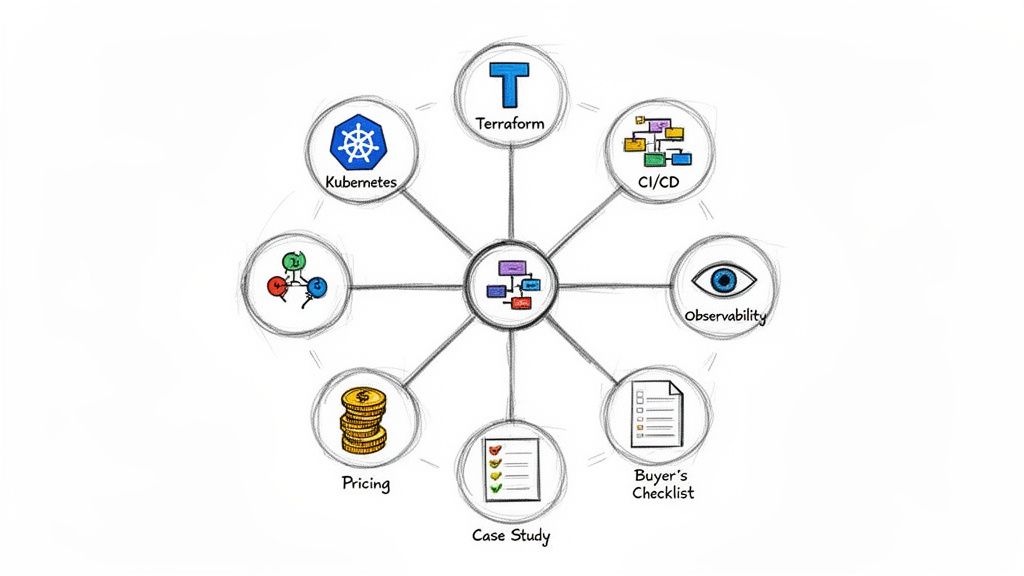
The demand for elite DevOps expertise in areas like Kubernetes orchestration, Terraform automation, and resilient CI/CD pipelines has outpaced the available talent pool. For engineering leaders and CTOs, this creates a critical bottleneck that slows releases, increases operational risk, and stalls innovation. Simple hiring is often not a fast or flexible enough solution to meet urgent infrastructure demands. This guide moves beyond the traditional hiring model and dives into the strategic landscape of DevOps outsourcing companies and specialized platforms.
We will provide a technical deep-dive into seven distinct models for acquiring specialized skills. This isn't a generic list; it's a curated roundup designed to help you make an informed decision based on your specific technical needs and business goals. We'll explore everything from managed service providers and curated expert platforms to vetted freelance networks and integrated cloud marketplaces.
The goal is to equip you with actionable criteria to assess partners based on technical proficiency, engagement flexibility, and operational transparency. For each option, you will find:
- A detailed company profile focusing on their core DevOps competencies.
- Ideal use cases to help you match the provider to your project scope.
- Key trust signals like case studies, SLAs, and client reviews.
- Screenshots and direct links to help you evaluate each platform efficiently.
This analysis is designed to help you find and vet the right partner to accelerate your roadmap, stabilize your cloud infrastructure, and achieve your operational objectives without the long lead times of direct hiring.
1. OpsMoon
OpsMoon is a specialized DevOps services platform designed to connect engineering leaders with elite, pre-vetted remote DevOps talent. It operates as a strategic partner for companies aiming to accelerate software delivery and enhance cloud infrastructure stability. Instead of acting as a simple freelance marketplace, OpsMoon provides a structured, managed service that bridges the gap between high-level strategy and hands-on engineering execution, making it a compelling choice among devops outsourcing companies.
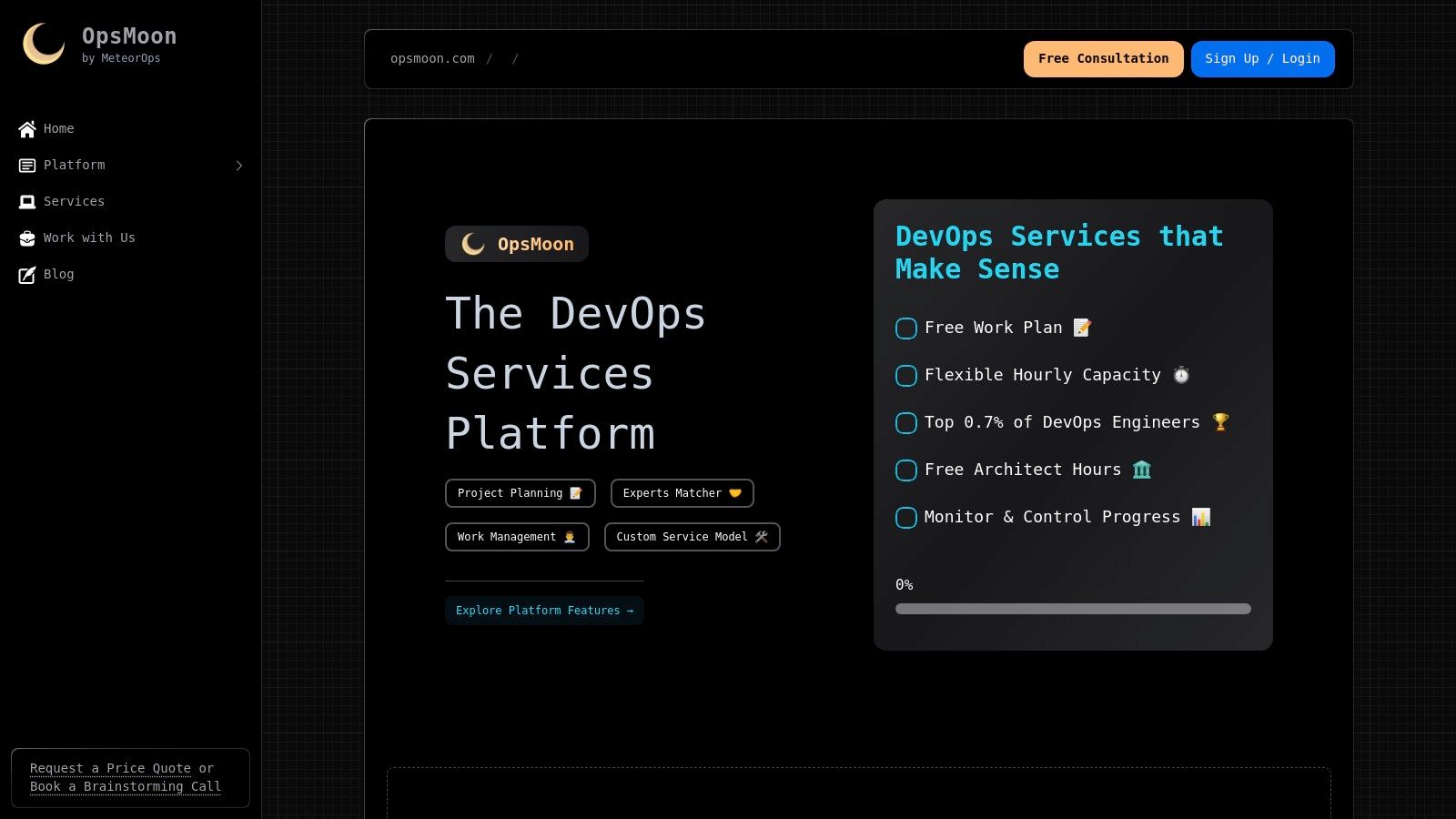
The platform distinguishes itself through its rigorous talent vetting process, which it claims sources engineers from the top 0.7% of the global talent pool. This is paired with a low-risk onboarding process beginning with a complimentary work planning session. Here, clients can architect solutions with a senior engineer, receive a detailed technical roadmap with specific deliverables (e.g., Terraform modules, CI/CD pipeline YAMLs), and get a fixed-cost estimate—all before any financial commitment. This de-risks the engagement and ensures precise technical alignment from day one.
Core Service Areas and Technical Capabilities
OpsMoon provides deep expertise across the entire DevOps and cloud-native landscape. Their engineers are adept at implementing and managing complex tooling to solve specific business challenges.
- Kubernetes Orchestration: Beyond basic cluster setup, their services include multi-cluster management with GitOps (via ArgoCD or Flux), advanced security hardening using policies-as-code (Kyverno, OPA Gatekeeper), cost optimization through tools like Kubecost, and implementing custom Kubernetes operators for automated workflows.
- Infrastructure as Code (IaC) with Terraform: They specialize in building modular, reusable, and scalable infrastructure using Terraform and Terragrunt. This includes creating CI/CD pipelines for infrastructure changes with tools like Atlantis, managing state effectively in team environments, and codifying compliance and security policies using Sentinel or Open Policy Agent (OPA).
- CI/CD Pipeline Optimization: OpsMoon designs and refactors CI/CD pipelines (using Jenkins, GitLab CI, GitHub Actions) to reduce build times via caching strategies, increase deployment frequency, and implement progressive delivery strategies like canary releases and blue-green deployments with service mesh integration (e.g., Istio, Linkerd).
- Observability and SRE: They build comprehensive observability stacks using the Prometheus and Grafana ecosystem, integrating logging (Loki), tracing (Jaeger/Tempo), and alerting (Alertmanager). This enables teams to define and track Service Level Objectives (SLOs) and error budgets to methodically improve system reliability. For a deeper look into their outsourcing model and how they structure these engagements, you can learn more about their DevOps outsourcing services.
Engagement Models and Ideal Use Cases
OpsMoon’s strength lies in its adaptable engagement models, which cater to different organizational needs and project scopes.
| Engagement Model | Description | Ideal For |
|---|---|---|
| Advisory Consulting | Strategic guidance, architectural reviews, and roadmap development with senior cloud architects. | Teams needing a technical deep-dive on a planned migration (e.g., VM to K8s) or an audit of their current IaC practices. |
| End-to-End Project Delivery | A fully managed, outcome-based project with a dedicated team responsible for delivering a specific scope. | Building a new Kubernetes platform from scratch, migrating monoliths to microservices, or implementing a complete observability stack. |
| Hourly Capacity Extension | Augmenting your existing team with one or more vetted DevOps engineers for specific tasks or ongoing work. | Startups needing to scale their DevOps capacity quickly without long-term hiring, or teams with a temporary skill gap in a tool like Istio. |
Pricing and Onboarding
OpsMoon uses a transparent, quote-based pricing model. There are no public pricing tiers; instead, costs are determined during the free initial consultation based on the project scope, required expertise, and engagement duration. The platform advertises a "0% platform fee" and includes valuable add-ons like free architect hours to streamline kickoff. This direct-pricing approach ensures clients only pay for the value they receive without hidden platform markups.
Key Highlights:
- Pros:
- Expert Matching: Access to a highly curated talent pool (top 0.7%) ensures high-quality engineering.
- Flexible Engagements: Models tailored for strategic advice, full projects, or staff augmentation.
- Low-Risk Onboarding: A free work plan, estimate, and architect hours reduce initial investment risk.
- Operational Visibility: Real-time progress monitoring provides transparency and control.
- Broad Tech Stack: Deep expertise in Kubernetes, Terraform, CI/CD, and observability tools.
- Cons:
- No Public Pricing: Requires direct contact for a quote, which can slow down initial budget planning.
- Remote-Only Model: May not be suitable for companies that require on-site, physically embedded engineers.
Website: https://opsmoon.com
2. Upwork
Upwork is a sprawling global freelance marketplace, not a specialized DevOps firm, which is precisely its unique strength. Instead of engaging a single company, you gain direct access to a vast talent pool of individual DevOps engineers, Site Reliability Engineers (SREs), and specialized agencies. This model is ideal for companies that need to rapidly scale their team with specific skills for short-term projects, fill an immediate skills gap, or build a flexible, on-demand DevOps function without the overhead of a traditional consultancy.
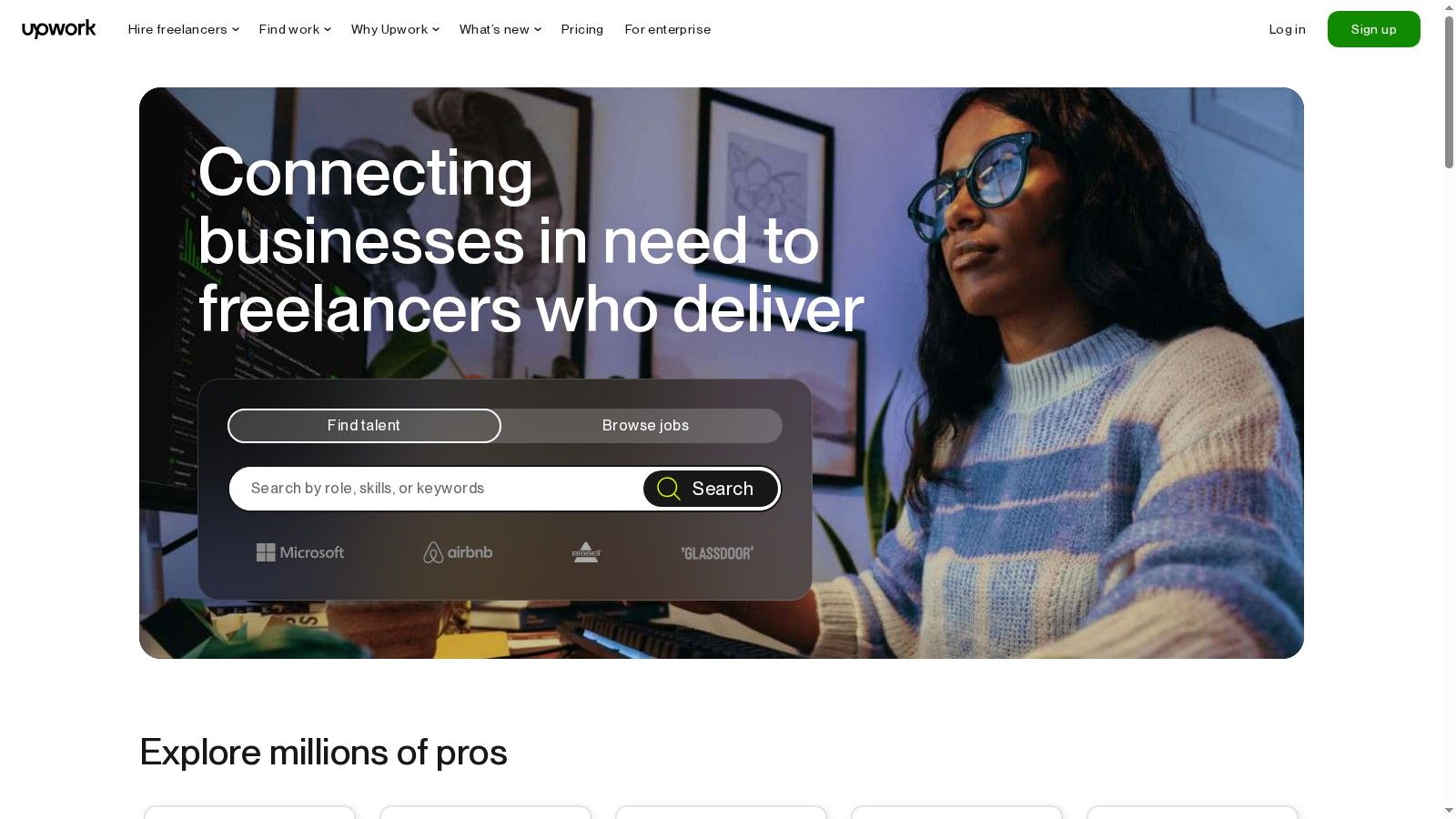
The platform empowers you to act as your own hiring manager. You post a detailed job description, outlining your tech stack (e.g., Kubernetes, Terraform, AWS/GCP/Azure), the scope of work (e.g., CI/CD pipeline optimization, infrastructure as code implementation), and your budget. You then receive proposals from freelancers and agencies, allowing you to vet candidates based on their profiles, work history, and portfolios.
Engagement Model and Pricing
Upwork’s primary advantage is its flexibility in both engagement and pricing. It’s a self-serve model that puts you in control.
- Engagement Models: You can hire on either a fixed-price basis for well-defined projects (like a Terraform module build-out) or an hourly basis for ongoing support and open-ended tasks. There are no minimum commitments.
- Pricing Signals: The marketplace is transparent. You can see a freelancer's hourly rate upfront, with typical senior DevOps engineers ranging from $40 to over $100 per hour, depending on their location and expertise. This direct cost visibility makes it one of the most cost-effective devops outsourcing companies for budget-conscious projects.
- Trust and Safety: Upwork provides built-in protections. For fixed-price contracts, funds are held in escrow and released upon milestone approval. For hourly work, the platform's Work Diary tracks time and captures screenshots, offering a layer of accountability.
Pros & Cons
| Pros | Cons |
|---|---|
| Speed and Scale: Access a massive global talent pool instantly. | High Vetting Overhead: Requires significant time to screen and interview. |
| Cost Control: Set your budget and negotiate rates directly. | Quality Variability: Skill levels vary widely across the platform. |
| Skill Diversity: Find experts in niche tools and technologies. | Less Strategic Partnership: Better for tasks than for holistic strategy. |
| Flexible Contracts: No long-term commitments required. | Management Burden: You are responsible for managing the freelancer. |
Actionable Tip: To find top-tier talent on Upwork, use highly specific search filters. Instead of just "DevOps," search for "Kubernetes Helm AWS EKS" or "Terraform GCP IaC." Look for freelancers with "Top Rated Plus" or "Expert-Vetted" badges, as these indicate a proven track record of success on the platform. Treat the hiring process with the same rigor you would for a full-time employee, including a hands-on technical screening with a specific, time-boxed task (e.g., "Write a Dockerfile for this sample application and explain your security choices"). This approach is key when you need to outsource DevOps services effectively through a marketplace model.
3. Toptal
Toptal positions itself as an elite network for the top 3% of freelance talent, a stark contrast to the open marketplace model. For DevOps, this means you aren’t sifting through endless profiles; instead, you are matched with pre-vetted, senior-level engineers capable of handling mission-critical infrastructure and complex, enterprise-grade challenges. This curated approach makes it an ideal choice for companies that require a high degree of certainty and expertise for projects like a full-scale migration to Kubernetes or architecting a secure, multi-cloud IaC strategy from scratch.
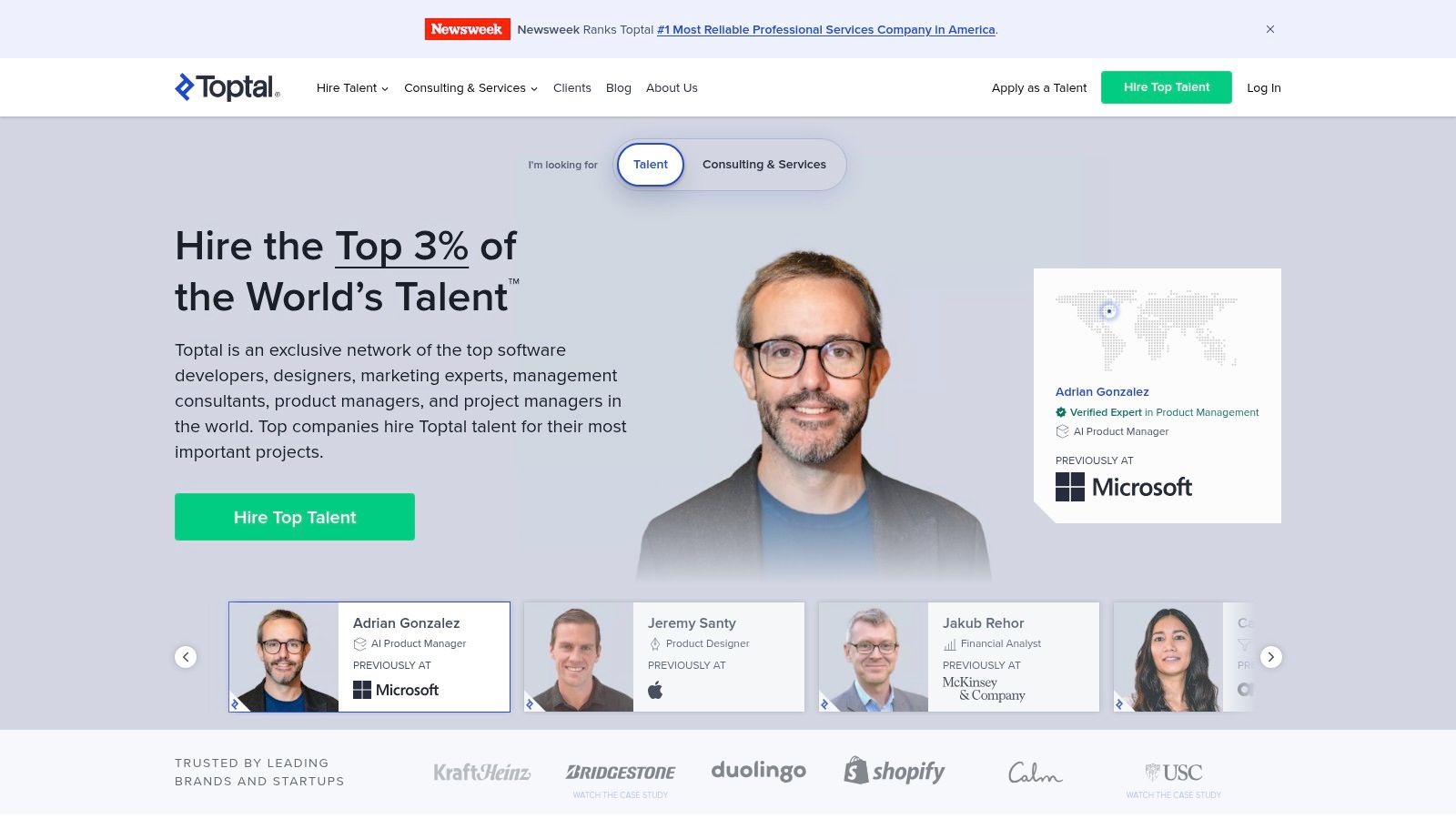
The platform’s core value proposition is its rigorous screening process, which includes language and personality tests, timed algorithm challenges, and technical interviews. When you submit a job request detailing your specific technical needs (e.g., "senior SRE with experience in Prometheus, Grafana, and Chaos Engineering on Azure"), Toptal’s internal team matches you with a suitable candidate, often within 48 hours. This significantly reduces the hiring manager’s screening burden.
Engagement Model and Pricing
Toptal’s model is built around quality and speed, which is reflected in its premium structure and engagement terms.
- Engagement Models: The platform supports flexible arrangements, including hourly, part-time (20 hours/week), and full-time (40 hours/week) contracts. This allows you to engage talent for both short-term projects and long-term, embedded team roles.
- Pricing Signals: Toptal operates at a higher price point than marketplaces like Upwork. Rates for senior DevOps engineers typically start around $80 per hour and can exceed $200 per hour, depending on the engineer’s skill set and experience. Clients are often required to make an initial, refundable deposit (historically around $500) to begin the matching process.
- Trust and Safety: The platform’s key trust signal is its no-risk trial period. You can work with a matched engineer for up to two weeks. If you’re not completely satisfied, you won’t be billed for their time, and Toptal will initiate a new search, minimizing your financial risk when evaluating talent.
Pros & Cons
| Pros | Cons |
|---|---|
| Pre-Vetted Senior Talent: Access to a highly curated talent pool. | Premium Pricing: Higher hourly rates compared to open marketplaces. |
| Fast Matching: Connect with qualified engineers in as little as 48 hours. | Initial Deposit: Requires a financial commitment to start the process. |
| Low Screening Burden: Toptal handles the initial vetting and matching. | Less Control Over Selection: You are matched rather than browsing all talent. |
| Risk-Free Trial: Trial period ensures a good fit without financial loss. | Smaller Talent Pool: Less volume than sprawling freelance platforms. |
Actionable Tip: To maximize your success on Toptal, be extremely precise and technical in your job requirements. Instead of asking for a "Cloud Engineer," specify the exact outcomes you need, such as: "Implement a GitOps workflow using Argo CD for EKS, with end-to-end observability via the ELK Stack." The more detailed your request, the more accurate the talent matching will be. Leverage the trial period aggressively. Provide the engineer with a real, non-critical task from your backlog during the first week to assess their technical execution, problem-solving approach, and integration with your team's workflow. This makes Toptal one of the more reliable devops outsourcing companies when you cannot afford a hiring mistake.
4. Arc.dev
Arc.dev sits between a massive open marketplace and a high-touch consultancy, offering a curated talent network of pre-vetted remote engineers. Its unique value proposition is its rigorous, Silicon Valley-style technical vetting process, which filters its talent pool significantly. This model is perfect for companies that need to hire senior DevOps or DevSecOps talent quickly but want to avoid the time-consuming screening process typical of larger, unvetted platforms.
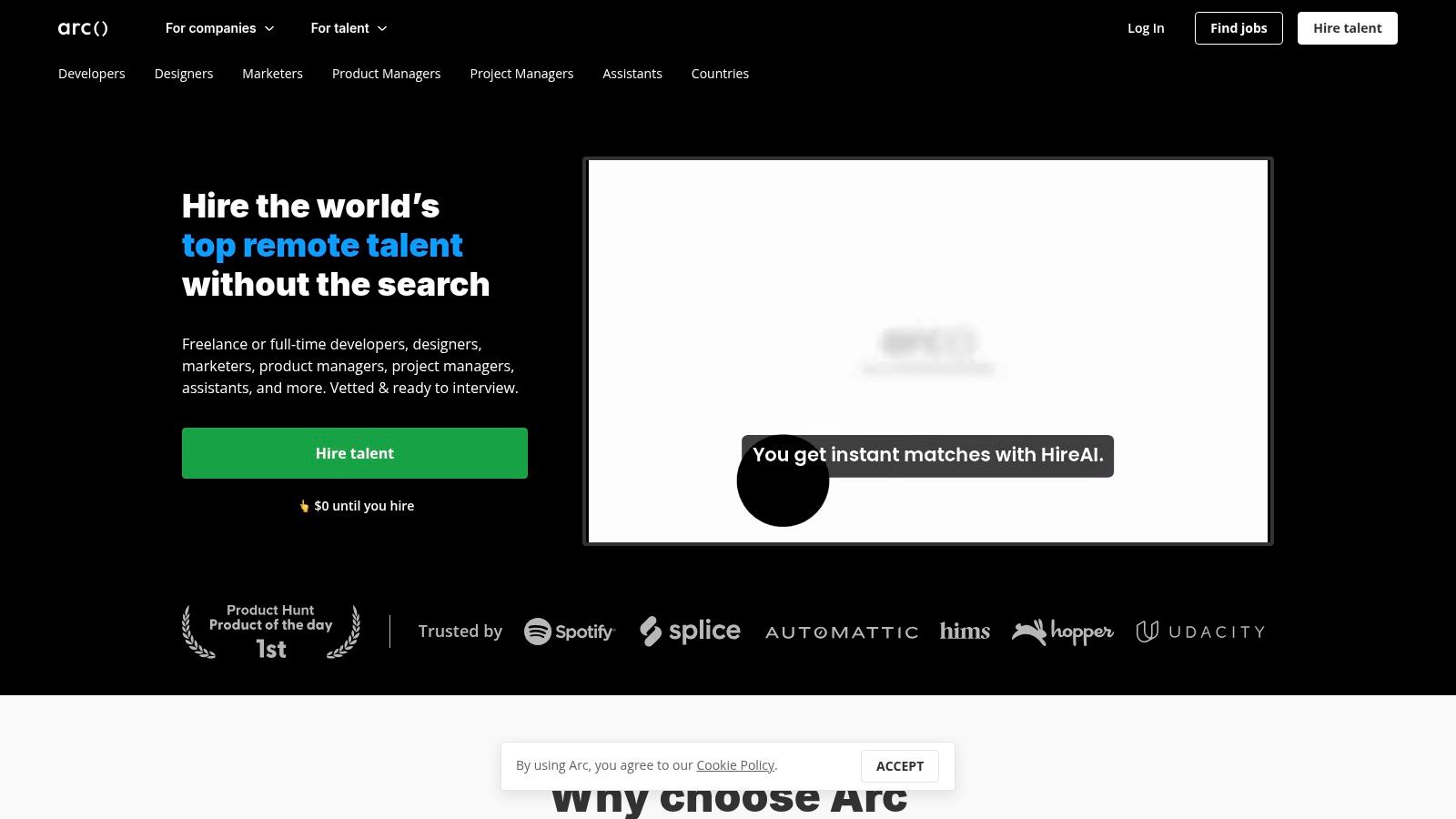
Unlike open marketplaces, you don't post a job and sift through hundreds of applications. Instead, Arc.dev matches you with a shortlist of qualified candidates from its network, often within 72 hours. This streamlined approach allows you to focus your energy on a smaller, more qualified group of professionals who have already passed technical and communication assessments. This makes it an efficient choice among devops outsourcing companies for high-stakes roles.
Engagement Model and Pricing
Arc.dev offers a hybrid model that supports both contract and permanent hires, providing clarity on rates to simplify budgeting.
- Engagement Models: You can engage talent for contract roles (ideal for project-based work or temporary staff augmentation) or hire them directly for permanent full-time positions. The platform facilitates the entire hiring process for both scenarios.
- Pricing Signals: Arc.dev provides transparent rate guidance, which is a key differentiator. Senior DevOps and DevSecOps engineers typically have hourly rates ranging from $60 to over $100 per hour. This upfront clarity helps teams forecast project costs without extensive negotiation.
- Trust and Safety: The core trust signal is the multi-stage vetting process, which includes profile reviews, behavioral interviews, and technical skills assessments. This ensures that every candidate you meet has a proven technical foundation and strong soft skills.
Pros & Cons
| Pros | Cons |
|---|---|
| High-Quality, Vetted Talent: Reduces hiring risk and screening time. | Smaller Talent Pool: Less supply than giant marketplaces like Upwork. |
| Fast Matching: Get a shortlist of qualified candidates in days. | Niche Skills Scarcity: Highly specialized roles may take longer to fill. |
| Clear Rate Guidance: Simplifies budgeting and financial planning. | Variable Service Fees: Total cost can vary; confirm details with sales. |
| Supports Contract & Full-Time: Flexible for different hiring needs. | Less Client Control Over Sourcing: You rely on Arc's matching algorithm. |
Actionable Tip: To maximize your success on Arc.dev, be extremely precise in your job requirements. Instead of a general "DevOps Engineer," specify the exact deliverables, such as "Implement a GitOps workflow using Argo CD on an existing GKE cluster" or "Automate infrastructure provisioning with Terraform and Atlantis." This level of detail helps Arc’s matching system pinpoint the best candidates from its vetted pool. For those looking to build a remote team, this platform provides a reliable way to hire remote DevOps engineers with a higher degree of confidence.
5. Gun.io
Gun.io operates as a highly curated freelance network, focusing exclusively on senior-level, US-based software and DevOps talent. Unlike massive open marketplaces, Gun.io acts as a pre-vetting layer, ensuring that every candidate presented has passed a rigorous, engineering-led screening process. This makes it an ideal choice for companies that need to quickly onboard a proven, senior DevOps professional for complex projects but lack the internal resources to sift through hundreds of unqualified applicants. The platform is designed for trust and speed, aiming to connect clients with contract-ready experts fast.
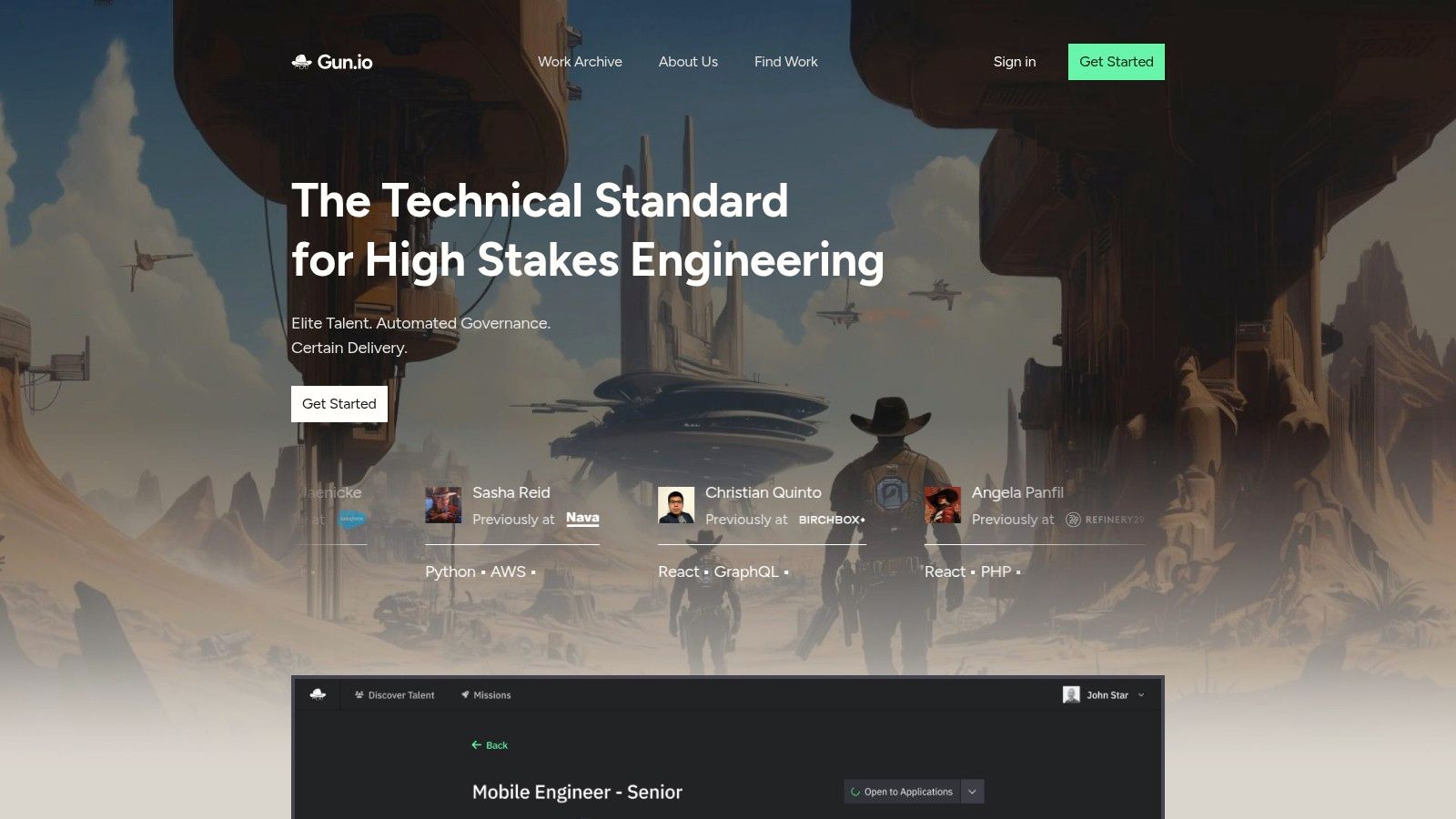
The core value proposition is its stringent vetting protocol. Candidates undergo algorithmic checks, background verifications, and live technical interviews conducted by other senior engineers. This process filters for not only technical proficiency in areas like Kubernetes, CI/CD, and cloud architecture but also for crucial soft skills like communication and problem-solving. As a client, you receive a small, hand-picked list of candidates, significantly reducing your hiring effort.
Engagement Model and Pricing
Gun.io's model is built on transparency and simplicity, removing the typical friction of freelance hiring. It is less of a self-serve platform and more of a "talent-as-a-service" model.
- Engagement Models: The primary model is a contract-to-hire or long-term contract engagement. It is best suited for filling a critical, senior-level role on your team for several months or longer, rather than for very short-term, task-based work.
- Pricing Signals: A key differentiator is its all-inclusive, transparent pricing. Each candidate profile displays a single hourly rate that includes the freelancer's pay and Gun.io's platform fee. This eliminates negotiation and hidden costs. Senior DevOps rates typically fall in the $100 to $200+ per hour range, reflecting the pre-vetted, high-caliber nature of the talent.
- Trust and Safety: The platform's rigorous upfront screening is the main trust signal. By presenting only pre-qualified talent, Gun.io mitigates the risk of a bad hire. Their high-touch, managed process and positive client testimonials further reinforce their reliability among devops outsourcing companies.
Pros & Cons
| Pros | Cons |
|---|---|
| High-Quality, Vetted Talent: Rigorous screening ensures senior-level expertise. | Higher Cost: Rates are at the premium end of the market. |
| Fast Time-to-Hire: Averages just ~13 days from job post to hire. | Smaller Talent Pool: A more selective network means fewer options. |
| Transparent Pricing: All-in hourly rates are shown upfront on profiles. | US-Centric: Primarily focused on US-based talent. |
| Reduced Hiring Burden: Eliminates the need for extensive candidate sourcing. | Less Suited for Short Gigs: Best for long-term contract roles. |
Actionable Tip: To maximize your success on Gun.io, provide an extremely detailed technical brief and a clear definition of the role's impact. Since you're engaging senior talent, focus the brief on the business problems they will solve (e.g., "reduce EKS cluster costs by 30%" or "achieve a sub-15-minute CI/CD pipeline") rather than just listing technologies. Be prepared to move quickly, as top talent on the platform is often in high demand. Trust their vetting process, but conduct your own final cultural-fit interview to ensure the contractor aligns with your team's communication style and workflow.
6. AWS Marketplace – Professional Services (DevOps)
The AWS Marketplace is far more than a software repository; its Professional Services catalog is a curated hub for finding and engaging AWS-vetted partners for specialized DevOps work. This makes it an ideal procurement channel for companies deeply embedded in the AWS ecosystem. Instead of a traditional, lengthy vendor search, you can procure DevOps consulting, CI/CD implementation, and Kubernetes management services directly through your existing AWS account, consolidating billing and simplifying vendor onboarding.
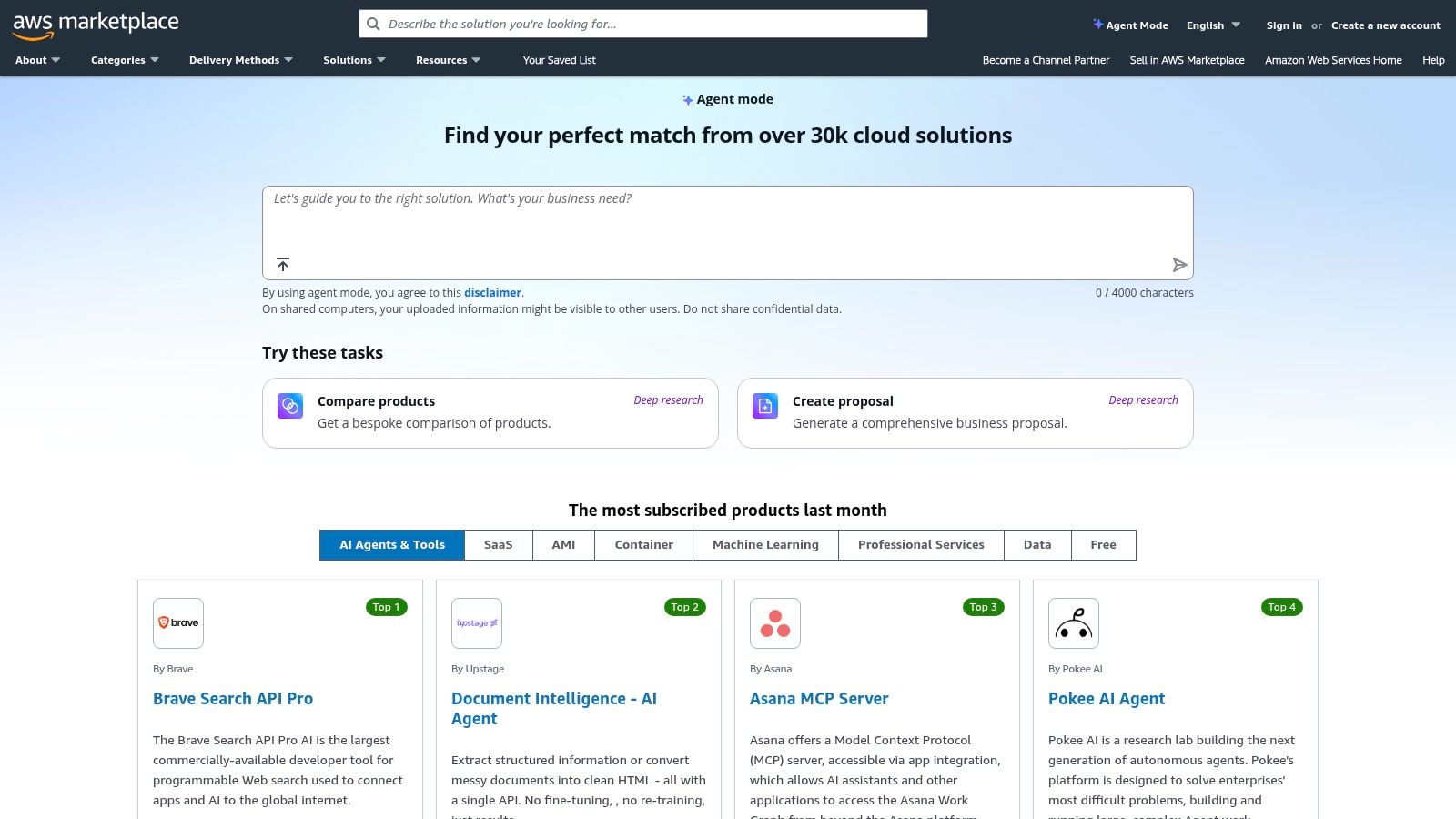
This model is built for organizations that prioritize governance and streamlined procurement. You can browse standardized service offerings, such as a "Well-Architected Review for a DevOps Pipeline" or a "Terraform Infrastructure as Code Quick Start," from a variety of certified partners. The platform facilitates a direct engagement with these devops outsourcing companies, allowing you to request custom quotes or accept private offers with pre-negotiated terms, all within the familiar AWS Management Console.
Engagement Model and Pricing
The AWS Marketplace streamlines the entire engagement lifecycle, from discovery to payment, leveraging your existing AWS relationship.
- Engagement Models: Engagements are typically project-based or for managed services. You can purchase pre-defined service packages with a fixed scope and price, or you can work with a partner to create a Private Offer with custom terms, deliverables, and payment schedules.
- Pricing Signals: While some services have public list prices, most sophisticated DevOps engagements require a custom quote. Pricing is often bundled into your monthly AWS bill, which is a major advantage for finance and procurement teams. The platform is transparent about the partner's AWS competency credentials (e.g., DevOps Competency Partner), giving you signals of their expertise level.
- Trust and Safety: All partners listed in the Professional Services catalog are vetted members of the AWS Partner Network (APN). The entire contracting and payment process is handled through AWS, providing a secure and trusted transaction framework that aligns with corporate purchasing policies.
Pros & Cons
| Pros | Cons |
|---|---|
| Streamlined Procurement: Consolidates billing into your AWS account. | AWS-Centric: Primarily serves companies heavily invested in AWS. |
| Vetted Partner Network: Access to certified and experienced AWS experts. | Pricing Isn't Public: Most complex projects require a custom quote. |
| Enterprise-Friendly Contracting: Supports private offers and custom terms. | Account Required: Requires an active AWS account with proper permissions. |
| Clear Service Offerings: Many listings have well-defined scopes. | Limited Non-AWS Tooling: Focus is on partners with AWS specialties. |
Actionable Tip: Use the AWS Marketplace to short-circuit your procurement process. Instead of starting with a broad web search, filter for partners with the "AWS DevOps Competency" designation. When engaging a partner, request a private offer that includes specific Service Level Agreements (SLAs) for response times and infrastructure uptime. Beyond leveraging the AWS Marketplace for professional services, understanding the profiles of individuals in key DevOps and AWS infrastructure management expertise roles can further inform your partnership selection. This gives you a better baseline for evaluating the talent within the partner firm you choose.
7. Clutch – DevOps Services Directory (US)
Clutch is not a direct provider of DevOps services but rather a comprehensive B2B research and review platform. Its unique value lies in its role as a high-trust discovery engine, allowing you to find, vet, and compare a curated list of specialized devops outsourcing companies, particularly those based in the US. Instead of offering a marketplace of individuals, Clutch provides detailed profiles of established agencies, complete with verified client reviews, project portfolios, and standardized data points. This model is ideal for companies seeking a long-term strategic partner rather than a short-term contractor.
The platform functions as a powerful due diligence tool. You can filter potential partners by their specific service focus (e.g., Cloud Consulting, Managed IT Services), technology stack (AWS, Azure, GCP), and even by client budget or company size. Clutch’s team conducts in-depth interviews with the clients of listed companies, creating verified, case study-like reviews that offer authentic insights into an agency's performance, communication, and technical acumen.
Engagement Model and Pricing
Clutch itself doesn't facilitate contracts or payments; it's a directory and lead generation platform. All engagement and pricing discussions happen directly with the vendors you discover.
- Engagement Models: The companies listed on Clutch typically offer a range of models, including dedicated teams, project-based work, and ongoing managed services (retainers). The platform helps you identify which model a vendor specializes in.
- Pricing Signals: Each company profile includes helpful pricing indicators, such as their minimum project size (e.g., $10,000+) and typical hourly rates (e.g., $50 – $99/hr, $100 – $149/hr). This transparency allows you to quickly shortlist firms that align with your budget before you even make contact.
- Trust and Safety: Clutch's primary trust mechanism is its verified review process. By speaking directly with past clients, it mitigates the risk of fabricated testimonials and provides a more reliable assessment of a firm's capabilities and reliability than a simple star rating.
Pros & Cons
| Pros | Cons |
|---|---|
| High-Quality Vetting: Verified, in-depth reviews provide authentic insights. | Directory Only: You must manage outreach and contracting separately. |
| Strong Discovery Filters: Easily narrow options by location, budget, and specialty. | Potential for Marketing Fluff: Profiles are still vendor-managed and can be biased. |
| Direct Comparison: "Leaders Matrix" feature helps compare top firms in a given area. | US-Centric Focus: While it has global listings, its deepest data is for US providers. |
| Transparent Pricing Signals: Filter out vendors that are outside your budget early on. | Slower Process: Finding and vetting takes more time than hiring a freelancer. |
Actionable Tip: Use Clutch’s "Leaders Matrix" as your starting point. Select your city or region (e.g., "Top DevOps Companies in New York") to see a quadrant chart that plots firms based on their ability to deliver and their market focus. Drill down into the profiles of the top contenders and pay close attention to the full interview transcripts in their reviews. Look for technical specifics: Did they just "manage AWS," or did they "migrate 200 EC2 instances to an EKS cluster with zero downtime using a blue-green deployment strategy"? This deep dive into verified client experiences is the best way to pre-qualify potential partners.
Top 7 DevOps Outsourcing Providers Comparison
| Provider | Implementation complexity | Resource requirements | Expected outcomes | Ideal use cases | Key advantages |
|---|---|---|---|---|---|
| OpsMoon | Medium — guided planning and tailored delivery | Remote vetted DevOps experts, client input for roadmap | Faster releases, stabilized cloud ops, clear roadmaps | Startups, SaaS, SMBs and mid-to-large teams needing rapid remote DevOps support | Expert matching, flexible engagement models, SRE/K8s/Terraform capabilities |
| Upwork | Low — self-serve job posting and hiring | Client-led screening, variable contractor quality and time investment | Cost-flexible, fast hires for short-to-mid engagements | Short tasks, ad-hoc work, budget-sensitive projects | Massive talent pool, visible rates, escrow/work protections |
| Toptal | Low-to-medium — curated matching with trial option | Senior vetted talent; higher budget and engagement expectations | High-quality senior engineers for mission-critical initiatives | Enterprise-grade projects and critical system builds | Deep vetting, fast matching, trial period to reduce hiring risk |
| Arc.dev | Low-to-medium — curated sourcing with rapid matching | Curated remote seniors; published rate guidance | Senior hires with reduced screening effort | Remote contract or full-time senior hires | Balanced pricing vs. elite networks, Silicon Valley–style vetting |
| Gun.io | Low — agency-led sourcing and screening | US-focused senior contractors; transparent all-in pricing | Senior contractor engagements with clear total cost | English-fluent teams seeking senior contractors for rapid hire | Rigorous screening, transparent profile pricing, quick time-to-hire |
| AWS Marketplace – Professional Services (DevOps) | Medium-to-high — procurement and vendor onboarding via AWS | Requires AWS account, procurement approvals, partner coordination | Consolidated billing, enterprise-compliant engagements, partner implementations | Organizations standardizing on AWS procurement and billing | Streamlined procurement, vetted partners, private/custom offers |
| Clutch – DevOps Services Directory (US) | Low — discovery and shortlisting only | Client-led outreach; requires off-site contracting with vendors | Curated vendor shortlists and due-diligence signals | Vendor selection, market research, pre-procurement scouting | Verified reviews, filters by budget/location/specialty, case studies |
Your Technical Due Diligence Checklist for Choosing a DevOps Partner
Navigating the landscape of DevOps outsourcing companies requires a structured, technically-focused approach. The journey from identifying a need to forging a successful partnership is paved with critical evaluation points. As we've explored, options range from specialized agencies like OpsMoon, which offer managed project delivery, to talent marketplaces like Toptal and Upwork, and directories such as AWS Marketplace and Clutch that connect you with a wide array of service providers. The "best" partner is not a universal title; it is the one that aligns precisely with your technology stack, operational maturity, and strategic goals.
Choosing the right partner is less about a single 'best' option and more about the best fit for your technical requirements, team culture, and business objectives. Use this actionable checklist to structure your evaluation process and make a data-driven decision.
1. Technical Validation and Stack Alignment
Your first step is to move beyond marketing claims and validate genuine technical expertise. A partner must demonstrate deep, hands-on experience not just with general concepts like "Kubernetes" or "CI/CD," but with the specific tools, versions, and cloud environments that constitute your core stack.
- Action Item: Request anonymized architecture diagrams, sanitized Terraform modules, or sample CI/CD pipeline configurations from past projects that mirror your own challenges. Ask probing questions: "How have you managed state for a multi-environment Terraform setup for a production workload on GCP?" or "Describe a complex Kubernetes ingress routing scenario you've implemented."
- Skill Assessment: When evaluating potential DevOps partners, a critical part of your due diligence involves assessing their team's capabilities. Understanding the key technical skills to assess can significantly streamline this process, helping you differentiate between superficial knowledge and true engineering depth.
2. Engagement Model and Operational Flexibility
The contractual model dictates the entire dynamic of the partnership. Misalignment here can lead to friction, unmet expectations, and budget overruns. Ensure the provider’s model directly supports your immediate and long-term objectives.
- Project-Based: Ideal for well-defined outcomes like a production infrastructure build-out or a CI/CD pipeline implementation. Clarify the scope, deliverables, and payment milestones upfront.
- Staff Augmentation: Best for increasing your team's velocity or filling a specific skill gap (e.g., a senior SRE). Vet the individual engineers, not just the company, and ensure they can integrate with your existing workflows.
- Strategic Advisory: Suited for roadmap planning, technology selection, or high-level architectural design. This is about leveraging senior expertise for guidance, not just hands-on-keyboard execution.
3. Security, Governance, and Compliance Posture
In a world of infrastructure-as-code and cloud-native environments, security cannot be an afterthought. Your DevOps outsourcing partner will have privileged access to your most critical systems, making their security posture a non-negotiable evaluation point.
- Action Item: Ask directly how they handle sensitive credentials (e.g., Vault, cloud provider secret managers), manage IAM roles with the principle of least privilege, and secure CI/CD pipelines against supply chain attacks.
- Compliance: If you operate in a regulated industry, inquire about their direct experience with standards like SOC 2, HIPAA, or PCI DSS. A partner familiar with these requirements will build compliance controls into the infrastructure from day one.
4. Communication Cadence and Collaboration Tooling
Technical excellence is ineffective without seamless communication and collaboration. The partner should function as an extension of your own team, not a siloed black box.
- Define the Cadence: Establish clear expectations for daily stand-ups, weekly syncs, asynchronous updates via Slack or Teams, and documentation handoffs in a shared knowledge base like Confluence or Notion.
- Tooling Alignment: Ensure they are proficient with your core project management and communication tools (e.g., Jira, Asana, Linear). This reduces friction and onboarding time.
5. SLAs, Support Guarantees, and Incident Response
For production systems, this is where the partnership proves its worth. Vague promises of "support" are insufficient; you need contractually defined guarantees that align with your business's uptime requirements.
- Action Item: Scrutinize the Service Level Agreements (SLAs). What are the guaranteed response and resolution times for incidents of varying severity levels (e.g., Sev1, Sev2)? What are the financial or service credit penalties for missing these SLAs? This is a fundamental measure of their commitment to your operational stability.
Ultimately, a successful partnership with one of the many capable DevOps outsourcing companies hinges on this blend of technical alignment and operational transparency. Platforms like OpsMoon are designed to streamline this complex evaluation process by initiating the engagement with a free, collaborative work planning session. This unique approach allows you to validate expertise, co-create a detailed roadmap, and ensure you are investing in a partner who is truly capable of elevating your DevOps maturity before any financial commitment is made.
Ready to partner with a DevOps team that prioritizes technical excellence and transparent collaboration? OpsMoon offers a unique project-based model that begins with a free, detailed work planning session to build your custom roadmap. Explore how OpsMoon can de-risk your DevOps outsourcing and accelerate your goals.
Leave a Reply