Navigating the crowded market of DevOps services companies requires more than a cursory glance at marketing claims. Making the right choice directly impacts your software delivery velocity, system reliability, and overall engineering efficiency. A mismatched partner can introduce technical debt and architectural bottlenecks, while the right one acts as a true force multiplier for your team. This guide cuts through the noise to provide a technical, actionable framework for evaluating and selecting a DevOps partner that aligns with your specific technology stack and business objectives.
We will move beyond generic advice and dive deep into the specific criteria you should use to evaluate potential partners. This includes assessing their Infrastructure as Code (IaC) proficiency in frameworks like Terraform versus CloudFormation and scrutinizing their CI/CD implementation patterns with tools such as GitLab CI, GitHub Actions, or Jenkins. When evaluating potential DevOps partners, understanding their expertise in various Top Cloud Infrastructure Automation Tools is crucial for long-term success.
This curated roundup details seven leading platforms and marketplaces where you can find top-tier DevOps talent. We analyze a range of options, from specialized consultancies and managed talent platforms to the official marketplaces of major cloud providers. Each profile includes core offerings, engagement models, and who they are best suited for, helping you find the perfect fit. Our goal is to equip you, whether you're a CTO, Engineering Manager, or technical lead, with the knowledge to make an informed, strategic decision that accelerates your technical roadmap.
1. OpsMoon
OpsMoon positions itself as a specialized platform for startups, SMBs, and enterprise teams needing to accelerate their software delivery pipelines. Rather than functioning as a traditional consultancy, it operates as a talent and project delivery platform, connecting clients with a highly vetted pool of remote DevOps engineers. This model is designed to provide immediate access to specialized expertise, bypassing the lengthy and often costly process of hiring full-time, in-house staff.
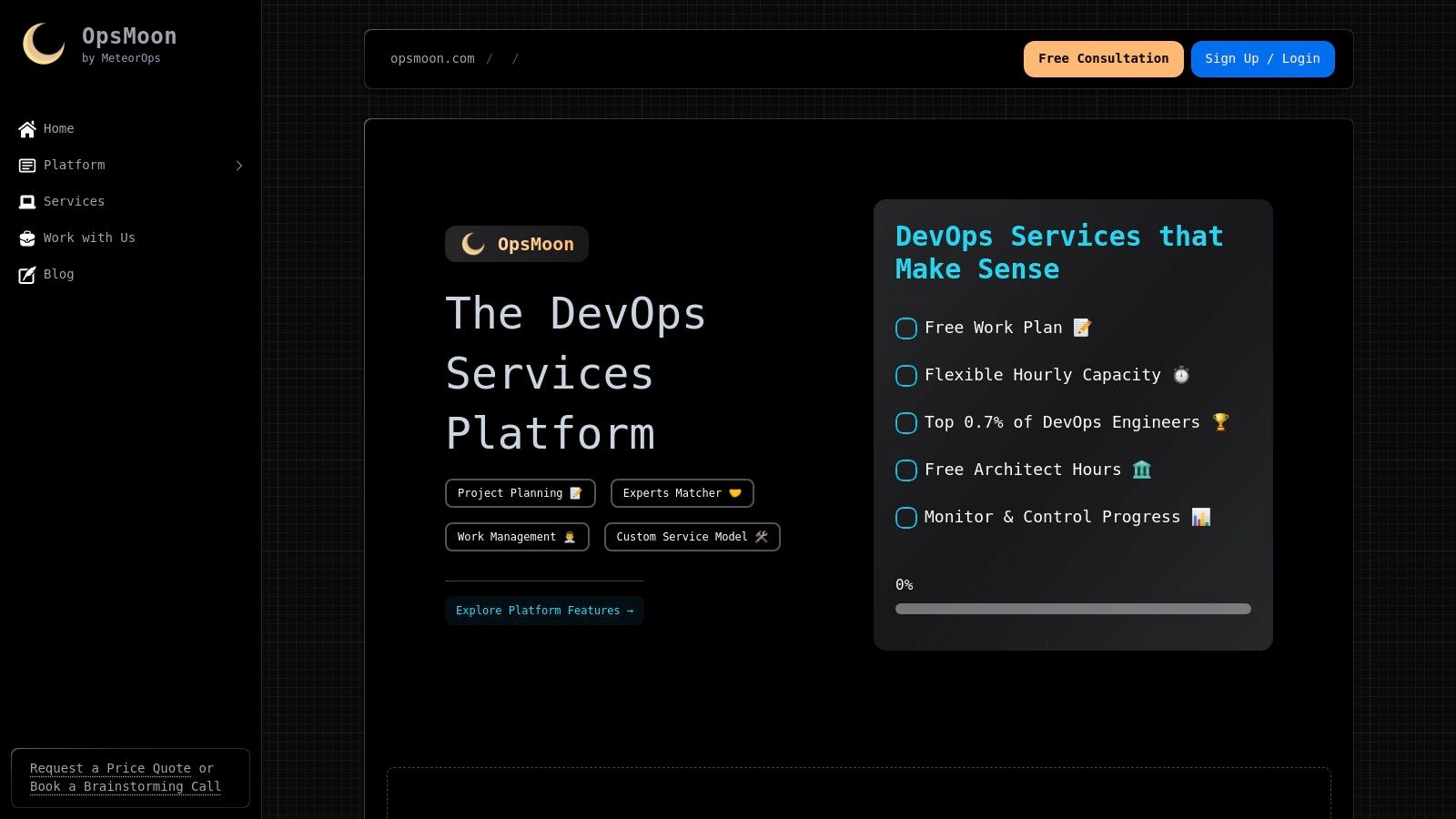
The platform's core value proposition lies in its combination of elite talent, structured delivery processes, and flexible engagement models. OpsMoon claims its engineers represent the top 0.7% of global talent, a claim backed by a rigorous vetting process. This focus on high-caliber expertise makes it a strong choice for organizations tackling complex technical challenges where senior-level insight is non-negotiable.
Core Service Offerings & Technical Stack
OpsMoon provides end-to-end support across the entire DevOps lifecycle, from initial infrastructure architecture to ongoing optimization. Their experts are proficient in a wide range of modern, cloud-native technologies.
Key technical domains covered include:
- Infrastructure as Code (IaC): Deep expertise in Terraform and Terragrunt for building scalable, reproducible infrastructure on AWS, Azure, and GCP. This includes writing custom modules, managing state with backends like S3 or Terraform Cloud, and implementing Sentinel policies for governance.
- Containerization & Orchestration: Advanced implementation and management of Kubernetes (K8s), including EKS, GKE, and AKS, along with Docker for containerized workflows. Expertise extends to service mesh (Istio/Linkerd), custom controllers, and Helm chart development.
- CI/CD Pipelines: Design and optimization of automated build, test, and deployment pipelines using tools like Jenkins, GitLab CI, GitHub Actions, and CircleCI. This involves creating multi-stage YAML pipelines, optimizing build times with caching, and integrating security scanning (SAST/DAST).
- Observability & Monitoring: Implementation of robust monitoring stacks using Prometheus, Grafana, Loki, and the Elastic Stack (ELK) for real-time insights into system performance and health. This includes instrumenting applications with OpenTelemetry and setting up SLO/SLI-based alerting.
- Security & Compliance: Integration of security best practices (DevSecOps), including secrets management with HashiCorp Vault and implementing compliance frameworks like SOC 2 or HIPAA using automated checks and infrastructure hardening.
- GitOps: Implementing Git-centric workflows for infrastructure and application management using tools like Argo CD and Flux. This ensures a single source of truth and automated reconciliation between the desired state in Git and the live cluster state.
Standout Features and Engagement Model
What sets OpsMoon apart from many traditional devops services companies is its low-friction, high-transparency engagement process. The client journey is designed for speed and clarity, making it particularly suitable for fast-moving startups and product teams.
| Engagement Feature | Description | Best For |
|---|---|---|
| Free Work-Planning Session | An initial, no-cost consultation where clients and OpsMoon experts collaborate to define project scope, goals, and a high-level roadmap. | Teams with an idea but an unclear technical path; helps de-risk the engagement by aligning on objectives before any financial commitment. |
| Experts Matcher | A proprietary system that pairs project requirements with the most suitable engineer from their vetted talent pool based on skills and experience. | Organizations needing specific, niche expertise (e.g., advanced Terragrunt modules, Istio service mesh) without a lengthy interview process. |
| Free Architect Hours | Complimentary hours with a senior architect to refine the technical approach and provide an accurate project estimate. | Projects requiring complex architectural decisions or migrations, ensuring the foundational plan is solid. |
| Flexible Capacity Models | Engagements can range from advisory consulting and end-to-end project delivery to flexible hourly capacity to augment an existing team. | Companies needing to scale DevOps resources up or down based on project phases, product launches, or seasonal demand. |
This structured approach, drawing from learnings across over 200 startups, ensures that projects are not just technically sound but also strategically aligned with business goals. For those looking to understand the benefits of this model, OpsMoon provides additional resources on what to expect when hiring a DevOps consulting company.
Who is OpsMoon Best For?
OpsMoon is an excellent fit for engineering leaders (CTOs, VPs of Engineering) who need to achieve specific DevOps outcomes without the overhead of traditional hiring. Its model is particularly effective for:
- Startups and Scale-ups: Companies needing to build a scalable, production-grade infrastructure quickly to support rapid growth.
- SMBs without a Dedicated DevOps Team: Businesses that require expert guidance and implementation for cloud migration, CI/CD automation, or security hardening.
- Enterprise Teams with Skill Gaps: Large organizations looking to augment their existing teams with specialized, on-demand expertise for specific projects like Kubernetes adoption or IaC refactoring.
- Pros:
- Fast, low-friction onboarding with free planning sessions and architect hours.
- Access to an elite, pre-vetted global talent pool, reducing hiring risk.
- Flexible engagement models that adapt to project needs and budget.
- Broad and deep technical expertise across the modern DevOps stack.
- Transparent project management and communication processes.
- Cons:
- Pricing is not published, requiring a consultation for a custom estimate.
- The remote-only, senior talent model may be more expensive than hiring junior in-house staff and doesn't suit roles requiring an on-site presence.
Website: https://opsmoon.com
2. Upwork
Upwork is not a traditional DevOps services company but a global talent marketplace that provides direct access to a vast pool of individual freelance engineers and specialized agencies. This model offers a fundamentally different approach for businesses needing to augment their teams, source specific skills quickly, or manage short-term projects without the overhead of a full-scale consultancy engagement. It’s particularly effective for sourcing talent with niche, in-demand expertise like Kubernetes orchestration, Terraform for Infrastructure as Code (IaC), or Jenkins/GitLab CI/CD pipeline automation.
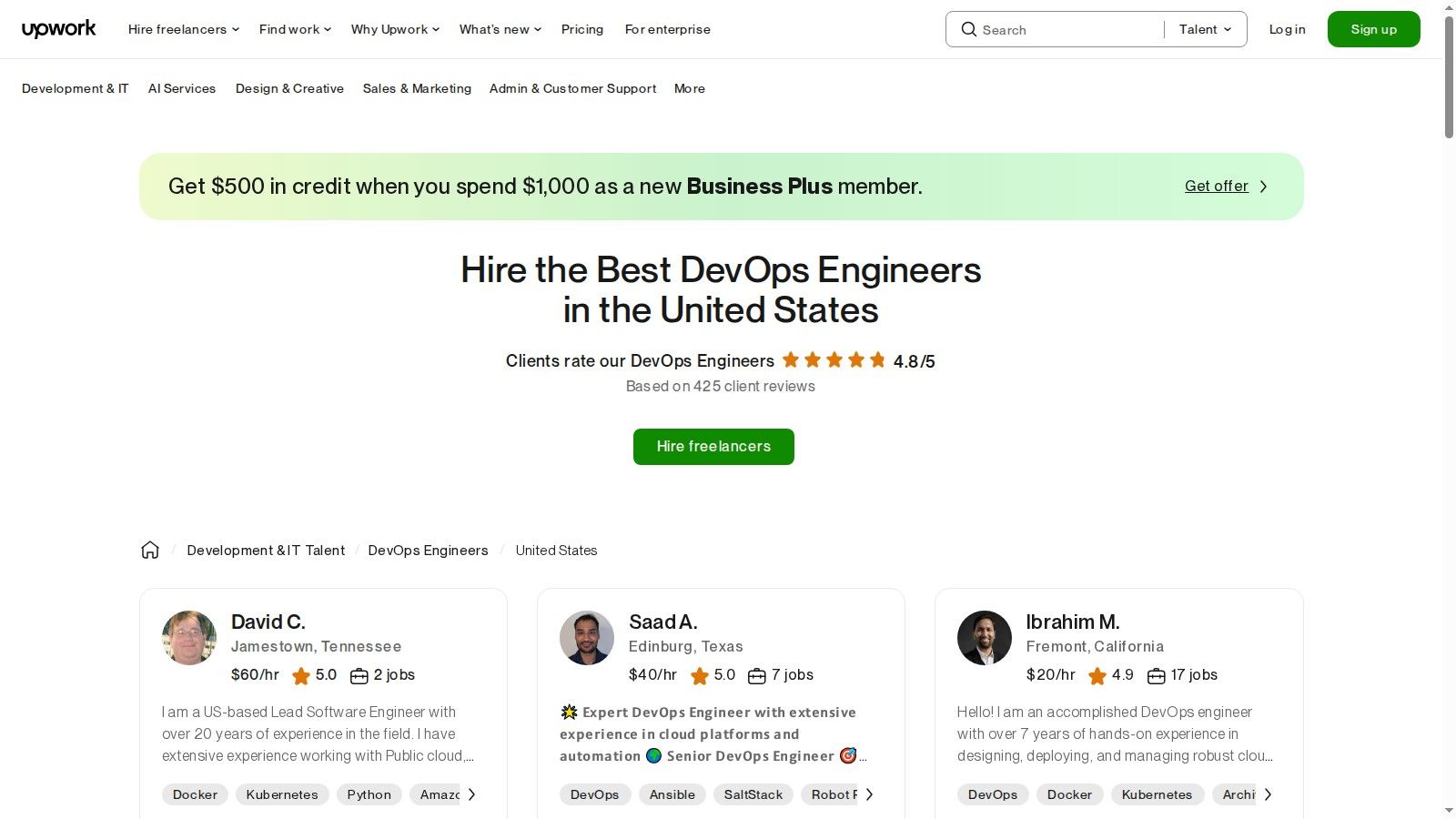
The platform's strength lies in its flexibility and speed. Companies can post a detailed job description and receive proposals from qualified candidates, often within hours. This rapid turnaround is invaluable for addressing urgent skill gaps or accelerating a project that is falling behind schedule. The platform also offers robust tools to manage engagements, including escrow services for milestone-based payments, detailed work diaries with time-tracking, and a dispute resolution process, which provides a layer of security for both clients and freelancers.
Key Features & Engagement Models
Upwork supports two primary engagement models, catering to different project needs and budgeting styles:
- Hourly Contracts: Ideal for ongoing support or projects with evolving scopes. You pay for the hours logged by the freelancer, with the ability to set weekly caps to control spending. Upwork provides published rate guidance, giving you a benchmark for budgeting DevOps talent in specific regions.
- Fixed-Price Projects: Best for well-defined tasks with clear deliverables, such as setting up a specific CI/CD pipeline or performing a security audit. Payments are tied to milestones, ensuring you only pay when specific goals are met.
This flexibility makes Upwork a powerful tool for organizations that want to precisely control their DevOps spending and scale their team up or down on demand. To learn more about structuring these types of arrangements, see our detailed guide on how to outsource DevOps services.
Practical Tips for Success on Upwork
The primary challenge with Upwork is the variability in talent quality. Effective vetting is non-negotiable.
- Create a Hyper-Specific Job Post: Instead of "Need a DevOps Engineer," write "Seeking Terraform expert to refactor AWS infrastructure, migrating from EC2 to ECS Fargate with cost optimization via Spot Instances." Include your tech stack (e.g.,
Terraform v1.5+,Terragrunt,AWS provider v4.x) and expected outcomes. - Design a Technical Vetting Task: Ask top candidates to complete a small, paid task (e.g., write a simple Dockerfile and a GitHub Actions workflow to build and push the image to ECR) to validate their hands-on skills. Review their code for best practices like multi-stage builds and security linting.
- Interview for Communication: A great engineer who can't communicate asynchronously is a liability. Assess their responsiveness, clarity, and proactiveness during the interview process. Ask them to explain a complex technical concept (like Kubernetes Ingress vs. Gateway API) as if to a non-technical stakeholder.
Upwork is best for businesses that have the internal capacity to manage freelancers and vet technical talent but need a flexible, fast, and cost-effective way to access a global pool of DevOps specialists.
3. Toptal
Toptal positions itself as an exclusive network of the top 3% of freelance talent, offering a highly curated and premium alternative to open marketplaces. For businesses seeking DevOps services, this translates to access to deeply vetted, senior-level engineers, SREs, and cloud architects capable of tackling complex infrastructure challenges. Instead of sifting through hundreds of profiles, Toptal provides a white-glove matching service where a dedicated expert understands your technical requirements and connects you with a handful of ideal candidates, often within 48 hours.
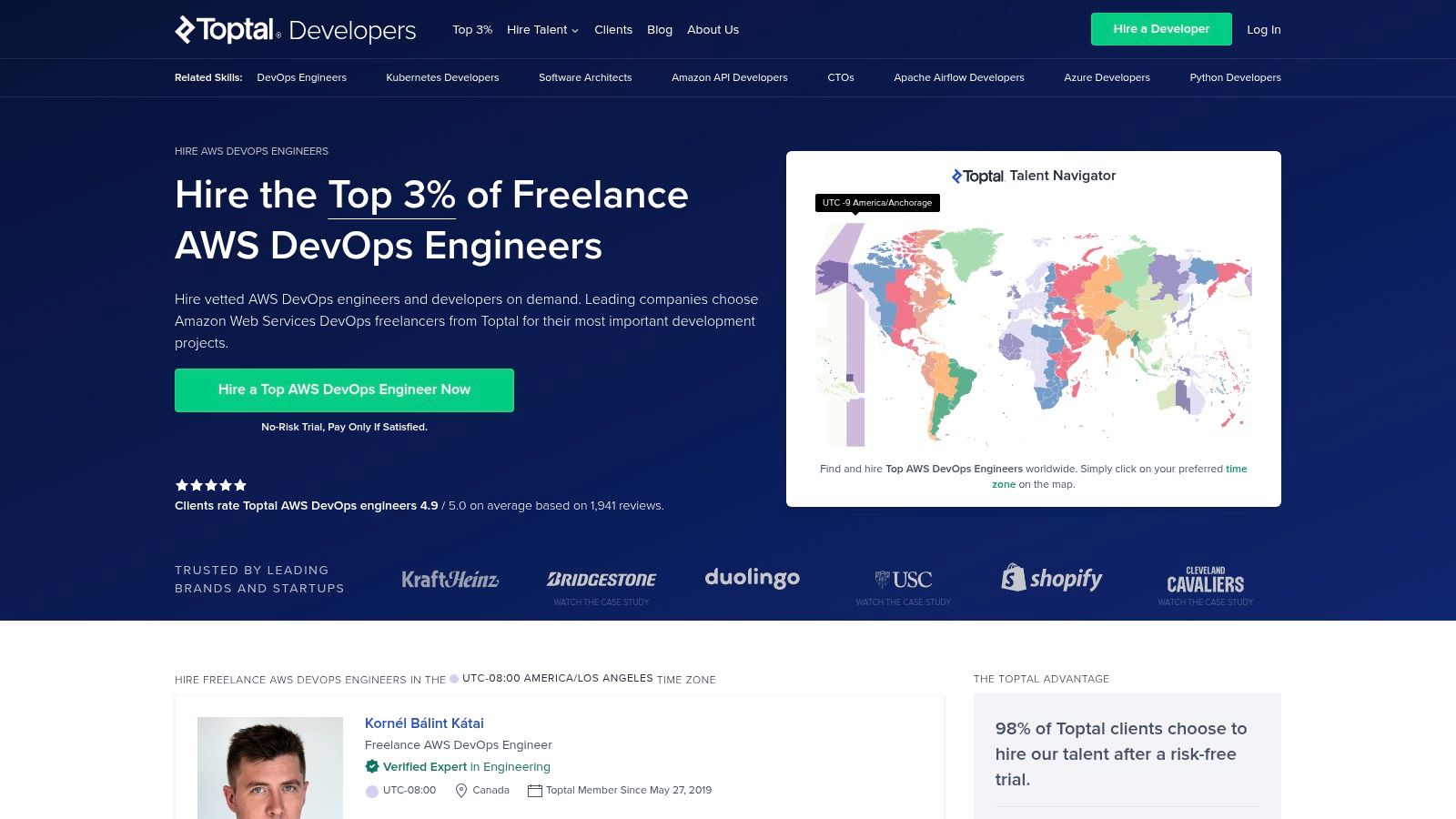
The platform’s core value proposition is its rigorous, multi-stage screening process that tests for technical expertise, professionalism, and communication skills. This pre-vetting significantly reduces the hiring risk and time investment for clients, making it a strong choice for founders, CTOs, and engineering leaders who need to confidently engage high-caliber talent for mission-critical projects. This model is particularly effective for sourcing experts in specialized domains like multi-cloud Kubernetes federation, advanced FinOps strategy implementation, or building enterprise-grade internal developer platforms (IDPs).
Key Features & Engagement Models
Toptal’s service is designed for speed and quality assurance, with engagement models built to accommodate various project demands:
- Flexible Contracts: Engagements can be structured as hourly, part-time (20 hours/week), or full-time (40 hours/week), providing the flexibility to scale resources according to project velocity and budget. This is ideal for roles like a fractional SRE or a dedicated cloud architect for a major migration.
- No-Risk Trial Period: Toptal offers a trial period of up to two weeks with a new hire. If you are not completely satisfied, you will not be billed, and the platform will initiate a rematch process. This significantly de-risks the financial and operational commitment of engaging a senior consultant.
This curated approach ensures that you are only interacting with candidates who possess verified, top-tier skills, saving valuable engineering leadership time. To learn more about Toptal's DevOps talent and engagement process, visit their AWS DevOps Engineers page.
Practical Tips for Success on Toptal
While Toptal handles the initial screening, maximizing your success depends on providing a precise technical and business context. The primary challenge is the higher cost and potentially limited availability of highly specialized talent.
- Define Your Architectural End-State: Be prepared to discuss not just your current stack but your target architecture. For example, specify "We need to migrate a monolithic Node.js application from Heroku to a scalable GKE Autopilot cluster with Istio for service mesh, using a GitOps workflow with Argo CD for deployments."
- Leverage the Matcher's Expertise: Treat your Toptal matcher as a technical partner. Provide them with internal documentation, architecture diagrams, and clear definitions of success for the first 90 days. The more context they have, the better the candidate match.
- Prepare for a Senior-Level Dialogue: Toptal engineers expect to operate with a high degree of autonomy. During interviews, focus on strategic challenges ("How would you design for multi-region failover?") and architectural trade-offs ("What are the pros and cons of using Karpenter vs. Cluster Autoscaler for our EKS node scaling?") rather than basic technical screening.
Toptal is best suited for organizations that prioritize talent quality and speed over cost, need to fill a senior or architect-level role quickly, and want to minimize the internal effort spent on sourcing and vetting.
4. Fiverr
Fiverr operates as a massive marketplace of pre-packaged, fixed-price services called "gigs," making it a unique entry among DevOps services companies. Instead of engaging in long-term contracts, businesses can purchase highly specific, task-based DevOps solutions like setting up a GitLab CI/CD pipeline for a Node.js app, creating a Terraform module for an AWS S3 bucket, or configuring a basic Prometheus and Grafana monitoring stack. This "productized service" model is ideal for teams needing to execute small, well-defined tasks quickly and on a tight budget.
The platform's main advantage is its transactional speed and clarity. You can browse thousands of gigs, filter by budget and delivery time, review seller ratings, and purchase a service in minutes. This is perfect for startups needing a proof of concept, teams experimenting with a new technology, or developers who need to offload a small but time-consuming infrastructure task. The transparent scope and rapid purchase flow remove the friction of traditional vendor procurement for bite-sized projects.
Key Features & Engagement Models
Fiverr’s model is built around discrete, fixed-price gigs, which are often structured in tiered packages (e.g., Basic, Standard, Premium) that offer increasing levels of complexity or support.
- Fixed-Price Gigs: The core offering. You purchase a pre-defined package with clear deliverables and a set price. This is perfect for tasks like "I will dockerize your Python application" or "I will set up AWS CodePipeline for your microservice."
- Custom Offers: If a standard gig doesn't fit, you can message sellers directly to request a custom offer tailored to your specific requirements. This provides a degree of flexibility while still operating within the platform's fixed-price framework.
- Pro Services: A curated selection of hand-vetted, professional freelancers. These gigs are more expensive but come with a higher assurance of quality and experience, making them a safer bet for business-critical tasks.
This gig-based economy makes Fiverr a powerful tool for rapid prototyping and filling very specific, short-term skill gaps without the commitment of a full contract.
Practical Tips for Success on Fiverr
The main challenge on Fiverr is navigating the wide variance in quality and technical depth. A meticulous approach to seller selection is crucial.
- Look for Technical Specificity in Gig Descriptions: Avoid sellers with generic descriptions. A high-quality gig will detail the specific tools (e.g., "Ansible playbooks for Ubuntu 22.04"), cloud platforms, and methodologies they use. Search for keywords like "Idempotent," "StatefulSet," or "IAM Roles for Service Accounts (IRSA)."
- Review Portfolio and Past Work: Don't just rely on star ratings. Examine the seller's portfolio for examples that are technically relevant to your project. Look for public GitHub repositories or detailed case studies. A link to their
terraform-aws-modulesfork is a good sign. - Start with a Small, Low-Risk Task: Before entrusting a seller with a critical piece of your infrastructure, hire them for a small, non-critical task as a paid trial. For example, have them write a simple bash script to automate a backup or review a Dockerfile for security vulnerabilities to assess their competence and communication.
Fiverr is best suited for organizations that can break down their DevOps needs into small, self-contained deliverables and are willing to invest the time to thoroughly vet individual service providers. It is an excellent resource for tactical, short-term needs rather than strategic, long-term partnerships.
5. AWS Marketplace (Consulting & Professional Services)
AWS Marketplace is not a single company but a curated digital catalog that enables organizations to find, buy, and deploy third-party software, data, and professional services. For those seeking DevOps expertise, the "Consulting & Professional Services" section acts as a streamlined procurement hub. It features AWS-vetted consulting partners offering transactable services, which simplifies purchasing for companies already standardized on the AWS cloud. This model is ideal for enterprises that need to procure DevOps services through established channels, leveraging their existing AWS billing and legal agreements.
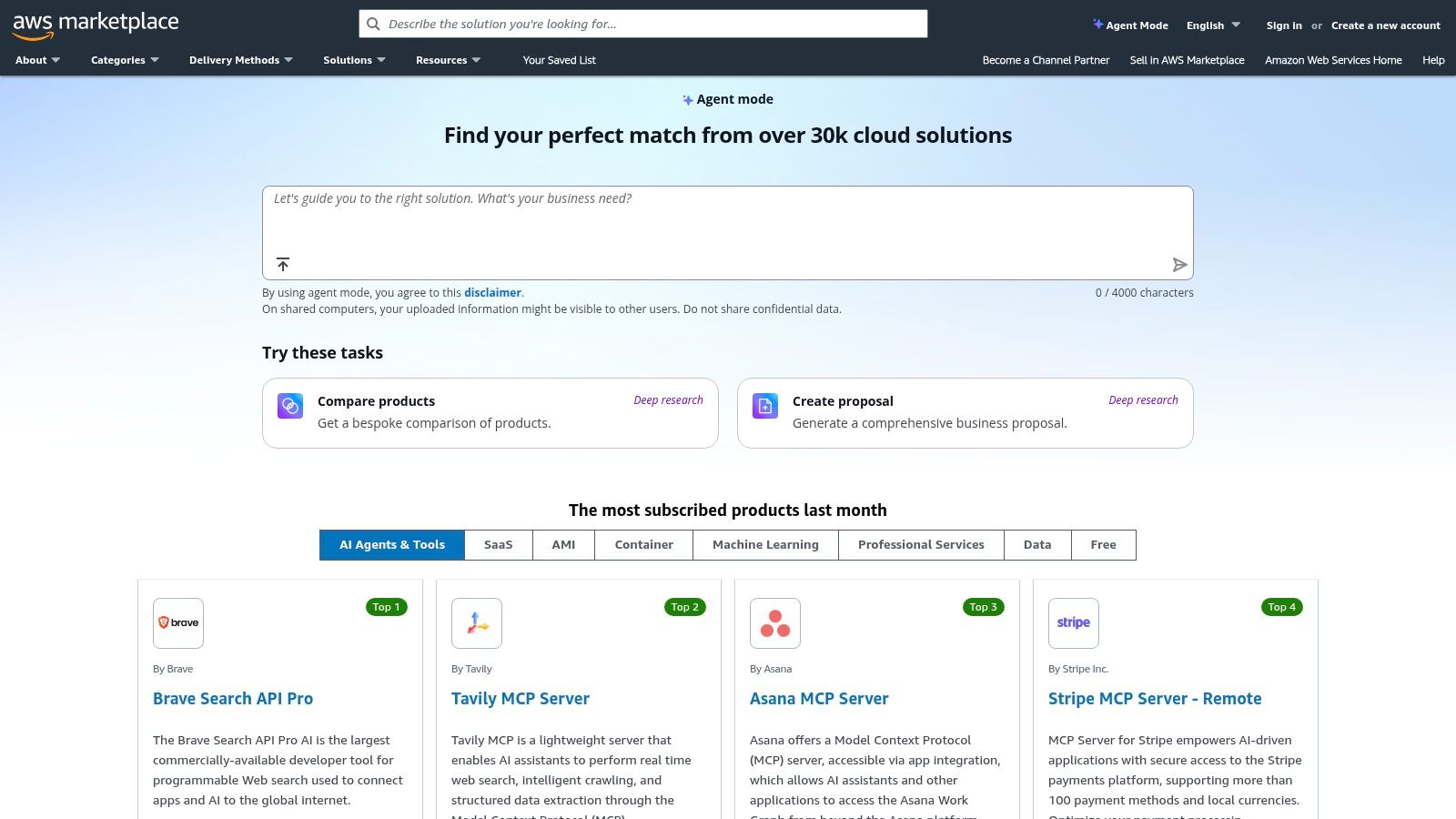
The platform's primary advantage is its tight integration with the AWS ecosystem, creating a governance-friendly purchasing experience. Instead of navigating separate procurement cycles, enterprises can use their AWS accounts to purchase services, consolidate billing, and often use standardized contract terms. Service listings are typically aligned with AWS-native patterns and best practices, focusing on tools like AWS CodePipeline, CloudFormation, and Amazon EKS. This ensures that the solutions offered are optimized for performance, security, and cost-efficiency within the AWS environment.
Key Features & Engagement Models
AWS Marketplace offers a structured, quote-based model for procuring expert services directly from qualified partners:
- Private Offers: This is the most common engagement model. After discussing your project requirements with a consulting partner, they can create a custom, private offer on the Marketplace with specific pricing and terms. This allows for tailored scopes of work, from a multi-month EKS migration to a two-week CI/CD pipeline assessment.
- Direct Procurement: All transactions are handled through your company's AWS account. This simplifies vendor management and consolidates DevOps service costs into your overall cloud bill, which is a major benefit for finance and procurement teams.
This model is particularly powerful for organizations with committed AWS spending, as Marketplace purchases can sometimes count toward their Enterprise Discount Program (EDP) commitments. For a deeper dive into how AWS compares with other major clouds, see our detailed AWS vs. Azure vs. GCP comparison.
Practical Tips for Success on AWS Marketplace
The main challenge is that pricing is not always transparent upfront, and success depends on selecting the right partner.
- Leverage AWS Competencies: Filter partners by official AWS Competencies like "DevOps," "Migration," or "Security." These designations are difficult to earn and serve as a strong signal of a partner's proven technical proficiency and customer success. The "DevOps Competency" is a non-negotiable filter.
- Request Detailed Scopes of Work: Before accepting a private offer, demand a comprehensive Statement of Work (SOW). It should detail deliverables, timelines, technical specifications (e.g., which AWS services will be used, instance types, IAM policies), and the specific engineers assigned to your project, including their AWS certifications.
- Compare Multiple Partners: Use the platform to request proposals from two or three different partners for the same project. This allows you to compare their proposed technical approaches (e.g., one suggests Blue/Green deployments with CodeDeploy, another suggests Canary with App Mesh), timelines, and costs to ensure you are getting the best value.
AWS Marketplace is best suited for established enterprises deeply embedded in the AWS ecosystem that want to simplify procurement and ensure any engaged DevOps services company adheres to AWS-certified best practices.
6. Microsoft Azure Marketplace (Consulting Services)
For organizations deeply integrated into the Microsoft ecosystem, the Azure Marketplace is more than just a place to find virtual machines; it's a curated directory of vetted consulting services. This platform offers direct access to Microsoft partners providing specialized DevOps assessments, implementations, and managed operations. It’s an ideal starting point for businesses that have standardized on Azure, Azure DevOps, or GitHub and need a provider with proven expertise in that specific technology stack.
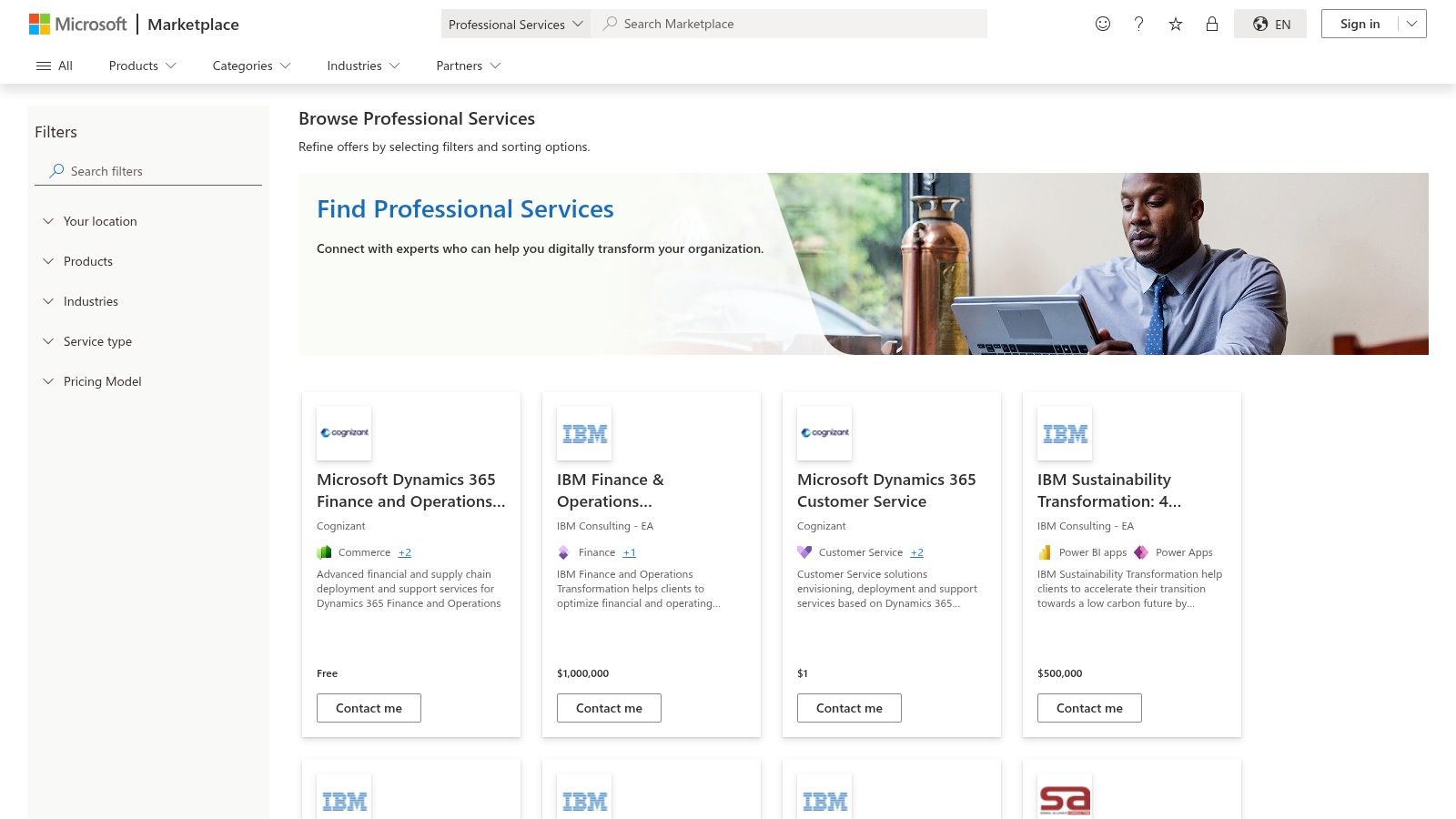
The key advantage of the Azure Marketplace is its structured, pre-scoped offering format. Many services are presented as time-boxed engagements, such as a "1-Week DevOps Assessment" or a "4-Week GitHub CI/CD Implementation." This approach simplifies procurement by clearly defining deliverables, timelines, and often, the partner’s credentials and Microsoft certifications. It eliminates much of the initial ambiguity found in open-ended consulting proposals, allowing technical leaders to compare concrete service packages from various devops services companies side-by-side.
Key Features & Engagement Models
The Azure Marketplace primarily features structured consulting offers, which fall into several common categories tailored for specific business needs:
- Assessments & Workshops: These are typically short, fixed-scope engagements designed to evaluate your current DevOps maturity. A common example is a 5-day assessment that analyzes your CI/CD pipelines and IaC practices, culminating in a detailed roadmap for improvement and a cost-benefit analysis for migrating to Azure DevOps or GitHub Actions.
- Proof of Concept (POC) & Implementation: These longer engagements focus on hands-on execution. You can find offers to build a specific Azure Kubernetes Service (AKS) cluster, migrate Jenkins jobs to GitHub Actions, or implement a comprehensive DevSecOps pipeline using Microsoft Defender for Cloud and Azure Policy.
- Managed Services: For ongoing operational support, some partners offer managed services for Azure infrastructure. This model outsources the day-to-day management of your platform, including monitoring with Azure Monitor, patching, and incident response via Azure Lighthouse, allowing your internal team to focus on application development.
This standardized model makes it easier for organizations to find and engage with partners who have demonstrated expertise directly within the Azure ecosystem.
Practical Tips for Success on Azure Marketplace
Navigating the marketplace effectively means looking beyond the listing titles and digging into the partner profiles and offer specifics.
- Filter by Competencies and Solution Areas: Use the marketplace filters to find partners with specific Microsoft designations, such as "DevOps with GitHub" or "Modernization of Web Applications." These credentials, especially the "Advanced Specialization" badges, serve as a first-level quality check.
- Scrutinize the Deliverables: A listing for a "4-Week AKS Implementation" should detail exactly what you get. Look for specifics like "ARM/Bicep templates for VNet and AKS cluster," "GitHub Actions workflow for container build/push to ACR," and "ArgoCD setup for GitOps deployment." Vague promises are a red flag.
- Request a Scoping Call: While many offers are pre-packaged, they are rarely one-size-fits-all. Use the "Contact Me" button to schedule a call to discuss how the standard offering can be tailored to your specific technical environment (e.g., hybrid with Azure Arc) and business objectives.
The Azure Marketplace is best suited for organizations already committed to Microsoft's cloud and DevOps toolchain who value the assurance of working with certified partners and prefer to procure services through standardized, clearly defined packages.
7. Google Cloud Partner Directory
For organizations deeply embedded in the Google Cloud Platform (GCP) ecosystem, the Google Cloud Partner Directory is the authoritative starting point for finding vetted DevOps services companies. Unlike a direct consultancy, this is a curated marketplace of partners that have demonstrated proven expertise and success in implementing Google Cloud solutions. It allows businesses to find specialized firms that align precisely with their existing tech stack, from Google Kubernetes Engine (GKE) and Cloud Run to BigQuery and Anthos.
The primary advantage of the directory is the built-in trust and validation provided by Google itself. Partners are tiered (Select, Premier, Diamond) based on their level of investment, technical proficiency, and customer success, offering a clear signal of maturity and capability. This system significantly de-risks the selection process, as you are choosing from a pool of vendors whose skills have already been validated by the platform provider. This is especially critical for complex projects like multi-cluster GKE deployments or implementing sophisticated CI/CD pipelines with Cloud Build.
Key Features & Engagement Models
The directory is built around a powerful search and filtering system, helping you quickly narrow down the vast list of partners to find the right fit for your specific technical and business needs.
- Partner Tiers & Specializations: Filter partners by their tier (Select, Premier, Diamond) to gauge their level of commitment and expertise. More importantly, you can filter by specializations like "Application Development" or "Infrastructure," ensuring you connect with a firm that has certified expertise in the exact GCP services you use.
- Geographic and Product Filters: Easily find local or regional experts who understand your market or search for partners with proficiency in a specific GCP product, such as "Terraform on Google Cloud" or "Anthos deployment."
- Quote-Based Engagements: Most engagements begin with a formal contact and qualification process, leading to a custom-quoted project or retainer. While less transactional than a freelance platform, this model is better suited for strategic, long-term DevOps transformations.
This model is ideal for companies that prioritize official validation and deep platform-specific knowledge over the lowest possible cost.
Practical Tips for Success with the GCP Directory
Navigating a partner directory effectively requires a strategic approach to identify the best-fit vendor beyond their official badge.
- Look Beyond the Tier: A Premier partner is a strong signal, but a Select partner with a specific, niche specialization in a service like "Cloud Spanner" might be a better fit for a targeted database migration project than a generalist Premier partner.
- Request GCP-Specific Case Studies: During initial calls, ask for detailed case studies of projects similar to yours that were executed entirely on GCP. Ask them to explain their technical decisions, such as why they chose GKE Autopilot over Standard or how they leveraged Cloud Armor for security. Probe their understanding of GCP-specific concepts like Workload Identity.
- Verify Engineer Certifications: Inquire about the specific Google Cloud certifications held by the engineers who would be assigned to your project (e.g., Professional Cloud DevOps Engineer). This validates hands-on expertise at the individual level and is a much stronger signal than a company-level badge.
The Google Cloud Partner Directory is the go-to resource for businesses standardized on GCP who need a trusted, highly skilled DevOps partner to architect, build, and optimize their cloud-native infrastructure.
Top 7 DevOps Service Providers Comparison
| Service | Implementation complexity | Resource requirements | Expected outcomes | Ideal use cases | Key advantages |
|---|---|---|---|---|---|
| OpsMoon | Medium — structured kickoff and managed delivery process | Moderate — budget for senior remote engineers; free estimate available | End-to-end DevOps delivery, clear roadmaps, real-time progress | Startups to enterprises needing scalable, immediate DevOps expertise | Vetted top-tier talent, free planning/architect hours, broad DevOps stack coverage |
| Upwork | Low–Medium — post job and vet proposals manually | Low–Medium — hourly/fixed budgets, escrow, project management | Variable quality hires quickly sourced for specific tasks | Fast sourcing of niche skills or short-term engagements | Large talent pool, rapid proposals, budget controls (time-tracking/escrow) |
| Toptal | Low — white-glove matching and vetted introductions | High — premium rates for senior freelancers | High-signal senior/SRE/architect-level talent with guarantees | CTOs/founders needing senior-level or mission-critical hires | Rigorous screening, trial period, replacement guarantees |
| Fiverr | Very low — immediate gig purchase and delivery | Low — fixed-price bundles for small tasks | Quick, bounded deliverables or experiments | Small, well-defined tasks, POCs, rapid experiments | Fast purchase flow, transparent packages and delivery times |
| AWS Marketplace (Consulting) | Medium–High — procurement via AWS account and partner qualification | Medium–High — quotes/private offers, enterprise procurement processes | AWS-native implementations with vendor governance and billing consolidation | Enterprises standardized on AWS seeking compliant procurement | Consolidated billing, partner competencies, AWS-aligned solutions |
| Microsoft Azure Marketplace (Consulting) | Medium–High — standardized offers but partner contact often required | Medium–High — timeboxed engagements, regional/compliance considerations | Scoped Azure-native assessments/implementations with documented deliverables | Organizations standardized on Azure, Azure DevOps, or GitHub | Standardized offer formats, Microsoft partner credentials and regional info |
| Google Cloud Partner Directory | Medium — search and contact vetted partners; quotes required | Medium — partner engagement, quotes; moving toward transactable offers | GCP-aligned professional services from tiered partners | GCP-centric teams looking for vetted partner expertise | Partner tiers/badges, searchable filters, clear specialization visibility |
Making the Right Choice: Finalizing Your DevOps Partner
Navigating the landscape of DevOps services companies can feel like architecting a complex system; the right components, assembled in the right order, lead to a robust, scalable outcome. Conversely, a poor choice can introduce significant technical debt and operational friction. This guide has dissected seven distinct platforms, from freelance marketplaces to curated talent networks and cloud-native partner directories. Your final decision hinges on a clear-eyed assessment of your specific operational needs, technical maturity, and strategic goals.
The journey begins with an honest audit of your current state. Are you a startup needing to bootstrap a CI/CD pipeline from scratch? Or an enterprise grappling with the complexities of a multi-cluster Kubernetes environment? The answer dictates the required level of expertise and the ideal engagement model.
Recapping the Landscape: From Gigs to Strategic Partnerships
The platforms we've explored cater to fundamentally different use cases. Freelance marketplaces like Upwork and Fiverr excel at tactical, well-defined tasks. They are ideal for sourcing talent for a specific, short-term project, such as scripting a Terraform module or configuring a Prometheus alert. Their value lies in speed and cost-effectiveness for isolated problems.
In contrast, cloud-specific marketplaces from AWS, Azure, and Google Cloud offer a direct path to ecosystem-vetted partners. These are your go-to resources when your project is deeply intertwined with a particular cloud provider's services. Engaging a partner here ensures certified expertise, streamlined billing, and deep knowledge of platform-specific IaC tools and managed services. This approach is often a subset of a broader IT strategy. To effectively select DevOps services companies, it is vital to understand the offerings and benefits of Managed Services Companies, as many cloud partners operate under this model, providing ongoing operational support.
Aligning Your Needs with the Right Model
Choosing the right partner is less about finding a "best" option and more about finding the "right fit" for your unique context. To finalize your decision, consider these critical factors:
- Project Complexity and Scope: Is this a single, isolated task (e.g., "set up GitLab CI for our Node.js app") or a long-term strategic initiative (e.g., "migrate our monolithic application to microservices on EKS")? The former is suited for freelance platforms, while the latter demands a dedicated team or a specialized service like OpsMoon.
- Required Skill Depth: Do you need a generalist who can handle basic cloud administration, or do you require a specialist with deep, verifiable experience in a niche area like service mesh implementation (e.g., Istio, Linkerd) or advanced observability (e.g., eBPF, OpenTelemetry)? Vetted platforms like Toptal and OpsMoon filter for this level of elite talent.
- Engagement Duration and Flexibility: Are you looking for a one-off project completion, or do you anticipate needing ongoing, flexible support for maintenance, scaling, and incident response? Your need for on-demand SRE support or long-term platform engineering will guide you toward a more strategic partnership model.
- Risk Tolerance and Vetting: How much time can your team dedicate to interviewing, testing, and vetting candidates? Platforms that pre-vet their talent significantly de-risk the hiring process, saving valuable engineering leadership time and ensuring a higher quality of technical execution from day one.
Ultimately, the most successful partnerships arise when a company's delivery model aligns perfectly with your technical and business objectives. For rapid, tactical wins, the freelance and cloud marketplaces provide immense value. However, for organizations seeking to build a resilient, scalable, and secure software delivery lifecycle, a strategic partnership with a specialized, deeply vetted talent network is the most effective path forward. This approach transforms DevOps from a cost center into a powerful engine for innovation and competitive advantage.
Ready to move beyond ad-hoc fixes and build a truly strategic DevOps function? OpsMoon connects you with the world's top 1% of pre-vetted DevOps, SRE, and Platform Engineering experts. Start with a free, in-depth work planning session to build a clear roadmap and see how our elite talent can solve your most complex infrastructure challenges.
Leave a Reply